Feeds:
Posts
Comments

Archive for the ‘Johann Sebastian Bach’ Category

 SOUNDTRACK: MIRAMAR-Tiny Desk Concert #594 (January 27, 2017).

Miramar is from Richmond Virginia, but they play beautiful bolero music.

When the members of Richmond, Virginia’s Miramar first heard the music of Puerto Rican composer Sylvia Rexach, they were intrigued that she wasn’t as well-known as other popular bolero writers. So they came up with an album’s worth of her songs to cover, and have been wowing audiences across the country with their exquisite renditions of her songs.

When they pulled into NPR to play behind Bob Boilen’s desk, Miramar’s members made time stop with a performance that swept us off our feet, ably backed by friends of theirs from Richmond who played gorgeous string arrangements behind the band. So turn the lights down low, clear out the living-room carpet and find your dance partner for this one.

What is it about bolero music?

Some say you have to have loved and lost to appreciate the beauty of the bolero. Since its inception in Cuba in the early 20th century, the music has been designed for thoughtful and emotional consideration of the joys and pains that come with loving someone so intensely, it becomes like a religion to adore that special someone (an actual bolero lyric).

They play four songs: “Sin Ti” (without You) opens with some great Spanish guitar and shakers (which sound like water).  The song slowly builds and then the two singers come in.  Rei Alvaresz and Laura Ann Singh sing beautifully together.

The rest of the band includes: Marlysse Simmons Argandoña (piano, organ); Hector Barez (percussion); James Farmer (bass) and Sebastian Cruz (guitar).

“Estatua” (Statue) is faster and more upbeat.  The large string section is put to full use here. (With strings provided by Ellen Riccio (violin); Treesa Gild (violin); Kimberly Ryan (viola) and Schuyler Slack (cello)).  I love when she is singing “te creo” and he is singing low vocals underneath her.  The strings add wonderful drama to this mournful yet beautiful song.

“Urgancia” (Urgency) has some very cool organ sounds—very retro 60s swinging (almost soap opera)–sound.  But in addition there’s beautiful guitar and their great vocals as well.   The first three songs were all originals

“Tus Pasos”  (Your Footsteps) is by Sylvia Rexach–the inspiration for everything they’ve done.  It is a sweet, romantic, old-fashioned sounding love song.

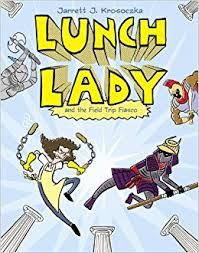
[READ: July 6, 2016] Lunch Lady and the Field Trip Fiasco

I’ve been really enjoying the way the events of the previous books lead to the follow-up.  So you actually should read these in order, which is more fun anyway.

Our opener shows masked men robbing a grocery store–Lunch Lady is able to stop them with fizzy soda.

But the plot of this book is the field trip that was foreshadowed in the previous one.  The Breakfast Bunch is excited to go, except that Hector forgot to get his permission slip signed.  So Dee (who is increasingly more sarcastic as the books go on) forges the signature–who will know?

Lunch Lady and Betty are bored because everyone is going to the field trip–there’s no lunch today.  But when Mrs Palonski learns that her chaperone can’t come she reluctantly agrees to let Lunch Lady come along.  (Betty tells her to go and have fun even though she sighs when she’s left all alone).  Of course Mrs Paloski is worried that Lunch Lady never stops talking (which proves to be an ironic worry). (more…)

Read Full Post »

SOUNDTRACK: BADBADNOTGOOD-Tiny Desk Concert #593 (January 23, 2017).

I’m amused at how kinda dorky all of these guys look–except for the drummer who looks “cool.”  Why is that amusing?  Because of this blurb:

BADBADNOTGOOD made a name for itself by reworking songs from the likes of Nas and Ol’ Dirty Bastard, eventually catching the attention of Odd Future leader Tyler, the Creator. The masses took notice in 2015 when the group produced an entire LP for Ghostface Killah, Sour Soul. BADBADNOTGOOD has been called a hip-hop ensemble, but its foundation is clearly jazz, which provides a gateway to countless genres. On IV, the group allows that gateway to widen, adding soul and funk to the repertoire.

And they are all only in their 20s!

They play three songs from IV.  This first “And That, Too.” is a very jazzy song.  I love the complex piano melody that’s getting thrown around–syncopation and almost chaos, but always staying true to the great rhythm laid down by the bass and gentle drums.  I also happen to love the flute solo that rides over the top of everything–it provides a great 19070s jazz vibe.  The flute switch es to alt sax, and instrument that I think is kinda cheesy–I’d have rather it stayed with flute.  But his solo is pretty great–meandering and intense.

Introducing “In Your Eyes” the drummer says that he was fortunate enough to go to high school with a sax player who he didn’t know would have a voice that would blow him away … “later in my life” (ha).  Charlotte Day Wilson’s voice is deep and sultry although I don’t particularly like it–it feels too forced or something?  But she does sound much older than she looks.  Which is shame because I think the music of the song is pretty great.  The flutist has switched to guitar for this song (that’s a talented dude).

Before introducing the final song the drummer says “My 2017 is feeling pretty good so let’s keep it going.”  The fact that this was recorded sometime around the inauguration trump feels incredibly tone deaf.  But whatever.  “Cashmere” (“which only slightly veered from the studio version”) is a ten-minute song that opens with a very cool high bass note section and lots of piano.  The guitarist switches to yet another sax (four instruments in three songs).   The middle of the song is just the bass notes and a  lengthy piano solo.  i also like how the song seems to be over but that bass line picks up one more time.

I was surprisingly delighted with this Tony Desk Concert.

[READ: July 4, 2016] Lunch Lady and the Bake Sale Bandit

As Book 5 opens, Lunch Lady foils some safe robbers (in a very funny way).  I really enjoy how every book starts out with an intro comic showing off Lunch Lady’s mad skills.

Then it switches over to a school bus.  The Breakfast Bunch is trying to get on board–they don’t usually ride the bus–but the driver, Brenda, is pretty awful. To them and to everyone.  She drives like a maniac and yells at everyone.  She’s nice to the principal bit once he tells her his news, she can’t even pretend to be nice to him.

The news is that there is going to be a bake sale.  And if it goes well, the students will get a field trip and… Brenda will be the bus driver!

Gah! “How she despises children.” (more…)

Read Full Post »

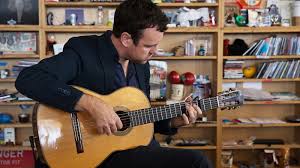
SOUNDTRACK: DEREK GRIPPER-Tiny Desk Concert #587 (December 16, 2016).

There are so many amazing musicians in the world that it’s impossible to have heard of all of them.  So it’s no surprise I haven’t heard of Derek Gripper, but at the same time, he is so mesmerizing I’m surprised that I haven’t heard of him before.

The 38-year-old started on violin at age 6, then wound up with one of the few classical-guitar professors in his native South Africa. But touring the world playing the music of the great dead white men was not all that appealing (though Gripper still loves to play Bach). Then he heard a record by the Malian kora player Toumani Diabate. He decided that that’s what he wanted to do: not play the kora itself, but play kora music on the guitar.

Of course, the kora has 21 strings, each tuned to a fixed note. The nylon-stringed guitar Gripper plays has six. But by using unusual tunings and fretting the strings up and down the neck with his left hand, he can pretty much hit all of the kora’s notes.

The remarkable thing is, he figured all of this out — and recorded two acclaimed albums — just by listening to CDs and checking out music online. Gripper painstakingly transcribed what he heard onto a kind of notation called tablature — similar to the music written for the Renaissance vihuela, which was also an inspiration. Earlier this year, Gripper finally made it to Mali, where his efforts received the blessing of Toumani Diabate himself; the two even jammed together.

That’s an amazing story but it’s nothing compared to the quality of his music.  It really does sound like he’s playing, if not the kora exactly, then certainly an instrument with more than 6 strings.

He plays four songs, three are traditional pieces which he has arranged for guitar and the fourth is an original piece.

Hearing the opening notes of “Tuth Jara” (Trad. Arr. Derek Gripper) and you know that you’re not listening to a typical guitar–the trills and runs sound so West African.   And once you get past the mesmerizing nature of his fingers. The melody is really pretty too.

“Joni” is an original piece about a love affair with a singer–the way he tells the story is delightful.  I love that part of the song is him actually down tuning one of the strings for a bit and then tuning it back up (all while playing everything else).  I also really like that he makes relatively quiet humming/singing noises while he’s playing.

He says he was inspired by Diabate who turned the kora into a solo instrument–which is much easier than traveling with a  band.  And then he illustrates how he plays kora music on his guitar–a bassline, the accompaniment and the melody–all on the guitar all by himself.  That’s his introduction to “Jarabi” (Trad. Arr. Derek Gripper).  And during the incredible playing out comes a beautiful, catchy and fun melody line.  All too soon, it’s over.

But since he has some time, they encourage him to play one more–“they’d be happier!” if he did.  So he ends with “Duga” (Trad. Arr. Derek Gripper) which he describes as a conversation between ngoni and kora.  The kora wins because he knows more about kora.   And like so many of his pieces, it is over way too soon.

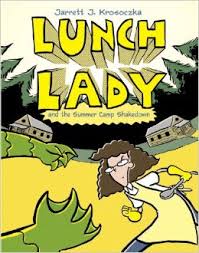
[READ: June 13, 2016] Lunch Lady and the Summer Camp Shakedown

As Book 4 opens, Lunch Lady is seen in a two-page spread wielding her fish-stick-nunchucks.

Then we see that everyone is heading off to summer camp.   The kids have been looking forward to summer camp since they were little and they are finally old enough. Sadly Milmoe the bully will be there too.

And, unbeknownst to Lunch Lady and Betty, they are working at the same camps as the kids.  Lunch Lady has worked there before and she knows everyone, she gives us the lowdown on the counselors like Scotty who has always been the most popular and Ben, the new guy, who is pretty foxy himself.

The counselors are super excited when the kids show up, although Dee is a little blasé about it.  And then they run into Lunch Lady. (more…)

Read Full Post »

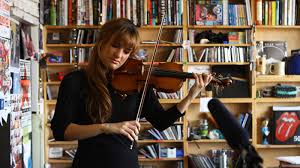
SOUNDTRACK: RACHEL BARTON PINE-Tiny Desk Concert #555 (August 5, 2016).

I’ll let the blurb do the introduction:

Violinist Rachel Barton Pine began playing Bach in church at age 4. Ever since, she’s been mastering and re-mastering Bach’s set of six Sonatas and Partitas—more than two hours of solo violin music that looms like a proverbial Mount Everest for any serious fiddler. The trick is getting the details down. Bach left us with the notes but not much else. Pine recently analyzed every measure of these works, and prepared a new edition of the music with her own dynamic markings, phrasing indications, bowings and fingerings.

For this performance, Pine chose three contrasting movements from the set and plays them on her Guarneri del Gesu violin, which was built in 1742 — eight years before Bach died. She highlights the spirit of the dance in the “Tempo di Borea” (a Bourée from the First Partita). She unfolds a serene melody, just lightly accompanied, in the “Largo” (from the Third Sonata), and she closes with the intertwining “Fuga” (from the First Sonata), which sounds like three violinists in deep discussion.

And the music is gorgeous (Bach is truly sublime) and Pine’s violin playing is stunning.

She plays three pieces:

  • J.S. Bach: “Tempo di Borea” (from Partita No. 1)
  • J.S. Bach: “Largo” (from Sonata No. 3)
  • J.S. Bach: “Fuga” (from Sonata No. 1)

The first she describes as dance music.  She says that even though this was not created for the dance, you can sense the implicit choreography.

She describes the second piece as the sorbet course in between the exciting stuff.  It is in the key of F major, which historically is an intimate key.  This piece is calm and peaceful with the sparest of accompaniments.

For the final piece she says she will finish by playing the most complex of violin pieces.  Bach wrote it as a fugue for solo instrument.  She describes a fugue as a musical pattern that the voices toss around in conversation with each other.  So this little four string violin sounds like a full string ensemble.  And it absolutely does.  The opening melody is followed by the same melody on a lower string (while the first string is playing something else at the same time).  And then that riff is continued on the next string while the other two continue.  It is amazing.  And then near the end, she plays some incredibly fast dervishes of flying fingers and that crescendo is not even the end.

You might say that Bach was cruel, except it sounds so amazing, it’s worth it.

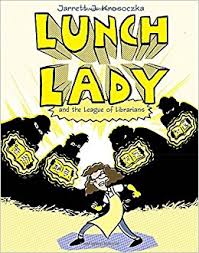
[READ: June 13, 2016] Lunch Lady and the League of Librarians

Librarians don’t really like when librarians are portrayed as villainous–unless they are done well.  And these librarians are pretty evil.

I enjoyed how this book also started out with a short clip of Lunch Lady stopping some bad guys before we even get to the story proper.

This book sees the Breakfast Bunch split between wanting to play video games (Hector is excited about the new X-Station 5000) while Dee is excited for the Read-a-thon contest.  Of course when they go to check out the Book Fair, the librarians insist that it starts tomorrow, not today.

Things seems calm and quiet for Lunch Lady.  In the meantime, Betty has come up with a new gadget: taco-vision night goggles. (more…)

Read Full Post »

after-room SOUNDTRACK: NICOLA BENEDETTI-Tiny Desk Concert #274 (May 6, 2013).

nicolaNicola Benedetti is a Scottish violinist who has had a storied career already.

Benedetti was mentored by Yehudi Menuhin starting at age 10, and won the BBC Young Musician of the Year Award a decade ago.  She plays a 1717 Gariel Strad. (It’s worth some $10 million.)

The first piece she plays was instantly recognizable–where had I heard it before?  Ah yes, the mournful and harrowing music from Schindler’s List.  [Williams: Theme from ‘Schindler’s List’].  She plays it perfectly, of course.  It’s evocative and instantly brings back scenes from the film.  And then apologizes for it being a bit of  sombre start.

 Then she plays a piece by Bach–he wrote six sonata and partitas trying to emulate many instruments at once.  This one is Bach: “Chaconne from the Partita for Solo Violin in D Minor.”  She says she’s not playing the whole thing because it’s 16 minutes long.  But she plays the first third which is also recognizable.  Once again, it sounds beautiful.  The blurb speaks of “the way she makes room for silence in Bach’s Chaconne before tearing deep into its dense warp and weft.”  And it is indeed enchanting.

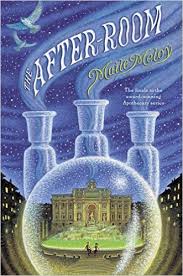
[READ: May 30, 2016] The After-Room

This is the final book in a trilogy (what is it about trilogies that are so popular?) that began with The Apothecary.

This book is set in 1955.  (Sarah and I were commenting on how this era of history is an unusual one for stories to be set and how that’s a nice change).  Janie and Benjamin are safely back in Michigan after the deadly exploits of the previous book.

Benjamin’s father was killed at the end of the previous book and Janie’s parents have agreed to take care of him–so he is living with them.  Janie’s father is quite suspicious of a romance between the two of them and he has every right to be.  Janie is certainly in love and Benjamin probably is too, but he has other things on his mind right now.

I had planned to read this book when it came out, but I was involved with a very big book when it came out.  But I was at the library with nothing to do so I grabbed this and started reading it and I was hooked immediately.  In fact, I found this book so good, so fast paced and exciting that I put down my other reading and just flew through this. (more…)

Read Full Post »

tacocaoSOUNDTRACK: CANADIAN BRASS-Tiny Desk Concert #220 (May 26, 2012).

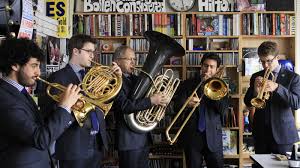
brass I hadn’t realized that Canadian Brass part of the institution of Canadian Brass.  They’re not only part of it, they are it.  Indeed Canadian Brass

led by its avuncular tuba master (and sole original member) Chuck Daellenbach, essentially put the idea of the brass quintet on the map.  Then there are the recordings — more than 100 of them, selling more than two million albums total.  Daellenbach and his fresh-faced players, each with red-striped sneakers and matching outfits, strolled into the NPR Music offices, took their places behind Bob Boilen’s desk and started blowing as if they’d played this peculiar gig a hundred times.

They began with a version of J.S. Bach’s intricately woven “Little Fugue in G minor,” an impressive staple that stretches back to the band’s first recording. In those days, precious little was available for brass quintet (two trumpets, horn, trombone and tuba), so the band relied on making arrangements of existing music. Since then, Canadian Brass has transcribed and commissioned more than 200 works, including “Tuba Tiger Rag,” Luther Henderson’s lighthearted tribute to Dixieland jazz. It’s a showpiece for Daellenbach, who twirls his tuba (while playing) and lands on a final note of such subterranean depth that you feel it more than hear it.

The players closed with another favorite, Rimsky-Korsakov’s dizzying “Flight of the Bumblebee,” in an arrangement by Canadian Brass trumpeter Brandon Ridenour. Although the music buzzes past in less than two minutes, players get plenty of opportunities to shine — as in the lightning-fast runs negotiated by trombonist Achilles Liarmakopoulos, the newest member of the group.

The band consists of   Christopher Coletti, trumpet; Brandon Ridenour, trumpet; Eric Reed, French horn; Achilles Liarmakopoulos, trombone and Chuck Daellenbach, tuba.

The band sounds amazing playing these familiar songs in a way that is–unexpected–but still right on.

J.S. Bach: “Little Fugue In G minor” is probably one of my favorite classical pieces.  I really enjoy Bach’s fugues a lot and this one is just perfect–and the arrangement here is great–everyone gets a chance to explore the phrasing.  It starts with the tuba and then the trombone and then the horn and finally the tuba.

Luther Henderson: “Tuba Tiger Rag”  Introducing this piece he says that in Bach everyone is equal, but he felt they needed a tuba song.  He says that while this song might be low art for other instruments it is high art for a tuba.  And yes he does spin it around while playing it. He uses that instrument to make roaring sounds and incredibly deep notes.  This is a medley, I think, because while the trombone and tuba play, the other three sing “hold that tiger / tuba tiger.”  How on earth does he reach that super low note?

Before the final song Bob says that his tuba doesn’t look brass.  And Chuck replies that there’s an old joke: “How old do you have to be to play the tuba and the answer is old enough to be able to carry it but young enough to still want to.”  He still wants to so he’s been  so he;s lightening the horn with carbon fiber.

For the final song Nikolai Rimsky-Korsakov: “Flight Of The Bumblebee” he tells us that the two trumpets play very fast–it must be easy for them. But the trombonist Achilles didn’t know what was coming when they had him play along.  Chuck says you’ll never see anyone play this song this fast on this instrument.

And it is amazing.  The song flies past–a blurry of fingers.  And I love that at the end, one of the trumpets sings the triumphant final high note.

You wouldn’t expect a band as old and legendary as Canadian Brass to be so funny and good-natured, but they sure are.  And that makes these familiar songs even more fun.

[READ: February 7, 2016] Ava and Tacocat

Sarah brought this book home, in part because Clark’s reading group called themselves tacocat which is a palindrome.  Turns out that Clark wasn’t interested in the book, so Tabby and I got to read it together, which was really fun.

The whole book is a language lovers’ dream, chock full of big spelling words and all kinds of palindromes littered throughout.

It was a few chapters into the book before we realized that this is actually the second book of a series (the first one is called Ava and Pip) and that this book references things that happened in book one without exactly explaining what happened.  That’s a little annoying for us, but it certainly made us want to read the first book.

The book is set up in diary form with Ava writing in it on most days.  I like that she loves palinromes so much (S-E-N-I-L-E-F-E-L-I-N-E-S) and every time she mentions one in the book, they spell it out like that. (more…)

Read Full Post »

sleepanna  SOUNDTRACK: ALESSIO BAX-Tiny Desk Concert #541 (June 17, 2016).

alessio2Alessio Bax is a pianist and a new father.  His daughter Mila is 22 months old and, a first for Tiny Desk, she is visible through the whole show.  And, no matter  Alessio is playing, all eyes are on Mila because she is completely adorable (and very well behaved).

In honor of his new daughter, Bax plays three pieces which are essentially lullabies.

Perhaps in honor of NPR/PBS, Mila is playing with a cookie monster doll for most of the set and she is being quite cuddly with it–even putting it on her head and resting it on the piano.

Introducing the first piece, J.S. Bach’s (arr. Petri): “Sheep May Safely Graze,” Bax says that Bach asks the pianist to do three things at the same time which is similar to a new parents life.

It is a lovely (somewhat familiar) piece with some beautiful melodies.

alessioWhen the song is one Mila smiles very big and claps along with everyone else and says “papa”

He acknowledges her and says, “She’s my fan #1.”

Lucille Chung, Bax’s wife and Mila’s mom duets with him on the second piece, Brahms: Waltz No. 15 in A-flat major, Op. 39.  They share the piano, which is pretty cool.  As she sits down, Mila says, “Mama too,” which wins over everyone.  Chung takes the high notes while Bax plays the lower notes. It’s a brief song, and very sweet.  Once again when the applause starts, she happily claps along.

Bax says, “We should have her play something–it will be her debut.”

He introduces the final song, Rachmaninoff: Prelude No. 4 in D, Op. 23, but before he starts, Mila says “no practicing” which he says they deal with all the time.

The song begins as a kind of lullaby and then gets much more “hot-blooded” with a stormy middle section that eventually returns to a dreamy ending.  Mila has a small keyboard of her own.  She starts “playing” it, although it proves to be a little too loud and her mom takes it away.  The song does indeed get a little intense in the middle, but is overall quite lovely.  And as it finishes she says papa piano and then beams with a big smile as she applauds with everyone else.

[READ: March 1, 2016] Sleep Tight, Anna Banana

I didn’t realize that this book was a translation at first.  I also didn’t read the biographies of the two people involved. It says that the author Dominique decided to write picture book when her adult son Alexis became a picture-book artist.  So his success inspired her to write these books.  They were translated by Mark Siegel.

We seem to read a lot of translated picture books in our house. Sometimes the very premise behind them is so unfamiliar it’s obvious they were not created by Americans.  Other times the books feel just a little …off somehow.  Like in their rhythm or something.

This book never really came to life for me. (more…)

Read Full Post »

[ATTENDED: March 13, 2016] Avi Avital

aviA few months ago I wrote about Avi Avtal’s Tiny Desk concert.  I had never heard of him, but his mandolin playing was amazing.  And then about three days later I saw that he was going to be playing in Princeton.  Well, I immediately got tickets.

And today we saw him and he was even more amazing in person.

In the Tiny Desk show, he played solo.  But in this show (and tour) he played with two people accompanying him: Ksenija Sidorova on accordion and Itamar Doari on percussion.

The only complaint I had about the show was that there was no progamme, so I had to look up everything online to know what we had just seen.  Fortunately I was able to find a setlist, because I never would have remembered what he told us.

Anyhow, in this show, titled Between Worlds Avital and company explore the borders between folk and classical music.  What that means is that they play music from classical composers, but also some very traditional folks songs from around the world.

Mandolin doesn’t seem like the instrument of choice for classical music, but Avital, who has been playing since he was little is amazing at the instrument–playing incredibly fast and clear and managing all of those Bach notes like nobody’s business. (more…)

Read Full Post »

moomin3  SOUNDTRACK: PAUL JACOBS-Tiny Desk Concert #148 (August 12, 2011).

pauljacobsPaul Jacobs is an organist.  In fact he heads the Julliard School’s organ department.  For this Tiny Desk Concert they moved in Jacobs’ massive organ–complete with foot pedals.  I feel like he should have played for an hour for all the work that must have gone into moving this.

I had thought about describing the way the Tiny Desk Concert has changed as I went through the Concerts.  But I have gone out of sequence so often that it’s kind of moot.  Nevertheless, it’s fun to marvel at how in the first few shows, it was one camera, there was little editing and what you got is what you saw.

Well, for this, the 148th Concert, they have three cameras.  And that is perfect because one is on Jacobs’ face.  One is on Jacobs’ hands as he plays these amazing Back pieces.  But the best one is on Jacobs’ feet.  Jacobs play a melody with his hands and a separate melody with his feet.  Watch as he looks like he’s tap dancing all over these massive foot pedals. The mind boggles watching him.

He plays four Bach pieces:

  • J.S. Bach: “Gigue” Fugue
  • J.S. Bach: Arioso
  • Bach/Reger: Invention in F Major
  • J.S. Bach: Fugue in A Minor

The Arioso is recognizable to me as a familiar piece.  It’s low and beautiful with washes of foot pedals.  But even more familiar is the Invention in F minor which most piano students try to play.  This version was arranged by Max Reger who turned the left hand melody into a foot pedal melody–so Jacobs is all over the keyboard on this one.  It’s stunning.

The final piece is somewhat recognizable (well, to me its recognizable as Bach, since his stuff is so elaborate and cool).  This piece is really fun to watch his hands and feet at work.  Especially at the end when he plays an intense “foot solo” before returning to an incredibly fast finger coda.

It’s such a neat instrument and he’s an amazingly talented player.

I prefer to watch on the NPR site, but its easier to embed the YouTube version:

[READ: January 13, 2015] Moomin Volume 3

Moomin Book 3 is slightly different n that it has four stories instead of three.   The stories feel shorter too, although I don’t have the other books handy to compare.

This book contains the stories: “Moomin Falls in Love,” “Moominvalley Turns Jungle,” “Moomin and the Martians,” “Moomin and the Sea,” and “Club Life in Moominvalley.”  As with the others these stories originally ran in the Evening News, London 1953-1959. (more…)

Read Full Post »

kazam1 SOUNDTRACK: ALISA WEILERSTEIN-Tiny Desk Concert #80 (September 15, 2010).

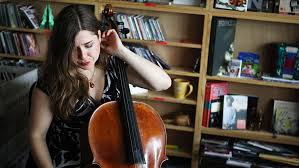
alisaI have concluded that the cello is my favorite solo classical instrument and Alisa Weilerstein plays a beautiful cello indeed.

She plays three songs: two pieces from Bach and one from Golijov.

I can’t speak to specifics about Weilerstein’s style or skills, but she plays beautifully.

J.S. Bach: “Bourree & Gigue” (from Solo Cello Suite No. 3)
Osvaldo Golijov: “Omaramor”

[READ: May 15, 2015] The Last Dragonslayer

I have loved Jasper Fforde’s books.  His Thursday Next series is brilliant (and I plan to re-read it someday).

This is the first book of his 4 part (not a trilogy!) YA series (called The Chronicles of Kazam) and it was fantastic.

The story is about Jennifer Strange.  Jennifer is a foundling who has been working for the past four years at Kazam Mystical Arts Management.  Foundlings from The Lobster are sent for indentured servitude for six years.  She has been quite successful at Kazam and when the owner Zanarerilli disappeared several months ago (she wont say how) she has basically been in charge of the building.  Not bad for a 16 year old  (well, she’ll be sixteen in a couple of months).

Kazam is in the Kingdom of Hereford in the Ununited Kingdoms.  Kazam is the home to some of the most powerful wizards alive.  Sadly there aren’t that many left.  Magic has slowly been dying and as the magic goes so goes the fancy titles of the wizards.  And now you have to fill out all kinds of paperwork every time a wizard is going to cast a largish spell.   They are stuck doing basic magical deeds for people–lifting illegally parked cars, magically rewriting houses, etc.

Also in the house is the Quarkbeast–the most ferocious creatures every created. Well, at least he looks that way.  He is actually quite sweet. (more…)

Read Full Post »

« Newer Posts - Older Posts »