 SOUNDTRACK: HURRAY FOR THE RIFF RAFF-Tiny Desk Concert #702 (February 5, 2018).
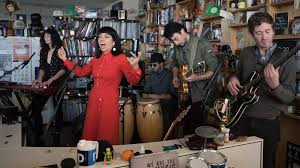
I first heard of Hurray for the Riff Raff from their previous album (the song “The Body Electric”). I loved Segarra’s voice and the politics behind the song. I could hear that she was a proud woman, but I had no idea that she was a proud Puerto Rican as well. I learned about that aspect of her music when they played Newport Folk Festival.
Alynda Segarra’s unamplifed voice in this Tiny Desk performance had no problem rising above the drums, congas, cello, violin, bass, keyboards, and an electric guitar. The passion for her Puerto Rican roots feels boundless. As Soul Captain for Hurray for the Riff Raff, she and her band weave tales of man’s inhumanity to fellow humans, often from bigotry, intolerance and ignorance.
“Rican Beach” adds a lot more Latinx accents to the music–between the congas and other percussion from Juan-Carlos Chaurand and the riffs and, of course, Segarra’s lyrics, this is a much more culturally aware album without removing any of the folk/rock that the band is built on.
First they stole our language
Then they stole our names
Then they stole the things that brought us faith
And they stole our neighbors
And they stole our streets
And they left us to die on Rican Beach
“Pa’lante,” is such a wonderful mix of the Hispanic and Americana. Singing in Spanish to Juan and Miguel the song includes a more traditional American folk style with piano (Sarah Goldstone), violin (Claudia Chopek), cello (Patricia Santos) and even a guitar solo (Jordan Hyde). Introducing the song, she says, “There’s a lot of people trying to hold us back but we have a whole generation of children counting on us to change the world. And I believe in us.”
The song “Pa’lante,” one of the most articulate songs of a generation, speaks of being colonized and hypnotized, sterilized and dehumanized, with the refrain, “pa’lante” which translates as “forward.” To continue the fight to freedom and respect:
“To all who lost their pride, I say, Pa’lante!
To all who had to survive, I say, Pa’lante!
To my brothers, and my sisters, I say, Pa’lante!”
But before that empowering end, the opening lyrics speak to the everyday that we all want: Over a simple piano melody, she sings:
Oh I just wanna go to work / And get back home, and be something
I just wanna fall and lie / And do my time, and be something
Well I just wanna prove my worth / On the planet Earth, and be, something
I just wanna fall in love / Not fuck it up, and feel something
And then more specifically:
Colonized, and hypnotized, be something
Sterilized, dehumanized, be something
Well take your pay / And stay out the way, be something
Ah do your best / But fuck the rest, be something
After four verses the song shifts gear entirely. There’s some louder chords and then it moves on to a an almost chamber-pop style with some prominent snare drum Charlie Ferguson. The end of the song, with her singing “P’alante” it’s catchy and inspiring at the same time.
For “Nothing’s Gonna Change That Girl” Segarra picks up a guitar. It’s a slower more traditional folk song with full string accompaniment. There’s quiet backing vocals and delicate yet pronounced bass from Justin Kimmel and some fun percussion before the ending refrain “before you love me like this, oh yeah, love me like this.”
I have tickets to see them and Waxahatchee this spring, it should be a great double bill.
[READ: July 22, 2016] “Sweetness”
I haven’t read very much by Toni Morrison. I have always intended to but just never did.
So this might be the first thing I’ve read by her. And man, does it pack a lot into the few pages of it.
The story begins with a woman saying, “It’s not my fault. So you can’t blame me.” And then she reveals that what’s not her fault is the color of the skin of her baby. The woman–the mother–is a light-skinned black woman with “good” hair, “what we call high yellow.” So was the girl’s father. So how could the baby have come out so dark-blue black? She was embarrassed as soon as the baby was born.
She talks about her family’s past–how her own mother was light-skinned and could have passed but chose not to. She told the price she paid for that decision–colored water fountains and, even more offensive: a colored Bible. (more…)
Read Full Post »
 Back in 1998, I won a radio contest (not through luck, I knew the name of a song and couldn’t believe no one else did!) and scored a ticket to the Newport Folk Festival. It was in a lull back then and also, I believe there was only one stage (it’s hard to remember). Now it is at full power, selling out before artists are even announced.


 I Just Read About That...