Feeds:
Posts
Comments

Archive for the ‘Emerson, Lake & Palmer’ Category

SOUNDTRACKCOPLAND HOUSE: Tiny Desk (Home) Concert #110 (November 13, 2020).

Every Tiny Desk (Home) Concert is unique.  But this one seems extra special.

the desk – and the home setup – for this performance beats them all. The location is the home, and not so tiny writing desk, of Aaron Copland, America’s beloved composer.

Copland, who would have turned 120 on Nov. 14, gave us Appalachian SpringFanfare for the Common Man and Rodeo, among many other works that helped define a singular American sound.

These pieces are familiar to anyone who has listened to any classical music anywhere (or Emerson, Lake & Palmer).  But these three pieces were ones I didn’t know at all.

The set begins with one of the composer’s earliest pieces in a jazzy vein.

The piece is called “Three Moods: III. Jazzy.”  It is an upbeat, yes, jazzy, bouncy piano piece.  That last all of 80 seconds.  It is indeed, as Michael Boriskin says, delectable.

Michael Boriskin plays Copland’s own piano. He’s the artistic and executive director of Copland House, located an hour north of New York City in the lower Hudson River Valley. What was once Copland’s home is now a creative center for American music.

Up next, Boriskin plays a duet with violinist Curtis Macomber.

The Violin Sonata that follows embodies America’s wide open spaces, filled with possibilities.

“Sonata for Violin and Piano: I. Andante semplice – Allegro” is the only major piece Copland wrote for violin. It is sombre and pretty, with a kind of back and forth violin and piano.  There’s lots of lengthy, slow, almost mournful violin parts.

Macomber departs and is replaced by flutist Carol Wincenc.  They play “Duo for flute and piano: II. Poetic, somewhat mournful; III. Lively, with bounce.”  Those descriptors are part of the title and also describe how the music is to be played.  This piece

 was actually written at the very desk seen in this video.

The first part is slow and sad, while the second one is much more fun and bouncy.  The middle of the second part has a a sow staccato dialogue between the flute and piano.  There’s a fun moment where the flute and piano play the exact same very high note and the sound is really unusual.

I found these pieces to be less engaging than his more famous pieces.  But maybe that’s just because I am much more familiar with them.

[READ: December 9, 2020] “Parade for the Dead and Dying”

This year, S. ordered me The Short Story Advent Calendar.  This is my fifth time reading the Calendar.  I didn’t know about the first one until it was long out of print (sigh), but each year since has been very enjoyable.  Here’s what they say this year

You know the drill by now. The 2020 Short Story Advent Calendar is a deluxe box set of individually bound short stories from some of the best writers in North America.

This year’s slipcase is a thing of beauty, too, with electric-yellow lining and spot-glossed lettering. It also comes wrapped in two rubber bands to keep those booklets snug in their beds.

As always, each story is a surprise, so you won’t know what you’re getting until you crack the seal every morning starting December 1. Once you’ve read that day’s story, check back here to read an exclusive interview with the author.

It’s December 9.  Kelly Luce, author of Pull Me Under, can always pull a quick U-turn if she misses the exit. [Click the link to the H&O extras for the story].

I love how this story started in a kind of surreal location and then did a U-Turn and wound up in an even more surreal place.

Palmsville, Florida, has decided to have a parade for the dead and dying.  The floats were from various hospitals.  County supplied four bodies from the morgue to ride on the back of one of the floats.  Mount Sinai putthree geriatrics (and their ventilators) in a convertible. (more…)

Read Full Post »

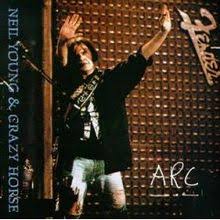
oct30SOUNDTRACK: NEIL YOUNG-Arc (1991).

arcArc came with Neil Young’s outstanding live album Weld (and then later on its own).  It contains one 35 minute track called “Arc (A Compilation Composition).”

This album was recorded during Neil Young’s tour with Sonic Youth opening (MAN, I wish I had seen that tour).

Because it was 1991 and you couldn’t really look up this kind of information, I just assumed that Neil and Crazy Horse had created some kind of 35 minute jam (even though it doesn’t really sound like all one song, but how closely does one listen to Arc?).

Of course, listening to it now, it is pretty obvious that it’s pieces of shows strung together.  (the subtitle also gives it away, although I don’t think that the subtitle was on the actual disc).

Wikipedia talks about an interview that Neil Young gave in which he says he recorded a film in 1987 called Muddy Track

 which consisted of the beginnings and endings of various songs from his 1987 European tour. Young placed a video camera on his amplifier during the 1987 tour and recorded the beginnings and endings of various songs, and later edited them down into the film’s soundtrack. “It was the sound of the entire band being sucked into this little limiter, being compressed and fuckin’ distorted to hell,”

And in what makes 100% sense, on this 1991 tour,

Young then showed the video to Sonic Youth’s Thurston Moore, who suggested that he record an entire album in a similar manner. However, Arc was not recorded through video camera microphones, as was the case with Muddy Track, but instead was compiled from various professional multi-track recordings made throughout the tour.

So what you get is 35 minutes of noise (not so much feedback, as guitar rumblings that a band might do as a song slowly grinds to a rumbling halt).

You can hear snippets of vocals.  In particular, you can hear him singing “Like a Hurricane” and “Love and Only Love” in what definitely sounds like the end of a take–as the band’s instruments ring out.

There’s occasional moments where the rumble is interrupted by a burst of drums from Ralph Molina or you can clearly hear some of Frank “Poncho” Sampedro’s guitar and univox stringman.

There’s a little bit of audience response.  At the opening of the disc but especially at the 25 minute mark as a song feedbacks out and the crowd cheers before the band puts out  rocking drum-filled cacophonous ending.

At 28 minutes the “song” actually sort of turns into an actual song with Billy Talbot playing a simple four note bass line.  But that doesn’t last too long before another ending is tacked on.

The last few minutes has someone singing “No more pain” and then shouting a story that is somewhat inaudible although I think I hear “mom” and “post office.”

This is certainly not something to listen to much.  But I found it an interesting sonic experience today.  if nothing else, it made me really wish I had seen that 1991 show.

[READ: August 30, 2019] “Beyond the Pale”

I really like Nick Hornby’s music (and book) reviews.  He and I don’t share the same taste, but we have a lot of moments that overlap (he’s more traditional while I’m more experimental).

In many ways it is no surprise that he hated Radiohead’s Kid A, but the amount of savagery he does to it is quite astonishing.

He essentially compares it to Lou Reed’s Metal Machine Music and Neil Young’s Arc.  Not in content, but in the giant middle finger he feels it is to fans of the band.  Although he does admit that Kid A is “nowhere near as teeth-grindingly tedious” as Metal Machine Music.

He feels that the album stems from the idea that fans are interested in “every twist and turn of the band’s career no matter how trivial or pretentious.”  Although a valid question is what has earned Radiohead its huge audience.  I have not figured that one out myself. (more…)

Read Full Post »

novocSOUNDTRACK: BUKKENE BRUSE-The Loveliest Rose (2002).

bruseI’m not entirely sure how I came to own this disc.  But I’m so glad I do.  This is a Christmas album from one of Norway’s traditional ensembles (pronounced: BUH-kayna BREW-sah).  They have been around since the 1990s and have toured extensively around the world.  This is their only Christmas album.  It was recorded in an Oslo church.

The album features four players on some great traditional instruments: Arve Moen Bergset – vocals, violin & Hardingfele; Annbjørg Lien – Hardingfele & nyckelharpa; Steinar Ofsdal – flute; Bjørn Ole Rasch – pipe organ.

The album is a wonderful collection of music.  I prefer the instrumentals, although Bergset does have a lovely singing voice.  What I found most interesting is that the sound of the music conveyed many non-Norwegian feelings.  I heard some Irish sounding traditional music and even some Native American (the flute in the final song).

The pipe organ sounds amazing and the fiddle, especially on “Father Fiddled on Christmas Eve” is fantastic.

Nine of the songs are traditional, the rest are written by the band, aside from St. Sunniva, the opening of which comes from ELP’s “Karn Evil 9, 3rd impression (I kid you not–it is quite stripped down here).

I really love this non-traditional traditional Christmas album.  I’m including the track listing mostly because I wanted to have all of this Norwegian in a post.

  1.   A Child Is Born in Bethlehem «Eit barn er født i Betlehem» (3:18) [great flute and a surprisingly catchy hallelujah]
  2.   Lullaby for Julie «Lullámus» (3:15) [great sound of the Hardanger fiddle which has two drone strings]
  3.   Spirit of the Grove «Haugebonden» (5:14) [a gorgeous melody]
  4.   Christmas Eve «Juleftan» (3:38) [unusual fiddle sounds and an unusual and captivating melody]
  5.   My Heart is with Jesus «Mit Hjerte Altid Vanker» (6:32) [the pipe organ really elevates this song]
  6.   St. Sunniva «St. Sunniva» (3:44) [organ and fiddle together in this Irish sounding song]
  7.   A Little Child So Pleasant/In the Sweet Christmas Time «Et lidet barn saa lystelig / I denne søde juletid» (7:20) [beautiful flute and solo violin]
  8.  Father Fiddled on Christmas Eve «Så spela far juleftan» (3:02) [that cool, unusual fiddle is back]
  9.  The Loveliest Rose has Been Found «Den fagraste rosa er funni» (2:35) [the voice is really great on this one]
  10.  Christmas Gangar «Romjulsgangar» (3:22) [beautiful fiddle and flute dance with some unusual sounds from both instruments]
  11. For Such Generous Gifts «For saadan’ mildheds gaver» (2:53) [a New Year’s tune that is rather haunting, I must say]

[READ: December 14, 2014] Novocento

In continuing with my obsessive reading of all things Baricco, I had to interlibrary loan this book from Johns Hopkins.

Novocento is confusingly titled because that is the Italian title as well and although it is a number (which could be translated) in this book it actually refers to a person, which would not get translated–so look carefully for the English edition (done by Oberon) and wonderfully translated by Ann Goldtsein).  It was designed as a play (and this edition is the play).  However, it is a one man monologue (with music ion the performance), so it doesn’t “read” like a play.

The book is 56 pages long.  They have also made a movie out of it (called The Legend of 1900, not just 1900 which is a different movie).  Amazingly the movie is 170 minutes (Italian version) and 120 minutes (international).  That must be a lot of music.

The story is simple, Novocento, as he is called, was born on a ship–an ocean liner that transported people primarily from Europe to America in the early 20th century.  His parents were undoubtedly lower class and left him on the piano aboard the boat (we don’t hear their story at all).  One of the crew finds him and names him Danny Boodman T.D. Lemon Novocento.  Danny Boodman is the man who found him, T.D. Lemon was on the side of the box he was left in and Novocento was the year. (more…)

Read Full Post »