Feeds:
Posts
Comments

Archive for the ‘Carla Bozulich’ Category

odddicksSOUNDTRACK: CARLA BOZULICH-Boy [CST102] (2014).

carlaI listened to this disc casually a few times and never really got into it.  But when I listened with headphones and focused on it, there was a lot of good stuff about it.  The music is really spare and it’s kind of hard to grab onto anything on a casual listen.  As with much of what Bozulich does, she’s very free form—there’s usually a melody but it’s not up front.  But careful listening pulls out what the songs are designed to do.  It’s not always rewarding listening as her stuff is certainly abrasive, but I was pleased to hear some really cool sounds on the disc.

“Ain’t No Grave” is an impressionist song made up of a few bass notes and a  lot of voices.  There’s Bozulich singing and peaking and a male singing low notes with her during the chorus.  About half way through, the song adds complicated drumming and a sprinkling of keys—all impressionistic stabs at rhythm and melody.  It’s a difficult track and certainly a difficult opening track, but the catchy parts are intriguing the way they emerge from the chaos. “One Hard Man” opens with percussive drumming and Bozulich’s repeated refrain of “one hard man.”  Noisy guitars are added between verses and the thumping is strangely catchy.   “Drowned to the Light” is mellower with quiet instruments and delicate singing.  It’s the first “pleasant song” on the disc despite the menacing tone.  The chorus introduces a pretty melody both in vocals and violin.  It follows a murder ballad style.

“Don’t Follow Me” is mostly spoken word with percussion and accents of keyboards although the chorus does add a melody to the voices.  It’s amazing how simple chords and a backing voice can really add something to what is such a spare song.  The song ends with a  cool refrain of “spinning dreams spinning dreams” that builds nicely.  “Gonna Stop Killing” opens with sound effects and backwards rolling tapes.  But the vocal melody is the catchiest so far with a great chorus of rising notes and Bozulich’s aching voice and hammered dulcimer.  The middle section even has a fairly conventional melody line.  It’s unexpectedly pretty given the lyrics.

The second half of the disc seems to coalesce into a more melodic and song-structured  half. “Deeper Than the Well” has scratching guitars and deep slow  bass with the lyrics “I wish that I could fuck up the whole world.”  It’s menacing but catchy and seems to lurch along with only Bozulich’s voice keeping the song going.  “Danceland” opens as a slow bluesy song with quiet verses and a simple three note bass line.  But it’s joined by a really surprisingly catchy chorus “if we could spin under the light in  dance….land.  It was always night in dance….land.”  The middle section is a little weird until it resolves to that familiar chorus again.  The song really seems to slowly unfold with quieter moments leading to if not louder ones, then certainly fuller moments.   “Lazy Crossbones” adds some keyboards to the main melody.  It has one of the stranger catchy melodies that I can think of—quietly and slowly sung “hey hey it’s a parade.” But the organ sound is so unlike anything else it really stands out.  “What Is It, Baby” begins as a kind of slow, almost bluesy type of song until the big chords kick in for the chorus (which I imagined someone like Elvis singing).  The middle of the song has a soaring “ooooh” section which sounds quite unusual for her.  The ringing chords sound so vivid.

The disc ends with “Number X” an almost entirely instrumental 4 and a half-minute track.  The song starts slowly with meandering guitar notes and an interesting yet menacing melody underneath.  A nearly four-minute build up leads to Bozulich reciting a kind of poem that ends with the disc.

Bozulich consistently explores unusual territory and while this will never get played on any radio, it is more friendly than some of her other releases.

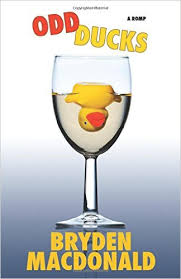
[READ: April 1, 2016] Odd Ducks

Odd Ducks is a play commissioned by the Nova Scotia playhouse.  It is set in Tartan Cross, Nova Scotia.

There are four characters, all in their 40s. Ambrose Archibald, he is unemployed but charming and a total narcissist; Mandy Menzies was the high school beauty queen but she is in a bad marriage now, a naive sweet woman. Estelle Carmichael is Mandy’s friend and housekeeper–she had a crush on Mandy in school and has sworn off men forever.  Freddy Durdle is Ambrose’s only friend but even he is fed up with Ambrose’ behavior.

The play opens with Ambrose out in the woods trying to find himself.  And after a few minutes of soul searching and a minor fright he has succeeded.  He is pontificating about himself when Estelle comments that she can’t listen to this crap anymore.  She tells him he is full of it.  To which Ambrose says, I forgive you. (more…)

Read Full Post »

1352113437munkeemanSOUNDTRACK: EVANGELISTA-Hello, Voyager [CST050] (2008).

helloThis is Carla Bozulich’s first “band” on Constellation. I didn’t really care for her solo album because it sounded way too all over the map.  She has brought in some great musician to rein her in somewhat and it really helps.  This album is still loose and wild and uncomfortable and at times hard to listen to and also really cathartic.  It feels like there is direction to the madness.

The first song is probably the least appealing.  It’s almost a free form poetry slam, but there’s enough incidental music to make it feel like there should be more.–the music doesn’t necessarily follow what’s going on, as if the musicians were told to do what they wanted but weren’t listening to her.

That improv feeling exists throughout the album, but the other songs feel like they have a structure and a melody which really really help.  Like “Smooth Jazz” in which the drums keep a loud steady beat which regulates the tempo and makes her screams all the more intense.  Or “Lucky Lucky Luck” in which a beautiful vocal melody and backing vocal combine with pulsing bass to make a platform for the noisy guitars.  “For The L’il Dudes ” is a creepy string quintet.  But “The Blue Room” is a full complex song with a captivating melody and strings that really work well.

“Truth Is Dark Like Outer Space” is a heavy rock song with great distortion, while “the Frozen Dress” brings back the creepy and spooky sounds. “Paper Kitten Claw” reunites those minimal sounds with a mellow melody.  It feature the great lyric (and theme) “Every time you see the word never, cross it out.”  The disc ends with “Hello, Voyager!” Crazy noises open this 12 minute ramble.  Carla sounds like a crazy preacher and by the end it’s just a free form chaotic mind fuck.  But in a good way.

It’s not always fun to see where Carla’s mind will take you but in this case the crazy trip is disturbingly fun.  Not for the faint of heart.

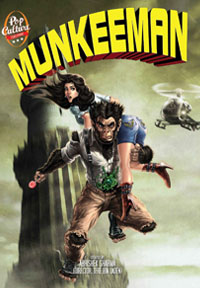
[READ: May 18, 2014] Munkeeman

This comic came across my desk and I was intrigued by it.  I’ve never read a graphic novel published in India (and written in English) before.  One thing that struck me about the drawing style was how dark (full of a lot of lines and very little white space) the book was.  It’s very busy, demanding a lot of attention.  I prefer my graphic novels to be a little more open and less claustrophobic (okay, I’ll say it, more “white”–racist!–meaning I like more white space in the drawings because I find the heavily drawn dark lines to be a little too busy for me).  But having said that, I enjoyed this style.  The details were always interesting to check out, especially the crowd scenes were Sharma has a lot of fun with background characters (it reminded me of Mad Magazine a bit).

At the same time I was also somewhat surprised at how conventional the story looked.  I don’t know what I was expecting–something more decisively Indian perhaps, but this could have come from an underground comic publisher anywhere.

This is all background to say how much I enjoyed this kind of twisted book.

Incidentally Sharma also directed a film called Tere Bin Laden which is a comedy about an Osama bin Laden double and which sounds quite funny.  I’m going to have to give that a try if I can find it.

So the book starts with an explanation about Munkeeman–he appeared (for real) as an unseen villain in the Hindi film Delhi-6 (which I’ve never seen).  You don’t need to see that movie to quickly learn that there was a villain (the Black Monkey) who is now getting his story told from his point of view.  Especially since the prologue fills you in that nobody ever got a full glimpse of him but he was referred to as The Munkeeman. (more…)

Read Full Post »

eaveptotterSOUNDTRACK: ELIZABETH ANKA VAJAGIC-Nostalgia/Pain EP [CST035] (2005).

This album is considered an EP, probably because it runs about 33 minutes. And yet with 3 songs and one of them nearly 20 minutes long, it feels like a much bigger release.

The first song, “Nostalgia” is 17 minutes long and begins with three minutes of scratchy violin “warm up” sounds.  Around 3 minutes guitars start playing some simple chords which gives the violin some direction.  Around 4 minutes’ Vajagic voice comes in, throaty and raw like a wounded PJ Harvey crossed with Patti Smith.  The song doesn’t vary all that much in the 17 minutes, but it’s her voice that carries the anguish and pain of the song along.  The interesting touch of the scratching guitars on the edges gives more angst to the song.  Starting around 12 minutes, the song kind of devolves into a series of noises –clicking drums, scratching violins.  A kind of free-form exploration like the beginning was.

So although the song is 17 minutes, it’s really only about nine of actual song.  The rest is sort of an experimental jam, with the volume down quite low in comparison.

Song 2, “Pain” is 12 minutes and opens with a slow guitar melody.  But the real focus is Vajagic’s voice because the instrumentation is basically a guideline.  Until, that is, the 4 minute mark comes around, when the guitar turns electric and more powerful and EAV’s voice goes away for about 3 minutes.  The melody is simple but has a good yearning and building quality with an interesting slow guitar solo meandering around.  Around 8 minutes she begins singing again, repeating the original vocal melody but now with screaming guitars behind her–it’s quite a change and a cathartic introduction of new sounds.  The ending kind of drifts away without ever really letting go.

The final sing is only 4 minutes.  It opens with cracking sounds and a music box.  When the song proper starts there’s more quiet guitars and EAV’s voice and that’s all the song is–like a microcosm of the longer songs and somewhat more powerful for its condensed nature.   Although I do prefer the louder more angsty music she makes, this is a nice showcase for her restraint.

This is the last record that I’m aware of her releasing.

[READ: April 26, 2014] Lord Tottering: An English Gentleman

I saw this comic strip book at work and decided it was interesting looking and might be fun to read.  The title made me laugh as did the Registered Trademark “Tottering-By-Gently” and is a kind of compendium of Lord Tottering comic strips.

Never heard of Lord Tottering?  Me either, but it has been appearing weekly in the magazine Country Life since 1993 and is “phenomenally successful” according to the introduction.  Which also states that Annie Tempest is one of the top cartoonists working in the UK.  (I’ve never heard of her either, but again, that doesn’t mean much).

The cast consists of Daffy Tottering, who reflects “the problems facing women in their everyday life” (if you are rich and British, and live in “their stately home in the fictional county of North Pimmshire).  She also spends time (and I feel compelled to put all of this in here because it is an amusingly long list):

“reflecting on the intergenerational tensions and the differing perspectives of men and women, as well as dieting, ageing, gardening, fashion, food, field sports, convention and much more.” [She must be exhausted].

Her husband is Dicky.  He is basically a retired rich Englishman who hunts and fishes and goes to the kind of club that is mocked endlessly in Snuff Box.

I mock this cartoon a little bit because it is pretty mockable–wealthy aristocrats suffering white people’s problems.  Think of it almost like Cathy for Rich Britons.  And yet, despite all the mocking, I got a chuckle out of a lot of the strips, and I’m sure it brings a smile to many people. (more…)

Read Full Post »

 superheroSOUNDTRACK: ELIZABETH ANKA VAJAGIC-Stand With the Stillness of This Day [CST028] (2004).

eavlpElizabeth Anka Vajagic is a singing in the vein of Carla Bozulich (whose solo album CST would release a few years after this one).  She has a powerful, raw voice that can go low but can also rage.  She has a lot of control over her voice (which is seems sometimes Bozulich doesn’t) which leads to a lot of tension-filled songs.  EAV plays guitar and some piano.  These songs are also filled with cello, harmonium and an oud.  The songs are slow but powerful, and her voice suits the melodies very well–dark and full of longing.

“With Hopes Lost” has that mournful keening vocal, and the cello really provides that hopeless-feeling component.  “Around Here” is a dark stormy song with aching strings and piano.  “Where You Wonder” is a dark song but with a fight left in it–resistance to the darkness it feels.  The song feels mostly sparse until 4 and half minutes when it rages with a screaming guitar solo and big bold chords.  “Iceland” has probably the most fun chorus of the bunch, something actually sing-alongable.    The next song is called “Why.”  I’m always suspicious of a song called “Why” and this one is a little deservedly so–vague statements are not really anyone’s forte.  She has the keening down well, but it feels a little flat–brevity helps on this one.  “And the Sky Lay Still” opens with a slow echoing guitar, and as it slowly builds, ther’s a great vocal melody that builds for the verse  “Sleep with Dried Up tears” is an acoustic song.  It’s definitely a bit of a downer after the intensity of the album (which is dark but powerful).

EAV is definitely not for everyone.  It depends on your taste for screaming and, your taste for strings instead of heavy guitars to accompany those screams.

[READ: April 23, 2014] The Adventures of Superhero Girl

I grabbed this book from the library because I like Hicks’ work.  When I brought it home, Sarah thought that I brought it for her because it is on her Hub Reading Challenge List.  But no, I liked Hicks enough for myself (so selfish–although I did let her read it first).  She loved it, and so did I.

The Adventures of Superhero Girl is an online comic which Hicks seems to have started in 2010.  Online it is black and white (this book is done with colors by Chris Peters). I didn’t check to see if this is the entire series, but I assume it is. It went on hiatus in 2012 and has been eerily silent ever since.  So at least we have this pretty hardcover document of this hilarious series.

The strip is a genuine, honest to god, comic strip–8 panels and a punchline!  (okay most have fewer than 8 panels, but that’s the set up).  It’s sort of a goof on superheroes, but as the introduction by Kurt Busiek points out, it is really not a parody of the genre.  Superhero Girl is a superhero, with powers (but not amazing powers) and she does help people and she suffers angst from it.  But Hicks plays around with the most basic tropes of super heroes.

Superhero Girl, first of all, doesn’t have a superhero name.  She’s not hugely muscular, she’s not super sexy, she doesn’t wear a sexy costume.  She’s a young Canadian girl in a mask and (sometimes) a cape. She doesn’t have an agonizing backstory.  She just has superpowers and wants to help people. (more…)

Read Full Post »

SOUNDTRACK: EVANGELISTA-In Animal Tongue [CST082] (2011).

Evangelista is probably my least favorite band on the Constellation label.  I’m especially surprised/disappointed in this because I loved Carla Bozulich’s earlier bands.  I’ve said before that I find her vocals to be weirdly and wonderfully disconcerting.  And when it’s played over aggressive confident music it works wonders.  But when it’s paired with music that is also kind of abstract and untethered, it just sounds like a mess.

After that introduction, I’ll say that this album is their best release yet.  Her voice (the Constellation site suggests her melodies are “largely improvised” (!)) sounds like it always does–unsettling, haunting, compelling, drawing you into whatever world she is invoking.   The title track is the most intriguing–the music is subdued, drawing you in even more.   “Black Jesus” is also compelling in that it is one of her more subtle releases.

“Bells Ring Fire” has the catchiest section, practically a singalong.  “Die Alone” reverts back to that old nebulous style where there’s just nothing to grab on to.  Indeed, “Enter the Prince” and “Hatching” both have interesting sound effects (especially “Hatching”) but they’re not really compelling as songs.

I think the real problem with these songs is that they’re all too long.  Since they don’t have any hooks in them, since there’s nothing to really grab you and make you want to like them, having them come in around 5 minutes is just too much to ask of the listener.  Some of these songs would be inetresting for two or three minutes, but by 5 I’ve given up.

Check it our for yourself here

[READ: May 15, 2012] “Reading Graffiti in the Early Modern Book”

This may be the most current scholarly article I have read from JSTOR.  Part of the fun of reading the JSTOR scholarly articles is that they are usually old enough that you can have either a) contemporary knowledge about what the author got right or wrong or b) a fun nostalgia based upon the word choices or references that are in the text.  So with this one, which is not even two years old, there’s neither of those possibilities.  What’s also interesting is how the article is clearly current–the references that Scott-Warren uses are contemporaneous (“the Banksy of his day?”)

So what is this article about anyhow?  Well, Scott-Warren looks at the notes and scribbles that people have written in their books.  But not just your average textbook or library book, he goes back very far to the “early modern” period and sees that people have been graffiting their books since there were books.  He mentions how anyone studying books from that era will see all kinds of things on the pages of the book, from scribbles to pressed flowers to even the rust outline of scissors.  But he wants to focus on what people have written.  And he wants to see of any of these notations are comparable to graffiti in the current sense of the word.

He discusses current definitions (including tagging) to explain that graffiti is all about saying “I am here.”  (He even interviews a graffiti artist named Claw).  Then he goes back to 1434 and sees a Latin inscription from Jan van Eyck on his painting Arnolfini Double Portrait that more or less says “Jan van Eyck has been here.”  Although it is his own painting it has a feel of graffiti, of making a public note that you exist.  Similar inscriptions can be found in many books of the period as well.  There is a 1565 edition of a book with a heavily flourished signature, there’s a 1548 edition book with a doodle that may include a self-portrait.  There’s even a bible that has been inscribed by every member of the family (daughter Mildred’s is stunningly ornate).  Another book has the owner’s signature about fifty times throughout the book.  Are these words to the world?  Public notations?  or something else?

Scott-Warren wonders if these markings can be considered “pen-trials”–pens were hard to use back then, the ink was homemade and paper was scarce.  Another possibility is that they were an attempt to prove and expand on literacy.  A third possibility was ownership. Like the graffiti in a 1685 Indian Bible, written in Massachusett: “I Nannahdinnoo, this is my book…I, I Nannahdinnoo, own this forever.  Because I bought it with my money”

I especially enjoyed the book that had written, under the name Walter Vaughn, “This book belongs not to Walter Vaughn but to James Vaughn because his later father John Vaughn gave this book in his last will and testament to the same James Vaughn and therefore the said James is the true owner of the book” (1582).

In addition to the I of graffiti Scott-Warren looks at the “was here” aspect.  In a 1549 History of Italy, there is an inscription noting that the owner had been to Venice.

The key to all of this seems to be its public-ness.  Some inscriptions were prayers that were clearly meant for others to read.  In another case, the person wrote his opinion about the booksmith where the book was purchased.  There’s even some graffiti that is like trash talking of others.

I enjoyed this article because there were lots of pictures of the inscriptions, although i could have used a few more, frankly.  It was also curious to think about why people wrote things in books long ago–who exactly did they think would be reading their copy of a book?  Was it just a public act of disobedience at a time when a public act had to be very self-contained?

Read Full Post »

SOUNDTRACK: EVANGELISTA-Prince of Truth [CST061] (2009).
This is the second disc by Evangelista, the band fronted by Carla Bozulich. This disc continues in the vein or the previous disc, which is a little disappointing.

The disc is chock full of a lot of noise: stringed instruments, textures, layers, but they all add up to very little.  Bozulich’s voice is in another location entirely.  On most of the songs, there’s no real connection.

Two songs in the middle, “You Are a Jaguar,” and “Iris Didn’t Spell” are more reasonable attempts where Bozulich’s wild vocals are wedded to a more standard musical composition.  And those tracks work pretty well.  But when there’s so much directionless stuff floating around on the disc, it’s hard to want to listen to it.

[READ: May 25, 2010] “Afraid to be Men”

This is a conversation between two men.  They are given no context and are speaking abstractly.  These two things combines make for a less than satisfying read.

Admittedly, this piece is excerpted from a longer piece called “Manifesto.”  I’m not planning to read the longer piece, so I’ll never find out of context is given. (more…)

Read Full Post »

bowl.jpgSOUNDTRACK: CARLA BOZULICH-Evangelista [CST041] (2007).

carla.jpgThis record comes from the mighty Constellation label. Don and Ian are super nice guys in Montreal who release some fantastic music. I have been a fan for years, and I have all of their releases. I get them sight unheard, because I know they release good, quality music with great packaging. They came to my attention through Godspeed You Black Emperor, a fantastic instrumental band, and their spinoffs (A Silver Mt. Zion, etc.).

Initially, they released pretty much only bands that had connections to each other (to see who plays on each others’ records, you’d need a spreadsheet about ten pages long). They have since branched out to include some really notable musicians like Vic Chesnutt (!) and Carla Bozulich.

Carla Bozulich was the singer for the great band The Geraldine Fibbers. gfib.jpg She has a very strong voice, and sounds not unlike Diamanda Galas, meaning she can hit the high notes, and the powerful notes, and the screechy notes, and tends to be a bit scary from time to time. In the context of the Geraldine Fibbers, it was really an amazing thing to behold.

They were a sort of country-punk band, and they were really tight. Carla’s vocals could scream or soothe depending on her mood. And working together, they were pretty great.

I mention this band because Carla’s solo album is a little too free-form for her own good. She thanks the producers for letting her get out things that have been inside. And I’m sure that was cathartic. However, I find that her voice needs the stabilizing force of a solid backing band. This solo album has very erratic (and very interesting) music, but when combined with her voice, it’s just a little too much chaos. With the Fibbers, the grounding of the backing band and structured songs really made her voice shine. On this one, there’s just so much going on that it’s all a bit of a mess.

The music itself is actually pretty great. It’s very unusual, with strings, and staccato sounds. Her voice also sounds great. After all, it’s been a few years since the Fibbers broke up, so it’s nice that she can still hit the notes. It’s just that the off-kilter music really competes with her off-kilter voice leading to an overall unsatisfying experience.

She has a new one coming out with a full band called Evangelista. I’ve listened through once, and it sounds much more cohesive. I think the solo record was just something to get out of her system.

[READ: March 10, 2008] Bowl of Cherries

McSweeney’s published this book. And the only story behind this book that you may have heard is that the author is old. Really old, not just old for McSweeney’s old, but like nineties old. It’s something of a shame that this was the first (and pretty much only) thing I heard about this book. And yet it is an interesting background in and of itself. (more…)

Read Full Post »