 SOUNDTRACK: NEGATIVLAND-No Other Possibility (1989).
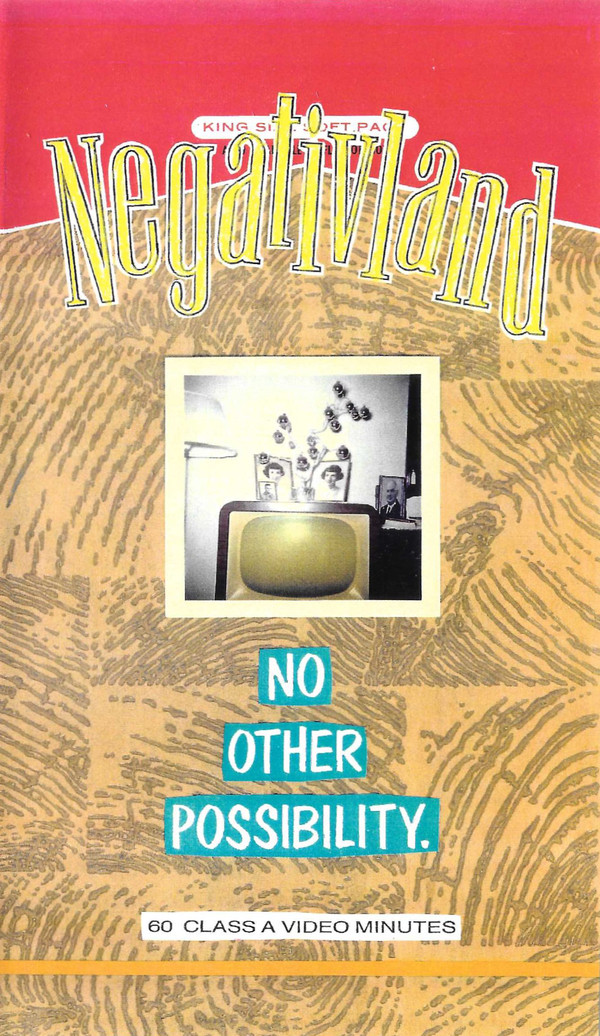 In the year that Helter Stupid came out, Negativland released this one hour video. It is a visual approximation of a Negativland album. Lots of cuts, lots of snippets of ads and songs and news broadcasts. It’s mostly nonsense with some reality and some things that may or may not be reality. Who knows?
It opens with a critical diatribe that scrolls over a test pattern. The diatribe by Crosley Bendix criticizes everything that is (correctly) poor about the video and making up other things–the death of a stuntman.
After the opening credits, the video opens with David Willis’ mother watching TV. On the screen is a clip from Dick Vaughn and his Jack-O-Lantern (more below). Then she asks David for her cigarettes and the song from A Big Ten 8 Place is acted out hilariously.
After some clips from video games and a commercial for Marlboro, there’s a video for “Nesbitt’s Lime Soda Song.” When the bee comes into the song, it turns into clips of David filming his family talking about bees and more (like his grandma looking in the fridge for potato chips which makes David laugh).
Change channels until The Dick Vaughn Show comes on and he brings out David Willis to light up a Jack-O-Lantern with 700 volts.
After a commercial from ZOTOS and Nation Hairdressers and Cosmetologists Association that tells women they have to look their best in order to get a job. “Appearance and good grooming are essential.”
Then it’s time for Trick or Treat with David Willis who is dressed as E.T.
He talks about Halloween safety with 5 hand drawn posters.
- no fresh fruit–nails razors
- looks for holes or tears in wrappers–inject chemicals
- avoid homemade treats
- avoid weird, strange-looking people.
- if you bob for apples make sure your partners are not sick
Then some explosions with cars flipping. A small video slowly evolves revealing a live performance of David singing the “Very Stupid” song from 10-8. It is noisier and rocks pretty hard while David yells the lyrics: “1, 2, stupid ; 3, 4 dumb.” The version slowly comes into focus as David roams the audience. he even adds new lyrics: “1,2 urinate ; 3, 4 defecate ; 5, 6 fornicate ; 7, 8 seat be sate!”
After a text: “Earlier that same evening,” a car drives into the building under a scroll from Dick Goodbody raving about this beauty, “her name is Monarch Mercury Monarch.”
Followed by a commercial for the Monarch.
Then there’s a video clip of the fire in the Negativland recording building (which I think is true?). They interview Mark Hosler who grabbed master tapes and studio equipment. He tours the burned out building.
Then there’s interstitial questions of what people think about TV.
- An old man complaining about sex on TV.
- Teenage girls saying they like soap operas because of the sex.
- A guy saying TV would be improved if they quit showing so many commercials.
Up next is Crosley Bendix (“Director, Stylistic Premonitions” played by Don Joyce) of the Universal Media Netweb has an insane piece about numerology, at the end of which he cries, “Thanks a million!
- MTV has fine guys on it
Then comes Negativland “Fire Song” with Mark singing in the burnt house.
A series of ads for canned foods: tomatoes, grapes, yams, dog food over a muzak version of “Age of Aquarius.”
Then comes the religion portion of the show. Another diatribe by Crosley Bendix complains of people always searching for more intense entertainment. Since Jesus’s time. In fact, The Last Supper is the crucial link-up of food and show business.
Then comes more live scenes of some crazy music and kids walking around in costumes who start shouting about ice cream and other food.
- I don’t watch religious TV because I have a personal relationship with Jesus Christ.
Clips of preachers and then Pastor Dick comes out,
He tells some dad jokes like asking for coffee without cream and the waitress saying “you’ll have to have coffee without milk because we are out of cream.”
He brings out a racist ventriloquist dummy Enrico Gomez. Then has everyone sing along with the Christian Youth Fellowship song from the album How Do You Spell Joy?
He has a Stop sign and asks everyone to clap along. Stop! [clap clap] And let me tell you what the Lord has done do me. When he turns around the sign is a hand written note “fuck you pastor dick.”
Then comes the 5 eyewitness news team featuring Hal Eisner, with the video of the audio used in side one of the album Helter Stupid. Don Joyce is interviewed.
As the video ends, there’s one more guy that they interview. He says
TV is gonna make me famous one day. When the interviewer asks how, the guy says
“you gotta know how to exploit the media.”
Was he a plant? Who knows. There is no other possibility, godammit.
[READ: April 25, 2019] “Attention Geniuses: Cash Only”
Woody Allen doesn’t seem to write much for the New Yorker these days. I’ve found over the years that I rather like some of his New Yorker jokes and then others are just ho-hum. Of all of the short “funny” pieces in the New Yorker, Woody tends to be able to pull off three pages better than others.
Although this one drags and often come across as an excuse to throw out pretentious references.
And yet he’s got some great turns of phrase:
Jogging along Fifth Avenue last summer as part of a fitness program designed to reduce my life expectancy to that of a nineteenth century coal miner



 I Just Read About That...