 SOUNDTRACK: WEEZER-Hurley (2010).
 In my head, no band garners as much debate as Weezer. According to this article, a man offered them $10 million to break up. Even I go back and forth about whether they are great pop song writers or incredible sell outs. I mean, look at one of the items on their thanks list for Hurley: “Dodge–makers of the timeless Challenger.” Is this ironic or not and if not, does it matter? I’m also torn by Rivers Cuomo’s Harvard degree, which I would think means he would write intellectually rigorous songs–and yet he never does.
But what of it? Let’s talk about the music. It has dawned on me that the closest band to compare them to is Cheap Trick. They write poppy songs with often heavy guitars that are completely sing along-y but are in no way alternative to anything. And yet everyone loves Cheap Trick, so why not love Weezer, too?
Hurley is no different. Each song is 3 minutes of pure pop (for crying out loud Desmond Child is on one track–put one in the sell out column). But they also have some odd fans on this disc: the crew from Jackass sings backing vocals on “Memories” and Michael Cera plays mandolin and sings backing vocals on “Hang On” (although you can’t hear any of them really). “Hang On,” by the way is their most Cheap Trick-y song to date.
“Unspoken” features a flute and acoustic guitars until about two minutes into a three-minute song. Then it bursts out of acousticland and into heavy rocking guitars. The one song I don’t get is “Where My Sex?” which I suppose is the controversial song on the disc. He’s clearly talking about socks but he keeps saying sex. I really have no idea why. It’s not funny, even remotely. It’s just an odd decision. And I would say I rather dislike the song, but the chorus is great, as is the totally unexpected third section (which is like pop song unto itself) that comes in 2 and a half minutes out of nowhere.
“Smart Girls” has to be ironic, but who knows anymore. To me the most interesting song is “Brave New World.” It eschews the standard big-chords-for-choruses format they’ve been using with a much heavier guitar and single guitar notes in the verses. (Although the chorus is, once again super catchy).
My version of Hurley has bonus tracks which are separated by an interesting 10 seconds of string music. The bonus tracks include a cover of a song from Yo Gabba Gabba ( I really must watch that show some time). There’s also a great cover of Coldplay’s “Viva La Vida” (in many ways Weezer is like a harder rocking version of Coldplay in terms of success and obvious sellout possibilities). Although this live version shows that Rivers’ voice is no match for Chris Martin’s.
“I want to Be Someone” is an earnest acoustic solo track while “Represent” (Rocked Out Mix) is one of the heaviest things they’ve done. I assumed the original was on Raditude, but it’s not. Evidently it’s the unofficial song of the U.S. World Cup soccer team. Huh, who knew?
So yes, it seems that they’re pretty much sell outs. And yet for thirty minutes (all of their discs are so nicely short) it’s easy to stop worrying about “indie or not” and just sing along.
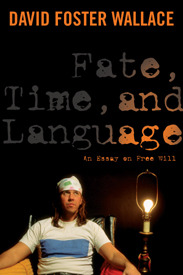
[READ: November 7, 2010] Fate, Time and Language: An Essay on Free Will
First I wanted to thank Columbia University Press for sending me an Uncorrected Proof of this book. I was pretty excited to read it, but to get it a few weeks early was even cooler (and, no, this won’t have any impact on my review).
Second, I wanted to state exactly what this book IS (because I wasn’t entirely sure myself). The book is a reprinting of David Foster Wallace’s philosophy graduate undergrad thesis. However, rather than just publishing the thesis (and giving us a short book or a long book with one sentence per page), Columbia University Press has packed the book with a great many essays that help to contextualize the thesis. The Preface by Steven H. Cahn & Maureen Eckert explains this quite neatly.
So, my (briefer) version of the background: DFW’s thesis is about Richard Taylor’s article “Fatalism” (1962). CUP has also included Taylor’s initial article (so we can see what DFW is talking about). And even more than that, when Taylor’s article was initially published, it caused a bit of controversy and a lot of responses. So, to get a sense of everything that DFW was working with (and against), this book also includes the intellectual dialogue: articles that range from four to ten pages (and also include a dense of Taylor by Steven H. Cahn himself (published in 1964).
Part II of the book includes an introduction by Maureen Eckhart and DFW’s essay.
Part III is a brief look at DFW as a student written by a former professor, Jay Garfield.
Before I get to the meat of the book itself, I wanted to say that I didn’t know anything about this essay. And I’d thought about this thesis as possibly an interesting piece of philosophy from an author whose work I greatly admired. Well the introduction to this book states in pretty certain terms that my thinking about this thesis is a massive understatement. For, in fact, DFW’s thesis undermined Taylor’s argument in ways that no other argument had been able to do before. His thesis more or less repudiated Taylor’s original essay. The thesis also won the Amherst University Gail Kennedy Memorial Prize in Philosophy (and a wonderful piece of trivia: DFW’s father James won the same prize in 1959). So, yes, this isn’t just a graduate undergrad thesis, this is real philosophy.
On to the book: (more…)


 SOUNDTRACK: KATHLEEN EDWARDS: Back to Me (2005).
 This is Kathleen Edwards’ middle disc. It continues in the vein of her first, although I think her voice sounds smokier and better. The opening two tracks are stellar, catchy, snarky/funny and just fantastic.
 SOUNDTRACK: THE TRAGICALLY HIP-Live from the Vault-Volume 4 (2009).
 Faithful reader will recall that this disc got trapped in my car’s CD changer. When I had it the player replaced, they sent the old one back to mysterious Toyota offices far away. And, about a month or so after sending it out, I received a package from Toyota with my three lost discs (this one, a Black Sabbath disc and, a promo disc I took from the library to try and wedge into the player to get it to eject the other discs (that doesn’t work, by the way) which was, embarrassingly, Ozzy & Kelly Osbourne doing a duet of something or other).
 I Just Read About That...