Feeds:
Posts
Comments

Archive for the ‘Marriage Trouble’ Category

2016-12-05-21-06-09SOUNDTRACK: EXITMUSIC-Tiny Desk Concert #228 (July 2, 2012).

I’d published these posts without Soundtracks while I was reading the calendars.  But I decided to add Tiny Desk Concerts to them when I realized that I’d love to post about all of the remaining 100 or shows and this was a good way to knock out 25 of them.

exitmusicI didn’t know Exitmusic before this show.  The band is a 4 piece and they make a really big sound .  In fact, when I was only listening to the show I forgot that they were at a Tiny Desk.  Their sound is not loud, but it’s enveloping.  They have two keyboards a guitar and an electronic drum.  The guitar is gauzy, playing high chords.  But it’s the keyboards, and washes of sound that really create the whole show.  Lead vocals are provided by Aleksa Palladino and her voice is stark and wavery, slightly scary and scared at the same time.

The blurb says that they tend to play big spaces, but

Palladino and Devon Church, the married couple behind Exitmusic, began playing music together several years ago in their New York home, layering textures and shimmering voices, each awash in echoes and cinematic anguish. To work within the challenges of our space, the two — along with new band members Dru Prentiss and Nicholas Shelestak — returned to their living room to practice a set in a pared-down configuration which still captured its essence.

I love at the end of “White Noise” as the keyboards aren’t changing what they are playing but the guitar changes chords—a repetitive downward progression that works perfectly with what everyone else is playing.

The second song, “The Modern Age” sounds like it could be a track from The xx, but her voice is so different that it totally changes the feel of the song.  Aleksa also switches guitar on this track, layering in fast chords.  And the chorus is wonderfully raw sounding.  The melody she sings is just great and the song builds accordingly.

It’s funny to see her smile so broadly after each song where she sings so dramatically and sounds heartbroken.

“The Cold” is a slow song (she’s on guitar again), short and moody while the final song “Storms” is much bigger.  On this track she is playing fast chords on a very quitter guitar while the other guitar plats slow, building chords over the top.   She make a funny comment at the end of the song: “I know I was all over the place timewise.” But it still sounded great.  They really won me over with this set.

[READ: December 13, 2016] “Obscure Objects”

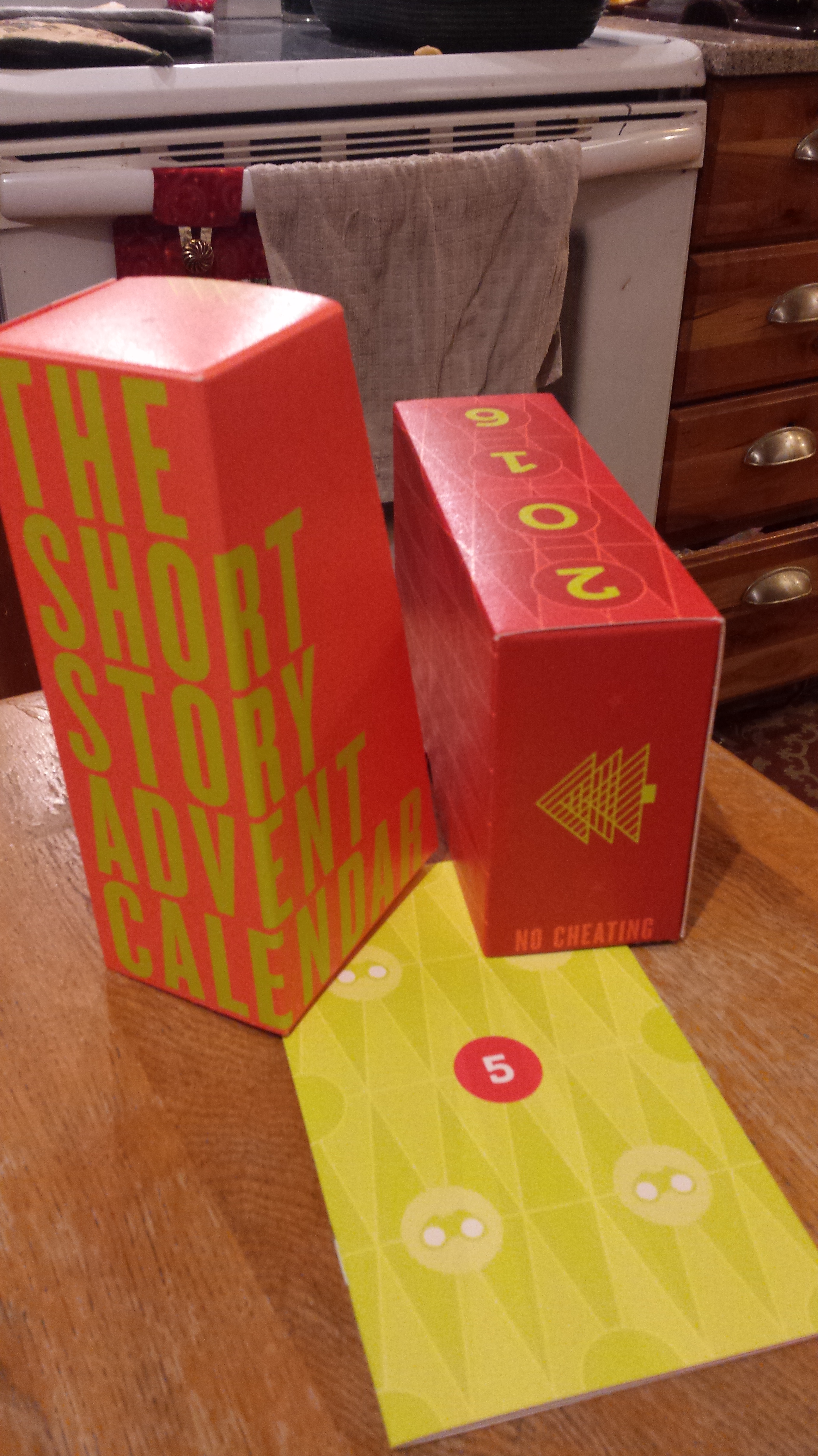
Near the end of November, I found out about The Short Story Advent Calendar.  Which is what exactly?  Well…

The Short Story Advent Calendar returns, not a moment too soon, to spice up your holidays with another collection of 24 stories that readers open one by one on the mornings leading up to Christmas.  This year’s stories once again come from some of your favourite writers across the continent—plus a couple of new crushes you haven’t met yet. Most of the stories have never appeared in a book before. Some have never been published, period.

I already had plans for what to post about in December, but since this arrived I’ve decided to post about every story on each day.

This story was really cool, although I had to read it twice to make sure I knew exactly what was going on.

Told in first person, this is the story of a woman who has just come back to Canada after some time abroad.  She is a writer (published in literary magazines) and has a teacher’s certificate, but she needed a job quickly so she took one a:

a private ESL college that recruited students from all over Asia.

Or, it was a private tutoring agency that catered to children of wealthy immigrants and ADD-afflicted offspring on the Canadian born-rich.

I haven’t decided yet.

That’s the first clue that something is unusual about this story.  (more…)

Read Full Post »

castle SOUNDTRACK: TINDERSTICKS-The Waiting Room (2016).

tinderstIt had been four years since the previous Tindersticks album.  And this one was not released on Constellation Records, but rather on Lucky Dog.  Whether or not that had anything to do with the sound of this record I don’t know, but I really like this album a lot.

“Follow Me” is a slow broody melancholy instrumental with a high accordion playing a lovely melody.  It’s completely evocative.  “Second Chance Man” has a kind of unsettling vibrato on Staples’ voice.  But the melody (sparsely played initially on keyboards) is really catchy.  The rest of the band fleshes out the sound after a verse and chorus.  I love that it builds in the middle and then again at the end with horns lifting the gloom off the song.  “Were We Once Lovers” has a thumping bass line and an uptempo feel as Staples’ sings in a kind of falsetto.  I love the way all of the parts form together in the chorus that’s introduced by a simple but effective guitar: “How can I care if it’s the caring that’s killing me.”

“Help Yourself” opens with some soulful horn blasts and Staples’ whispered vocals.  The bass keeps the song going as occasional horn blasts accent this strangely catchy song.  Staples also sings in an uncharacteristically angsty style in this song, which is strangely unsettling as well.  I love the way the song keeps circling round and then almost surprising the chorus when it comes back.

Whenever Tindersticks use a female guest vocalist, they really seem to step up their game.  “Hey Lucinda” is an incredibly catchy song, starting with simple bells and an accordion playing a great melody.   When Staples’ deep voice is balanced by the exotic voice of Lhasa, it makes for a great pairing.  It’s unusual for a catchy song to be so spare, but the simple accordion accents really hold the song together before it takes off near the end.

“This fear of Emptiness” is another gentle instrumental with bass and acoustic guitar accompanied by accordion sections (sometimes dissonant near the end).  “How He Entered” is another spare song with mostly bass and keys and an occasionally scratching sound as an ascent.  But it’s still a very catchy melody.

“The Waiting Room” has that same echo on his voice as he slowly sings over a keyboard melody.  His anguished singing of “don’t let me suffer” totally makes the song.  “Planting Holes” is a short delicate instrumental with a sweet but melancholy keyboard riff running through it.

Perhaps the most dynamic song on the disc is “We Are Dreamers!”  It’s the angriest song I can think of from Tindersticks, with rumbling keyboards and tribal beats as Staples sings bursts of vocals.  But it’s when Savages’ singer Jehnny Beth adds her voice that the song turns really aggressive.  They sing the chorus “This is not us/ We are dreamers!”  And as Beth takes over the chorus, shifting pitch and intensity, Staples is commenting including lines like “You can rob us/ You can trick us/ Peer over our shoulders and steal our ideas”

The final song is “Like Only Lovers Can.”  The delicate and pretty keyboards belie the sadness in the lyrics: “We can only hurt each other the way lovers can.”  The quiet keyboards end the disc.

[READ: March 15, 2016] Castle Waiting Volume 2

I loved Castle Waiting.   And I couldn’t wait to read Volume II.

And I loved it even more.  Linda Medley is such an engaging storyteller.  Her characters feel utterly real and funny and charming.  I could read more and more and more from her.  Which is why I am so bummed that the series ends here (with rumors that she is doing more).

This volume is a bit more playful.  The characters are well-established and settling into their lives at the castle.

As in the previous volume, there are a lot of flashbacks to Jain’s childhood.

But there’s also a lot of wonderfully meandering stories in the present. The man who looks like a horse (literally) has injured his hoof, so he is hobbling around and is not as useful as he might be (and is cranky about it).

But the main story centers around the arrival of two dwarves, I mean hammerlings–only racists would say dwarves.  They are the relatives of Henry, the quiet blacksmith (who is actually human, but was adopted by the dwarves).  Henry is super excited to see them (as excited as his monosyllabic grunts allow him to be).  Actually, we finally learn why he is so standoffish and quiet most of the time.

They are here for a very specific an(and embarrassing) purpose.  They need women’s clothes for the human who works with them back home.

Their presence enlivens everyone in the Castle. They are fun and interesting–enjoying hard work and being very playful. It is with their help that the Castle dwellers do some remodeling, find a booby trap and even learn how to play nine pin bowling.  The older women who still live in the castle take some bets about who will win–with much merriment.  I love that there a whole chapter about them bowling.

There’s a subplot about Jain’s son Pindar being a leshie–a species we learn a bit about, although we also learn that they are extinct.  This plot line is never concluded properly, though.

We also finally learn about Doctor and his crazy mask (it was a sort of gas mask for the plague).  They are all worried about his sanity, especially when he starts walking around wishing everyone a happy Yule (the Christmas stocking subplot is outstanding).

Speaking of Jain, she has decided to move into the Castle (where there is indeed a ghost).  But her kindness appeases the ghost somewhat.  Especially when she teaches Simon to read (I love the scene where he learns to read and then sits at the table reading instead of eating–just like in my house).

There’s a hilarious thread about a very stubborn goat (whom Simon can outsmart).  And a multi-chapter thread about Sister trying to get a cross for Jain’s room.  We finally get to the bottom of the house sprites (they are adorable when we finally find out what they want).  Finishhtory!  Finit!  Reetoomee.

I am so attached to these characters, that I need to hear more about them.

As in the previous book,Medley’s art is simply gorgeous.  She does realism like no one I know and her characters have an awesome blend of realism and hyper-realism that makes them so enjoyable to look at (and unbelievably detailed as well).

There have been a number of graphic novels that I have gotten completely attached to, but none like this.  It was so bittersweet to finish this, knowing there’d be no more–but holding out hope for a surprise some day.

Read Full Post »

castlewaitingSOUNDTRACK: TINDERSTICKS-The Something Rain [CST086] (2012).

tinders This was Tindertsicks third and final full length album for Constellation.  It has some noisy elements–especially the distorted guitar–that feel different from their other releases.  Although overall I find the album a bit too slow and drawn out.

The first song on this disc, “Chocolate” is quite unlike other songs by the band.  It is a 9 minute slow song with a spoken word story delivered by by keyboard player David Boulter.  The music sets a nice tone for this story of living in a squalid bedsit and heading into town.  As the song picks up momentum, the guitar lines and the rest of the band add more atmosphere.  In the story, he goes to the bar to play some pool and picks up a woman–a regular.  By six minutes, the whole band, including horns is playing and the song is louder and more noisy while the story continues.  For the final two and a half minutes the band drops out and the denouement reveals a secret.  It’s a cool story, well delivered.

“Show Me Everything” opens with some slow bass and a buzzy electric guitar as the backing voice sings “show me…”  And, after ten minutes on the disc, we finally hear Stuart Staples’ iconic voice sounding deep and whiskery as lawyers.  I love the songs with the female backing vocals like this one.  “This Fire of Autumn” is a faster song with a throbbing bass line and catchy chorus (with more backing vocalists).  The addition of the vibes makes this a great Tindersticks song.

“A Night so Still” slows things down almost to whisper with the gentle keyboard riff under Staples’ languid delivery.  “Slippin’ Shoes” is a bit more upbeat and the horns come in right at the front of the song.  I love the way the bridge seems almost sinister and slick before resolving into a bright chorus.  “Medicine” is another slow song with multiple layers of guitars and slow horns and strings.

“Frozen” opens with slow horns that sounds like feedback, almost.  When the fast bassline and almost discoey drums come in, it’s kind of surprise, but a nice pick me up from the previous slower songs.  Staples is singing quickly over himself–the echoes of his voices catching up to his new lines. And the scratchy guitars and jazzy horns make a nice moody soundtrack of him pleading “If I could just hold you, hold you.”

“Come Inside” is  7 minute song with a simple keyboard riff that floats over the slow beat.  There’s a long slow jazzy outro–too long frankly.  The final song is the 2 minute “Goodbye Joe.”  Its all tinkling bells and a shuffling bass, a pleasant instrumental to end the disc.

While Tindertsicks albums tend to be kind of slow, this one has a few too many extended slow parts and not enough of Staples’ magical crooning or the more dramatic sounds that the band does so well.  I’m not sure why their next album was not put out by Constellation, ether.

[READ: February 15, 2016] Castle Waiting 1

I have been aware of Castle Waiting for a long time.  I believe I have even picked up an individual book at the comic book shop (of course I never read it because I wanted to start from the beginning).

So this book collects Chapters 1-19 (plus an epilogue).

I was instantly hooked by Medley’s outstanding drawings–so believable and realistic while exaggerated enough to make them all unique characters.  Not to mention the fact that there are humans and human hybrid creatures (and no one bats an eye).  And then top it off with the incredibly creative first chapter.

The story opens with a king and queen having a baby.  Actually they couldn’t have a baby so they employed a local witch for assistance.  The nice witch gives them good advice but when the town’s evil witch hears of this betrayal she plans to curse the baby.  And thus on the girls’ fifteenth birthday, the evil witch says she will prick her finger on a needle and die.  This should sound vaguely familiar to fans of fairy tales   But Medley puts a twist on things immediately by removing all needles form the castle and hiring a creature named Rumpelstiltskin to do all of their work off site.  Rumpelstiltskin has been cut in half and stitched together so when the creature asks for the Queen’s child in payment, the King yells at him and says he knows what kind of trouble that leads to.

The good witch is able to deflect the curse somewhat to make her sleep for 100 years (that should also sound familiar) rather than dying.  So, when the girl’s fifteenth birthday arrives, the bad witch comes and brings a needle to set the plan in motion.  The princess falls asleep–the whole castle falls asleep and, in a neat twist, the bad witch is killed.

And then Medley has a ton of fun with the story.  When the prince comes to wake up the princess, they run off an get married.  And there’s a hilarious multiple paneled spread of the rest of the castle sanding there, mouths agape.  As the scene ends, we see three older women telling a man with a bird’s head that that all happened along long time ago.  And the castle has been a refuge ever since. (more…)

Read Full Post »

2016-12-05-21-06-09SOUNDTRACK: CRAIG FINN-Tiny Desk Concert #193 (February 9, 2012).

I’d published these posts without Soundtracks while I was reading the calendars.  But I decided to add Tiny Desk Concerts to them when I realized that I’d love to post about all of the remaining 100 or shows and this was a good way to knock out 25 of them.

finnCraig Finn opened for My Morning Jacket when I saw them in New York.  However, we arrived late, so I missed him.  I was fairly certain that Craig Finn was actually Neil Finn when I saw his name, so I expected Crowded House, not The Hold Steady.

For this solo venture, Finn has crafted some slow folk songs.  He sings slowly and deliberately on these three acoustic songs.  The melodies are simple and his voice sounds very California to me. He’s accompanied by Ricky Ray Jackson playing a great-sounding echoey slide guitar.  In fact, I feel like Jackson is the highlight of the show.

“Apollo Bay” and “Western Pier” are from the solo album.  They are story songs.  The final song “Jeremiah’s Blues” is not on the record, but it’s fun to challenge yourself.

[READ: December 6, 2016] “Just Like Us”

Near the end of November, I found out about The Short Story Advent Calendar.  Which is what exactly?  Well…

The Short Story Advent Calendar returns, not a moment too soon, to spice up your holidays with another collection of 24 stories that readers open one by one on the mornings leading up to Christmas.  This year’s stories once again come from some of your favourite writers across the continent—plus a couple of new crushes you haven’t met yet. Most of the stories have never appeared in a book before. Some have never been published, period.

I already had plans for what to post about in December, but since this arrived (a few days late for advent, but that was my fault for ordering so late) I’ve decided to post about every story on each day.

I really enjoyed this story about a girl and her mom and the struggles they have had.  It opens with the excellent line: “It wasn’t easy to get kicked out of Happy Trails RV Park and Camp.”  The owner put up with a lot.  Including her son, who was rather a layabout.  He was injured in a construction job and is on disability–meaning he doesn’t do anything around the camp either.

Nina was fourteen, part white, part Chinese.  Her father returned to China when she was a baby  and sent them money for the first two years.  And then suddenly he stopped.  So her mama had spent time with many different boyfriends.  Her last boyfriend, Roy, seemed promising until she caught him cheating on her (for the third time).  And after that she decided it was time to get outta California.  So they got in their camper and took off.

There’s a line that I really enjoyed: “She turned on the radio…the lead singer wailed about a small-town girl escaping into a lonely world–the coincidence of a song about our lives.” (more…)

Read Full Post »

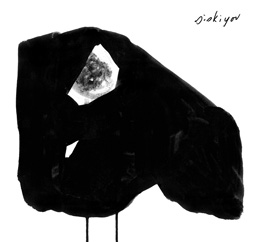
sempleSOUNDTRACK: SISKIYOU-Nervous [CST109] (2015).

cst109covera_258x242This album begins with “Deserter,” in which a choir of children singing over a kind of spooky tone.  And then a loud rumbling bass and scratching on a guitar.  It’s quite different from the previous Siskiyou releases and outpaces the others by several steps.

Once Colin Huebert’s voice kicks in, that familiar Siskiyou sound returns—acoustic guitar and Huebert’s voice which is a mix between a whisper and Win Butler from Arcade Fire.  But “Deserter” features backing vocals and, perhaps most surprisingly, a wild baritone sax solo by Colin Stetson.  But it stays grounded with that cool rumbling bass line.

The second song “Bank Accounts and Dollar Bills (Give Peace a Chance)” opens with an echoed guitar likes some classic 1990s shoegaze music.  The vocals are a cool, intense whisper.  The verses are great and then the chorus adds a piano and his vocals rise into an impassioned wail.  The third song “Wasted Genius” adds a kind of steel drum sound that includes a great melody to the simple and slightly ominous verses.   The middle of the song switches to pummeling drums and a buzzy guitar solo before returning to the mellow verse.

“Violent Motion Pictures” has another cool whispered vocals and quiet guitars that get accented with a low bass and percussion.  There’s a neat section of falsetto vocals that remind me of Pink Floyd over a bouncy melody–before it returns to the verses.  It’s a wonderfully catchy, if brief, segment.  “Jesus in the 70s” has slow guitar lines and atmospheric keys.  “Oval Window” is a bouncy folk song (with a slightly creepy vocal over the top), but its even got a folksy kind of guitar line on it.

“Nervous” is a slow ballad.  “Imbecile Thoughts” is a fun song with stomping drums.  It has a cool ending that leads to the slow building, strings-included nearly 7 minute “Babylonian Proclivities.”  The disc ends with the 1 minute “Falling Down the Stairs.”

This album is really fantastic–an overlooked gem from 2015.

[READ: November 8, 2016] Today Will Be Different

I’ve really enjoyed Maria Semple’s books.  And this one was no exception.

She really conveys the hectic, overstimulated, over scheduled life of middle age parenting.  It helps that her stories are typically set around Seattle and that there’s a lot of excitement, tech and pop culture to throw around, too.

This is the story of a day in the life of Eleanor Flood.  Sarah pointed out, as I didn’t quite realize it, that the story takes place in one day (hence the title) although there are flashbacks that flesh out the story too.

Eleanor is, or perhaps “was” is the better verb, an artist.  She was lead animator (or something–it’s a little confusing) on the successful show Looper Wash.  When the show ended she received an advance to write a book/memoir.  That was eight years ago.

Things have been sprialling out of control for Eleanor for a while, but she vows that today will be different.  She will make a difference. (more…)

Read Full Post »

odddicksSOUNDTRACK: CARLA BOZULICH-Boy [CST102] (2014).

carlaI listened to this disc casually a few times and never really got into it.  But when I listened with headphones and focused on it, there was a lot of good stuff about it.  The music is really spare and it’s kind of hard to grab onto anything on a casual listen.  As with much of what Bozulich does, she’s very free form—there’s usually a melody but it’s not up front.  But careful listening pulls out what the songs are designed to do.  It’s not always rewarding listening as her stuff is certainly abrasive, but I was pleased to hear some really cool sounds on the disc.

“Ain’t No Grave” is an impressionist song made up of a few bass notes and a  lot of voices.  There’s Bozulich singing and peaking and a male singing low notes with her during the chorus.  About half way through, the song adds complicated drumming and a sprinkling of keys—all impressionistic stabs at rhythm and melody.  It’s a difficult track and certainly a difficult opening track, but the catchy parts are intriguing the way they emerge from the chaos. “One Hard Man” opens with percussive drumming and Bozulich’s repeated refrain of “one hard man.”  Noisy guitars are added between verses and the thumping is strangely catchy.   “Drowned to the Light” is mellower with quiet instruments and delicate singing.  It’s the first “pleasant song” on the disc despite the menacing tone.  The chorus introduces a pretty melody both in vocals and violin.  It follows a murder ballad style.

“Don’t Follow Me” is mostly spoken word with percussion and accents of keyboards although the chorus does add a melody to the voices.  It’s amazing how simple chords and a backing voice can really add something to what is such a spare song.  The song ends with a  cool refrain of “spinning dreams spinning dreams” that builds nicely.  “Gonna Stop Killing” opens with sound effects and backwards rolling tapes.  But the vocal melody is the catchiest so far with a great chorus of rising notes and Bozulich’s aching voice and hammered dulcimer.  The middle section even has a fairly conventional melody line.  It’s unexpectedly pretty given the lyrics.

The second half of the disc seems to coalesce into a more melodic and song-structured  half. “Deeper Than the Well” has scratching guitars and deep slow  bass with the lyrics “I wish that I could fuck up the whole world.”  It’s menacing but catchy and seems to lurch along with only Bozulich’s voice keeping the song going.  “Danceland” opens as a slow bluesy song with quiet verses and a simple three note bass line.  But it’s joined by a really surprisingly catchy chorus “if we could spin under the light in  dance….land.  It was always night in dance….land.”  The middle section is a little weird until it resolves to that familiar chorus again.  The song really seems to slowly unfold with quieter moments leading to if not louder ones, then certainly fuller moments.   “Lazy Crossbones” adds some keyboards to the main melody.  It has one of the stranger catchy melodies that I can think of—quietly and slowly sung “hey hey it’s a parade.” But the organ sound is so unlike anything else it really stands out.  “What Is It, Baby” begins as a kind of slow, almost bluesy type of song until the big chords kick in for the chorus (which I imagined someone like Elvis singing).  The middle of the song has a soaring “ooooh” section which sounds quite unusual for her.  The ringing chords sound so vivid.

The disc ends with “Number X” an almost entirely instrumental 4 and a half-minute track.  The song starts slowly with meandering guitar notes and an interesting yet menacing melody underneath.  A nearly four-minute build up leads to Bozulich reciting a kind of poem that ends with the disc.

Bozulich consistently explores unusual territory and while this will never get played on any radio, it is more friendly than some of her other releases.

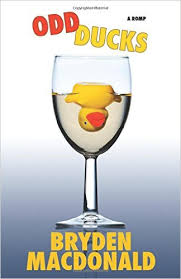
[READ: April 1, 2016] Odd Ducks

Odd Ducks is a play commissioned by the Nova Scotia playhouse.  It is set in Tartan Cross, Nova Scotia.

There are four characters, all in their 40s. Ambrose Archibald, he is unemployed but charming and a total narcissist; Mandy Menzies was the high school beauty queen but she is in a bad marriage now, a naive sweet woman. Estelle Carmichael is Mandy’s friend and housekeeper–she had a crush on Mandy in school and has sworn off men forever.  Freddy Durdle is Ambrose’s only friend but even he is fed up with Ambrose’ behavior.

The play opens with Ambrose out in the woods trying to find himself.  And after a few minutes of soul searching and a minor fright he has succeeded.  He is pontificating about himself when Estelle comments that she can’t listen to this crap anymore.  She tells him he is full of it.  To which Ambrose says, I forgive you. (more…)

Read Full Post »

bream SOUNDTRACK: THE INTERNET-Tiny Desk Concert #474 (September 29, 2015).

internetThe Internet are an offshoot of Odd Future.  This is an R&B group fronted by Syd the Kid, and the music is really delicate–almost easy-listening-sounding keys and a ropey bass line.

Syd’s voice is beautiful and soulful and she raps and sing delicately.  Which is why it’s surprising that the first words of the first song are “now she wanna fuck with me / live a life of luxury.”  But after the surprise of these lyrics the chill music is kind of soothing: “roll up an L and light it.” And I love her falsetto for the chorus”

“She blowin up my phone.  All I hear is wha wha, wha wha (Band: wha wha).”

“Under Control” is a song dedicated to her band:  she promises she’ll be there for all of them “when I’m a legend baby and we’re all rich”

Her confidence and casualness is totally infectious. And I love the the wah-wahs effects on the keys as the song nears the end.

The last song is called “Dontcha” which gets a “yes!” from the crowd when she says she’s going to play it.  (That makes her very happy).  She says she’s never done an acoustic version before.  I gather it’s a single, although I enjoyed the other two songs a bit more.

The veering into R&B territory is not my thing, but it’s cool to hear her branch into different genres in one song.

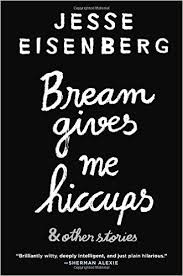
[READ: May 15, 2016] Bream Gives Me Hiccups and Other Stories.

I’ve really enjoyed the comic pieces that I’ve read by Eisenberg–he writes a lot for the New Yorker.  In fact, I had recently decided that I would read and post about all of Eisenberg’s New Yorker pieces at some point in the future.  Well, it turns out that nearly every one of those New Yorker pieces has turned up in this book (there’s three that didn’t).  So that saved some time.

What that means is that most of these pieces are quite short.  And that very few of them are stories in the conventional sense.  They tend to be a few pages long, or sometimes longer pieces done as diary entries.

What is most interesting about Eisenberg’s writing is that most of these stories are funny–some are very funny–but there is also a lot of pathos and sadness in them.  Many of the characters come from broken homes and many of the situations are rather bleak.  And yet he manages to make them funny. (more…)

Read Full Post »

black-daimons SOUNDTRACK: LAST EX-Last Ex [CST107] (2014).

last-exOne of the things I love about Constellation Records is that you often never know what you’re getting.  They used to very specifically release a certain kind of music, but they’re now just releasing interesting and exciting music.  But also, a band name can’t really tell you what to expect from this label.

So who knows what a band like Last Ex will sound like.  And how cool that their first few songs on this are so good.

The disc’s sides are split into Side X and Side XX.

“Hotel Blues” opens with some scattered drums and chords.  It has  vaguely early-Pink Floyd feel to it.  But around a minute in, the synths pick up a repetitive melody and the bass and drums kick in to give it a very Can or Kraftwerk vibe.  The song is fairly straightforward, but there are sprinklings of notes—sometimes slightly off and vibrated that add some very cool textures to this pulsing track. It’s really groovy and fun.  But it’s “Girl Seizure” that I find so strangely compelling.  Again, over simple repetitive drum and bass, the guitar (or keyboards) play warbling notes that are unsettling and yet enticing.  The song quiets to almost nothing and then resumes in much the same way—and you welcome that weird warble and its of Moog feeling.  At just under 3 minutes its just the right length.

“Flûte magique” slows things down with some simple arpeggios.  There’s not a lot to the song, but it is wonderfully soothing as the bass notes tick away and then the guitar notes rise higher and higher.  The song picks up speed as it goes along and leads to a middle section that’s almost stiffly funky, if that’s possible.  The ending gets a little louder as it thuds to a conclusion.

“It’s Not Chris” opens with some static and strange noises and some soaring keyboards.  About a minute and a half in a strange staccato organ melody comes in with a violin sound doing a kind of solo over the top.  It’s all a little strange but it drops out in the middle to a kind of sinister pulsing, and when the melody resumes, it seems strangely comfortable again.  The end of the song has some high-pitched violin notes that sound almost like a theremin.

“Resurrection Drive” is mostly drums and echoed surf guitar chords. After a minute or so some strings are added to the mix.  It’s only 2 minutes long but it introduces some interesting tension.

Side XX has a quieter feel overall.  “Nell’s Theme” opens with acoustic guitars playing a simple, pretty four-note melody.  The song slowly grows more complex as a violin is added to the song. With about 30 seconds remaining, everything drops away save for a mournful violin.

Thudding bass and picked notes echo through “Trop tard.”  It has a slow, spacey feel (like mid-period Pink Floyd).  A guitar is added and it speeds up some but still sounds of the era and then settles back down to a languid pace.  “Cape Fear” is less than 2 minutes of swirling outer space sounding synths—a creepy, lonely feeling.

“Cité d’or” has more slow pulsing rhythms and more echoing surf guitars and the whole thing feels rather tension filled.  Some squealing  feedback intersperses the surf guitar.   “Hotel Blues Returns” for 1:43.  It’s primarily the drumming pattern of “Hotel Blues” with some swirling synth noises (it’s good for headphones).  “Hotel Kiss” ends the disc with sirens and then a slow thudding drum and more noir guitars.  This could be used in a Twin Peaks scene.

So this album is an interesting mix of rocking songs with unsettling noises and mellower songs with cool synth effects.  It’s a great find.

[READ: September 24, 2016] The Black Diamond Detective Agency

I read this book a while ago, but I never posted about it.  And that gave me the opportunity to re-read it and, frankly, to enjoy it more.

This is the third book by Eddie Campbell that I have read.  I have found his stories to be complicated and hard to follow on first read.  They really demand a second and even a third read.  Part of it is that he writes complicated and somewhat intentionally convoluted narratives.  And part is because of his drawing style.

I love the cover of this book, how it is set up to look like an Old West placard: ORPHANS! MAYHEM! TERROR!  “In This the most recent offering from The First Second Quality line of Books.  An epic take of a newly industrialized America as revealed in words and pictures by the inimitable Mr Eddie Campbell.  Based upon  the manuscript of a Kinematographic play by Mr C. Gaby Mitchell.”

And its this last part that I missed when I first read it–that it was based on a screenplay.  And this book does resemble a screenplay.  However, I noted that in my other posts about Campbell that I’ve said of this book: I liked and didn’t like this book.  Well, which is it?

The story is incredibly complicated–with double and triple crosses.  And the visuals call for mistaken identity and hidden identity as well as new characters who all look vaguely the same–like pale photographs of turn of the century urban gangsters. But the story is really interesting. So I liked it, although I think I’d like to see it more as a film. (more…)

Read Full Post »

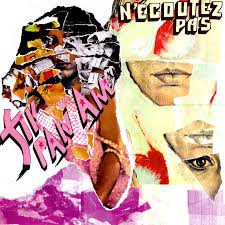
clowns SOUNDTRACK: LE FLY PAN AM: N’écoutez pas [CST031] (2004).

flypanam31N’écoutez pas (Do Not Listen) was the third and final full length album from Constellation’s Fly Pan Am (or in this case Le Fly Pan Am).  There are several short tracks on the disc as well as two 11 minutes songs

“Brûlez suivant, suivante!” (Burn Next, Next!) Opens the disc and hints that it’s going to be a standard rock album—4×4 drums and a dense buzzy electric guitar.  And even when the song proper starts, there’s chanted worded in French and some noisy guitar—its very far from the bass and funky glitchy stuff of previous albums.  The song has very conventional element—a drum break where one might clap along and what sounds like people singing lalalalalala, but all under a veneer of noise and decay that makes it anything but poppy.  There’s a deep voice speaking insistently in French and way in the background a person screaming.  So, really it’s rather unconventional, but within a relatively “normal” framework.  “Ex éleveurs de renards argentés” (Ex breeders silver foxes) is the noise of completely detuned guitars getting plucked and strummed for 30 seconds until a piano plays a chord and all else stops.  It seems like a song will begin but, no, more noises—industrial waves and cars honking takes over.  And then a cacophony of voices begins talking all over each other (including a couple in English).  It’s all over after about 2 minutes.

“Autant zig-zag” (As much zig-zag) is a totally apt name for this song.  This is the first 11 minute track.  After a minute or so introduction, the song comes in with a propulsive bass (not funky at all like the last album) and the song feels like it’s ready to rock.  And it does.  It keeps up this rhythm for a bit and then shifts to a new part with wordless vocals.  There’s even a call and response section with sung words and ooh ooohs as response.  The song shifts to a kind of pummeling section that continues for several minutes until the end.  It contains pretty much everything the band does.  “Buvez nos larmes de métal” (Drink our metal tears) is a noise collage with dramatic movie soundtrack type music played behind the static and distant voices and noises.

“Pas à pas step until” (Step by Step until) has a commanding one, two, three, pause, four, riff going on that is at once catchy and noisy.  The song proper comes in with whispered singing and a wild bass line.  Alexandre St-Onge contributes his wonderful chaos to this song which has some really catchy backing vocals in it

“…” opens side two with what sounds like a voice repeating Fly Pan Am over an over amidst the sound of someone else chewing.  It segues into “Très très ‘retro'” “Very Very ‘Retro’” is the other 11 minute song.  It has two guests, Dominique Petrin on vocals and Tim Heck on electronics.  The song opens with a high-pitched bass and some great counterpoint rhythms.   There’s more hidden vocals throughout the song  Around three minutes in, the bass gets funky.  This runs on for several minutes with some interesting sound effects thrown in until there’s a loud pop and silence.   And then another pop and organ music takes over.  At about 9 minute the song resumes the funky bass line. Again, the band has crammed a lot of stuff into this song.

“Vos rêves revers” (Your dreams setback) has a nice bass sound with some ringing guitar notes.  There’s whispered vocals that sing a melody of sorts.  It’s a fairly conventional song—catchy and bouncy with vocals and everything (true they are whispered and hushed vocals but they do follow a melody line).  At about 4 minutes (of 6), the songs crashes unto itself with the drums and the guitars seeming to fall apart

“Ce sale désir éfilé qui sortant de ma bouche” (This dirty tapered desire coming out of my mouth) has a deep echoing drum kick which keeps a beat.  In the distant background a keening voice kind of follows the melody.  The disc ends with “Le faux pas aimer vous souhaite d’être follement ami” (The false not love you madly want to be friend).  It’s a one minute song with sliding guitars and rock drums which propel this to as close to punk as the band has gotten.  There’s chanting and excitement and fun and then the whole song unravels after about 40 seconds at the end with a sloppy piano denouement.

And that was it from this avant-garde band. The members went on to make lots of other music, Jonathan Parant went on to form Feu Thérèse. Felix Morel has played drums with all kind of interesting bands including Et Sans.  Roger Tellier-Craig has been in Et Sans and Set Fire to Flames among others.  And Jean-Sebastian Truchy has played in several bands including Avec le soleil sortant de sa bouche.

[READ: February 6, 2016] City of Clowns

In the afterword to this book, Alarcón explains how it as written.  He lived in Lima, Peru for a year, teaching.  But while he was there, he had writer’s block.  So he moved to a farmhouse in the middle of America–pure solitude.  And there he wrote the story “City of Clowns” (which I read back in 2013 in the New Yorker) in English.  Sheila Alvarado talked to him about turning the book into a graphic novel.  And so it was completed (after much labor, he says) in a slightly condensed Spanish edition to be released in Spain.  And then, eventually, it was translated into English again, from the Spanish graphic novel.

Since the story really doesn’t change from the short story version, I’m going to put my original comments here:

It opens with Oscarcito going to the hospital because his father died the night before.  He finds his mother mopping floors because his father’s bill was unpaid.  And in that very first paragraph, she introduces her son to Carmela—the woman whom his father left them for.  She was mopping the floor with Oscarcito’s  mother.  He is confused and enraged by this.

His half brothers are also there.  He had never met them before, preferring to stay away from his father’s other life.  But he saw them in front of him and clearly saw that they were related to him.  But the most galling thing was that although he was the oldest of all the children, they were clearly the chosen children—after all, his father stayed with them.

Then we learn about his father’s life.  He was born in Cerro de Pasco and moved to Lima when his young family was still young.  He worked hard in semi-legitimate businesses and then brought his family to the city.  Young Oscarcito, age 8, loved it.  But his mother hated missing her family in Cerro de Pasco.  And now they were living with his father who was practically a stranger. His father worked hard and succeeded, but he was rarely home.

Between flashbacks to his father’s story we see that Oscarcito is now a reporter for the local newspaper and he has been asked to write about the clowns that are prevalent around the city.  Oscarcito is on a bus when a clown approaches.  The clown is pelted by water balloons but still manages to climb aboard the bus and peddle his wares—gaining a few coins for his “act.”  Oscarcito is not interested in the subject and puts it off.

So he travels to his mother’s house to see how she is doing, but a neighbor there tells him she has been living with Carmela since his father got sick.  His mother was embarrassed by this and asked the neighbor not to say anything to him.

His mother had been a cleaning lady since they moved to Lima.  She worked for the Azcártes, a wealthy local family who treated her very well and treated Oscarcito practically like their own son.  Oscar was even sent to a nice school where he was welcomed until they realized where he was from.  Gangs would steal anything from anyone, and were called Piranhas.  And that became Oscar’s nickname at school.  And soon he was made fun of by just about everyone, but especially by one boy.

A flashback then shows that Oscarcito went to work with his father doing construction on a few occasions—they worked very hard on expansions of people’s houses—working hard and working well and making good improvements.  But all the while, they were waiting patiently until they could rob them of all of their fine things.

So when he found his father was working for the father of the boy who made fun of him, he wanted in, and he stole the boy’s suit.

Finally, after putting off his article for ages, Oscarcito meets and interviews a clown.  And that clown tells him how he started and invites him along.  And Oscarcito does.  He finds that he likes the anonymity of the job.

All of the threads come to a head as the story reaches its close—where Oscar will confront his mother and deal with his newfound joy at being a clown.

The ending was very powerful and I enjoyed this story immensely.

There are few details from the original story that have been changed (and I amended my comments accordingly).

There is also an extra scene added of him dating a girl named Carla who walked on stilts.  There’s an erotic moment which is really interesting and which brings a whole new level of fascination to Oscar’s clown life.

Obviously the biggest change is Alvarado’s illustrations.  She does an excellent job recreating these scenes much as I imagined them.  I really  enjoyed the way she worked within the mens’ professions–putting words on bricks as his father was laying them, hanging papers up to dry with text on them, and using excellent distinctions of black and white to show the different settings in Oscar’s life.

The biggest change I think is the depiction of Oscar in his clown suit.  It’s nothing like I imagined and is all the better for it.  Alarcón says that now this is “its true and definitive form” of the book, and I imagine that this is what I will think of when I think of the story.

For ease of searching, I include: Daniel Alarcon.


Read Full Post »
jerusalemSOUNDTRACK: JERUSALEM IN MY HEART-If He Dies, If If If If If If [CST114] (2015).

ififif Since 2005, Jerusalem In My Heart has been Radwan Ghazi Moumneh (all music) and Charles-Andre Coderre (all visuals).  This is only their second album, however, because they were always more of a live band.

Obviously there’s no real visual component to the record.

Since I don’t know all that much about this band, I rely on the Constellation records website for my information.  Thus:

Moumneh expands his compositional palette on If He Dies, If If If If If If, exploring new deconstructions and juxtapositions of both traditional and popular Arab musical currents, with an album that oscillates between powerfully emotive vocal tunes and instrumental works that primarily make use of Radwan’s expressive acoustic playing on buzuk as a point of departure.

The album’s first song “Al Affaq, Lau Mat, Lau Lau Lau Lau Lau Lau (The Hypocrite, If He Dies, If If If If If If)” opens the disc with a short piece of processed vocals.  The Arabic traditional voice is mildly auto-tuned which sounds kind of cool.  [FROM CST: One of Moumneh’s finest melismatic a cappella vocal performances].

Track 2, “A Granular Buzuk” is a 7-minute instrumental piece of Moumneh on buzuk with pulsing electronic background music.  [CST: the buzuk is processed, re-sampled and otherwise disrupted through Radwan’s real-time custom signal patches]. As with a lot of this record, pretty instrumental passages are interrupted and taken over by noise—this time a kind of mechanical scratching.  It ends with some quietly ringing percussion as the electronics all slowly drift away.

“7ebr El 3oyoun (Ink From The Eyes)” is a vocal track with an electronic drone.  It sounds traditional and mournful, but about 3 minutes in, a drum and buzuk keeps time and the song grows a bit more upbeat.  [CST: languidly plaintive vocals set against a gradually accelerating riff underpinned by hand percussion].

“Qala Li Kafa Kafa Kafa Kafa Kafa Kafa (To Me He Said Enough Enough Enough Enough Enough Enough)” has incredibly loud static with a buzuk playing in the background.   After a minute and a half the static drops away and the background is filled with a quiet pulsing kind of static.  You can finally hear the instrument being played in all its glory.  [CST: a scabrous white noise intervention wherein the entire audio mix is fed through a contact mic placed in Radwan’s mouth].

“Lau Ridyou Bil Hijaz (What If The Hijaz Was Enough?)” is mostly synth–again an old sound with metronymic electronic percussion and quiet vocals. It’s all kind of muffled and very retro.  [CST: Moumneh continues to channel his love for Arabic pop and Casio/cassette culture with this silky lo-fi dance].

“Ta3mani; Ta3meitu (He Fed Me; I Fed Him)” is a faster piece.  Echoed vocals and drones rest behind a fast buzuk melody.  [CST: he pays homage to the until-recently-exiled Kurdish poet and singer Sivan Perwer on this traditional-minded, unadorned folk tune].

“Ah Ya Mal El Sham (Oh The Money of Syria)” opens with a loud vocal and a flute mirroring the voice.  It runs for seven-minutes and ends quietly.  [CST: a tour-de-force drone piece built from Bansuri flute (performed by guest player Dave Gossage)].

The disc ends with “2asmar Sa7ar (The Brown One Cast A Spell),” a fast buzuk solo played over the relaxing sounds of oceans waves.  It has a cool melody and runs quickly and then calmly for some five-minutes before the disc ends with more waves lapping against the shore.  [CST delicate acoustic number set against the sound of waves recorded on a beach in Lebanon].

As with the previous record, song titles employ the transliterative characters used in Arabic phone texting, which I think is pretty cool.

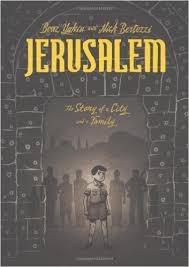
[READ: March 30, 2016] Jerusalem

With a title and subtitle like that you know this isn’t going to be a fun and lighthearted story.  And it is not.  The introduction explains how this is the story of a family, but it is more about the land and the strife that has been there for generations.

A lengthy history of Jerusalem is given, but for the purposes of this story the most recent action is the 1929 dispute over prayer rights which led to riots.  And then the British imposed the White Paper of 1939 which blocked Jewish immigration and was in place as the Nazis were riding to power. This led many Palestinian Jews to regard the British as hostile. And yet many Palestinian Jews joined the British army to fight the Nazis in Italy and the Middle East.  At the same time there were underground forces of Palestinian Jews who were attacking the British.

The action of this story takes place in 1945.

There is also a history of the Halaby family about whom this story is concerned.  Yakov Halaby was born after a series of girls were born in his family.  His father vowed that if they had another son they would move to Jerusalem.  After Izak was born they did so.  But Yakov was jealous from the start.  And he made Izak’s life miserable.  Eventually Izak left and married an Egyptian woman and they both moved back to Jerusalem. (more…)

Read Full Post »

« Newer Posts - Older Posts »