Feeds:
Posts
Comments

Archive for the ‘Marriage (Happy)’ Category

SOUNDTRACK: GORD DOWNIE AND THE COUNTRY OF MIRACLES-The Grand Bounce (2010).
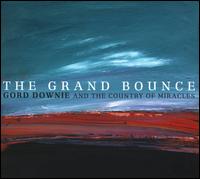
I knew I was going to write about Canadian musicians for this series of Extraordinary Canadians, but I wasn’t sure who would get matched to whom. I figured I’d match Gord Downie to Mordecai Richler, but when I saw this in the liner notes to this disc, I knew I’d made the right choice:

Thank you to the Richler Family for the font you are presently reading.  The Richler font, not publicly available, was created and named for the great Mordecai Richler.  It was commissioned by Louise Dennys, designed by Nick Shinn and graciously made available by Florence Richler.  I am grateful for this honour.

So Gord Downie is the driving force behind The Tragically Hip.  I’m always curious when a guy who pretty much runs a band needs to do a solo album (or three).  And in this case, since the last Hip album was much more mellow and almost country, it seemed like he got some of his less rocky side out on that disc, so what’s the need?  Unless, of course, it’s just the need to play with some other folks once in a while.

Well, whatever the reason, this disc finds Downie in incredible form.  In fact, I think I like this disc better than the last Hip disc (which I did like, but which was a little too mellow overall).  The songs are all great, from the simple folk tracks to the more elaborate rockers.  And, yes, while the disc never rocks as hard as some Hip songs tend to, this is not a simple acoustic guitars and solo vocals record.

“The East Wind” is a wonderful starter.  It’s fairly simple with awesomely catchy lyrics.   I learned that the lyrics are from a quote by Todd Burley.  And they are an awesome way to describe a hostile and violent wind: it’s lazy, because “it doesn’t go around you, it goes right through you.”  Fantastic.

“Moon Over Glenora” sounds a lot like a Hip song.  Downie’s lyrics are almost mumbled and understated until he gets to the end of each verse when he raises his voice an octave for maximum effect.   The stops and starts in the bridge are also great.  “As a Mover” is also smoothly catchy with a wonderful rising chorus.

“The Dance and the Disappearance” is another great conceit.  This song is inspired by a quote from Crystal Pite: “Dance disappears almost at the moment of its manifestation.”  It is suitably dramatic with some great verses.  “The Hard Canadian” is a gentle acoustic number that would not be out of place on the more recent Hip records.  “Gone” feels like a continuation of “Heart,” almost like the slightly more rocking second half of it.

My favorite track is “The Drowning Machine” (I seem to like anything that Downie writes that’s about the sea).  It’s a minor chord wonder, dark and mysterious and wonderfully catchy.  The rock comes back on the rather simple “Night is For Getting.”  It’s probably the least essential track on the disc except that once again the chorus/bridge is really great and memorable.

The last three tracks bring on the mellow, which is a fitting ending for the disc, although since the three t racks take up about 12 minutes, it makes the end drag a bit.  “Retrace” is a country-tinged (steel guitar) mellow track (again, Downie’s voice brings out the excitement) .  “Broadcast” has an extended outro of gentle guitars and piano that for all the world sounds like the end of a disc, so I’m always surprised that there’s a final track after it.   And so the final track “Pinned” feels like filler.  It has a movie projector clicking sound and gentle piano with almost inaudible vocals.  It’s actually a pretty song, but it feels almost discarded here.

One of things I’ve always liked about Downie’s lyrics is that they are atypical of rock songs.  They’re not “about” sex or rock or drugs or swagger or anything like that.  In this case they are about locations and events.  And it really paints a picture.  And speaking of painting, Downie painted the cover art.  The beautiful simplicity of the painting is not unlike the beautiful simplicity of the music on the disc.

Oh and my copy is autographed too! (although I wasn’t there when he autographed it, so it could have been anyone who scribbled on the cover).

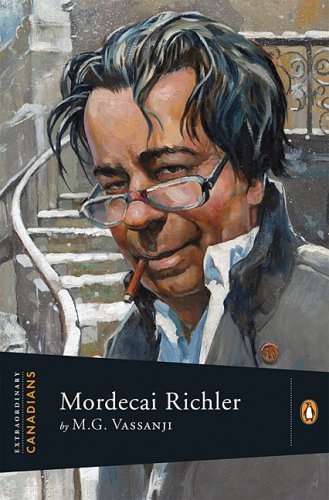
[READ: November 15, 2010] Mordecai Richler

I don’t know a lot about Mordecai Richler, although I feel like whenever I read about him it’s in hushed tones (a neat trick, that).  Nevertheless, for a number of reasons I have wanted to read him for many years but have just never done it.  Now, the stars are aligning with me for Richler.

There’s this book, there’s the cover of the October 2010 issue of The Walrus and the recent filming of his book Barney’s Version (the filming of which is discussed in the same issue).  And then a patron asked for the film of The Apprenticeship of Duddy Kravitz.  So, it’ about time to read one of his books.  But here’s the rub…do I start with the great books or do I start at the beginning and work my way through his career?  And, there’s also a huge new biography coming out (the review of which mentions a wonderfully offensive event in which Richler absolutely dismisses his Jewish audience).

This book was written by M.G. Vassanji.  I feel that I’ve heard of him but I’ve never read him.  And yet listen to this incredible biography:

M.G. Vassanji was born in Kenya and raised in Tanzania.  He attended University in the United States, where he trained as a nuclear physicist, before coming to Canada in 1978.  Vassanji is the author is six novels and two collections of short stories…and he has twice won the Giller Prize.

Damn.

Since I read this right after Coupland’s McLuhan it’s tempting to compare them.  And yet, as I said in that review, it seems quite apparent than Coupland’s book will be like no one else’s, so I won’t say much about that.  Instead, Vassanji opens the book by talking about the similarities between himself and Richler and their few awkward but pleasant meetings.  (In this respect yes, it is sort of like Coupland’s book in that the author puts himself into the text). (more…)


Read Full Post »

SOUNDTRACK: Ô PAON-“Courses” (2010).

This album, Sainte Patronne De Rien Pantoutemade ranked #7 on Viking’s Top Ten list and it is very different from the other albums on the list.

This is a simple song with a gentle guitar motif repeated over and over.  There also appears to be some looped vocals.  The singer, Geneviéve Castrée, sings in Quebecois-French and is assisted by Godspeed You Black Emperor mainstay Thierry Amar.

As with many of the songs on this list, the song builds and builds as it repeats itself.  But unlike the other songs, this one never grows menacing or dark.  Rather, it builds, layer upon layer of instrument or voice until the song (whatever it’s about) reaches its climax.

Viking says that there are English liner notes on the disc, but you ‘ll have to buy the disc to get them.  I liked this track more with each listen, and would like to hear more from her.

[READ: January 4, 2011] “Costello”

This is a story of perseverance.  Costello is a middle-aged man with two kids.  When the story opens, we see him floating on a raft in his pool. The pool is overgrown with grossness and, down in the filter, there is a dead lizard.  But Costello seems, if not exactly content, then at least not unhappy.  He has everything he needs nearby: a newspaper, a Zippo and smokes.

Costello is a plumbing salesman, and he has been nominated as salesman of the year (you can read about it in Pipeline!).  It’s pretty much the only exciting news he’s received recently, especially since his beloved Dodgers are middling at best.  Although even he likes being able to watch the Disney fireworks from his roof.

Costello seems like a decent guy.  He also seems liked by others: his coworkers like him, his neighbor likes him (although Costello hasn’t accepted a dinner invitation from him in almost a year).  Through the course of the story we wonder why his wife isn’t there with him.  The answer to this is revealed slowly throughout the story. (more…)

Read Full Post »

SOUNDTRACK: CEE-LO GREEN-“Fuck You” (2010).

Like the entire world, I am in love with this song.  I have long postulated that songs with cursing in the chorus are almost by definition catchier than songs that have none.   And this song is one of the most catchy fucking songs ever.   (I of course admit that the censored radio version “Forget You” is equally as catchy but we can’t forget that the curse version came first).

I have listened to this song dozens of times now and I simply haven’t grown tired of it.  It has a simple construction with an interesting descending musical motif and a killer killer hook.  But of course the key is Cee-Lo’s voice.  I first heard him with Gnarls Barkley and I considered getting some of his solo stuff based on the amazingness of his voice.  (I never got a round to it).  And now this song has pretty well solidified him in my esteem.(Actually his appearance on The Colbert Report where he sang Fox News in the chorus was the real solidification for me.

This song transcends genre (it’s played all the time on an alt rock station by me).  And I think that’s why it is so appealing and such a big hit.  And now I’m going to be whistling the chorus for the rest of the day.

[READ: November 20, 2010] “Two’s Company”

This story follows Franzens “Breakup Stories” rather nicely because it too is about a breakup.  This time, though, the story itself is much longer than the others (4 whole pages!).

The story is about Pam and Paul, a couple who married young and were immediately successful as TV scriptwriters.  They worked together, created memorable sitcoms and owned a company whose logo shows their names with a heart between them.

But as they settle into greater success they begin to look for something slightly different to occupy them.  I love that they said Paul stopped appearing in public because he had trouble “remembering whether the ‘O’ in ‘Michael Ovitz was long or short.”  And their public persona, just like their logo, shows them to be perfectly content and in love.  Of course, as seems inevitable, some cracks begin to surface in their perfect facade.

They are to cowrite a movie.  He has always be the more highbrow of the two (and usually gets the bigger laughs), but it is her common, even cliched, sensibility that makes all the money.   And Pam more or less takes the reins of the screenplay, writing about a couple who is perfectly happy together (the husband doesn’t even glance at the hot women that his friends are constantly ogling).  Paul feels that the story is supposed to be about them, and he starts to resent her.  He thinks her script idea is crap (a bland comedy for older ladies) and he begins to think that Pam is less attractive than she used to be.  The speed with which their partnership disintegrates is rather astonishing.

I enjoyed the story–Franzen has a great way with character.  Although I admit I was a little sad that the story went this way.  It would have been nice (like her purposed movie script) to see a couple who could work together, be successful and remain happy (I guess I’m a bland old lady).  But, as Paul seems to think, that’s just a fantasy.

Read Full Post »

SOUNDTRACK: SHARON VAN ETTEN-“Don’t Do It” (2010).

This song is available from NPR’s All Songs Considered.  I’d never heard of Sharon Van Etten before, so I didn’t know what to expect.  And this was a great way to learn about someone new (to me) and to find a song that I fell in love with.

This is a dreamy kind of track, sort of like later period Cocteau Twins, but less ethereal.  And I have to say on first listen I was really blown away because what starts as a simple song really blossoms into a full blow epic.

The song isn’t staggeringly original, by which I mean I can hear many precedents in the song (Throwing Muses, perhaps, but again, not as extreme).  And yet, she takes this template and really makes it shine in her own way.  This song is layered and textured with more depth of sound coming on each verse.  And it feels like by around the third minute or so, you’re totally caught up in the song.

On further listens, that effect is still there.  It’s very subtle, but really effective.  And I keep getting sucked right in.  I’ll definitely check out her full length, Epic.

[READ: October 20, 2010] “Peep Show”

This was the final story of the 1999 New Yorker 20 Under 40 collection that I read (there’s one more after this, but I read them out of order).  The excerpt in the main issue was intriguing but very short and the whole story blew my mind with its unexpected surrealism.

Allen Fein, a man with his shit together, trips over a curb on his way to Port Authority.  It throws off his stride and his whole day.   When he straightens up, he looks up to see a barker offering peep shows for 25 cents.  Fein had been to a peeps how once before as a teen, and he sort of thinks that his day is a mess anyhow, so why not.

When he goes in, things are not as the were when he was a kid.  In fact, the glass that usually keeps peeper from peepee is removed, and the first word that the woman says when the door goes up is “Touch.”  And Allen finds himself in a weird position, especially when he touches the woman and his erection won’t subside. (more…)

Read Full Post »

SOUNDTRACK: TRACY BONHAM-Live on Mountain Stage, September 29, 2010 (2010).

I loved Tracy Bonham when she first came out.  Her EP and first LP were amazing explorations of controlled anger with great bursts of violin.

As with many angry songwriters from the 90s, Bonham seems to have become, shall we say, happier.  She has a new album out this year called Masts of Manhatta.

I haven’t heard the album, so I don’t know if this Mountain Stage performance represents it well or not.  I’m guessing that the Mountain Stage setting has made it somewhat more mellow than the original (steel guitars and fiddle solos?), but that may not be the case.

Regardless of the tone of the album, the songwriting tricks that Bonham has always employed are still in evidence here.  In fact, even though I’d never heard these songs before, the chord progressions (and of course, her voice) make these songs sound distinctly hers.  And lyrically she’s still clever as anything–witness most of the lyrics to “We Moved Our City to the Country”  which also features a very conventional fiddle (no, not violin) solo.

It seems like Bonham has grown as an artist and is exploring lots of different styles. And although I really love her early rocking stuff, and I was a little concerned that she had gone soft, it’s clear she’s just channeled her hardness in a different direction.  She’s also got great stage presence.

Manhatta here I come.  The show is available here.

[READ: October 12, 2010] “The Third and Final Continent”

Jhumpa Lahiri was the final writer in the 1999 New Yorker 20 Under 4o issue.

I have heard such wonderful things about Jhumpa Lahiri, and I have been intending to read her novels and short story collections for quite some time.  I’m a bit saddened that this is the first fiction by her that I’ve read.  But it was an excellent place to start.

The story is a masterful telling of what, even the main character admits, is “quite ordinary.”  And yet it is touching and moving and a wholly realized experience.  [DIGRESSION: I have been listening to old interviews with David Foster Wallace and in most of his interviews he argues that good writing should be “real” as opposed to ironic and sarcastic.  He worries that hipster irony has eroded people’s ability to tell real stories.]  Well, this is a very real story.  It is simple and honest and wholly believable–just what the doctor ordered].

The story opens with an Indian man leaving India for London in 1964.  In 1969 he gets a job offer to work in the library at M.I.T.  Before leaving though, he confirms his arranged marriage, meets his bride and officially weds.  But days later he has left for America with the intention of her following in about six weeks.  He lands in Massachusetts on the day of the moon landing.

After staying at the YMCA, and adjusting to American life, he finds an apartment at an old woman’s house.  He tells the old woman that he is married bit she is insistent  that he has no female visitors.  The old lady is strict and a little crazy (she makes him marvel about the moon landing on a nightly basis).  And yet, despite herself, it is clear that she approves of this polite man. (I was a little surprised that she would be so approving of a foreigner, but maybe she was more progressive than I give her credit).

And the bulk of the story is made up of his life in this small apartment with this ever-present landlady who he feels somewhat indebted to, even though all he really owes her is $8 a week. (more…)

Read Full Post »

[LISTENED TO: October 19, 2010] David Foster Wallace Eulogies

There are some really nice eulogies done for when DFW died.  The official (written) memorial service eulogies (from Jonathan Franzen, Zadie Smith, George Saunders and others) are available here (from an outstanding online journal called Five Dials).  They’re all beautiful (I was amused that the second longest one comes from DFW’s editor!).

The audio eulogies are available at The David Foster Wallace Audio Project.  They include two very long full length ceremonies and several news (NPR mostly) reports.  And there’s a lengthy interview with David’s sister, Amy, which is by far the most moving one.

The first of the lengthy pieces is the ceremony from Amherst.  It consists of colleagues, friends and students all telling stories about DFW.  And their collective memories join together to create a great portrait of the man; things that you’d never know about him (except you kind of would) from reading his work.  The thing that really struck me from this memorial was just how many friends he had.  This seems like an insult but it isn’t meant to be; rather, the impression I had was that he was quite a solitary man, holing up with his dogs and his pens.  But the stories and love from his friends during his college years especially are really quite nice to hear, and showcase a side of him that he left out of his work (except, of course, really he didn’t). (more…)

Read Full Post »

SOUNDTRACK: BARENAKED LADIES-“Fight the Power” (1993).

Public Enemy’s “Fight the Power” is one of the greatest anthems of the late 80s and 90s.  It’s got everything: noise, strength, rebellion great lyrics and Chuck D.  So, what can five white Canadians do with it?

Well, they keep the intensity of the song very strong–even in an acoustic setting–by overloading their version with a whole mess of music.  Between the noisy piano, the occasional sound effects and the fantastic noisy drumming, they manage to really capture what a great “song” this is (as opposed to being a powerful anthem and protest).  Divorced from the awesome cacophony of the original, you realize that it’s really catchy, too.

BNL are usually goofy, and they do put a bit of nonsense in the song (during the Elvis was a hero to most section).  And they clean up one of the words, with a great twist (changing “motherfuck” to David Duke” in “David Duke him and John Wayne).

BNL has been performing this song for years.  Their first version appeared on The Yellow Tape [1991] (a much simpler version with drums, bass and two vocals).  But this version (which as far as I can tell only appears on the Coneheads soundtrack, ugh) is really solid and (aside from the fact that nobody’s voice could ever compare to Chuck D’s) sounds like an good Unplugged version of the track.

[READ: September 14, 2010] “An Arranged Marriage”

Freudenberger is one of the New Yorker‘s 20 Under 40.  I have to say I was (unfairly) surprised that a story written by a woman named Freudenberger was about a woman named Amina who lived in Bangladesh.

Nevertheless, the story was a good one and was an interesting twist on the concept of the titular arranged marriage.  Amina meets George online at AsianEuro.com (after having met several men who were not what they said they were).  Amina (and her parents) had always planned for her to move to America.  Somehow.   She had considered applying for a college degree, but found that even that was prohibitively expensive.  So why not, as the Voice of America radio suggested, find a mate? (more…)

Read Full Post »

SOUNDTRACK: SINÉAD O’CONNOR-The Lion and the Cobra (1987).

I was tempted to say that this album came before all of the controversy.  But then, she’s always had controversy around her.  Just the fact that she had her head shaved was enough to incite some people to alarm (not to mention, we never received this more fierce looking album cover).

But before all of the success of “Nothing Compared 2 U,” she released this amazing, empassioned debut album.

I’ve no idea what the first track is about, but there’s something about her voice on the “oh’s” in particular that still gives me chills.  “Mandinka” has a great guitar sound (seemingly destined for hit radio) that seems very out of place on this disc (again, I’m lost on the lyrics here, too).

The album comes into its own with the really odd but delightful “Jerusalem.”  Musically it’s got a sort of funk base which resolves itself into a very winning chorus.  And, once again, her voice sounds otherworldly.  It’s followed by the largely acoustic “Just Like U Said it Would B” (Prince fan much?).  It’s a  fairly simple song (with interesting arrangement–I like the flute) that builds to a strong climax.

“Never Get Old” opens with some spoken Irish (and features future star Enya), but it’s “Troy” that is the absolute breakthrough on this disc.  From the occasionall string swells, to the eerie silences to the incredible heights that she reaches (and the notes that she can hold) it’s really tremendous.

“I Want Your Hands on Me” seems like another grab for a single.  The single version featured a bizarre little rap from MC Lyte.  In the pantheon of silly rap lyrics, I’ve alwys kept this near the top: “I’m not the kind of girl to put on a show coz when I say no, yo I mean no.”  Sentiment and good intentions aside, it’s very clumsy.   Not my favoite track.

The final two, “Drink Before the War” and “Just Call Me Joe” are interesting denouements after the pop of “Hands.”  “Drink is a slow paced, somewhat quiet track, until the chorus really blasts off.  And “Joe” sounds like a demo: a raw electric guitar, cranked way up (but mixed quietly) accompanying Sinéad’s instructions to just call her Joe.

In some ways this album is less subtle, and by that reckoning, less sophisticated, than the bajillion-selling follow up, but I find the naked passion on this disc to be even more amazing.

[READ: Week of August 30, 2010] Ulysses: Episodes 18

The final chapter of Ulysses is all about Molly.  It enters her head and doesn’t leave.  It doesn’t even pause for punctuation (there’s none in the entire chapter except for the final period).  There are paragraph breaks, which means that there are eight sentences in total.

The Episode is crass and sexual, beautiful and moving, personal and insightful and it seems incredibly forward thinking coming from a male writer.  And although it gets a lot more press as a stream of consciouness piece, it’s not that far removed from Stephen’s or Bloom’s pieces, [except that she doesn’t actually intearct with anyone to interrupt her thoughts].

The Epsiode reflects upon what we’ve learned in the day.  It inadvenrtanetly corrects some misperceptions (regarding Molly’s past infidelities–she didn’t have any–), but it also shows some pretty poor judgments on Molly’s part (mostly regarding Stephen).  And there’s just so much going on in the episode that it’s hard to catalog it all.   But it is certainly full of a lot of sexual thoughts. (more…)

Read Full Post »

SOUNDTRACK: JOHN PRINE-“New Train” & “Ain’t Hurtin’ Nobody” (1995).

We’re staying at a beach house for the 4th of July.  There’s John Prine on the iPod.  I’ve never heard him before, although I have of course heard of him.

We listened to several of his tracks and I enjoyed them quite a bit.  Midway through the second or third track I realized that his music is absolutely perfect for hanging around eating brunch at a beach house.  I can’t remember a single thing about these songs, and I probably couldn’t even find them again on the iPod, but they were perfect for the mood.  Okay, they were on a playlist and were easy to find, which is why they are titled now.

I can’t wait to check out Quicksilver Messenger Service!

[READ: July 3, 2010] “Here We Aren’t, So Quickly”

I enjoyed Foer’s Extremely Loud and Incredibly Close very much, although I haven’t read his first novel (or his nonfiction piece).  This short story is, not gimmicky exactly, it just feels awkward.  It is quite short (two pages), but it resolves itself quite slowly.

The opening paragraph is many sentences that start with I (“I was not good at drawing faces. I was just joking most of the time”).  The second paragraph is many sentences that start with You (You were not able to ignore furniture imperfections.  You were too light to arm the airbag”).  And the story proceeds alternating bits of data from one side to the other, back and forth.  I found it very difficult to read. (more…)

Read Full Post »

SOUNDTRACK: RUSH-A Farewell to Kings (1977).
Although I recently said that Caress of Steel is one of my favorite Rush albums, I’m really torn between a number of their albums from the 1970s.  I’ve loved A Farewell to Kings since the time I got it: it’s over the top, and it showcases all of the band’s strengths.

The opener “A Farewell to Kings” features a wonderful classical guitar intro that morphs into a heavy rocking masterpiece.  There’s time changes galore and it’s all over in just about 5 minutes.

It’s followed by “Xanadu,” one of Rush’s all time great epics.  Tubular bells, cool guitar effects, Rush’s first great use of keyboards-as-effects, even a cowbell solo all open this song with sufficient grandeur for what’s to come.  A slow vocal intro leads to a super fast exploration of Coleridge’s “Kubla Khan.”  Whenever people wondered why Neil’s drumset was so big or why Alex (and Geddy) had doublenecked guitars, they needed only listen to this to be amazed that three men could play it all.  11 minutes long and not a wasted second.

One of Rush’s biggest hits and perennial favorite “Closer to the Heart” comes next and it still sounds pretty fresh all these years later.  “Cinderella Man” is an overlooked track on this disc, but it showcases Rush’s drift away from the individualism vs state of 2112, and move toward the individualism of doing what’s right for all: “he held up his riches to challenge the hungry.”  It also features a blistering solo from Alex.  “Madrigal” is a very short acoustic song, quite a departure for the time but a nice delicate track before….

“Cygnus X-1.”  The other epic on this disc.  And right from the start you know you’re in new territory here.  A fully distorted voice, bells echoing like they are floating at sea (or in outer space), all kinds of build-up lead to a noisy bass line coming from far away in the depths of space.  And after 2 and a half minutes of build up, the whole band kicks in with this off kilter heavy rocker.  It’s basically the story of a space ship flying into a black hole. It also features some of Geddy’s most screechy vocals.  I wish I could remember the exact quote, but my friend Joe’s bandmate had a wonderfully derogatory description of the end of this song.

But aside from the end, the main body is great.  From the 5 minute mark, the song is a catchy, driving song as the Rocinante flies through the galaxy.  From the 7 minute mark, the song is seemingly caught in the black hole, as the song drifts about, compressing the song into a manic session of fast fast fast riffs and Geddy’s tortured screams.  It’s pretty intense, and guaranteed to alienate as many people as it wins.

The album features so much experimentation, and it’s wonderful to see a band with so much creative energy release a disc with so many fantastic moments.  Very few records take risks like this anymore.

[READ: March 21, 2010] The Color of Heaven

This final book of the Kim Dog Hwa’s trilogy is a wonderful conclusion to this sweet story.  If you’ve read my previous two posts about these books, you know that this is the story of, Ehwa, a young woman as she matures in rural Korea several generations ago.  By this third book, she has turned 17 and has met the love of her life.  Sadly for her, Duksam has had to leave suddenly.  At the end of book two, he set sail in part because he was fleeing an angry mob, but also in an attempt to make money as a fisherman so that he can save up for his beloved Ehwa. (more…)

Read Full Post »

« Newer Posts - Older Posts »