Feeds:
Posts
Comments

Archive for the ‘Magazines’ Category

SOUNDTRACK: MARTHA WAINWRIGHT-Live at the 9:30 Club (2006).

This show had Martha Wainwright opening for Neko Case (a nice bunch of Canadians, eh?)  I’m not sure if the set is truncated or not (she claims to be hungover) but it’s only 30 minutes.  I guess that’s not terribly short for an opening act, but it seems on the brief side–although it is 9 songs.

Martha is a bit cranky as the set opens, (or maybe that’s just her speaking voice) but she kind of warms up and is a funny chatterer.  Seven of the songs come from her debut self-titled full length (which I don’t own). One song is new (“So Many Friends” which appears on I Know You’re Married…) and one comes from an EP (“New York, New York, New York”).

Martha has a unique voice that I find hard to describe.  It can easily polarize listeners–some will find it way too exotic.  It comes as a special surprise after she has just bantered with the audience in her low gravelly voice when it busts out with her higher (perhaps nasally) voice. I think once you get used to her voice it brings a special resonance to the lyrics.

She is also not afraid of the four letter word.  The final song, crowd favorite “Bloody Mother Fucking Asshole” is just one of the obscene things that she sings here.  The funny thing is that she never sounds angry when she’s singing these lines.  He voice is charming (and yes odd) but never angry.  It’s a weird mix, but one that I like.

This is a good introduction to her music (and Neko Case on the same page).

[READ: March 18, 2011] “The Smell of Smoke”

Unlike “What He Saw” which was erotically charged but hard to believe, this Walrus story–which is even more erotically charged and, on the surface utterly unlikely–was easier to believe as a story.

Green is a fourteen year old boy.  Maggie is his twenty-one year old neighbor.  As happens in a story like this, she seduces him.  And they spend most of the summer having crazy sex.  This all seems really unlikely, but I’ll throw in the detail that it’s 1968 and her parents are away quite a lot (which also seemed to happen a lot then).

The story is told in third person from Green’ point of view.  And, despite the horny teenage fantasy story that this really is, the writing is tender and sweet and fairly believable.

For me the nice thing about the story was that although it eventually had to end, it never ended because they got caught or had any kind of scandal.  Rather, she went off to college.  But it doesn’t just end there. (more…)

Read Full Post »

SOUNDTRACK: STARS-Tiny Desk Concert #108 (February 3, 2011).

Stars are a wonderful Canadian band who play pop songs with a very dark undercurrent.  They’re the kind of band that’s so easy to sing along to until you realize just what you’re singing.

This is the shortest Tiny Desk show that I’ve heard so far–it’s barely ten minutes in total.  The performers are singers Amy Millan and Torquil Campbell with an acoustic guitar accompaniment.  And they sound wonderful.

They play two songs from their newest album The Five Ghosts (which I have only streamed online and have to admit I didn’t love as much as their earlier discs).  The songs sound wonderfully impassioned in this strip down format.  (Perhaps I didn’t give Ghosts a fair listen).  They also play one old, classic song, “Your Ex-Lover is Dead” which sounds great as well.

It’s a nice little dose of unplugged Stars.

[READ: March 17, 2011] “What He Saw”

This was a very short (less than three pages) story and the whole process seemed to be so effortless, that I wound up being disappointed by it.

It’s a very simple story of a couple on vacation.  They have a fight (again) and she storms off the beach into the water leaving Gus by himself with his sketches (he’s an artist).  She swims out as far as she can–to the rope that cordons off the yachts that are docked there.

When she reaches the rope, she sees a couple on a buoy by the boats.  She swims to the couple and starts chatting.  She learns a bit about them and then sees that not only is she topless (it is Europe after all), but that they are both bottomless as well.  She has clearly interrupted something, but they don’t seem to mind.  Indeed, the man seems to be encouraging her to come closer to them. (more…)

Read Full Post »

SOUNDTRACK: MEAT PUPPETS-KEXP in studio November 10, 2009 (2009).

According to my stats, this is my 1000th post.  Wow!

I had liked the Meat Puppets somewhat when I was into SST back in the 80s, then I really got into them in the late 90s (when Nirvana introduced us to them).  I thought Too High to Die was a great album.  But they kind of fell from those heights (and Cris Kirkwood fell into serious trouble–drugs and jail) by the end of the decade.  So Curt Kirkwood continued without Cris and I kind of didn’t care anymore.

This session from 2009 sees the return of Cris (who came back for their 2007 album) with songs taken from their 2009 album, Sewn Together.  I don’t know what the album sounds like but this session is heavy on the country feel.  The new songs seem quite mellow, and a bit less bizarre than some of their earlier songs.

They sound good though.  Even with the drummer playing garbage cans and recycling bins.  As a sort of encore, they play “Plateau” (a Nirvana cover, ha ha).  About midway through, Curt messes up the lyrics and gives up singing.  But they play the extended coda regardless.

Curt doesn’t come across as the nicest guy in the world, but he’s been through enough to not give a toss what anyone thinks.  I’m glad the Puppets are back together and recording, but I don’t think I’ll be delving too deeply into their new stuff.

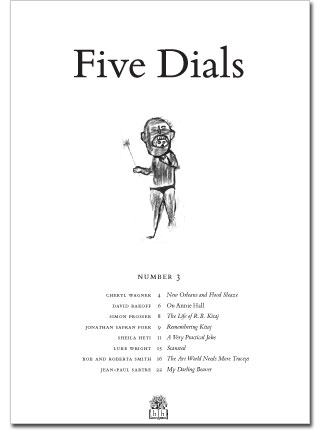
[READ: April 19, 2011] Five Dials Number 3

Five Dials Number 3 ups the page quantity a bit (26 in total) and also includes several art print reproductions  from Margaux Williamson, an artist who is mentioned in one of the articles.   This issue really solidifies the quality of this magazine.  It also introduces the possibility of correspondence with the readers.

CRAIG TAYLOR-On Alibis and Public Views
As mentioned, this letter introduces the idea that people are writing to the magazine.  Sadly there is no letters column (even if Paul F. Tompkins hates letters to the editor, for this magazine, I thought they’d be interesting).

CHERYL WAGNER-Current-ish Event: “The Ballad of Black Van.”
This is a true account of Wagner’s life in post-Katrina New Orleans, where a man in a black van is squatting in abandoned properties and selling everything imaginable.  And there’s no cops to help.  It’s a sad look at the state of New Orleans.

DAVID RAKOFF-A Single Film: Annie Hall
I haven’t read much David Rakoff, but he persist in amusing me whenever I do (hint to self: read more by David Rakoff).  This is an outstanding piece about the beloved film Annie Hall.  It’ s outstanding and goes in an unexpected direction too. (more…)

Read Full Post »

SOUNDTRACK: THE HEAD AND THE HEART-KEXP in Studio, September 14, 2010 (2010).

My saga of The Head and the Heart continues.  Sarah had ordered me the disc for Christmas, but the self-released CD had gone out of print.  This is because Sub Pop was going to re-release the record sometime in the new year.

Well, NPR loved the album, so why wouldn’t they have more recordings by them?  (This is one of the great things about enjoying new bands…they are far less likely to restrict listening and downloading abilities online).  So, this session (September) was recorded shortly after they released their album (July).  I have still yet to hear the actual album, but I have fallen in love with these songs.

This set (which has some very brief interview portions) is five songs. The band sounds great, with wonderful harmonies.  The first two songs “Cats and Dogs” and “Coeur d’Alene” meld together seamlessly, and it works wonders.  “Lost in My Mind” is an amazingly catchy single: the “whoo whoos” (which sound not unlike a train) are wonderfully catchy (in a Mumford and Sons kind of way).

They also play “Ghosts” (another catchy catchy song) and the non-LP song “Down in the Valley” (which has the slightly uncomfortable opening lyrics: “I wish I was a slave to an age-old trade”).

This neo-folkie revival has generated some great bands, and The Head and the Heart are yet another one.

[READ: April 14, 2011] “A Withered Branch”

This is a very brief short story (a page and a half) translated by Anna Summers.

A young woman hitchhikes into Vilinus.  She is picked up by a trucker and is unbothered until they get to a rest stop.  While they are having dinner, one of the drivers wonders who she will sleep with that night.

But that is the prelude to the story.  When she arrives in the city, she meets a woman of about fifty who, when the narrator asks if there is any place to stay, offers her own house to the (dirty and sweaty) stranger/narrator. (more…)

Read Full Post »

SOUNDTRACK: CIBO MATTO-“Sugar Water” (1996).

We have been rewatching Buffy the Vampire Slayer.  In episode one of season two the (then) hip band Cibo Matto appeared, playing “live” at the Bronze.  It was the first time they had a “real” band on the show.  In season one there was an occasional live band, Sprung Monkey (they were in the first episode pretty prominently) but Cibo Matto were the first “national” band–with a hit single or two–to be on the show (and look, there’s Sean Lennon in a dress!).  The song works pretty well here for the atmospherics and moodiness.

I really liked Cibo Matto when they came out.  Sure, they were kind of a novelty, (two Japanese singers with an Italian band name who sung a bunch about food) but then the late 90s were all about novelty.  Of course, even within the realm of the alt rock 90s, a song called “Know Your Chicken” was pretty unusual (noisy and weird) .  “Sugar Water” on the other hand, is a moody piece.  It’s slow with delicate keyboards and a (very mildly) spooky verse.  But the overall feel is a kind of “space age” one for notes and tones.  It also has a kind of Stereolab-vibe (especially in the la las).   It’s a catchy song and I enjoyed hearing it again after all thee years.

Not to mention the video is suitably curious.

[READ: April 8, 2011] “Goo Book”

This is a strangely sentimental story for one that starts out with the sentence: “It was fucking hot.”  In fact, the story is strangely sentimental for a story about a gangster’s apprentice (and one which has so much cursing!).

The protagonist is a young man who is a petty thief.  Mostly he steals from tourists (I was pleased that when he took he thought was a wallet but which turned out to be a notebook, he then gave the book to a kid to make sure the tourist got it back–stealing money is one thing but returning the notebook showed a decency that I approved of).

But he also worked for Mishazzo as his driver. (And I have to admit that perhaps the one flaw of the story is that I couldn’t follow the timeline at all).  Mishazzo is a gentleman who owns a lot of businesses.  And the driver was told explicitly that he didn’t know anything.  At all.  He just drove.  And the driver was fine with that.  He asked no questions.  And the driving was fine–usually to one of Mishazzo’s coffee shops for an undetermined  length of time.  So he started carrying a bottle with him in case he had to pee (he wasn’t allowed to leave the car), and started smoking like a fiend.  But the money was good, and he honestly didn’t know what Mishazzo was up to (he assumed it wasn’t good, but he also assumed it wasn’t that bad either). (more…)

Read Full Post »

SOUNDTRACK: GOGOL BORDELLO-Tiny Desk Concert #66 (June 28, 2010).

I had heard a few minutes of Gogol Bordello before this concert but it was during a TV show that I was half watching.  When I sat down and listened to this show, I was blown away by hem and immediately bought two of their CDs. Gogol Bordello is a multi-piece, multi ethic band that plays rocked-up Russian folk music (mor or less).  The sound is very traditional, with a kind of gypsy edge sprinkled onto it.  I’m not sure how many people are in the band, or how may people showed up for this concert but it sounds like about 100 in the tint room.  This is also the longest Tiny Desk show that I’ve heard (it runs almost 25 minutes).

The band plays five songs (and there’s a little chatting in between) and as the session goes on the band gets more rowdy (and more fun).  The video (also available at the same site) shows the singer sitting in the laps of the NPR folks and jumping on some desks and just having a blast.  And even though I enjoy shoegazing music, this is the kind of rollicking fun that I would love to see in concert.

The songs are political, but not overtly so, it’s more of a communal feel, of people uniting (which is indeed political).  I think they could get old kind of quickly, but in small doses the band is energizing and wonderful.

[READ: March 27, 2011] “U.F.O. in Kushiro”

This story was originally published in the March 19, 2001 issue and was inspired by the incidents of the 1995 earthquake in Kobe, Japan.  It was reprinted here to memorialize the recent earthquake in Japan.  The story is accompanied by rather devastating photos (and some surreal ones) of the aftermath of the earthquake in Kobe.

The story (translated by Jay Rubin) opens a few days after the Kobe Earthquake.  And even five days after the Kobe earthquake, Komura’s wife is still engrossed in the TV footage from Kobe.  She never leaves the set.  He doesn’t see her eat or even go to the bathroom.  When he returns from work on the sixth day, she is gone.  She has left a note to the effect that she’s not coming back and that she wants a divorce.  Komura’s wind is knocked out of him. (more…)

Read Full Post »

SOUNDTRACK: RICHARD THOMPSON-Tiny Desk Concert #107 (February 1, 2011).

This Tiny Desk concert sees Richard Thompson playing three songs from his most recent disc Dream Attic.  I really enjoyed this album, but because it was recorded live, and there’s lots of instrumentation on it, I wasn’t sure how well these songs would translate to a simple acoustic guitar.

I needn’t have worried.  RT is a master songsmith and even stripped down to just him and his guitar the songs swell where they should and haunt when they ought.  “The Money Shuffle” doesn’t need the horns that accompany the original (he supplies the power with his voice), and “Stumble On,” a gorgeous ballad, works fine solo.  I appreciated the introduction he gives to the final song “Demons in Her Dancing Shoes” as I didn’t realize it was about something specific.  He plays all the fast bits (including a brief solo) wonderfully on that acoustic guitar, too.

This is not to say that I think these songs are better solo than with the band.  It’s just to say that RT can play anything and make it sound great.  It’s an excellent (if not brief) set.

[READ: April 4, 2011] “Atria”

I hated this story as I read it.  I felt like it was deliberately trying to manipulate me.  I felt like it was playing some very obvious cards and leading to an obvious conclusion.  By the end I wanted to scream at it, yet it kept surprising me.

The story is about Hazel, a sophomore in high school.  She has not had any kind of experience with sex until one afternoon when circumstances conspire for her to have sex behind a 7-11.  She doesn’t really enjoy it but she didn’t really protest it either.  She was just sort of there.

Soon afterward, she is raped (I know), by a man who is clearly not all there.  The rape occurs behind the church (I know), and once again, she probably could have gotten away, but she was just sort of there.

Now, of course she’s pregnant (I know).  She doesn’t know who the father is obviously, but now she has a scapegoat.  The man is vilified but never found (the police artist was a joke).  The town puts up a bunch of Hazel-inspired alert phones all over town (fat lot of good they do her now).

She is treated with kid gloves in school.  Even the religious girl doesn’t blame her for being raped (I know).  All the time she is pregnant she imagines the kind of animal that will come out of her.  It’s never a baby, just different kinds of animals: birds with beaks pecking at her and having multiple babies themselves–which are crushing each other, even a four-legged beast.  It’s very trippy, and she seems to be as well.

When the baby is finally born she determines that it is a seal.  And she realizes that it needs to be kept wet.

The ending of the story was very, VERY disturbing and I simply couldn’t believe what I was reading.  And yet for all of the obvious (and by contrast highly disturbing) stuff that happened, I didn’t want to stop.  There’s was something strangely compelling about this story.  I will keep an eye out for her in the future.

Read Full Post »

SOUNDTRACK: WU MAN-Tiny Desk Concert #124 (April 27, 2011).

Wu Man is considered the master of the pipa. If that sentence was complete gibberish, the pipa is a 4 stringed lute-like instrument and Wu Man is a Chinese virtuosi of the instrument.  This Tiny Desk Concert shows Wu Man playing three songs, solo.

The songs are, if not traditional Chinese songs, then at least traditional in style.  Needless to say they are not for everyone (and really, they’re not even my cup of tea–I’m not downloading it, just watching it), but watching her fingers move on this instrument and really paying attention to the kind of things she’s doing with four strings, it’s quite an impressive feat.

She doesn’t sing, and the songs do not follow western musical structure at all.  But it’s an interesting look into Chinese musical culture.

Even if you only watch the first song, it’s worth the time.

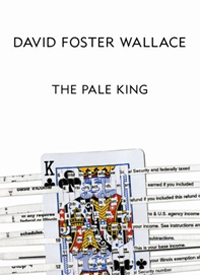
[READ: April 29, 2011] The Pale King

[Note: this review is pretty much free from spoilers–some details are given but I don;t think they ruin anything–but it is full of speculation and imaginings of what could have been]

I finished The Pale King today.  It took about a month, but that was because I only read it at lunch hour.  And I was surprised to find that, unlike with other books, I didn’t always feel up to pushing my lunch hour a few extra minutes to get some extra pages in.  Not because I didn’t like the book, but I think it was just really dense and often quite intense.

I’ll also state that I hadn’t been making any kind of notations when I started.  Then, a bit of the way through, when I realized there were a lot of characters, I started jotting down some names and characteristics.  But then I stopped again, because it was interfering with my absorption of the story as a story (such as it is).  So, this review is based on an initial read (yes, I’ll be reading it again in the not too distant future, that’s for sure), without any real note taking.

Is note taking necessary?  Well, yes, at least to keep the characters straight.  There are many many characters and most of them do not interact (or at least not explicitly) so it’s not always easy to know who is who or which person’s weird characteristics are showing up in any given chapter.  Plus, there are dozens of chapters in which unnamed people are described.  It’s hard to know how deliberate that was or how much of it is just the fact that book was unfinished.

The other thing is the ending, of course.  DFW fiction is notorious for its “lack” of endings.  Broom of the System ends mid-sentence, Infinite Jest ends in the middle of a scene, so who can imagine what The Pale King would have ended.  As such, we have only to go by editor Michael Pietsch’s placement of chapters.

So, in many respects, this book is very much Pietsch’s project.  Sure, DFW wrote all the words, but it was Pietsch’s job to piece them together.  Who is to say that DFW would have wanted §50 to end the book?  Pietsch also includes about ten pages of notes at the end of the book all showing ideas that DFW had asked himself about the nature of the finished product.  Some of these questions are minor, but others are quite significant, and would effect not only connections in the novel, but also the overall shape of the book.  It also implies that there could have been as much as another 500 pages coming.

The book feels like a kind of culmination of all of the things that he has been putting into his work for the past few collections.  There are character sketches based on interviews (Brief Interviews), there are lengthy sections of bureaucratic minutiae, lovingly rendered (“Mr Squishy”), there are scenes of conformist office work (“The Soul is Not a Smithy”) and there is redemption in the everyday (“This is Water”).  The mind reels at what this could have been had it been finished.

So this book is obviously, radically unfinished (and yet it’s still over 500 pages long).  So, why bother reading it?

(Here’s where the review really starts).

Because what is here is amazing. (more…)

Read Full Post »

SOUNDTRACK: PJ HARVEY-Uh Huh Her (2004).

After the sort of mellow, almost commercial release of Stories from the Sea, PJ Harvey throws the fans a left turn once again with Uh Huh Her.  It’s a heavy, raw album although not raw like Dry was.  It seems  simpler, somehow.  And I think it’s with this disc that you realize that every PJ Harvey record is going to be different.  It was apparent that she had a trajectory on those first few discs, but this one changes everything, and she proves that you’ll never know what’s going to come from her.

“The Life and Death of Mr Badmouth” has a very simple blues riff with kind of chanting (and occasional creepy backing vocals) by PJ.  While “Shame” adds more texture (melodica?) and some more washes of sound.  “Who the Fuck?” is a wonderfully vulgar and raw track with brutal guitars and overly loud vocals.  “Pocket Knife” is a buzzy but quiet track which feels like a demo (the guitar even seems out of tune), while “The Letter” has a great fuzzy guitar sound and a cool melody.

“The Slow Drug” is one of several slower pieces.  As with many of her quieter stuff this does nothing for me, although it’s a nice change on the disc.  “No Child of Mine” is a brief acoustic number.  It feels more like an excerpt or a transitional song than any actual song (being only a minute long).  It leads to the rocking “Cat on a Wall.”  “You Came Through”  mixes things up very nicely with a heavy percussion.  The effects in the song are really captivating.

“It’s You” is a slow piano-based song, while “The End” is a brief instrumental (more melodica).  And “The Desperate Kingdom of Love” is a dark ballad.  The oddest track is “Seagulls” which is a minute of actual seagulls squawking…an unusual addition for any disc.  The album ends with “The Darker Days of Me & Him.” It’s a quiet acoustic song which shows just how many different style she’s willing to experiment with even on one disc.  Even though to me this is a raw rocking disc, there are still a number of acoustic tracks as well.

This album feels like some kind of psychic purge.

[READ: March 31, 2011] The Littlest Hitler

I picked up this collection of stories because I enjoyed Boudinot’s story in the BlackBook collection very much.  I didn’t realize that that story was in fact part one of a two-part story (although part two bore no relation to part one, as you’ll see).  The story in BlackBook was funny and dark, but it didn’t prepare me for just how dark these stories would get.  And for the most part, it seemed like the darkness came at the very end; a surprise, a shock.   I admit i grew a little weary of the device by the end of the collection, although not all of the stories employed it, so there was some diversity. (more…)

Read Full Post »

SOUNDTRACK: WEAKERTHANS-World Cafe Live, December 5, 2007 (2007).

I really like the Weakerthans, and they are surprisingly unknown here in the States.  I say surprisingly because they write exceptionally catchy (almost absurdly poppy) songs which would fit on many radio stations’ playlists.  But what sets them apart is John K. Samson’s lyrics which are clever and interesting and about people and loss (maybe that’s why they never made it down here).

This World Cafe set came about shortly after the release of their last studio album, Reunion Tour.  David Dye asks some great questions (I’ve never really seen/heard any interviews with them, so it’s all new to me) and the band plays three songs from the album.

We learn that Reunion Tour was initially inspired by Edward Hopper paintings (and the whole album was going to be devoted to Hopper until Samson grew sensible again).  We also learn the official pronunciation of the recurring cat on the Weakerthans albums is Virtute (Vir-too-tay) which comes from the city of Winnipeg’s crest.

They play “Night Windows,” “Civil Twilight” (and talk about the video, which I watched and it’s very cool), and “Virtute the Cat Explains Her Departure.”  The interesting things about the Weakerthans is that they don’t sound all that different live than on record.  So, these songs aren’t terribly revelatory.  There are some effects that are changed, and the tempos feel slightly different as well.  But nevertheless, the songs sound great.  The only problem is that the set seems mixed rather loudly, so there’s distortion (unintended, I assume) on some of the tracks.

Nevertheless, this is a great introduction to a relatively unknown band.

[READ: April 19, 2011] Five Dials Number 2

After just one issue, Five Dials has already lied to us.  In Number One, they said that all of the artwork would be black and white, but here is Number 2, and we have a host of beautiful color pictures (perhaps they only meant that Number 1 would be in black and white).   Of course, I’m only teasing them because the color pictures are really nice, and they really bring a new aspect to the magazine.

Number Two is a bit larger than Number 1 (twenty pages).  This issue has a vague sort of theme as well (it’s unclear if the issues will be thematic in the future), but this one has a general theme of adventure/nature/environmentalism. (more…)

Read Full Post »

« Newer Posts - Older Posts »