Feeds:
Posts
Comments

Archive for the ‘Magazines’ Category

SOUNDTRACK: STEVEN KATZ-In the Garden of Earthly Delights (2009).

Since I mentioned an album my Aunt Marg gave me, I’m also going to mention this one, that she gave me the following Christmas.  She told me that Steven Katz is a classical guitarist in St Croix.  They saw him play when they were on vacation and they were amazed that he this amazing guitarist who was just sort of hanging around in St Croix (that’s the life, eh?)

I enjoy classical guitar, although I suspect if I was able to play it I’d enjoy listening to it even more.  As it stands, I can appreciate the fast trills (and Katz is masterful at them) and the general feel for the form.  On the other hand, I’m a terrible critic of this kind of music.  It all sounds kind of samey to me.   This is not a criticism of the genre or of Katz, it’s simply an admission that I like the stuff, but I couldn’t tell you a grand master from a regular master.  The one big difference I can say is that unlike the Gipsy Kings (of whom I am quite a fan) there are no extended clapping sections (well, a small clapping section in “Moroccan Roll”).

All of Katz’ composition are beautiful (all the songs are original except for one cover).  They often feature slow sections that are very moody as well as virtuosi parts (that I’ll bet are amazing to watch).  Katz is an amazing guitarist (of course I think anyone who can play this style is amazing).  He plays a Flamenco acoustic guitar over some simply keys and percussion on most of the tracks.  If I had any song to quibble with it would be “Parting at the Ganges” which has a cheesey keyboard in the background and chimes that are clearly sampled–that isn’t a bad thing necessary, except when they stop abruptly and start again.  But I only noticed that on my third listen.  But most songs have simple arrangements (bongos and whatnot).

On the plus side there’s some really unexpected guitar lines at the end of “Gypsy Caravan” and the whole feel of “Moroccan Roll” is very cool.  “Shake It Up” diverges from style on the rest of the disc with some interesting and familiar south of the border musical setups (before returning to some amazing fretwork).  I also really liked the opening of “Desert Rain Cry” because it sounds (I’m sure completely unintentionally) like the opening of Rush’ “Xanadu” (without the wooden blocks).  (The rest sounds NOTHING like the Rush song).

I mentioned the Gipsy Kings above and the comparison is apt because like the Gipsy Kings, Katz also does  cover of Hotel California. Unlike the Kings’ version, there are no vocals. Also unlike their version, this version is quite subtle.  He uses his guitar to play the vocal line, but he does it in a flamenco style–incorporating the melody into the fingerwork–it’s very cool.  He also incorporates the famous guitar solo into his playing–you hear it but he’s not “just” playing the solo.  It becomes and entirely different song than the original.

I went to Katz website and he is funny and self-deprecating, but he also tells us that he has played with all kinds of people including Dr. John, Mavis Staples, Edgar Winter and Mountain (this last one shows that he’s not a young man).   But I’m also quite certain he is not this Steve Katz who was in Blood Sweat and Tears.

[READ: February 21, 2012] “Thief”

I have read two other things from Walter, both of them via McSweeney’s journals.  It’s interesting to read him outside of that context as this piece is different from those two (I’m also amazed that he is releasing his sixth novel!).

I didn’t like the way this story started out, but once we got past the awkward introduction, I thought it was extremely compelling.  And then when it ended, I had some weird feelings about the conclusion.  But more on that later.  (I’m learning that when I say things like “I didn’t like the beginning, it’s usually like the first paragraph or two, which isn’t really fair, but which can often make or break someone’s interest in a story).

So the story starts out with observations about the Girl from her dad (capitalized because all three kids are apparently referred to as Little, Middle and Girl).  Wayne is watching his daughter sleep.  He had her when he was just 19 and she changed his world.  Now she’s 14 and he doesn’t like that Girl hangs album covers on the wall and wears her hair like Peter Frampton (I did enjoy the very simple pop culture references that set the time of this story perfectly).  Then he looks in on the sleeping Middle (who is so unlike Wayne that he thinks of him as the Milkman’s kid) and Little.  Any of the three could be the thief.  Little is a greedy sumbitch (I love the detail about his first words).  Middle is a pretty unlikely candidate (he’s bookish and timid).  And then there’s Girl.  She walks to the bus stop but sneaks a ride with the guy in the Nova; she’s probably smoking pot.

One of them is definitely the thief.

Wayne has a giant jug in which he dumps his change.  It is the family vacation jug.  After two years of change, it will be full enough for a vacation.  And this year’s is Kelowna, BC and the Bedrock City there (yes a Flintstone’s Theme Park–which was real, but is now sadly closed).  Wayne suspects that the Girl doesn’t want to go to Flintstones land and is stealing money to sabotage the trip.  His wife thinks he’s crazy, but he has set little traps and he knows the vacation jug is moving and emptying. (more…)

Read Full Post »

SOUNDTRACK: RED BUDDHA-Raindance (2007).

My Aunt Marg gave me this disc for Christmas a few years ago.  She said that she knew it from a spa that she went to.  And I can totally tell. I don’t know anything else about the artist, and it’s even hard to find stuff about him online.

The disc has an Indian (Eastern) vibe (which surprises me given the name of the artist and the African-looking person on the cover).  It also has a real world music feel.

Sarod

Overall, I like the music quite a lot.  It’s certainly new agey, but not treacly new age or anything.  It showcases some cool world music without resorting to clichés.  However, I admit to not caring much for the spoken lyrics of the opening track,  “Sometimes.”  His voice is deep and distracting, especially over such mellow music.  Despite the very Indian feel of “Sometimes,” the rest of the disc explores other sounds as well.  “Kokou” has a 70s kind of organ and bongos (with more appropriately world musicy chanted vocals).  “Raindance” has a cool flute over some bongo beats (all very soothing…with crickets).

Veena

I really like “Girl from Orissa” with its cool Eastern instrumentation.  There’s a sarod, a veena and a sitar on the disc.  (Orissa is located on the eastern side of India).  “Khali Gandaki” also features this cool instrumentation. (The Khali Gandaki valley is in Nepal).

“Mswati” opens with some percussion. But this track differs because of the interesting riff that plays throughout the song (whether guitar or keyboard, I can’t tell).  “Touba” has a nice bassline, which really stands out on a disc with minimal bass. It also has some neat wah-wahed guitars.  And “Preaching of Buddha” has a kind of Dead Can Dance feel to the vocals (they’re my go-to band for world music).

Sitar

“Katarajama” (a pilgrimage site for Sri Lankans and South Indians) has a great riff to it, and it’s even better when the other instruments play along.  “Patan Part 1” also has a cool sitar riff.  Although if Part 1 is 8 minutes, how long is  the whole song?

The final song, “Sufi Kalaam” has a somewhat more sinister or perhaps just movie soundtracky sound (low bass chords underpin the beginning of the track).  There are chanted vocals and lead vocals in another language.  I rather like the song, but it doesn’t really fit on the disc.

The whole disc is definitely a background/new agey kind of deal.  I can hear it all (except the first and last songs) working well for a relaxing evening of massage.  Just don’t listen to it while driving!

[READ: February, 17 2012] “Lorry Raja”

“Lorry Raja” won Narrative magazine’s “30 Below” contest for 2011.  After the wonderful stories that came in second and third place I expected something pretty amazing to win.  And I was maybe a little disappointed by this story because of it.  And I think I have to blame a cultural disconnect for that.

This story is set in Karnataka, India, a poor state in the south of the country.  People there are so poor that they live in tents and work in the mines–smashing up rocks to get at the iron ore inside.  The children can’t afford to go to school, there’s no electricity and everyone is covered in a red dust from all of the dirt in the mines.

Madhuri Vijay is able to create a compelling story out of this harsh environment.   The story concerns one family as they struggle to survive under these conditions.  The father (I had a really hard time keeping the names straight, so I’m not going to include them here) had an accident and cannot work to his full capacity, so he is stuck working less lucrative jobs. The mother works smashing up iron ore.  The middle son, 12, works and plays around the mine (collecting a few rupees each day).  They put some money aside for his eventual education.  The older brother has just gotten a job as a lorry driver for the mines–he takes the ore out to the port cities.  He is only 14, and, being 14, he takes especial care of his lorry–cleaning it from all the red dust and driving it in a very proud manner.  So much so, that everyone starts calling him Lorry Raja.  There’s also a baby brother who doesn’t play much of a part except (in the way I read it) to show off how hopeless things are (the boy is playing in the dirt and when it is time to feed him, his mother just takes her breast out in front of everyone).

The story is narrated by the middle son.  And we watch as he grows jealous of his brother–the Lorry Raja.  We see the narrator break up rocks, spy on his mother, spy on his father (who is lowered by a rope in to a deep mine (!)).  And we see him talk to the owner of the mine (who has a car, a generator and drinks Pepsi).  And finally we see him spend some time with his brother’s ex-girlfriend (they broke up more or less once he started driving his lorry).

When the girl casually remarks that the narrator should get his lorry license and then he could drive her to China, that sets a new part of his life in motion.  (They are thinking about China because the “Lympic Games” (“Whatever they are” he says) are being played there this year). (more…)

Read Full Post »

SOUNDTRACK: PETER BJORN AND JOHN-Falling Over (2005).

This is Peter Bjorn and John’s second album.  I enjoyed Writer’s Block and Living Thing and when I read that their earlier discs were just as good, i had to check them out to be sure.  Their first two discs are less polished, less slick.  Normally I’d say that automatically makes them better, but PB&J’s sound is pretty great with or without the production values.  This disc feels like  a transition disc, like something big is going to be coming soon (which it did).

The opening song is a pop masterpiece in the tradition of The Beatles (or more accurately, The Monkees–who wrote great pop songs with just a little less panache).  It is catchy right out of the block, with some interesting slower parts to add drama.  And Peter’s voice is perfect for this kind of pop convection.  It even opens with a Speak n Spell!  “Money” has a harder riff, but the chorus is trippy and fun.  “It Beats Me Every Time” is a darker song with a melody (and vocal style) that reminds me of Michael Penn (especially the chorus).  [I love Michael Penn and think he is vastly underrated].

“Does It matter Now?” is the first song that isn’t awesome.  It’s a fine song and there’s some great backing vocals in the middle of the track, but it’s not as good as the first three.  But “Big Black Coffin” springs back with a wonderful melody and chorus (and more Michael Penn style).

“Start Making Sense” is 2 minutes long and that’s fine, but it would probably drag if it were longer.  But then “Teen Love” is great, with a cool drum section that bridges to the a great chorus.  “All Those Expectations” is a slow guitar ballad.  It is sweet but a bit too long.  “Tailormade” ends the record on a good note, an interesting keyboard-based song with multiple parts and although the verses seems long the pay off in the chorus is worth it.

Strangely, the disc actually ends with what sounds like a demo, “Goodbye, Again Or.” If it’s not a demo, then it sounds like he’s in the next room. Maybe with the door shut.  I can’t really grasp the song as I’m so distracted by the recording.

My version of the disc has five bonus tracks.  I’m not sure that this is the kind of disc you want bonus tracks for, (my first listen I couldn’t believe this album was so long!) but, really, who says no to free music?

“(I Just Wanna) See Through” has a rock n roll guitar intro.  “The Trap’s My Trip” starts out slowly but adds drums with a wonderful introduction after two minutes and then brings in a  great rocking guitar.  It’s a wonderful b side.   “Punk’s Jump Up” is a fun little jam/practice.  While “Unreleased Backgrounds” is a slow guitar song.  These are nice bonus tracks.  Not essential but enjoyable.

This is a solid record from PB&J.  Even though some of the early songs are really catchy, nothing is as immediate as “Young Folks.”  But it’s still really strong.

[READ: February 15, 2012] “The Silence Here Owns Everything”

Continuing with Narrative magazine’s “30 Below” winners for 2011, this story won second place.  It was deceptively simple and I enjoyed it quite a lot.  The story was broken down into several sections (which I like), although all the action takes place over one  weekend.

It’s written in the first person from the point of view of a high school sophomore (I gather).  She and her best friend Kendra are walking home from school on a Friday afternoon.  Kendra has bruises on her face, which we assume are from her father.  It’s obvious that despite Kendra’s difficulties, the narrator looks up to her quite a lot (she may even have a crush on her, but that’s not really an issue).

The bulk of the story centers on the girls as they walk home, as they hang out at Kendra’s house, as they smoke some weed and as they fall asleep–you know, a typical high school weekend.  And Clodfelter captures the tone and details of the setting perfectly.  It feels completely real.  Especially when Kendra reveals that her boyfriend is coming over in the morning and the narrator wishes (but doesn’t say) that it could be just the two of them instead. (more…)

Read Full Post »

SOUNDTRACK: PAT JORDACHE-Future Songs [CST076] (2011).

I love this Constellation release. It is one of my favorite releases of theirs in a long time.  This album sounds like a kind of TV on the Radio demo/tribute.  I don’t mean that in a knock-off way, but there are many elements about TV on the Radio that I recognize here (voice and musical style).  But the fact that a) Jordache plays all of the instruments himself and b) he keeps things simple, makes this an impressive release.

It opens with “Radio Generation,” which has a really cool bouncy guitar riff and bassline.  It doesn’t quite display the signature sound that I think of this album as having but it certainly points to it. “Get It (I Know You’re Going To) is where I hear the first signs of TV on the Radio.  Jordache sings with two voices at the same time–with his deep voice underpinning his higher voice.  It’s a great effect.  And the fiddly guitar bits are really interesting.

“Salt on the Fields” opens with some “wee ooh” vocals in a fairly high register but when the main vocals come in, they are processed and sound not unlike an old radio (and a singer who I can hear but whose name I can’t place) and then midway through, the song introduces a great guitar riff.  “Phantom Limb” features drums and looping from Merrill Garbus who I didn’t know when I first heard this album but who I now know is tUnEyArDs. And, heh, a little browsing tells me that they are in a band together called Sister Suvi.

“Gold Bound” feels more like a demo than the other tracks, it’s a very simple guitar melody with some echoed vocals.  It’s also the shortest song on here and it’s a nice change of pace.  It also ends with a strange excerpt from something else, a vulgar, rocking little piece advising you to run mother fucker.

“Song for Arthur” returns to that cool high-pitched ooo-ooing.  But “The 2-Step” changes things quite a bit.  An interesting processed guitar and loud echoey drums, but that voice is recognizably his.  There’s also more guitars than on other songs which brings a new texture to this album.

The final song “ukUUU” is a slow meandering piece. There’s some interesting sounds going on (reverse vocals and such) and a lengthy spoken piece about love, but it lacks the punch of the rest of the disc.

Nevertheless, this album is interesting, intriguing and a lot of fun.  I’m looking forward to more from him.

[READ: February 12, 2012] “Liability”

I recently saw that Narrative magazine picked three “30 Below” winners for 2011.  So I thought I’d see just what kind of short stories win their prizes.  This is the third place finisher.

I admit I was a little less than excited when I started reading the story.  It was written in second person, which I liked, but it seemed like a pedestrian story about “you ” and your wife.  How she is so beautiful and you feel you have let her down.  But my misgivings soon gave way.  And I think it was with this little section that won me over:

You crave energy and excitement, and to this end you have bought a beautiful condo downtown in the “bohemian quarter,” as the realtor pitched it, which means that it’s cheap enough for artists and poor black people.  That’s okay.  You love art and hate racism.”

By the middle of the next page, after the explanation of your wife’s job (guidance counselor in a poor school) we get to what turns out to really propel the story: “Although, to be honest, she has a small drinking problem.”  He diffuses this bold statement with a qualifier in the next paragraph: “But the drinking problem is only a problem sometimes, and the drinking problem is not a problem tonight.” (more…)

Read Full Post »

SOUNDTRACK: THE FEELIES-Crazy Rhythms (1980).

Not too many albums start out with clicking blocks and quiet guitars that build for a minute before the actual song kicks in.  Not too many albums sound like early Cure sung by Lou Reed and not too many albums are called Crazy Rhythms when the thing that’s crazy about them is their vocals and guitars.  But that’s what you get with The Feelies debut.

In addition to the blocks, the opening song also features some sh sh sh sounds as a rhythm (techniques used by The Cure on Seventeen Seconds, also 1980).  There’s two guitar solos, each one vying for top spot in different speakers and, yes, the rhythms are a little crazy.

The album feels like it is experimenting with tension–there’s two vocalists often singing at the same time, but not in harmony.  There are oftentimes two guitars solos at the same time, also not in harmony.  The snare drum is very sharp and there’s all manner of weird percussion (all four members are credited with playing percussion).

That early-Cure sound reigns on “Loveless Love” as well, a slow builder with that trebly guitar.  There’s a lot of tension, especially with the interesting percussion that plays in the background.  And there’s that whole Lou Reed vibe in some of the vocals.

But not every song sounds like that, “Fa Cé-La” is a punky upbeat song with two singers trying to out sing the other.  “Original Love” is another short song, it’s fast and frenetic and fairly simple. It’s as if they couldn’t decide if they were going to be The Velvet Underground or New Wave punks.

The next surprise comes from their choice of covers: “Everybody’s Got Something to Hide (Except for Me and My Monkey”).  It goes at breakneck speed with some surprising pace changes after the chorus.  And a wonderful ringing percussion that makes the song sound even more tense than it is.  “Moscow Nights” is a more traditional song (although the backing vocals seem very spartan.

“Raised Eyebrows” is almost an instrumental, until the last-minute when the seemingly random vocals kick in.  And the final track, “Crazy Rhythms” seems to combine the speed of the faster tracks with the insanity of the other tracks.  It’s a pretty amazing debut, really heralding an age of music.

  It’s a shame it took them 6 years to make another (very different sounding) record.

[READ: February 8, 2012] “To Reach Japan”

I love Alice Munro’s stories, but I found this one a bit confusing.  Now, I admit that i read this under poor circumstances (while I was supposed to be attending a company-wide presentation), so that may have led to my confusion. But it felt like there was some questionable juxtapositions of the timeline in this story.

It opens simply enough with Greta and her daughter Katy waving goodbye to Peter (the husband and father) as they pull away from the train station.

The story immediately jumps back to Peter’s mother and how she fled on foot from Soviet Czechoslovakia into Western Europe with baby Peter in tow.  Peter’s mother eventually landed in British Columbia,where she got a job teaching.

The second time jump comes a few paragraphs later.  It seems like we’re back in the present, but the section opens, “It’s hard to explain it to anybody now–the life of women at that time.”  This describes how it was easier for a woman if she was a “poetess” rather than a “poet.”  But I’m not exactly sure when that was.  Presumably when Greta (who is the poet) was younger, but how long ago was that?  In Toronto, even?

The story jumps back to the present to say why Greta and Katy are on the train and Peter isn’t.  They are going to housesit for a month in Toronto while Peter goes to Lund for a summer job.

Then it jumps back to when Greta was a poetess and actually had poems published.  The journal was based in Toronto, but there was a party in Vancouver for the editor.  So she went.  And she had a lousy  time among the local literati.  She gets drunk and sits in a room by herself, but soon enough a man approaches her and offers to take her home. There is the potential for something more to come of it but it never materializes.  But she never forgot the man’s name: Harris Bennett, journalist. (more…)

Read Full Post »

SOUNDTRACK: LOS CAMPESINOS!-Romance is Boring (2009).

Even though I had heard good things about Los Campesinos! before I got this album, this was the first one I bought.  I see that it gets less high marks than previous discs but I think it is fantastic.  It is frantic and catchy, it is intense and mellow, it is loud and soft and most of the time that’s in the same song.  And, as you’ll see below, lyrically I think it’s fantastic.

The disc begins slowly.  Then the vocals come in and you can tell that Gareth Campesinos!’ voice is somewhat abrasive, but well enunciated. When at the 2 minute mark the song more or less stops and turns into little twinkling bells you’re not prepared for the next bit–the guitars are noisy and the drums are loud and the lyrics are even stranger (sung in a slightly off-key style): “I’m leaving my body to science, not medical but physics.”  By the end, the song has mellowed almost completely and we have an almost a capella ending, “Would this interest you at all?”  But before you have a chance to answer that, the next song, “There are Listed Building” ratchets forth in both speakers with loud and quiet sections, group vocals and the lead singer’s more shouting style.

“Romance is Boring” has some super catchy shouted vocals as well as the first real exposure to the co-vocalist Aleksandra Campesinos!’ beautiful gentle female voice. “We’ve Got Your Back” is primarily sung by the female vocalist until the male voice come back with “and so fucking on and so fucking forth” and my favorite shouted chorus: “What would you do?  I do not know.”  “(PLAN A)” is a screaming punk blast of discord.  Until, of course, the much more palatable group sung chorus kicks in.

One of the best songs they do is “Straight in at 101” a wonderful song about breakups that is catchy and funny. It opens with, “I think we need more post-coital and less post rock.”  And then after some great alt rock, the song comes to an end with an a capella section that is quietly sung:

I phone my friends and family to gather round the television;
The talking heads count down the most heart-wrenching break ups of all time
Imagine the great sense of waste, the indignity, the embarrassment
When not a single one of that whole century was… mine

“I Warned You: Do Not Make an Enemy of Me”  has frenetic guitar and the wonderful line, “if this changed your life, did you have one before?”  And the wonderfully titled “A Heat Rash in the Shape of the Show-Me State” opens with this lyrical stanza:

She’d a bruise so black they watched it fade through the full spectrum of colours.
They kept it like a pet; a private joke they told no others.
And how the tissue repaired, and how it turned to yellow
And she found it disgusting, ’cause it didn’t match her clothing.
He said “that’s not yellow, it’s golden”.

Also lyrically interesting is “The Sea Is A Good Place To Think Of The Future,” because how can you make this couplet work in a rhythmic way.  But he does! “At fourteen her mother died in a routine operation from allergic reaction to a general anesthetic.”

There are fast songs and slow songs and pretty sections and harsh sections.  I think they meld it all together wonderfully.

[READ: February 6, 2012] “Los Gigantes”

I think I begin every T. Coraghessan Boyle story with some trepidation.  I liked Boyle because of The Road to Wellville, but I find that most of his other stories are very Southwestern, a region I really don’t know very well.  And yet for all my trepidation, I find I do enjoy his stories.

This one has a very simple premise.  All of the largest men in the area have been offered jobs by the President (I’m not sure where this is set but I assume, if it’s not entirely fictional, that it’s meant to be in Central America).  Although the men have some freedom during the day, at night they are locked into cages.  But their job is a simple one–eat, sleep and have sex with very large women.  That’s all.  It’s kind of boring, but  they are provided entertainments.  And it could certainly be worse (wait until you see what conditions the women love in!).

Discontentment begins to settle in as they realize that they are little more than stud animals (the President is breeding them for their size for a secret army in several generations).  And so one night two of los gigantes escape (it’s fairly easy, they are very strong men).  But they basically get as far as town where the pleasures of the  town’s bar keep them from returning home.  They are caught and punished, but the punishment is not that bad because the President really wants their offspring.

The men issue demands–a nicer living situation mostly–which are met, and they are contented once more. (more…)

Read Full Post »

SOUNDTRACK: ISOBEL CAMPBELL & MARK LANEGAN-Sunday at Devil Dirt (2010).

Sarah bought this disc for me for my birthday a few years ago.  I had a hard time getting into it even thought it was supposed to be amazing.  It turns out that it is amazing, but only when I’m in the right mood.

The is a disc of slow, moody songs.  The closest comparison I can think of is Leonard Cohen (even though all of the songs are actually written by Isolbel Campbell)–this disc is at times more and at times less ponderous than Cohen.

The main reason I couldn’t get into it is because the first two songs are really really slow.  “The Seafaring Song” is almost comically slow–as slow as Lanegan’s voice is deep.  And yet there is a very nice melody (and beautiful accompaniment from Campbell).  “The Raven” sounds like an old Western movie.  Indeed, a lot of the disc sounds like an old Western.

“Salvation” introduces the first real up-front melody. “Back Burner” has a very old school chanting chorus which is quite a change for this album (although at 7 minutes, it does drag a bit).

“Who Built the Road” is very much like a Leonard Cohen duet (especially the La la part) while “Come On Over (Turn Me On)” is like a sexy Serge Gainsbourg duet (the album really picks up around here).  “Shotgun Blues” is a big sexy blues (surprising for Campbell who sings lead) while “Keep Me in Mind, Sweetheart” is a country-style ballad.

By the time that “Sally, Don’t You Cry” comes on, I find that I have more or less had enough of the disc.  But that is the last official song.  My copy has five bonus tracks after two minutes of silence. But the bonus songs mix things up a bit more.  “Fight Fire with Fire” is a jaunty piano based song (although it’s still pretty slow-paced).  It’s funny to hear them talking about AC/DC albums in this slow piano song.

“Violin Tango” is just what the title says while “Rambling Rose, Clinging Vine” is probably the most upbeat song on the disc. Finally “Hang On” feels the most like a song from her old band Belle and Sebastian (by way of The Velvet Underground).  It’s also the only one she sings solo.

So yes, I do like this album quite a lot. Lanegan is a perfect foil for Campbell’s sweet voice and songwriting. They made another disc together, maybe I’ll get that in another couple of years, too.

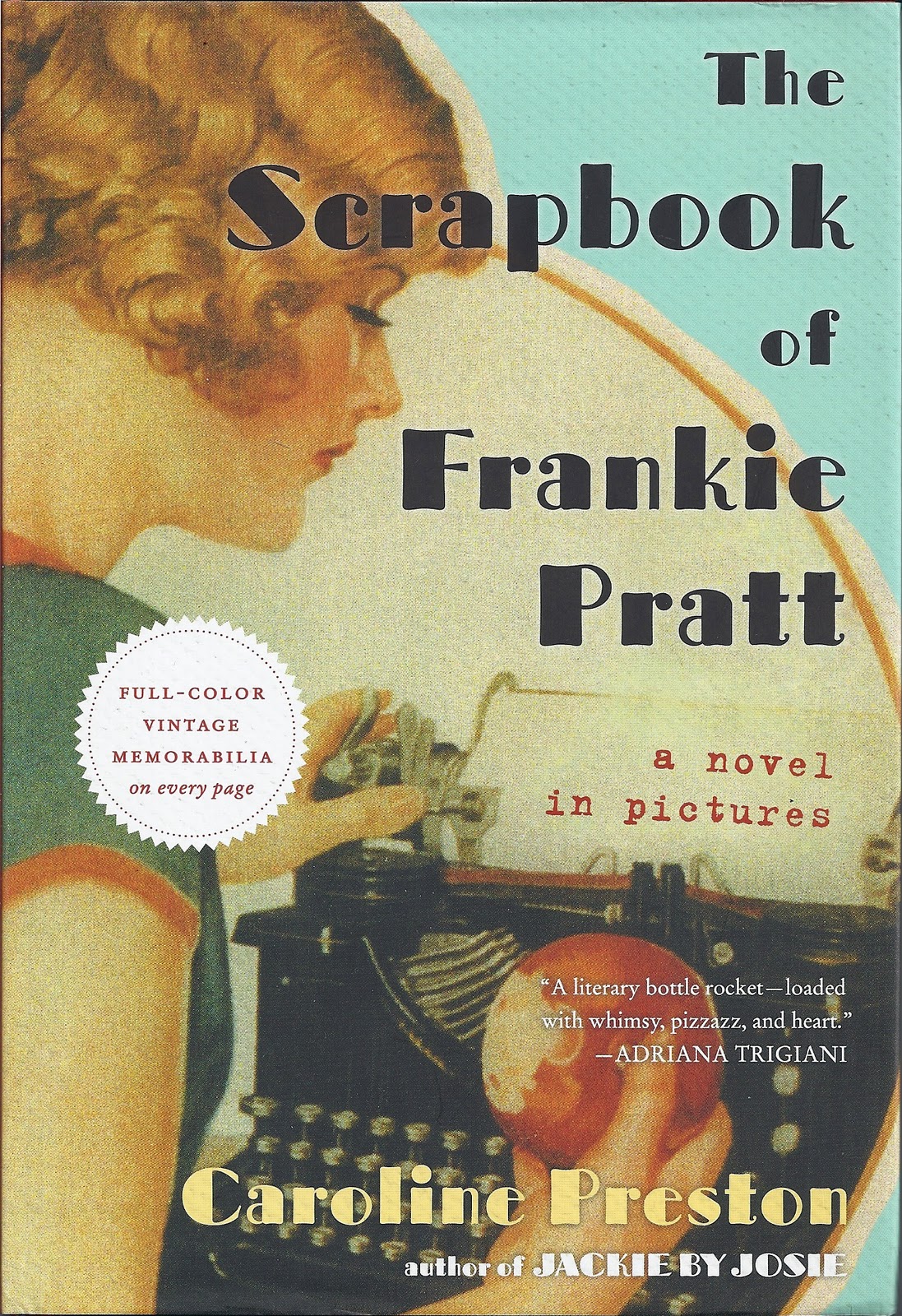
[READ: February 5, 2012] The Scrapbook of Frankie Pratt

This was a wonderful book that Sarah brought home and told me I had to read.  And I’m so glad I did.

The Scrapbook is a very simple story–it’s a biography of a lady named Frankie Pratt from the ten or so years after she gets out of high school.  She went to high school in Cornish, New Hampshire in the early 1920s; that’s when this scrapbook starts.  Over the decade, Frankie goes to college, gets a job in New York City, travels to Paris and then returns home.  That is the basic plot, but that simple summary does a grave, grave injustice to this book.

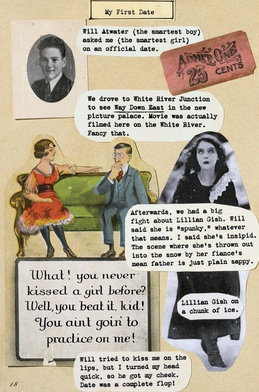
For Preston has created a wondrous scrapbook.  Each page has several images of vintage cutouts which not only accentuate the scene, they often move the action along.  It feels like a genuine scrapbook of a young romantic girl in the 1920s.

Check out the picture on the right.  Every page is like that–full of old photographs or ticket stubs, candy wrappers or advertisements.  And a few words here and there that Frankie has typed to move the story along.  It is a wondrous trip down vintage lane.

Now, as I said, the story is pretty simple (but it is befitting a scrapbook).  It showcases the highlights of Frankie Pratt’s life.  How she meets a man who wines her and dines her and treats her fine, until he reveals a shocking secret.  How she got out of Cornish, New Hampshire and went to Vassar (I admit I found this first section a little slow, but I was so absorbed in the look of the book that I didn’t really mind).

Once she gets to Vassar though, things are much more interesting because Frankie, small town girl with no money, is introduced to the rich sophisticates who attend Vassar–New York and Boston socialites.  She even rooms with one woman (who sends her down a path of debauchery and potential loss of scholarship).

Frankie longs  to be a writer, and she heads to New York to work on a magazine.  There she meets a man who wines her and dines her and treats her fine, until he reveals a shocking secret. (more…)

Read Full Post »

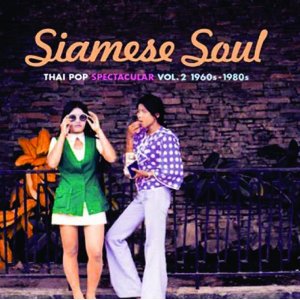
SOUNDTRACK: KWAN JAI & KWAN JIT SRIPRAJAN-“E-Saew Tam Punha Huajai” (1960s-1980s).

This song is the basis for My Morning jacket’s “Holdin’ on to Black Metal.”  It’s not the inspiration…it’s the exact song.  In fact, it could even be a cover, except with completely different lyrics.  Well, I say completely different lyrics without knowing what the original lyrics are, although it translates as “Advice Column for Love Troubles” which “Holdin’ on to Black Metal” certainly is not.

This original is a tad slower and, perhaps, a tad stiffer (which is funny that it’s on a collection called Siamese Soul).  The riff is pretty cool, and in this version they use (what I assume are) Thai flourishes the keyboards are just all over the place, bringing in a crazily noisy texture.  The vocals are all in Thai (I assume).  But what’s amazing is that the opening vocal melody is copied exactly by MMJ (and then MMJ take it in a very different direction).

After that opening riff, the similarities in vocals end, as the singer (I am so vague about this because I can’t find anything about this album anywhere) takes off on a more conventional non-Western singing style.  I prefer the MMJ version, but this is a fun little addition to Circuital.

Check it out and be surprised.

[READ: January 31, 2012] “Someone”

I normally don’t like titles like this one.  “Someone” seems to show a real dearth of imagination, and it doesn’t really inspire anyone to want to read the story.  Having said that, the title actually proves to be quite apt, albeit only after reading the whole thing.

I haven’t read any McDermott stories before, although I have heard of her, but I have no idea if this is the kind of story she normally writes.

This one is set in 1937.  Marie is 17 and has just been asked by Walter Hartnett what is wrong with her eye.  What’s wrong with her eye is that the sun makes it squint involuntarily.  Walter tells her not to do that, that it makes her whole face look funny.  This must be a charming pick up line circa 1937 because later that day Marie and Walter go on a date.

The story quickly flashes forward to the present–we see Marie examining her squint in the mirror. She also thinks back to when her daughters started dating and she warned them: (a rule that I agree with): “If he looks over your head while you’re talking, get rid of him.”  But the daughters didn’t want to hear another story about Walter Hartnett.  So we get to hear it instead.

On that first date, Walter invited Marie upstairs for a minute.  We all know what getting invited upstairs means, but did it mean that in 1937?  Well, Walter does live with his mom, so maybe not.  But his mom is not home, and there’s beer in the fridge.  And soon enough Marie is having her first kiss.  And Walter doesn’t take it slow.  He’s already moving on to second base–with kissing and biting and….  And then they hear the door open downstairs.  Marie is stunned.  (more…)

Read Full Post »

SOUNDTRACK: LES MOMIES DE PALERME-Brûlez de Coeur [CST070] (2011).

This is the second disc from Constellation’s MUSIQUE FRAGILE 01.  Les Momies de Palerme, comprised of Marie Davidson and Xarah Dion, create ethereal music that would not be out of place on NPR’s Echoes (wonder if John Diliberto knows about the album).

There is a female vocalist who has qualities of Cocteau Twins’ Elizabeth Fraser (big surprise there) as well as early Lush.  But while the music is often swirling and intriguing, it is also sometimes odd.  There are moments in “Solis” which remind me of Pink Floyd’s “Several Species of Small Furry Animals Gathered Together in a Cave and Grooving with a Pict.” (That’s the second time I’ve mentioned this song in just over a month).

“Incarnation” has a vaguely middle eastern feel and works more in a Dead Can Dance kind of vein and “Le Cerf Invisible” has some really cool sound effects that spring up throughout the song.

The title track has a spoken word section that reminds me of the spoken word part in Sinéad O’Connor’s “Never Get Old” from The Lion and the Cobra (probably because it’s spoken by a woman and is in a foreign language, although on Sinéad’s album it’s Gaelic (spoken by Enya(!) and on this one it’s French).  I rather like it.

Most of the songs are longer than five-minutes, but there are two short ones: “Médée” is just under three and “Outre-Temps” is just under two, but they retain the same style of music, although “Médée” introduces acoustic guitars.

“Je T’aime” ends the disc with a bit more acoustic instrumentation.  The album kind of becomes more grounded as it goes along.  But it’s always ethereal.  It’s a neat experience.

Their website has a great front page, too.

[READ: January 23, 2012] Five Dials Number 22

Most Five Dials issues are chockablock with different ideas: contemporary issues, flashbacks to the past, fiction, poetry, ethics, music.  A wonderful melding of interesting ideas.  But Number 22 is entirely different.  Simon Prosser and Tracy Chevalier co-edited this issue and as they say in the editor’s note, they asked a group of contributors “to write grown-up fables about nineteen trees native to the UK.”

This issue is also promoting trees by highlighting the work at http://www.woodlandtrust.org.uk, an organization with three aims:

1 Work with others to plant more native trees…

2 Protect native woods, trees and their wildlife for the future…

3 Inspire everyone to enjoy and value woods and trees…

Simple but noble goals.  You can even buy a copy of this book in print from them at their store.

Even though I love nature and like being in the woods, I don’t know a lot about different kinds of trees.  I’m always stumped when it comes to tree identification.  So this issue was kind of enlightening for me.  Each fable has a picture of a leaf (presumably from that tree) which were painted by Leanne Shapton.  The fables also create backstory for what tree-lovers know about their favorite trees, and so this was also helpful just to learn what people know about trees.

But at the same time, it makes me uniquely unequipped to really talk about these fables.  So I’m just going to list the authors and their trees and say a word or two about their style. (more…)

Read Full Post »

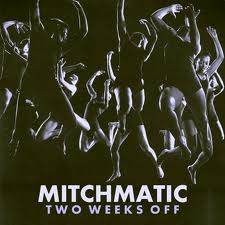
SOUNDTRACK: MITCHMATIC-“D-Bags” (2011).

On the show New Girl, my favorite joke in the pilot (which was brought back in a recent episode) is the douchebag jar.  Every time someone in the house (well, Schmitt, really) says something a douchebaggy, money goes in the jar.

This song has a crazily simple bass line–which sounds like “Another Bites the Dust,” but isn’t.  It’s unclear from the beginning exactly what the song is about.  But once the chorus comes in, the song is just perfect: “D-Baaaaaags: Hey I’m calling from a handicapped stall, dude; D-Baaaaaags:oh I’m a jerkwad? I’m a jerkwad?  D-baaags, Don’t tell me how to carb load, I know how to carb load.”

There are three rappers in the song.  Mitchmatic takes the first verses.  Mikey Maybe gets the best line: “say irregardless while trying to seem smart.”  The Joe has a really fast delivery that reminds me of Paul Barman (in lyrics and style).

I’m really enjoying Mitchmatics’s beats.  You can download Two Week Off for free.  Or you can watch the video (which seems to have the studio version of the song over a live video)

The video goes on a little long after the song, but the song is pretty great.  It might actually do to give it a proper video.


[READ: January 24, 2012] “Shore Ting”

When I signed up to receive Narrative magazine, I also signed up for their emails.  And the January 9 email contained this story (as well as many other things).  This story was chosen as their Story of the Week.

I really wanted to not like this story.  There were so many things about it that seemed like they should be red flags to me: a tourist getting entwined with a local urchin; the tourist “doing good” for the urchin when none of the locals want anything to do with him; a wife who is very Christian; and the implication of forthcoming violence throughout the story.  Not to mention a piece of foreshadowing that I assumed gave away the ending (although it doesn’t).

The story opens with an interesting scene.  The tourist, Dale, gives the urchin (named Sammy, although this was obviously a name for tourists) a cigarette and then realizes that he has personally started this boy on a lifetime of smoking. And he feels bad about that.

Sammy hits up Dale for work.  Dale doesn’t have work, but since he is looking into renting a sailboat, he more or less hires Sammy to help him on the boat.  Dale asks Sammy if he can do various things and whatever he asks, Sammy replies, “Shore Ting.” (more…)

Read Full Post »

« Newer Posts - Older Posts »