Feeds:
Posts
Comments

Archive for the ‘Magazines’ Category

SOUNDTRACK: KISS-Destroyer {Resurrected} (2012).
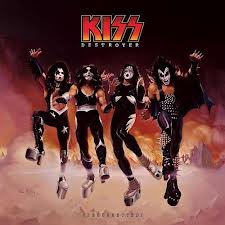
Bob Ezrin, überproducer, decided he wanted to remaster Kiss’ Destroyer album (for its 35 year anniversary).  If his notes are to believed, this was all Ezrin’s doing with little input from the band.  The notes are interesting and explain Bob’s rational at the time and his rationale for remastering it now.

The remastering isn’t major–the guitars sound more vibrant (there seems to be extra flourishes on “King of the Night Time World”, the vocals sound a little fuller (with some extra echo).  I actually think I’d like the drums to be a little louder–Peter does some great drumming here and it should be emphasized more.  Ezrin explains that do to the limitations of the originals there wasn’t a lot he could do to  re-mix the album.

The most exciting find of the remaster is the new guitar solo for “Sweet Pain.”  It’s not a huge deal, it’s only a few notes, but it is  fun to hear a new take (even if the “real: solo is better).

He adds a “Get Up/Get Down” at the end of the solo in “Detroit Rock City” (which I do not like).  He also repeats an “ahhh” in “Beth” in the middle which just makes me think the song should end.  In the liner notes, he says they added new car crashes at the end of “Detroit Rock City” although  I can’t really hear it. There seems to be more of the little kid’s voice in “God of Thunder” (I always wish they’d provided transcript of what he says).  And overall I think that song sounds the best with the new mix–more intense, more scary, more bombastic.  As for the mellower songs (“Great Expectations,” “Do You Love Me?”) there’s a bit more oomph in the backing vocals.

In the notes he says he fixed something that has been bugging him for 35 years.  The internet boards suggest that it is this: In “Detroit Rock City,” Paul sang “Moving fast down 95,” but 95 goes nowhere near Detroit, so he mixed Paul’s voice to say “moving fast doin’ 95.”  I never really understood which one he was saying to begin with, so I can’t be sure of this.  Overall, is it worth getting this remaster?  Well, probably not. It sounds better and fuller, but not radically different.

The only other  Kiss albums he produced were Revenge and The Elder–Bob, I’d love a remaster of The Elder!

[READ: September 23, 2012] “The Casserole”

This really short story (less than two pages) has a title that’s not terribly exciting.  It also prepares you very little for what will happen and just how the casserole will come into play.

The story is of a trip that a long-married husband and wife take to her family’s ancestral home–a large farm with tons of acres, tons of livestock and worth tons of money.  But he and his wife don’t want the farm (which her parents want to give them), they’re happy in the city, being school teachers who live frugally, saving for a rainy day.

The story is almost all flashback as the couple waits to board the ferry that crosses the river to the house.  He thinks about how they don’t have kids (and never wanted them) and how this drives her parents crazy (they desperately want an heir to their property).  He thinks about how they spend very little money on anything–keeping it squirreled away for their retirement.  Even if his wife might like to go to Belize to show off her still hot body.  He thinks about how the only thing he would spend money on is a beautiful room to house his record collection and maybe to buy an awesome stereo–and how his wife is unimpressed by this. (more…)

Read Full Post »

SOUNDTRACK: KISHI BASHI-Tiny Desk Concert #215 (May 10, 2012).

A few days after the concert at the 9:30 Club, K Ishibashi stopped in at the NPR offices to record a Tiny Desk concert.  The Tiny Desk  concerts are always fun–incredibly intimate and always well recorded.  He plays three of the five songs that he played at the 9:30 Club, and while they sound quite the same, there are little differences.

I find it very cool how similar they sound–since most of the sounds he makes are with his voice, it’s quite cool that he has that much control.  But I also like that he varies things a bit (although it sounds like a slightly flat note that plagues “Atticus in the Desert”).

What’s interesting is that although he doesn’t play things very differently, the feel of “I am the Antichrist to You” is quite different in the Tiny Desk setting.  I don’t really understand why, but it sounds very different, and equally wonderful.

Watching the Tiny Desk show is also neat–I’ve never seen anyone strum chords on a violin before.   And watching all of the technical adjustments is very cool too.  I’ve definitely become a fan of Kishi Bashi.

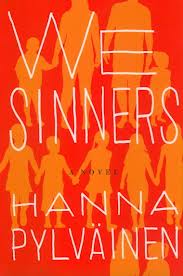
[READ: August 28, 2012] We Sinners

This has got to be the fastest turnover I’ve ever had where I read a short story and then read the author’s novel.  Well, it turns out that “Jonas Chan” was not a short story, but an excerpt from this novel.

The novel is a series of short stories about the same family.  I’m reluctant to brand it one of those connected-short story novels, but I think it really is.  Each chapter has a title and a specific focus and, as the excerpt showed, each chapter can work independently–although having all of the information certainly fills out the story.  (Unless I am mistaken, a few things that really depend upon the rest of the book were left out of the excerpt).

The novel is about the Rovaniemi family.  They are a very traditional Finnish family living in the midwest United States.  More than just Finnish, they practice Laestadianism, a very conservative kind of Lutheranism that is unique to the Finns.  There are nine children in the family (and 11 chapters in the book), and the novel follows them through about 18 years (the youngest, Uppu, is born in the first chapter and the second to last chapter is about her leaving for college.

There’s even a handy family tree:

WARREN  –  PIRJO  (parents)

BRITA  TIINA  NELS  PAULA  SIMON  JULIA  LEENA ANNI  UPPU

There isn’t an overall plot so much as an evaluation of this traditional family and how modern life impacts them.   And wisely, the book opens with the oldest daughter.  This (as opposed to first looking at the parents) allows us to see what kind of difficulties the kids will have with their religion.  We see Brita in school facing a tough decision.  The Laestadian religion doesn’t permit dancing (or TV, or much of anything).  And Brita has to inform her “boyfriend” that she can’t go to the dance because she isn’t allowed.  When Tiina finds out that Brita revealed their religious secret she freaks out that people will know about her too. (more…)

Read Full Post »

SOUNDTRACK: KISHI BASHI-Live at the 9:30 Club May 1, 2012 (2012).

I had never heard of Kishi Bashi before this concert.  Kishi Bashi is a one man band headed by K. Ishibashi.  He plays violin and sings and, as is the trend it seems, he records and loops his own beats and melodies.  Whether or not this is overdone by others, Kishi Bashi does an amazing job.  His songs are powerful and his soaring falsetto is fantastic.

I find myself singing lines from “Atticus in the Dessert” all the time.  And who could resist the title “I am the Antichrist to You.”  Hearing him pull this stuff off live is really impressive.  When he’s not sampling and beatboxing, his violin is gorgeous–I never really understood the folks who could violin and sing at the same time, but he does it wonderfully.  He’s got a funny, charming stage presence and this whole brief set is really enjoyable.  Check it out (audio and video!).

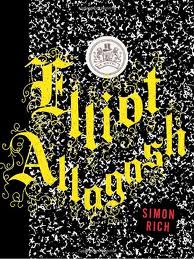
[READ: September 1, 2012] Elliot Allagash

I really enjoy Simon Rich’s humorous pieces.  But somehow I totally missed that he had written a novel (or two–the second one came out in August).

This novel eschews Rich’s humor style–there’s no absurdist takes on life–and focuses on a plot. The plot is pretty straightforward.  Seymour Herson is a middle school loser–everyone picks on him.  In a nice twist on the high school loser, Seymour’s family is pretty cool.  They play Monopoly every Friday night, they eat together and are generally supportive of each other.  While they might be somewhat geeky, they are not played as straw men for Seymour’s problems.

At his school there are three rows of lunch tables.  The popular kids sit at the first row.  The rest of the kids sit at the second row.  And Seymour sits in the final row.  By himself.  In part that is his plan, so he can score a minimum of 5 chocolate milks at lunchtime without the other kids seeing.  Then one day Elliot Allagash sits next to him. (more…)

Read Full Post »

SOUNDTRACK: CIRCLE TAKES THE SQUARE Live at Black Cat Washington DC, August 31, 2011 (2011).

I had never heard of Circle Takes the Square before seeing the link to this show on NPR (Thank you, Viking!).  I like the band name (Hollywood Squares reference), and couldn’t imagine what they sounded like.

Song titles like “In the Nervous Light of Sunday” and “We’re Sustained by the Corpse of a Fallen Constellation” and even “Non-Objective Portrait of Karma” lead one in many possible directions.  But it turns out that the band is sort of pigeonholed as screamo, a post-hardcore style that allows mostly for screamed vocals.  And yet these guys also incorporate intricate playing, odd time signatures and some beautiful instrumental passages.

Even though the band plays fast, they don’t play only short songs.  The shortest songs run about three minutes but they have two songs that are over 6 minutes, with several different sections.

I listened to this show a few times and I confess I never really got into it.  I liked some of it but I was never fully able to grasp what was going on.  It could have been the recording quality.  Usually NPR shows are crystal clear, but this one was a bit muddy–which may have been intentional from the band as they are pretty raw sounding.  I did like  the split male/female vocals which added a cool depth to the songs.  But mostly I was impressed by the kind and almost sweet attitude of the lead singer.  He was polite and thankful to the audience (thanking them for braving the weather–the show was during Hurricane Irene–thanking them for coming from both far and near and talking about how excited he was about Pg. 99, the headliners.  It’s funny to hear polite thankfulness and then screaming lyrics like: “Embrace the sweet sound of self-destruction.”

I’d like to hear a studio release before passing final judgment, because there was a lot to like here.

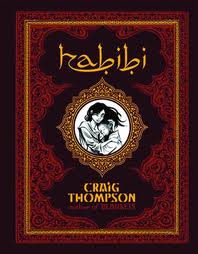
[READ: August 29, 2012] Habibi

I saw this book in a review by Zadie Smith in Harper’s a while back.  I didn’t realize at the time that the author was the same person who did the wonderful Blankets.

This book is an amazing piece of art.  And the story is very good too.

So this massive book (almost 700 pages) is the story of  a woman born into a fictional Middle Eastern country called where the Qur’an is studied and women are more or less chattel.  As the story opens Dodola is sold by her father to a wealthy man who becomes her husband.  The scene of her deflowering, while not graphic at all, is very disturbing nonetheless.  She is afraid of this man and cowers in the fear until they gradually start to see each other as human beings.  And although their age difference is substantial (and yes, gross), she learns to appreciate him.

Until he his killed by the king’s men and Dodola is taken away to the king’s palace to be sold as a slave–her hair is tied to another girl’s hair so they cannot escape.

Through a series of events, she does escape, and when she is hiding out she manages to save the life of a black baby named Cham.  She calls him Zam after the Well of Zamzam (Arabic: زمزم‎) in Mecca, the holiest place in Islam.  And while she is only 12, she takes care of this 3-year-old boy and raises him as her own child. (more…)

Read Full Post »

SOUNDTRACKFUJIYA & MIYAGI-Live at Gibson Showroom, New York (2008).

This set is available for Download from KEXP.  I don’t know Fujiya & Miyagi all that well, but I really enjoy everything I’ve heard from them.  They place a keyboard-heavy, almost-dance music, but they use a lot of guitars to propel their songs further.

The most noteworthy thing about the band is the vocals–they are whispered (and often nonsensical–“Vanilla, strawberry, knickerbocker glory”) but the whisper seems to make the song move faster somehow–adding an almost sinister edge to the tracks (although sometimes it can feel sensual as well–it’s a neat trick).

This show has five songs from the album Lightbulbs–and it’s their first tour with a live drummer, which adds a nice complexity to their set.  One of these days I’m going to have to check out  their studio releases.

[READ: September 8, 2012] “My Journey to the Outer Limits of Funk”

Here’s another author I admire writing a short piece in Rolling Stone.  This one, unlike Lethem’s recent contribution, is about something he himself has done.  This article is a kind of music-based background explanation of his new book, Telegraph Avenue.

The premise of one of the plotlines is that two guys work in a record store, Brokeland Records, and are aficionados of jazz.  But he felt that was kind of dull, so Chabon delves into how he was able to get his characters to feel more interesting.  He didn’t wan them to just be “into jazz”–blah–he needed to add even more details so that they were more than just jazzies.  So he talks a bit about what he learned from Wax Poetics a magazine that refracted black popular culture through hip hop.   (more…)

Read Full Post »

SOUNDTRACK: OF MONSTERS AND MEN-Live from Iceland Airwaves (2011).

This brief set was recorded at KEX hostel in Reykjavik, Iceland (how on earth KEXP in Seattle was there I don’t know).  This set was performed before the release of their debut EP, although “Dirty Paws” which they play was not on that EP.  “Little Talks” their (reasonably) huge hit them was on the EP and is on their full length album–it’s a great duet (and reminds me a bit of Stars).

There’s an amusing fail in the horn solo on “Lake House,” which is kind of surprising, but not terribly tragic or anything.  The band sounds great, especially in front of a home country crowd (I love hearing them say “Takk” at the end of the songs).  There’s five songs in all, and by  the final one, they feel  sound like they’re really enjoying themselves.

[READ: September 1, 2012] Wampeters, Foma & Granfaloons

This collection contains essays reviews and speeches.  So it’s non-fiction.  Except that, ever the contrarian, Vonnegut includes one fiction piece–a short play.  The title of this book comes from three words from his novel Cat’s Cradle: “a wampeter is an object around which the lives of many otherwise unrelated people may revolve.  The Holy Grail would be a case in point.  Foma are harmless untruths, intended to comfort simple souls.  An example: ‘Prosperity is just around the corner.’ A granfallooon is a proud and meaningless association of human beings.”

That all comes from the preface.  The preface also says that there are people who have collected everything he has ever written (even stuff he has forgotten about) but he will not let most of that see the light of day.  Here he has whittled down the least embarrassing stuff for publication.  He also explains that at some point (supported by reading this) he decided to stop giving speeches; to stop “talking” and to concentrate on writing.  So he did.

The final straw for this was a comment from the President of the American Academy of Arts and Letters.  Vonnegut had prepared a speech.  The president reread it and hated it, but the president told Vonnegut that nobody would actually listen to the words: “People are seldom interested in the actual content of a speech.  They simply want to learn from your tone and gestures and expressions whether or not you are an honest man.”

While Vonnegut’s essays are powerful and effective, it’s the Preface that really tells it straightg.”Not nearly as many Biafrans were butchered by the Nigerians at the end of the war as I had thought would be.  At a minimum those damaged children at the exact middle of the universe will be more honorable than Richard M Nixon.  [Nixon] is the first president to hate the American people and all they stand for.”

Get ready for a happy collection. (more…)

Read Full Post »

SOUNDTRACK: DAN DEACON-“Call Me Maybe Acapella 147 Times Exponentially Layered” (2012).

Dan Deacon (whose twitter handle is “ebaynetflix” ha!), created a cover of Carly Rae Jepsen’s “Call Me Maybe,” for a digital album with 43 artists covering the pop delicacy.  I listened to a few samples from the album and they span the gamut from kind of serious to kind of crazy to mocking to Deacon.

Stereogum describes Deacon’s version this way: “Dan Deacon piles “Call Me Maybe” on itself over and over again, creating the most dissonant, harrowing take on Carli Rae Jepsen’s [sic] hit known to man.”

He begins with a sample from the verse, then he adds some lines from the chorus (while the verse is playing). You can hear “here’s my number, so call me maybe” a few times, but the background is growing in intensity and menace.  By 90 seconds in, you can still hear her a little bit, but she is almost entirely consumed by noise.  Then around 2 minutes, things seems to calm down a bit (she’s still plugging away at the chorus).  By 4 minutes the whole thing has seemingly collapsed in on itself.  And the whole time, there seems to be a steady beat that you can dance to.  This track may indeed produce insanity.

You can listen to Deacon’s monstrosity below, or go to the original site.

  To see the lineup for the whole album, go here.

[READ: August 22, 2012] 3 Book Reviews

I don’t quite understand how Cohen pulled this off, but in the July issue of Harper‘s right after his story, “The College Borough,” which I mentioned yesterday, he also had three book reviews.  How does one get two bylines in Harper’s?  Has that ever happened before?

Because I liked the story so much, I decided I would read these reviews too.  Cohen sets up the reviews with the idea of political gestation periods (12 months for donkeys, 22 months for elephants) and how novelists work even slower when it comes to writing about events.  Norman Mailer’s The Naked and the Dead came out 32 months after V-J Day, John Steinbeck wrote about the depression from 1937-1945.  So now in 2012 we see the “spawn of Bush’s two terms of excruciating contractions.”  Books that fictionalize the realities of post-9/11 life: “that the canniest distraction from class war is war-war.” (more…)

Read Full Post »

SOUNDTRACK: DAN DEACON-“Guilford Avenue Bridge” (2012).

I only know Dan Deacon from his “cover” of “Call me Maybe” (in which he layered the song on top of itself 147 times).  Deacon has a new proper album out and while it’s not quite as outlandish as the “Call Me Maybe” cover, it’s still pretty out there.

This is the opening track–a noisy barrage of sound set to a really catchy drum beat and bassline.  But you almost have to listen hard for that beat because it is just a wall of noise that goes on for 90 seconds until the song completely stops and is replaced by a manipulated banjo solo (I think).  This slowly morphs into pianos and then waves of delicate keyboards (all of which I’m sure is some kind of manipulated sound).  With about 30 seconds left the noise comes back and the songs ends much like it started.  Although it ends with a very happy chord.

This is definitely not for most, but the experimental nature is quite fun, and it’s definitely not something you’re going to hear on the radio very often.

[READ: August 22, 2012] “The College Borough”

I hadn’t read any Joshua Cohen before this story (he wrote the 800+ page buzz book Witz, but is NOT the author of a book called Leverage which Sarah reacted very strongly to–that would be Joshua C. Cohen, this one is Joshua A Cohen).  Also, I put it off because it was long.

Before I summarize, I want to state that this story is flipped on its own head by the final line.  The final few words completely changed how I felt about this story.  And I have to wonder what the risk is for a writer to do something like this.  For the entire story we don’t know why the narrator acts the way he does (in the present).  The flashback that the story provided is very thorough and detailed but it does not answer our pressing question.  Even when we return to the present, and the past comes to meet them, it still doesn’t explain it. It is literally the last few words that justify everything.  That’s audacious.

I’ll say more about this at the end.

It also begins with an audacious statement: “I helped build the Flatiron Building though I’ve never been to New York.”  Indeed, it seems that the narrator never wanted to go to New York.  But ow that his daughter, a junior in high school, wants to go to college in Manhattan (they hope she’ll stay in-state), he agrees for them all to go to New York City.

The narrator met his wife, Dem, in college (at in-state college).  They were both in the writing program and they’d had some classes together before they enrolled in Professor Greener’s seminar.

The beginning of the story is mostly the narrator’s complaints about New York.  I especially enjoyed this line: “I know no city can contain all the amenities you’d find at a place like our alma mater.”  Back home they have more pools, more StairMasters and their very own Flatiron Building (dubbed the Fauxiron).

Then the story pulls back so we can figure out what the hell this guy is talking about. (more…)

Read Full Post »

SOUNDTRACK: MOGWAI-Music for a Forgotten Future (The Singing Mountain) (2011).

This track is a 23 minute instrumental that was used for an art installation by Douglas Gordon (who made the film Zidane, for which Mogwai provided the score) and Olaf Nicolai called “Monument for a Forgotten Future”.  The more I learn about  his installation, the more intrigued I am by it.  According to wikimedia, “Monument for a Forgotten Future” is a sculpture by Olaf Nicolai and Douglas Gordon on the so called “Wilde Insel” (wild island) in Gelsenkirchen-Horst, Germany. It is 1:1 replica of a rock formation in Joshua Tree National Park with a sound installation by Mogwai that can be heard from within the “rock.”  Someone has even posted a video of their trip to it.  In the video (which is literally of a rock), as the filmer approached you can hear the music only when he or she gets pretty close to the installation. It’s just barely audible.  Cool.

As for the music itself, it is very mellow an atmospheric, quite perfect for being on a Wild Island and sitting by/staring at a rock.  There are definitely hints of Mogwai’s sound in the music, although there are a lot more keyboards than guitars (which befits their more recent albums).  It’s very peaceful and quite beautiful.  At about 19 minutes it fades out and seems to being another string laden piece into the mix as well, but it more or less fades into static (which would be a lousy time to get to the installation!).

The music comes free with most editions of Hardcore Will Never Die But You Will.

[READ: August 2, 2012] “Without Blood”

After reading Baricco’s Emmaus, I wanted to see what else he had written.  I found this short story (which is also the name of one of his novels, although I’m not sure if this is an excerpt or the inspiration for the novel–Wikipedia says it is a “revised form” of the novel, whatever that means).

I was a little disconcerted by this story when it opened because it has a very violent introduction.  The farmhouse of Manuel Roca is the site of bloodshed.  Three men, Salinas, El Guerra, and Tito pull up in a Mercedes.  Manuel Roca is the man they are looking for.  He has two children a boy and a girl, Nina.  He tells Nina that she must hide when the men come.  Hide in the cellar and be absolutely still, no matter what happens.  And to not be afraid.  The son, slightly older, wants to help, he even has a gun, but Manuel tells him to hide in the woodshed.  And then the house was riddled with bullets.

Manuel survived that first round but when he looked up, Tito (who was described as a boy but was in fact 20) was standing there with a gun pointed at Manuel.  And he shouted to  Salinas “IT’S TITO.  I’VE GOT HIM.”  When the threesome get inside, they see that Tito has shot Roca in the arm because he had a gun.

When the two men come face to face we learn that this fight has to do with the war.  Roca says the war is over, although Salinas, says “Not yours, Not mine, Doctor.”  Salinas was known as the rat because he deciphered Roca’s men’s coded messages.   But despite the war, Salinas has only shot a gun twice.  The first one was at no one, the second was at his brother who was in the hospital when the war ended.  Salinas went to the hospital with the intent of killing Doctor Roca and his men, but they had fled, leaving all of the sick and dying unattended.  When Salinas’ brother asked him to kill him…please, he could only comply.

After this flashback, Roca’s son came into the room with a shotgun.  From here the scene gets really violent with both Roca and his son killed.  The men realize that Nina must be there as well, so they look all over for her.  It is the boy Tito who finds her in the cellar.  They stared at each other, but Tito let her live.  And the men left.  After they set the house on fire.

Three days later a man on horseback found Nina and took her away.

Wow. (more…)

Read Full Post »

SOUNDTRACK: MOGWAI-Hardcore Will Never Die, But You Will (2011).

With an album title like that, you expect, well, some pretty loud music, right?

For this Mogwai album that’s not what you’ll get.  You’ll get lots of keyboards, and on the opening track “White Noise” you’ll get one of their prettiest melodies in ages.  Sure, there’s some distorted guitar by the end, but this is quite pretty.  “Mexican Grand Prix” opens with a computerized drums, keyboards, a propulsive bass line and whispered vocals.  This could be a dance hit.  What has Mogwai done with Stuart Braithwaite?  When the processed vocals start singing along (no idea what they’re saying), you can easily imagine a dancefloor packed with people for this track.

“Rano Pano” brings in the buzzy guitars again, both the first intro sounds and the noisier melody guitar, while “Death Rays” returns to the happy keyboard feel for a song that reminds me of Explosions in the Sky.  Once again, the melody is beautiful.  “San Pedro” brings guitars back in, with another killer melody and at 3 and a half minutes, it’s the shortest blast of rock.

“Letters to the Metro” opens with a spare piano melody and adds delicate washes throughout.  “George Square Thatcher Death Party” opens with some chanting (no idea what they’re saying) and then some of the loudest bass so far.  It’s another propulsive song, with some buzzy guitars way in the background, but the main force again is the keyboards.  This song sounds very 80s to me, with the processed computerized voice and the keyboard sound they use.  “How to Be a Werewolf” is 6 minutes. It’s a nice song but it doesn’t really grab me like the others.  “Too Raging to Cheers” has more 80s style keyboards (reminding me of Brian Eno or a PBS documentary about space) until about 2 and a half minutes in, when the Mogwai of old come crashes through–lots of cymbals and loud guitars.

“You’re Lionel Richie” is an 8 and a half minute song that opens with some French dialogue.  There’s a complicated guitar melody that plays for a time.  By about 5 minutes, the noise comes in–guitars, keyboards, cymbals, and while it doesn’t crescendo like Mogwai of old, it certainly gives you tastes of them.  This later section of the song brings in a good guitar melody that plays along until the slow fadeout at the end.

I continue to think of Mogwai as a loud, intense band, but their more recent output shows a band changing into something else.  Their melodies are still top notch and they definitely flirt with using noise in some of their songs, but they seems to be making more commercial sounding music (although realistically no band that makes almost exclusively instrumentals can ever be accused of selling out).

[READ: August 10, 2012] “Ghost Town Choir”

I have a read a few things from Ferris.  This story caught me completely by surprise.

The story is from the point of view of a boy who is living with his mom.  She is dating a man named Lawton.  Lawton had moved some of his stuff into their house, including his record collection–his prized possession.  They have a fight; he sings to her from outside their trailer, “What have you got planned tonight, Diana, he sang, though my mom’s name is Sheryl.”  She threw all of her dishes at him until he left.  He came back later that night calling her all kinds of unforgivable names.

Then the story shifts to Lawton’s point of view (both POVs are in first person, although they are quite distinct in style).  The boy goes to Lawton’s trailer even though he is not welcome anymore: “Your momma and me, we’re done.”  Lawton fancies himself a cowboy, and the backing singer in a cowboy band.

Back at home, Sheryl is on a cleaning binge–purging herself of everything.  When she gets to Lawton’s records, she is ready to toss them but the boy asks her not to.  She doesn’t listen and hauls them to the dumpster.  The boy grabs them later on and brings them to his fort in the forest.  That’s where he kept all of the things that the men left in his house after they were gone: “I wonder did they know about he cigarettes they’d never finish?” (more…)

Read Full Post »

« Newer Posts - Older Posts »