Feeds:
Posts
Comments

Archive for the ‘Magazines’ Category

5dials32SOUNDTRACK: DEATH CAB FOR CUTIE-Tiny Desk Concert #430 (April 6, 2015).

dcfcIt’s hard for me to believe that Death Cab for Cutie had not been on a Tiny Desk Concert before.  But they are here at last.  Well, three of them anyhow.  It’s simply Ben Gibbard (of course) on vocals, Nick Harmer on bass, and Zac Rae on piano (now that Chris Walla has left).  And what makes this concert so special is that all 4 songs are played on piano–there’s no guitar at all.  It gives all of these songs (familiar and new) a much starker feel.  Not better, but very different.

There are two new song from Kintsugi, “Black Sun,” and “No Room In Frame” which sound so much like Death Cab for Cutie (probably because of Gibbard’s voice), that they fit in perfectly with the other two songs. “Your Heart Is An Empty Room” from Plans and “Passenger Seat” from Transatlanticism.

It’s a little uncomfortable watching Gibbard sing close ups with his eyes closed, but he sounds right on.  He says some nice words about NPR (a station they actually listen to for news) and he gets a nice round of applause when they say they’ll do a fourth song.  And Gibbard can even hit those high notes in this quiet setting.  This is a must hear for any fan of the band.

[READ: April 2, 2015] Five Dials 32

Issue Number 32 is a thematic one–based around the Australia & New Zealand Festival of Literature & Arts.  And so many of the writers and artists are from New Zealand.  There are dozens of paintings by Francis Upritchard: colorful watercolors of monkeys, monocolor paintings of people and colorful masks.  They all look incredibly simple–like first drafts–yet are quite effective in their displays.

A Letter from the Editor:  On New Zealand Issues
Craig Taylor didn’t have a letter last issue.  This time he talks about the issue and about issues in New Zealand. He talks a bit sadly about how the New Zealand writer most often find a home in London even if the writers mostly think about national (New Zealand) issues. (more…)

Read Full Post »

dec2014SOUNDTRACK: BOOGIE-Live at SXSW (March 21, 2015).

boogieAt this year’s SXSW, NPR had a showcase featuring 5 artists.  One was Courtney Barnett (see Saturday’s post).  The other artists were Stromae, TV on the Radio and Shamir.  I assumed that they’d be posting full shows from all the artists.  But aside from the Courtney Barnett show and two songs from Stromae, the boogie show is the only other one that we can view.

The first artist was rapper Boogie. Boogie is from Compton and he defied Compton stereotypes by not only not singing about gangs (well, he does but not as a gang member) but actually speaking about love and change. Like many rappers he has a weird tic (most seem to say Uh huh, yeah, but he says “wuh wuh” a lot). It’s a bit tiresome but not the end of the world.

I didn’t enjoy his first few songs because although his introductions to the songs were really nice—about love and respecting women while disrespecting bitches etc, I thought his lyrics were really poor.  Just a ton of repeated fucks and bitches. It was lazy.  And the second song “Bitter Raps” was just list of things he doesn’t like, which I also thought was weak—although may be the crowd enjoyed it.

And the beats weren’t all that interesting to me—I don’t really like the music behind West Coast rap so that’s a strike against it for me anyhow.

But by the end of his set I thought he really showed some good stuff.  “Gangbangin’” was a really good song (rhyming bullshit with pulpit was clever). “God Work” was also good, but “Oh My” was the best song of the night—a great chorus of “Oh my goodness” was funny but also effective.  Using his 5 year old son as a sample was also fun as the boy really enjoyed putting so words down for his dad.

By the end of the set with “The Change,” he had won me over, and while I won’t be listening to him again, I imagine he was a good warm up for the night.

You can watch his set here.

[READ:March 25, 2015] “Forbidden City”

I enjoyed this story a lot more than I was expecting to.  It’s not that I thought it would be bad, I just didn’t really have any expectations.  I barely know Dyer at all.  But it proved to be really enjoyable.  Although I feel like the ending was a bit of a let down (and how could it not be, with the way it was set up?).

James is a (British) author on a tour of China.  He has been to many cities in China and he is exhausted.  He had been to Shanghai and Beijing and he had been plied with many many drinks.  These combined with his jetlag to wipe him out.

He was being chaperoned by Min, the coordinator from his Chinese publisher and although she had done just about everything with him, she was relentlessly cheerful and up.  And on his last day the last thing he wanted to hear was that she had scheduled a tour of the Forbidden City.  He feared the well meaning and knowledgeable tour guide would bore him silly as they walked around the huge Forbidden City in stultifying Beijing heat. (more…)

Read Full Post »

dec2014SOUNDTRACK: TORRES-“A Proper Polish Welcome” NPR Lullaby SXSW (March 21, 2015).

torresFrom March 17-March 21, the SXSW festival raged on. And my friends at NPR Music were there so I didn’t have to be. In past years they have had a nightly recap of their favorite shows of the day. This year they upped the ante by inviting a musician to sing a lullaby.  Most of these lullabies occurred in some unexpected outdoor location at 2 or so A.M. after a long day of music.

The final lullaby comes from new to me singer Torres. She has one of my favorite songs from the NPR Austin 100 “Strange Hellos.” It starts slow and builds and builds.  This is not that song (which would never work as a lullaby).

This is the only lullaby to feature an electric guitar.  And even though it is played quietly you can hear her fingers sliding up and down the strings squealing away.  This is a song from her new album Sprinter.  And it’s quite lovely.  I’m looking forward to hearing the full album when it comes out.

Check it out here.

[READ: March 23, 2015] “Hammer Island”

This issue of Harper’s featured five essays (well, four essays and one short story) about “Growing Up: five coming of age stories.”  Since I knew a few of these authors already, it seemed like a good time to devote an entire week to growing up.  There are two introductions, one by Christine Smallwood (who talks about Bob Seger) and one by Joshua Cohen who talks about the coming of age narrative.

I’m not sure why Wells Tower submitted fiction rather than an essay (he comfortably does both), but I’m glad he included this story as I think it’s a really interesting one.  And yes it does cover growing up–and may even be based on fact, who knows.

This is written from the point of view of a seventeen year old girl, Maxine.  She has been invited to Hammer Island (of the coast of Maine) for the summer to watch the (frankly wicked) daughter of famed film producer Morris Walls.  Walls terrifies people in Hollywood, but when he comes to Hammer Island he is treated like everyone else.  I loved this example:

Morris flicked a cigarette butt over the boardwalk rail. A teenage boy walking behind us retrieved it. He jogged up to Morris, tapped him on the shoulder, and slipped the cigarette butt into his palm. “No littering,” said the boy. “I know you’re new here, but we take it pretty seriously. Technically, there’s a three-hundred-dollar fine. I’m not going to report you, but just so you know, most people would.”  In California or New York, threatening Morris Walls and handing him garbage would have been a sure way to get sworn at, slapped, doused with hot coffee. But Morris understood that attacking the boy would be pointless. The boy was of the island, and he spoke with the full authority of the place behind him.

And I loved the general pretension of the island:

Whenever anybody walked by, you had to call, “Hello! Come up, come up! We’re picking crabs!” Or you had to say that if you owned the house and the person passing by owned a house on Hammer, too. If you had been coming to Hammer Island for thirty summers, renting the same house for $4,000 a week, you did not get summoned to a porch for crab picking. You were still looked upon as an interloper and a thug.

Interestingly, this is all just set up for the real story which has little to do with Walls and nothing exactly to do with the island.  For this story is about Maxine and a teenaged boy, Todd Greene.  When Maxine is able to get a way from Lola (the brief story about Lola is hilarious), she would watch Todd play tennis.  He was masterful.  And after his matches he would talk with her.  And soon enough he invited her onto his boat.

When she arrived at the dock, a short, dwarfish man was polishing the boat and Todd was nowhere to be seen.  The man seemed to have nothing but admiration for Todd, talking about what a good sailor he was and making the boat perfect for the young man.  When Todd finally arrives, he takes the keys, says nothing to the man and he and Maxine head out to open waters, where “Todd talked me out of some but not all of my clothes.”

Two days later, Maxine was invited to the Greene’s house where she discovered that the “dwarf” was actually Todd’s father.  Todd’s mother and brother are, like Todd, gorgeous, and she can’t figure out the father’s place.  But it seems that his place is simply to serve everyone.   And when he makes a mistake with dinner, the whole family reams him out.  But this time, having had enough, the father storms out and is not seen on the island again that summer.

Maxine is surprised that Todd keeps in touch over the year with quarterly updates on his exploits.  And they both plan to return to Hammer Island next summer.  When they do return Todd’s father is there waiting (and he has a plan).  The end of the story is exciting and emotionally complicated.  It’s a very satisfying story indeed.

I’m looking forward to more fiction from Tower.

Read Full Post »

dec2014SOUNDTRACK: LAURA MARLING-“Walk Alone” NPR Lullaby SXSW (March 19, 2015).

marlingFrom March 17-March 21, the SXSW festival raged on. And my friends at NPR Music were there so I didn’t have to be. In past years they have had a nightly recap of their favorite shows of the day. This year they upped the ante by inviting a musician to sing a lullaby.  Most of these lullabies occurred in some unexpected outdoor location at 2 or so A.M. after a long day of music.

This late night lullaby was actually recorded much earlier than most (around 9:30P.M) because one of the gang had to leave early.

Marling has become one of my favorite new (to me) voices. I love the way she sings. It feels unconventional or unexpected somehow.  The way she doesn’t follow the melodies of her guitar playing is really cool and exiting. And when she drops into a nearly spoken word it’s quite arresting.

This song is from her soon to be released new album Short Movie, and it is as enchanting as anything she’s done.  You can check it out here.

[READ: March 23, 2015] “Nina”

This issue of Harper’s featured five essays (well four essays and one short story) about “Growing Up: five coming of age stories.”  Since I knew a few of these authors already, it seemed like a good time to devote an entire week to growing up.  There are two introductions, one by Christine Smallwood (who talks about Bob Seger) and one by Joshua Cohen who talks about the coming of age narrative.

This is a story of meeting a bad person and getting sucked into her life.  There’s nothing terribly original about this.  However, the characters (her name has been changed) are not your typically teenage angsty college students.  Set in 1981 at NYU, the narrator is Indian and the girl sitting next to him is Latina.  It’s cool to have a familiar story told with slight differences like this one does.

The girl asks him for help with her computer.  He fixes her problem and she asks to get his number so they can keep in touch.  She is very pretty.  He couldn’t resist calling her, so he invited her to a play and she agreed. (more…)

Read Full Post »

dec2014SOUNDTRACK: MYNABIRDS-“All My Heart” NPR Lullaby SXSW (March 19, 2015).

mynaFrom March 17-March 21, the SXSW festival raged on. And my friends at NPR Music were there so I didn’t have to be. In past years they have had a nightly recap of their favorite shows of the day. This year they upped the ante by inviting a musician to sing a lullaby.  Most of these lullabies occurred in some unexpected outdoor location at 2 or so A.M. after a long day of music.

For this lullaby, the NPR gang met by Waller Creek, giving Laura Burhenn a perfect backdrop to her 2 A.M. lullaby. It’s just her and her tiny Casio keyboard (which is on an interesting setting that makes it sound more like a harmonium).

This is an as yet unreleased song.  It is simple and charming.  And I really like the way she plays an unexpected note in the chorus. Her voice is dusky and quiet and it all works so well in this setting. It’s a beautiful lullaby.

Check it out here.

[READ: March 23, 2015] “My Mother’s Apartment”

This issue of Harper’s featured five essays (well four essays and one short story) about “Growing Up: five coming of age stories.”  Since I knew a few of these authors already, it seemed like a good time to devote an entire week to growing up.  There are two introductions, one by Christine Smallwood (who talks about Bob Seger) and one by Joshua Cohen who talks about the coming of age narrative.

I don’t know Barrodale’s writing.  She says that she was 24 and took a writing class but only lasted for one day in the class.  She felt that getting an MFA was dishonorable.  Rather, she wanted to a have a real job but to write fiction on the side:  “I wanted to be like William Gaddis.  I wanted to work, drink, wear normal clothes, pay my bills and write.”

She was 31 when she realized her plans were not going to come true. (more…)

Read Full Post »

dec2014SOUNDTRACK: LULUC-“Star” NPR Lullaby SXSW (March 18, 2015).

lulucRecorded outside of Stubbs while the groundscrew was cleaning up the huge mess, Luluc play a beautiful quiet ballad.

Steve Hassett plays lead acoustic guitar and sings harmonies while Zoë Randell plays rhythm guitar and sings lead. Interestingly, his voice often goes in higher registers than hers.

I really like the solo that he plays that adds a bit of uptempo feel to this otherwise quiet song.

Check it out here.

[READ: March 23, 2015] “At First Blush”

This issue of Harper’s featured five essays (well, four essays and one short story) about “Growing Up: five coming of age stories.”  Since I knew a few of these authors already, it seemed like a good time to devote an entire week to growing up.  There are two introductions, one by Christine Smallwood (who talks about Bob Seger) and one by Joshua Cohen who talks about the coming of age narrative.

Here’s yet another piece by Karl Ove (like the recent essay in the New York Times Magazine) translated by Ingvild Burkey

It’s hard for me to imagine that Karl Ove (who has written literally thousands of pages about his life) could have anything more to say–any incident that he hasn’t gone over with a microscope.  And yet, here he is with a new incident.

As with most things from Karl Ove, it explains a minute detail which proves to be a big event.  He was 12 and in school and told to spit out his gum.  As he walked up to the wastebasket the attention made him blush.  The first time he can recall the burning shame making him more self-conscious which then kept repeating itself.   And then some one said “Karl Ove’s face is all red!” (more…)

Read Full Post »

dec2014SOUNDTRACK: TOM BROSSEAU-“Will Henry” NPR Lullaby SXSW (March 17, 2015).

tbFrom March 17-March 21, the SXSW festival raged on. And my friends at NPR Music were there so I didn’t have to be. In past years they have had a nightly recap of their favorite shows of the day. This year they upped the ante by inviting a musician to sing a lullaby.  Most of these lullabies occurred in some unexpected outdoor location at 2 or so A.M. after a long day of music.

Tom Brosseau was the first up. He has a long history with All Songs Considered, and he was game to play a song he has never recorded–a murder ballad about Will Henry.

Brosseau has a delicate voice. And with just him and his acoustic guitar (and the sounds of bird and traffic, this is a delightful lullaby.  Even if the words are a murder ballad.

The song is pretty consistent in its simple musical pattern, so that at around 3 minutes when he runs a riff, it’s quite stimulating.

Check it out here.

[READ: March 23, 2015] “Beeper World”

This issue of Harper’s featured five essays (well four essays and one short story) about “Growing Up: five coming of age stories.”  Since I knew a few of these authors already, it seemed like a good time to devote an entire week to growing up.  There are two introductions, one by Christine Smallwood (who talks about Bob Seger) and one by Joshua Cohen who talks about the coming of age narrative.

Russell’s essay is all about growing up in the age of beepers in Florida. For her 14th birthday she received a Motorola beeper.  She says the beeper was an evolutionary adaption for teenagers.  [I for one am not that much older than Russell, but I missed the whole beeper phenomenon and found them incredibly silly].  Before she turned 14 she was a solitary person but the beeper was a way to get hee out and mingling with people (more…)

Read Full Post »

harp jan SOUNDTRACK: RHEOSTATICS-CBC Studios (1999, 2000 or 2001).

cbcrheoThis is a hard event to document.  According to the Rheostatics Live website, this show was broadcast on Sonic 102.9 in 2000, but it appears to be a rebroadcast of a live show that the band recorded at CBC2 Studios in 1999 or, possibly, even in 2001 (according to the link to the video below which states Rheostatics CBC In Session October 26 2001 Just Concerts. Vancouver BC Studio 2, although that may just be a cut up version of the audio–so confusing!).

Whatever the case, the sound of this in-studio live show is tremendous.  It is one of the few instances where you can totally hear Dave’s acoustic guitar in the mix.

Kevin Hearn is there too, so they play a number of songs that they might not be able to without him.  And Michael Philip Wojewoda is on drums. (This complicates my understanding of the recording too, since Don left in 2001, but MPW often played with them anyway).

The audio version contains eight songs and two interview segments.  The interviews are funny (of course) and informative (although Tim sounds totally high), but it’s the music which is the highlight.

They play “Wieners and Beans,” “Martin’s Waltz (Blue Hysteria)” and “Kevin’s Waltz” form Music Inspired by the Group of 7.  They play “Easy to Be with You” “Monkeybird” and “Song of the Garden” from Harmelodia and then “Stolen Car” and “P.I.N.” as “new” songs.

The video below (which is the best video version of these recordings I’ve seen) has “Song Of The Garden” “Easy To Be With You” “Martin’s Waltz (Blue Hysteria)” “Stolen Car” and “Wieners and Beans.”  No word where the other three songs went.  But I love watching the video to see the way Martin makes the crazy sounds out of that little Steinberger guitar.

This is the last Rheostatics show I have for 2000.   I’ll be resuming with some shows from 2001, including Don Kerr’s final shows in a few months.

[READ: March 9, 2015]: “Two Parts”

I have only read two things by Dixon–the two McSweeney’s-released books I and End of I.

This story is a reflective look at regrets and decisions. It is told, as you might guess, in two parts.  He asks if he should start with his father or with Lotte.  He decides to start with his father.  He says he was thinking about something and he decided to talk at Abby about it. This framing device is used throughout the story.

The story about his father is from back when he was about ten and his father was about 51.  His father had always been in good health, but he had a temper.  Especially when it came to the narrator.  And while the father never hit the narrator with his hand, he did whack him with a rolled up newspaper. (more…)

Read Full Post »

harp febSOUNDTRACK: RHEOSTATICS-Scherzo Pub, Kingston, ON (October 15, 2000).
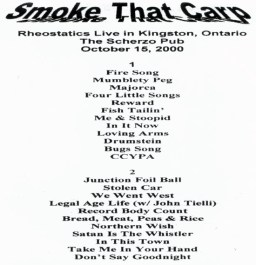
rheoscerzoThis show has some fun art work to go with it.  The notes say:

“Rare original drawing by local artist “tully” drawn during the october 15 2000 rheos gig at the now defunct scherzo pub, kingston, ontario. the story goes that “tully” goes to shows, does a drawing of the band, and just leaves it on a random table for someone (like me!) to find it. i actually found it on the floor!”

The other joke on the set list over here is the Smoke that carp joke which is from Martin talking about something before the set even starts.

They play a lot of songs from the then unreleased NotSS.  The version of “Four Little Songs” is crazy fun–lots of wildness, and a superfast ending.

In addition to playing “Majorca” they play two songs from Introducing Happiness and then talk about Martin’s guitar with the maple leaf on it.  They challenged Gordie Johnson from the band Big Sugar to put a leaf on his guitar. Dave says that not only did he put the leaf on his guitar (on the back) but he plays O Canada at every show now.

In the middle of “Junction Foil Ball” Dave talks about how much he struggled to get the riff (earlier Martin said Dave was very proud of the riff).  It’s a very lengthy talk with demonstration about the riff–quite amusing.

The end of the show has what sounds like an acoustic unplugged set.  Not quite acapella, but Don is only playing the tambourine.  It sounds like perhaps they are in the crowd or near the crowd or something.

Srheoscerzo2o for “Record Body Count,” the crowd sings along beautifully and “Bead, Meat, Peas and Rice” is also done in this format.  For “Northern Wish” Martin say he’s going to start it acoustic while the rest of the band goes back to their instruments.  It’s a great version of the song. In fact all three are wonderful, and it’s cool to hear them sounding so different.

There’s another long chat from Martin about Burton Cummings and how they saw him playing a casino.  It’s very funny.  Then he insists on a “golden drag” on his cigarette before starting the next song.

The disc ends oddly with “Take Me in Your Hand” also done in that acoustic format as the earlier songs–which makes me think it should have been earlier and was placed at the end by mistake.  It sounds great either way.

This is definitely a great show and one for any Rheos fan to enjoy.

[READ: March 5, 2015] “Family Life”

I had recently read something about Zambra that made me want to read him, and then, here he was in Harper’s.  I like serendipity.

This story was translated by Megan McDowell, and I gather is part of a collection of stories called My Documents which will be out soon from McSweeney’s.

This story is a simple one, although it has an unusual beginning.

Martín is headed to a house for a job.  He is to house-sit for a family while they are away for four months.  I enjoyed the way the family members were laid out for us to meet: in alphabetical order: Bruno, the husband, Consuelo the wife (well, actually not the wife, because they never married although they act like a married couple) and Sofía their daughter.

We learn that Bruno sand Martín ‘s fathers were cousins.  Martin’s father has just died.  They barely know each other, although they did know each other when they were kids.  But Bruno tries to strengthen this familial connection, because it builds trust.  Otherwise they have a stranger in their house for four months.

When Martín arrives Sofi runs past him (“These days kids don’t say hi”) chasing the cat Mississippi.  Consuelo is friendly and gives him instructions, which largely entail looking after the cat (who has a swinging door which is open all the time).  When Martín looks at a large hour glass, Sofi runs up and says it last 12 minutes.

To pass the time Martín plays Sofi in chess.  And when they get bored, he changes the rules so that the object is to get beaten, which Sofi enjoys more.

While Sofi is going to bed, Martín and Bruno talk.  Bruno suggest that he “use the time to have ago with one of the neighbors.”  Martín thinks (but thankfully doesn’t say out loud) that he’s like to have a go with Bruno’s wife.

After they leave, Martín discovers a photo of Consuelo and puts it up on the wall.

Martin plans to try a different route every day (different stores, different roads) so as not to make an impression on anyone in the town. But one day Mississippi doesn’t return from his nightly stalking.  Two days go by and Martín grows concerned. So he puts posters up around town.  But when he emails Bruno he doesn’t say anything.

A few days later he sees that someone has posted lost dog posters up over each one of his lost cat posters.  He calls the number (while drunk) and talks to Paz, the woman who put up the posters. He complains about what she has done. The next day she does around moving her posters off of his.  He gets some courage and goes to talk to her about their lost animals.

A week later he sees a dog that looks like hers and he calls her.  They go looking for the dog but don’t find it.  Then, after a month, Mississippi returns. He is beaten up , bloody and gross.  Martín takes him to the vet and gets medicine that he must apply to Mississippi every night.  When Paz calls him, he tells her about the cat and she comes over.

Paz scrutinizes his house–the photo of Consuelo–and he creates and elaborate fiction about his former life with Consuela and their daughter.  How they are broken up and he is reluctant to date.  Later, they have sex and start seeing each other every day.

Things are going quite well, although of course, it is all based on a lie. And the time of Martín’s departure (and Bruno’s family’s return) is coming up.  But the sex is great and he really like her.  She even invites him to go to a wedding with her.

What will happen when it’s time for Bruno and Consuela to return?

This is an unusual story (I guess) to start with because I’m not sure if Zambra’s other fiction is anything like this.  This story was erotic and a bit salacious and was predicated on a lie.  I enjoyed the idea of the main character being someone else and then realizing that he could be that person forever.  (Even if that’s not an original concept).  But Zambra’s handling of the story was really good and I’m interested to read more from him.

Read Full Post »

harp febSOUNDTRACK: RHEOSTATICS-Commodore Ballroom, Vancouver, BC (August 18, 2000).

commThe band went back to the West Coast again (man, they’re everywhere).  They must have played a few shows out there, but this is the only one we’ve got. It’s over two hours and the sound is amazing (thanks so much for soundboard recordings).

Michael Phillip Wojewoda is with them on this leg, playing keyboards.  Which allows them to open with “Monkeys Will Come.”   This is the only other place I know of them playing it after Canada Day.  The recording quality is much better than the Harbourfront show so you can really get a good sense of the song.

Tim Vesely gets two songs in a row with “Remain Calm” and “We Went West” (which they have been extending to nearly 7 minutes).

When they play Satan is the Whistler, Dave says they’re not welcome back in Whistler anymore.  The crowd is rowdy and fun, but at one point someone shouts out for a moment of silence for the Russian Sub (I had to look this up, it was the Kursk disaster).  Dave says, everyone prays in their own way.

“Horses” continues to throw in the “Still Waiting” section from the Talking Heads during the middle improv.  And “Dope Fiends and Boozehounds” has a drum solo and an interesting synth part, along with a very brief coda of “Alomar!”

The set has a weird dancey bit at the end, which seems like maybe the songs are out of order.  It’s hard to be sure, but the set is great nevertheless.

One programming note is that the set list states “RDA” but it’s not.  It’s actually “Song of the Garden.”

[READ: March 5, 2015] “The Moronic Inferno”

As I had done with the New Yorker, I had also done with Harper’s.  Namely, I had put off reading several months worth of issues.  So I’m doing a run through of the last eight months or so.  The good news is that Harper’s is a monthly, so there’s a lot fewer issues to worry about.  Although I do find that I typically write about three or four pieces per issue.  The February 2015 issue had two worthy pieces.

This is an excerpt from Revulsion: Thomas Bernhard in San Salvador, translated by Lee Klein.  It is described as fiction, although Moya appears to be a character.

I have no sense of what the full book is like, but this expert (which is barely a whole page) is one long paragraph with the character of Vega ranting at Moya.  The rant is all about how horrible San Salvador has grown.   (more…)

Read Full Post »

« Newer Posts - Older Posts »