For some sad reason, this video cuts off about half way through the second song, so you need to watch it on YouTube instead. Basia Bulat is a Canadian singer of Polish descent. She’s adorable and plays weird instruments. What’s not to like?
The first song “The Shore” is done entirely on a pianoette–she may be the only singer to play one. The pianoette is a zither-like instrument with a strummed section and a hammered section. Her voice is low and breathy. And when, during the second verse, her backing band’s harmonies come in, it’s quite breathtaking.
The second song is done on guitar. It’s a Polish folks song–she says it was a big hit in the 60s in communist Poland. She sings it in Polish and says it was a great way to learn her Polish words and pronunciations. “W Zielonym Zoo” means “In The Green Zoo.” It’s cute how happy and smiley she is as she explains this song. It begins with just her on guitar and it’s quite a delight when Holly Coish on ukulele, Allison Stewart on viola and Ben Whiteley on bass join in.
Her brother Bobby Bulat joins her on percussion for “Heart Of My Own.” This song is louder and more dramatic and a lot of fun. The final song “In The Night” is one she normally plays on the autoharp (see, unusual instruments) but she didn’t have it so she plays a rollicking guitar version with the full band (there’s some great violin solos in it). Just before it starts she says that if it sucks, don’t use it. It doesn’t suck at all.
I really like Bulat’s music a lot and this is a great way to witness it up close. And here’s a picture of a pianoette.
[READ: January 8, 2015] “Ash Monday”
I wasn’t sure how much I would like this story (same old intro from me) because I didn’t like the main character (or one of the two main characters). Dill is a delinquent. He’s 13 and with a car (well, he has the car, he just cant drive it). And hes loves the smell of gasoline.
When his mother tells him to goes outside to light the grill (as he does most nights–his mom doesn’t cook in the house apparently), he puts gasoline in it to light it up. On this night he discovers a rat in the grill, so he takes the opportunity to dose the rat with the gasoline and set it on fire. (If you’re squeamish, there is also the death of hundreds of chinchillas although that is from natural causes).
We don’t learn much about Dill’s mother except that her husband is gone and she is looking to date someone new.
The scene cuts to the next door neighbor, Sanjuro Ishiguro (Dill calls him “Itchy-goro” and once called him a motherfucking gook). Ishiguro is a respectable businessman. He works long hours often getting to work before everyone else. And although he gets along with his workmates, he is definitely not one of them. They like to ask him about sports when they know he knows nothing about it. (more…)
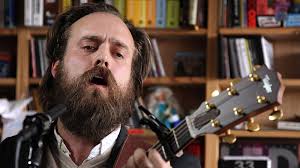
SOUNDTRACK: IRON & WINE-Tiny Desk Concert #105 (January 21, 2011).
I have enjoyed Iron & Wine, but not extensively. I knew that it was more or less a Sam Beam project (until recently, as the band has since grown in size). And I knew that he sang beautiful folk songs. I did not know that he was such an amiable and sweet fellow.
For this Tiny Desk, Beam plays four songs. Three are from his then new album, Kiss Each Other Clean, and they are great. Beam’s voice sounds fantastic and his playing is excellent too.
After the first song, “Half Moon,” Bob Boilen asks him when he has time to write songs and Beam replies that he has less and less time. He has to get up early to take the kids to school, so he works like a day job for song writing.
For the second song, “Big Burned Hand” he begins with the capo on fret five and then switches it to fret four apologizing that it’s early. It’s another beautiful song. At the end he apologizes for the word “fucking” in the final line (“the lion and the lamb are fucking in the back row”) but says that no other word would have had the same impact. He doesn’t use words like that lightly in his songs.
He says that “Tree By The River” is a song he had been writing for ten years. He was afraid it was always turning out saccharine, but thinks he finally got it.
Before playing the final song, Robin Hilton requests an old song (I can’t hear it) which Beam says he will butcher. Robin says he will die happy if Beam plays it, but Beam says he’ll die unhappy if he plays it badly. So instead, the final song is an older one, “Naked As We Came,” which has become a set-ender for the band. Stephen Thompson says it’s great to hear this in this stripped down acoustic format instead of the full band version that has been common now.
And speaking of the full band, when Kiss Each Other Clean came out, the full band of Iron & Wine performed it live on WNYC (you can hear all four of these songs with the full band). And NPR has archived that performance, which you can download here.
[READ: January 7, 2015] “Wakefield”
I have always intended to read more from Doctorow, but he always seems to fall off my radar. So I don’t know how this compares to his other works. I really enjoyed it even if I felt like I had to suspend my disbelief a number of times in what was otherwise a somewhat realistic story.
Realistic or not, I really loved the conceit behind it. The narrator and his wife of many years have had a fight about something stupid. He went off to work as usual, but on the way home strange things happened. First there is a problem with is train and he winds up arriving home much later than usual. And then he finds there’s a power failure (it was interesting to read this right after Updike’s power failure story last week).
He gets out of his car and sees that there are raccoons behind the garage so he chases them away. When he goes upstairs in the garage he sees that there are baby raccoons there too. He chases them away and, since the power is still out and he is mentally taxed, he sits in a tattered rocking chair.
He only wakes up the next morning. And he knows that his wife will never believe the truth. (more…)
As part of my New Year’s resolution, I’m going to try to keep up with the Tiny Desk shows as they happen.
This is the first Tiny Desk Concert of 2016, and I’m afraid it was pretty disappointing.
Rapsody is a rapper, but I feel like she doesn’t have a lot of flow. Or if she does, it’s kind of slow and meandering. There was nothing really captivating about her style. And her rhymes weren’t all that exciting either.
“Godzilla” is a very pro-God song (the twist on God and Zilla is interesting), but the song isn’t that inspired. She spends most of the song asking people to clap (the room is full of students from Howard University). Her rhymes are just not that interesting in this song.
Her second song (with a horrific cheesy sax solo throughout) has a great premise–a song about the boys who have grown up too fast because they lack strong black fathers. The problem with it is that a song like this, which could be powerful as a message, has a chorus of “I been the motherfuckin ….” Which ain’t going garner much airplay.
“Hard to Choose” is about being a black female in hip hop. She wanted to be a good role model for young girls. Once again, her flow isn’t that exciting and her rhymes don’t really do much for me. Of course, she disses hipsters who don’t understand, and I guess that’s me.
Rapsody has some great messages. I wish her a lot of success and I hope that her positive messages are heard by millions. I just wont be listening.
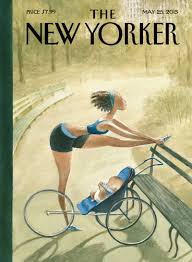
[READ: January 5, 2015] “Outage”
As part of my new year’s resolution, I’m going to read all of the old New Yorker stories from 2008-2015 to fill in any gaps (I’ve missed about 50 stories in seven years). In a few months I should have all of the stories from 2008-2016 (or close to the current story as possible) read and posted. How exciting!
This was something of a perfect short story and a great way to start the back issues.
I don’t read a lot of Updike, for no particular reason. So I don’t really know if this is the kind of thing he typically writes. But the way it was constructed and the details he put in made this story seem so effortless and very true.
Set in the suburbs of Boston, Brad Morris is working from home when a storm comes through the area. The weatherpersons had made a huge deal out of it since they are “always eager for ratings-boosting disasters.” But the actual weather seemed to be on and off heavy rain.
And then just as the storm seemed to be over, the power went our. The description, “the house seemed to sigh, as all its lights and little engines, its computerized timers and indicators, simultaneously shut down.” That is exactly right. (more…)
SOUNDTRACK: NICK BUZZ-Arnold Schoenberg and the Berlin Cabaret (2003).
In 1901, Arnold Schoenberg wrote eight Brettl-Lieder (Cabaret Songs). The songs were short and fun with naughty (cabaret influenced) lyrics. Some 100 years later, inspired by the Art of Time Ensemble who commissioned Nick Buzz to play pieces for their Schoenberg show.
So the guys from Nick Buzz got together and recorded four of the eight pieces. Then Martin Tielli released this disc as number 2 of his Subscription Series. Some of us were a little disappointed when this came out since it was only 15 minutes of music, but the art is wonderful and I have recently rediscovered this disc and have enjoyed it immensely.
Basically the Buzz guys have interpreted the songs in their own style, but they have remained faithful to the original melodies and lyrics (which were in German but are now in English).
“Gigerlette” explores electronic manipulations (presumably by Hugh Marsh) and offers lots of fun samples (what I assume is some earlier recordings of the song in German). It opens with sampled female singing and staccato piano as well as other unusual effects. Then Martin’s vocals come in and the effects clear out and the song becomes simple piano ballad for a brief moment. Then the noises come back in again, playing around with this amusing song. It’s a song of romance and love with the sweet punchline being that cupid is driving their coach and four. At over 5 minutes this is the longest song by far, even if the basic song is just over two minutes.
“Der genugsame Liebhaber” (The Modest Lover) opens with what sounds like a distorted harp (presumably the piano) and scratchy records (from Marsh). This song is about a man going to see his lover, but his over’s pussy loves his bald head so much that she continually climbs atop it. It is charmingly naughty. There’s some wonderful violin from Hugh Marsh on this song
“Galathea” is the most conventional of the three songs. A lovely piano ballad to Galatea.
“Arie aus dem Spiegel von Arcadien” (Aria from the Arcadian Mirror) is super fun. The music is weird and goofy with a very drunken feel. And the chorus is just wonderful “my heart begins to thump and dance just like a hammer’s blow it goes boom boom boom boom boom boom boom boom boom (getting faster and faster). I’ve listened to the original and it is very much the same, although Nick Buzz’s version is much better.
You can find some of these songs on line from a recording at Lula’s Lounge (Dec 9, 2010)
It’s cool to see how they recreate the album so faithfully in a live setting. It’s only a shame that the video isn’t a little closer so you could see just what they are doing.
Nick Buzz-December 9 2010 Lula’s Lounge
[READ: September 1, 2015] My Documents
I have enjoyed some of Zambra’s stories in other locations, so I was pretty excited that McSweeney’s released this collection (translated by Megan McDowell). The book is pretty much all short stories, although the first items feels a bit less fictional and more memoirish.
“My Documents”
This is a brief historical account of Alejandro as a child and as a writer. He talks about when he started working on computers and what happens when the computer dies with the information inside. He explains that this file is in his My Documents folder and he’s going to publish it “even though it’s not finished. Even though it’s impossible to finish it.”
“Camilo”
I read this story in the New Yorker. It concerns the relation of a man and his godfather, whom he has not seen since his father and godfather had a falling out years ago. See my link for a more complete synopsis. I enjoyed it just as much the second time.
“Long Distance”
The narrator worked as a phone operator in 1998. He liked the job–his boss was cool and would let him do anything he wanted so long as he answered the phones quickly. The job was in a travel insurance office and one day he received a call from a man named Juan Emilio. After speaking for a time about various things, the narrator realized it had been 40 minutes since they first started talking. They were expected to call clients back 14 days later as a follow-up and this time Juan Emilio talked with him foe a while and, upon learning that the narrator studied literature, asked if they could meet and discuss books. The narrator was already teaching classes at night, and these two situations overlapped somewhat. I loved the way all of this information is used as backdrop to a romance he has with a student known as Pamela. And the final line is great.
“True or False”
The titular phrase is uttered by a boy, Lucas, who declared, based on an inscrutable internal feeling, that things were True or False. An armchair might be true, while a lamp might be false. Hid father Daniel had a cat, Pedra, even though pets were forbidden in his building. Lucas loved the cat. Then the cat had kittens. There is a metaphor at work about the fatherless kittens and Daniel’s own behavior toward his son. I really enjoyed this story and the strangeness of the true or false brought a fascinating childlike quality to the story
“Memories of a Personal Computer”
The conceit of this story is great. A PC remembers what it was like to observe a relationship as it begins and then ebbs–and how the PC was moved around into different rooms as things changed in the relationship.
“National Institute”
At the school where the narrator went, they were called by number. He was 45. The main subject of his story was 34, although he doesn’t know the boy’s real name. 34 had failed the grade and was made to repeat it, but rather than being sullen about it, he was popular and fun. All of the students were worried about failing–the final test was very hard. But one day 34 approached 45 and told him he had nothing to worry about. The other students didn’t know what to make of it, but he slowly assessed everyone and told them whether they had anything to worry about. By the end of the story, when 45 is brought to the inspector of schools, he is told a lesson he will should never forget.
“I Smoked Very Well”
A look back on smoking and how quitting smoking made him a different (though not necessarily better) person.
“Thank You”
She is Argentine, he is Chilean and they are not together (even though they sleep together). They were in Mexico City when they were kidnapped together. The incident has unexpected moments. It’s a weird story (with some really unexpected moments) but a really good one.
“The Most Chilean Man in the World”
A Chilean couple has decided to separate once she was accepted to school in Belgium. After several months he is convinced that she wants him to visit, so he spends a ton of money and heads out to Belgium. Without telling her. And it goes very badly. But he can’t just leave Belgium, now can he? So he goes to a pub where he meets some new friends who call him the chilliest man in the world. The story hinges on a joke, but the story itself is not a punchline.
“Family Life”
I read this story in Harper’s. I thought it was fantastic–it was one of the stories that made me want to read more of his works. This is story of a man house sitting and the false life that he constructs around him. It was surprisingly moving.
“Artist’s Rendition”
I loved the way this story began. It tells us that Yasna has killed her father. But we slowly learn that Yasna is character in a detective story that an author is trying to write. We learn how the author constructs details about this character and the things that she has experienced which make her who she is. As this story unfolds we see how those first lines proved to be true after all.
This was a great collection fo short works and I really hope to see more from him translated into English.
SOUNDTRACK: RHEOSTATICS–The Media Club, Vancouver, BC, (October 21, 2004).
Every year, the Rheostatics would perform what they called Green Sprouts Week in Toronto. In 2004 they did a West Coast version. Five nights in a row at The Media Club (with each show being crazier than the last). There aren’t always recording available for these shows, but on this leg there are recordings from the third, fourth and fifth nights.
This recording is about 90 minutes and I assume is edited (most of their GSMW shows are quite long and there’s no banter). There’s also crazy static on a certain instrument, which mars the quality somewhat.
The band has added keyboards, although I’m not sure who is playing them. Morgan from The Buttless Chaps guests on a nice rendition of “Claire.” They play a great version of “Jesus Was Once a teenager Too” with a folky breakdown in the middle. “Take Me in Your Hand” is slow but really good.
There’s goofing on “Song of Flight” with them ending the song quickly and booing and yelling “stinky” I wonder what happened). “Marginalized” is blistering and “Record Body Count” is a little goofy. Perhaps the highlight of the night is “Horses” which is an amazing rendition and ends with a few lines and acoustic guitars from “When Winter Comes”
The encore starts with “Pornography” a song later recorded by Bidiniband. Then there’s some great harmonies on “Dope Fiends and Boozehounds.”
They do a rocking version of Talking Heads’ “Life During Wartime” which is musically spot on, even though no one really knows the words. The last few songs are more covers. A very fast version of Jane Siberry’s “One More Colour,” and then a perfect version of “Takin’ Care of Business” (the guitar and vocals sound right on) which segues into a sloppy/fun “My Generation.”
The Green Sprouts shows often allow the band to mess around a bit which is great for fans.
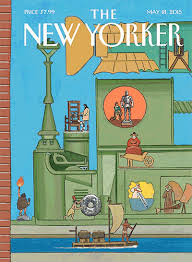
[READ: July 21, 2015] “The Duniazát”
I generally like Rushdie’s work. This story is told in the style of a 1001 Arabian Nights tale and consequently I didn’t enjoy it that much. Although I was interested to find out some details about those stories. There was originally a Persian book called “One Thousand Stories” which had been translated into Arabic. In the Arabic version there were fewer than a thousand stories but the action was spread over a thousand nights, or, because round numbers are considered ugly, a thousand nights and one night more. Huh.
The stories featured a beautiful storyteller knows as Sheherazade, who told her tales to a murderous husband in order to keep him from executing her.
Anyone, in this story, Rushdie tells a similar type tale.
Set in the year 1195, the great philosopher Ibn Rushd (I enjoyed the play on his own name there) was a physician to the Caliph. But when he started espousing liberal views, he was discredited (sound familiar?). He wound up living in a village where Jews were forced to convert to Islam and could not speak of Judaism. So he felt right at home as an outcast. (more…)
SOUNDTRACK: RHEOSTATICS-Evolve Festival Antigonish, NS (August 28, 2004).
The Rheostatics do a lot of festivals, and they always seem to have a good time. But it also means a shorter set. Unlike yesterday’s Nova Scotia show, this one doesn’t focus on new music too much (although they mention that 2067 is coming out Oct 5).
The sound quality isn’t great in this show either–there’s a lot of rumbling which sounds like winds, but who knows.
But they are even more charming in this setting. Dave compliments someone one on their excellent sign and says that the sign demographic has let everyone down for this show–so her request will be honored.
The show starts with a cool jam from the Whale Music soundtrack (mostly “Song of Flight”). When they play “Four Little Songs” one of the verses is a verse from Gordon Lightfoot’s “Early Morning Rain.”
Later they play a great version of “Saskatchewan” and perennial festival mates Chris Brown and Kate Fenner are there to help. During “Stolen Car” they sing a few lines from “Another Brick in the Wall Pt 2.”
There’s great versions of “California Dreamline” and “Claire.” The show ends with the new song “Power Ballad for Ozzy Osbourne” and there’s a breakdown during the song (no way to know what happened, but they have a laugh about it).
You can see photos from the day here (although none of the Rheostatics).
[READ: July 21, 2015] “The Freezer Chest”
I found Nors’ previous story to be a little odd. And so I find this one. There’s something about the way it was written (or translated) that I found it very stiff to read. It is also told in a flashback which is later revealed to be a very-long-ago flashback.
What is particularly strange about the story is that the “action” of the freezer chest is all of about three paragraphs. And while the story isn’t long overall, it takes a circuitous route to get to that part.
The narrator is a young girl, Mette. She is on a boat with her classmates and their English teacher. Mark is also part of the group and he has made it clear that he does not like the narrator (that happened in a previous instance). The crux is that Mark claimed to be an amazing guitarist. And he is trying to get the narrator to respond to this information. She genuinely does not care although she says she believes him. (more…)
Rheostatics are reuniting for 3 shows at the Art Gallery of Ontario in a few weeks. And I am going to see them!
So it’s time to listen to a few shows from eleven years ago. This show doesn’t even mention a club, but that’s ok. It’s a fun gig in Nova Scotia. The quality of the recording is not great–it was recorded in the audience and you can hear a lot of audience chatter (and consequently the band is not as clear as could be).
Their final album 2067 is out in just a few months from this show, and they play a few songs from it: “Marginalized” and “The Tarleks.” Later, Martin describes “Aliens” as “The Tarleks Part 1.” They also play “I Dig Music” a fun jazzy number. There’s a drum break in the middle and drummer MPW says that he was trying to play the intro from Rush’s “Lakeside Park.”
There’s a wild middle section in “Satan is the Whistler.”
This show has lots of banter, and there’s a discussion about an audience member mocking The Headpins. And later when a fan says his friend was kicked out, Dave gets mad at the bouncers and seems genuinely concerned for the friend and offers to go get him.
After they play “My First Rock Show” they ask MPW about his first rock show. The discussion devolves into a discussion of John Cage’s smell (Old man vegan smell).
For “Take Me in Your hand” a fellow named Reid does guest vocals.
During the encore they play a version of happy birthday to someone whose birthday it is which is followed by a scorching version of “Rock Death America.”
As the encore winds down Dave says “dim the lights, chill the ham,” which I assume is a nod to fellow Canadians Shadowy Men on a Shadowy Planet and their 1991 album. Martin (I assume) also starts playing around with a voice modulator as the song ends.
If the audio was better this would be an amazing show.
[READ: July 20, 2015] “So You’re Just What, Gone?”
I’ve enjoyed most of Taylor’s stories, even though his protagonists tend to be unpleasant. But this story felt entirely too insubstantial for me to get beyond the grossness of it.
Charity is a high school student. She is flying with her mother to visit her grandmother. She doesn’t want to go and doesn’t want to be with her mom. She’s pleased when she and her mom are separated on the plane (five plus hours of freedom!).
She winds up sitting next to a guy who tries to be chatty with her. She wants none of it, but when she wakes up mid-flight to find that she has been sleeping on the guy’s shoulder, she feels a little bad and actually talks to him. When Mark asks her if she gets bored and then says she is pretty, you know things are creepy.
When Mark he grabs her inner thigh and squeezes it and then gives her his business card, well, you just know the guy is a shit. (more…)
Oddisee is a positive rapper. That photo of him smiling really conveys the tone of his songs–well, that and the fact that the first song is called “That’s Love.” He raps really quickly. He also gets a wonderful call and response going on “That’s Love” where he has the NPR staff sing along to his chorus. (The opening scene shows him practicing with the audience). And he really gets everyone going.
I don’t know what his recorded output sounds like, but in this Tiny Desk, he’s with only a keyboardist and a drummer. The live drummer is a great addition.
“Contradiction’s Maze” has a few sung choruses (he has a good singing voice too). They don’t really modify the keyboard sound for the songs, which isn’t all that interesting. It sets a nice background for all the songs, but it does make things sound a little samey. “Belong To The World” is similarly uplifting, but I honestly had a hard time distinguishing it from the previous song.
Despite that, his positive attitude and generally upbeat personality were quite infectious.
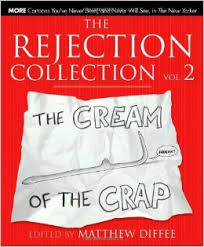
[READ: July 24, 2015] The Rejection Collection 2
The Rejection Collection is back! Presumably the first collection was successful enough that Diffee was prepared to do another one. He gathers many of the same cartoonists (although at least a half a dozen did not return) and he gathered some new folks as well (for a total of 38 this time).
Returning: Leo Cullum, Pat Byrnes, Sam Gross, Mike Twohy, C. Covert Darbyshire, Drew Dernavich, Christopher Weyant, Kim Warp, John O’Brien, Marisa Acocella Marchetto, Danny Shanahan, Mick Stevens, Mort Gerberg, Michael Crawford, P.C. Vey, Gahan Wilson, Glen LeLievre, Alex Gregory, J.C. Duffy, Carolita Johnson, Ariel Molvig, Michael Shaw, Eric Lewis, P.S. Mueller, David Sipress, Jack Ziegler.
New additions include: Paul Noth, Roz Chast, Marshall Hopkins, Nick Downes, Robert Leighton, Julia Suits, Zachary Kanin, Harry Bliss, Jason Patterson, J.B. Handelsman, Sidney Harris, Jack Ziegler, Robert Weber. (more…)
SOUNDTRACK: HOP ALONG–Tiny Desk Concert #450 (June 22, 2015).
Not too long ago a friend asked if there were bands that we wanted to like but didn’t. Some people just said no, of course not, you either like a band or you don’t. But I knew what he meant. There are a lot of bands that I’d like to like. And Hop Along is one of them.
Lead singer Frances Quinlan has the kind of raspy voice that is practically iconic (think Janis Joplin after a rough day). And their music, which is kind of folky, also has a rawness that should combine with her voice to make me listen all the time.
And yet, for all of that, I really don’t like her voice. It should be right up my alley but it, well, isn’t. And that goes a long way to me not really liking the band.
They play three songs and although the blurb about the band talks about the music being more than her voice, I really can’t get past it.
None of the songs is bad, although they all sound a bit the same to me (her voice again). “Horseshoe Crabs” has a folky feel and some soft/loud sections.
“Well_Dressed” has some unusual dissonant chords thrown into the mix. It’s especially interesting given the pleasant acoustic guitar that accompanies this song.
“Sister Cities” has some lyrics about shooting your dog which is a bit of a turn off.
So yes, I would like to like Hop Along more, but I just don’t.
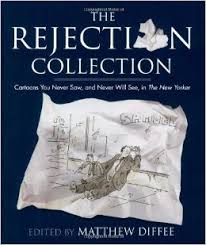
[READ: July 20, 2015] The Rejection Collection
I heard about this book because it was listed under Matthew Diffee’s books in his bibliography. I enjoyed his Hand Drawn Jokes for Smart Attractive People so much that I wanted to see what else he’d done. Well, I didn’t quite understand the premise of the book. Instead of it begin a collection of his rejected cartoons, he had edited a collection of cartoons that were rejected by thirty of the New Yorker’s regular contributors.
Which means there’s a lot more variety and a lot of funny stuff in here.
He gives us some context: each issue of the New Yorker has about 15-20 cartoons. There are some 50 cartoonist vying for these spots. Each of these 50 artists brings 10 cartoons each week and the editor pick the few that will make it (and those that are chosen are the only ones who get paid).
So that means that there are dozens of really good cartoons that just aren’t going to make it. Many of those cartoons will be saved by their creators and submitted somewhere else or even back to the New Yorker in case the editors have a change of heart.
There are many reasons why cartoons are rejected. Some aren’t very good, some aren’t appropriate for the magazine, and some just aren’t as funny as others this week (but may seem even funnier in two weeks’ time).
If you’ve read the new yorker (or ever been in a cubicle) you have seen the work from most of these people (even though you probably don’t know their names):
Leo Cullum, Pat Byrnes, Sam Gross, Mike Twohy, C. Covert Darbyshire, Drew Dernavich, Christopher Weyant, Kim Warp, William Haefeli, John O’Brien, Marisa Acocella Marchetto, Danny Shanahan, Tom Cheney, Mick Stevens, Mort Gerberg, Michael Crawford, P.C. Vey, Barbara Smaller, Arnie Levin, Gahan Wilson, Glen Le Lievre, Alex Gregory, J.C. Duffy, Carolita Johnson, Ariel Molvig, Michael Shaw, Eric Lewis, P.S. Mueller, David Sipress, Jack Ziegler.
SOUNDTRACK: STRAND OF OAKS–Tiny Desk Concert #449 (June 15, 2015).
I didn’t know anything about Strand of Oaks when I first heard them last year. I assumed from the bio info that I’d heard that he, Timothy Showalter, had been in a a band and that this was his solo project. But no. His history is actually far more interesting.
The Wikipedia summary is pretty simple and shocking:
While Showalter was on tour, his wife had an affair. Escaping his detrimental relationship, he moved back to Wilkes-Barre, Pennsylvania in 2003. A couple of months later, he came home to find his house burned down. [WHAT??]. Showalter spent his nights in hotels and on park benches with a borrowed guitar while working at an orthodox Jewish day school. Despite the turmoil, he was able to find inspiration to continue writing music that would later be released.
He released three self-produced albums and then made Heal. Which ALSO has a shocking tale attached to it: On Christmas Day in 2013, Showalter and Sue were driving back to Philadelphia from Indiana when they hit a patch of ice and crashed into two semi trucks. Showalter suffered a concussion and broke every rib on his right side. The near-death experience gave Showalter a boldness during mixing sessions while creating HEAL with John Congleton, just days after the crash.
Yipes. I don’t know his earlier records, but I really like Heal. It’s got an interesting sound, with some great guitar work.
For the Tiny Desk, he plays three songs. The first is the single from his album, “Goshen ’97”. This version is just him on his black electric guitar with lots of echo. It’s very slow and kind of broody. I prefer the original, but this is a very interesting version. And his voice sounds really good in this stripped down style.
After the first song he says how nice it feels to play this gig–just what he imagined it would be like. He says he could play there a long time and when someone says “Ok” he say they’d get sick of him: “Oh that bearded guy is still here.”
“Plymouth” has even more echo on the guitar–this one a hollow bodied steel string guitar. It sounds lovely and since I don’t know the original as well, I like this slower more meditative version.
“JM” is for Jason Molina and for this track, he switches its back to the black electric. I love the album version of this song a lot, as the soloing is just fantastic. This version is quite different. Again, it’s slow and broody, and really good. I still like the album version (because of the solos) but this is good too.
I’m fascinated by Showalter now, and plan to see what his earlier albums sound like.
[READ: June 15, 2015] Hand Drawn Jokes for Smart Attractive People
Although I was unfamiliar with Diffee’s name, I was familiar with his cartoons from the New Yorker. Diffee has three other books out (under the Rejection Collection moniker–he’s great with book titles). I certainly loved the title of this book.
There are 16 chapters in the book–each is devoted to a particular topic and has a rather amusing introduction in which Diffee goes off on that subject: Medical Professionals, Lumberjacks, Relationships, Pet Owners, Old People, Utensils, Real Jobs, Indians and Eskimos, Food, Sex, Prison, Religion, Wealth, Children, Sports and Tattoos.
What I really enjoyed was that the cartoons that fill the introductory sections look very different from his more “official” style (which I recognized immediately from the magazine). It’s cool that he has a distinctive style but is not pigeonholed into that style.
Occasional cartoons have an accompanying silhouette (presumably himself) with an extra bonus joke tangentially related to the topic. Sometimes these are funnier than the original cartoon. (Does a polygamist refer to his wives as his “better eighths?”).
It’s hard to mention favorite cartoons without describing the cartoon, which is never funny, but there are few punchlines that work with out a visual, like:
“Therapist: “These feelings of inadequacy are common among the inadequate.”
Waitress: “Sorry, we don’t serve the Lumberjack breakfast to accountants.”
Drug sniffing dog: “I’m starting to really like the smell of cocaine.”
And this one which is not from the New Yorker: “Wade Greenberg, wearing his hemp blazer, inadvertently became the life of the party when he stood too close to the menorah.”
He also really loves to hate sporks: (50% spoon, 50% fork, 85% useless).
All of these are funnier with the accompanying cartoon of course, and I really like his drawing style.
By the way, the section on tattoos was capped off by “knuckle tats you’ll never see” like FLAU TIST or ALAN ALDA.
I enjoyed this book a lot and will certainly look for his previous collections.
 OUNDTRACK: BASIA BULAT-Tiny Desk Concert #106 (January 24, 2011).
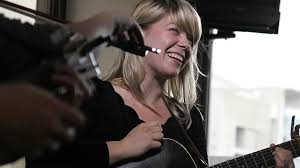 For some sad reason, this video cuts off about half way through the second song, so you need to watch it on YouTube instead. Basia Bulat is a Canadian singer of Polish descent. She’s adorable and plays weird instruments. What’s not to like?
 Her brother Bobby Bulat joins her on percussion for “Heart Of My Own.” This song is louder and more dramatic and a lot of fun. The final song “In The Night” is one she normally plays on the autoharp (see, unusual instruments) but she didn’t have it so she plays a rollicking guitar version with the full band (there’s some great violin solos in it). Just before it starts she says that if it sucks, don’t use it. It doesn’t suck at all.