Feeds:
Posts
Comments

Archive for the ‘Lucky Peach’ Category

SOUNDTRACK: RHEOSTATICS-The Quilted Bear, Banff, Alberta (February 11, 1997).
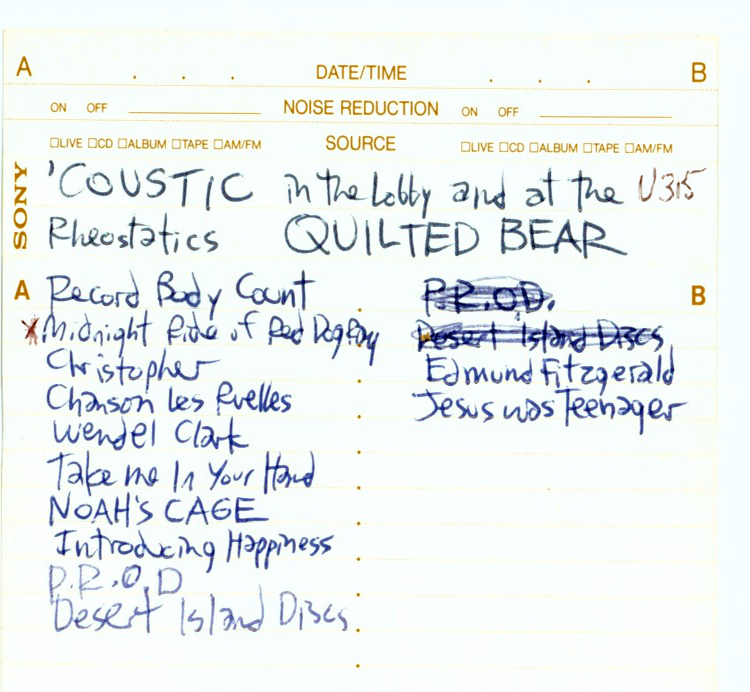
I am quite surprised that the Rheostatics Live site doesn’t make a bigger deal about this show, given its unique nature.  This is an acoustic show that sounds like it was played in front of ten people and a lot of beer.

The shows seems to have started with the second song (at least the way Dave introduces it).  But the first track is a romping acoustic “Record Body Count” (sound check? or maybe just put out of place?).  Whatever, it sounds great with some electric guitar squeals but mostly just folk style with lots of backing singers).

The show proper starts with Dave introducing “an Ontario drinking song.”  There’s lots of shushing as people keep talking over him (although those people might be Tim an Martin).  Dave says, “a drinking song, there’s got to be some drunks talking.”.  Dave tells the story behind the sons and then they launch into a spirited rendition of Stompin’ Tom Connor’s “Midnight Ride of Red Dog Ray.”

Next comes “Christopher.”  It’s hard to believe they used this version for Double Live because it is so imperfect.  Martin coughs in the beginning and his voice cracks a bit.  But it sounds great and is a wonderfully unique version, especially for the live record.

It’s followed by a folksy rendition of “Chanson les Ruelles.”  Although Tim is too quiet.  mid song, you can hear someone in the crowd says “is it in French?  Yea!”  The version of “Wendell Clark” that comes next is only the second part.  But it is stompin and rompin (with someone yelling “yeeeha”).  At the end someone shouts Wendell broke his back.  “He didn’t really break it.”  “Well, he hurt it.”

Someone shouts for “Palomar” (or “Alomar” that seems less likely).  But they play “Take Me in Your Hand” instead.  It is also a folkie version and the end features a percussion addition of wood blocks.

Dave shouts “Hey, Mike, you wanna do Noah’s Cage?”  I have to assume this is Mike O’Neill from The Inbreds (the song is an Inbreds song).  They play the song although Mike forgets the second verse so he repeats the first.   He says its been a while since he played it.

Martin introduces “Introducing Happiness: as “this is a song about being happy.”  Dave says, “I hope so.”  It’s followed by a surprising acoustic version of “P.R.O.D.”  Surprising only because the song tends to get noisy and out of control, but it’s not in this version.  Towards the end, Dave shouts “all percussion solo–whatever you got.”

Martin busts into the melody of “Dope Fiends” but instead they play a long funny version of “Desert Island Discs.”

Dave: AC/DC-Back in Black; Ramones-Rocket to Russia; Martha and the Muffins-Danseparc.
Tim: The Inbreds-Hilario; The Inbreds-Kombinator ; The Inbreds-It’s Sydney or the Bush.
Donny: Randy Newman-Creates Something New Under the Sun; Grace Jones-Nightclubbing; Herbet von Karajan conducts Beethoven’s… “Last Waltz?” (Dave: could you believe he said the classical one?)
An audience member: Kiss-Dressed to Kill;  The Beatles White Album, and… someone says Billy Idol-White Wedding.  Dave: Billy idol?  Gigs over.  And a later line: I’m going to get me to an island not with that guy though, he wants to bring Billy Idol. I don’t even think White Wedding’s the name of the album (it’s not)–although the fans argue the point).
One last guy: Pink Floyd-The Wall; Led Zeppelin-IV… how many picks? How many picks!?)  ZZ Top-Degüello.

“The Wreck of the Edmund Fitzgerald” is sung my Tim, Dave sings “I wish I was back home in Derry” at the appropriate moments.

They end with a piano-based version of “Jesus was Once a Teenager Too.”  He has to start again (“it’s just that that thing fell over”), but when he does it sounds really good–very different.

What a fun show to have been at.  There’s a lot of interaction with the band and fans–I really wonder how many people were there.

[READ: April 3, 2017] “Girlfriend on Mars” 

This story is probably my favorite Lucky Peach story (even if it had nothing to do with food).  Although the end seemed to maybe spiral out of control a little bit–with a finale that was, possibly, a little trite (although, not exactly).

This plot is simple.  Amber Kevinn, the narrator’s girlfriend is going to Mars.  Well, maybe.  She has (unbeknownst to Kevin) entered a reality show contest in which two winners will be selected to travel to Mars on MarsNow.  They will live on Mars until they die–no hope for returning.  This story intersperses the contest with just how Amber’s boyfriend feels about the whole thing.

Amber and Kevin are drug dealers.  Well, not exactly–they sell drugs, but only to family and friends.  They grow them hydroponically–this skill with plants was one of the reasons she was accepted for Mars in the first place.  But why didn’t she say anything to her boyfriend (of twelve years!) until it got to this point?

She made a video, she sent in an essay she even met with the TV people–all without him knowing.  Of course, Kevin’s a pretty heavy stoner at this point so he doesn’t notice much. (more…)

Read Full Post »

secondsSOUNDTRACK: FOO FIGHTERS-Wasting Light (2011).

Foo_Fighters_Wasting_Light_Album_CoverThis summer I began writing about Foo Fighters’ albums.  Somehow I stopped before the final two.  Even though I had talked about Wasting Light before, in respect of a sense of continuity here’s more words about it.

It took four years for the Foo Fighters to release this album (I guess Grohl was doing one of his many side projects?).  The big story about this record was that Grohl wanted it all recorded with analogue equipment (in Grohl’s garage).  And he chose Butch Vig, who recorded Nevermind to do the work. Pat Smear was also included as a member of the band for this album (he even plays a baritone guitar)

Although to my ear it doesn’t sound any different from the digital recordings, there is a warmth and bigness to the album that their recent records seemed to lack

“Bridge Burning” opens with a bunch of muffled notes that give way to a big screamed opening verse.  This song grows more adventurous with some guitar harmonics at the end of the verses. The bridge leads to a classic Foo Fighters chorus (with more vocal harmonies in the background, that just seems to make it feel bigger)).  I love the descending chords in the (what, sixth?) part of the song.  Before the simple but great closing riffs.  It was released as the fifth (!) single from the album.

“Rope” was the first single.  It opens with some echoed guitar chords and then what sounds like a big old Rush riff and intro.  The riff is a little unusual but really cool (guitarist Chris Shiflett to comment that “What my guitar is doing over the bass makes no sense in a way. It does, but you don’t know how.” ) The verses have that riff in between them and a big “ow!” in the bridge.  Unsurprisingly, despite all of the oddness of the verses, the chorus is big and friendly with some great sing along parts.  There’s even a section for a (brief) drum solo.

Bob Mould (clearly an influence on Grohl) came into sing and play guitar on “Dear Rosemary.”  You can’t really hear him all that much, but when he pops up (especially near the end) it sounds great.   “White Limo” is a punky blast, with Grohl’s vocal shredding (lyrics are pretty much inaudible) right from the get go.  There’s some interesting riffs and chord changes (the music is so much cleaner than the distorted vocals).  “Arlandria” sounds like the Foo Fighters, but there’s something unusual about the feel of the song (the bridge especially).  The chorus is pure Foos, but the verse has an interesting style that’s not like anything Grohl has done before.

“One of These Days” opens with some rather unusual guitar notes (Grohl has clearly been experimenting with his guitar skills over the years).  It progresses into a smooth verse and then shifts to a big (but short) chorus with stadium chords and then another sing a long part after it.  It’s a very cool song (and Grohl has said it’s his favorite song that he’s written).

“Back & Forth” has a strange backwards kind of riff that opens the song and a kind of chugga chugga heavy metal guitar verse.  The song is one of the simplest ones on the record–almost completely poppy (if not for being so heavy).  It also seems weird that it ends with the riff too.  “A Matter of Time” starts out as mostly drums and vocals with some guitar riffs. It moves to a kind of unusual staccato riff around one minute and then turns into yes, a huge chorus.  The verses after the chorus seem bright and sweet with a newly added guitar line.

“Miss the Misery” features Fee Waybill, lead singer from The Tubes (and a friend of Grohl’s).  The opening riffage actually reminds me a song by Aldo Nova (who?).  I like the chorus (and backing vocals, although I never would have guessed it was Fee Waybill).

And Krist Novoselic plays bass (and accordion!) on “I Should Have Known.”   It has a slow echoey intro (complete with mellotron and strings).  It has an aching vocal delivery in the chorus.  The bass doesn’t really kick in until about 3 minutes (when the song really fills out)

“Walk” ends the album.  It is pretty classic Foo Fighters at this point, a slow opening and then big choruses (and was written about helping his daughter to walk).  This one even has a radio friendly pause in one of the choruses.   (I love that the final song was released as the second single, and am so glad they didn’t front load the album!).  And that the song and album end with a fast chord .

This is a solid album from start to finish.  I think when they keep their albums under 50 minutes, they keep the music tight and don’t throw in any filler.

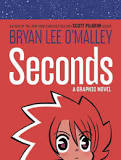
[READ: January 13, 2015] Seconds

Wow I loved this book.

I had been reading a lot of graphic novels and I was a little burnt on them, but this one rose above everything else I’d read in a while.

O’Malley did the Scott Pilgrim series, one of my favorite series and a darn good movie too.  While this has similar sensibility to Pilgrim (including the punchline of the same joke, ha) I think this being a a single book made it more impactful.

The story is about Katie.  She is a chef.  She also looks a lot like the style of O’Malley’s characters–sort of short roundish features, bordering on anime but with his own style thrown on top.  Katie’s most recognizable feature is her awesome flame of red hair on top of her head.

Katie co-owns Seconds, a very popular restaurant.  People come for her food because she is a very good cook.  Even if she doesn’t actually do much cooking anymore–she’s more a manager than a chef (having read a lot about chefs in Lucky Peach, I understand what this whole scene is like more than I might have otherwise).  She is really interested in opening up her own place (called Katie’s) across the river.  Since she is only co-owner of Seconds, she wants to be out of it and into her very own restaurant (even if she still likes the other co-owner).

We meet the others who work at Seconds.  The new head chef Andrew (with whom there’s a bit of a romance) and the waitresses, especially Hazel, a very tall mousy kind of woman whom everyone else thinks is very strange.  Hazel is quiet, she’s really hot, and she always wants to close the restaurant at night (others have seen her doing strange things before she leaves). (more…)

Read Full Post »

lp14SOUNDTRACK: YES-Relayer (1974).

Relayer_REMUS_spine_Layout 1After Tales, Rick Wakeman left and the band decided to get back to business.  So they made an album kind of like Close to EdgeRelayer is a dark album which didn’t quite bring the band back from the brink (even if there were only 3 songs and one was 20 minutes long).  It did sell well, though, even if there wasn’t any real radio airplay.

I happened to really like this album in college (my friend Sean introduced me to it).  And there are moments here that I think are great, but I can also see that it is not quite as user friendly as CttE.

I love the way “The Gates of Delirium” opens with guitar harmonics and some loud bashes of noise (good to see Squire and White asserting themselves again).  The lyrics come in around 2 minutes in and it’s a very sweet and interesting opening.  The guitar lines grow more complex as the song progresses.  Anderson says that it is a war song, with a prelude, a charge, a victory tune, and peace at the end, with hope for the future.  The “listen” section is quite catchy and moves along very well.

Around 5 minutes, the song changes into more of an instrumental sound (the charge, perhaps?)  A great riff begins at 8 minutes with a very heavy section (the battle?) beginning as well.  Squire takes over around 10 minutes and then the chaos befalls the song.  Anderson and White stopped by a scrap yard and bought metal car parts which were used as percussion during the song’s battle section. During the battle section, White formed a tower of the parts and pushed it over to make a crashing sound.

Patrick Moraz (who later played with the Moody Blues) took over for Rick Wakeman on this album and the difference is notable.  Moraz adds good keyboard sounds, but it is so clearly not Wakeman–there’s no flourishes or frills  (one imagines he would have added some pretty impressive things to this battle scene).

At around 13 the battle ends and a new riff comes out–uplifting but not overtly so.  Then things mellow out at around 15 minutes, with some washes of sound.  The biggest surprise comes around 16 minutes when the song turns very pretty with a slow echoey section known as the “Soon” section.  This section, which is about 5 minutes, was released as a single.

Track 2 “Sound Chaser” opens with a weird keyboard sound and then some chaotic drumming and bass (it’s loud and cool).  This is their jazz fusion song with drumming that’s all over the place and some cool riffs.  There are vocals (it’s hard to imagine them fitting vocals on to the riffage).  And then around 3 minutes the song turns into a big time guitar section with a lengthy dramatic solo and then Moraz’ keys underneath.   At 5 and a half minutes the songs mellow out an Anderson begins singing a gentle passage.  Then a little after 6 minutes the songs repeats with the chaos of the opening and that cool riff.  But this time, a noisy guitar picks up afterwards and a new riff begins and slows down until the unusual “cha cha cha/cha cha” section begins.  It’s followed by a wild keyboard solo from Moraz.

“To Be Over” opens with some more gentle notes as it slowly builds. Sitar plays over the notes.  This is a mellow track with lovely harmony vocals.  There’s an interesting slide guitar section in the middle of the song.  It shifts to a very typical Steve Howe guitar solo after that (very staccato and interesting).  By 5 and half minutes there’s big harmony vocals and then around 7 and a half minutes the song breaks into a new, catchier section, with a cool keyboard outro.

It’s not as immediate and grabbing as previous Yes albums, but I still think it’s pretty great.

Since almost every Yes album had different personnel, I’m going to keep a running tally here.   Here we have a new keyboardist, although Wakeman would soon be back.

Chris Squire-bass
John Anderson-vocals
Alan White (#2)-drums
Patrick Moraz (#3 replaced Rick Wakeman)-keyboards
Steve Howe (#2)-guitar

[READ: March 24, 2015] “The Route”

I’m generally puzzled about the fiction in Lucky Peach.  It’s usually food related, which makes sense. But this one wasn’t especially.  And then at the end of the story to see that it was originally published in Escapes in 1990 just makes the whole thing seem odd.  But hey, they can publish what they want, right?

The story is about a married couple–she is a youngster and he is middle-aged.  Their marriage is poor and so they go on a road trip from New York.

Each entry in the story is about a spot and what they did that day–traveling through Connecticut and Spotsylvania, Virginia.  Until they get to North Carolina where he is bitten by a bat.

And this is evidently, fatal.

They continue on South, with this soon to be fatality proving to be an aphrodisiac.  They go through Georgia and into Florida. And they finally get to Mile 0 in Key West.

The whole story was strange and unsettling and I really didn’t get a lot out of it. It seems odd that they would bother to reprint it here.

~~~~~~~~

The rest of the issue was, as usual, excellent.

There were several articles about wheat and other grains and interviews with different chefs.

But my favorite article was the one about Colonial Chocolate (and how Mars got involved).  And my second was about the Monopoly game at McDonalds which I’ve never played and had no idea was over 25 years old.

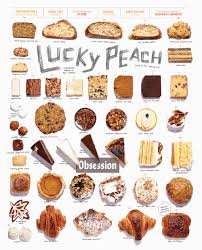
The theme of the issue is obsession, and there are obsessions about endives (pronounced ondeev) and Pizza (including the guy with the record for most pizza boxes) and so much more.

The story about a Jewish man and his love of pork was interesting, especially the part about pork roll:

She takes a bite and her eyes roll back.  Then she hands it to me.
As I dig into my first Taylor Pork Roll I realize that everything I appreciated in the ham… is more concentrated in this superior sandwich.  It’s saltier porkier and smokier and the flavor lingers on the tongue….  It’s like a ham sandwich squared.

There’s also a fascinating look at Ranch dressing and its belovedness in West Virginia.

I may not always love the stories, but Lucky Peach continues to be a great magazine.

Read Full Post »

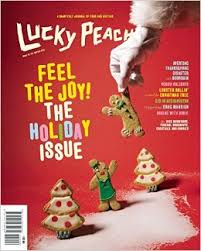
peach13SOUNDTRACK: ULTRA LOUNGE: CHRISTMAS COCKTAILS Hi-Fi Holiday Cheer from Santa’s Pad (1996).

xmastails1Because I am a total hipster, I love these Ultra Lounge collections.  Actually, I don’t think we were called hipsters when these collections first started coming out, but I have loved all of them.  And I especially love these Christmas ones.  Indeed, this may be my favorite Christmas album of all.

I’d say in part it’s because I great up listening to big band and I can totally imagine my parents being into this back in the day.

BILLY MAY-“Rudolph, The Red-Nosed Reindeer” opens with a crazy yelling of all of the reindeer names.  Then a funny, almost drunken, sounding horn version of the song with weirdly shouted phrases throughout. It really sets the mood.  PEGGY LEE-“Winter Wonderland” is a more familiar and traditional version of the song—it’s delightful although it’s hard to reconcile with that earlier piece.  RAY ANTHONY-“Christmas Trumpets / We Wish You A Very Merry Christmas” is a wonderful sorta cheesey version of “Jingle Bells” and other songs on trumpets.  LOU RAWLS-“Christmas Is” Rawls’ voice, which I don’t love in general works well for this song.  I like the big horns in the middle.  JIMMY McGRIFF-“Santa Claus Is Comin’ To Town / White Christmas” this is some fun, easy listening Hammond organ instrumental.  It is 6 minutes of ice rink spectacular.

JULIE LONDON-“I’d Like You For Christmas”  The backing vocalists singing the tune of “Jingle Bells” (but slowly) and then Julie sings a slow romantic song that I’m unfamiliar with. Not my fave—too slow and I don’t care for the backing responders.  AL CAIOLA- “Holiday On Skis” but this is a zippy and fun instrumental on guitar.  KAY STARR-“(Everybody’s Waitin’ For) The Man With The Bag” is a fun silly song and I like this version.  HOLLYRIDGE STRINGS- “Jingle Bells / Jingle Bell Rock” I love this swinging string version that is fun and a little off with the musical runs.  I would like more by the Hollyridge Strings who are known for their easy listening renditions of classic songs.

DEAN MARTN-“I’ve Got My Love To Keep Me Warm” I love this classic version.  EDDIE DUNSTEDTER-“I Saw Mommy Kissing Santa Claus/Jingle Bells Bossa Nova” a wonderful ice rink version with a bossanova flair–the best way to hear the first of these two songs (instrumentally).  RAY ANTHONY AND HIS BOOKENDS “Christmas Kisses” wonderfully cheesey and fun song about kisses for Christmas.  I didn’t know this song before this version.  JACKIE GLEASON-“I’ll Be Home For Christmas / Baby, It’s Cold Outside”  The first bit is a somber, pretty instrumental version of the song, it is strangely mingled with a wild whistling version of the second song.  Gleason is wonderfully campy.  NANCY WILSON-“What Are You Doing New Year’s Eve?” Sweet version. I think I like Nancy Wilson a lot more than I realized.  CAPITOL STUDIO ORCHESTRA-“Cha-Cha All The Way”  The best Christmas song ever.

NAT KING COLE-“The Christmas Song (Merry Christmas To You)” I love this song very much and Nat’s version is the best. I’m not exactly sure it belongs on this compilation, but I never don’t want to hear it.  LES BROWN AND HIS BAND OF RENOWN-“The Nutcracker Suite” I love this whole version of various Nutcracker pieces (it’s clear that Brian Setzer used this as the basis for his swinging version). I love the Nutcracker in general but this is so much fun.  FRED WARING-“Ring Those Christmas Bells” This opens with various songs thrown together by a jolly group of carolers. Then a jolly version of “Ring those Christmas Bells” another song I don’t know but which I like a lot.  THE CONTINENTAL-“Violets For Your Furs”  This is a strange “bonus” track in which over soap opera music an accented Lothario comes on to a woman with violets for her furs.  Weird. PEGGY LEE/NAT KING COLE./NANCY WILSON-“Toys For Tots”  weird “toys for tots” refrain, but nice vocals from the trio asking for help with the program (who knew it was that old?).  The final track is JOHNNY MERCER-“Jingle Bells” which is a fun Christmas Card from Capitol Records–I wonder who received this?

[READ: December 26, 2014] “Christmas Story”

After reading enough Lucky Peaches I have learned that chefs are bad-tempered, foul-mouthed individuals, who relish good living and big eating (and drinking).  So it should come as no surprise that Bourdain as a fiction writer lives up to that essence in his stories (vulgarities abound and there’s lots of good food).

This is the story of Ricky, a chef whom the narrator learned from.  Ricky was a lifer in the business, having worked first in the army and then as a line cook and for the past two decades as head chef for a club.

Ricky had a sixth sense–he could look at a crowd and determine what they were going to order before they even knew it.  He would be able to determine that they needed more shrimp or if the crowd was just a simple pigs in blankets bunch just by the way they walked in.

Ricky liked the narrator and so gave him Christmas off this one year–a rarity in any chef job.  The narrator was psyched until his wife said that they should cook and serve Christmas dinner, real traditional-like, to their families.  The narrator said he could do a room of 200 easily but a dinner for 12 freaked him out.

So he asked Ricky’s advice.

And the bulk of the end of the story is Ricky’s suggestion for what to cook (it’s like a huge long recipe).  I appreciated the idea that putting stuffing in a turkey is like a breeding ground for bacteria.  But I really liked his idea that you should cook two turkeys, a big one and small one.  The small one is the stunt turkey.  When it is cooked, you bring out the stunt turkey to the table but you have already carved the larger turkey so that moments later you bring in the bird all carved up and everyone oohs.  But more importantly, with two turkeys you know you will always have enough food.

It worked for the narrator, and would probably work for you, too.

(more…)

Read Full Post »

peach SOUNDTRACK: FOALS-Holy Fire (2012).

I foalsloved Foals’ debut album Antidotes, it was a modern rock/prog rock/dancable mashup with angular guitars and all kinds of weird time signatures.  Then Foals returned with a new album which I haven’t heard anything of, except to have heard that it was very different.  Then I heard “Inhaler” from this album and I loved it.  It was easily in my top ten songs of 2012.

But it was so different from the Foals of Antidotes that I wasn’t sure what to make of it.  And in fact, that Foals, with all of their angularity, has been replaced by this much dancier version of the band.

“Prelude” is like an extended intro to “Inhaler.” It’s 4 minutes of intro music with chatter and noises.  Then comes “Inhaler,” a slow building song that rises and falls, rises again then falls again and then bursts into a big rocking chorus.  It’s fantastic, it feels louder than is possible for such a song.  “My Number” introduces some of that unusual staccato song style but in a far more dancey framework. The synths are louder and bolder.  I really like this song.   “Bad Habit” is a far slower song, but it’s a nice tempo changer.  And the chorus is still catchy.

“Everytime” brings in more shoegaze elements (so let’s see, there’s angular punk, shoegaze and dance music here).  This song even has a discoey chorus.  “Late Night” and “Out of the Woods” feel even more dancey than the earlier tracks–with a kind of earlier 80s British alt rock flavor–spiky guitars and exotic percussion.  I hear some of the guitar sounds of early U2 as well, especially on the intro of “Milk & Black Spiders” (the rest of the song sounds nothing like U2.

“Providence” brings back some of that louder guitar, coupled nicely with a combination of shoegaze and screamy vocals.  The heavy guitar plays a very nice counterpoint to the picking of the second guitar.  It’s the last great song on the record.  “Stepson” is a slow song, the slowest on the disc, and I fear that it rather runs out of steam.  “Moon” continues the slow drifting sense of the end of the album.  It’s pretty song, but it feels so far removed from “Inhaler” that it seems to be from a different record.

So I’m not entirely sure what to make of this record.  It has a few great songs, and then a number of songs that seem to want to go in a different direction, but what direction that might be remains unclear.

[READ: September 6, 2014] “The Happy Valley”

Lucky Peach 10 is “The Street Food Issue,” and it is a fun issue with all kinds of interesting food you can buy on the street (and recipes to try them at home).

Like food in tubes.  Take “Sausage Quest” (what the locals do with their various sausages all around the world), or “I Went to Thailand and All I Got was a Sausage Stuffed in My Mouth” (I can’t wait to make sausage blossoms).  Beyond sausages there’s a list of the most compelling street foods around the world from New York to Naples to Tunisia. We look at street food vendors in Malaysia and South East Asia.  And then we meet the Lucha Doughnut Man of East LA (Mexican donna vendor by day and masked wrestler by night).

Then there’s some articles that are not about food.  Like the surprising article about the microbiology of used cigarette butts (no butts were eaten).  Or the very interesting history of charcoal (which dates back to Henry Ford).  I had no idea charcoal came from trees.   There’s an essay about rapper Jibbs and his song “Chain Hang Low” which was apparently ubiquitous in 2006 although I don’t know it).  The essay discusses how it used “Turkey in the Straw” as a motif.  Most likely, he took it from the ice cream trucks that he heard as a kid, but there is a whole history of racism packed in to that song, let me tell you.

I enjoyed the idea (throughout the issue) that if you’re in a new place, sometimes you can’t always trust reviews for what’s good, you just have to trust your gut (and your nose).

Then there’s several articles about corn.  Making tortillas or masa–the whole process of nixtamilization.  (more…)

Read Full Post »

lp12SOUNDTRACK: OXFORD DRAMA-“Asleep/Awake” (2014).

dramaOxford Drama is, unexpectedly, from Poland.  Their lyrics are in English, although their Facebook site is all in Polish.

“Asleep/Awake” is a slow, synthy track with Małgorzata Dryjańska singing in a breathy whispery voice.  Her voice feels delicate even if the lyrics are somewhat empowering (and she has no discernible accent).  The instrumentation (all synth and electronic drums) is by Marcin Mrówka.  I like the way he throws in some occasional bass lines to add more texture to his simple beats.

The song feels very much like a 90s British trip hop sound.  Although on the more mellow side of trip hop. It’s quite pretty and dreamy.  It’s interesting to hear this kind of music coming out of Poland (although why shouldn’t it, honestly?).  I rather hope they break through in the states.

Their 4 song EP is available on bandcamp.

[READ: September 7, 2014] “Trilobites”

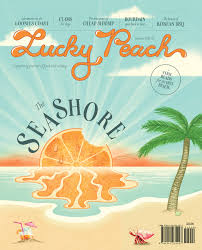
Lucky Peach issue 12 is all about “The Seashore.” And thus there are lots of beach-related foods under discussion. Lisa Hanawalt has a wonderful story about hanging out with otters (if she weren’t so hilariously vulgar (she’s wearing a shirt that says “Every day I’m not covered in otters is a piece of shit”) I’d have my kids read it because it is so cute). There’s a brief article explaining the particular smells of the seashore.

Chris Ying has a hilarious article about sea cucumbers (and just how hard it is to make them appetizing). And there’s a wonderful little section that compares the “sea” version of things to their “land” counterparts. Like the Sea Anemone, the Sea Cow and the Sea Horse and how different they are from the land based creatures with the same names.

There’s an amusing tribute to the Goonies (a movie I haven’t seen in 30 years); and a lot of talk about Crayfish. Perhaps the most interesting of these articles was the seaweed farmers—who basically say that any seaweed is edible, so next time you’re in the ocean, chow down.

And then there’s the clams and abalone and whatnot. This includes a brief explanation of the edibleness of 8 different bivalves. There’s also Robert Sietsema’s trip down the Atlantic Seaboard going to as many clam houses as he can.

There’s also an article about sushi—but not the sushi itself, rather the stuff that comes with it. Like Krab, which is not crab at all, but various fish pieces minced up and dyed to look like crab! Or the wasabi that you get, which is not real wasabi (real wasabi is super expensive ($100/lb)). That green paste is actually horseradish, mustard oil, citric acid and yellow and blue dye.

And what beach/resort issue would be complete without s tory about the Harvey Wallbanger (I enjoyed this history quite a bit).

The issue is also chock full of recipes and then it ends with this piece of fiction

“Trilobites” is set on a downtrodden farm in the South. I wonder if the South gets tired of their fiction depicting fathers as brutal drunks. In this case, there’s this instance of the father whipping the narrator: “One time I used an old black snake for a bullwhip, snapped the sucker’s head off, and Pop beat hell out of me with it.”

He is also not too fond of his mom. Once Pop died, his mother was interested in selling the fam. She’d like to move to Akron where she has family. He has no interest in the farm but doesn’t want to leave either. This exchange, in which they laugh at the funny phrases Pop used to say sums up his attitude:

I think back. “Cornflakes were pone-rakes,’ and a chicken was a ‘sick-un.’
We laugh.
“Well,” she says, “he’ll always be a part of us.”
…I think how she could foul up a free lunch.

The trilobites in the story are in Company Hill, a former river bed that is now home to fossils. The narrator has never been able to find a trilobite.

The narrator pines for his love from high school, Ginny. In her yearbook he wrote “We will live on mangoes and love.” But she left for Florida.

Now she’s back in Charleston on break and asked to visit. But as with many stories full of desperation, especially in the South, nothing good can come from anything.

He has to deal with the man who wants to buy the farm. He can’t really communicate with his mother. The girl who is still around (who is super cute) is jailbait. Even his “date” with Ginny is a disaster. She has a boyfriend back in college, she tells him. But she wants to have fun with him while she’s back. They fool around, but it is ugly and ends with Ginny mad. And even the trilobites don’t come out.

I just didn’t really get this story. I know I am out of my depth in a story like this as the boy huntsfor a “turkle” in the water (which I guess is a turtle). His father used to like “turkle in a mulligan” whatever that means. This is just not my kind of story.

Read Full Post »

lp11SOUNDTRACK: AMASON-“Älgen” (2014).

amasonI was delighted when I heard this song on NPR because of the unexpectedness of it.  It starts out fairly simply with a fast shuffle drum and swirling guitars.  Then comes in a deep, very synthy sounding keyboard playing a simple and straightforward riff.   All of this instrumental section lasts nearly a minute and a half (of a 4 minute song).  Then the vocals come in.  A very deep (and wholly unexpected) voice sings a few words and is quickly followed up by a female voice singing quicker vocal lines, almost speeding up the song.

Amason is a Swedish band (with members connected to nearly every Swedish alt rock band you’ve ever heard of).  And like a lot of Swedish music, it is super catchy but somehow just a little different, which keeps it interesting.  I want to hear more from them (although when you search them, you have to keep saying, no I am not looking for “Amazon”).

[READ: September 6, 2014] “Lobsters”

Lucky Peach 11 was the “All You Can Eat” Issue. So the issue focused a lot on buffets (don’t feel compelled to get your money’s worth, you’ll only get sick). But there was also some interesting twists about all the things you could eat if you were so inclined.

My favorite article was from Mark Ibold, about Pennsylvania Dutch cooking and the amazing buffets you can find in Lancaster. He recommends the popular but for worth it Dienner’s on Lincoln Highway East (next to a fake revolving windmill!). Lisa Hanawalt’s illustrated stories have also become a favorite. This one is set in Las Vegas, with all that that implies.

There’s a tremendous article on Quebec and the stunning foods of the French Canadians, and a very funny article called “Decision Fatigue Related Eating” how as you get tired your food choices suffer as well (WINGS Fri-DAAAAY!”). There’s a lengthy article about crashing weddings in the country of Georgia (where you will likely be invited to a wedding even if it’s your first day there).

There’s several recipes with the main ingredient of celery. Peter Meehan opens with a very funny set up “There are things one can never seem to buy in appropriate quantities at the grocery store…. Celery’s natural packaging comes in one size: more than you can eat…. It’s cheap and it last forever so you buy a whole head…. be honest: isn’t there always a nearly complete head of celery heading toward middle age in the crisper?” This is followed by some possibly good celery recipes. (more…)

Read Full Post »

givingtuesToday is #GivingTuesday.  Giving Tuesday is a campaign to create a national day of giving at the start of the annual holiday season.  It encourages a national day of giving to kick off the giving season added to the calendar on the Tuesday following Thanksgiving, Black Friday and Cyber Monday.

In honor of GivingTuesday I wanted to post about two young people whom I have encountered recently (in print, not in real life).  Each one of them has blown me away with his and her selflessness and resourcefulness.

freethechild

The first was in the book Breakfast on Mars and Other Essays (which will get a post tomorrow) from Craig Kielburger, a Canadian man who was just 12 when he made a difference.

Craig Kielburger wrote an essay called “A Single Story Can Change Many Lives.”  In it he recounts his own personal experience of outrage at reading a horrible news story.  In 1995, when he was 12 years old, Craig saw a headline in the Toronto Star newspaper that read “Battled child labour, boy, 12, murdered.” The accompanying story was about a young Pakistani boy named Iqbal Masih who was forced into bonded labour in a carpet factory at the age of four.  Masih eventually snuck out and began telling people about what had happened.  When he was 12 he was shot dead.

Kielburger, at age 12, immediately wanted to do something about this.  He took the article to school, gathered friends founded a group called the “Twelve-Twelve-Year-Olds.”  In December 1995 before he started eighth grade, he took two months off of school and backpacked through Asia, Kielburger traveled to Asia with Alam Rahman, a 25-year-old family friend from Bangladesh, to see the conditions for himself.  His group evolved into the Free The Children fund, and international organization.  And his foundation has to date built over 650 schools and school rooms and implemented projects in 45 developing countries through its approach of “children helping children”. The majority of the organization’s annual funding comes from funds raised by young people.

marys

The second story is in the most recent Lucky Peach Issue (#9).  In an insert entitled “Guts,” there is a story about Martha Payne, a Scottish ten year old girl who has made a huge difference.

Martha was nine years old and was asked for a class to write like a journalist.  She thought it would be fun to make a blog about her school meals (this would allow her to include pictures).  So she created NeverSeconds. In one of her posts she wrote “I need to concentrate all afternoon and I can’t do it on 1 croquette. Do any of you think you could?”  Her dad tweeted it and soon it was a sensation.  People really responded to the size of her meal.

And then someone posted that she was lucky to get a meal at all.  She had been helping to raise money for Mary’s Meals for years–in her words, “they provide free school dinners in a place of education in sixteen of the poorest countries in the world.  Children can go to school instead of working or looking for food.”

never secondsBecause of the attention, she set up a JustGiving page that sends money to Mary’s Meals.  She raised £2,000 in a short time.

Back at home, her school began improving their meals and she began rating them (one even got a 10 out of 10).  And she started gaining fame in the region, making the paper and meeting chefs who were curious about her.  And then her school told her she had to shut down her blog.  She wrote about it here.

Of course, that made her blog explode.  She received thousands of messages and emails and began raising more and more money.  She had hoped to raise £7,000, as I write this she has raised £131,219 (that’s 1874% of her goal)–remember, she’s only 10.

Martha notes that $20 will feed a child for a year.  Here’s that link again JustGiving.

It’s amazing what determination can do.  Happy holidays.

Read Full Post »

lp8SOUNDTRACK: CHASTITY BELT-“Black Sail” (2013).

noregerstChastity Belt are notorious for their band photo.  And the fact that their album is called No Regerts (sic).  By rights they should play ugly abrasive punk or something weird and edgy and probably a little scary.

So imagine the surprise when “Black Sail” opens and sounds like a Guster song–simple chords with a very catchy melody (it reminds me of a rawer version of “Architects and Engineers”).

Then the vocals come in and the singer sounds a bit like Jefferson Airplane-era Grace Slick–powerful but kind of slow.  It’s a very compelling mix.

Especially when things change in the chorus–a simple, pretty guitar riff leads us into the simple chorus “black sail, strong wind.”

The difference between the image and the music is so striking that i wonder if I’d have been as taken with the music with out the picture.  Was this a brilliant strategy or just a really bad idea (it has already made a list of unfortunate band photos).  You can decide for yourself, I’m including the picture at the end of the post.

And you can listen to the song on NPR or at their bandcamp site.

[READ: September 12, 2013] “Amaranth”

Amaranth is a 12-year-old girl who goes by the name Merry.  She is out driving with her father one night when he gets a call from his business partner.  Amaranth pretends to be asleep while her father goes to talk to the man.  But rather than a conversation, the partner, Otto, kills her dad.  And Amaranth saw the whole thing happen.

Amaranth is devastated.  But she is even more devastated when Otto starts coming around.  Like a remake of Hamlet, soon Otto and Amaranth’s mother are getting married.

Amaranth wants nothing to do with this; the rest of the story details the ways she rebels against the unpardonable acts.

First she begins starving herself.  She eats just enough to survive but her mother hates how thin she is getting. Eventually they send her to a place for girls with eating disorders.  She returns plumper, but with a new scheme.  This time her rebelliousness gets her put into a special hospital. (more…)

Read Full Post »

lp8.1SOUNDTRACK: TYPHOON-“Dreams of Cannibalism” (2013).

typhoonNPR was steaming this album for a while.  Now they’re giving away this song.

Typhoon is yet another band that has a crazy amount of people in it (between 12 and fourteen) and they have a vast array of instruments in play at any one time (Horns, violins, xylophones, electric guitars and mandolins for example).

At the same time, Singer Kyle Morton’s vocals are distinctive enough and are used like an instrument as well as to deliver lyrics.  This gives them quite a unique sound.

The song opens with an array of horns slowly building to a simple guitar melody.  The verses are somewhat quiet with occasional punctuations of band (and great backing vocals).  But as the song progresses, more instruments kick in (horns adding a melody line).  I really like the way the end of the song shifts direction totally, bringing in a complex instrumental section with interesting time shifts and even better backing vocals..

I enjoyed the whole album while it was streaming.  And while I can’t say that this song stands out more than the other songs, (I think “Artificial Light” is probably the best,) it represents the sound of the band pretty well.

[READ: September 2013] Lucky Peach Issue 8

I haven’t been reviewing Lucky Peach issues in their entirety because they are mostly about food and cooking and recipes and I don’t really have anything to say about that (I enjoy the articles a lot, but I don’t need to comment on them).

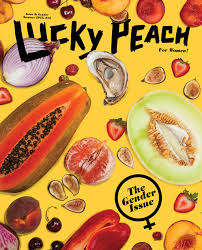
But I wanted to bring special attention to this issue because of the way it is presented.  This is the Gender Issue.  It has two covers (see the “female” cover tomorrow) and the magazine must be flipped over to read the different genders.

It’s not often that I think of food and gender as being connected, but there are some really interesting articles in here that talk about not only food itself, but about the people who prepare it.  Like the fact that most big name chefs are men even though cooking has traditionally been “women’s work.”

The women’s side of the magazine has these interesting articles: (more…)

Read Full Post »

« Newer Posts - Older Posts »