Feeds:
Posts
Comments

Archive for the ‘Harper’s’ Category

SOUNDTRACK: THE SWORD-Warp Riders (2010).
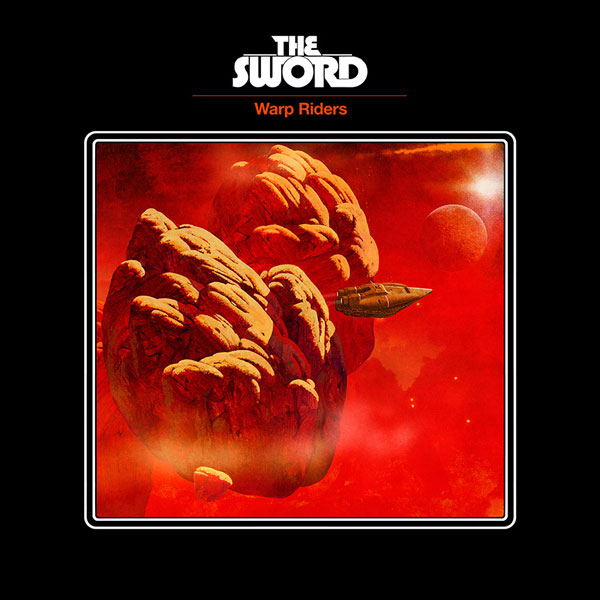
I have heard some great things about this disc from The Sword–that it was old school metal who usually sang about swords (duh) and sorcery but were warping into the future on this disc.  I put the disc on and was blown away by the opening track, the instrumental “Acheron/Unearthing The Orb.”  It sounds very 80s metal: heavy guitars, and great riffs coupled with tremendous solos.  The second song opens just as strong but then something weird happened.  I hated the lead singer’s voice (my discussion of their previous disc came to the same conclusion).  It doesn’t do ANYTHING that 80s metal should do–it’s neither growling nor yelly nor operatic.  In fact, once the vocals kick in, the song takes on a distinctly non-metal feel.  More specifically, it feels like heavy classic rock from the 70s.  The guitars are still heavy as anything, but the melody and vocals change things.

I really didn’t like the album all of a sudden, until I listened a few times and accepted that this blend actually worked.  Once I acknowledged that it wasn’t what I thought it would be, I wasn’t disappointed by it anymore, and I was able to really enjoy it.  “Tres Brujas” has a simply wonderful sing along chorus that I can’t get out of my head.  And it continues in this vein–heavy riffs (the guitars on “The Chromancer 1: Hubris” and “The Chromancer II: Nemesis” (love the names!) are really heavy) and surprisingly catchy choruses. 

The biggest surprise comes with the song “Night City” which sounds like, well, like Thin Lizzy.  The macho riffs, the swagger, the lyrics, it’s all Lynott.  And once I realized that, I really understood what The Sword was all about, and the disc has been in heavy rotation ever since.  I don’t mean to say that I had to analyze the disc to “get” it, but once it all clicked, it clicked really well.

[READ: December 13, 2011] “The Pharmacist from Jena”

This is my first story from Michael Dahlie and I have to say that I was hooked from the start. 

The story is set in 1912, when the narrator was sent from his home in Stockholm to Winslow, Indiana.  He was sent to work with his uncle as a pharmacist’s assistant. 

It’s in the second paragraph, after the exposition, that things take off: “My uncle was a passionate lover of cocaine and had situated himself in such a way that he supplied nearly all the nearby interested parties.”  He was also renowned as a great “voluptuary and eroticist.”

There is a real plot, which gets established late in the story, but in the beginning, the story is all about the narrator’s adjustment to this life.  How his aunt seemed to believe he was a girl and decorated the room accordingly.  How his uncle had a fight with a bear (long story) in that very girl-themed room (long story) and how the room was soon, no longer girl-themed.

One thing I really liked about the story was the narration.  Like: “At the time I was living in Winslow, it was fashionable for wives of wealthy men to suffer from mental disorders.”

His uncle experimented with shock therapy, but he mostly used it for erotic experimentation.  The end of the shock experiments occurred when a local husband found out what the good doctor was doing (from the burns that his wife received at the doctors hands).  (more…)

Read Full Post »

SOUNDTRACKPEARL JAM-Austin City Limits (2009).

Pearl Jam records (and sells) most of their shows and they occasionally videotape them as well.  But they don’t do TV all that much (excepting the recent Late Late Show episodes).  There seemed to be something special, or at least different, about Pearl Jam on Austin City Limits.  Think of it almost like Unplugged Updated.

It opens slow with Eddie on an acoustic guitar and strings behind him.  In fact, the whole set seems less heavy than many of their sets.  But that’s not to say that the band doesn’t rock out, because they do.

The first six songs of the set come from Backspacer.   And then they bust out “Army Reserve” (which makes sense given who is in the audience, see below).  Then there’s a wonderfully raucous version of “Do the Evolution” (one of my favorite PJ songs).

After that riotous track, they bring the strings out for one more song.  It’s a rather funny little joke because it’s just the strings and Eddie on acoustic guitar playing “Lukin,” the 80-second song that is so fast you can barely hear the words.

For an extra treat, touring mate Ben Harper comes out to play slide guitar on “Red Mosquito” (which is always a treat).  And the set ends with an amazing version of “Porch” with a super long guitar solo in which Mike McCready really shows off his chops.  There’s even a moment where Mike and Stone are riffing off each other, classic rock style.
The set ends the Eddie talking about playing for the wounded veterans in the audience and how it was quite moving for him given all they have done for us.  Over the closing credits you see the band mingling with the veterans (including a guy who has lost a leg).  It’s all surprisingly touching for a rock show.

[READ: November 20, 2011] “Perchance to Dream”

A while back I read all of the Jonathan Franzen articles that were published in The New Yorker.  I thought I had read everything he’d published until I realized I had forgotten to read this piece (possibly his most famous) that was published in Harper’s.  It fits in well with this weekend’s theme because it was mentioned in Evan Hughes’ article that I talked about yesterday and because David Foster Wallace is mentioned in it.

As with most of Franzen’s non-fiction, it’s not easy to write about critically unless I want to argue with him, which I don’t necessarily want to do.  So instead, I’ll try to summarize.  Of course, this is a long and somewhat difficult article, so let’s see what we can do with it.

The first surreal thing is when you see the byline: “Jonathan Franzen is the author of two novels, The Twenty-Seventh City and Strong Motion, and is writing a third.”  It’s hard to imagine he got a huge article in Harper’s before he wrote The Corrections.

The second surreal thing comes in the text: It opens with “The country was preparing for war ecstatically, whipped on by William Safire (for whom Saddam Hussein was ‘this generation’s Hitler’) and George Bush, whose approval stood at 89 percent.”  And it is only a few paragraphs later when he mentions Patriot missiles that it clicked that this was written in 1996 and not 2001 and that he was talking about the 1991 Iraq invasion.  He mentions this as a prelude, saying that he was trying to sequester himself in order to start writing again.

Then he talks about Paula Fox’s novel Desperate Characters as a benchmark in terms of insight and personal conflict, even if it is so crazily outdated (that someone would throw an inkwell!).   He talks about this book quite a bit. I’m, not sure I found it compelling enough to want to read, but it’s always interesting to hear a fan write about a book I’ve never heard of.  He will return to this book throughout the essay. (more…)

Read Full Post »

SOUNDTRACK: WILD FLAG-World Cafe, November 10, 2011 (2011).

I’ve been really enjoying Wild Flag’s debut album.  Wild Flag consists of Carrie Brownstein and Janet Weiss of Sleater-Kinney, Rebecca Cole, who I don’t know but who has been in a few different indie bands, and Mary Timony from Helium.

This World Cafe episode is a brief interview (mostly with Carrie, although all four women are present), in which they talk about the origins of the band and what it’s like to play as a foursome. 

There are three songs and the band sounds tight and perfect.  In fact they sound so perfect I almost wondered if they were really playing live (but there’s one keyboard flub that proves that humans are involved).

It’s a great sample of the record, which is all great, and it’s a good chance to get caught up with these rocking women. 

[READ: November 15, 2011] “The First Venom”

This is an excerpt from Marcus’ forthcoming novel, The Flame Alphabet.   I’ve read a number of Marcus’ things in the past and I realized that most of his McSweeney’s pieces I do not like.  Some of the short stories in the New Yorker I have enjoyed, although usually not right away.  So, clearly Marcus and I don’t see eye to eye on fiction.

And that’s the case with this excerpt.  It’s hard for me to say I wouldn’t read a longer piece based just on an excerpt because who knows what else the rest of the book contains (this could be a small fraction of a much different story), but this excerpt absolutely didn’t make me want to read any more.

In the excerpt, a married couple is sickened by their daughter.  Literally.  All of the words that she says and whispers and scribbles wash a sickness over her parents.  They cringe and try to get away but she keeps talking and talking.

At first this seemed like a metaphorical sickness–who hasn’t grown tired of their kid’s incessant chatter, but it soon becomes clear that this is very real. (more…)

Read Full Post »

SOUNDTRACKСУБИТО (Subito)-“Du Hast” (2011).

Субито (pronounced Subito) is from the Ukraine.  They’re a bunch of miners and they play music.  In addition to this cover, which is generating some meme buzz on the internet, they have a few other songs (and videos) of note.

This cover is notable in that the only real difference between this song and the original is the prominence of the button accordion.  The vocals are nearly identical (he’s got his German goth down perfectly), and the rest of the band plays quiet heavily (I love the triangle instruments!).  But the accordion changes the entire texture and tone of the song.   It’s still ominous (I mean, those vocals!) but the accordion adds an air of whimsy that undermines the menace and yet also somehow makes the rest of the song seem even more menacing.

Of course the video is quite silly which leads one to assume that they’re not taking their version too seriously and yet their playing is impeccable and their backing vocals are right on.

So, yes, I rather like this song, and I like being able to include the word Субито in my post.

[READ: November 10, 2011] “The Good Samaritan”

Joyce Carol Oates has a wonderful way of turning her stories into something dark.  Even if it starts out in a rather innocent light.

This story is set in 1981 on a train coming from Utica, NY.  The narrator, Sonia, finds a woman’s wallet stuffed into the seat of the car.  The story begins with Sonia thinking about the woman, wondering what she’s like, looking at the photos of herself and her family and sort of daydreaming what it would be like to be older and married.  It’s only after a brief reverie that she, a poor college student, checks the money to see what’s there.  (About $25).  She hopes that the woman is old enough to give her a reward, but assumes she is not.

Sonia is to be heading home to help her mother with her ailing grandmother, something she’s not looking forward to.  So she decides that she will return the wallet to the woman who, after all, lives only a few blocks from the station.

What is wonderful about this story is that this innocent setup masks the real story, which is never fully explored, but is hinted at enough to keep us all guessing.  When Sonia arrives at the house, the woman’s husband is home and he seems….surprised that Sonia has brought this wallet home.  She feels sympathy for him when he begins to explain that his wife ran off and must have dropped this wallet on this train while she was fleeing.  Sonia wants to help the man in some way.  He invites her inside and she thinks of all the things she could do for him–stupid things like make dinner or maybe even look at her things to see is she can help figure out where her wife went.  She suggests this last idea and he accepts. (more…)

Read Full Post »

SOUNDTRACK: SUFJAN STEVENS-The Age of Adz (2010).

Sufjan Stevens has released a bunch of albums of beautiful orchestral rock.  It is multi-layered and complex with classical elements and all kinds of cool instruments.

And this album starts out with a beautiful acoustic guitar melody and Sufjan’s delicate vocals.  Although it is a far more stripped down song than usual, “Futile Devices” seems like it is heading in the standard direction.  But anyone who heard Sufjan’s Christmas album number VIII knows that he has been having some fun with electronics.  And they show up with a vengeance on track two, “Too Much.”

All of the multilayered noise that was once orchestral and (some might say) precious has been replaced by a cacophony of gorgeous electronic noises.  The beginning of the song reminds me of the sounds in Skinny Puppy’s “Stairs and Flowers” (how many Sufjan Stevens reviews mention Skinny Puppy?).  The song is nothing like Skinny Puppy once the vocals kick in–it’s catchy and delicate–but those electronics underpin the whole thing, bringing his pastoralia into the twenty-first century.  When I first reviewed this song I didn’t like it but once you get absorbed by Sufjan’s world, it’s an enticing place to be,

“Age of Adz” takes this electronic nonsense even further with an 8 minute brew of strange sounds and choral voices.  But he always manages to throw in some catchy parts, no matter how strange the song gets.

For me one of the highlights of the disc is “I Walked” it features one of my favorite Sufjan things–falsetto vocals in a beautiful but unexpected melody.  And this song has them in spades.  “Now That I’m Older” has a very disconcerting sound–his voice is slowly warbled and mournful.  It’s a beautiful melody that is alienating at the same time.

“Get Real Get Right” returns to his earlier style somewhat (there’s more layers of music, although the electronica is still in place).   “Vesuvius” is a beautiful song and “All for Myself” is another of those great falsetto tracks that I like so much.

“I Want to Be Well” eventually turns into a manic electronic workout in which he repeats the chorus “I’m not fucking around.”

But nothing compares  to “Impossible Soul” a twenty-five minute (!) multi-part suite of electronic chaos.  It’s a fantastic song complete with autotune (used to very cool effect), repeated swelling choruses (it’s like a Polyphonic Spree tribute), electronic freakouts, and acoustic comedowns.  All in a positive, happy message.  I can’t stop listening to it.  “It’s not so impossible!”

Sufjan continues to impress me.

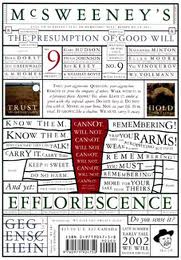
[READ: November 10, 2011] McSweeney’s #9

After the excesses of McSweeney’s #8, I was excited to get to the brevity (and urgency) of McSweeney’s #9.  This one is a paperback and looks like the first couple of issues.  The cover is mostly text with a hodgepodge of phrases and pleas.  You get things like: Thankful, Emboldened, The (Hot-Blooded/Life-Saving) Presumption of (Perpetual/Irrational (or More Likely, Irreducibly Rational) Good Will, Efflorescence, Our motto this time: We Give You Sweaty Hugs,” Alternative motto: ” We Are Out Looking,” GEGENSCHEIN (no more), and the promise: “We will Do Four This Year.”

This is the kind of issue that makes me love McSweeney’s.  There are some wonderful short stories, there are some nice essays and there are some dark moments all centered vaguely and tangentially around a theme.  There are some great authors here, too.

The back cover image is called Garden Variety by Scott Greene and it’s a fantastic painting.  You can see it here (navigate through the 2000-2004 paintings, but I have to say I really like the style of all of his work.

There are no letters and no nonsense in this issue.  So let’s get to it. (more…)

Read Full Post »

SOUNDTRACK: YEASAYER-Odd Blood (2010).

Sometimes albums have a single that is nothing like the rest of the album.  So you buy the album and hate everything but that one song.  This album is almost the exact opposite.  It opens with a song that is so odd–noisy and with massively manipulated vocals, that you would never guess the rest of the album is like some of the best Depeche Mode-friendly pop in the last thirty years.

That opening song, “Children” is creepy, with lots of percussion and atmosphere.  And it gives you no expectation for what comes next: “Ambling Alp” a bouncy track with a super catchy chorus.  This track reminds me of Erasure at their heyday.

“Madder Red” seems to be comprised mostly of (rather nice) backing vocals) with lead vocals done in a mellow Depeche Mode style.  “O.N.E.” sounds pretty much exactly like a keyboard-heavy alt-radio hit from 1991 (it’s fantastic).  And “Love Me Girl” with its tremendous dual-vocals sounds like one of the best pre-guitar Depeche Mode songs ever.  It’s amazing. 

And yet for all of  this talk of sounding like mid 80s alt rock, Yeasayer adds enough new ideas–recording techniques, fullness of sound and current studio tricks that they don’t sound dated.  Or like a rip off.

The frantic keyboard lines of “Rome” propel that song, while “Strange Reunions” slows things down considerably.  Things pick up again with the chanting and the cool keyboards (and great post chorus riff) of “Mondegreen.” 

The disc ends with “Grizelda.”  It continues with this current groove.  Not the best song, but a decent ending to a great disc.  Just don’t let that first song scare you off of what’s inside.

[READ:  October 21, 2011] “Sez Ner

Sez Ner is evidently a place.  And this story is a snapshot of a day or two of that place. 

Sez Ner has a swineherd, a cowherd, some other farmhands and a priest.  This snapshot shows the men in their daily lives: accepting the fate of the dying animals, pushing the living animals to the edges of abuse and/or not really caring that much about them.  Some animals escape.  Some die.

The priest blesses everyone, takes his bounty and leaves. (more…)

Read Full Post »

SOUNDTRACK: SISKIYOU-Siskiyou [CST067] (2010).

Siskiyou is a fascinating band whose debut album was released on Constellation last year.  The main guy in Siskiyou is Eric Huebert, who was drummer for the Great Lake Swimmers.  He quit the band and moved to an organic farm in British Columbia. And while farming he created this album (which is named for the California mountain range and is not, as a I imagined, a play of the phrase Sick of You (which I will still think regardless of the truth).

There’s a wonderful article at Paste about this album, where I learned a lot about the disc.  The disc was recorded in stairwells (which seems so cool) and at field recordings on the beach.  It was made on the cheap and very independently.  And I love it.

It feels very much like a small solo project (although he is quick to point out that he had help from another Great Lake Swimmer, Erik Arensen, as well as his wife and some friends.  But really, it feels like a vulnerable man singing in his wavering voice over some stark acoustic songs.

But unlike a poppy folk album, this one feels awkward.  The melodies are beautiful, but the lack of polish and production makes the recordings feel more fragile than they might otherwise be.

Indeed, Huebert’s voice, while always on pitch, threatens to just collapse under the strain of recording that first song, the gorgeous “Funeral Song.”  But it’s the second song that tells you this isn’t just a home recording.  “Everything I Have” feels like a great Lou Barlow/Sentridoh song–recorded on lo-fi equipment, until you hear the gorgeous horns come in a play the simple yet very winning melody over the loud folk guitars.  Again, if this had been over-produced it might have veered in cheesy, but the lo fi sound (and the cool lyrics) make this one of the best folk songs I’ve heard in ages (and it’s only 2 minutes long, too).

This is followed by two delicate songs: simple melodies, on either banjo or piano and shuffle drums.  My favorite song is “It’s All Going to End.”  Horns give it a kind of mariachi feel, but lyrically it’s wonderful: “I don’t like you one little bit, keep that shit up man, you’re gonna get hit.” All sung in his delicate wavery voice (and again, under 2 minutes long).

Another highlight is the “cover” of “This Land is Your Land.”  Called “This Land,” it opens with a slow piano melody that doesn’t sound anything like the original.  And then he begins whispering the lyrics–once again totally unlike the original.  But mid way through he changes the lyrics, to a new type of song about how he is never going home.  It turns the song mournful and rather powerful.

“Never Ever Ever Ever Again” is a wonderful song of repetition.  And the two short (just over a minute) tracks, “Inside of the Ocean,” and “We All Fall Down” are charming interludes before the lengthy “Big Sur.”  “Big Sur” starts with an upbeat banjo riff but then settles down into a slow (slightly out of tune) guitar piece.  The slow pace is particularly amusing given the incredibly slowly sung lyrics “So let’s party.  Let’s party.  Let’s party.  Party all night long.”

The disc ends with “Brevity and Insult” a song of static and banjos.

Typically I don’t like slow music, but this album adds so many interesting aspects that it doesn’t actually feel slow to me, it feels interesting and challenging  and strangely uplifting.  And I’m looking forward to their next release.

[READ: October 19, 2011] “Snake

This (surprisingly short) story packs so many different ideas into it that it really jostles the reader’s emotions.   It opens with a woman in a car. She’s in the parking lot of a supermarket waiting for her boyfriend, when she begins watching two boys.  They are playing with something on the ground, although she can’t quite tell what it is.

After seeing them lifting a stick, she realizes that it is a mostly-dead snake that they are playing with.  They don’t see her and she watches them decide what to do with the creature.  They decide to play a prank.  The boys test all of the cars in the parking lot and when they find an unlocked door they drop the snake in. (more…)

Read Full Post »

SOUNDTRACK: HELLBENDER-Hellbender (1993).

Hellbender is a band that Wells Tower was in before he became a professional writer.  He played guitar and sang backing vocals (and wrote some lyrics, but not on this album).  The drummer, Harrison Hayes is now the drummer for Les Savy Fav and the bassist and singer Al Burian is most notable for his zine Burn Collector (for a time he was the most famous former Hellbender, although I’d never heard of him).  They were always pretty small time, although their third album did receive some attention.

This first album is pretty rough–quickly made and cheaply mastered and yet there are good dynamics, cool breaks and a whole lot of punk.  Al Burian’s voice is in shouty punk mode (lyrics are not all decipherable) and although his voice works it’s a bit samey throughout the disc.  The drums don’t always sound great, but there are often cool drum breaks.  And the guitars are quite assured.  Despite the punk attitude, it’s not all flat out speed.

There are some dynamic breaks, like in the second track “Housebroken,” which has some cool moments when the drums highlight an unexpected tempo changed.  “Clocked Out” was the single they released prior to the CD and it has some real production values (and a very funny intro from a local DJ).  The guitar highlights the trebly end in a kind of ska riff which is quite different from the rest; there’s also some discernable bass lines and a cool bass/guitar solo (punk, yes, but branching out a bit).  It’s a great track.

“Two Twenty Two” made it onto a couple of local compilations.  It has a slightly less heavy feel, with some interesting guitar lines.  “Aisle Ten” has verses that end with some really heavy (reminding me of Metallica) riffs that really punctuate the vocals.  “Peeling” has some cool backing vocal chanting (as well as what sounds like an answering machine message) that sets it apart from the other songs.  “Clarence” has a really long instrumental opening (1 minute out of a 2 and a half-minute song) that shows of more of Burian’s bass lines.

“Couch” was the B-side to “Two Twenty Two” and it has better production values as well–and lots more dynamic parts.  The final song, Retread” is a sorta political song, “Do you remember when we were young–revolution seemed like fun.  I thought I could get things done by yelling at the top of my lungs.”  Not mind-blowing lyrically but a good sentiment nonetheless.

The band is very tight–their breaks and starts and stops are right on–many of their songs end suddenly and the band pulls it off very well.  When I first listened to the album, I thought it was kind of pedestrian, but after really listening, I realized this is a very well-formed debut. It’s an interesting addition to any punk fan’s collection and an interesting footnote for any fan of Wells Tower.  You can find a copy of the disc at Metro/Sea.

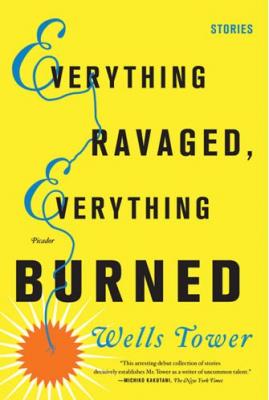
[READ: September 30, 2011] Everything Ravaged, Everything Burned

After talking about Wells Tower for a while and reading all of his uncollected stories and nonfiction, I finally got around to reading his short story collection.  And I think I have an interesting perspective on the book because at least two of the stories were totally reworked from their original release.  Not simply updating a thing or two, but totally revamped.  In my experience, aside from the David Foster Wallace essays that were truncated in their original form, this is the only book I know where the stories inside were totally rewritten for the compilation.

There are nine stories in the collection.  And I have to say as an overview to this book, I can’t get over how much I enjoyed them.  I mean, I knew I liked Tower from what I had read before, but I didn’t expect to enjoy this book quite so much because Tower writes a very manly kind of story.  He usually writes about tough guys and men who have a hard time interacting with their fathers and other situations that are out of my ken.  But Tower upends many conventions in his stories and his prose is tight and succinct and his stories are very quick to read and really enjoyable. (more…)

Read Full Post »

SOUNDTRACK: PHISH-Live Phish Downloads 07.06.98 Lucerna Theatre, Prague Czech Republic (2008).

This live release is fascinating to me because there’s some major mistakes during the show.  It’s interesting to me that when I read other people talking about this show, they rarely speak of the mistakes.  I know that any band that plays as often and for as long as Phish does is bound to make mistakes, and of course, mistakes are part of the live experience.  Nevertheless, they are often jarring. 

And there are three pretty big ones in this show.  The first comes in “AC/DC Bag.”  This one is particularly noticeable because it comes after a brief pause in the song.  The band comes back in after the break and whonk–wrong chord.  A similar thing happens in their cover of “Cities,” it’s a staggered musical section and whonk–they’ve missed it.  But by far the most egregious is in one of my favorite songs, “Golgi Apparatus.”  There’s a really wonderful musical interlude in the middle of the song.  And in this version, holy cow.  Trey misses the notes to start the instrumental and he just cannot find them again, so the wrongness continues for almost a full minute.  It’s incredible.  Trey is a pretty mellow guy, I’d love to see his reaction during all of that.

But aside from these errors, the set is otherwise really good.  They come to a dead halt in the middle of a jamming, really blistering guitar solo section of “Maze” to thank the audience for coming and to apologize for not thanking them last night.  It’s a weird, quirky thing to do, but it’s amazing that they then pick up the song right where they left off, blistering away to the end. 

The version of “Ghost” is really fantastic with an amazing solo in the jam.  There’s a funny interlude near the end of “Makisupa Policeman” in which there are John Fishman, the drummer takes a solo audience is invited to whistle when the solo has gone on too long.  Amusingly, the solo is very simply a high hat and snare–no indulgences at all.  The crowd starts whistling and the song ends.  But the two highlights for me are the amazing 20 minute version of “Piper” with, again, an absolutely ripping guitar solo and “David Bowie, ” another great song with a cool guitar riff.

When live albums used to come out, they were polished and perfect–sometimes fixed up, or entirely recorded in the studio.  In these days when bands release full concerts all the time, it’s more common to hear mistakes.  But this was an offical release, one of but a handful of CD live releases, and I applaud Phish for not shying a way from a concert with some incredible highs and some major lows.   

[READ: September 25, 2011] 4 books reviewed

I’m including this other book review because I like William H. Gass and I labor under the mistaken belief that I will read all of his books some day.  In the case of this review I was totally fascinated by its construct and its length (Gass is not afraid to be long-winded).  The subject is Elizabeth Bishop, an author whom I know nothing about.  He talks about four books by or about her, her two collections: Prose and Poems, as well as Elizabeth Bishop and the New Yorker: The Complete Correspondence and Words in Air: The Complete Correspondence Between Elizabeth Bishop and Robert Lowell.

The review opens with Gass’ serious criticism of one of Bishop’s poems (he really seems to be laying into it).  He proceeds to say that back in the day (when Wallace Shawn was editor and earlier) that the New Yorker was quite different about the kind of things it accepted (wonderful examples include them not wanting to publish a poem at a certain time of year because it didn’t fit the season (!) or that the editors were uneasy about printing a poem that contained a clause about dirty underpants (!!–they published the poem but removed the clause).  The prissy nature of the rejections is hilarious, especially given the kind of explicit stuff they publish now. (more…)

Read Full Post »

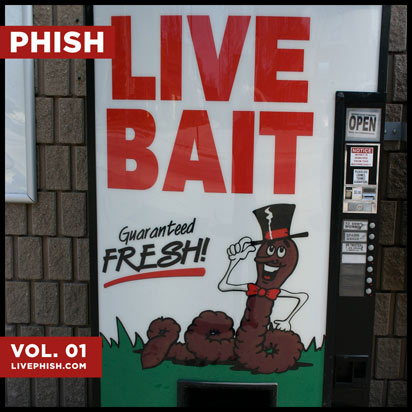
SOUNDTRACK: PHISH-Live Bait, Vol 1 (2010).

This first Live Bait release contained songs from Phish’s 2010 tour.  It was a good way to see how the band sounded these days and, as the title suggests, it was a good way to bait the fans into buying full shows.  The sampler covers shows from NJ, NY, GA and MA and it runs about 80 minutes.

Although it features primarily older tracks (a great version of “Tweezer” and a lengthy “Slave to the Traffic Light”) it also includes my first exposure to a live version of one of their new songs: “Backwards Down the Number Line.”  It also contains “Show of Life” a song that’s really a Trey Anastasio solo song–although frankly it doesn’t sound any different from a Phish song here.

The band sounds great–the hiatus did them wonders and it’s an auspicious beginning to a whole bunch of free music.

[READ: September 25, 2011] 3 Book Reviews

When I first discovered that Zadie was going to be writing the New Books column at Harper’s I deliberated about whether or not to write about each one here.  I mean, first off, it’s book reviews, how much can you say about someone else’s book reviews?  But second off, would I be writing about her reviews forever?  I mean, it’s a monthly column, it would be exhausting.

Well, it was exhausting–for her anyhow.  At the end of the column she admits that she can’t keep up the schedule (and frankly, reading that many books a month would be exhausting for me, but she’s also trying to write a novel, teach classes and “bring up a kid.”)  So this is her last one.  She had a pretty decent run from March-October 2011.

And she ends unexpectedly (for me anyhow) by talking about science fiction! (more…)

Read Full Post »

« Newer Posts - Older Posts »