Feeds:
Posts
Comments

Archive for the ‘Harper’s’ Category

SOUNDTRACKTANYA TAGAQ-Live at Massey Hall (December 1, 2015).

This show begins the third season of Live at Massey Hall.  There are ten episodes in all.  And the first one is with the otherworldly whirlwind of Tanya Tagaq.

Tanya Tagaq is an Inuit singer.  She works with throat singing, but in a new (and somewhat controversial) manner.  She pairs the deep growls and grunts with high-pitched wails.  Her songs become primitive and raw and she seems to become possessed by the music.

This performance is simply amazing–there’s probably been nothing like it.  And what is most remarkable about the performance is that it is all improvised.

But none of this would work if the music were subpar or uninteresting and here’s where she is to be commended for selecting this group of musicians.  Including the 50 voice Element Choir.

Jesse Zubot plays violin like no one else, often as a percussive instrument and with all kinds of effects. Bernard Falaise plays guitars in washes of sound.  he’s also manipulating everything to create otherworldly effects.  And Jean Martin plays drums like no one I have seen.  It’s so much fun to watch.  And the way he punctuates things on and off the beat is really inspired.

The performance is intercut with an interview from before the show.  Its kind of a shame to interrupt the flow of the performance, but she’s also got a lot of interesting things to say.

The show opens with Zubot’s amazing violin, which includes him sliding the bow up and down the neck sideways to make a kind of scraping (but pleasant) sound.

She tells us (paraphrasing)

The combination of the venue and the audience impacts the music which is improvised.  They fall into the groove of the place–a cement box of mosh pits will come out differently from a seated hall.

I’m pretty grounded and I’m lucky because I spend half my time in the air.

Indigenous people are having a voice.  When I was growing up there was more shunning of our own culture.

Around 3:40 she starts singing/fluttering her voice. The choir is filling in behind her.

Around 5 minute she starts doing some real deep vocals and the drums kick in.

Martin is an amazing drummer.  He keeps the beat constant but is playing all over the cymbals and snare on polyrhythms with lots of clacks and rim shots.

Things get really intense around 8 minutes with the choir singing and the lights swirling and Tanya hitting cool high notes.

A kind of natural quieting moment occurs around 10 minutes and she talks about throat singing.

13 minutes she gets into a kind of rhythmic breathing with some cool sound effects from….someone.

After 19 minutes things start to build in intensity. It is so much fun watching the musicians play everything especially Martin–the way he is practically out of his seat hitting things.  Tagaq is singing in a  high voice, on her hands and knees.

Around 24 minutes things build to a peak that lends to a quieter moment and it cuts to her cracking up over

having people give me shit for not being traditional…. over the internet

Then the show comes back until the end.  She makes animal noises sounding like she’s having a conversation, with finger-animal-horns on her head.  Ecstatic moans and animalistic groans evoke a kind of call and response with the choir.

The final uninterrupted ten minutes are just an amazingly tense exercise.  Between the lights, the tension of the guitar the thumping of the drums and Tagaq herself being possessed where you can hear her “human voice” coming through the growls.

At 31 minutes she starts howling, and it sounds like a wolf–not a person doing a wolf.  The chorus is answering her as she poses and distorts her body.   And then she starts her circular breathing.  The sound of her breathing in and out is so intense–is she being chased, is she in the throes of passion.  Combined with the motions she makes and again the amazing percussion the last ten minutes are just mesmerizing.

Then it’s all denouement as she comes back into herself with thunder rumbling and crackling as she breathes.

I sure hope Owen Pallett didn’t have to follow that!

[READ: May 15, 2018] “Slingshot”

This is a story about love and how people perceive it.

The narrator explains that she was 70 when she met Richard who was thirty-two at the time.

Richard moved in next door and had lots of parties.  He was a fun-loving kind of guy and he had lots of lovers.

But he also stated that there is no such thing as love.  The narrator’s granddaughter Rose claimed to be in love all of the time and would then wind up crying by the phone.  The narrator herself had been in love–she had been married once some thirty years ago. (more…)

Read Full Post »

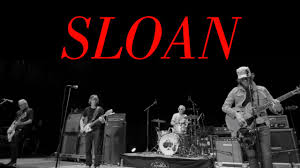
SOUNDTRACK: SLOAN-Live at Massey Hall (September 11, 2015).

Having now seen Sloan twice, it’s nice to compare this earlier show with mine.  And I get  to say that my shows were longer!  Much longer.

This edited for the web version leaves out 11 songs (including the ones which drummer Andrew Scott sings on–so there’s no switching instruments).  Having said that, the band sounds great and the set list is really strong.  I also had no idea that Gregory MacDonald had been touring with them for that long.

Jay Ferguson compares Massey Hall to Carnegie Hall and then regrets comparing something Canadian to something American).  Chris Murphy says “I don’t often use the word “hallowed,” but it is a “hallowed hall.”

He continues, “We are quite loud, we wondered, Do we try to tailor our set for Massey Hall–more like a theater set of songs?  We didn’t do that essentially because we’re incapable:   everybody turn down and then its like a volume war everybody turning up until we’re as loud as ever.”

They start with a great Jay song “You’ve Got a Lot on Your Mind.”  The band sounds great although the dominance of keyboards from Greg is surprising as the first song.

Introducing “The Rest of My Life,” Chris says, “You don’t have to stand but… sing along please.  Of course everyone sings “I know that I’ll be living it in Canada.”  As the song rings out, Chris starts a clap which segues into Patrick singing “Ill Placed Trust.”

Chris says, “We never got giant but we enjoy an audience that has followed us for a long time.  Thank you.”

The start the great guitar riff on the dark “The Other Man.”  There’s lots of sing-alongs in this one, too.

Jay is back with the super catchy “Who Taught You to Live Like That.”  And as the song fades out the siren roars the intro for “Money City Manis.”  Chris notes, “You actually have to stand up for this one.  You have to.”

Patrick and Chris take turns on lead vocals and then during the instrumental break Chris calls a six-year-old girl up on stage who dances, plays the tambourine and knows all the words.  Patrick says, “like I’m gonna be able to solo over that–that’s the solo right there.”  Chris wonders, “When you look at this stage, where does your eye go?”  She is amazingly self-possessed.

They end with the obvious–but a wonderful obviousness with “Underwhelmed.”  They (and the audience) have a ripping time of it.

It’s interesting just how long the band played in reality.  But yes, even after all this time, Sloan is a dynamic live act.  And this is great proof of that.

  1. O Canada
  2. Deeper Than Beauty
  3. If It Feels Good Do It
  4. C’mon C’mon (We’re Gonna Get It Started)
  5. Carried Away
  6. Keep Swinging (Downtown)
  7. Snowsuit Sound
  8. Fading Into Obscurity
  9. Forty-Eight Portraits
  10. Unkind
  11. You’ve Got a Lot on Your Mind
  12. The Rest of My Life
  13. Ill Placed Trust
  14. The Other Man
  15. Who Taught You to Live Like That
  16. Money City Maniacs
  17. encore
  18. People of the Sky
  19. Underwhelmed

[READ: May 10, 2018] “Dinner Party”

This is an excerpt from a novel Kudos.  It being an excerpt does explain some of the sparseness, but it feels like such a unique event that I can’t imagine even who the main character is supposed to be involved with in previous and future pages.

A writer enters a restaurant.  She is at a writing conference and she and the other delegates are to be treated to dinner.  I love this line “The delegates were reluctant to [sit], knowing their fate would thus be settled for the duration of the meal.”

The narrator recognized a woman from an all-female panel discussion who recognized her and instantly came over to talk to her.  The woman introduced herself “with the pragmatic directness of someone who accepts rather than fears the likelihood of such things being forgotten.” (more…)

Read Full Post »

SOUNDTRACK: ZEUS-Live at Massey Hall (September 11, 2015).

I had never heard of the Canadian band Zeus.  They seem pretty well-known (and have since become the backing band for Jason Collett when he’s not doing Broken Social Scene).

The band has been active for nearly a decade, but have only released a couple of albums (it is mentioned during the set that they are working on new material, but that was three years ago).

They talk about the amazing sound in Massey Hall.

Massey Hall is the furthest from a giant gnarly arena you can get.  We’ve played places with similar capacity and similar sound but there is something different here.  It sound really good and clean.  Maybe I would be intimidated if I played on this stage but you remember that not just anybody gets to pay here–you get asked to play here. This takes some of the onus off of being intimidated–you feel important in here.

Carlin says, “You never wanna say you had a shitty show at Massey Hall.  But you can hear yourself really well here, maybe that’s why they are all so good.  There’s always legendary shows there.

Everyone in the band switches instruments throughout.  It’s hard to keep track of what everyone is doing.  The only one who doesn’t move is Mr Robert Anthony Drake on the drums.

“Come Home” starts with a Carlin Nicholson on bass and Mike O’Brien on the electric guitar.  They share a microphone and the harmonies.  Neil Quinn is on acoustic guitar off to the side. adding a third voice.  It’s a surprisingly short song.

“Where is My Love” has Neil, still on acoustic, singing lead with his deep voice and an occasional falsetto on certain notes.  This song is quiet for the beginning with just the acoustic guitar and keys before the rest of the band kicks in.  The song shifts gear and musically sounds like a slower Sloan song (whom they were paired with that night) but the vocals are quite different.  Mike has shifted to keys with Carlin still on bass.  Jason Haberman is also playing multiple instruments–he’s on guitar for this one.

“Miss My Friends” has a kind of funky, almost disco rhythm.  Carlin has switched to keyboards and Mike O’Brien is on bass where he sings lead vocals.  Neil Quinn plays electric guitar and c Habermans has switched to electronic percussion.

Carlin introduces the next song, “This goes back to the very first Zeus record, “I Know.”  It’s got Carlin on keys and lead vocals. Neil on bass, Mike on guitar and Haberman on acoustic guitar.  Carlin invited people to sing is they know it but I can’t hear of anyone does.

Neil shifts to a pretty melody on the keys with a gorgeous intertwining melody from Mike.  It’s a great opening to “Heavy on Me.”  There’s cool 70’s sounding keyboards and a great bass rumble.  There’s a lot of quieter moments where the bass is all there is and the riff is cool and slinky.  The song ends with great jamming session with a noisy rocking guitar solo and heavy drums.

After the applause, Neil says, “Thank you.  This is just what this band needs right now–a house fill of love like this.”

“Air I Walk” has a shuffling beat with (questionable) electronic percussion hits.  Carlin back  bass with Neil on acoustic guitars and lead vocals.  It sound kind of mid 8os Dire Straits

“Throwdown” doesn’t sound like a throw down as it opens.  There’s quiet guitars and gentle vocals from Mike.  But it gets really big by the middle and sounds like a non-synthy 80s classic rock songs.

The show ends with “Are You Gonna Waste My Time.”  Just like the opening, Neil is on guitar and vocals, Mike plays a great lead guitar and Carlin is on bass.

I really enjoyed this set quite a lot.  Zeus is a little soft rock for my tastes, but their musicianship and songwriting is top notch.

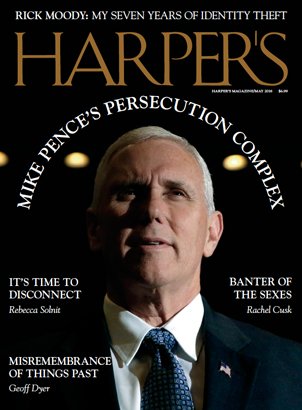
[READ: May 21, 2018] “Seven Years of Identity Theft”

Rick Moody had his identity stolen.  We all hear about this happening, but he really shows you how much of a real pain in the ass it is.  It’s not just a matter of getting new credit cards.

This essay is written as a series of letters.

The first letter is to the Most Honorable President of Nigeria, Muhammadu Buhari.  He writes of leaving his bank card in an ATM in Macon, Georgia and that’s when he assumes it all started–the theft of his identity–back in 2011.

A week later his replacement card was rejected and ultimately deactivated due to fraudulent transactions. (more…)

Read Full Post »

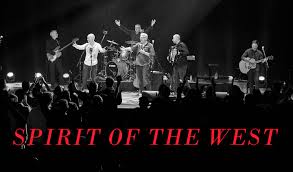
SOUNDTRACKSPIRIT OF THE WEST-Live at Massey Hall (June 6, 2015).

This proves to be a pretty powerful show.

I was introduced to Spirit of the West by my Vancouver based friend Amber back in the 1990s.  I didn’t really keep up with them, but I have long enjoyed their album faithlift.

But here it is 2015 and as the blurb at the beginning of the show says:

In 2014, at the age of 51, John Mann, Spirit of the West’s lead singer, was diagnosed with Early Onset Alzheimer’s Disease.  On June 6, 2015, Spirit of the West would play their one and only show at Toronto’s Legendary Massey Hall.

The rest of the band includes Hugh McMillan, Vince Ditrich, Tobin Frank and Matthew Harder all of whom play various instruments including keyboards, accordion and all things with strings.

Most of the band have never been in Massey or even seen it.  But they marvel at the venue and are genuinely moved by the end of this show.

They open with their hit (from faithlift) “And If Venice is Sinking.”  It’s got accordion and a big bass line and some funny lyrics and a full backing vocal chorus.

We made love upon a bed
That sagged down to the floor
In a room that had a postcard on the door
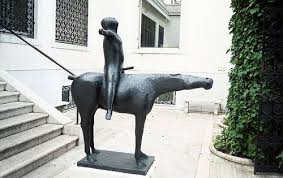
Of Marini’s Little Man
With an erection on a horse
It always leaves me laughing

John Mann is the lead singer, Geoff Kelly is the co-lead guy.  He does most of the speaking.  He says “This is as close as were every gonna get to Beatlemania.”

Next up is “King of Scotland” about a man who desperately wanted to be Scottish.  It, like many of their songs is a rousing half-trad/half rocking song.  Incidentally, Mann has been singing off of an iPad to help with his memory.

“Doin’ Quite Alright” is the first of many songs sung by Kelly.  he also plays bodhran.  It sounds quite trad and is much faster with a  cool bassline.  The addition of 70s sounding keyboards is a little odd though.

“July” sees the introduction of what I think is a bouzouki and sounds an awful lot like “Love is All Around” by Wet Wet Wet except for the fun and powerful chorus of JuLYYYYYYYY!

Kelly jokes that someone in the band is delighted by Massey Hall because it is finally something he’s found that is older than Kelly is.

Up next is “Political,” a song “we recorded on our Labour Day record in 1988ish and then again on Go Figure and then again with the Vancouver symphony.  I guess we really like this song.  Kelly is on flute and plays a wild harmonica solo.

Next up is their newest song, which is about 12 years old.  It’s about how every year New Year’s parties just get worse and worse.  “Another Happy New Year” starts out with slow staccato piano and then it really takes off (with Kelly on the penny whistle).

After sincerely thanking everyone for their kindness (it’s getting pretty emotional), they are going to play a drinking song called The Crawl.  The crowd really gets into the raucous song.

The night ends with Kelly saying this was the most awesome night ever.  They are going to leave everyone with “Home for a Rest.”  The audience sings along with Mann for the first verse and then Mann backs off and lets them sing it all.  It’s pretty great.  As is the song which ends with a wild instrumental jam that’s basically a flute-led jig which ends the sing and the show.

I imagine being there was pretty special.

[READ: May 15, 2018] “Nothing But”

This is a wonderful short essay on memory with the epigram: “The truth–that thing I thought I was telling.”

He begins by talking about a chapter in his book White Sands about a visit to the house of Theodor Adorno.  The essay takes its title “Pilgrimage” from a short story (why is it not considered a memoir?) by Susan Sontag in which she and her friend Merrill went to the house of Thomas Mann when she was 14.

It came out later that Merrill never understood why Susan left their friend Gene (who had gone with them) out of the story entirely.  (It happened in 1947, she wrote it in 1987).   This shows “a startling manifestation of the vagaries of memory and a vindication of what can sometimes seem like the fussiness of editorial fact-checking.” (more…)

Read Full Post »

SOUNDTRACK: DARLINGSIDE-EP1 (2010).

It’s amazing in retrospect how bland the first Darlingside song on their first EP is.

Darligside is a unique band, with gorgeous harmonies and unexpected instrumentation.  Their songs are gorgeous.

But this album is very different.  The first main difference is that there is a drummer–a real drummer named Sam Kapala.  Kapala is quite good, but wow does that change the entire tone of a Darlingside song.  Second, the band doesn’t sing everything in harmony.  Rather, there is one main singer (I think David) with the other guys singing fairly standard backing vocals.

The whole Ep has a kind of raspy-voiced-folk rock exploration feel.  The first song “Good Song” still has some mandolin, but only sparsely and the chorus melody sounds so much like another song or songs that I can’t get past it

“Surround” has a bit more of that Darlingside feel–the music is a bit more esoteric.  But the vocals are the same–that raspy-voiced lead singer.

But each song gets more interesting.  “Malea” has more of that cool violin and some really good drumming.  There’s definitely flashes of greatness on this EP, including in this song–although they need to bring in some of that cool vocal stuff.

“Catbird Seat” has some lovely violin and great whispered vocals.

“All That Wrong” starts almost a capella with some quiet guitar. It builds slowly until the middle section with the fast guitar and mandolin and the squeaky violin solo which is awesome.

“In the Morning” ends the disc with a quiet vocal melody but it eventually adds more singers and starts to sound more and more like the Darlingside we know.  In part because the drumming is left out almost entirely.  It feels like with three more songs they’d be on the verge of creating Birds Say.  But not yet.

[READ: January 22, 2018] “If Told Correctly”

I think the reason for William’s constantly publication is that it is so easy to fit at least one, or even more of them into a space in a magazine.  Got a small column to fill?  Grab 7 Williams stories.

This is a collection of five such stories

None of This Would Have Been Remotely Feasible
This story begin with the narrator admitting that she is smart and likes jokes.  So this is suitable for certain people.  The police found her in a pile of snow saying she didn’t want to live anymore.  Her mother saved her life. “This morning I was walking toward a tree… A woman was crying Melba! Melba!”  Perhaps it is a dog, that’s what we’re led to believe.  The last sentence is just a random jumble of words: “After a pause I looked into the world but I never found those.”  What? (more…)

Read Full Post »

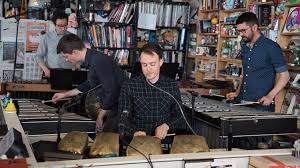
SOUNDTRACK: THIRD COAST PERCUSSION-Tiny Desk Concert #747 (May 29, 2018).

I have always been taken with percussion.  I especially love vibes and marimba.  But I love it even more when bands make music using unusual items.  Third Coast Percussion does both of those.  And the songs are beautiful as well.

The quartet of gentlemen who form the Chicago-based Third Coast Percussion [will] play their sophisticated, modern marimbas and vibraphones, but be on the lookout for the subtleties of tuned cowbells and 3/4″ galvanized steel pipes, like those found at the local hardware store. Add to that a glockenspiel, a MIDI synth, a melodica, a drum kit, children’s deskbells, crotales, a Thai gong and a singing bowl, and you’ve got significant noise-making potential behind Bob Boilen’s desk.

They play three beautiful pieces.  And the blurb sums them up quite well:

The mesmerizing opening number, “Niagara,” written by the group, is from the band’s latest album, the aqua-centric Paddle to the Sea. This water is fast-moving, with pulsing, repeating patterns in the vibraphone, punctuated by drum beats and a bed of low synth.

David Skidmore behind the drum kit is also playing the synth while Sean Connors has the main up and down melody on the marimba. The other two (Robert Dillon and Peter Martin) are playing the same glockenspiel until Rob starts with some drum hits (while David behind the kit plays accents of that main drum beat).  There is just so much going on!

There’s a wonderful moment about half way in when the marimba starts playing a slightly different melody and it’s really quite enchanting.  I am quite taken with the song.

The Third Coasters follow with another from the album, their own arrangement of a slowly rippling ode to the Amazon River by Philip Glass. Beginning with droplets on the glockenspiel and evocative bowing of both vibraphone and crotales (small bronze discs), the music flows softly, taking its time to fan out in all its quiet beauty.

The group busts out the children’s desk bells on the second song, a cover pf Philip Glass’ “Amazon River.”  Sean plays them while also hitting the glockenspiel.  David is bowing the crotales (which he later hits with mallets) while also playing a melodica.  Rob plays a four mallet marimba while Peter plays a four mallet glockenspiel melody.  Sean gets to hit the Thai gong before it almost stops and then he goes behind the marimba to join Rob with three mallets.  Meanwhile for thee second half of the song, David is hitting some small bell-like instrument and Peter has the singing bowl.  As the song ends, David gets to conclude with the Thai gong.

The final song is completely intense.

Torched and Wrecked is, as David Skidmore mentions, something that once happened to his band mate Sean Connors’ automobile. It’s also a butt-kicking ride that includes those steel conduit pipes, which the band cuts to specific lengths to get the desired pitches. Skidmore wrote the piece, but it’s Connors who appears to achieve a kind of cathartic glee pounding on the metal tubes.

There’s no funky instruments om this, but the song is great.  David (2 mallets) goes behind the marimba with Rob (4 mallets).  Peter is at the glockenspiel (4 mallets) and yes Sean has the metal tubes.  The song is fast and intense and I get lost with just who is playing what sounds by the end.  It’s really cool.

It’s also fun to see them all pop up at the end when they all finish at the same time.

[READ: January 14, 2018] “Six More Considerations”

Lydia Davis writes short, short pieces.  Flash fiction, they call them. Sometimes I think they are great. Other times they just irritate me.

This group falls into the irritation camp.

Anyhow, the six stories are

(more…)

Read Full Post »

SOUNDTRACK:  HAYDEN-Live at Massey Hall (February 28, 2015).

The second season of Live at Massey Hall features ten videos from 2015.

A friend of mine from Vancouver got me into Hayden back in 1995.  Back then Hayden had a rough, bassy, somewhat peculiar voice.  Now, twenty years later, that rasp is almost all gone and his songs feel a bit more commercial.

He talks about the Toronto music scene and how important Massey Hall was.  But also the craziness of seeing Dinosaur Jr play at Massey Hall–it was unusual to see a band tearing it up on that stage.  All bands are excited to play there–the rumors of how good it sounds on stage are true.  Massey Hall is a musicians dream.

“Almost Everything.” is from his 2013 album and features him on piano (and harmonica).  I like the organ sound (from J.J. Ipsen) on the song and, lyrically, the song is pretty great:

But I’m recording once again
While my kid is upstairs in bed
And I’ll admit now and then
That some nights when I’m strumming
Or maybe just drumming
The music is still everything…
Well almost everything

“Bass Song” is about “self-defense using a bass guitar.”  This is an earlier song and his delivery is a bit closer to that earlier style of singing.  The song has a really satisfying and fine melody line and riff throughout.  As the song builds to the end, Hayden himself starts playing more and more weird and dissonant chords on the piano while playing a great harmonica solo.  Strangely enough the bassist Jay McCarrol plays drums for this song, while the drummer Taylor Knox switches to bass (but just for this song).

“No Happy Birthday” was written for his five-year-old daughter who is nonverbal. When he tries out new songs or “back catalog classics” with her, she gives the sign for “all done” really quickly.  (Someone shouts, I love you).  She loves me too, she just doesn’t love my songs.  Her favorite song in the word is “Happy Birthday.”  How do you compete with that?  The song is just him on guitar and harmonica.

Taking a break, he says, “You always see musicians fawning over this building. I don’t really see what the big deal is.  [pause] I have to say I’m kidding.  I started feeling really bad there.

“Next is a song about a bar.”  It’s from the soundtrack to Trees Lounge.  It sounds a lot like the original because he’s singing with his bassist’s deep additions to the vocals.

“Hey Love” is a new song with wonderful harmonies. The middle section has him taking out the plug for his guitar and touching the metal part so that it buzzes rhythmically.

“Dynamite Walls” gets a big response. It’s an older song and is very catchy.  There’s a lengthy cool jam session at the end.  It’s nearly three minutes long and it gets really noisy and chaotic with the drummer in particular going crazy by the end.  Then it settles down for the end.

It’s a really solid concert.

[READ: February 2, 2018] “People Who Are Refined”

This is a collection of four stories.  I didn’t really like any of them, but I was absolutely fascinated by the way these stories were discovered.   I remember hearing about this when it happened and it is still fascinating.  So, far more interesting than the content is this:

By Robert Walser (translated by Susan Bernofsky), four stories from The Microscripts, to be published next month by New Directions and Christine Burgin Gallery. Written on scraps of paper in markings often only a millimeter tall, the microscripts were at first mistakenly thought to be a secret code when they were discovered after Walser’s death in 1956. Magnification of the texts revealed them to be a miniaturized form of standard German script.

The first story is about a sorrowful man who disregarded desires.  He was full of loneliness and could not escape his worries.  Midway through he says, “Here I would appear to have completed the first section of my essay.  Now I shall turn to his son or progeny (how did a man living life in loneliness have a son?  Unclear).  The son did not have his father’s worry.  He was happy-go-lucky.  It appears that his soul was unhappy but the language kind of got away from me.

The second story is about a man given a book by a good woman who was married to bad man.  She was delicate and he was trivial.  While she was single she didn’t mind being a charming idealist.  But her husband changed her mind and now she wanted to be bad.  Being good regardless of the circumstances–oh how difficult this was proving to be. She went to what I gather is a brothel

The third is more of a statement about his will to shake a refined individual to rattle him about as if he were a scraggly tree bearing only isolated jittery leaves.  But the abuse is verbal and seems to be a back and forth more than straightforward abuse.

The fourth story is about a man who numbered among the good and refined. He created an enterprise which required the support of other nice, good, devout, refined people.  Surely this was reckless. Yes, they left him in the lurch and abandoned him.  The rest of the story turns into a sort of color scheme.  He is Mr Brown, he meets Mrs Black whom he hates because they harmonize so well.  They met a rascal clad in sky blue who smiled in yellow, cast down his eyes in fiery red, and spoke a deep green.

This ends with “his is certainly a peculiar story, and in any case it has never before appeared in print.”

The same could be true of all four.

Read Full Post »

SOUNDTRACK: KHRUANGBIN-Tiny Desk Concert #743 (May 16, 2018).

The sound of the guitar that Khruangbin create is so dead on for an old sixties band that as they started this set I thought perhaps it was a sample they were opening up with.

But it was all live.  And as the camera comes on for “Maria También” we see this trio jamming this really groovy instrumental song (with whispered words from bassist Laura Lee).  The guitar melody is full of circular riffs but when it shifts to the main body, I love the way the bass and guitar play the same thing but it sounds like a fresh addition of low-end (his guitar seems to eschew the low-end entirely).  The middle of the song is a cool guitar solo with lots of hammer-ons and chords thrown in to generate a really wonderful sound–the tightness of the ending is really cool too.

So Khruangbin is a

trio from Houston, Texas heavily inspired by 1960s and ’70s funk and soul from, of all places, Thailand. That musical passion has taken them on a journey that, these days, incorporates music from Spain, Ethiopia and the Middle East. Khruangbin’s largely instrumental music is grounded in Laura Lee’s bass, with Mark Speer playing those melodic, richly reverbed guitar sounds and Donald “DJ” Johnson on drums and piano.

“August 10” is a jazzier number with lots of slow but evocative bass. The main part of the song is gentle chords with some cool riffage.  The middle slows things down with some very gentle na na na nas from all three members. Johnson’s drums are pretty simple and standard throughout–keep the beat and add some accents.  It’s that funky bass line that is so great.

Two of the three songs performed at this Tiny Desk Concert are from their 2018 album Con Todo El Mundo, which is dedicated in part to Laura Lee’s Mexican-American grandfather. He’d often ask her how much she loved him and the response that pleased him most was when she would say, “con todo el mundo,” (with all the world.)

The third track in this performance is one of the band’s first forays into vocals, from their 2015 debut album, The Universe Smiles Upon You. “White Gloves” gently pays homage to a “classy lady” who was “a fighter” and who “died in a fight.” Its open-ended lyrics could imply a battle that was violent or an illness. It isn’t clear.

“White Gloves” is more mellow and less jamming.  I am fascinated that Johnson switched to piano (no drums on this track) for this song. Unlike the other two songs, this one needed to grow on me, but I enjoyed it by the end.

[READ: January 28, 2018] “The History of The History of Death”

This story is written as a speech given at a Symposium held at the University of Melbourne, 2— The Symposium was called “Postmortem of the Printed Word.”

The speaker announces that in 490 BC Hermodorus tried to refute Heraclitus’ claim that “everything changes and nothing remains still.”  He did so by writing a History of Death in which “only those things which had ceased to change” would be recorded.

After writing the first volume, he died of a seizure.  Another scribe had just recorded Hermodorus’ death when he himself fell ill and died.

Future writers chronicling this History of Death also died in complex ways.  One was trampled by a horse, one died of stomach cancer.  When it was translated into German, it became like something of a light for moths as so many scholars wound up dead. (more…)

Read Full Post »

SOUNDTRACKRHEOSTATICS-The Horseshoe Tavern, Toronto (December 10, 2016).

This show is the second of two shows at The Horseshoe Tavern featuring the return of Dave Clark on drums, Hugh Marsh on Violin and Kevin Hearn on Vocals and Keyboards.

After about an hour, there is a ten minute intermission, but this show is about twenty minutes longer overall than the previous night’s.  And the sound quality is 100 times better–nice and full.

The band plays the same five new songs this evening but not all together.  Surprisingly, (a little although I get why it is this way), the set list is pretty similar to the previous night.  The only songs played the first night that were not played the second night were “It’s Easy to Be with You,” “People’s Republic of Dave” and “Self Serve Gas Station.”  The only songs played the second night but not the first were “Palomar” “Halloween Eyes” (!), “Horses” and “Christopher.”

On the download, the intro to “Stolen Car” is actually about 5 minutes of drum machine before the band comes out.  Then Dave Clark plays a bit of an introductory drum solo while I gather the rest of the guys ambled out.  After about 2 minutes of drums, Martin plays the guitar opening to “Stolen Car” and he sounds fantastic singing it.  It’s a really lovely version and Martin hits those high notes with no problem.  When it’s over you hear someone say “never open with a show stopper.”

Bidini says, “More songs about breaking the law.  Although ironically we will not be performing “Breaking the Law” (booo) I guess… never say never, eh?”

Tim sounds great on “King Of The Past” and Kevin does the whole Mister Rogers introduction for “Fan Letter To Michael Jackson” which again sounds different (but only a little) with all of the extra keyboard stuff.  The band is always tight on this song.

Dave apologizes for the TFC, Toronto Football Club, loss.  Was anybody there?  Nobody.  Good. We don’t want any angry football fans here.

Have you said hello to Dave Clark yet?  Dave is playing with a stolen timbale tonight, although he made good.  Way back in the 1980s, Dave stole that drum from Mr McKay’s music class at Martingrove Collegiate.  However, one wintry morning a couple of years ago he enumerated the value of the drum and paid them $500 for it.  “Then I walked home to my old house.  You could have rolled a bowling ball down the roads and not hit a thing.”

I love “P.I.N.” more with each listen.  The four-string guitar sounds great and the band is always having fun.  Whether it’s Kevin’s keyboards floating around or Tim’s interjections midsong, it’s always fun.

Clark is gonna play some brushes for “Mountains And The Sea” which sounds much better at this recording than the previous one.  Mid-song, Dave whispers (that’s Hugh Marsh on the violin).

Then Bidini introduces Martin’s fancy guitar …two necks… two guitars?  Siamese guitar?  Then he notes “a very interesting discussion going on back there.  Are you all discussing my post lounge debut?.”

Martin: Dave’s very exited about the mike… going hand held.
DB: I seized the mike.
Tim: Let’s limit that to one song.
Martin: Seized the mic?  It’s right in front of you.
Kevin: Carpe Mikem [much laughter]
DB: That’s my stage name.

Tim: I think they’re discussing music stands on stage … Lack of commitment?
Martin: Bands that have music stands I want to kill them all… they’re racist….  I don’t know.

They finally start “Northern Wish,” but after a beat Clark says, “Let’s start that again.  I’ll tell you why.  Because I saw a squirrel go by.”  It sounds great and is followed by Tim’s “Palomar” which is dedicated to the dog that’s accompanying someone in here.

They play “saskatchewan” which opens with a long meandering opening, that’s quite lovely.

They take the ten minute break which on the download is primarily synthy jazz, although it doesn’t really seem to be from the club.  When the ycome back Dave says “Our break was good.  We beat up some yuppies in the alley.  Do yuppies till exist?  We are probably yuppies.

DB: Can you see Tim is he lit enough?  No!
Tim: My sister came last night and complained about the light show.  I was in the dark.  I said that’s the way I like it.
Martin:  That’s bass-ial discrimination, Tim’s lightning.

Tim’s “Music Is The Message” also sounds much better in this fuller situation, although it is still primarily piano and Martin’s quiet soloing. When it’s over, someone shouts “Happy Birthday Tim.”

Kevin explains that “Chemical Valley” is from a recording he made with Martin and Hugh last winter, (with Gavin Brown on drums).   Dave says that he and Tim were on a cruise.  There’s lots of Hugh Marsh’s soaring violins.

Kevin says that Martin’s going to sing his song called “The Albatross.”  Martin “The Unlucky Albatross.”

Dave tells a story of Martin working at the Royal Ontario Museum as a young fellow.  Martin says he defleshed an ostrich and a rhinoceros while getting bones for comparative paleontology.  He brought the meat home to eat.
DB: The Tielli’s were famous for their rhinoceros soup.
Martin: The rhino was worse, it was rank, But we got to have a piece of real rhino.
DB: Is it true your dad made grappa with the rhinoceros bones?
Martin: Horn, David, grappa cornuto.
DB: It’s the bands secret.

Kevin: Anyway, Martin’s going to sing his new song.  It’s called, “The Albatross”
Tim: Mr Reality over there.
DB: Fucking talk show host.
Kevin: Happy birthday, Tim and here’s Martin with his new song “The Albatross.”

This version is really good and much more fun, but it still feels more like a solo Martin song than a Rheos song.  But “California Dreamline’ sounds terrific.

Its followed by a 10 minute “Dope Fiends and Boozehounds.” (Three Martin songs in a row).  There’s a beautiful flute-like melody playing throughout the song (Kevin, I assume) and another cool drum solo from Dave Clark.  At he end of the song when it gets to the “dark side of the moon” and the howling starts the sounds get kind of dark and spooky and weird and someone plays the riff for Pink Floyd’s “Money” while some howling goes on.

More banter: “This is the end of our Canadian tour.”  “Did you know it was Tim’s birthday?  He’s 71.”
Tim: That last song really went to the dark side didn’t it?  For a moment, I was on the dark side.”

“Claire” sounds great with Martin playing a wonderful solo and then mid-song it just stops dead.  Tim was saying to bring it down and Martin was saying to bring it up.  Tim says he wanted to hear more of Martin’s guitar.  “It’s your birthday, you can hear all the Martin you want.  I want a guitar solo for my birthday, Martin.  I want some violin on this guitar solo.  Wah wah wah, it’s all about me.  And a little drum solo at the end.

There are cool keyboard twinkles that lend atmosphere to the opening of “Shaved Head.” The song sounds amazing although just before the ending, there’s a pause with much laughing (but Martin doesn’t lose it).  I wonder what happened.

After the encore, Chris Brown comes on to play keys for “Queer.”  After the song, Kevin sings “Waiting For My Man” with the refrain of “Hey Chris Brown what are you doing uptown?  Chris Brown / Uptown.  They start jamming a bit and Dave says, “C’mon, Tim, it’s your birthday, so Tim sings a few lines of “Halloween Eyes.”

After a pause they start playing “Horses,” but Martin says, “Clarkie, just think about the Royal Albert in 1987 and the guy named Tex with the fart gas can and the cowboy hat.
Clark:  He didn’t even work there, he just took it on himself.  He was like a vigilante fart gas man.
Martin: What do you mean he didn’t work there?
DB: You were very disturbed by Tex and his fart gas canister.
Martin: I’m disturbed that fart gas in a can even exists, Dave.
Kevin: Yeah, Dave.
Martin: That’s just weird in itself.  Stop your song that they wanna hear.
Kevin: Yes, let’stalk about this.
after some discussion
Clark: I’ve got a giant can of Beano in the back.
Martin: What’s Beano for?
Clark: It’s for starting songs, lets do one.

“Horses” rocks.  Midway through the song he starts singing “Smoke on the Water” but no one really seems to play along with him.
DB: I’m still in that Dope Fiends Black Hole.
Martin: That Pink Floyd black hole?
Kevin: There’s a cream for that.

Clark sing “Super Controller” which sounds much bigger and more fun with those “ba ba bas.”

There’s another encore break and they come back for “Legal Age Life” which was performed acoustic in the crowd and is thus silent till the ending part.  The recording doesn’t really follow them and you can hear people talking at one point someone even says, “that is them, I thought it was a bunch of other people.”  Then you can hear the end of the song.

Finally, they’re back up on stage and Martin says, “somebody get me a shot, the bar’s closing.”  This leads to an awesome version of “Christopher” to end the night.

It’s a fantastic show and confirms that they are back and better than they have been in years.  Next time I see that they are playing I need to haul myself up to Toronto to watch them.

[READ: January 28, 2018] “One, Two, Three and Four Rabbits”

This was a story published posthumously and was translated by Ezra E. Fitz.

I pretty much never knew what the heck was going on.

It starts with

I. The Future…

From where is the future related?

That’s all of Part I.

Then

II.  The Past (more…)

Read Full Post »
SOUNDTRACK BELA FLECK & ABIGAIL WASHBURN-Tiny Desk Concert #741 (May 11, 2018).

I know and like Bela Fleck.  I know and like Abigail Washburn.  I had no idea they were married.

A very pregnant Abigail Washburn points to Bela Fleck at the Tiny Desk and says “and just so you know, this is his fault.” I won’t spoil the video by telling you his response.

Bela Fleck and Abigail Washburn are two American musical treasures. This husband-and-wife banjo duo write original tunes steeped in the roots of folk music. Their playing is sweetly paced with melodies interweaving through their intricate, percussive picking all while Abigail soars above it all with her discerning, yearning voice.

I also had no idea how political they are.

Their first tune, “Over the Divide,” was written at the height of the Syrian Refugee Crisis. They’d read a story about a Jewish, yodeling, Austrian sheep herder who helped Syrians out of Hungary, through the backroads that likely only sheep herders know.

Lyrical content aside, the music is just stunning.  The banjo is oft-mocked for its twang, but these two play such beautiful intertwining lines, it is just magical.   The opening melody is just jaw-droppingly lovely.

They each switch banjos to rather different-looking ones–deeper more resonating sounds

The second tune, “Bloomin’ Rose,” is a response to Standing Rock and the Dakota pipeline that is seen as a threat to water and ancient burial grounds. The intensity and thoughtfulness in Bela Fleck’s and Abigail Washburn’s music is why it will shine for a good long while, the way great folk tunes stay relevant over the ages.

But Abigail isn’t just banjo and vocals,

For the third tune, Abigail waddled over to a clogging board. And before she began her rhythmic patter, told us all that “my doctor said that what I’m about to do is ok! I have compression belts and tights on that you can’t see.” [Bela: so do I].  They then launched into “Take Me To Harlan,” another one of their songs from their 2017 album Echo In The Valley.

She says that they met at a square dance in Nashville, and she loves dancing and movement.  Bela plays and Abigail sings and taps for this jazzy number.  The middle of the song features a call and response with Bela on banjo and Abigail tapping [“Eight month?  No problem.”].

For the final song, “My Home’s Across the Blue Ridge Mountains,” Abigail says it’s usually done in a perky bluegrass country style but they listened to the lyrics and decided it was not perky at all.  So they turned it into a different thing.  It’s a somber song with Bela on a relatively slow banjo (with a slide that he sneaks on near the end) and Abigail singing mournfully (she can really belt out a tune).

Although as Steve Martin pointed out, with a banjo almost everything is upbeat.

The parties at their house must be a hoot.

[READ: January 21, 2018] “Active Metaphors” and “Death By Icicle”

“Active Metaphors” is one of Saunders’ funniest pieces that I’ve read.  And whats strange about that is that it was an essay published in the Guardian newspaper.

There are two headings: “Realistic Fiction” and “Experimental Fiction”

“Realistic Fiction” begins with the narrator in a biker bar.  He overheard two bikers, Duke and StudAss discussing these two types of fiction. –they’d purchased their “hogs” with royalties from their co-written book Feminine Desire in Jane Austen.  There was some verbal sparring during which they threw Saunders out a window “while asking questions about F. Scott Fitzgerald’s fallen American utopia.”

The narrator explained his theory of realism to them–everything happens the way it actually would and then suggests that maybe a central metaphor would help define things.  There’s an impotent farmer and every time he walks past the field, the corn droops.  An active metaphor like this helps the reader sense the deeper meaning of the story.

As they ride off with him on their hog, the bikers use some great professorial language–the end is hilarious. (more…)

Read Full Post »

« Newer Posts - Older Posts »