Feeds:
Posts
Comments

Archive for the ‘Harper’s’ Category

SOUNDTRACK: BRODY DALLE-“Dressed in Dreams” (Field Recordings, July 15, 2014).

For this Field Recording [Brody Dalle: Raging Into the Light], Brody Dalle plays in an Indian Restaurant!  I fancy myself a knowledgable punk fan, but I’ve never heard of Brody or either of her bands.

Throughout her career, punk icon Brody Dalle has embraced her aggressive side. Best known as the lead singer of The Distillers and Spinnerette, Dalle has a sandpaper- and velvet-tinged voice that speaks to rebellious young punks who are curious about the world yet vulnerable to its sharp edges. “I’ve never understood why there was such a fuss about aggressive women in music,” Dalle says. “To me, aggression is a human instinct. … I’ve felt provoked for most of my life, especially as a child. I guess I’ve carried those feelings into my songs.”

So it was a pleasant surprise that Dalle was open to the challenge of crafting a stripped-down version of her song “Dressed in Dreams.” An anthem about getting back up when you’ve been kicked down, the song is personal to Dalle: After overcoming addiction, she almost immediately faced a brutal bout of postpartum depression. “I had a hard time getting myself up and running before I wrote this record,” she says. “I felt worthless. I was embarrassed and lost.”

Luckily, Dalle was able to use her songwriting as a way to fight back. Earlier this year, she released Diploid Love, her first solo album, and she says she happily embraces her day-to-day life as a working rock mom and wife. As Dalle set up her gear at New York City’s Panna II, we noticed the way the chili-pepper strands that covered every surface of the restaurant bathed her in a weirdly fierce yet serene red light. They provide a nice little visual metaphor for the way raging against the darkest points in life can help bring you into the light.

I love the fuzz she gets on an acoustic guitar.

But I have since listened to the recorded version and I like it a ton more.  The extra guitar really helps make what is an otherwise simple and repetitive song far more interesting.  Her voice also sounds a lot better on the record.

But the weirdest thing is how long this song is.  The Distillers songs were proper punk songs, last about 3 minutes or less.  This one, running over 4 doesn’t have enough variety to sustain that length.

[READ: February 5, 2018] “A Failure of Concern”

I wrote this about a Ben Marcus story published in Harper’s in 2011:

It goes on for several pages.

There is some degree of amusing shock value in the way he speaks … but as with much of what I’ve read from Marcus, I feel like I could have read half of this and gotten enough.

No explanation is given for the problem (and, fair enough, it is only an excerpt) and anyway, by the end, I didn’t really want one.

And I feel exactly the same about this story.

The nutshell story is that the narrator’s father and a lodger in their house are both missing, possibly murdered.  There is a detective there looking for clues.

The narrator is a lunatic, a mental case, and idiot, a deviant, a murderer, something, whatever.  The narrator gets common quotes and facts wrong. The narrator seemed to hate both his father and the lodger and seems likely very guilty. (more…)

Read Full Post »

SOUNDTRACK: SEVYN STREETER-“It Won’t Stop” (Field Recordings, August 6, 2014).

The blurb for this song totally cracks me up (especially 4 years removed) because not only did this song not seep into my collective consciousness, I’ve never heard of it. Nor have I heard of Sevyn Streeter.

Although it is funny that just last week my wife and I were utterly mocking people who name their child a number–what else did George Costanza tell them to do? And how misspelling it like this is even worse.

Anyhow, here’s the blurb:

In the spring of 2013, songwriter and R&B singer Sevyn Streeter released a song called “It Won’t Stop,” which she’s called her “baby.” Over the year and change that’s followed, the song has sunk into our collective consciousness through commercial radio play and a music video viewed more than 35 million times, and on the recommendation of a growing group of critics and fans. The lyrics are vernacular, warm, unpretentious, while the performance demanded by the music is not for the meek. Away from a studio — and air conditioning — in a New Orleans boxing gym, Streeter executed with muscle and grace.

Having mocked the blurb, the song itself is pretty.  I’ve no idea what the original sounds like, but this version is done with just two acoustic guitars–one of whom seems to be playing some bass melodies from time to time.  Streeter sings and warbles all over the song and does those R&B quivering notes that I hate, but she does have a nice voice.

But damn is this song long.  Why is a pop song five minutes long?

It’s neat that they filmed this Field Recording [Sevyn Streeter Knocks Us Out] in a boxing gym–how on earth were they able to eliminate all of the ambient noise?  It almost seems like it’s not live.

[READ: February 8, 2018] “Microstories”

This is a collection of flash fiction pieces which may or may not be connected.

Rain
Never ending rain seemed to be the truth until the day he was born.  While everyone was delighted for him that he never had to experience it, he lived with regret that he would never have the chance.

Divorce
He is dressing for his grown up daughter  What a strange thing to have to do–how infrequently he sees her, how should he look.  No idea what happened at the end of it though?  An earthquake? (more…)

Read Full Post »

SOUNDTRACK: CÉCILE McLORIN SALVANT-Tiny Desk Concert #790 (September 25, 2018).

The blurb talks about Cécile McLorin Salvant’s punk roots.  This made me thing that their might be some rough elements in these songs.

But these songs sound akin to old-fashioned-sounding jazz standards (even if she wrote them recently) in the vein of Ella Fitzgerald or Sarah Vaughn.

The nod to punk seems to come in the vaguely erratic piano which verges on atonality at times.  And yet:

From listening to McLorin Salvant’s exquisite performance here, I also couldn’t tell that when she was 15, she was listening to Alice in Chains, sported a Mohawk and was into what she calls “radical feminist punk stuff,” as she told NPR after the performance. “Sometimes I still really like Bikini Kill, and I still have my little Pearl Jam grunge moments.”

What can be heard in each song is a seasoned jazz singer with a vast vocal range, meticulous technical execution and a superb classical vocal foundation, which actually began when she was just 8. Her background in classical piano is evident in the inventive harmonic and melodic construction of the first three songs heard here; all are romantically themed McLorin Salvant compositions from her third album, For One to Love, recorded in 2015. The record won her a 2016 Grammy for Best Jazz Vocal Album.

“Fog” opens with some striking minimalist almost atonal piano playing.  The song veers through many different tones and styles throughout its five plus minutes.

About “Look At Me” she says, “This was originally called “‘Friend Zone’ which is a zone I know so well.”  The piano is delicate–twinkling–as she sings about being the friend when she wants more.

She says the next song is called “Monday,” “Lets see if I remember the lyrics.”  After introducing Foster, he comments, “I just learned this on the train here, so bear with me.”  This is notable because there is a lengthy, lovely piano instrumental part in the middle.

After a hog, Foster leaves and McLorin Salvant prepares for the last song.

McLorin Salvant closes with “Omie Wise,” an American folk song that tells the tragic story of murder victim Naomi Wise and her husband and killer, John Lewis:

Then pushed her in deep waters where he knew that she would drown
He jumped on his pony and away he did ride
The screams of little Omie went down by his side.

Feminist themes are common in McLorin Salvant’s music, and while “Omie Wise” addresses gender-based violence, she says she sings difficult songs like this to address an important historical legacy. “We don’t sing to our kids and we don’t know any of our folk music anymore,” McLorin Salvant says. “But like all of the history of race songs, coon songs, minstrel music, music from Vaudeville, all of that is like, ‘No, we’re not going to address that — that’s too ugly.'”

This song is especially powerful sung a capella and even more so when it is heard on the weekend that that piece of excrement Kavanaugh is having his Supreme Court hearings.

[READ: January 19, 2018] “Admiral”

T. Coraghessan Boyle is an incredibly prolific writer.  He writes about a huge variety of topics as well.  Some of his stories are down to earth and realistic while others, like this one, are based in a near-future fantasy.

The premise of this story is simple and not all that far-fetched (especially in 2007).  A rich couple has cloned their beloved dog, an afghan named Admiral, for $250,000.  They want to raise this dog exactly as the first Admiral was raised.  They believe in the cloning to create an identical dog, but they also believe in the nurture aspect which means they need the girl who dog-sat for him to do everything exactly as she did all those years ago.

That girl, now a woman, was recently laid off and needs some cash. So when Mrs Striker called and told her she had an opportunity, Nisha said… why not?

She returned to the house where she hadn’t been in four years but which was such a large part of her childhood. (more…)

Read Full Post »

SOUNDTRACK: WILD BEASTS-A Simple Beautiful Truth” (Field Recordings, October 23, 2014).

I don’t know if there was an initial mission statement for Field Recordings, but I feel like this one fits my model of Field Recordings perfectly.  For this Field Recording [A ‘Beautiful Truth’ In A Beautiful Bar], NPR brought a band into Grand Central Station to play a song.

Of course, they can’t have the band play in the middle of Grand Central Station (well they could and that would be awesome–but not if they want a lush version of the song, which they do).  So they had them play in The Cambell Apartment, a bar tucked into Grand Central Station. What?

You can be 10 feet from The Campbell Apartment, a bar tucked into the corner of New York’s Grand Central Station, and not have any idea it’s there. The office of a member of the New York Central Railroad’s Board Of Directors in the 1920s (and later a storage closet and a jail), the room is intimate in spite of its 25-foot ceilings and the enormous leaded-glass window that faces Vanderbilt Avenue.

The band Wild Beasts does not in any way live up to their name.  There’s hardly anything wild or beastly about them.  They play a kind of new wave, almost old-time music (Roxy Music-ish): “The band’s sound — from the street-urchin-inspired lyrics of its early songs to the new-wave synths woven through its latest album, Present Tense — arrived fully intact via time machine.”

“A Simple Beautiful Truth” has a delicate synth line and loud electronic drums.  It wouldn’t make sense in Grand Central Station.  I’m not entirely sure it make seen here, but the band’s overall vibe does make sense in this old-timey bar.

[READ: October 10, 2017] “A Report on Our Recent Troubles”

This story is indeed written as a report.  The recent troubles are a euphemism for the rampant suicide that has struck a village.

But because the story is written as a report, it has a formal, detached tone that really allows for much thinking about suicide.  The suicide is so rampant that families have moved away, leaving those who remain to deal with their shattered existence.

The town was once pleasant–connected to the city and culture and yet with a rural sensibility.

They the undersigned are reluctant to look for one thing that changed everything but they can’t help but note that when Richard And Suzanne Lory killed themselves, things seemed to change.  Each in their early fifties, happily married and with lots of friends.  They killed themselves and left no note. An investigation turned up no scandal.

Two weeks later a 74-year-old retired high school math teacher killed himself.  He had been diagnosed with cancer of the liver.  This was less scandalous and almost understandable. (more…)

Read Full Post »

SOUNDTRACK: JON BATISTE AND STAY HUMAN-“Believe in Love” (Field Recordings, November 6, 2014).

I had never heard of Jon Batiste and Stay Human until he became the bandleader and sidekick on The Late Show with Stephen Colbert.

It’s always fun to read about a famous person from before they were famous.  But this blurb doesn’t say much about him (that’s him in the yellow suit and melodica).  But the story about this Field Recording [Jon Batiste Leads A Private Street Parade Atop A Fort] was too good not lead the whole thing in.

Jon Batiste is from New Orleans, where a street parade might assemble around the corner on any given day. Evidently, he likes a good walkabout: He’s liable to lead his band at a guerrilla concert in the New York City subway, or out of a venue, or — as he did at the Newport Jazz Festival — off stage and into the audience.

After playing a set at Newport, he and the Stay Human band kept walking. They walked past the backstage trailers, through the quad stage and up onto an overgrown rampart of Fort Adams — the 190-year-old edifice that houses the festival. After a long day of travel, interviews and a headlining performance, they were there to give us a special and private encore.

The song they played, “Believe in Love” which is upbeat and pleasant.   It is a pretty New Orleans-inflected  (must be the sousaphone bass) poppy/jazzy song.  It’s a lovely understated song, with simple instrumentation: Jon Batiste, voice/melodica; Eddie Barbash, alto saxophone; Barry Stephenson, bass; Ibanda Ruhumbika, tuba; Joe Saylor, tambourine; Jamison Ross, cowbell/backing vocals.

The keyboardist and bandleader calls his portable performances “love riots”: attempts to generate instant community through music.

I love at the end, before they finish, they simply turn around and walk off (even the upright bass), still paying as the music fades from the microphone.

[READ: October 9, 2017] “The Proposition”

This story is about a successful immigrant to Toronto.  His success is more or less everything he hoped for himself, but he wishes he had just a bit more.

Roman Berman had, like many Jews, migrated to this area of Toronto and because he was successful, he was always asked for various avenues of help.  He wanted to sell his old car, but before he could, a friend called and asked if he would sell this car to Svirsky.  So he waited in his office, but of course Svirksy (who bought a lemon of a car previously) did not show at the appointed time.

Berman was sympathetic to his plight but still angered about the delay.  But he knew that when he first arrived he was also looking for help from anywhere.  He worked very hard to get hat he had–and still worked very hard–to the point of irritating the people he relied on for referrals.  But it was necessary if he wanted to provide a good life. (more…)

Read Full Post »

SOUNDTRACK: FEDE GRAÑA Y LOS PROLIJOS-“”El Gigante” (Field Recordings, May 5, 2015).

Fede Graña Y Los Prolijos are from Uruguay and play a stomping bluegrass (which is why this is called A Bluegrass Ditty By Way Of Uruguay).

Every year SXSW hosts a night of music from Uruguay.

Nestled between Argentina and Brazil way down on the southern tip of the Americas, Uruguay spends way too much time in the shadows of its better-known neighbors.

But a closer listen reveals something for just about everyone: rockeros, sure, but also fans of hip-hop, folk-influenced downtempo music and singer-songwriters with distinct voices and stories to tell.

With an electric bass and a small hand drum laying down the thumping rhythm and an accordion adding to the flair, the fascination comes from the very American-sounding guitar solo that introduces the song.  But once you comfortably know that this is bluegrass, it’s even more surprising when they all sing in Spanish.

After a couple of verses, there’s an accordion solo followed by an acoustic guitar solo (from the other guitarist).  There’s a slow down that seems like an ending but it’s a fake out as the song takes off once more,.

There’s some great guitar fingerwork by he singer as the song races to an end

What a fun song, although I never heard the word “Gigante” once..

[READ: January 5, 2017] “Chicken Hill”

Joy Williams’ stories never do what I expect them to do–for better and worse.

This is the story of Ruth.

It begins with Ruth going to a memorial fundrasier at the Barbed Wire, a biker bar “in a somewhat alarming part of town.”  She had donated $30 to the memorial of a boy, Hector, who has been run over by a sheriff’s deputy.

Ruth was pleased that the father was suing the sheriff–then she found out it was the boy’s fault–he had run in to traffic against the light.

The transition is a strange one: “It was probably just a coincidence that a child appeared not long after that.”  This was a girl who lived in a house nearby.  She was the daughter of a doctor and rather than introducing herself she said to Ruth “I would like to draw you in plein air.” (more…)

Read Full Post »

SOUNDTRACK: JESSE BOYKINS III-“4 U 2 B Free” (Field Recordings, October 8, 2014).

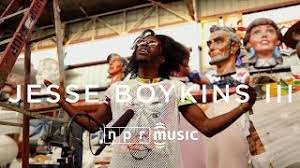
This Field Recording [Jesse Boykins III Breaks It Down] starts with a lot of ambient noise–a giant overhead fan–which I thought might be an interesting component to the song.  But once Boykins starts singing, it’s just his voice. And that’s all–it’s a lovely a capella performance.

The day after playing a set at the Superdome during the Essence Music Festival this summer, eclectic R&B singer Jesse Boykins III wandered into Mardi Gras World — an expansive, airy warehouse packed wall to wall with floats used in New Orleans’ infamous parades. The floats are built from the ground up in-house, so Boykins found himself surrounded by unfinished works and spare parts.

It’s creepy and unsettling to see these giant heads–eyeballs at eyeball height, but just a head–staring at you.  It’s also surreal with the various colors and shapes and the head of Abraham Lincoln looking on as Jesse sings.

He sang one of the most emotional tracks from his latest album a cappella. While singing “4 U 2 B Free,” Boykins pulled back the layers of his own creation, matching his performance to the exposed, oddly vulnerable characters surrounding him.

But Boykins’ performance is really powerful especially at the end as his wonderful high notes as if no no one is watching.

[READ: October 4, 2017] “Enter the Ford: Lost Chapters from A Death in the Family”

I knew nothing about this book, so I had to look it up.

The first chapter sees a young by, Rufus, waking up wearily with his dad.  The boy is very excited and the father seems pretty delighted to be awake with his son so early.  They try their best not to wake the baby girl or the mom.  Of course the mom wakes up and asks for the dad to do some things before he leaves.  The dad makes breakfast–with stern admonitions to the boy not get burnt by the coffee pot, bacon or stove–and then he helps the boy with the difficult buttons.

We don’t know too much about the dad yet, but this exchange is interesting:

“You’re getting pretty good, buttoning yourself.” he said.  Rufus said nothing.
His father thought damn fool thing to tell a child; dumb as a fish.

In the second chapter they head out to Chilhowee Park and the entire chapter is given over to the most exquisite descriptions of this amusement park through the eyes of Rufus.  Everything is amazing and wonderful and the language is of a person taking everything in–from the color of the lake to the swans on the water to the roller coaster and the fairy’s wheel.

And then came the merry-go-round.  We learn how first Rufus rode only on the bench.  And then was allowed to ride the horses that did not go up and down.  And then on the up and down horses only if his dad was holding on.  And finally, today, to ride the up and down one by himself.  The amount of detail about the merry-go round is wonderful.

The only thing more wonderful than the merry-go-round was the little train.  We hear his father’s kind words about how amazing the train is.

Then things go sour a little because there’s also the arcades–where adults play games of chance.  There’s games that one never won–like the seventeen jewel watch.  But the worst was a place where there was “a darky with his head through a hole.”  And the people were meant to, as the carny said, “hit the nigger in the head and you get a cigar.”

Rufus’ mom hated this game.  And Jay wasn’t too keen on it either.  The one time they were there, Jay conceded that the man’s got to make money some way.  Jay tried to ease his wife’s concerns by showing her that the ball wasn’t that hard.  He lifted it up but she refused to even touch it.  The carny got mad at him for touching the ball. And Jay got huffy back.  She calmed him and he walked away.

But on this visit, he did not back down. the carny did. And that made Jay’s day even better.

Chapter 3

This chapter opens with Jay and his wife, Laura, talking about something extravagant.  She wants it, he doesn’t seem to want it and he seems to twist her words against her.

It comes out that he wants to get a car so that they can visit the in-laws once in a while.  She is nervous that cars are dangerous.  He admits they are but sometimes living in a house is dangerous.  But he says that having a wife and kids means he will be even more careful than everyone else out there who has nothing to be careful about.

She agrees to the car.  But in the middle of the night she has a premonition of something bad happening to the family in the car.  He says that they won’t get one.  Then later she gets over the premonition and agrees that they should go ahead and get one.

Chapter Four.

And then daddy drove home in a gas buggy–a new ford  Rufus is thrilled.  Laura can’t believe he drove it there all by himself.  And the neighbors all come out to gawk.

“Course they got an awful name for breaking down… But where Ford’s ahead, he supplies you the parts.”

They go for a before-dinner ride.  Jay drives very well and everyone is enjoying themselves.  Laura is nervous and says so, but he is careful and considerate of them.  He pulls over when another car comes by and he is very cautious around a horse and buggy–the horse is not spooked at all.  But their joy ridge is somewhat ruined by a speed demon who comes buzzing by them scaring them all half to death.

As the excerpt ends, Jay and Rufus take the car out for a spin and Jay really lets the speed fly.  They almost have an accident but Jay is able to handle it and he confides in the boy that they must never tell their mom that they went fast.  He agrees.

I don’t actually know much else about this story.  Between the title and what kind of tension a scene like this builds I expected something bad to happen.  It never did (hooray), but i assume it does),

The writing in this story was exceptional.

Read Full Post »

SOUNDRACK: T.I.-Tiny Desk Concert #780 (August 27, 2018).

Sarah asked me to describe trap music and I couldn’t.

So Wikipedia tells me:

Trap music is defined by its ominous, bleak and gritty lyrical content which varies widely according to the artist. Typical lyrical themes portrayed include observations of hardship in the “trap”, street life, poverty, violence and harsh experiences that artists have faced in their urban surroundings.

It’s interesting that the music isn’t really mentioned in this description.  Because it was the music that I was most attracted to in this Tiny Desk Concert.  The riffs and melodies are really interesting–especially in this concert in which he brought along high school students from a non-profit Atlanta Music Project, who put a classical twist on his street anthems, adding strings and brass in place of 808 bass.

Tip “T.I.” Harris has lived the last 15 years of his life on the big stage. Fans have watched him rise, fall and ascend to new heights again, remaking himself each step of the way. From dope boy to dope emcee. From inmate to activist. From reality star and box-office draw to real estate developer and film producer.

Rapping along to a group of high school string players instead of his classic tracks. Without his usual audio prompts, he kept lyric sheets close at hand while running through the definitive street hits “Rubber Band Man,” “What You Know” and the Billboard 100 chart topper featuring Rihanna, “Live Your Life.” He may have stumbled a few times, but when you’ve successfully reinvented your career as often as Tip has had to it’s probably hard to stick to the same old script.

This Tiny Desk Concert is barely 8 minutes long–one of the shortest I can think of and certainly the shortest for a major act like this.  I didn’t know any of his songs before this, so I was puzzled why each song appears to be barely a minute long (he is either using only his verses because he has guests on the record, or he is only doing a verse and chorus).

The first song, “Rubber Band Man” has a great melody–made even better by the live instruments.  But he seriously plays it for one minute (the band plays it for two).  After a verse or so he

kept his set funky with off-the-cuff stories of the drama behind his music — like the time when he found out, after shooting the video for “Rubber Band Man” with Puff Daddy, that his home had been raided by police. “This music was about the elements that people have to endure in their lives every day and find a brighter side and make a way out of no way,” he said. “That’s what this music represents.”

I love the melody of “What You Know” (I listened to the recording and like this version much better).  The crowd really responds to him as if he were a preacher.  Again, this is a short song, just a verse, and at the end he says he goes into the studio to  bring some soul and funk to get you through the day–to reach the best side of yourselves.

He is super polite and friendly and is very kind to the kids:  “That’s a true example that really says that you’re never defined by your environment unless you want to be,” Tip said, crediting the youngsters for their commitment to craft.

Introducing “Live Your Life” he says that Rihanna ain’t here so…and the crowd responds “we got you!”  It’s fascinating that his original songs are some 4 or 5 minutes long.  This one is reduced once again to a minute or so.

[READ: January 22, 2018] “Thirteen Dreams”

This is indeed a list of thirteen dreams.  They were translated from the Arabic by Raymond Stock.  The full book is described that in his final years, Egyptian Nobel Laureate Naguib Mahfouz distilled his storyteller’s art to its most essential level. Written with the compression and power of dreams, these poetic vignettes… telescope epic tales into tersely haunting miniatures.

I’m not sure why they chose these 13, but I’m summarizing without the endings.

Dream 105
All men get their beard trimmed at Uncle Abduh’s salon by a beautiful woman.  One day he was walking down the street and she came close to him.  He had to stare, but she soon turned into a block of wood.  When he turned around…

Dream 106
There was a coup d’etat and an older man said he’d heard such a thing once in his youth.  The dreamer said he knew who started the coup and he laughed with pride.  But the old man said he once laughed with pride about such things…. (more…)

Read Full Post »

SOUNDTRACK: ERYKAH BADU-Tiny Desk Concert #776 (August 15, 2018).

I remember when Erykah Badu released “On & On.”  It was such a great, catchy song, but it felt really different.  And then I basically lost track of her.  I didn’t realize she was still making music (and she hadn’t made much) until 2008’s New Amerykah Part One was a huge hit.

So I hadn’t followed her transformation into an incredibly iconic and powerful woman.  Back in 1997 she wore large turbans.  Now, some twenty years later she looks amazing but also kind of scary–the pink eyeshadow and pale purple lipstick makes her look almost dead or perhaps reborn.  And when she points at the camera and stares “you tricked me,” watch out!

She sounds almost otherworldly as well.  Instead of the turban she has massive dreads (with butterflies in them).  She looks like an earth goddess.

Some folks around the NPR Music office said they felt an almost spiritual connection to Erykah Badu during her visit to the Tiny Desk. And that was before she and her band even played a single note. It came from the waft of earthly scents that followed in her wake, to the flowing dreads and clothes that hung on her like robes.

After her self-introduction, which included a rundown of her spiritual and creative aliases: Badoula Oblongata, Sara Bellum,  Silly E, Manuela Maria Mexico, Fat Belly Bella, she introduced her band, including on drums, “that’s my son, Seven.”  I’m just kidding that’s not Seven, his name is Delta 9.

The band, a collection of great jazz players launches into a brief (2 minute) version of 1997’s “Rimshot.”  She does some wonderful improv with it and it sounds terrific–particularly her voice.

For the song, Badu

play[s] with time — stretching it, stopping it, suspending it. Propelled by jazz chords on the piano and the steady pulse of the acoustic bass, the playful performance unfolded in the tradition of the best bebop.

She plays only one more track, a 12 minute panoramic song “Green Eyes.”  ….  It’s wide-ranging in scope and musical arrangement and brilliantly executed by the jazz and hip-hop musicians in her backing band. The story of heartbreak is striking enough, but her interpretation showcases her formidable vocal skills. By the time it was over, we were all just as emotionally and spiritually spent as she was from the experience.

There is so much in this song, it’s hard to take it all in.

It opens with a bouncy piano melody: “My eyes are green because I eat a lot of vegetables–it don’t have nothing to do with your new friend.”  A muted trumpet adds to the jazzy feel.  She hits a powerful high note and it feels like another short song, but the piano changes tempo and the song is only just getting underway.

I love the melody and the riff that follows certain verses.  Around 9 minutes into the show, the song feels like its ending again, but a flute picks up and the song moves along with a new urgency.  Until she says Wait and sings

Just make love to me
Just one more time
And then you’ll see
I can’t believe I made a desperate plea
What’s with me?

And the pain and power in her voice as she sings me is wonderful.  As the song nears its conclusion, she hits some incredible notes–showing just how amazing her voice still sounds.

Her music has been described as neo-soul, but to me this felt like old school jazz.  As the blurb concurs

Erykah Badu is an artist for the ages. To old-school jazz fans like myself, names like Nina Simone, Betty Carter and Shirley Horn come to mind as much as Billie Holiday because of Badu’s singular approach to a lyric. They all cut their own creative path and left behind a legacy that you can identify with just one note. Erykah Badu is on that same path, and one day her name will be mentioned along with the other Elders who share her spirit of musical adventure.

Erykah Badu (lead vocals), RC Williams (Keys), Braylon Lacy (bass), Cleon Edwards (Drums), Frank Moka (Percussion), Kenneth Whalum (Sax), Keyon Harrold (Trumpet), Dwayne Kerr (Flute).

[READ: January 19, 2018] “Why Are We in Zefra?”

This excerpt was published in Harper’s.  The blurb about the book gave some basic information, but it was on Karl Schroeder’s website that I found this more detailed explanation of the book:

In spring 2005, the Directorate of Land Strategic Concepts of National Defense Canada (that is to say, the army) hired me to write a dramatized future military scenario.  The book-length work, Crisis in Zefra, was set in a mythical African city-state, about 20 years in the future, and concerned a group of Canadian peacekeepers who are trying to ready the city for its first democratic vote while fighting an insurgency.  Both the peacekeepers and the insurgents use a range of new technologies, some fantastic-sounding, but all in development in 2005.  Needless to say, the good guys win, but not without consequences; the document explores everything from the evolution of individual soldiers’ kits to strategic considerations in world of pervasive instant communications.  The project ran to 27,000 words and was published by the army as a bound paperback book.

That’s pretty fascinating.

The excerpt was pretty compelling as well. (more…)

Read Full Post »

SOUNDTRACK: MAC MILLER-Tiny Desk Concert #773 (August 6, 2018).

Man, I hate Mac Miller’s delivery on “Smaaaaaall Worlds.”  The way he drags out those words, the fact that his mouth i full of gauze,  The way he pauses from time to time which makes it seem like he forgot the words.  Although as with a lot of rappers at Tiny Desk, the live band including Alexander “Justus” West (Guitar) and Kendall Lewis (Drums) really make the music sound good.

The best part is when Thundercat comes over decked out ion his colorful regalia and plays the shaker midway through the song.  And when Mac acknowledges Thundercat on the shaker–why is Mac’s speaking voice so much clearer than his rapping voice?

Mac real name Malcolm James Meyers McCormick is pretty funny when he’s just talking, too.  I was wondering how a young guy I’d never heard of could be so cocky at this Tiny Desk, then I saw

With nearly a decade under his belt at 26 years old, these words ring like an artist twice his age.  We were introduced to Mac Miller via 2011’s XXL Freshman Class, which featured a special crop of MCs such as Kendrick Lamar, Meek Mill and YG, all of whom are now considered in the upper echelon of hip-hop. After his big splash, he’s been able to find a groove and consistently release quality rap records, ultimately keeping his name in the conversation with the other young greats. These consecutive triumphs amassed plenty of fame, fortune and insurmountable obstacles, causing a stumble here and there. Throughout the years, however, Mac has brushed himself off and put it in the music.

The real star of “What’s the Use” is Thundercat on bass.  I don’t even follow the words I’m so focused on Thundercat’s amazing six string bass work.  And when Thundercat sings “I Just Wanna Fly” and takes a credit, it wins over the room.

The other bassist Joseph Cleveland is also great, when Thundercat trades off for the final song.

For the final song, “2009” he says he wanted to have strings on this song but they couldn’t travel with strings.  So they sent the music to these guys (Robin Fay-Massie (Violin), YaShauna Swan (2nd Violin), Lelia Walker (Viola), Melanie Hsu (Cello)).  They just played it for the first time 20 minutes ago.  The strings are lovely with the piano (Javad Day).  The music deserves better than his lame drawl for a vocal line.  Even if the lyrics are introspective and “mature.”

[READ: November 11, 2018] “The Poor Girl”

F. Scott Fitzgerald kept a notebook for stories ideas.  This story comes from idea he never wrote about.  Nunez and other authors wrote stories from these ideas for McSweeney’s 22.  I didn’t write about individual stories in that post, so I get to here.

Nunez chose”Girl marries a dissipated man and keeps him in healthy seclusion.  She meanwhile grows restless and raises hell on the side.”

And she conveys it well, with some delicious details.

This is told by a third party, a friend of the dissipated man.  He explains that Calvin Trent had been a writer, now well into his decline, when he met the girl (more…)

Read Full Post »

« Newer Posts - Older Posts »