Feeds:
Posts
Comments

Archive for the ‘Irish Writer’ Category

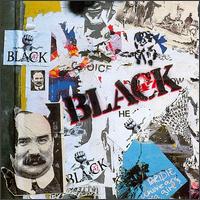
SOUNDTRACK: BLACK 47-ep (1992).

The name Black 47 comes from the Irish famine (and it’s mentioned in Episode 12 of Ulysses.  I saw Black 47 on tour in Boston just before this EP came out.  They played a fantastic live set and had a ton of energy.  I was really excited to ge the EP.  And I liked it very much.

Then I got a new roommate who was from Ireland, staying in the US for school.  And man did he hate Black 47.  He hated the “fiddle dee diddle dee” and the “Bridie!” and oh so much about the band.   And now when I listen to it I hear all of his complaints and I like the disc a bit less.

It’s true, the single “Funky Ceili” is pretty over the top with the Irishyness, and having a chorus of fiddle dee diddle dee didley dee is kind of obnoxious.  But the song still stands pretty strong.

I am much more taken with “James Connolly” a rousing rocker with historical awareness.  I can do without the over-earnest bit about “Lily” but the rest is pretty great.

Overall the disc has a bit too much in the wailing saxophone department.  I don’t dislike the saxophone in general, but there’s a bit too much of it on here.  Larry Kirwan’s voice tends to veer into some weird whiny territory (once or twice I thought he sounded like Robert Smith), but his main singing voice is just fine, especially when he’s rocking out.

The band is still playing today and in fact released an album this year, although I haven’t listened to them much since the 90s.

[READ: Week of August 2, 2010] Ulysses: Episodes 10-12

Much like last week’s reading I really didn’t enjoy this week’s very much on the first read through.  On my second skim through the chapters, I got a lot more out of it.  It feels like there’s a lot of “noise” in the chapters–he’s including little bits of everything–but if you can cut through the chatter, you can find the meat.

Episode 10, which was from many different perspectives, was a nice break in the stream of consciousness.  But Episode 11 was a dry slog about music and Episode 12, while often kind of funny was (I assume deliberately) long-winded with many man lists and all kinds of esoterica about Ireland. (more…)

Read Full Post »

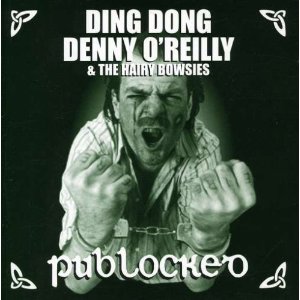
SOUNDTRACK: DING DONG DENNY O’REILLY & THE HAIRY BOWSIES-publocked (1996).

My friend Lar introduced me to this ol’fella (he may have even sent me this CD, as I can’t imagine where I’d have found it on my own).

Ding Dong Denny is the alter ego of Paul Woodfull (who created the Joshua Trio a U2 tribute/pisspull).  And, as I know precious little else about the man, I’ll let the more enlightened pass along the details.

Publocked is a lowbrow amalgam of all kinds of Oirish nonsense.  It’s vulgar and crass and often quite funny.  (Some of the bits stand up to repeated listening–the songs more than the chatty bits, although the chatty bits are especially funny).

Take “The Ballad of Jayus Christ” which sounds like a pretty standard simple ballad until you realize what he’s singing:  “Jaysus O Jaysus As cool as bleeding ice…It’s funny you never rode, coz its you I do my shouting for each time I shoot me load.”

But it’s not all blasphemy.  The “single” “Flow River Flow” is a very sensitive track about the benefits and majesty of the sacred waters (with tin whistles and everything): “When I was just a young man, I sit on the river bank  I loved your gentle water so much I’d have a wank”  With the glorious swelling chorus: “Flow river flow, fuck off to the sea, go where you are wanted, to the deserts of Gobi”

True, now, that’s all kind of crass.  But Ding Dong takes a political stance, too. Take “Spit at the Brits.”  “We Spit at the Brits an we showered’em in a lovely shade of green…we spit at the brits, and then they blew us all to smithereens.”

And what Irishman could ignore the Famine.   “The Potatoes Aren’t Looking the Best” is a view of the famine through the eyes of a farmer.  Shite.

Not everything is a winner, “I Get A Round” is a “cover” of “I Get Around.”   The lyrics are changed to reflect being in a pub (get it?).  And “My Heart Gets So Full (You’d Swear I Had Tits)” is pretty funny, especially since it’s played as an oh so serious ballad, but there’s not much in the world that’s funny for 7 minutes.

So, yes, it’s not quite Joyce, but then Joyce does talk about masturbating by the water, so it’s all equal, right?

[READ: Week of July 26, 2010] Ulysses: Episodes 7-9

Before I begin, I want to make sure that everyone has checked out Ulysses Seen.  It’s an illustrated rendition of the book.  The details are exquisite and you’ll no doubt pick up things that weren’t as apparent in the proper text.  The only bad thing I can say about it is that it’s not finished yet.  So far Robert Perry has only completed Episode One, and it sure looks like that took a long time (it’s really stunning); but between the details ion the drawing and the extensive reader’s guide that comes with it, one can perch there for quite a while.

I admit that this week’s slog through Ulysses was rather unpleasant for me.  The three episodes included here were massive doses of stream of consciousness.  I actually found them exhausting to read.  Not to mention, in terms of plot advancement, they’re rather paltry. (more…)

Read Full Post »

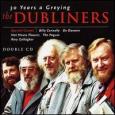
SOUNDTRACK: THE DUBLINERS-30 Years A-Greying (1992).

The Dubliners were an Irish folk grew founded in 1962.  Probably the most notable thing about the band was lead singer Ronnie Drew’s voice, which out-gravels Tom Waits in depth and impact.

I don’t know a heck of a lot about them as a band or their impact on traditional Irish music, but Wikipedia tells me that they were a major force in the export of trad music.  So there.

So if you like traditional Irish music (that’s not as “pretty” as some artists).  The Dubliners are a good resource.)

When I bought this album many many years ago, I was under the impression that it was a greatest hits with extras.  In fact it’s not (although there are a number of classic trad songs here).  The selling point is that there are a lot of guest vocalists (The Pogues, of course, among others).

But I think a cheaper, shorter compilation would be the way to go, (you’d definitely want “Finnegan’s Wake” for instance).  And I have to say I was a bit surprised by the inclusion of “The Rose” (even if The Hothouse Flowers are on it, too).

Nevertheless, if trad Irish music is what you’re after, The Dubliners are your man.  And they’re named after the Joyce book, too.

[READ: Week of July 19, 2010] Ulysses: Episodes 4-6

I would be remiss if I didn’t include a link to the Infinite Zombies discussion about Ulysses. There’s some great stuff there!

This week’s reading introduces us to Leopold (Poldy) Bloom.  We meet his wife Molly and learn about their daughter Milly (who is away) and their son Rudy who died in childbirth.  The most notable thing about these three Episodes is that, despite the continued use of interior monologue, they sound so different.  Whereas Stephen’s was very intellectual (ineluctable modality of the visible, and all), Leopold’s is much more visceral.  He focuses quite a lot on excrement and organs.  And of course, there’s Bloom’s very introduction:

Episode 4 “Calypso”
“Mr Leopold Bloom ate with relish the inner organs of beasts and fowls” (45). (more…)

Read Full Post »

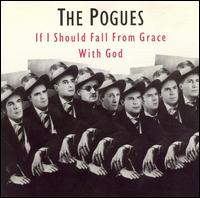
SOUNDTRACK: THE POGUES-If I Should Fall From Grace with God (1988).
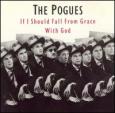
So the cover of this album has James Joyce on it (and a hilarious pastiche of the rest of the band).  I guess we know what we’re in for, then.  This is the Pogues third album and the one that tamed the wildness of their first shambling discs into a (somewhat) presentable collection of songs.  And, jaysus, it’s fantastic.

The Pogues seamlessly blended punk and traditional Irish music (and on this disc they expanded into latin & middle eastern motifs too).  The first track opens with a fast paced Irish whistle playing what is pretty darn close to a jig.  And then Shane MacGowan (whose teeth are not to be believed–or if you are lucky, not to be seen) sings his slurred, fantastic lyrics.  MacGowan always presented such a contradictory figure for this band of well dressed resctable players.  And it’s often confusing wondering how he became the front man of this band.  But he adds that certain something to make the band unforgettable.

“Fairytale of New York” is one of the most gorgeous, sad Christmas anthems ever.  It’s a duet with the much missed Kirsty MacColl and it’s moving and charming, even with the lyrics: “you scumbag, you maggot, you cheap lousy faggot, happy Christmas me arse, I pray God it’s our last.”

Then you get a crazy instrumental, “Metropolis” fast paced, manic energy and a great riff (and of course, let’s not forget the quoted musical passage too).

What’s surprising is when you get a tender ballad like, “Thousands Are Sailing.”  Lyrically it is stunning, and you wonder why is Shane singing it with that slurry voice of his.  And then you realize it works perfectly as a drunken lament.  And then you get to the chorus, and you stop caring and just enjoy the song.

They even throw in a couple of traditional songs, like “South Australia” and “Medley” (which incorporates “Rocky Road to Dublin.”)  But after “Fairytale,” I think my favorite track is “Fiesta” which is a Spanish/Mexican sounding song with loud horns and absurd faux Spanish lyrics.  Ole!

And, just so we know, it’s not all drinking and rollicking, Shane also wrote “Birmingham Six.”  “There were six men in Birmingham / In Guildford there’s four / That were picked up and tortured / And framed by the law / And the filth got promotion / But they’re still doing time / For being Irish in the wrong place /And at the wrong time / In Ireland they’ll put you away in the Maze
In England they’ll keep you for seven long days”

The Pogues would release two more albums before Shane MacGowan took off. And they’re all pretty darn good, but I’ve always been partial to this one.

[READ: Week of July 12, 2010] Ulysses: Episodes 1-3

This is my third time reading Ulysses.  The first time I was a freshman or sophomore in college and I signed up for a James Joyce class because, get this, the Canadian band Triumph had released a CD called Thunder 7 which was supposedly based on the 100-letter words in Joyce’s Finnegans Wake (which I had bought and found impenetrable).  Our teacher was intense and tried to scare everyone off (which worked for some, but not me).  The class was hard (first assignment : read The Odyssey over the weekend for a quiz on Monday).  I enjoyed Dubliners and Portrait of an Artist as a Young Man, but I thought Ulysses was pretty daunting.

I read it again when I re-took the class with the same teacher (not for credit this time, but because I wanted to, imagine that).  And that time I learned to really appreciate what Ulysses had going on for it.  I was also inspired by it to try to write challenging fiction, paying careful attention to every single word, and even possibly using different writing styles in the same book.  (The world appreciates that that never panned out).

But so the careful attention thing: Joyce spent seven years working on Ulysses.  Every single word was charged with meaning.  He even made up his own words.  And it’s very apparent that he was the inspiration for countless modern authors (for better or worse).

I’m excited to pick the book up again.  In part, because it was ranked number 1 on the MLA list of books, but also because for twenty-some years I’ve felt the book was fantastic.  And I wanted to see if I would enjoy it without guided instruction.

I was curious about which edition to read.   Since my class, when there was only really one edition available, many many editions have been published.  There’s a great discussion about this at Infinite Zombies, and I considered getting the third one Judd mentions.  But when I consulted with my old professor, he said the Gabler edition is still the best, so I went with that one.  And that edition is littered with all the notes I took from class and from the supplemental resources.

I decided not to read the supplemental resources this time (although I can;t help but look at my notes), to see what I can get from the story AS A STORY.

I remember a bunch from the class, but one thing that I distinctly remember is that to get everything out of Ulysses, you need to understand Catholicism (the mass in particular), The Odyssey, European history–especially Irish history, and popular Irish culture circa 1920.  It also helps to know Latin.  And these are all things that Joyce would have known and his audience probably would have known.  Every year we move away from its publication, means we know less about what he was writing about.  But that’s all the little details and jokes and blasphemies.  I wanted to see (with some background, which certainly gives me an advantage) if I could enjoy the story without all the help.

So… (more…)

Read Full Post »

SOUNDTRACK: FRIGHTENED RABBIT-The Winter of Mixed Drinks (2010).

I enjoyed Frightened Rabbit’s previous disc ever so much: a twisted blend of rocking folk music and very dark lyrics.  The fact that a number of these songs were used in Chuck was a treat for me.

I’ve never heard their first disc, so I don’t know how much their songwriting changed from disc 1 to disc 2.  But there’s a pretty huge leap from disc 2 to disc 3.

The most notable track has got to be “Swim Until You Can’t See Land.”   And it’s notable for having a really rocking and catchy and undeniable chorus.  They liked it so much, they reprise it later in the disc (with new instrumentation and such) on “Man/Bag of Sand.”

The rest of the disc sounds like Frightened Rabbit, but like the full band version.  There’s just so much music, that it actually distracts a bit from the lyrics (on the previous disc, the lyrics were certainly more of the focus).  There’s even a string arrangement on “Living in Colour.”

And yet despite all of these changes, they never lose what makes FR special: that voice and that outlook.  Although I’m sure I would have enjoyed if this disc was similar to the previous one, I’m always delighted to see a band take some chances and try something different.  And here they did, and it works wonderfully.

[READ: May 19, 2010] “Ash”

On April 14, Iceland’s volcano Eyjafjallajokull erupted.  And here, barely a month later, Roddy Doyle has written a story in which that eruption plays a role.  I’m impressed enough that he could get a coherent story written in that short amount of time, but I’m amazed that it was squeezed so quickly into The New Yorker‘s fiction schedule.  Admittedly, I don’t know how The New Yorker does anything, so I don’t know if they had a slot open (doubtful) or if they had to push back other stories (unlikely) or maybe he was slotted to give them something else, and whipped this out instead?  Beats me.  Whatever the reason, I was really surprised to see this here. (more…)

Read Full Post »

SOUNDTRACK: THE SAW DOCTORS-If This Is Rock’n’Roll, I Want My Old Job Back (1991).

A line from a Saw Doctors song is quoted in this book, so why not review the whole disc,yeah?

I’d first heard of The Saw Doctors in college.  My friend Jaime brought this very disc over to a party (although I prefer the title of their second disc: All the Way from Tuam, better).  I din’t really give them much thought after that.  But then, several years later I saw them live at the Guinness Fleadh Festival and they were fantastic.  I saw them at another show elsewhere (details are sketchy now) and they were excellent then too.

This is their first disc and it’s a bit more subdued and folky than their later releases.  The fun part, of course, is the singer’s greatly Irish-accented singing and so many of the regional references.  I mentioned earlier that there’s a song quoted in this book, and that song is “N17” one of the great anthem songs of all time (even if you’ve never been on the N17, which indeed, I have not, I’ll still happily sing “I wish I was on the N SEVENTEEN, stone walls and the grass is green”).

In general, but even moreso on their later discs, they sing anthemic folk rock (the kind of songs that work very well live).  But they mix elements of trad, punk and just good old rock in as well.  In many ways they’re like a clean cut version of the Pogues (I mean, just look at them on the cover of their greatest hits).  And their Greatest Hits is a good place to check them out.  You get a lot of singles (and they are definitely a singles band), for a good oul’ Oirish rocking time.

I recently learned that they are one of the highest selling Irish artists of all time (although I can think of maybe one other band that has outsold them, yeah?).

[READ: January 31, 2010] These Green fields

Full disclosure right up front.  The author of this book is the boyfriend of one of my friend’s sisters.  Of course, I’ve never met him, and I’ve only met her once or twice, so it’s not like they’re any conflict of interest, but I know how the internet likes to gossip, so I’ll be straight witcha.

I ordered the book from his site, and when it arrived, I was a little concerned because the back cover and the prologue were rather confusing.  Confusing not because they’re about hurling (a lot more on that later) but confusing because the writing wasn’t that sharp.  The back cover just didn’t really grab me, and the prologue, while in retrospect makes a lot of sense, it just wasn’t all that exciting.  But that problem was cleared up once the book proper started,  so I had my guard up for naught.

But so what’s this about hurling?  Well, hurling is an Irish sport (and I’m going to mangle this, so my apologies to those who know the game better than me).  Okay, so basically, you’re on a big field with goals at either end (like soccer, say).  But each goal, in addition to having a net (which has a goalkeeper) also has uprights (like American football, say).  Points are scored in two ways: Hit the ball through the uprights and you get one point.  Hit the ball past the goalie and you get 3 points.  But just to confuse matters, the scoring delineates between the two forms of scoring: Goals-Points, so you see scores like 2-16 to 3-19.  I believe that it’s the total point tally that picks the winner, but it’s amazing how quickly fans can look at these tallies and tell who won.

And what a bout the ball?  Well, I’ll back a up a little and say that thee are two sports that are played on this field.  (Both sports are sponsored by the GAA, the Gaelic Athletic Association): Gaelic Football and Hurling.  Gaelic Football uses a ball like a soccer ball (forgive me, Gaelic Footballers for that simplification).  But hurling, glorious hurling, goes in another route altogether.  The ball is similar to a baseball and the bat–yes they use a bat–is like a field hockey stick, except the base is flat.  (I have a sliotar (the ball) and a hurley (the bat) at home, although I’ve never really gotten to use them.

So the men (women play a similar game called camogie) run up and down the field with these hurleys scooping up the ball and running with the ball balanced on the end of the hurley (you can only use your hands to catch a ball in the air or to throw it to yourself for self-hitting purposes).   And when you get close enough, as you might imagine, you whack the ball at the goal.  I’ll repeat.  You run with the bat and ball, stop and whack the ball down the field with your stick.  Is there any doubt what sport real men play?  By the way helmets became compulsory on Jan 1, 2010.  American Football, you’re a bunch of nancy-boys compared to this.

Oh, and the players are all volunteers!  My friend Louise told me that her teachers used to play on the weekend and they would routinely come into class with black eyes or busted teeth.

For an official explanation of this awesome game, check out these videos (#2 has some great footage and playing rules):

But hey we’re here for a book, right? (more…)

Read Full Post »

SOUNDTRACK: NO FORCEFIELD-Lee’s Oriental Massage 415-626-1837 (2000).

I was terribly disappointed with the second No Forcefield album (so why did I get this one?  Because I got them both used at the same time for $1 each).  And I can’t help but think Id have been so much more disappointed in it had I listened to this one first.

This first record is really quite good.  I still have no idea why Ler from Primus is in the band or what he does on this disc (and he’s the reason I learned about the band to begin with), but this disc sounds like a proper album and not just a bunch of undercooked ideas.

This disc is primarily a collection of electronic/scratching tracks.  The beginning of the disk has more scratch-heavy pieces (provided by DJ Disk), and as the disc moves along we get slightly longer more instrumental-only dancey tracks.  But they’re not really dance tracks either, they’re heavy electronic tracks in the vein of say Prodigy (with no lyrics).  They’re quite inventive and they rock pretty hard.

But it must be said, it sounds nothing like Primus.  There’s virtually no bass, and no guitars and no vocals.  I assume that Brain does all of the electronics and drums, and then there’s a few extra folks helping out.  There’s some definitely worthwhile tracks on here (and the samples are all fun…Mister Roger’s Neighborhood music, for example).

This isn’t a genre I know very well, so I don’t know how it compares globally to others. But I do know bad techno music and this isn’t it.

Not bad for $1.  And, no I never called the phone number.

[READ: January 26, 2010] “Fjord of Killary”

This is a quick, dark story.  It concerns a poet, named Caoimhin, who moves from the city to the West Coast of Ireland.  Specifically, he goes there to buy a hotel.  The hotel has been extant since the 1600’s and was even written about by Thackeray.  Since he is having massive writer’s block, he assumed that this little community on a fjord will give him lots to write about.

But instead, he finds himself very busy tending to the locals (the hotel bar is the real draw) and largely uninspired to write anything.

The actual plot of the story concerns a terrible storm.  The raging ocean that is right below the hotel is rising and rising.  Caoimhin is rather nervous, but the patrons, all old residents of the area, tell him not to worry.  Well, actually they ignore him, (despite all of his lame attempts at conversation making) but the effect is the same.

It’s only when the water actually comes up the porch and under the doors that the people start to really get nervous. (more…)

Read Full Post »

17Many many years ago, I discovered Might magazine.  It was a funny, silly magazine that spoofed everything (but had a serious backbone, too).  (You can order back issues here).  And so, I subscribed around issue 13.  When the magazine folded (with issue 16–and you can read a little bit about that in the intro to Shiny Adidas Track Suits) it somehow morphed into McSweeney‘s, and much of the creative team behind Might went with them.

The early volumes (1-5 are reviewed in these pages, and the rest will come one of these days) are a more literary enterprise than Might was.  There’s still a lot of the same humor (and a lot of silliness), but there are also lengthy non-fiction pieces.  The big difference is that McSweeney’s was bound as a softcover book rather than as a magazine. And, I guess technically it is called Timothy McSweeney’s Quarterly Concern as opposed to Timothy McSweeney’s Internet Tendency. (more…)

Read Full Post »

jokeSOUNDTRACK: FRIGHTENED RABBIT-Midnight Organ Fight (2008).

rabbitMy friend Jarrett introduced me to this band.  He rather casually called it his favorite album of the year, so I figured it was worth checking out.

Frightened Rabbit are a group from Scotland, and they play a sort of disaffected folk.  Although that’s not a wholly accurate description because they do kick in the drums and louder guitars.  So, yeah, they don’t sound anything like Belle and Sebastian.  This is complemented by the lyrics which are somewhat bitter or aching.

And speaking of lyrics, the first song that I wanted to sing along with most was “Keep Yourself Warm” and then I realized that the chorus is “It takes more than fucking someone to keep yourself warm.”  There’s also a very pointed use of the mother of all C words, in another song, too.  And I’ve had that song in my head for about three days now.  But I absolutely cannot sing the song at work or at home, or, well, anywhere except in the car when I ‘m by myself.

This all leads me to wonder, Do bands save their best songs to fill with curses or am I just 8 years old and I listen to the song with curses the most?

The one thing that has troubled me about the record is that at times the singer can sound like the guy from the Counting Crows.  And the Counting Crows are probably the band I hate the most in the universe.  But I just focus on the Scottish burr which lessens the Durwitz effect, and then I can enjoy the disc again.

[READ: Summer 2008] The McSweeney’s Joke Book of Book Jokes

This is a collection of humorous vignettes that are, if not about books exactly, certainly literary in nature.  If you like your humor to be bookish, then this is a great, funny collection.  It starts with the cover itself, as it is printed backwards and upside down w(the cover above is actually on the back).

Many of these pieces are very short (some are a page, even some more are just a few sentences.)  Plus, there are so many pieces that I’m not willing to write all that much, just a one-line summary (that I will try to make funny without giving away the punchline).

I thought about indicating in some way which ones I liked best or some kind of rating system, but that just seems extensive and cruel.

Most of these pieces came from McSweeny’s online, and I’m sure many of the pieces are still available there, but I’m not going to do all the work for you.  And it’s funny how many jokes there are about: James Joyce, Kafka, Homer and children’s books!

Oh, and authors: I started to include all of your names in my Categories, and then it just got too overwhelming.  But if you want to be added, just drop me a note!

Click here for the egress: (more…)

Read Full Post »

tristramshandy2SOUNDTRACK: PEARL JAM-Binaural (2000).

binauraBinaural bursts forth with the rampaging “Breakerfall” and “God’s Dice.”  The latter pauses only briefly for a chorus break.  They are followed by “Evacuation,” a song that sounds a bit off kilter in this studio version but which blasts off on the live version. It’s got a great shouty chorus too.

“Light Years” is another wonderfully singalongable PJ track. The verses are delicate and, while the choruses don’t build, they are still very catchy.  “Nothing as It Seems” is a haunting track that is dark and fantastic.  The opening guitar riff sounds like it’s coming from the middle of a desert, and the rest of the song is great and great sounding too.  “Thin Air” is another mid- tempo song that doesn’t wear out its welcome, and is fun to sing along to as well.

“Insignificance” is one of the great stop/start songs in PJ’s history. The staggered guitar work builds and stops, builds and stops and just gets better as it goes along.  “Of the Girl” is one of those moody pieces that on previous discs sounded kind of throwaway, and yet this song has enough interesting nooks in it that it never gets dull.  It doesn’t really ever bust out into big chorus, but the subtle changes are just as powerful.  “Grievance” is also fantastic. Another staggered type of song with powerful lyrics and rocking verses and choruses. And when played live, this song is a behemoth.

“Rival” is one of those weird little songs that PJ throws in.  An experiment that works more than some of t heir others.  Followed by “Sleight of Hand” one of their more impressive ballads.  Even though the chorus isn’t dramatically different, it’s still very powerful. “Parting Ways” is one of their best album enders in a long time. It’s another slow one, yet it doesn’t meander. There’s some nice guitar interplay that keeps the song interesting.

And then there’s “Soon Forget” a little number played on a ukulele.  For another band this would be a gimmick yet Eddie’s sincerity pulls it off quite nicely. There’s also a hidden track at the end (evidently called “Writer’s Block”) which is the sound of a typewriter typing.

This was the disc that got me back into Pearl Jam, and it really is a great album. Most of their first barrage of live discs came from this tour, which may explain why I like these songs so much (I heard them all about 70 times, right?), but it’s a great place to start for latter-day Pearl Jam.

[READ: April 2007] The Life and Opinions of Tristram Shandy, Gentleman

I read this book a long time ago, in college, based on the recommendation of my friend Gene.  I really enjoyed it and found it quite funny.  Then, last year, I watched Tristram Shandy: A Cock and Bull Story, which is sort of a film adaptation of Tristram Shandy.  A post about this movie could be just as long as the movie itself, but the short version is that the hilarious Steve Coogan is an actor in a production of the film of Tristram Shandy.  As they are filming Tristram Shandy, the camera follows Coogan, the actor, as his neuroses get the better of him in both his professional and personal life.  This Coogan stuff has absolutely nothing to do with the book, making the whole proceeding weird and wonderful. (more…)

Read Full Post »

« Newer Posts - Older Posts »