Feeds:
Posts
Comments

Archive for the ‘Humiliation’ Category

nySOUNDTRACK: TAKEN BY TREES-Tiny Desk Concert #253   (November 29, 2012).

treesTaken By Trees plays only 2 songs, and it’s one of the shortest Tiny Desk Concerts I can think of (it’s not even 7 minutes long).  I clearly have gotten Taken By Trees confused with a number of bands with similarly constructed names (band with By and The in the title), for I had no idea what this band sounded like.

They are a four-piece with a lead singer, Victoria Bergsman, who sings in such an understated way that it’s almost melodic speaking.

“I Want You” has a reggae feel to it—the quick guitar chords and slow bouncy bass, but with Bergsman’s delivery the song couldn’t sound less reggae.

“Only You” is a bit more uptempo.  It was in this song that I noticed Bergsman’s accent (she and the band are from Sweden).  The set up of this song is similar to the previous one–a deep bass running through under high guitar chords.  It doesn’t sound reggae this time, but it sounds very delicate.

This was a gentle concert, which I enjoyed, although I don’t know that I’d ever want to see them live.

[READ: July 14, 2016] ”La Vita Nuova”

I enjoyed the fragmentary way that this story was constructed.  The story begins on the day that Amanda’s fiance left her.

Her parents were upset and angry.  Her friends said that he was no good.

She walked home, took out her wedding dress and brought it to work where she had all of the children at her school “decorate it.”  The school didn’t appreciate this gesture: “your personal life is not an appropriate art project for first grade.”

Then she lost her job at the school and later that year her ex-fiance married someone else (as her friend said he would). (more…)

Read Full Post »

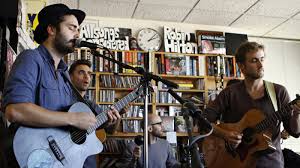
2014_11_10SOUNDTRACK: LORD HURON-Tiny Desk Concert #247 (October 25, 2012).

lordhironLord Huron is one of those bands that I hear of a lot, but whom I don’t really know much about. I also think they are someone I like, but listening to this Tiny Desk Concert, it’s clear they are not any of the bands I think they are.

As far as this Tiny Desk Concert goes, Lord Huron proves t be a five piece folk outfit.  They have lovely harmonies

“She Lit A Fire” is a pretty standard folk song.  Although I like the way the song shifts gears to a faster guitar style.  I really like the way the one guy’s guitar sounds like mandolin, too.  “Time To Run” is a bit faster and catchier.  In fact, when the oh oh oh oh part comes in, it’s hard not to want to sing along.  And the middle part where it’s just guitar and bongos is pretty hard not to enjoy.

“Lonesome Dreams” opens with some echoed bass notes. It’s got some really catchy parts although I don’t really love the yodeling voice that he puts on.  The band does four songs (practically unheard of).  “Ends of the Earth” opens with that same yodeling voice, but once the harmonies kick in it sounds great.

I didn’t realize that Lord Huron had only released their first album in 2012.  They have really made a name for themselves.

[READ: July 20, 2016] “Primum Non Nocere”

I enjoyed this whole story except for the very end which seemed to turn the story into something else.  In retrospect that something else is also pretty interesting and it throws a whole new light on the story, but I enjoyed the story so much as it was that the twist really impacted the way I enjoyed the rest of the story.

The title translates as “first, do no harm” and the story is about a youngish girl and her mother–who is a psychotherapist. 

I loved the way the story began.  Jewel is totally embarrassed that her mother asks her patients if they are “Cell phoning.”  She says it all the time.  How lame.  Until she realizes that her mom is actually asking if they are “self-harming.”

Her mother was brutally honest about a lot of things and was, of course, right about everything.  One thing that her mother always said was “that no one ever gets beyond high school. It’s all high school for the rest of your life.” Not true, Jewel knew, yet also true.

Her patients loved her for that unconventional understanding. She stood up for them; she visited their homes and talked to their problematic relatives, went to the store with them, walked them along the river, allowed them to bring their pets to their therapy sessions. She came to her children’s defense, too, with teachers or friends or the parents of those friends. She was brutally honest, blunt.

(more…)

Read Full Post »

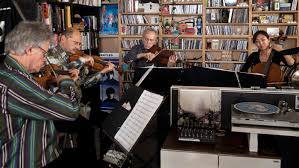
 socks kronosSOUNDTRACK: KRONOS QUARTET-Tiny Desk Concert #322 (November 25, 2013).

2013 was the 40th anniversary of Kronos Quartet.  I first heard of them about eight years after they started with their cool arrangement of “Purple Haze.”  And then I learned that they were like a sponge, soaking up and playing music from all over the world: In just one year they released albums with tango, songs by South African composers, Polish composers, jazz musicians and so much more.

I have many of their releases, although I realized I more or less stopped listening to new stuff from them around the turn of the century (since when they have released some 16 albums!).

Well, amazingly, the Quartet is still the same original players (except for the cellist–the cello is like Kronos’ drummer as they seem to replace her every couple of years).

They play three pieces here and the three range the gamut from dark and broody to rather sweet to quirky.  In other words, typical Kronos.

For more info:

The musicians —  David Harrington (violin) and longtime members John Sherba (violin) and Hank Dutt (viola) and new (as of 2013) cellist Sunny Yang — could reminisce over more than 800 new works and arrangements they’ve commissioned in 40 years. But instead, the new-music train pushes ever onward to new territories. They remain a living, breathing world-heritage site for music.

Now in the midst of its 40th-anniversary tour, Kronos brings to this Tiny Desk Concert a new arrangement, a work from a new album and, for Kronos, something of a chestnut, a piece the group recorded a whopping five years ago.

“”Aheym” (Yiddish for “homeward”) was written for Kronos by Bryce Dessner; a member of the Brooklyn rock band The National, he studied composition at Yale. The music thrives on nervous energy, pulsating with strumming and spiccato (bouncing the bow on strings) while building to a tremendous fever.”

I love this piece. It is intense and dramatic with its 4-3-3 bowing from all four members.  There’s an interesting cello melody with pizzicato strings from the rest.  The overall melody seems somewhat circular with different instruments taking on different leads.  But this song also plays with some interesting bowing techniques.  In addition to the spiccato (about 4 minutes in), the players drag the bow for momentary scraping and scratching sounds.

Another wonderfully dramatic moment comes at 7 minutes where each musician takes a turn bowing his or her note while the violin plays a super fast series of notes.  The song builds and build in dramatic until it gets to about nine and  half minutes and it reaches its powerful ending.

“Lullaby,” opens with plucked cello notes and strummed viola.  “It is a traditional song with Afro-Persian roots (from the group’s Eastern-flavored 2009 album Floodplain), [and] is woven from different cloth altogether. Colorful tones that lay between our Western pitches are threaded through the music, anchored by a gorgeous solo from violist Dutt; his contribution takes on the warm and weathered sound of a grandmother singing to a child.”  It is slow and moody and beautiful.

Harrington introduces the final piece by saying it’s by a performer that no one had heard of–including, until recently, even himself.

“Kronos caps off the concert with another hairpin turn, this time to a fresh arrangement of “Last Kind Words,” a little-known blues song from around 1930, recorded by singer and guitarist Geeshie Wiley. In Jacob Garchik’s exuberant arrangement (which Kronos premiered this fall), interlocking strums and plucks provide a kind of rhythm section, while Harrington’s violin stands in for the now-forgotten blues singer.”

There’s lots of plucked notes from everyone–including plucked bent note on the viola which gives it a real “early” guitar sound.  While I don’t know what Geeshie sounded like, so I can’t compare the violin to her vocal, the whole thing sounds great together.  In fact the whole thing is unlike any string quartet I’ve heard–so different and wonderful.

I’m going to have to bust out so Kronos CDs.

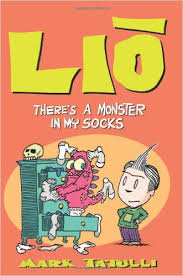
[READ: September 10, 2016] There’s a Monster in My Socks

I’ve been quite puzzled about the publication history of the Liō books.  And this just adds another layer of confusion.  This book covers the exact same time period as Happiness is a Squishy Cephalopod which was published in 2007.  The difference is that Cephalopod placed all of the strips in order, while this one seems to move things around quite a bit (the thinner format also means that it can’t quite handle the single panel strips very well.   But more egregious is that this volume (remember, the one printed after the previous one) prints the Sunday color strips in black and white.

The book also leaves some of the strips out.  It covers the date range from May 15, 2006 – Feb 16, 2007 (Cephaolopod went to May 23), but while it has the Feb 14 strip, it does not have the Feb 15 strip.  Weird.

So, basically this is an inferior version of the same book, but the publishers presumably wanted the books in this more friendly size (or some other nefarious reason).

I’ll include the review of Cephalopod below.

And, here’s the current list of existing Liō books. It’s a shame that there are years and years of strips thus far uncollected. (more…)

Read Full Post »

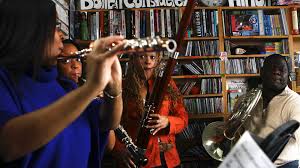
dressSOUNDTRACK: IMANI WINDS-Tiny Desk Concert #277 (May 29, 2013).

windsFor some reason this video and audio has been removed from the NPR site (no explanation is given).  But I found it elsewhere and was able to really enjoy it.

But they have left up the blurb:

When Igor Stravinsky began composing The Rite of Spring, his ballet for vast symphonic forces, he could hear the music in his head but couldn’t quite figure out how to write it down. It was just too complicated.

Today, 100 years after The Rite‘s premiere, the fearless musicians of Imani Winds make it all sound remarkably easy, given that they’ve condensed Stravinsky’s massive walls of sound down to just five instruments: bassoon, clarinet, flute (doubling on piccolo), oboe and French horn.

Make no mistake: Many of the jagged rhythms and crunching chords remain viscerally intact, albeit on a more intimate scale. As the group huddled behind Bob Boilen’s desk, bassoonist Monica Ellis noted the opposing ratios, saying, “It’s apropos in some strange way that we are playing one of the most massive pieces in some of the smallest instrumentation in one of the smallest settings that it could possibly be played in.”

The setting might be small, but in this clever arrangement by Jonathan Russell, we learn that a wind quintet, when called upon, can make a mighty and sonorous wail. Just listen to how the Imanis cap off “Dances of the Young Girls” with the entire quintet in full cry (at about 4:30 into the video). The bassoon repeats a fat bass line while the clarinet runs its snaky scales. The piccolo, in piercing chirps, serves as a foil to a frenzied oboe and snarling “whoops” from the French horn.

But not everything in The Rite is all pound and grind. Stravinsky’s transparent introduction, almost impressionistic, is a fluttering aviary of winds — even in the original — with individual colorings for each instrument. It’s all rendered beautifully here by Imani Winds, musicians brave enough to play David to Igor Stravinsky’s imposing Goliath.

This concert is fascinating to watch (and listen to) because even though this piece is familiar (to me) in theory, it’s apparent that I don’t really know it.  And I can see why this piece was so controversial when it came out–it is weird and chaotic and almost random at times.  I imagine that seeing it as a ballet might make it more cohesive, but it’s still pretty out there.

I love that the bassoon seems to be the primary instrument–one that doesn’t typically take center stage.

The group breaks up their selections into three primary chunks.

Selections from The Rite of Spring:

For “Introduction” the bassoon is the primary instrument playing the initial melody.  Then the clarinet and oboe give the whole thing an unsuaul sound–to say the least.  The French horn actually works as the the bass for this part.  It’s also neat watching the flautist switching between flute and piccolo.  I’m not sure when the second part “Augurs of Spring” begins, but I assume it’s when the bassoon repeats that initial melody and then the French horn plays a staccato bass note. The music sounds kind of threatening but whimsical at the same time.

Somewhere in here “Dances of the Young Girls”  begins.  I assume once the piccolo starts chirping and swooping.   And then the band grows very loud before abruptly stopping.

The second segment she describes as incredibly picturesque. “Ritual of Abduction” begins nosily with almost total chaos from all the instruments–the piccolo stands out as sharp and piercing.  As with the other segments, I’m not sure when “Spring Rounds” begins, but I have to wonder if this is when the music seems to go circular and then slow down. There are low notes from the French horn while someone is playing accent notes that sound, not off, but dissonant–providing stark contrast with the rest of the slow movement.  There are some blares of music from the French horn as well.

I’m guessing that “Dancing Out of the Earth”  begins with the fast bassoon melody: up down up down up down up down with trills and swirls from the flutes and clarinet.  It rises and rises very dramatically and then stops.

They tell us that it’s not possible to play the entire ballet so they have taken the “greatest hits” and for this show it’s the greatest hits of the greatest hits.  Consider it a deconstruction with five instruments. But it still evokes the spirit of this sacrificial dance.

She talks about how controversial this was in 1913, “when ballet was meant to be about… I was going to say flamingos…. fairies swans, the other water animals.”   This is the final moment the virgin who sacrifices herself dances herself to death.  And they are going to exemplify trombones and timpani and all that loud stuff (the French horn player laughs and says “Grr I am trombone”).

“Sacrificial Dance: The Chosen One” begins with a three note melody–again it is somewhat threatening.  There’s lots of little fast runs by the French horn with accents from everyone else.  It stops dramatically at one point and then resumes with so many different melodies.  And then comes the surprise ending with a rising flute line and then a low end from the horn.

Without taking away anything from Imani Winds, I ‘m sure this performance doesn’t do the whole thing any justice.  But it is amazing to imagine how much more there is to it.  And it is amazing that these five instruments can evoke so much.  It’s an uncomfortable and somewhat shocking first listen.  It’s amazing that is over 100 years old, although it sounds so contemporary.

I don’t know why it’s not on NPR any more. I found it on YouKu (whatever that is).  I have been able to watch it twice but on two other times I was unable to watch it.  So keep trying, it’s worth the effort.

[READ: May 5, 2016] The Boy in the Dress

David Walliams is best known (if he is known at all) as the tall one on the sitcom Little Britain.

I had no idea he wrote books (he has done over half a dozen children’s books), and I was happy to start with this, his first one.

This book is illustrated by Quentin Blake, who is best known (if he is known at all) as the illustrator for the Roald Dahl books.  So his simple, somewhat sloppy, style might look familiar.

The story is, as the title suggests, about a boy who wears a dress.  And the story is very funny–not because it makes fun of him for wearing a dress, oh no.  In fact, I love the story for going out of its way to show that it is normal that a boy might want to wear a dress. (more…)

Read Full Post »

two-worse  SOUNDTRACK: CHEICK HAMALA DIABATEN-Tiny Desk Concert #285 (July 6, 2013).

hamalaNPR Music has been the sole source of my exposure to music from Mali.  I have really grown to like its slightly unusual patterns which are all based on a fairly standard rock structure.  But unlike some of the other Mali musicians I’ve been exposed to, Diabaten does not play guitar.  He plays banjo and the ngoni (but there is plenty of guitar in the song too).

The blurb tells us

Malian tradition lies at the heart and foot-stomping soul of Cheick Hamala Diabate and his band, but their melodies and undeniable rhythms cut across age and ethnicity. Diabate primarily plays the ngoni and the banjo; think of the ngoni as a great-grandfather to the banjo and it all makes sense, because both instruments share the ability to convey melody and plucked percussive rhythm.

Diabate is from Kita in Mali and born into a family of griots, or storytellers; his first cousin is the legendary kora player Toumani Diabate. Cheick Hamala Diabate makes his home these days in a Maryland suburb a few miles over the D.C. line, and his musicians are American-born and inspired by this lively lyrical music, which often tells a tale about Mali and its people as part of the sway and shake.

“Mali De Nou” sounds fairly traditional–with all of the percussion.  And then about a minute and half in a noisy scratchy guitar solo plays over all of the music–a very Mali sound.  But it’s interesting that, for the beginning anyhow, Diabate isn’t doing all that much.  In fact, the song feels almost overwhelmed by percussion (but in a good way). There’s a shaker or two, big floor drums (congas?) and a drum held between the knees and there’s even that big round gourd drum.

There’s also a sax and a bass, the lead guitar and of course, Cheick’s banjo.  By the middle of the song,  Chieck does some lead banjo playing.  And then it sounds like he’s put some effects on the banjo making it sound almost like a kettle drum—he even plays the strings below the bridge.  He really gets a lot of cool sounds out of the instrument

After this song he chats briefly and wants to “Invite you guys to visit Mali, it’s a beautiful country, you’ll be more happy.”

For “Talcamba” he switches to the ngoni.  He explains that the original ngoni had 4 strings, but his has 7 so he can play…more.  This instrument can play reggae, salsa, everything.  This is when he says the American banjo is like the grandson of ngoni.

Tacamba is a dance from north Mali—you can move your body (he waves his arms).  There are vocals but they are mostly a chanted refrain   The solo on the ngoni isn’t a conventional solo, it’s him flicking the strings making a very interesting sound.  I could have used more close-ups of this instrument as you could barely see the strings, and I’d love to see how he fit 7 on that small neck.  Half way through the song it shifts gears and the tempo really picks up—there’s a fast guitar solo with all that percussion keeping up.  And then the percussionist puts down her shaker and starts dancing in the center of the room.  It feels inspired and impromptu and it’s a lot of fun to watch.  While she’s doing that, Cheick picks up a hand drum and starts creating a new rhythm.  It is joyful and celebratory.

For the final song, “Djire Madje,” he switches to acoustic guitar which he plays lefty upside down (so the high notes are at the top).  He plays the lead riff.  At one point the electric guitar is also playing a lead but in a very different styles and they work very well together.

[READ: October 10, 2016] The Terrible Two Get Worse

I really enjoyed The Terrible Two, and this sequel is just as enjoyable.  The pranks are bigger, but the victim has changed.  Why?

Because Niles Sparks’ and Miles Murphy’s pranks got their principal fired!

Principal Barkin was the perfect guy to play a prank on–he had no sense of humor, he was pretty jerky and his face got really purple when he was upset.  But Principal Barkin is nothing compared to his father.  We met his father in the previous book–he yelled a lot, especially at Principal Barkin.  You see, the principal’s father was the previous principal, and he was a tough guy–he took no guff from anyone.

So after a delicious opening prank, Niles and Miles set about to making a great prank on Photo Day.  One of the great things about these books is the illustrations (by Kevin Cornell).  Sometimes the text incorporates the illustrations into the story. Like with Picture Day–the hilariously bad “pictures” absolutely make the sequence.  But it’s what they do to Principal Barkin’s son (who has paid the extra $10 for a gray background) is frankly genius.

But even better is what they have done to the whole school photo– a prank many months in the making.

(more…)

Read Full Post »

two SOUNDTRACK: MOHAMMAD REZA SHAJARIAN-Tiny Desk Concert #276 (May 20, 2013).

rejaI had never heard of Mohammad Reza Shajarian, but I see that he was voted one of NPR’s 50 Great Voices.

With the visit of the incredible, honey-voiced Mohammad Reza Shajarian from Iran, we lucked out by having him sing on not just any day, but on the biggest holiday of the Persian calendar: Nowruz, the New Year.

Shajarian is accompanied by brothers Sohrab and Tahmoures Pournazeri (celebrated musicians in their own right) and French percussionist Robin Vassy.

They play one song, an improvised piece called “Az Eshgh (Love Song).”  There is an upright, bowed instrument, the Kamancheh which plays the lead melody for much of the song.  The rest of the music comes from the Tar, one of the most important musical instruments in Iran and the Caucasus.  It has a rather tinny sound.

Meanwhile, the drummer has several different gourd drums.  He hits one with his fist and scratches the notches on the side.  Around three and a half minutes in, he starts blowing into this whistle-like object that makes a wind sound.  He also has two gourds that are floating in water.  He takes one out and we can hear the dripping.  He gets almost two minutes of a solo to play all of these sounds.  Its very cool.

Interestingly, even though this Tiny Desk is all about Shajarian, he doesn’t sing all that much.  But when he does, it’s quite powerful.  As the blurb says:

In the course of this love song, titled “Az Eshgh,” Shajarian unleashed torrents of swooping, soaring, goosebump-inducing sound — still perfectly controlled at age 73.

[READ: September 20, 2016] The Terrible Two

I love Mac Barnett.  He’s one of my favorite children’s authors.  I only know Jory John a little but I’ve enjoyed what I’ve read by him.  There are also fantastic illustrations by Kevin Cornell to make this book a delightful story about pranksters.

The book opens in Yawnee Valley, a quiet place where cows are the main thing.  Literally.  They are everywhere–and you hear them mooing all day and night (and throughout the book).  Miles Murphy (the dark haired boy on the cover) is moving to Yawnee Valley.  And he is not happy.  He has already sighed 100 times that day.  He hates the thought of leaving his friends and starting a new school.

Page twelve lays out an excellent summary of what it’s like to be a new kid in a school.  What kid are you going to be?  chess kid? basketball kid?  front-row kid? kid who’s allowed to see R-rated movies?  Kid whose family doesn’t own a TV and just wants to watch your TV?  And so many more options.  But Miles knows who he is.  He’s the prankster.

But when he gets to school (this is the first day of school), someone has moved the principal’s car to the front of the stairs–blocking the front door. Looks like Yawnee Valley Science and Letters Academy already has a prankster.

The principle is Principal Barkin.  He loves being principal of the school, as his father and his father and his father and his father had been.  There was one embarrassment in the family chain of command–the principal who actually closed the school during a blizzard, but otherwise, their record was sound–no closures.  And Barkin’s own son was poised to become the principal as well. After all, he had been elected president the past two years–just as had all of his ancestors–president and then principal–that’s the plan.

But this first day of school was not a good day for Principal Barkin.  And Chapter 6 lists the 40 things that happened as soon as he found out that his car was blocking the main entrance (none of them were good for him).

Principal Barkin suspects and questions everyone for being responsible for doing this prank.  And when he sees Miles–the only child he doesn’t recognize–he automatically assumes he is guilty.  Miles assures him that he didn’t do it.  Principal Barkin says okay but he will have his eyes on him.

Barkin then gives him a book called 1,346 Interesting Things You May or May Not Know About Cows.  He also gives Miles a buddy.  The buddy is named Niles.  He is dressed in a blazer with a sash that reads “school helper.”  The introduction goes like this: “Niles is the student who first told me abut my car.  Miles is the student who I suspect moved it.”

Niles is the most cheerful, obnoxious child Miles has every seen.  And he will not let up.  Niles introduces Miles to people (like Holly the girl who sits next to him).  He states the obvious.  And he tells Miles about Josh Barkin, the Principal’ son.  And boy is Josh a jerk.  Josh intentionally hits Miles in the face with his backpack as he walks by.

Niles says “while i don’t want to call anyone the worst, Josh is pretty mean sometimes…also he really likes the word nimbus for some reason.” (Josh calls everyone a nimbus as an insult).

Another kid who makes a lot of noise and is used mostly for comic effect is Stuart, Stuart talks in all caps and really really states the obvious.  Everyone hates him.

Miles is still pretty bummed about someone else being the school prankster.  But when Josh comes over in the cafeteria to give him a hard time, Miles deliberately dumps his food all over himself and then manages to blame Josh.  Josh says he didn’t do it, but Niles supports Miles.  When Miles asks why he would lie for him, Niles says that Josh made him swallow a rock over the summer–twice.

Miles gets home an has a kind of rough night.  So doe Principal Barkin whose father calls to yell at him for the embarrassment of his school day.  But while Bakin is beaten down, Miles is inspired.  And he comes out with his greatest prank ever.

The awesome birthday party of a boy he just made up, Cody Burr-Tyler.  The plan?  Make the party secret, tell only a few people and then watch everyone show up with presents.

It’s a great plan and it works.  And just as he is about to reap his rewards, Cody Burr-Tyler shows up and steals the show.  What just happened?

I don’t want to spoil who the prankster is.  He is impressed by Miles but sees some serious flaws.

Like the birthday party–did Miles really think he could fool the entire class and walk away with a bunch of presents and have people still like him?  He had to learn to be subtle.

And so the prankster offers to let him join forces to become a great pranking team.  But there is no way Miles is going to join forces with HIM.  So instead, Miles challenges him to a prank battle.

And the rest of the book is a series of escalating pranks.  The whipped cream one is outdistancing as is the diorama double cross (everything about the plan is genius–on both sides).

Can these two join forces to torment the person who most needs some comeuppance?  (Yes).  But what can they do that will really be a spectacular prank that people will talk about for years?

I was surprised and delighted by the final prank and I love the way they pulled it off.

I’m really looking forward to book two.


Read Full Post »

pipSOUNDTRACK: DANIEL BACHMAN-Tiny Desk Concert #256 (December 9, 2012).

dan-bach Lars Gotrich, an NPR music dude, loves metal and weird music but also amazing Americana folk guitarists.  Daniel Bachman was an early-twentysomething when he recorded this Tiny Desk Concert.  And he is very impressive indeed.  Lars explains:

His approach to the American Primitive style of acoustic guitar — a sonically vivid fingerpicking technique developed by John Fahey and expanded by the likes of Robbie Basho and, later, Jack Rose and Glenn Jones — is conversational and uplifting, much like the man himself. After a rousing performance of “Honeysuckle Reel” from a forthcoming seven-inch single, however, Bachman turned beet-red in the NPR Music office and said, “I’m not going to lie. I’m pretty nervous.”

He only plays two songs, although each one is about 7 minutes long.  Lars says, “Strap on a pair of heavy boots and “Honeysuckle Reel” becomes an ecstatic dance tune or, at the very least, a foot-stomping good time.”  And he’s right.  It’s really amazing to watch him playing.  He uses a thumb pick and the low notes are constantly going–an incredibly fast rhythm, in contrast to the slower melody he’s playing on the higher strings while finger picking.  It’s a very pretty melody.

The second piece, “Seven Pines,” is slower and more reflective.  It comes from one of two albums he put out in 2012). The simple melody “dives in and out of low-string chord crashes and tumultuous swirls of dizzying fingerpicking.”

The sound he gets from his guitar is really fantastic and while I don’t tend to listen to guitar music like this, I really enjoyed this a lot and would like to hear more from him.

[READ: February 3, 2016] Ava and Pip

Since Tabby and I loved Ava and Tacoocat so much, we knew we had to read the prequel Ava and Pip as well.

This book is set up exactly as Tacocat is (I know that this book came first but since I read the other one first I’m comparing things backwards).

There are diary entries and it starts with Ava on her first day of school.  When she gets home she says that she is the only Ava in her class (which is frankly shocking as there are about 5 in my daughter’s grade).  Then we learn all about the Wren family and their love of palindromes.

Bob and Anna Wren had two daughters named Pip Hannah and Ava Elle.  And her diary entries wind up being chock full of spelled out palindromes (some obvious, others not). (more…)

Read Full Post »

tacocaoSOUNDTRACK: CANADIAN BRASS-Tiny Desk Concert #220 (May 26, 2012).

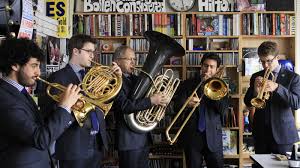
brass I hadn’t realized that Canadian Brass part of the institution of Canadian Brass.  They’re not only part of it, they are it.  Indeed Canadian Brass

led by its avuncular tuba master (and sole original member) Chuck Daellenbach, essentially put the idea of the brass quintet on the map.  Then there are the recordings — more than 100 of them, selling more than two million albums total.  Daellenbach and his fresh-faced players, each with red-striped sneakers and matching outfits, strolled into the NPR Music offices, took their places behind Bob Boilen’s desk and started blowing as if they’d played this peculiar gig a hundred times.

They began with a version of J.S. Bach’s intricately woven “Little Fugue in G minor,” an impressive staple that stretches back to the band’s first recording. In those days, precious little was available for brass quintet (two trumpets, horn, trombone and tuba), so the band relied on making arrangements of existing music. Since then, Canadian Brass has transcribed and commissioned more than 200 works, including “Tuba Tiger Rag,” Luther Henderson’s lighthearted tribute to Dixieland jazz. It’s a showpiece for Daellenbach, who twirls his tuba (while playing) and lands on a final note of such subterranean depth that you feel it more than hear it.

The players closed with another favorite, Rimsky-Korsakov’s dizzying “Flight of the Bumblebee,” in an arrangement by Canadian Brass trumpeter Brandon Ridenour. Although the music buzzes past in less than two minutes, players get plenty of opportunities to shine — as in the lightning-fast runs negotiated by trombonist Achilles Liarmakopoulos, the newest member of the group.

The band consists of   Christopher Coletti, trumpet; Brandon Ridenour, trumpet; Eric Reed, French horn; Achilles Liarmakopoulos, trombone and Chuck Daellenbach, tuba.

The band sounds amazing playing these familiar songs in a way that is–unexpected–but still right on.

J.S. Bach: “Little Fugue In G minor” is probably one of my favorite classical pieces.  I really enjoy Bach’s fugues a lot and this one is just perfect–and the arrangement here is great–everyone gets a chance to explore the phrasing.  It starts with the tuba and then the trombone and then the horn and finally the tuba.

Luther Henderson: “Tuba Tiger Rag”  Introducing this piece he says that in Bach everyone is equal, but he felt they needed a tuba song.  He says that while this song might be low art for other instruments it is high art for a tuba.  And yes he does spin it around while playing it. He uses that instrument to make roaring sounds and incredibly deep notes.  This is a medley, I think, because while the trombone and tuba play, the other three sing “hold that tiger / tuba tiger.”  How on earth does he reach that super low note?

Before the final song Bob says that his tuba doesn’t look brass.  And Chuck replies that there’s an old joke: “How old do you have to be to play the tuba and the answer is old enough to be able to carry it but young enough to still want to.”  He still wants to so he’s been  so he;s lightening the horn with carbon fiber.

For the final song Nikolai Rimsky-Korsakov: “Flight Of The Bumblebee” he tells us that the two trumpets play very fast–it must be easy for them. But the trombonist Achilles didn’t know what was coming when they had him play along.  Chuck says you’ll never see anyone play this song this fast on this instrument.

And it is amazing.  The song flies past–a blurry of fingers.  And I love that at the end, one of the trumpets sings the triumphant final high note.

You wouldn’t expect a band as old and legendary as Canadian Brass to be so funny and good-natured, but they sure are.  And that makes these familiar songs even more fun.

[READ: February 7, 2016] Ava and Tacocat

Sarah brought this book home, in part because Clark’s reading group called themselves tacocat which is a palindrome.  Turns out that Clark wasn’t interested in the book, so Tabby and I got to read it together, which was really fun.

The whole book is a language lovers’ dream, chock full of big spelling words and all kinds of palindromes littered throughout.

It was a few chapters into the book before we realized that this is actually the second book of a series (the first one is called Ava and Pip) and that this book references things that happened in book one without exactly explaining what happened.  That’s a little annoying for us, but it certainly made us want to read the first book.

The book is set up in diary form with Ava writing in it on most days.  I like that she loves palinromes so much (S-E-N-I-L-E-F-E-L-I-N-E-S) and every time she mentions one in the book, they spell it out like that. (more…)

Read Full Post »

crocs SOUNDTRACKRED BARAAT-Tiny Desk Concert #194 (February 14, 2012).

redbaraatBob Boilen opens his blurb about this band with high praise indeed:

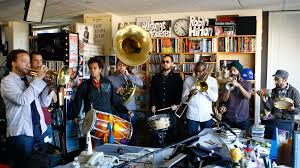
Red Baraat is the best party band I’ve seen in years. The group plays rollicking funk music steeped in Northern India’s wedding celebrations, with a dash of D.C. go-go beats and hip-hop. It’s all driven by Sunny Jain’s dhol, a double-sided barrel drum that hangs down low around his body.

But the music is not all about drumming

If the drum is the messenger, the brass is the message. Uplifting melodies emanate from baritone and soprano saxophones, bass trumpet, trombone and sousaphone. This is a band that jazz lovers can appreciate and rock fans can dance to.

They play three songs.  And the musicians are quite diverse.  Its fun to see a trumpeter (who totally wails) wearing a Sikh turban.

“Chaal Baby”  is really dancey with a simple, bouncy horn melody and all that percussion. In addition to the snare and the dhol, there’ s a percussionist making some great sounds, too.  And all through the song–which really swings–people are shouting “hey ho.” It’s a lot of fun.

“Shruggy Ji” opens slowly but after a few second the whole band kicks in with a kind of minor key feel (and a very Indian sound on the saxophone.  There’s some chanting–although I can’t tell what they’re saying.  The two note melody is great for shaking your hips to.  In the middle of the song there’s a call and response of “oh my may” and then he raps—he’s a little hard to hear (because he’s unmic’d and the rest of the band is so loud) but the gist is there and it’s fun (I believe he name checks Biz Markee).  As this song ends you hear Stephen Thomson shout “can you guys hear in the back?”

On “Dhol ‘n’ Brass” the guy with the dhol opens this song with a fast chanted opening that sounds a lot like the rhythm of the drums.  When the rest of the band jumps in, the song is really fast and a lot of fun

This is indeed a great party band and there’s plenty of diversity in the music to keep it really interesting and unexpected.

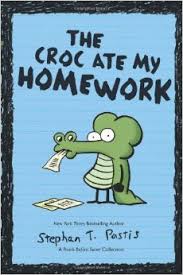
[READ: February 1, 2016] The Croc Ate My Homework

I knew of the comic strip Pearls Before Swine but had never read it before.

This book was published by the same folks who introduced me to Liō and I thought it might be funny.

From what I gather, this collection is actually a collection of the most kid-friendly strips from this series.  This I find very strange indeed, but I see that the actual strip is fairly adult and has been controversial on my occasions (although it is published in newspapers, so it’s never too dark).

I got a kick out of this collection, although I didn’t think it was all that great.  Of course, knowing that these strips are the somewhat watered down strips does make me want to read the real thing to see if these strips ware funnier in context.

The strip centers around a bunch of animals Rat (who is mean–unnecessarily mean, I felt, in this book, but again, without context), Pig who is a good-natured but naive. The Crocs (who are incredibly dumb–and very funny) and the Zebra who outsmarts the crocs–although that’s not very hard. (more…)

Read Full Post »

6916SOUNDTRACK: GIRL IN A COMA-Tiny Desk Concert #190 (January 30, 2012).

girlcoma I was planning on writing only about recent Tiny Desk Concerts for a while, but Nina Diaz’s (Aug 2016) Concert informed me that she was the singer of the band Girl in a Coma who are presently on a hiatus while Nina tours some solo material.

So I went back and watched this Tiny Desk to see the origins of Diaz’s music.

Girl in a Coma is a three-piece with Nina Diaz on guitar and vocals, her sister Phanie Diaz on drums and Jenn Alva on bass.  The blurb suggests that the band plays punk–typically loud crunchy guitars (although I listened to the recorded version of “Smart” and it doesn’t really sound very different from this version).  So I didn’t get that.

At any rate, the trio sounds great in this setting.  The percussion is simply tambourine and a shaker.  And Alva’s bass is really melodic and lovely playing more than just the same notes as the guitar.

“Smart” is really catchy (although Diaz does some weird things with her voice late in the song).  “Knocking At Your Door” has a fast, almost metal sounding guitar (albeit acoustic here).  But it’s the bass (which is not doing anything crazy) that takes center stage with the melodies she plays.

Before the final song Nina says it feels like show and tell or something.  And while she’s saying this, the other two switch places, with the drummer coming up front and the bass sitting in the back.

“So” has a pretty traditional folk song structure.  The reason for the switch of seats comes in the second verse when Phanie plays the melodica.  It’s a pretty song and Diaz’s voice is really nice.

I really can’t imagine them being a punk band at all, frankly.

I’m also going to point out what Diaz looks like here for contrast of what she looks like in her solo show four and a half years later.  In 2012, she’s wearing dark jeans and a v neck sweater (stripes in the purple family).  Her hair has bangs and a long braid on the side.  And she has no obvious makeup on.  Keep that in mind for the next post

[READ: November 1, 2008] “Tits-Up in a Ditch”

I read this story back in November 2008 and just couldn’t get into it.  I tried several times and could not penetrate the barrier that I felt Proulx was creating.  Well, here it is 8 years later and I tried it again, and not only did I finish it, I sort of enjoyed it.  Even though it, like everything else I seem to have read from Proulx was incredibly depressing.

The story is about Dakotah.  Dakotah’s mother abandoned her when she was a baby and left her own parents to take care of her.  They resented their daughter and Dakotah from the start.  They were harsh and uncaring towards her (although it could be prairie love, I suppose).  The grandparents are named Verl and Bonita Lister (Proulx has fun with names in her stories).

Verl and Bonita are hardscrabble, religious folks who don’t have a lot of joy.  Well, Verl had moments of happiness but probably no joy–he rode hard and then injured himself.  But he was stuck because during the 1980s in Wyoming oil companies came in and took away all the workers.

Verl gives us the title of the story when he says “Had me some luck today.  Goddam cow got herself tits-up in the ditch couple days ago.  Dead, time I found her.”  See, charming people. (more…)

Read Full Post »

« Newer Posts - Older Posts »