Feeds:
Posts
Comments

Archive for the ‘Huh?’ Category

SOUNDTRACKRHEOSTATICS-3rd Annual Green Sprouts Music Week Show 7 (Ultrasound Showbar, Toronto Ontario September 23 1995).

It has been a while since I’ve listened to a live Rheostatics show.  Darrin at Rheostatics Live has added a number of new shows in the last eight months.  On the last night of Green Sprouts Music Week, the band played two shows in one day. This first one is all ages, which I kind of think of as a children’s show, but really it means that people under 21 (or whatever the drinking age is) can get in too.

Seventh and final show of the annual Green Sprouts Music Week held at Ultrasound Showbar September 18-23 1995. Excellent finale to the week with some peak performances of the material being worked on for The Blue Hysteria album – most of which debuted live during the week long run. There are some great references in this show as well – to Martin’s new double neck guitar used for the first time and which they were debating how ugly it was (it had yet to be painted), the Whale Music Movie premier which was to take place in Los Angeles the following week, as well as Dave talking about the actual Joe Jackson at Massey Hall event noted in My First Rock Concert which is the sample noted below. Farm Fresh and Tamara Williamson guest, a great Spirit Of The West segue into Claire via Scaffolding and the traditional gift exchange at the end. Less than a month after this show they would perform Music Inspired By The Group Of 7 at the National Gallery in Ottawa…which at this point not a single note had been written.

Tyler from Farm Fresh will sit in with them tonight.  Sgt. Tielli will start the show (he’s wearing some kind of fancy suit–Martin: we used to tour with these outfits all of us.  Tim: I bet you never washed yours.) He begins with a lovely “Song of Flight” that segues into “California Dreamline.”

During “Fan Letter to Michael Jackson” the chant is Farm Fresh and They Suck. Tyler does a turntable solo.

Tamara Williamson comes up for “Sweet Rich Beautiful Mine.”  She’s with Mrs. Torrance and they’ll play her next Tuesday.

Martin debuted his double neck guitar this week. Martin: It’s a trial basis–I’m borrowing it to see if I like it.  Dave: It’s ugly but in a nice way.  It goes with the jacket.  It needs stickers (!).

After a lovely “All the Same Eyes,” Dave says “you just gotta spina around when you hear that song.”

Some Green Sprouts start whistling “You Are Very Star.”  Dave: You could start your own religion with a tune like that.

Don talks about a concert event this Sunday.  He’ll be playing with Cake (I don’t know if it’s that Cake), and on the bill is “Don’t Talk, Dance” and Bob Wiseman.  It’s a benefit for The Campus Coop Day Care which burnt down.  Tim: so when it says “members of the Rheostatics, they mean you.”  Tim says Bobby Wiseman’s new album is awesome.

The do alright with the counting on “Four Little Songs” and Dave says Neil Peart’s kitchen.  When Dave tells them to count off on the final 4321 some says “that’s your job Dave” and Dave retorts: “You guys are getting lippy.  On Monday the audience was quiet.”  Don: They’re tired of your jokes–same jokes 6 nights in a row.

Tim says that he taught the fellows the next song (“An Offer”) during rehearsal this week.  He kept writing out the charts but someone kept stealing them.  He got tired of writing them.  Someone shouts: I heard some other band play the song on the radio today!

After the song, someone shouts “encore!”  Dave: Encore already? The longest encore in rock.

“Desert Island Poem” features some scratching from Tyler and a solo from Martin.

Don sings “Never Forget” (I feel like he never quite gets the vocal right).

Dave says he was interviewed by CBC.  Originally he said no, but they paid him fifty bucks.  They interviewed him for like an hour and he was on TV for all of two and a half seconds saying “Italo-Canadian.”

Next song is in French.  “Chansons Les Reulles.”  Tim says, “Play it in French, Don.”

Martin: Someone asked me if the Joe Jackson song is really true.  Dave tells the story then sings the son.  He adds an extra first verse about Aerosmith and the Carpenters.  Never heard it since.

A footnote to ELO.  They were going to come out of a big spaceship–like a Big Mac box.  As it turns out they were sued for playing backing tapes.  My first real rock concert wasn’t even live.

“A Midwinter Night’s Dream” sounds good even though Martin doesn’t even try for the high note.  But he plays a wild solo.

Dave says that Whale Music is opening in Santa Monica.  Are we going down there?  No Hollywood party for them.   But then we thought–Hollywood party–free coke.  Don tells a story about cocaine when opening for a big big Toronto band.  He found a rolled up $20 sitting on a mirror.  He made $20 that night because you never get paid for those big gigs.

They play “Claire” (hard to believe how rare this song is. Tim opens with a verse of Spirit of the West’s “Scaffolding” before starting the song properly.  During the solo, Tim says, Martin, can you play the other neck?  Both at the same time?  he must do it because Tim sings “purify me / blow my fucking mind with that thing.”

They invite Farm Fresh to the stage for a gift exchange and Andrew Rourke’s vocal debut.

Farm Fresh brought 40 tapes and they sold out in the first night, so they’ve been dubbing them in the back.  Then Farm Fresh plays “Space.”

Their gifts include a music trivia book (he asks some of the questions).  Apparently a Red Sonya #1 (it’s worth $700 at least) and a Fantastic Four #358.  And also The History of the Bonzos by Bonzo Dog Doo-Dah Band.

Then Dave thanks a bunch of people.  The T-shirts sold out!  Or we lost them.
Dave thanks everyone.  Being a rock guy and playing big stadiums is good, but playing a club for a week and having people come all week long is the dream.

Farm Fresh present the Rheos with an album: Truck Stop Comedy by Gene Tracey: Double Clutchin “for tough adults only.”  Tim reads the back of the record (it’s hilariously bad) and they all fight for who will play it first.  You can actually find comedy by this guy online.

What a great week of music.  I wish I’d been able to go to alo of the shows, although I didn’t actually know them yet.

[READ: February 20, 2021] “Visiting George”

This is listed as a “Memory” in this issue.  I thought I was familiar with Nadine Gortimer’s work, but I don’t know if this is anything like what she normally writes.

It was really hard to follow as I don’t know who she’s talking about or even what exactly happened.

She says they were in London for a conference and wound up near a house where old friends lived.  She was about to say they should pop in–it had been so long. (more…)

Read Full Post »

 SOUNDTRACKTHE GO-BETWEENS-“Streets of Your Town” (1988).

In Stuart David’s book, In The All-Night Café, he lists the songs on a mixtape that Stuart Murdoch gave to him when they first met.

Although I’ve been a fan of Belle & Sebastian for a long time, I knew almost none of the songs on this mixtape.  So, much like Stuart David, I’m listening to them for the first time trying to see how they inspire Stuart Murdoch.

In the book, David writes how much he does not like “rock,” especially music based around bluesy rock.  Most of these songs, accordingly, do not do that.  In fact, most of these songs are (unsurprisingly) soft and delicate.

The Go-Betweens were the brainchild of wonderful songwriters Robert Forster and Grant McLennan.  They wrote beautiful poppy, catchy songs, often with dark lyrics.

“Streets of Your Town” starts out with a boppy beat and a catchy guitar riff.  It opens with the chorus–“round and round, up and down, through the streets of your town.”  Then the tone shifts.

The verse is still musically perky but then you get this lyric

,And don’t the sun look good today?
But the rain is on its way
Watch the butcher shine his knives
And this town is full of battered wives

Right back into the bouncy chorus. This was a pretty big single for them and yet those lyrics.  A perfect study for a budding sonmgrwiter.

[READ: February 3, 2021] “Waiting for To-Go”

This is a short Shouts and Murmurs piece from Sam Lipsyte.  I have really enjoyed his stories but realized I haven’t seen anything from him in a while.  This, like many Shouts and Murmurs, seems pretty funny but in reflection, is only mildly amusing.

The title is part of the joke in this piece.

Two people named E and V (see Beckett) are sitting in a room gazing at their phones

In the first scene one of them says he heard a podcast about the Neolithic or something.  The other asks if that was the Stone Age, but he says no, they had copper, like copper axes.

The second person says copper sounds nice, but he is referring to the copper pan that he just bought,

In scene two, later tin the night, one of them, looking at his phone, says “My God. That’s amazing.”

What is it?
No.
What?
Nothing.
Oh.

(more…)

Read Full Post »

SOUNDTRACKTHE RAILWAY CHILDREN-“Brighter” (1987).

In Stuart David’s book, In The All-Night Café, he lists the songs on a mixtape that Stuart Murdoch gave to him when they first met.

Although I’ve been a fan of Belle & Sebastian for a long time, I knew almost none of the songs on this mixtape.  So, much like Stuart David, I’m listening to them for the first time trying to see how they inspire Stuart Murdoch.

In the book, David writes how much he does not like “rock,” especially music based around bluesy rock.  Most of these songs, accordingly, do not do that.  In fact, most of these songs are (unsurprisingly) soft and delicate.

A looping almost marimba-like sound opens before a jangly guitar and steady bass.  Here’s another song where the main instrument is the bass with guitar flourishes added on top.  This band reminds me of The Church (who had put outa couple of albums by now).

Singer Gary Newby has a nice crooning voice and the chorus is quite catchy.  The instrumental break allows the guitar to shine a bit with a meandering solo.  But the biggest surprise comes about 4 minutes in when there’s a drum solo of sorts–played on something like a metallic bongo.  After all of the short songs, this one pushes five minutes and is something of a surprise.

There’s some other good stuff on Reunion Wilderness, like “Gentle Sound” which I thought was a bit catchier.

[READ: January 30, 2021] “A Poor-Aunt Story”

In this story Murakami discusses a poor-aunt. I don’t know of this is a universal idea as I’ve never heard it before, although I do get where he’s coming from.

He says it was a beautiful day and he was out enjoying it when he suddenly had the idea of a poor aunt.  There wasn’t even a poor aunt around, the idea just came to him and it stuck.  He needed to write a story about a poor aunt.

He told his friend he wanted to write a poor aunt story.  She asked if he had a poor aunt.  He said no.  She said she did have a poor aunt bit didn’t want to write about her.

He admits that chances are “you don’t have a poor aunt relative, but you have seen one.”

Every wedding reception has a poor aunt.

No one bothers to introduce her.  No one talks to her.  No one asks her to give a speech.  She just sits at the table like an empty milk bottle.

When people look at the photo album they ask about her and the groom says she’s no one, just a poor aunt of mine.

He woke up the next day and a found that a poor aunt–a little one–was stuck to his back.

Nothing alerted him to her presence, he just felt it. She wasn’t heavy and didnt breathe across his shoulder. People had to look hard to see she was there.  But people did see her–she gives me the creeps, a friend said.  He said it felt like his mother was watching them.

The narrator was unable to see the poor aunt but other people cuid and they all saw her as something else–usually something unfortunate–a friend’s dog who had died.  Soon enough friends stopped calling him–they found it depressing.  But the media swooped in on him. He even made it on the show “Look What Else Is Out There.”  He tried to explain what had happened but the show tried to sensationalize him–looking for a horror story or a joke.

One of his friends said she wished it had been an umbrella stand on his back–that would be more pleasant to look at and more practical.  He could even have painted it different colors.

The poor aunt left him in autumn. He was on a train ride and watched as a mother tried to deal with her squabbling children.  The boy was teasing his sister–stealing her hat.  She was getting very upset and complaining to her mother.  The mother was trying to read and was getting angry at the daughter for bothering her. Finally the girl reached across the seat and slapped the boy’s face and took her hat, feeling very pleased with herself.

The mother was furious and made the girl sit in a different aisle–next to the narrator.  The child protested but the mother said “You’re not part of this family anymore.”  He wanted to say something to the girl, to cheer her up.  Like that she had done a good job, but he knew it would only confuse and frighten her so he said nothing.

Sometime during that interaction, the poor aunt left him.  He wasn’t aware of it, she was just gone.

This was one of Murakami’s first experiments with the short story form.  It was translated by Jay Rubin.

Read Full Post »

SOUNDTRACK: COCTEAU TWINS-“Oomingmak” (1986).

In Stuart David’s book, In The All-Night Café, he lists the songs on a mixtape that Stuart Murdoch gave to him when they first met.

Although I’ve been a fan of Belle & Sebastian for a long time, I knew almost none of the songs on this mixtape.  So, much like Stuart David, I’m listening to them for the first time trying to see how they inspire Stuart Murdoch.

In the book, David writes how much he does not like “rock,” especially music based around bluesy rock.  Most of these songs, accordingly, do not do that.  In fact, most of these songs are (unsurprisingly) soft and delicate.

Of all the bands on the list, Cocteau Twins were the one I know (and like) best.  I’ve been a fan since 1987, so just after this album came out.  I never remember which songs are which by them, because they have titles like “Oomingmak.”

Cocteau Twins are a magical band and at the time (and perhaps even now) no one sounded like them.  Their music is so ethereal, it practically floats away both because of the shimmering echoing guitars of Robin Guthrie and Elizabeth Frasier’s high pitched vocals–often with non-intelligible words. [I honestly never knew she was actually singing words, but I see she was].

This song is the shortest song on Victorialand.  It has a fast repeating guitar line and Fraser singing softly.  Toward the end, she sings harmonies with herself in her slightly more harsh sounding vocal style.  It’s a lovely song, as all of their are.

[READ: January 20, 2021] “Touched”

Reading this right after reading the Arthur Miller story was really strange.  Because here was another thirteen year-old boy possibly having sex with an adult woman.

The story opens on Ali, the thirteen year-old.  His Bombay family has visited him in England and are now returning to India.  Ali was very sad to see them go,

Ali was most upset because his cousin Zahida was leaving. She was a year older than him.  She had pressed her lips to his and then they ran up into the attic together and then

he continued caressinuntil, making his way through intricate whirls of material, he reached her flesh and slid his hand into the top of the crack.

He was suddenly concerned about being discovered they quickly separated.

Wow. (more…)

Read Full Post »

SOUNDTRACK: THE WEATHER PROPHETS-“Almost Prayed” (1987).

In Stuart David’s book, In The All-Night Café, he lists the songs on a mixtape that Stuart Murdoch gave to him when they first met.

Although I’ve been a fan of Belle & Sebastian for a long time, I knew almost none of the songs on this mixtape.  So, much like Stuart David, I’m listening to them for the first time trying to see how they inspire Stuart Murdoch.

In the book, David writes how much he does not like “rock,” especially music based around bluesy rock.  Most of these songs, accordingly, do not do that.  In fact, most of these songs are (unsurprisingly) soft and delicate

I’ve been listening to all of these songs on Spotify.  So far, most of the songs have been deep cuts, but this one was The Weather Prophets’ number one song.

I’d never heard of them.  They put out two albums on the Creation label (in fact, Creation head honcho Alan McGee played bass in the band for a short time), and so it’s probably no surprise that they sound a but like The Stone Roses.  This is, so far, the bounciest and most immediately catchy song on the mixtape.

The guitars jangle, although not as much as in some of the other songs.  Like in most of the other songs, the singer kind of sing-speaks, although less than the others.  The biggest difference with this is that it really moves along a clip–much faster than the other songs.  A good pick me up in a mix tape.

[READ: January 20, 2021] “Bulldog”

I know that fiction is not true.  I know that.  But realistic fiction tends to be based on something.  So if this is based on something, then either Arthur Miller lived a very different life than I could imagine or things were very different in the 1920s.  I also had no idea that Arthur Miller was still alive in 2001 (he died in 2005).

This is a fairly simple story: a thirteen year-old boy sees an ad for puppies for sale.  They are brindle bulldogs for sale for $3 each.  The boy has some money (although $3 is a large chunk of it).  He bought an apple tree and a pear tree last year (30 cents each), so he is accustomed to spending money.  But his family has never had a dog–his brother even makes fun of him for wanting one.  What are you going to feed it, soup?

He travels across the city to the apartment in Brooklyn.  The woman opens the door in a robe and seems annoyed.  When he says he’s there for the dog, she loosens up and invites him in.  She asks his age and when he says 13 she seems tickled by that.

The look at the puppies.  He had looked up what the puppies should look like in the World Book, but there were no pictures of brindle bulldogs.  He thought these puppies were just brown and didn’t look like a bulldog at all.

While he was holding the puppy, she sat next to him and her robe opened.  She was naked.  She kissed him and soon they were on the carpet together. (more…)

Read Full Post »

SOUNDTRACK: THE BLUE AEROPLANES-“Veils of Colour” (1987).

In Stuart David’s book, In The All-Night Café, he lists the songs on a mixtape that Stuart Murdoch gave to him when they first met.

Although I’ve been a fan of Belle & Sebastian for a long time, I knew almost none of the songs on this mixtape.  So, much like Stuart David, I’m listening to them for the first time trying to see how they inspire Stuart Murdoch.

In the book, David writes how much he does not like “rock,” especially music based around bluesy rock.  Most of these songs, accordingly, do not do that.  In fact, most of these songs are (unsurprisingly) soft and delicate.

The Blue Aeroplanes have been around forever, forming in 1981 and releasing their most recent album in 2017.  I feel like I’ve heard of them, but I’m not sure now.  I guess I’ve never actually heard them as this didn’t sound familiar at all.   Nor does the core lineup: the mainstays are Gerard Langley, brother John Langley, and dancer Wojtek Dmochowski.  Their wikipedia pages lists about 90 other people who have played on their records.

“Veils of Colour” opens with a quiet guitar riff that, surprisingly, progresses rather than repeats.  It’s a quiet song and when the lyrics come in, they’re mostly spoken in an almost excitable whisper.  You can certainly see why they appealed to Stuart Murdoch.

The chorus is almost sung, but the addition of horns makes the it swell beyond what you’d expect from the verses.  Indeed, the song has a kind of understated urgency, but never gets very intense.

[READ: January 24 2021] “Hansa and Gretyl and Piece of Shit”

This story was peculiar for many reasons.  Obviously the title shows that this is a twist on a familiar story.  But, wow, does it veer off form what you might expect (just as the title does).

Gretyl is a girl in high school.  She wakes with terrible stomach cramps–not the “normal” cramps a girl might feel, but something far worse.  Her mother believes she is faking because she feels like a loser at school.

She walks to school and sees a man at the bottom of the hill.  His car seems to be constantly broken and he regularly asks Gretyl for help–a scrunchie to fix his carburetor, a paper clip to connect his fan belt (she gave him one from her paper, and her teacher changed her grade from an A to a B- because it had no fastener).  Today he asks her to steer while he pushes.  When his car is free, he gives her a whistle. If you need help, blow it, maybe we’ll come.

Gretyl’s family is strapped for cash. Although her father has a yacht and her mother has expensive jewelry–they don’t seem to have money to buy new things.

Gretyl’s mother resents her: Gestating you destroyed my metabolism.  Now I can’t practice medicine (she does not mention that the mother bore Gretyl at forty). (more…)

Read Full Post »

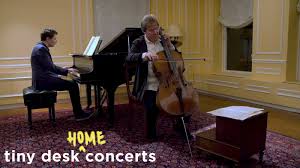
SOUNDTRACKJAN VOGLER AND ALESSIO BAX-Tiny Desk (Home) Concert #128 (December 16, 2020).

This is the third of three Tiny Desk Home Concerts to honor Beethoven’s 250th birth anniversary. This was my favorite. The first was just piano the second was a quartet of strings.  But this one, a combination of the two, was the most exciting.  I love the way the cello (Vogler) played off of the piano (Bax).

For this Tiny Desk (home) concert, we pay a visit to the doctor’s office. Actually, the venue is called Rare Violins of New York and it’s something of a second home to cellist Jan Vogler, who pops in frequently to have the experts give his 1708 Stradivarius cello a thorough checkup. If your multi-million-dollar fiddle has a cough or the sniffles, or even needs a full-blown restoration, Rare Violins, which sits just a block away from Carnegie Hall, can help. The firm also has a lovely music room, kitted out with a fine piano – something Vogler lacks at his place.  With help from the fine pianist Alessio Bax, Vogler makes a convincing case for Beethoven as one of the great heroes of the cello. Beethoven, whose 250th birthday falls this week, wrote five cello sonatas, plus other works for the instrument, which, before his time, was primarily relegated to beefing up the bass line in various chamber music situations.

Beethoven, in essence, liberated the cello. Listen to how it dances and struts in the opening scherzo from the Sonata in A, Op. 69.

“Cello Sonata in A, Op. 69: II. Scherzo” starts with a piano and the cello quickly jumps back in.  The song builds and swells and then quiets down to a pretty piano and cello melody.

Like Jonathan Biss, these two are very chatty. They are mostly chatty with each other, but they do direct their answers to the camera sometimes too.

Up next is a short piece from the beginning of his career “12 Variations on a Theme from Handel’s Judas Maccabaeus: Variation XI: Adagio.”   In this piece the cello “sings sweetly.”  Vogler says that Beethoven was friendly with a fantastic cellist and he may have inspired the composer to write more pieces for the cello.

Although the piece starts with a lovely piano intro and has several moments of just piano, the cello adds so much to it.

Before the final song the two talk about how the pandemic has changed them and what they are looking forward to doing when it is over.

And finally there’s the opening to Beethoven’s last cello sonata, which Bax — whose role is far more than just an accompanist here — says is compact with emotion, yet “stretches the boundaries” for the instrument.

“Cello Sonata in D, Op. 102: I. Allegro con brio” feels like a call and response–two instruments in conversation.  And they had a lot to say.

[READ: December 20, 2020] The Disaster Tourist

In continuing with my around-the-world reading, I picked up this novel that was originally written in Korean (translated by Lizzie Buehler).

This story sounded really weird and interesting.

Yona works for a company called Jungle which specializes in offering vacations in areas that have suffered a disaster.

On a disaster trip, travellers reactions usually went through these stages

shock; sympathy and compassion, maybe discomfortable gratefulness at their own lives; a sense of responsibility that they’d learned a lesson and maybe a feeling of superiority for having survived where others didn’t.

For instance, a tsunami had hit Jinhae–in an instant everything was underwater.  Yona travelled there because Jungle currently didn’t offer any tours there.  But they would soon.  Yona would give donations and offer condolences to the community.  Then she would create a vacation package that involved viewing the aftermath along with volunteer work.

Yona had worked at Jungle for over ten years.  She was something of a star.  But apparently, her star was starting to fade because she had all of sudden been asked to handle some customer service phone calls–never a good sign.

Things got even worse when a supervisor named Kim got on the elevator with her.  He said:

Johnson is asking me to send my greetings to you.
Who?
Johnson.  My Johnson. Kim pointed to his crotch.

At this point I had to wonder.  Is this level of harassment something that happens in Korea?  Is this  shocking incident for any reader?  Is this a hyper real fiction in which everything is just a bit beyond reality?  I don’t know.

Then Kim grabs her bottom and put his hand in her blouse.  The gesture suggested that Kim didn’t care if he was caught.

Yona was upset, but not because of the sexual assault. Because Kim was known to only target has-beens. (more…)

Read Full Post »

SOUNDTRACK: BORROMEO STRING QUARTET-Tiny Desk (Home) Concert #127 (December 15, 2020).

This is the second of three Tiny Desk Home Concerts to honor Beethoven’s 250th birth anniversary. 

The Borromeo String Quartet consists of Nicholas Kitchen: (first) violin, Kristopher Tong: violin, Mai Motobuchi: viola and Yeesun Kim: cello (who is Kitchen’s wife).

Beethoven doesn’t score high when it comes to positive personality traits. Paranoid, litigious and a micromanager, Beethoven didn’t suffer fools and often fought with friends. Still, he possessed a well-developed funny bone, which Nicholas Kitchen and company put on display here, along with their own whimsical tiny “desks.” Because of the virus, and the confined space, the players wear masks.

The humorous side of Beethoven’s personality seeps into his music, such as the false stops and musical giggles that fuel his two-minute-long Presto from the Quartet Op. 130, which opens this performance.

“String Quartet in B-flat, Op. 130, II. Presto” has many fast moments and interesting parts where the first violin pays fast melodies but the rest of the quartet plays slow triplets over and over.  This is one of Beethoven’s shortest movements and is full of variety and energy.

For contrast, the Borromeos follow with a serious movement from later on in the same piece, the prayerful Cavatina, which Beethoven said even got him choked up.

This movement is full of serenity and tranquil beauty.  This is called the beklemmt section meaning trouble breathing. 

Kitchen can barely contain himself about the humor in the next piece, “String Quartet in F, Op. 135, II. Presto.”  He says this has a playful melody and “berserk” middle with instruments going all over the place.

More hijinks ensue in the Vivace from the Quartet in F, Op. 135, where Kitchen says the music becomes “completely berserk.”

And finally, in the last movement of the same quartet, Beethoven inserts a musical inside joke, the brunt of which falls on a wealthy music lover who displeased the great composer by not showing up at an important concert.

Kitchen says that Beethoven never met an occasion when he did not have a pun.  And he enjoyed injection his own brand of humor into his pieces.  In “String Quartet in F, Op. 135, IV. Der schwer gefasste Entschluss” there is an inscription: question must it be?  answer: It must be it must be!  Kitchen explains there was a patron who did not attend the premiere of opus 130.  The next day the patron  asked Beethoven to send him the music so his court musicians could play it. Beethoven said he’d send it but “you not only have to pay the price of admission for the concert you missed but for everyone in your family.”  The man looked at him and said “Must It be?”  Beethoven wrote a canon for four men to sing “it must be it must be.”  Then he made that joke the basis of the last movement of Op. 135.

[READ: January 3, 2021] Dinner

The Linden Tree was an interesting trip down memory lane for Aira.  

Dinner, by contrast is a wild violent fantasy (translated by Nick Caistor).  But its starts in the mundane–with a man and his mother going to dinner.

The two of them went to his friend’s house.  The friend was a terrible storyteller.  But he and the narrator’s mother had one thing in common–they were great at remembering the names of everyone in Pringles.  They knew the genealogies and configurations of nearly all the families.

But the narrator was terrible at remembering names–he had no facility for it at all.  He had plenty of memories from the town, but could never put a name to an event.

Evernatully the friend brought out a precious toy that he had.  It wa an old and rather sophisticated wind-up toy.  Two separate gears would go at the same time.  As it began to run, the door to a bedroom opened an a fat man came out and started to sing (as well as an old 19th century toy could sing). An old woman was in bed and she began to move back and forth “as a blind person does.” Then the second mechanism kicked in an the bedspread began to move and it looks like flocks of birds were flying out from underneath it. (more…)

Read Full Post »

SOUNDTRACK: JONATHAN BISS-Tiny Desk (Home) Concert #126 (December 14, 2020).

This is the first of three Tiny Desk Home Concerts to honor Beethoven’s 250th birth anniversary. 

Biss is uniquely qualified for the task at hand. The 40-year-old pianist has recorded all 32 of Beethoven’s freewheeling sonatas, performed them worldwide and has taught an online course in the music.hat’s impressive. Still, what’s more astounding is the personal story behind Biss’ obsession with Beethoven. The recording project alone took nearly 10 years and the things Biss says he gave up – relationships, even his sense of self – in order to live the dream is heartbreaking. The pandemic has shut down the life and livelihoods of many musicians, and for Biss the down time offered space to confront his relationship to Beethoven and his own demons. He tells his story in a raw and insightful audio memoir called Unquiet: My Life with Beethoven.

You can hear some of Beethoven’s own struggle in these perceptive performances. The bittersweetness of the Bagatelle Op. 126, No. 1, the moments of fragility in the Sonata, Op. 90, and the interior perspective that reaches outward from the Sonata Op. 109, all prove that Beethoven’s music is as meaningful today as ever.

Jonathan Biss is a chatty pianist.  After playing the lovely if brief “Bagatelle in G, Op. 126, No. 1” (it’s under 3 minutes), he explains that the six bagatelles were the last thing Beethoven ever wrote for the piano. 

He also jokes that he had the overwhelming urge to introduce himself via the “invent your NPR name” by inserting your middle initial somewhere in your first name and your last name is the most exotic place you’ve ever traveled.

He says that didn’t expect to be drawn back to Beethoven during the pandemic because hos music is so intense and so much.  He thought he’d rather be drawn to comfort food.  But he can’t get away from Beethoven.

The pandemic has sidelined many big Beethoven birthday plans. Jonathan Biss was slated to play concerts around the globe in celebration of the 250th anniversary of the composer’s birth. Instead, he’s home in Philadelphia. So it’s no surprise that for this all-Beethoven Tiny Desk concert, Biss chose music that explores the composer’s own isolation, brought on by deafness and an uncompromising personality.

He talks about cancelling his tour in March.  He came home  and decided to read more–do he randomly picked out How to Be Alone as if the fates were telling him something.  Biss feels that beethoven provided a guide to being alone.  He was alone for most of his life–his personality was rather off putting, but he was also functionally deaf–the most profound form of isolation.  He retreated into his imagination to create these songs.

“Piano Sonata in E minor, Op. 90: I. Mit Lebhaftigkeit und durchaus mit Empfindung und Ausdruck” is a piece that shows his vulnerability–a rare things for Beethoven.

He plays the first two movements of “Piano Sonata in E, Op. 109: I. Vivace, ma non troppo — Adagio espressivo, II. Prestissimo.”  You can hear him humming an grunting along.

He signs off with his “NPR name” which I can’t quite make out.  Then he concludes with the final bagatelle, “Bagatelle in E-flat, Op. 126, No. 3” which ends by drifting into the ether.

[READ: January 1, 2021] The Linden Tree

I’ve had a few César Aira books sitting around that I wanted to finish and the beginning of a new year seemed like a great opportunity.

It’s not always clear if his stories are fiction, non-fiction or some combination of the two.  The back of this book calls it a “fictional memoir,” as if that clears things up.  Chris Andrews translated this fictional memoir.

The book opens with the narrator explaining that his father used to go into the town square to take leaves and flowers from the linden trees (in particularly one unusually large tree) and make a tea out of them.  This had some kind of regenerative properties for him–they cured his insomnia at any rate.

From there, as happens with Aira stories–it goes everywhere.

About a different Aira story Patti Smith once wrote:

I get so absorbed that upon finishing I don’t remember anything, like a complex cinematic dream that dissipates upon awakening.

And THAT is exactly the way Aira books work for me too.  I have to go back through them just to try to remember the details.

So, in this story the narrator’s father is black (mixed race marriages were unusual in Pringles at the time of their marriage).  His mother, who he praised for marrying a black man, was also flawed in many ways, including being very short and very bossy.

But the main thing about this story is the rise and fall of Peronism. (more…)

Read Full Post »

SOUNDTRACK: BLACK PUMAS-Tiny Desk (Home) Concert #122 (December 7, 2020).

After hearing a couple of Black Pumas songs on WXPN, I had to get the album.  They played such an interesting and catchy style of “gritty, retro soul.”

I was pretty happy for them when the were nominated for a bunch of Grammies.  Then S. and I were laughing because so many people we knew (who follow pop music) had never heard of them.  So I guess they are quite the niche band.  But I’m glad to have heard them.  And I’m glad they get the Tiny Desk Home Concert.

The Austin-based rock band Black Pumas is having a good 2020. The group, led by singer Eric Burton and guitarist Adrian Quesada, was just nominated for three Grammys, including album of the year for Black Pumas (Deluxe Edition), and both record of the year and best American roots performance for the track “Colors.” The band’s turn behind a tiny desk (and chair) shows why its debut album — now more than a year old — is receiving so much recognition right now.

The band is socially distanced in a studio with singer Eric Burton in a bad ass leather jacket up front.

Behind him are terrific backing singers Lauren Cervantes and Angela Miller.

Then, masked in the back row are guitarist Adrian Quesada, drummer Steve Bidwell bassist, Brendan Bond and keyboardist JaRon Marshall.

They play four songs and

the intensity level builds gradually throughout this four-song set. It’s clear why the band’s live shows have won over fans. From the opening strains of “Red Rover,” Burton digs deep and by the time we get to the ballad “OCT 33,” he’s burning with old-school soul heartbreak.

“Red Rover” is on the second disc of the deluxe edition, so I wasn’t as familiar with it.  But it’s got a nifty wah wah and echoed guitar solo from Quesada.

Up next is “Fire.”  Burton grabs a guitar as a keyboard melody opens the song.  Quesada plays a cool surf riff and then Burton takes over the vocals.  His voice is outstanding and this song is crazy cathy (the backing vocals are just icing on the cake).  When Burton sings a note mid song and kicks it even higher, his hat falls off–that’s the kind of intensity they bring.

Burton opens “OCT 33” with a soft, echoing guitar melody.  It’s simple but instantly grabbing.  He starts to sing as bass is added.  The song slowly builds over the length of it to a wonderful moment mid song where Burton sings and Quesada plays a ripping fuzzy guitar solo.

They end with the wonderful “Colors.”  An echoing, instantly memorable guitar lick opens the song.  Burton’s voice sounds fantastic as he sings.  I love the “doo doo doo doo” part in the middle and JaRon’s extended old soul-sounding organ solo is a fantastic treat.

The Pumas are probably my favorite new band of 2020.

[READ: January 3, 2021] “Rwanda”

I’ve really had a hard time getting into Wideman’s stories in the past.  I don’t like his writing style and I often feel like I know what’s going on until he starts to get really elliptical and he loses me.  I feel like this is a failing on my part, but who knows.

This story is told in four parts.

Part I

The narrator asks his niece (and us) a thought experiment.  If you were in charge of running the world and you learned that life on earth was going to end shortly (6 months at most) would you tell the public?

Wideman ties the story to what’s happening in the world.

What if this deadly plague meant that all life would soon end.  Would they tell us?  How would people react?  Would people freak out and go crazy–everyone for himself, or would some carry on as normal? (more…)

Read Full Post »

« Newer Posts - Older Posts »