Feeds:
Posts
Comments

Archive for the ‘Hitler’ Category

SOUNDTRACK: …AND YOU WILL KNOW US BY THE TRAIL OF DEAD-Live on KEXP, March 12, 2009 (2009).

Back in 2009, …And You Will Know Us by the Trail of Dead had been hit by a truck.  Really.  Evidently no one was hurt too bad, but they did have to cancel a show in Salt Lake City. 

Nevertheless, they managed to get to KEXP to play a four song set from their latest album The Century of Self.  The opener “The Giant’s Causeway” is full of bombast and noise  and has a surprisingly catchy melody in the middle.  It merges into “The Far Pavillion” (just like on the album) which sounds like pretty typical Trail of Dead–rocking and yet melodic, with some good screaming parts.

“Luna Park” is something of a surprise to me as it’s a piano-based ballad (which I suppose Trail of Dead plays, but which I don’t associate with them).   “Bells of Creation” also opens with a piano, but it quickly grows very loud.  It’s a cool song with lots of depth.

I had actually stopped listening to Trail of Dead after Worlds Apart (and album I liked, but I guess the band fell off my radar) so it’s nice to hear they’ve still got it.  At least as of three years ago.

[READ: September 17, 2012] Galápagos

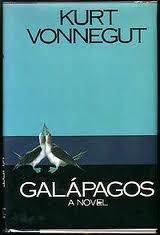
Each of these 1980’s era Vonnegut books gets darker than the last.  In this one the entire human race is wiped out (except for a few people who spawn what eventually becomes of the human race in a million years).  For indeed, this book is set one million years in the future and it is written by a person who was there, one million years in the past when the human race destroyed itself.  It’s not till very late in the book that we learn who the narrator is and, hilariously, what his relationship is to the Vonnegut canon.

In typically Vonnegut fashion, the story is told in that spiral style in which he tells you a bit of something and then circles back to it again later and comes back again later until finally 200 or so pages into the book you get all the details of what is happening.  Interspersed with the respawning f the human race (and flippers) is the story of the Adam and Eve and Eve and Eve and Eve and Eve who created the human race–how they got to be together, what their lives were like before and what contribution they made to humanity, such as it is now.

In another bizarre and fascinating twist, every character who is going to die in the near future gets a star next to his name so that the reader knows that that person is going to die.  We get a lot of things like ★Andrew MacIntosh for many pages until the character finally dies.  And pretty much everybody does die.  Well, obviously if it is set a million years in the future, but aside from that part, only a few of the characters survive.

So here’s how these few people managed to create a new human race in the Galápagos Islands.   (more…)

Read Full Post »

SOUNDTRACK: PINK FLOYD-Alan’s Psychedelic Christmas (1970).

I’ve always loved Pink Floyd’s Atom Heart Mother.  I have no recollection of how I stumbled upon this live bootleg, but when I saw that it contained one of the few live recordings of “Alan’s Psychedelic Breakfast” I had to give it a listen.

So this show is from 1970 and was recorded in Sheffield just before Christmas (Nick Mason evidently introduced the show while wearing a Santa Claus suit).  The sound quality is pretty good given that it is 40 some years old.  There’s a bunch of hiss, and the quieter talking bits are hard to understand, but the music sounds fine.

So the show opens with “Alan’s Psychedelic Breakfast” and what is so silly (and I assume funny to watch (a little less funny on bootleg) is that the band made and ate breakfast on stage.  As Collectors Music reviews writes: “This is the only known live recording of ‘Alan’s Psychedelic Breakfast’ but also hosts an amazing performance by the band which included them making morning tea on stage which is audible. Just like most of their earlier performances, the performance of “Alan’s Psychedelic Breakfast” slightly differs from the album version due to some nice jamming done by the band, especially Gilmour with his delay pedal.” As I said, some of the audio is static and hard to make out in this song–the band is conversing during their tea, but who knows what they are saying.  And who know what is o the radio.

Then the band gets down to business.  One of things I love about this period Floyd which is so different from their later work is that the played really long spacey jams often with very few lyrics.  So we get a 12-minute version of “The Embryo” (the only available studio version is a very short one on Works which is quite a shame as the song is really good).  A 14-minute workout of “Fat Old Sun” which is usually only about 5 minutes.

There’s a great version of “Careful with that Axe Eugene” and “Set the Controls for the Heart of the Sun” (15 and 12 minutes respectively).

Then in a killer version of “Saucerful of Secrets,” just as they get to the end, there’s a power failure (at least according to the song title).  The band is rocking out just hitting the climax when suddenly all you can hear are un-miked drums.  Ha. After a couple of minutes, power comes back and they pick up from just before where they left off.

Then the band launches into a full 31-minute version of “Atom Heart Mother” complete with horns and choir  of voices.  It sounds quite good (the horns seem a little sketchy but that might be expected with such staccato music).

The set ends and the band needs an encore.  Apparently they couldn’t remember anything else because they just re-do the last few minutes of “Atom Heart Mother” again.

One of the things that cracks me up about these shows in the 70s in England, is that the audience is so polite. Their applause sounds like a classical theater rather than a rock show.  And with a bootleg you know they didn’t try to make the audience sound bigger than they are.

The whole package is a fun trip.

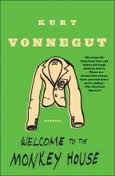
[READ: August 17, 2012] Welcome to the Monkey House

So this book is Vonnegut’s second collection of short stories.  But there’s a twist.  This collection contains all of the short stories from Canary in a Cat House except one. It also contains many of the stories he had written since then as well as stories not collected in Canary.  So you get basically 18 years worth of stories here.  And it’s interesting to see how much he has changed over those years (during which he wrote 5 novels, but not yet Slaughterhouse Five).

Since I read Canary a little while ago (see comments about the stories here), I knew that his 50’s era stories were influenced by WWII.  So it’s interesting to see how his stories from the 690s are not.  They deal more with day to day things and, of course, abstract concepts about humanity, although politics do enter the picture again once Kennedy is elected .

  • Where I Live (1964)

This was a good story to open with because it shows the then-later-period Vonnegut’s mindset and location.  This story is about Barnstable Village on Cape Cod (where I assume Vonnegut lived since there are a number of stories set on the Cape).  This is a very casually written story about an encyclopedia salesman who goes to the local library and sees that their two encyclopedias are from 1910 and 1938.  I enjoyed this line: “He said that many important things had happened since 1938, naming among others, penicillin and Hitler’s invasion of Poland.”  He is told to talk to the library directors who are at the yacht club.  I love the attitude that Vonnegut creates around the village which “has a policy of never accepting anything.  As a happy consequence, it changes about as fast as the rules of chess.” For really, this story is about the Village more than the encyclopedia salesman, and it’s an interesting look at people who move into a new place and want it to never change. (more…)

Read Full Post »

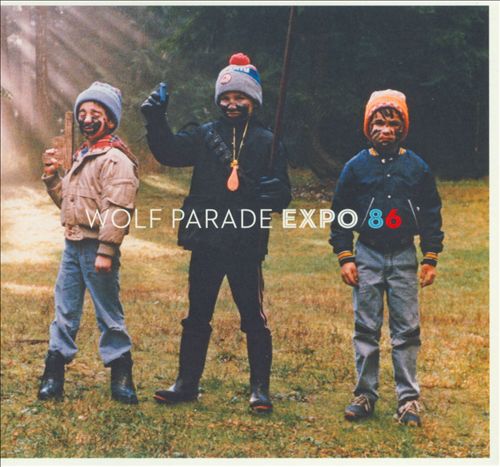
SOUNDTRACK: WOLF PARADE-Expo 86 (2010).

Wolf Parade is a strange band, no doubt. Both singers can craft super catchy songs, but they like to layer them with odd sounds and lots of song parts making the songs more challenging (and better in the long run).

“Cloud Shadow on the Mountain” starts the disc off with drums and an eccentric voice.  And the lyrics? “I was asleep in a hammock/I was dreaming that I was a web/I was a dream-catcher hanging in the window of a minivan/Parked by the water’s edge./I’d say that I was all alone.”

The song has some loud guitars, some great guitars riffs and (the most notable feature on the album) retro sounding keyboards.  On this song the keys play an alternate melody that compliments the song very well.  There’s some heavy rocking sections and a slowed down drums and vocals section.  It’s fairly exhausting how much is in this one song.  By the end, he’s repeating “you will never be born as a scorpion.”

“Palm Road” is a more straightforward and catchy song, although it’s certainly offbeat.  “What Did My Lover Say” opens with a cool guitar riff an counterpointed keyboards.  As with most of the songs on this record headphones or at least good stereo speakers really make a difference.  The rest of the album is hard to speak of in different terms because each song is unusual with angular guitars and interesting vocals.  The keyboards also provide unsettling atmospherics.   None of the songs are easy to sing along to, until one day the shifts in melody and phrasing sink in and it all sounds wonderful.

What I find notable about these songs is that they are all long (most are around 5 minutes) and they feel long–not in a dragging out way (although maybe “In the Direction of the Moon” drags) but in a–so much has been going on, this song must be really long kind of way.

Some other highlights include “Ghost Pressure” with its great keyboard riff (that feels not unlike The Cars).  Speaking of The Cars, the keyboards on “Oh You, Old Thing” have the great spacey Cars sound from the 80s.  “Pobody’s Nerfect” melds the catchiness that the guys are capable of with just the right mix of unexpectedness.  And the closing song “Cave-O-Sapien” seems to combine all of the best qualities of the above songs in to one–a great riff, catchy “oh oh ohs,” and bizarre lyrics, “I had a dream of a gorilla.”

This album is definitely not for everyone, but multiple listen reap big rewards.

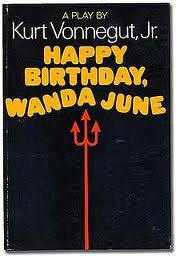
[READ: July 8, 2012] Happy Birthday, Wanda June

I have been chugging along nicely through Kurt Vonnegut’s oeuvre.  My plan was to read all of his novels and then read his short stories.  And then maybe read his plays (I wasn’t sure about that last bit).  But as I mentioned yesterday, reading a simple play can be a delight (and can be a very quick read, too).

Vonnegut opens the book with a prologue about how and when he wrote the book.  It was originally a play called Penelope, and he thought it was terrible.  Fifteen years later he kept the basic idea and rewrote it as Happy Birthday, Wanda June.  And the idea is straight out of Homer.  In the Odyssey, Penelope is Ulysses’ long-suffering wife.  When Ulysses came home from his travels some twenty years later, he was feted as a hero and the world (well, his world) rejoiced (except for Penelope’s suitors, of course).

So in this play, Harold Ryan is a loud, manly hunter and soldier, ready and happy to kill anything in his way.  He has been on an expedition for eight years–his plane went down and he  is presumed dead–even Mutual of Omaha thinks so.  His wife, Penelope Ryan believes him to be dead and has been entertaining two suitors–Dr Norbert Woodly, a pacifistic doctor and Herb Shuttle, a vacuum cleaner salesman.  The only person who doesn’t presume him dead is their son Paul Ryan, who bristles not only at the thought of his father being dead, but even more so at these wimpy suitors.  Although Paul is too young to ever have rally known his father (he’s 12), he keeps hopes alive that his father will return one day.

What I like about the play is that it maintains Vonnegut’s voice right from the start.  It opens with a speech from Penelope:

My name is Penelope Ryan.  This is a simple-minded play about men who enjoy killing–and those who don’t. (more…)

Read Full Post »

SOUNDTRACK: SIX ORGANS OF ADMITTANCE-“Even If You Knew” (2012).

Lars from NPR’s All Things Considered picked this as his summer music preview song.  I don’t know a thing about Six Organs of Admittance, but their discussion of this song makes it seem like this is atypical for the band (which has a massive output).  Evidently they’re usually more droney sounding. But man, this song is pummeling and wonderful.

It’s seven minutes long and opens with a simple, plodding heavy bass riff.  The vocals are kind of whispered and strained.  But then comes the guitar solo–a raging piece of distortion that complements the bass.  And that’s just the first three minutes.

The second half of the song features a quieter section–the bass is quieter, while the guitar noodles around and the vocals play over the rhythm.  The song slowly builds again, and by the last minute or so there’s another fierce guitar solo. Until the song is exhausted by the final distorted notes.

This is some beautiful noise.  And, no I have no idea what the band’s name means.

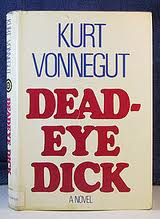
[READ: June 27, 2012] Deadeye Dick

Deadeye Dick is the last Vonnegut book that I was completely unfamiliar with.  I had no idea what it would be about.  So I didn’t realize until very late in the book, and then I looked online and confirmed that this book is set in the same location as Breakfast of Champions, Midland City, Ohio.  Indeed, some of the same characters appear in this book as appeared in that book.  But more about that later.

Vonnegut is not known for his happy books.  Misanthropy is pretty rampant in his pages.  But this book is one of his bleakest books yet.  The story concerns the Waltz family–Rudy (the protagonist) and his brother Felix are the only children of Otto and Emma Waltz.  Pretty early in the story we learn that Rudy is a double murderer.  Yipes!

As with most Vonnegut stories, this one is told in a convoluted and non-linear fashion.  He foreshadows (and really just casually mentions) a lot of crazy things that are going to happen in the book.  Like the fact that Midland City is going to be devastated by a neutron bomb.  In fact, his preface (like with many of his prefaces) tells us a lot about what’s in the book and who the characters are based on and the fact that there is a neutron bomb (but the reality of a neutron bomb is different from what he says).  There is something about knowing this information ahead of time that impacts the way you read the story.  Whether you think maybe he’s not telling the truth about what will happen (can the narrator really be a double murderer?) or maybe somehow the foreshadowing makes it even worse when it actually happens–the revelations are perhaps more deliberate.  But the style–a recursive style in which he says what happens and then he goes back and fills in the details, makes the events that much more powerful.

The funny thing about this story is that a lot happens to the characters in the beginning of the story and then not too much happens to them after that.  But that early stuff is pretty exciting and it has an impact all the way through. (more…)

Read Full Post »

« Newer Posts