Feeds:
Posts
Comments

Archive for the ‘History’ Category

SOUNDTRACK: CIAN NUGENT-“My War Blues” (2012).

I’ve never heard of Cian Nugent before (pronounced KEE-en).  He’s an Irish guitarist (his guitar playing reminds me of José González).  And this is a cover (but not really) of Black Flag’s “My War.”  What it really is is a solo acoustic guitar workout that is inspired by the riff of “My War” (there’s no vocals).  I love Black Flag and I can say that if I didn’t know that bit of information, I would never have guessed a connection.  But having said that, this song is an inspired workout.

He plays some wonderfully dissonant slow notes as the song opens.  From there, it picks up speed as Cian tests out some new variations.  And then he gets into the solo section, sounding like an inspired Richard Thompson, he plays one of he meanest acoustic guitar solos I’ve heard in ages.  At times angry, at times jaunty, and all the while keeping the beat on the low strings.

I’m going to have to check out more by this guy.

To hear this track, check out NPR.  You’re one of them.

[READ: May 15, 2012] “First Atlanta and Then the World”

This article comes from the archives, one of three monthly suggestions from my work that I enjoy checking out.  It’s a brief history of the rise of Coca-Cola from small idea to global behemoth.  But, and here’s the kicker, it comes from a local publication: The Georgia Historical Quarterly, so there is no (real) politicking in the article.  There’s nothing about global hegemony, there’s nothing about high fructose corn syrup and nothing about obesity (it was written in 1987, back in less politicized days).  And I have to say, this made it more fun to read.  Not because I have any vested interest in promoting the worlds’ most recognized brand, but because the Coca-Cola story is pretty fascinating.  And it’s interesting to read it from a local perspective.

I don’t know how scholarly The Georgia Historical Quarterly is (since it’s on JSTOR I know it has certain aspects of scholarship—it’s not just a booster for Georgia), but the tone of this article is very light, very fun.  It makes for an interesting read. (more…)

Read Full Post »

SOUNDTRACK: THE MOUNTAIN GOATS-“Drug Life” from Score! 20 Years of Merge Records: The Covers (2009).

 I could tell this was a Mountain Goats song right from the start–it’s lo fi and yet it sounds clear (especially the vocals). Normally with The Mountain Goats you talk about the lyrics, but since he didn’t write the song, there’s not much to say about them (in this paragraph anyhow).

The original, by East River Pipe is also very lo-fi.  It’s a very catchy song and it’s all about drugs: (“If it comes down to the drugs or you…baby we’re through.”).  The original is guitar and keyboards and Cornog’s straightforward singing.  The cover is simply acoustic guitar.  It’s a little faster (and a little shorter) and because I like The Mountain Goats, I prefer the cover.

Although really, they’re not very different.

[READ: April 16, 2012] “Transatlantic”

This story was out of my comfort zone–it’s about army men and airplanes, that’s not my scene, man.  And after reading the first few paragraphs, I wondered if I should keep reading it.  But McCann wrote a compelling story and I’m really glad I finished it.

The story is basically an account of two men, Teddy Brown and Jack Alcock, as they attempt the first transatlantic flight in their modified bomber called The Vickers Vimy.  Anyone with a working knowledge of the flight, or post WWI history knows that these are two real historical people.  I do not have such a working knowledge, so I had no idea that this was based on a true story.  If you know anything about them (and I swear, Google either of them and you will find all the details that you need) then you know how the story turns out.

I didn’t know how the story turned out and I found it thrilling. In part that’s because it’s an exceptionally exciting moment in history–two former army men modify a bomber and try to fly from Newfoundland, Canada to Ireland.  And really, there’s no way it should work–bombers don’t have enough fuel, they have no radar.  It could take days.   Hell the planes don’t even have a windshield that covers them.  But the excitement is also because of the way that McCann tells the story. (more…)

Read Full Post »

SOUNDTRACK: TEGAN AND SARA-“Alligator” on CDC Kids’ Mamma Yamma (2010).

Tegan and Sara take a slightly different approach than the other artists on Mamma Yamma.  Rather than creating a new song, they took their hit “Alligator” and made new words for it (much like many artists have done on Sesame Street).

The melody is exactly the same (which is good, as it’s a really catchy song). But rather than being about a failed relationship, it’s about alligators.

Old lyrics: Run around on me, I’d sooner die without

New lyrics: Run around a tree, skip and jump about

It’s a cute version and the band sounds very good.

I really enjoy these introductions to interesting musicians on kids shows.  I wonder if kids actually like seeing grown up musicians like this.

You can watch it here:

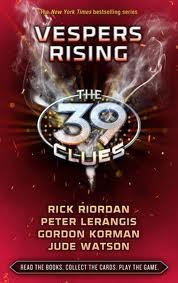
[READ: April 20, 2012] Vespers Rising

I finished The 39 Clues series last year. Or so I thought!  After completing books 1-10, I found out that they were planning a whole new series.  And they began with this transitional book, which they called #11 and which was co-written by four of the prominent authors.

Vespers Rising is actually four short stories that trace the history of the Cahill family and their feud with the Vesper family.  The Vespers were not a part of the first series at all.  In the first series, the 39 Clues were a kind of Amazing Race for Cahill family members.  (I’ll get to some details about the family in a moment).  It was a kind of private race for the prize–which was a life-enhancing serum.  But this book introduces a new villain to the story and explains that the villain has been there all along, just lurking.

Rick Riordan wrote the first story in this book takes us back to the beginning.  In 1507, off the coast of Ireland, Gideon Cahill invented this serum.  He was and alchemist, seeking an antidote for the Black Death which was ravaging Europe.  He was working for Lord Damien Vesper, a man bent on power.  Vesper wasn’t interested in helping people with the Black Death–he had no real value for life–however, he was interested in the results that Gideon might discover. (more…)

Read Full Post »

SOUNDTRACK: ST. VINCENT AND THE NATIONAL-“Sleep All Summer” from Score! 20 Years of Merge Records: The Covers (2009).

This cover is by The National with St. Vincent singing a duet with The National’s singer.  The original, by Crooked Fingers, is also a male/female duet, so this works nicely.  Indeed, having listened to the original, there’s not a lot of difference between these two versions.

The singer from The National has a distinctively deep voice.  And I really like St Vincent, although on this song, she’s not really doing anything amazing, she’s just singing (very nicely, but she could be anyone).

It’s a perfectly nice song, in both versions.  The original is a bit more interesting musically, but I like the vocals in the new version better.

[READ: March 15, 2012] “Gentleman’s Servant”

If you have read my other three posts about articles from Colonial Williamsburg, you have seen the cover of this magazine.  And, man, does it make me uncomfortable.  About as uncomfortable as I feared this article was going to make me.  I almost didn’t read it.  In the previous article I mentioned how the photos look…wrong.  And none look more wrong to me than the series of pictures for this article.

However, this article was not about slaves exactly.  It was more about servants or valets.  The article immediately puts us at our ease by telling us that there are schools today that teach how to be a valet, primarily in England.  And they make it out to be not such a bad gig.  It puts me in mind of Jeeves and Wooster, and what a lark it must all be.

Of course in the 18th century things were quite different (although it is described as similar duties–caring for the master and the master’s clothes and horse and such).  This paragraph tucks in a key phrase as it tries to make it all seem casual: (more…)

Read Full Post »

SOUNDTRACK: RYAN ADAMS-“Like a Fool” from Score! 20 Years of Merge Records: The Covers (2009).

I don’t particularly like Ryan Adams’ songs, so I was surprised how much I liked this cover of a Superchunk song.  The cover has an interesting vibe, a kind of Pearl Jam (in the guitars) meets Radiohead (in the vocals) sound.  It’s not too different from the original, although, as with many of these covers, I like the recording quality better.  I know I love my lo-fi world, and I love Superchunk but these newer versions just sound better.

Adams has a good voice, and he adds just enough orchestration to make the song a wee bit more interesting than the original.

[READ: March 15, 2012] “Department of Deportment: Stances and Dances Made the Eighteenth-Century Man–and Woman”

This article was intriguing but wasn’t quite about what I wanted it to be about.  Also, what was weird about this article–not so much with the others in the magazine so far, is that the photographs look simply too modern.  Usually for period pieces there is a hint of aging done to the film.  Obviously for the magazine they want the best possible quality photo, but it just looks really…fake?  Obviously modern people in old homes and dress.

The other thing that is odd to me about this article is that it begins with the idea that the reader doesn’t know what deportment means, or  that we misunderstand its meaning.  The true meaning–upright behavior and moral uprightness–doesn’t seem that hard to grasp.

However, despite these criticisms the article has some interesting history to impart.  The idea was that Gentlemen and Ladies were educated and would act with honor.  And part of that honor was the way one stood and acted.  Thus, Gentlemen had to maintain deportment.  Etiquette books also taught how to treat people of equal–and lower–standing.  Some people tried to appear gentlemanly by quickly learning deportment–but rules were complex and fakers were easily caught.  And those who were caught were punished by being thrown out of  a party or by public ridicule. (more…)

Read Full Post »

SOUNDTRACK: TOKYO POLICE CLUB “Cheer It On (Trey Told Em Remix)” and “Cut Cut Paste” from Viva Piñata! (2008).

Tokyo Police Club released one of the best LPs of short blasts of rock in a long time.  “Cheer It On” is a great song that name-checks the band and which I could listen to over and over.  It’s a hot punk blast.  This remix totally changes the song (which is better than just tweaking it or repeating the chorus over and over).  Trey makes it a discoey song (with the wah hoo! from “Celebration,” I believe) and big rubber disco bass lines over the music.  It really changes the sound. I like the original a lot better, but I enjoy a remix that actually remixes.

“Cut Cut Paste” is a studio release and it shows TPC in their element–a short fast song.  I love the way it starts out with a shifting guitar sound.  It has a great manic intensity.  Tokyo Police Club is definitely one of my favorite new bands.

[READ: March 20, 2012] Science News Letter

I’ve mentioned before when my company sends out links to articles that are interesting or cool.  Most of the time they are highly academic (that’s the kind of work I’m in), but they also do more general information as well.

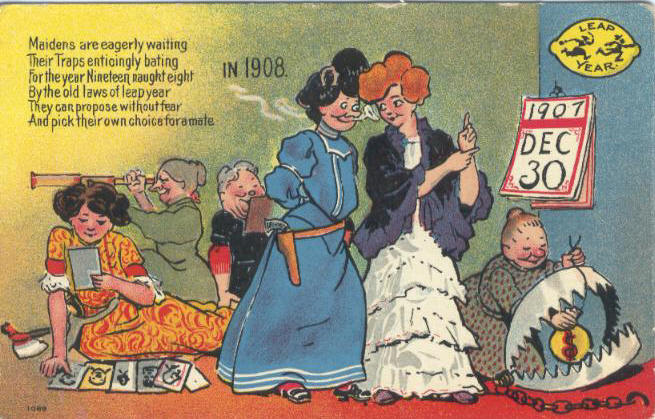
So this particular page was sent to us because of the article “Marriages Are Seldom Higher in Leap Year” (since this is a leap year).  There was a tradition in Britain and Ireland that on a leap year, women could propose to men (see the postcard below).

But this article (really only three paragraphs) which is addressed to “Marriage Shy Bachelors” says that only twice since the Civil War has the marriage rate been higher in a leap year (1896 and 1920) in America. And that in 1952 the supply of available unmarried persons has been depleted by the spurt in marriages following World War II.  Rest easy single guys! (more…)

Read Full Post »

SOUNDTRACK: QUASI-“Beautiful Things” from Score! 20 Years of Merge Records: The Covers (2009).

I’ve had this CD for a pretty long time just waiting for me to devote some time to listening to it.  The collection is a compilation of non-Merge label bands covers songs by Merge bands.

Quasi was a great band (I guess they are still together, so they are a great band).  I have their records from around the turn of the century (I love writing that!).  Sam Coombs and the wonderful Janet Weiss comprise the band (there’s a bassist, Joanna Bolme, added in 2007). And they sing wonderful, political alt-pop.

This is a cover of a song by the New Zealand band The 3Ds.  I don’t know the original (although I do know (and like) a few songs by them–mostly from the Topless Women Talk about Their Lives soundtrack.  This version has heavy keyboard prominence, but he sweet verses (sung largely by Janet with Tom doing backing vocals) are interspersed with some cool buzzy guitar solos.

  I just found the original online, and the cover is pretty accurate–although the Quasi version is a bit more dynamic.  Nevertheless, it makes me want to listen to The 3Ds a bit more.

[READ: March 15, 2012] “A Cup of Hot Chocolate, S’good for What Ails Ya”

Have you ever wanted to read about the history of hot chocolate?  No, of course not.  No one has.  And yet, when I started flipping through this article, Theobald introduced plenty of ideas that I found not only interesting but compelling.

Theobald explains how the Aztecs called this (at the time) very hearty, spicy and bitter) drink cacahuatl.  The Aztecs got the drink from the Mayans, who got it from the Olmecs.  The first Europeans to try this drink loathed it (one even called it a drink for pigs).

It was the conquistadors who mixed cacahuatl with sugar to make what we now know as chocolate.  Chocolate was a luxury back then–time consuming and difficult to make.

The Spaniards found the drink very hearty–hearty enough to be considered a meal.  This put Catholics in a tizzy about the state of the item.  They feared that if it was food it could not be consumed on fast days–it was ultimately deemed a drink.  The drink made its way through Europe and into England.  The first known English recipe called for sugar, long red pepper, cloves, aniseed, almonds, nuts, orange flower water and cacao. (more…)

Read Full Post »

SOUNDTRACK: SALLY SHAPIRO-“I’ll Be By Your Side” (Extended Mix) & “He Keeps me Alive (Skatebård Mix)” from Viva Piñata! (2008).

These two tracks also came from the Viva Piñata compilation.  “I’ll Be By Your Side” has a very Euro dance-sound to me (updated ABBA, perhaps?).  It sounds so incredibly 80s to me.  Unlike most of the other tracks, this is an extended mix, not a remix, so I assume this is what the real song sounds like, too.  It’s a fine little pop song (catchy chorus) although I don’t need an 8 minute version of it.

“He Keeps Me Alive” feels like  Julie Cruise song–straight out of Twin Peaks–until the bouncy synths come in (I can’t imagine what the remix did as it sounds so much like the other song).  The one possible remix element is the vocals, which get very synthesized near the end.

Both of these songs have that Europop feels that I like much more than American pop.   I had been puzzled by the name of the singer, because her name clearly wasn’t coming from where I though the music came from.  Well, Wikipedia tells me “Sally Shapiro is the pseudonym of a Swedish vocalist and the name of the synthpop duo composed of Shapiro and musician Johan Agebjörn.”  At least I got the Abba connection right!

[READ: March 22, 2012] “The Archduke’s Assassin”

This is an excerpt from Saul’s upcoming novel Dark Diversions (it was also published in Brick, although I read it in Harper’s).  What’s fun about this excerpt is that I have literally no idea what direction the rest of the novel could go.  This appears to be a self-contained incident and while it seems pretty clear who the protagonist is, it’s hard to speculate how much more of the book would be about him or his friends or even the excerpt’s titular assassin.

It begins with a discussion of Yugolslav politics circa 1987–how the official inflation rate of 50% is indeed official, which means mythological.  The setting is the Writers’ Union, a nineteenth century stone palace which housed the best restaurant in Yugoslavia.  The food was great, as was the gossip.

The narrator’s friends were all mixed race (in other words typical Yugoslavs).  But for the moment they were all Serbs.  The discussion moves to the assassination of Archduke Ferdinand and how the narrator should meet the man responsible.  When he replies that Gavrilo Princip died in prison in 1918,  his friend Dana corrects him and says she is talking about Vaso Čubrilović.  Čubrilović was one of several people who conspired to assassinate the archduke.  As of 1987 he was the only one still alive.  [He is a real person.  He got 13 years in prison, eventually became a history professor and died for real in 1990].

The narrator goes to meet the man at the University.  After a brief theoretical discussion of history, Čubrilović says that he believes that technology will save the future, that software will lead the way.  The narrator ponders this later over a meal and wonders if a new mythology is needed to distract people in a time of political emptiness.

There isn’t a lot to the excerpt–it’s not profound or anything, but it does what an excerpt should–it whets your appetite for more.  The writing is excellent and the topic is intriguing.

I enjoyed that the story mentions some Serbian dishes like kesten-pire sa šlagom (chestnut pureé with cream and chocolate) and  žito sa šlagom (crushed wheat, walnuts and dried raisins with cream).

For ease of searching, I include: Skatebard, Johan Agebjorn, kesten-pire sa slagom, zito sa slagom, Vaso Cubrilovic, pinata

Read Full Post »

SOUNDTRACK: BEN FOLDS-Free Folds Five E.P. (2011).

With the purchase of Ben Folds’ Imitation of Myself, I received a free download of this E.P.  It contains five tracks: three demos and two live tracks.

The demos are for “Underground” (1992), “Stevens Last Night in Town” (1994) and “Song for the Dumped” (1994).  Demos are a strange thing.  For fans of a song it’s interesting to hear an original version, especially if it is radically different.

These demos are not radically different although there are certainly some differences.  “Underground”‘s opening spoken bits sound more comical and less sung (it’s clearly just not mixed well).  And “Steven” has a strange spoken word section during the instrumental break.  It’s also less manic than the official release.

The most drastic change is in “Song for the Dumped” in which the chorus ends not with the humorous “and dooooooon’t forget my black T-shirt” but with the more abrasive (and Ben said harder for him to sing) “you fuuuuucking whore.”  So these demos are interesting for knowing that these songs were pretty much always meant to sound a certain way (and that even Ben has limits for how much he’ll curse).  But the official releases are better.

The live versions are both from solo shows.  “Narcolepsy” (1999) and “Dr Yang (2008).   Ben live is always a fun prospect.  He puts on a fun show and often stretches the songs out with fun jams.  “Narcolepsy” is notable for the incredibly buzzy bass guitar that they’re playing.  Neither one of these songs features any jams, but they both have a heavier, more intense feel than the studio versions.

Since the Imitation of Myself included live songs and demos, these make a nice addition to the set.  Although they’re certainly not essential.

[READ: March 15, 2012] “ΦΒΚ: Love of wisdom, the guide to life”

My family has traveled to Colonial Williiamsburg for our last few vacations.  We don’t spend all of our time there (Busch Gardens is just down the road, after all), but we have really enjoyed the history.  So last year I sent them a nominal fee and got some kind of membership coupon.  And then about a week ago, we received this magazine.  I don’t know why it took so long to get to us and I don’t know how many more we’ll receive.  I wasn’t even sure if I was going to read anything in it (I like Colonial Williamsburg, but probably not enough to read a whole magazine about it).  But I was delighted by the content of the magazine.  And I’ll mention a few of the other articles in the near future.

This one is about the origins of ΦΒΚ, Phi Beta Kappa.  It’s something I never even thought about, but once I started reading it, I found it really interesting. (more…)

Read Full Post »

SOUNDTRACK: ALEC BALDWIN reading “Lost and Found” (Selected Shorts September 10, 2011) (2011).

Alec Baldwin’s reading of Whitehead’s “Lost and Found” is really great.  His delivery is perfect and he strikes the ideal balance of humor and pathos, even if his inner-Boston peeks through this New York tale once in a while.  You can hear it for free at soundcloud.

[READ: February 12, 2012] “The Way We Live Now: 11-11-01; Lost and Found”

I didn’t know who Colson Whitehead was in 2001 (at the time of this piece, he had written two novels, neither of which have I read even now).  I read a lot of things about 9/11 after the attacks; however, I didn’t read everything (and really I didn’t want to try).

Strangely, the only way I found out about this is because my brother-in-law’s wife linked to the soundcloud page on Facebook the other day.   (I’m not sure what made her link to it now, either).

The amazing thing about this essay is that it was written less than a month after the attacks and yet it is it is humorous and wise (but not silly or light-hearted).  It strikes a perfect balance.  And in fact, doesn’t even mention the attacks by name.

The piece is more of an ode to New York City and how “No matter how long you have been here, you are a New Yorker the first time you say, ”That used to be Munsey’s’ or ‘That used to be the Tic Toc Lounge.'”  Your first memory of the City is how you will always think of the City.  Whether you were dragged there at Christmas time as child or to help a friend move. (more…)

Read Full Post »

« Newer Posts - Older Posts »