Feeds:
Posts
Comments

Archive for the ‘Graphic Novel’ Category

chigerSOUNDTRACK: KACEY MUSGRAVES-Tiny Desk Concert #463 (August 20, 2015).

kaceyKacey Musgraves is probably the most country country singer that I really like.   She makes a lot of music that is really really country–the kind I typically dislike, and yet her lyrics are just so good that I can look past the country sound that I dislike so much (and even start to enjoy it).

I love that she plays with all of the country cliches—her backing band is decked out in matching sequined suits, there’s whoops, there’s a ton of slide guitar.  And yet her lyrics question convention (and have wonderful word play).

She plays five songs (so many more than most people!)

She’s super fun and chatty, making lots of jokes and introducing her band.  She also says she’s not going to leave, which is okay with the crowd.

“High Time” is a fairly conventional country song.  It’s not as funny as some of the others and it has a real slide guitar thing going on.

“Family Is Family” is the first song I’d heard by her and I loved the words then and I still love them.  They are funny without being novelty.

“Late To The Party” is a more traditional song.  It’s a sweet ballad.

“Pageant Material” is another funny song, mocking the conventions of pageantry and poise and beauty.

Bob asks for a suit (they light up!) and she says okay but we’ve never actually seen him in one….  We also learn that the bassist plays the spoons and the spoons that he uses are ones that he whittled himself.

On the day that Musgraves played, the Supreme Court had legalized gay marriage across America mere hours earlier.  She played “Follow Your Arrow,” the most anthemic go-your-own-way jam on Musgraves’ 2013 debut album She says that her sister had called her earlier that day just ugly crying out of happiness.  Everyone gets into the song in the office.  It was a feel good moment of the year.

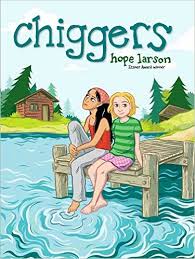
[READ: June 21, 2015] Chiggers

I’ve enjoyed Larson’s work in the past, and I was happy to read this book too.

It’s set at summer camp and while it deals with jealousy and other teenage problems, there is a supernatural element well, which is pretty cool.

Abby is excited to go back to summer camp.  She can’t wait to see her camp friend Rose and some of her other bunkmates from last year.

But this year Rose is a Cabin Assistant.  And while she is the CA for Abby’s cabin, it is also means that Rose is really busy with real things (and had less time for chatting).  Some of the other girls seem to have grown up too.  One has a boyfriend and she is getting her ears pierced (like the woman in the band Spite Storm).  She and her boyfriend are even going to start their own band Glittergloom.

Suddenly Abby doesn’t feel as cool as she did last year.  And she has trouble falling asleep at night.

Then it turns out that one of the girls in her dorm has to go home–and the rumor is that she got chiggers! (more…)

Read Full Post »

1963SOUNDTRACK: RESTORATIONS-Tiny Desk Concert #462 (August 14, 2015).

restor I don’t know Restorations, although I understand that they usually play pretty big loud guitar rock.   For the Tiny Desk they are stripped down (I guess) to the three guitars, but no drums or bass.  Lead singer Jon Loudon has a powerful and excellent voice.  On “Separate Songs” there are two guitars and a keyboard and wonderful harmonies.  The keyboardist sings backing vocals in the beginning of the song, so that when the lead guitarist joins in later, it’s even more impressive.

The guys are very friendly and funny.  The joke about the “desk” and about their constant tuning needs.

For “Tiny Prayers” all three play guitars and there some wonderful melodies that they play together.  The Future” is the slowest song of the three, but it contains all of the same elements–cool guitar sounds and wonderful harmonies.

The band has a great sense of melody.  And yet for all that I liked t his set, there was nothing that really stood out for me about the band.  They are simply a good rock band, and that’s not a bad thing.

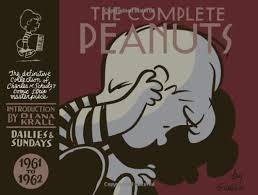
[READ: November 29, 2015] The Complete Peanuts 1963-1964

The drawing style of Peanuts that I most associate with the strip has been pretty consistent by this point.  And most of the characters look “right” (although Snoopy will continue to morph over the years).

Why does Charlie Brown keep going?  Despite all of the abuse Charlie gets, this one strip seems to sum up his strengths: “adversity is what makes you mature…the growing soul is watered best by tears of sadness.”

I feel like Schulz was either looking up facts to write about for some of this year.  Because we get things like this: Lucy: “You have to have [a note excusing you from school] otherwise the school can’t collect its state-aid money.”  Is that true or has Lucy hoodwinked Linus and me?  Later Charlie tells Lucy “when cranes and herons stand on one leg they can’t be injured by ground lightning.”  Later, Linus tells Sally that birds “have muscles in their feet which automatically contract when they fall asleep (which is how they sleep on a limb without falling off).  He then says the same principle applies with Snoopy’s ears.  Is this true?

In July 1963, there must have been an eclipse as the strip spends several days telling everyone how to safely watch it.

Linus’ blanket continues to occupy a lot of attention, with Lucy continually yelling at him about it.  His blanket hating grandma returns and even takes it away (she gives him a dollar bill which he tries to snuggle with).

Linus is full of ambition in these years.  He wants to be a rancher for several weeks in 1963.  Although, horror of horrors, he doesn’t make the honor roll in March of 1963.  But that doesn’t stop him.  And in a big surprise in 1964, he runs for school president (and has but one failing…and it’s not his blanket).

Schroeder continues to dismiss Lucy, this time even saying the chances are a googol to one (and then writing out how many zeros that is) of them getting married.  In July 1963 she complains that Beethoven never made it on any bubble gum cards.  Later when Lucy asks him why he doesn’t like her, Schroeder gives a very simple answer.  She replies, “I hate reasons.”

Rachel Carson returns in Feb 1964 with Lucy saying “we girls need our heroines.”  Of course Lucy also gets this quotable moment: “The crabby little girls of today are the crabby old women of tomorrow.”

Attacks on consumerism continue with a shoddy baseball about which Charlie says “this is what is called ‘planned obsolescence.'”

Speaking of baseball, there’s plenty of it.  I enjoyed the Sunday strip where Charlie using Snoopy to show how to break up a double play.  In 1964, Charlie suffers from Little Leaguer’s Elbow (and the team does great without him).  And when Lucy hurts her elbow (and refuses to call it Washerwoman’s elbow) she says she’ll sue Babe Ruth, Ty Cobb and Willard Mullin (Mullin was a sports cartoonist).

In August 1963, we see the first mention of Charlie Brown’s baseball hero Joe Shlabotnik (and the very distressing moment when Lucy won’t give let Charlie have his card).

I got a real kick out of Schulz returning to the McCovey joke from last year (in January!) saying “or why couldn’t McCovey have hit the ball even two feet higher?”

In 1963’s National Library week, Sally gets her library card this time and she is even more excited than Linus was.  She even has the line: “Happiness is having your own library card.”

Sally also addresses helicopter parents of 1963: “My mother is watching me out of the window.  Mothers feel secure when they see a child of theirs playing in a sandbox.  Sigh.  She’s secure and I’m bored to death.”

The little red-haired girl is obsessed over from time to time. Especially during Charlie’s lonely lunches.

Frieda has definitely dwindled by now–even if she never really did much.  She does abuse Snoopy about chasing rabbits but in one strip, we seem him playing with bunnies and four sleeping on his stomach on top of his doghouse.  This seems to set in motion Snoopy’s love of all other animals.

Later, there’s a really funny strip with Snoopy trying to fill his water bowl from a tap.  Then it rains on him.  The punchline “That’s one I’m going to have to think about for a while” is hilarious.

And…Snoopy goes to the hospital for a couple weeks! (nothing serious).  Charlie says he has a private room “he has a health insurance policy that pays forty dollars a day!”

In September of 1963, there’s a joke about ZIP Codes (Snoopy forgets his) and then shortly after a new character named 5 is introduced.  He explains, “My dad says we have so many numbers these days we’re all losing our identity.  He’s decided that everyone in our family should have a number instead of a name.”  His sisters 3 and 4 look like Peppermint Patty (who hasn’t arrived yet).  ZIP codes were introduced in 1963.

At Halloween in 1963 Linus slips about the Great Pumpkin and says “if he comes” (like in the TV show).  He’s doomed!

In February of 1964 a whole set of strips focuses on the existence of the humane society.

And in May of 1964 we get the classic bit from the movie when Charlie puts a coin in Lucy’s can and she sings “Boy what a sound.  How I love to hear that ol’ money plink!  That beautiful sound of cold hard cash!  Nickels! Nickels! Nickels!”

In June of 1964 there is a very touching Father’s Day strip.  (Although it wasn’t officially recognized until 1966 and signed into law as a official day by Nixon in 1972).

I really enjoyed the series of strips where they clean out Snoopy’s house and the dimensions (which we never see) are enormous!  There’s stairs, a pool table and all kinds of cool things.

For years now, Peanut has had strips where charters hold up signs–sometimes for Beethoven’s birthday, or national library week.  But in Sept 1964 it gets a bit more surreal with a bird holding a sign that has  ! on it.  Later another bird’s sign says ; and ?   A fight breaks out about it.  It’s very funny.

And in October 1964 Lucy pulls away the football despite given Charlie a signed document… “it was never notarized.”

And the year ends with something of cliffhanger.  Charlie has to do a report on Gulliver’s Travels over his holiday break, but he keeps putting it off… what will happen in 1965?

The foreword was written by Bill Melendez.  Melendez first met Schulz when they collaborated on an animated commercial for the Ford Falcon in 1960.  In 1963, they worked together on a documentary about Schulz using more animation.  Then in 1965 Coca Cola contacted him to see if Schulz would like to make a Christmas special.  They had 5 days to write the outline.  They used the kids from the Ford commercial as the voices. And they had six months to make the move.  It first aired on December 9, 1965.

Melendez raves about their work (rightfully) and then talks about the many other specials the made together–a Veterans’ Day one called What Have We Learned, Charlie Brown, and a show about cancer called Why Charlie Brown, Why?   In total they made fifty network specials and 4 feature films.  He talks about how great it was that they found Vince Guaraldi for the music and that they used real kids and no laugh track.  It’s hard to believe that special is so old!

Read Full Post »
percy3SOUNDTRACK: TROMBONE SHORTY-Tiny Desk Concert #162 (September 29, 2011).

tromb Trombone Shorty is from New Orleans and his backing band is called Orleans Avenue.  I can’t think of too many bands that are fronted by a trombone player.

This is a super fun set.  It opens with “Dumaine St.” a short (just over 2 minutes) jazzy number that comes from his then recent album For True.  There’s some great rhythm in the low end–the baritone sax and bass guitar keep a great groove, especially during the trombone solo (!).  It’s short, but it’s great.

Dan “Uncle Potato Chip” Oestreicher, opens the second song with a great bass line on the baritone sax.  The song is called “Lagniappe which is “a little gift you get for buying something. It’s an especially common practice in certain corners of the world, including Louisiana, where the term originates.”  It’s an improvisational piece built around the great bass line.  It features a trombone solo and great tenor sax solo by Tim McFatter.  The song builds (for about 5 minutes) to an exciting  conclusion (“a light workout,” Shorty calls it).

The final song has lyrics sung by Shorty. It’s probably my least favorite of the three as the lyrics aren’t that great (although his voice is good).  It’s got a good funky rhythm, but it slows things down when he is singing.  And I just want to hear him play.  Once he picks up the trombone again, the song springs to life and is a super amount of fun–with another great melody.

I wasn’t sure I’d like this set but I enjoyed it a lot.

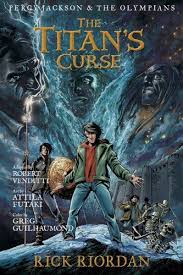
[READ: November 22, 2015] The Titan’s Curse

The good news was that I could get both the second and third graphic novels at the same time (both with art by Attila Futaki).  The bad news is that apparently the fourth (and fifth) books were never made!  I don’t know if there are plans for them to get made but as of right now, we’re stuck at a to be continued.

Of the three, I found this book to be the most confusing because so many characters looked alike.  There was also the addition of several new characters (and as with the previous book, there was very little in the way of introduction).

We don’t know why, but Percy and Annabeth have gone to a specific place to rescue two orphans, Bianca and Nico.  They are both half-bloods, unbeknownst to them.  Bianca is initially suspicious of the heroes, but Nico is right on board.

In terms of action, there’s quite a lot.  We meet Artemis, goddess of the hunt who has arrived with her hunters.  She speaks formally and is suspicious of men.

After careful consideration Bianca decides to join Artemis’ hunters (which gives her immortality–death may only come in battle–as long as she forswears romantic love, which she has no problem doing).  Meanwhile, Nico decides to return to the camp with the others.

Oh and Annabeth, while fighting a manticore, is thrown over the side of a cliff, presumably lost forever.  Percy is freaking out but they convince him to head back to camp for reinforcements.

A new quest is decided upon, but Percy’s first goal is to rescue Annabeth.  Although we soon see that she is not dead, she just has the weight of the world on her shoulders.  Literally.

And then Apollo shows up in his golden chariot (which is a sports car naturally).

Back at camp, the director has them don helmets for more training, this time hunter against half-blood.  The hunters win every time.  This was a hugely confusing scene since everyone is in battle gear. The book is also hugely confusing because several of the scenes are done with characters in close up and Zoe (whose origin I can’t even recall) and Percy look quite a lot alike

But there’s some really wonderful scenes, like when the horse speaks to Percy and later when Percy rescues the Ophiotaurus (which he calls Bessy).

I liked that the middle section takes place in the Museum of Natural History–which allows for some cool details.  The dinosaur teeth are actually dragon teeth and the lion is really the Nemean Lion.  And when the bad guys get some skeletons to rise from the earth, they are sent on a single mission–to destroy Percy.  And they cannot be stopped by half blood weapons.

There’ a great scene with a large flying statue and then a cool scene at the Hoover Dam.

I typically enjoy when the scenes turn mystical but I was confused a bit when Artemis returned to her sisters.  I think the character of Zoe perplexes me too much, even when she reveals her true identity.

And speaking of true identity, Nico’s reveal is pretty fantastic, too.

The final scene shows a meeting of the Gods again, which I liked.  Unfortunately it seems to set the stage for book four, which we won’t seem to ever get.

More reason to rad the actual novels, then, right?

Read Full Post »

percy2SOUNDTRACK: JENNY LIN-Tiny Desk Concert #160 (September 6, 2011).

linJenny Lin is an amazing pianist.  So it’s slightly disconcerting that she is playing these beautiful pieces on a Korg keyboard.

The write up says

It’s rare to see a world-renowned pianist willing to make such a sacrifice, but that’s how strongly Lin feels about getting the music out there, knowing that (with even more downsizing) folks could watch her perform this Tiny Desk Concert on their iPhones.

And while I wouldn’t think that a great pianist would have a problem playing an electronic piano, I had to wonder if the keyboard weight impacted her at all.  It sure doesn’t seem like it.

She plays five pieces altogether.  And they are all modern pieces.  I don’t know a lot about Shostakovic, but the blurb says that  Shostakovich, inspired by Bach wrote his own set of Preludes and Fugues in all 24 keys in 1950.  I would have guessed they were Bach, but you can hear differences in his more modern style (and not just because of the keyboard).  The notes are fast and furious (and beautiful).

I don’t know Federico Mompou at all, but the blurb says  “Barcelona-born Federico Mompou was a contemporary of Shostakovich’s, but that’s where the comparisons end. In the 1960s, he completed four volumes of piano music he called Musica Callada, or “Silent Music.” Mompou’s sound, [features]  austere beauty and emphasis on the spaces between notes.”  And you can really hear the way the notes ring out (I’ll bet even more so on a grand piano).

The final song is an arrangement of Gershwin’s “Fascinatin’ Rhythm” which has been “souped up by the late American virtuoso pianist Earl Wild. His arrangement turns the Gershwin song into a kind of stride-jazz extravaganza.”

Watch Lin’s hands fly around the keyboard.  It is hard to comprehend.  I don’t know which hand I am more impressed by.

It’s amazing to be able to watch a master so closely.

The setlist:

  • Dmitri Shostakovich: Prelude and Fugue No. 2 in A minor, Op. 87
  • Dmitri Shostakovich: Prelude and Fugue No. 7 in A major, Op. 87
  • Federico Mompou: Musica Callada — Nos. 1, 15
  • Gershwin (arr. Earl Wild): “Fascinatin’ Rhythm”

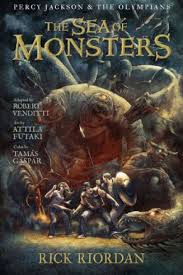
[READ: November 22, 2015] The Sea of Monsters

Clark really liked the first graphic novel and asked me to get the rest.  So I did.  And then I had to see how the story continued, too.

Book two of the graphic novel series (also with art by Attila Futaki) begins with Percy at home.  He is told he shouldn’t return to Camp Half -Blood, but his mom won’t say why.  At “regular” school, he is still picked on, but he now has help from a huge boy known as Tyson.  The bullies make fun of Tyson too, calling him a retard, but Percy sticks up for him. [The one problem with the graphic novels is they have to edit down so much, there’s no real introduction to Percy’s school or to Tyson].

On the next page, though, we learn that the bullies are actually demons and that Tyson is able to fight them off because he is …a cyclops.  (It must be very hard to create a cyclops–visually, they are just so wrong–where do you put that eye?  Do the normal eye sockets still exist? I always find them disconcerting to look at). (more…)

Read Full Post »

SOUNDTRACK: LOpercy1CAL NATIVES-Tiny Desk Concert #113 (February 21, 2011).

localI’ve decided to cherry pick some Tiny Desk shows for the end of the year–order be damned.

Local Natives are from L.A.  They play (in this Tiny Desk Concert anyway), a folkie alt rock which really emphasizes the band’s gorgeous harmonies.

For this set there are two acoustic guitars, an acoustic bass, a drummer and some cool extra percussion.  It also makes me laugh to see them all packed so tightly in that little space.

The first song “Wide Eyes” has lovely harmony vocals by the guitarist and the percussionist.  But when the backing vocals kick in, the sound really soars.

“Cards & Quarters” has a lovely guitar intro and fantastic three part harmonies.  I love the way the songs builds and builds to the end–it’s very dramatic.

For the final song, “Airplanes,” the percussionist switches to guitar (and sings lead vocals) and one of the guitarists plays the mandolin.  This song is very personal, with lots of details about the singer’s grandfather.  Again, the harmonies are gorgeous.

I’ve heard a lot about Local Natives and now I need to check them out more closely.

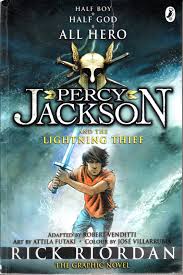
[READ: May 23, 2015] The Lightning Thief

I have seen the Percy Jackson movie and now I’ve read the comic book, but I have yet to read the actual novel (or series).  I figure I will some day.  But for now I’ve had this cool graphic novel to flesh out the movie.

It’s interesting how the movie and graphic novel (with art by Attila Futaki) emphasize different things.  It felt to me like the movie spent more time on introducing the characters once they got to “camp,” while the graphic novel seemed to gloss that.  But there were some other adventures that the group went on which were different between the book and movie (which may have just been for expenses).

Okay, so the brief summary of the book is that Percy Jackson is a boy in school.  He has trouble reading and his teacher gives him a hard time.  As we open, the class is learning about ancient Greek myths and the teacher is emphasizing how important they will be for Percy.  On the next page, one of Percy’s teachers turns into a demon and attacks him.   But no one else is aware of it.  Except maybe his best friend, Grover.

When school ends, Percy heads home to his mother’s house.  His mother is living with a totally awful guy (there was more about this in the movie) and explains that Percy’s father left before he was born.  But just as they settle in, Grover shows up and tells them they have to go.  Now. (more…)

Read Full Post »

olymmp SOUNDTRACK: TORRES-Tiny Desk Concert #461 (August 10, 2015).

torresI’ve really enjoyed a lot about Torres’ music this year.  Mackenzie Scott has an interesting delivery which reminds me of certain aspects of PJ Harvey, and her songs are angry but measured.

Her songs seem to have a lot of low-end in them (without being bass heavy exactly–in fact in this Tiny Desk, there is no bassist).  And her singing voice is often rather low (and sometimes growly).  There’s a moment in the first song “New Skin” in which the music drops out and then Mackenzie Scott starts playing her guitar anew and it’s a sound unlike any in the song before (even though she has been playing all along).

Guitarist Cameron Kapoor adds cool sounds to what I think is her best song, “A Proper Polish Welcome.”  Erin Manning provides wonderful harmony vocals along with keyboards on this song which is as powerful as it is understated.  The song gives me chills.

“The Harshest Light” is a slow song that has glimpses of light as she sings slightly higher notes in the chorus.  And when her voice breaks near the end, you can hear the intensity in her singing.

It’s a great three song set that only leaves you wanting more.

I had resisted getting this album, but realizing just how good these songs are might tip the tables to a purchase.

[READ: Summer 2015] Olympians 1-6

While I imagined that I might read all of the First Second books this year, I paused about mid way through (more for me next year).  But one of the last things I read from First Second was this series of outstanding mythologies about the Greek Olympians.  It also turned out that a few years back I got these books for C., not realizing they were under the First Second imprint.  I was intrigued by them then, but I’m really glad that I read them now.

George O’Connor is a massive geek and Greek scholar.  He has done lots of research for these books, including going to Greece and visiting sites and antiquities as well as comparing all manner of ancient stories to compile the most interesting pieces. He explains that since these stories were orally passed down, they were modified over the years.  He doesn’t change the myths, he merely picks the story lines that are most interesting to him.  And then he adds a lot of humorous modern touches (and dialogue) which keep it from being at all stuffy.

O Connor’s drawing style is also inspired by superhero comics, so his stories are presented in a way that seems much more like a super hero than a classical hero, which is also kind of fun.

Each book ends with an author’s note which is hugely informative and gives plenty of context.  It also has a bibliography, but more importantly, it has a list of notes about certain panels.  Do not skip these notes!  In addition to providing a lot of insight into the myths of the characters themselves, there are a lot of funny comments like “Greeks raced in the nude (point and laugh)” which really bring new depths to the stories. (more…)

Read Full Post »

dispossesSOUNDTRACK: YOLANDA KONDONASSIS-Tiny Desk Concert #96 (December 8, 2010).

yolandaI have mentioned a much more recent Tiny Desk concert from Yolanda Kondonassis in which she duetted with Jason Vieaux (from 2015).  This show is just Kondonassis and her harp.

And it is absolutely gorgeous.

Kondonassis plays three distinct styles of music to show the variety of music a harp can make.  It is amazing to watch her play as well.  She closes her eyes and simply knows where everything is, absorbed in the music.

Her first piece is by Domenico Scarlatti: “Sonata in A Major, K. 208,” which is considered a rather “traditional” harp piece (I love hearing her do the “fast notes” a the end of each section.

She introduces the second piece by saying that she wanted to compose a piece and through meeting a Chinese composer wound up arranging this traditional Chinese piece called “Small River Flowing.”  And it is amazing to hear the Chinese melodies immediately from the high notes.  But perhaps my favorite part of this song is that she hits the low bass notes to make them ring out almost like a gong.  I have never seen anyone do this before with a harp.

She says the final piece is by Carlos Salzedo: “Chanson dans la nuit” which crosses over into almost world music.  And in a short time, it really shows off all of the different sounds and colors that the harp is capable of.  She’s absolutely right.  While the song begins with some very traditional sounding harp music, she seems to also play some harmonics (who even knew you could do that on a harp) as well as some sounds of just her nails running across the strings–bringing a fascinating texture–as well as some very fast, loud chords and indeed, actual percussive sounds as she taps on the body of her (truly beautiful looking) harp.  The song is not as pretty as the others since there is so much going on, but it’s a wonderful song and it’s great to watch her play it.

I never knew I wanted a CD of harp music before, and now I do.

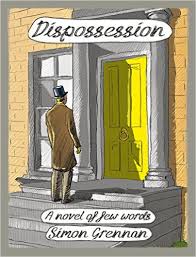
[READ: November 12, 2015] Dispossession

This graphic novel has a fascinating origin.  It is based on the novel John Caldigate by Anthony Trollope.  And in fact, it follows that story pretty faithfully.  However, it eschews massive amounts of the book (the original is quite long) and also adds a subplot of Wiradjuri peoples (which includes dialogue in Wiradjuri translated into English by Cheryl Riley).  There’s also a Postface (which is very helpful for explaining the origin of the story and how Grennan modified the original) by Jan Baetens and Ortwin de Graef.

The subtitle, A Novel of Few Words, proves to be accurate.  For the most part, each page has six panels, and the only words are sparse dialogue.  Grennan really has the story move quickly through these images, which tend to jump ahead pretty quickly.

We first meet John Caldigate.  Caldigate is a wealthy man, soon to be heir to his father’s fortune.  But he is unsatisfied in England.  And he decides to sell off his inheritance and to set off for New South Wales with his friend Ned.  There they will seek their fortune in the gold mines.

There is a woman he has left behind, Hester, the daughter of a local family.  She is certainly desirable, but it’s unclear how Caldigate feels about her because he wishes to find his fortune elsewhere.

Then the men set sail for Australia, two bachelors on a lengthy sea voyage.  Aboard the ship is Mrs Smith, a divorced actress who is also heading to Australia.  Mrs Smith is considered somewhat disreputable aboard the ship–and several people warn him against her.  But he cannot be denied. (more…)

Read Full Post »

1961SOUNDTRACK: NICK LOWE-Tiny Desk Concert #87 (November 1, 2010).

lowe Nick Lowe is legendary.  And yet I don’t really know that much about him.  I knew he did “Cruel to be Kind” which is very dated sounding but still great.  I didn’t know that he wrote my favorite Elvis Costello song “(What’s So Funny ‘Bout) Peace, Love, and Understanding?” (which he first recorded with his band Brinsley Schwarz).  He also produced a bunch of Costello’s albums.

This Tiny Desk is a mellow affair, with Lowe gently playing acoustic guitar and his low, smooth vocals singing interesting lyrics: “His heart’s a prune / when it once was a plum / If you know him / that’s the kind of man that I’ve become” (from “Man That I’ve Become”).

“Rome Wasn’t Built in a Day” is done in the same vein.  Cathy, mellow pop, with an almost countryish feel.

“All Men Are Liars” is a pretty typical song about lying men, until you get this fascinating lyric: “Do you remember Rick Astley?  He had a big fat it.  It was ghastly.  He said I’m never gonna give you up or let you down.  Well, I’m here to tell you that rick’s a clown.”

“House for Sale” was a then new song.  And it’s just as sharp and strign as the rest.

At the time of this recording, Lowe was 61 and he sounds great.  His voice has changed, but it hasn’t lost anything.

[READ: October 29, 2015] The Complete Peanuts 1961-1962

By this book, Peanuts had been in print for nearly 12 years.  And the core group has remained Charlie Brown, Lucy, Linus, Snoopy, Schroeder, and now Sally.  And to a smaller extent Shermie, Patty and Pig-Pen are still around.   But in 1961 he added a new character: Frieda, the girl with naturally curly hair.

One thing I hadn’t noticed so much in previous books is that he has been getting some very funny “jokey” punchlines.  Most of the Peanuts punchlines have been funny/thoughtful/amusing.  But I felt like this book had a few that were really funny.  Like Lucy saying in response to beauty being only skin deep “I have a very thick beauty.”  Or this funny groaner: Linus: “Do they always bring the cows in from the pasture at night?” Lucy: “Of course you blockhead, if they leave them out over night they get pasteurized.” I especially like that it isn’t even the final panel.  And in 1962, Charlie asks this question when he turns on the TV and sees reruns: “What would happen if comic strips had nothing but re-runs all summer?”

And of course, there’s a lot of baseball strips.  Including this one with a great set up and punchline.  Charlie is talking about the game and how “For one brief moment victory was within our grasp.”  To which Linus says, “And then the game started.” (more…)

Read Full Post »

sing no evilSOUNDTRACK: STILE ANTICO-Tiny Desk Concert #86 (October 25, 2010).

stile I’ve said before that one of the great things about the Tiny Desk Concerts is being introduced to bands that I never would have heard of anywhere else.  And that is certainly true of Stile Antico.  I really enjoy this kind of a capella music, although I never listen to it.  And I wouldn’t even know where to start looking for it.

So, lucky for me, I now know a band that performs gorgeous 16th-century choral music.  There are twelve singers.  And it is comforting in this day of pop singers who are more hot than musical that Stile Antico is all about the voice.  They don’t dress flashy or sexy, they don’t really do anything…except sing to the heavens.

They perform four pieces in about 20 minutes.  I don’t know any of them and I honestly couldn’t really tell them apart, but I loved the whole show.

The lead speaker (unnamed in this show) says that William Byrd is the best songwriter of the era, which is why they do two of his songs.  After the first one, he says that they want to transform this office into some kind of Tudor Chapel.

The second piece, “The Lord’s Prayer” is not done in any melody that I have ever heard it (and I assume it is in Latin).

But it’s the final piece that is really the showstopper, and the one that is fun to watch (even though, as I say they’re not actually doing anything–okay not true, they are nodding to each other instead of using a conductor).  Praetorious’s piece weaves 3 choirs together with 12 independent voices.  And the speaker jokes that each of the three choirs wind up flirting outrageously with each other.  It’s breathtaking.

Their voices are simply beautiful, and it’s amazing to see them working together silently as they sing.

The only problem is that now that I know who they are, which of their 11 records do I start with?

The songs:

  • William Byrd: “Vigilate”
  • John Sheppard: “Lord’s Prayer”
  • William Byrd: “Ecce Virgo Concipiet”
  • Hieronymus Praetorious: “Tota Pulchra Es”

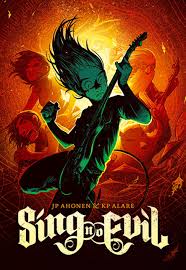
[READ: July 10, 2015] Sing No Evil

I saw this book at the library and loved the title.  As soon as I flipped through it I knew I had to read it.  This book was originally written in Finnish (cool!) and was translated by JP Ahonen into English.  It is all about Fininish death metal bands and the devil.  And it is cool and very funny.  It was originally called Perkeros (which is what the protagonist’ band is called) and which I can’t quite define, but that’s okay.

The book opens on Aksel rocking out (in his imagination).  He and his band are getting ready to go on stage and he is nervous.  Aksel is a perfectionist and his riffs and progressions are second to none (Perkeros is a progressive death metal band which I’d rather like to hear).  The problem for the band is that Aksel’s singing is poor.  But the band likes what they do.  So they keep playing.

Here’s the fun part.  The band consists of Aksel and Lily on keys (and here I have to comment that Lily and Aksel don’t look all that different in drawing style but somehow Alarea has made these simple lines create two very different looking characters, and with those simple lines you can see just how pretty Lily is).  There’s also Kervinen, a really old guy with a chest-length beard (he used to be a monk), and, well, a bear, yes, a bear, on drums (the bear’s story is never given).

The band is opening for Nelum Lucifera, a grease-painted death metal band (with names like Belphegor and Samael).  A fight ensures and the bands are banned from every playing that gig again. (more…)

Read Full Post »

nimonaSOUNDTRACK: HEY MARSEILLES-Tiny Desk Concert #85 (October 17, 2010).

heymaI knew Hey Marseilles from NPR’s coverage of the 2013 Newport Folk Festival.  But I guess I forgot what they sounded like because I wasn’t expecting this at all.

“Rio” opens with almost flamenco clapping and then the full band–accordion, bowed cello, trumpet, violin and guitar come forth (this must have been chamber music month at the Tiny Desk).  There’s a kind of shanty feel to the song.  The middle section has more clapping (and loud Hey Hey!s) and a trumpet solo (played with a mute).  It is super catchy.

“From a Terrace” starts out slowly, with strings.  It has a bit of a Decembersists feel in the vocal melody.  There’s a middle section with a wheezy accordion solo that transfers to a new section and then another rather jazzy muted trumpet solo.

“To Travels And Trunks” has a beautiful string melody to open.  It is a story song and it flows wonderfully.

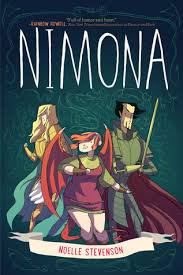
[READ: July 25, 2015] Nimona

Sarah brought this book home although she didn’t remember what inspired her to get it.  I liked the look of it and was happy to read it before it had to go back.

The drawing style is quite compelling to me–quite unlike other comic books.  I also loved that the title character was a young girl with crazy hair and a body type that is not, shall we say, sexy and superheroy.  That was quite a nice change of pace.

The one thing I didn’t love about the book was the text.  It was hand written and, dare I admit my age, felt like very small print to me.  It was not an easy on the eyes read.  But maybe that made me focus on it more, because I really got into it.

The story begins in a fairly simple way.  Nimona, a young girl, goes to visit the villain Ballister Blackheart.  She says she is a fan of his work and wants to work with him.  He says no. Then she changes into a shark and he decides that she might be quite useful (I loved that chapter one was two pages).  In Chapter 2 Nimona proves to be a far more ruthless individual than Blackheart–changing his minor evil plans into a plan where the whole village is burnt to the ground.

And then we get a flashback.  In a joust we see Blackheart fighting against a pretty blond man named Ambrosious Goldenloin (the names are awesome).  Blackheart won, but Goldenloin, upon losing, somehow exploded Blackheart’s arm, rendering him incapable of being a knight and thus forcing him into a life of villainy.

And then story proceeds apace with Blackheart being the kind of villain who follows the “rules.”  “Killing solves nothing, Nimona.  It’s vulgar it’s messy.”  But Nimona wants no part of that.  She immediately slays a couple of guards and everyone is shocked.  Then she sets off the self destruct button and is apparently killed.

But of course she isn’t and her reveal is hilarious.  Blackheart wants to know more about her and her incredible powers and she tells a story about rescuing a witch.  Blackheart is dubious (“really, turn the six-year-old into a dragon, that was her idea?”).   The later scene where she shape shifts into him and mocks him “SSCCIEEEENCE” is very funny too–Stevenson gets a comic tone perfectly.

Then we look into the world of Goldenloin and the Institution and it turns out that they are a pretty corrupt organization.  They are working with jaderoot–a poisonous substance which they have banned.  So Blackheart decides to try to use this to his advantage (which involves an apple saleslady named Tabitha).

I loved that although the story seems medieval with knights and dragons, it is set in a slighty futuristic times with phone screen and pagers and such.  They even go to a science expo where a Dr Blitzmeyer has created a fascinating orb which glows of its own power (she is wonderfully clueless).

Since the Institution owns the media, Blackheart is in trouble for things that the Institution has done (the jaderoot).  And soon also the Institution is done with Goldenloin–he is too good for them and his services are no longer needed.  So he is de-knighted.  When Blackheart and Goldenloin briefly meet they have a chance to revisit their joust.

But in the meantime, the Institution has captured Nimona and she is angry (and much more powerful than anyone realized).

I really enjoyed this book a lot.  I loved that Blakcheart was actually a nice guy as a villain–that’s always an enjoyable premise.  I enjoyed the way this story escalated from a simple shape-shifting concept into this apocalyptic setting.  And I really enjoyed the underlying feelings between Blackheart and Goldenloin (whatever they may actually be).  The ending was really rather sweet.

Read Full Post »

« Newer Posts - Older Posts »