Feeds:
Posts
Comments

Archive for the ‘Funny (ha ha)’ Category

SOUNDTRACK: FRANK ZAPPA-Civilization Phaze III (1994).
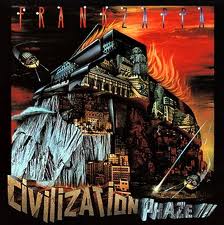
There were a number of choices for soundtracks for this week’s read.  I could have chosen the Andrew Sisters (and their wonderful “Don’t Sit Under the Apple Tree”) who get a mention in the book.  And, of course, I could have chosen Elton John’s “Rocket Man.”  But, when I read Trudi tell Magda about her boyfriend Gustav who wants to live inside a piano, well, it was hard not to think of this, Frank Zappa’s final work.

Civilization Phaze III is an opera-pantomime.  According to the libretto, “The speaking characters all wear oversized masks, gloves and shoes.  They live in an abstracted grand piano….”  And musically opens with this introductory spoken passage:

FZ: The audience sits inside of a big piano and they listen to it grow.
Spider: People are going to sit inside of a piano. They’re going to listen to this piano grow.
John: They’re going to listen to the piano grow?

Civilization Phaze III was released posthumously in 1994.  But here’s the weird thing.  Most of the sessions of “piano people” dialogue were recorded in 1967.  Zappa had a bunch of people come into the studio, sit under a piano that was miked and improvise dialogue (sounds like the 60s to me).  He released some of this dialogue on his  late 60s albums, but as far as I can tell, the parts about the piano were never included (in Lumpy Gravy someone talks about wanting to live in a drum).  I’m also not sure how well-known the “piano sessions” were at the time.

So, here’s the question…did Zappa influence Pynchon or did these two people come up with the same idea at roughly  the same time.  The reason Zappa put off using the material recorded in 1966 was because technologies were simply not advanced enough to let him manipulate the dialogue so it would sound decent, much less coherent.  So Civilization Phaze III became his exploration of the past with contemporary technology.

He also recorded new spoken dialogue in 1991 and merged the two.  It’s an interesting idea, but I fear that the new dialogue absolutely misses the vibe of the earlier dialogue.  In the early dialogue, they all sounds like they’re stoned and are talking crazy nonsense about horses, smoke and music.  The later dialogue is much more abrasive (especially Michael Rappaport, the only person who has since gone on to renown).  At the time, Rappaport had been on one TV show as a guest, but by now he is too famous for this.  I find him a distraction (not Zappa’s fault obviously), even more so because he talks as if he is black (he says “Nobody said nothin’ when y’all bought my people, right?”) while he is demonstrably not.  And then ruins it contextually by mentioning Yo MTV Raps, the only thing that places the story in time.  It’s weird that Frank wouldn’t have a black person say these lines, especially since he has so many other races and nationalities represented in his music.  But maybe that’s me intellectualizing that I just don’t like Rappaport.

So, what’s this monstrosity about?  I have no idea.  Improvised stoner dialogue from the 60s is pieced together into a kind of story.  Occasionally Frank’s voice chimes in and prompts them to talk about certain things (which is quite  disorienting).  And the whole “plot” well, I’m not even sure if it can be called a plot, but Frank tries to cobble something together–again, the 1991 dialogue seems to be more pointed, more about conflict, possibly something about overcrowding and racism, and there’s certainly some social criticism at work, but as for a story, well, not so much.

The music, on the other hand, is the culmination of Zappa’s more experimental, atonal “classical” music.  Most of the first disc is performed on the synclavier while most of the second disc contains more actual musicians.  The music is difficult and not to everyone’s tastes, for sure.

Atonal music is far more intellectual than visceral, so it’s hard to “enjoy” this music.   Zappa obviously knew how to write catchy poppy friendly music, so this is a deliberate attempt to write something more challenging.  I like Zappa’s crazy music in small dozes, so listening to this entire thing (over 2 hours) can be a tough in one sitting.  But each piece (especially the two really long pieces “N-Lite” (18 minutes) and “Beat the Reaper” (15 minutes) ) showcases something interesting or satisfying.

The libretto that Zappa includes with the discs explains the story in far more detail and shape than one would ever get from listening to the music.  Without the book, you would know that this is a dark and moody piece, but with the book, you can actually see what the music is showing.  That may be a flaw, or that may be the way of a staged performance.  I have no idea if it was ever staged.

There are certainly easier introductions to Zappa’s music.

[READ: Week of March 26] Gravity’s Rainbow 3.6-3.10

Last week was a bear of a read for me, but this week was so fast (and short) that I just kept going because I was so into the Slothrop story (I won’t go past the spoiler line, I promise).  And yes, it’s (almost) all Slothrop this week.

Section 3.6 begins with Slothrop violently ill.  [I admit I don’t think of novel characters as getting ill very much–unless it’s a plot point–but surely characters get colds and tummy aches just like everyone else, right?].  He drank out of an ornamental pond in the Tiergarten–but, duh, everyone knows to boil water before drinking these days.  This also introduces Slothrop as Rocketman, something we won’t get more details on until later. (more…)

Read Full Post »

SOUNDTRACK: FRANK ZAPPA AND THE MOTHERS OF INVENTION-Over-nite Sensation (1973).

When I saw Marvy’s Mothers, it was hard not to pass up the connection to Zappa and his band.  But oh, what album to pick?  (He released like 40). I chose the one released in the same year as Gravity’s Rainbow.

It also happens to be full of all kinds of sex (imagine that).

It opens with “Camarillo Brillo” the kind of simple, catchy song that Zappa seems to whip out very easily.  I assumed that the title was some kind of sexual slang (not a bad assumption), but Wikipedia suggests it has something to do with an insane asylum (Camarillo) and the crazy hair they often had, which makes sense given the crazy lyrics.  It starts kind of trippy with inscrutable lyrics.  And then the bridge, “she was breeding a dwarf” is pretty insane.  It also features a very funny sequence that was oft-quoted in MST3K–“Is that a real poncho or a Sears poncho.”

“I Am the Slime” is a funky (a great Zappa riff) diatribe against TV (because it makes you buy crap you don’t need and makes you listen to the government).  “Dirty Love” is a perverse song with lots of guitar solos.  There’s some kind of bestiality in this song (which also ties in with parts of this section).

“Fifty-Fifty” features the vocals of Ricky Lancelotti (in a screaming style that would later be used a lot by Terry Bozzio).  It’s about an ugly guy who is crazy enough to sing to us.  The songs seem to be more about solos though, as there’s a keyboard solo an electric violin solo (from Jean-Luc Ponty) and some crazy guitar solos.

I don’t know what “Zomby Woof” is about, but it has some wicked guitar soloing and horns playing Zappa’s staccato riffs up and down the scale.

“Dinah-Moe Humm” is a song perfectly suited to this book–it’s a song in which a woman bets the narrator that he can’t make her have an orgasm.  The melody is twinkly and silly.  It’s shockingly explicit. But it’s even funnier to know that the backing vocals are supplied by The Ikettes (Ike and Tina were recording in the next room).  They got paid almost nothing and when Ike heard the song he called it “shit” and asked that their name be removed from the credits.

It also plays around with hippy slang.  “Kiss my aura Dora/It’s real angora/Would you all like some more-a/right here on the floor-a/and how about you fauna/You wanna?”

He also starts talking about Zircon encrusted tweezers, which come back in “Montana.”  “Montana” is about moving to Montana to raise dental floss (really).  It features some wonderful fast pizzicato notes that are more or less Zappa’s signature.  The middle section is  hugely difficult and very impressive for the backing vocalists (Tina apparently was really impressed that one of her girls could do it).

Zappa packs a lot of music into 35 minutes, and this album seems to be a turning point in his desire to cram sex and craziness into his commercial music.  Just about every song on this disc was played a lot live and this album has become something of a classic.

[READ: Week of March 19] Gravity’s Rainbow [3.1-3.5]

This week’s read has been the most challenging for me so far.  I enjoyed Section 2 very much.  The Slothrop scenes were funny and wild and even advanced the plot.  I never expected that Section 3 would introduce a ton of new characters, more or less ignore the old charterers and stay with these new characters so that by not paying close attention to them in the beginning I was just confused by the end.

I do admit that while skimming again for this post, I was able to focus on the new characters more and found it far less confusing.  It’s just that on a first read, suddenly there’s this whole new sequence of people and their histories to deal with!  Wow.

It was especially surprising because Section 3 begins with Slothrop (so it’s not like in 2666 where a new section means a new cast).  But he meets new characters and then we flash all the way back through each person’s life.  And yes, it was quite interesting once I actually paid attention, and the connections were pretty awesome.  But it was still pretty surprising on the first read through.

Section 3 is called In the Zone.  And the Zone is mentioned quite a lot, although I never figured out where it is meant to be exactly. (more…)

Read Full Post »

SOUNDTRACK: YOU SAY PARTY! WE SAY DIE!-“Monster (RAC Remix)” and “Like I Give a Care (Octopus Project Remix)” from Viva Piñata! (2008).

Viva Piñata is a free CD compilation that I received I think when I ordered a Tokyo Police Cub CD.  It celebrates “5 years of ass-whippin’ at Paper Bag Records.”  It came out in 2008, so presumably, Paper Bag Records has now been whippin’ ass for 9 years.

You Say Party! We Day Die! (that’s a name that seems to be trying too hard) is from British Columbia, Canada and they seem to be a noisy keyboard band.  “Monster” is a keyboard-heavy poppy song.  Of course, since this is a remix I have no idea what the original sounds like.  The lead singer has a cool deep voice (a more poppy Kim Gordon, perhaps?).  But this song is dominated by the propulsive synths.

“Like I Give a Care” has a remix that is even more intense, overeffected, noisy and chaotic with a great propulsive bass.  It also seems like most of the song has been stripped, leaving just a chorus repeated.  As a remix it works fine.

I’ve often complained about remixes–if I like a song, why would I want to hear a remix of it?  This is the opposite.  I’ve never heard the song before and the remix is kind of fun. I’m intrigued to hear what they actually sound like.

[READ: March 22, 2012] “I Can’t Read”

Another month, another excerpt from a new posthumous Bolaño release.  This latest book is called The Secret of Evil which Harper’s says will be out this month (we’ll see about that).  The Secret of Evil is evidently a collection of unfinished pieces that Bolaño was working on when he died.

This particular story certainly seems finished, so who knows what the rest of the book will be like.

I am particularly fond of this kind of story from Bolaño–it reads like nonfiction (and maybe it is).  It seems to be a true account from his life (written in first person and about his family)–it’s a personal, relaxed style in which he muses about things and events.  It is also set during his first trip back to Chile since leaving in 1974 (a subject he mines quite well).

This one starts with the line: “This is a story about four people.”  The first two people he talks about are his son Lautaro and a new friend that his son made named Pascual.  Lautaro was eight and Pascual was four, but since Lautaro was desperate for someone to play with, he overlooked the age difference and made a holiday friend. (more…)

Read Full Post »

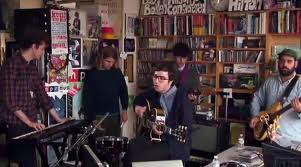
SOUNDTRACK: REAL ESTATE-Tiny Desk Concert #202 (March 12, 2012).

I enjoyed some Real Estate songs, but i never listened to their whole albums.  I thought this Tiny Desk show would give me more sonic information about them.

This three song set is very pleasing.  The music is soft and nonabrasive, with a very smooth feel (as you can see they are dressed in sweaters and cardigans, so this is not really a shock).  It’s poppy without having any real hooks.  They remind me of a less catchy Guster or a less dramatic Smiths (“Green Aisles,” especially for the bass and guitar solo) or gentler Death Cab for Cutie (“Municipality”).

There’s nothing to radically distinguish these three songs (radical is not a word that would apply to Real Estate), although “Green Aisles” has a few more dynamic moments (mostly from the change in drum patterns).

This review sounds like I didn’t like the set, but that’s not true.  As I said, it’s very pleasant.  And sometimes pleasant is what you want.

You can hear it here.

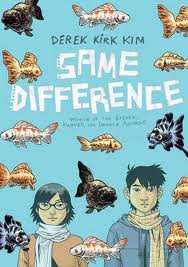
[READ: March 11, 2012] Same Difference

First Second continues to publish some of the most beautiful and thought-provoking graphic novels around.  This is a republication of a story that first appeared in a collection (and proceeded to win an Eisner, Harvey and Ignatz Award).

The story is about Simon and his close friend Nancy.  It opens with them in a Vietnamese Restaurant in Oakland, CA.  The first scene of the book is wonderfully drawn–we look in on the characters through a fish tank–fish are practically littering the panels–it’s very cool.

The two of them are with their friend Ian and they are shooting the breeze, talking nonsense.  And then Simon sees a woman that he knew from high school.  She is sitting at the bus stop and Simon wants to, but can’t, talk to her.  Her name is Irene, she seems sad, eyes downcast looking at the ground.  And then Simon reveals that she is blind.

In high school, he and Irene were very close.  He helped her out, described films to her in class, and “rescued” her from bullies.  And then she invited him to a Sadie Hawkins dance.  He doesn’t like her that way, so he lied to get out of it.  She never found out about the lies, but it has haunted him for the last seven years.

Later, Nancy figured out the truth of the matter, and even though we the readers probably guessed it as well, it still hit hard when it was spoken aloud. (more…)

Read Full Post »

SOUNDTRACK: NICK CAVE AND WARREN ELLIS-The Road: Original Film Score (2009).

I haven’t seen The Road, and I probably never will.  Nor have I read it.  The only reason I was listening to the soundtrack was because I like Nick Cave.  So this is a contextless review.  Of course, I know what the book is about and I rather assume that the film is equally harrowing.  I expected the soundtrack to be full of desolation and horror.

So I was quite surprised that most of the main themes are played on a piano with gentle strings or simply violins.  True there is a sense of emptiness and loss in these songs (they’re not jaunty piano pieces or anything) but they are still unexpectedly pretty.

Of course,a song like “The Cannibals” is bound to be more disconcerting, which it is.  It starts with creepy scratchy violins and then tribal drums take over–all set over a buzzing background.  This is more of what I expected the whole score to be like.   Similarly, “The House” must be a very frightening scene, as the music is threatening, loud, intense and quite scary with, again, more creepy percussion.  Unsurprisingly, a track called “The Cellar” is also spooky; it is only a minute long.

But then songs like “The Church” are so delicate and beautiful and not even all that sad–it actually makes me wonder what the scene in the film is showing.  The end of the score feels like the end of a movie, which I know it is, but it feels like a conventional movie, with closure, something I’m led to believe the book doesn’t have a lot of.

Taken away from the movie, this soundtrack is quite nice.  Aside from the three scarier tracks, this would make for some nice listening on a sad, rainy Sunday.

[READ: February 28, 2012] “The Longest Destroyed Poem”

I enjoyed Kuitenbrouwer’s “Corpse” so much that I decided to see what else she had written.  It comes to three books and four uncollected short stories.  There’s “Corpse” from The Walrus, this one here, another one called “Laikas” (which has a different title on the site where it lives) and a fourth with a broken link.  Boo.

But that’s okay because I’ll certainly investigate her books too.

Like “Corpse,” this story explores women’s sexuality, but it explores it in a very different way.  In fact, I loved the way it was introduced–especially because of the wonderfully convoluted way the sentence reveals it (and how it’s not even the main point of the sentence):

She looked fabulous. Better than back then, when she’d thought she wanted to be an artist, and Victor had made a point — she realized this as she realized many many things, that is she realized it in retrospect — of dropping into the conversation — the one she hadn’t actually been having with him, because she was instead focused almost solely on the fact his much younger roommate had a hand under the blanket her crotch also happened to be under — that he was off to bed early so he could work on a poem he’d been having trouble with.

I had to read it twice because I thought it was funny the first time, and when I fully parsed it, it was even funnier.

So yes, sex.  But as the story opens, years after the above event, Rosa sees Victor and decides to crash into him with her car.  It’s shocking and it’s shockingly well told.

I love the way Kuitenbrouwer uses language.  I could probably quote from this story six or seven times, but I love this sentence that forecasts the trouble ahead:  “Victor noticed her in that split second, too, and he knew what Rosa was up to, for his face changed, channel surfing from neutral smug — well, this was his everyday face — to impending doom.”

As she’s about to ram him (with a Prius, no less), we flash back to their spirited relationship. (more…)

Read Full Post »

SOUNDTRACK: MUMFORD & SONS-Sigh No More (2011).

I had assumed that this album was massive until an email sent around to some of my friends revealed that many of them had never even heard of the band.  So I guess it’s massive in my own little world.  Well that’s fine, I’ve always liked rougher folk music.  And there are two or three songs on this album that absolutely deserve to be massive.

If you’re like my friends and you don’t know Mumford & Sons, this album is a kind of rocking folk album (lots of banjos and harmonies).  But it’s less Fleet Foxes and more Waterboys–earnest folk with updates to the traditional sound.  The disc opens kind of slowly with “Sigh No More.” It take about two minutes to get going (and for the banjo to kick in).  In addition to the banjo (seriously, who knew a banjo could be so catchy?–well, bluegrass musicians, for one), the main selling point is main Mumford’s voice–it’s powerful, bellowing and quite emotive.

“The Cave” is the first indication that this album is going to be impressive.  It starts out deceptively simple. Once you get to the second round of the bridge, “and I….” the song soars to the heavens in catchiness, (the singer’s enunciated vowels are weird and fun too).  “Winter Winds” has a bit more Irish feel to it (Irish via The Pogues), but it also has the same kind of soaring qualities as “The Cave.”

“Roll Away the Stone” features the banjo heavily and is all the better for it.  And “White Blank Page” really features the rough-hewn vocals that are the signature of Mumford & Sons.  Never has the word “raaaaage” been so singable!

Some of the slower moments of the album kind of bog the disc down.  Of course you couldn’t play everything at breakneck speed and still have your dynamic parts sound dynamic.  So a song like “I Gave You All” opens slowly but it builds in power.  The break is welcome (although quite a lot of songs start out slow and then get faster).  But the chorus is outstanding.

The pinnacle of the album comes with “Little Lion Man” an amazingly catchy chorus (with a very bad word in it) and more raucous banjo playing.  It’s almost impossible not to stomp your feet along.  “Thistle & Weeds” is another slow builder–you can really hear the angst in his voice by the end.  The end of the album is kind of a denouement.  On my first few listens I didn’t care for the end of the disc so much but by now the album has so won me over that I can just enjoy this folkier ending.

In many ways there’s no major surprises on this disc–it’s rocking folk after all–except for just how damn catchy the band is.

[READ: February 22, 2012] “Corpse”

I wasn’t too keen on reading this story (one of the Walrus‘ longer stories) because of the title (and the accompanying picture of two boys with a deer in their sites).  I didn’t think I would enjoy a hunting story.  And yet, it started out so peaceful and zen that it sucked me right in.

It opens in a very female space.  Maura and Angie are relaxing in Maura’s house.  Well, Maura is doing yoga while Angie is relaxing.  Maura is talking about the yoni, the great universal twat. Angie visualizes a massive latex vulva that she and her boyfriend Gordon enter.  After a few moments, Angie and Maura look at each other and start cracking up.

The female space is penetrated by Malcom, Maura’s 13-year-old son, carrying the beginnings of a bow and arrow.  He wants to know what’s so funny.  They pass of a few lame jokes which he doesn’t fall for until Angie comes up with a really funny one.  One that is especially funny in the printed delivery, in which you’re not entirely sure that  joke is being told (a nice trick!).  So I won’t spoil it here.

Malcolm informs them that he is just going to shoot his arrows at cans with his friend Andrew.  But in fact they have bigger plans.  A deer has been spotted in the local dog park (they live in the city so the deer are a rarity).  After laughing at the joke, he runs off with Andrew to go hunting. (more…)

Read Full Post »

SOUNDTRACK: THE MARK LANEGAN BAND-“The Gravedigger’s Song” (2012).

Sometimes a song works perfectly with a story.  Titles alone, these two pieces work wonders together.  And then musically–sweet perfection.

I liked The Screaming Trees just fine.  Although they were always a third tier band for me–someone I enjoyed a song or two, but not much more.  I was surprised how much I enjoyed Mark Lanegan and Isobel Campbell together.  And now, here’s a “solo” Lanegan song.  For this song (and with Isobel Campbell), his voice sounds more mature, more robust–almost as if since he doesn’t have to rock out, he can make his voice more sinister.

In spirit it reminds me of Nick Cave’s Murder Ballads, but it’s got a very different sound.  It’s less claustrophobic–no doubt because of the grungy guitars.  In fact, sound-wise, it sounds more like Queens of the Stone Age (less trippy and more dark, but that may be more because of  the vocals).

The guitars are spare but have a  great sound (and cool solos).  And while the relentless drums are never in your face, they keep the song moving nonstop.

It’s a really gorgeous song (although obviously very dark) and makes me want to re-inspect more of his work to see what I’ve been missing.

[READ: February 17, 2012] “I Should Buy Some Cement”

This is the final piece from the maxbarry website that I’ll be talking about here. Thanks, Max for getting me through the dry spell.

The thing that made me laugh the most about this story was that at the very end he has a large box with these words:

Author’s Note: This was a Work of Fiction.

Yay fiction!  But it’s a good thing he includes that, this story is dark.  Very dark.

As you may guess from the title, Max is thinking he should really have some cement on hand.  Now, I also think that quite often.  I was delighted to have a couple of bags of cement in our shed on the afternoon that I erected our birdhouse.  But Barry has something else in mind. (more…)

Read Full Post »

SOUNDTRACK: THE FEELIES-Crazy Rhythms (bonus downloads) (2010).

The other day when I was playing Crazy Rhythms I noticed a little card that I had never noticed before.  It said that if I went to the label’s website, I could download bonus tracks.  That was pretty cool, so I did.

The are five tracks.  “Fa Cé-La” says it is a single version although it sounds even more spare and underproduced than the album version (and it’s a tad slower). “The Boy with the Perpetual Nervousness” and Moscow Nights” are demos.  “Boy” really sounds like a demo (the wood blocks are almost piercing!).  It’s interesting that the guitar solo, which sounds random on record was planned that way.  On “Moscow” the singer’s channeling Lou Reed pretty intently.

The next two tracks are live from a reunion tour in 2009.  I’m not exactly sure who was in the band, but that’s okay, the songs sound good.   “Crazy Rhythms” has a (simple) drum solo in the middle (more of a beat-keeping than a solo per se), and an extended jam towards the end song.  And the final song is a cover of Jonathan Richman’s “I Wanna Sleep in Your Arms,” at a frenetic two-minute pace.

Not bad for free downloads, eh?

[READ: December 31, 2011] “A Shade Less Perfect”

After reading all of those Max Barry blog posts, getting to read a real story is a real treat.

This is a very simple story of one-upmanship (a common trope of sitcoms–in fact just the other night Up All Night ran the “two brothers who must compete against each other at everything and never admit that they have failed at something” script).  And this story falls into the same general area, but Barry puts a surprising twist on the end.

Jonathan and Elizabeth are going to house of Jonathan’s boss, Dave.  Elizabeth likes Dave’s wife Julie.  They both had babies around the same time and met in birthing classes, so they are excited to catch up (it’s been about ten months since they’ve all seen each other).

Dave tends to lord everything over Jonathan at work.  Jonathan says he’s okay with this at work–Dave is his boss after all, but he doesn’t want to deal with it out side of work, too.  Naturally, Dave has a huge house and a convertible and every other material joy.  Even a nanny. (more…)

Read Full Post »

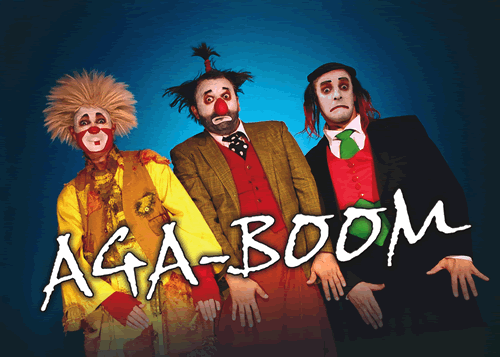
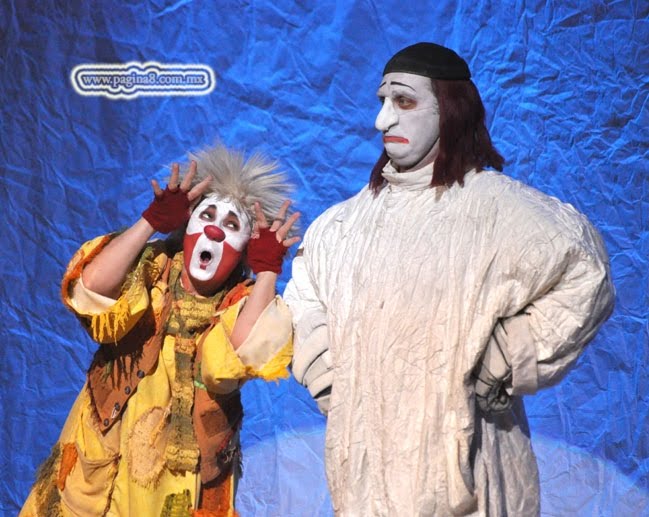
[ATTENDED: February 11, 2012] Aga-Boom

This past weekend, my family attended Aga-Boom, a “theatre of physical comedy and circus arts.”  It was incredible, and it was hard to believe that this was performed at the Raritan Valley Community College theater, which is nice and all, but seems small potatoes for a troupe that was part of Cirque de Soleil and which has been in Vegas and on Broadway.

Aga-Boom‘s show is perfect for all ages–my kids loved it, but I may have laughed more than they did.  There are three clowns, an older woman, a goofy “large” clown and a kind of morose alien-looking clown.  None of these are you typical “clown make-up” type of clowns.  In fact, I found the lady clown’s make up to be amazing–astonishingly emotive and expressive.  And the morose clown was all white face with a completely fake nose and a simple red frown line for a mouth and yet wow, they could convey everything.

There are several set pieces.  The first is a joke about paper getting stuck to the lady clown.  It’s a good introduction to the paper conceit that runs through the show (the stage “curtain” is a large sheet of paper!  It morphs into this amusing/intimidating section where the morose clown (dressed like an astronaut with (a wonderful detail) a water cooler bottle on his head as a space helmet–is mad because the woman clown accidentally launched his ship into space.

Then comes the goofy clown who does some amazing juggling with a suitcase.  I’ve never seen anything like it.  (more…)

Read Full Post »

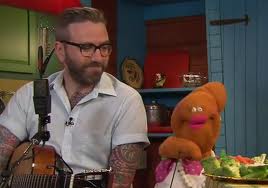
SOUNDTRACKDALLAS GREEN-“The Gift” on CBC Kids’ Mamma Yamma (2012).

I have no idea what Mamma Yamma is (well, obviously it’s a kids’ show on CBC–Wikipedia tells me, “Mamma Yamma, who is played by puppeteer Ali Eisner, is a yam who represents Ontario as the owner of a fruit and vegetable stand in Toronto’s Kensington Market” so now we know).  It’s pretty low budget and quaint and actually rather funny.  Also, (given the few links I’ve seen on YouTube) it must host some pretty hip Canadians.

On this episode Dallas Green (who is City and Colour) sings a little tribute to Mamma.  here’s a brief intro and then he starts singing.  As one of the comments says, “Dallas Green: Phenomenal musician, terrible actor.”  And that’s pretty accurate.  If you can get through the awkward introduction (although I have to say Mamma Yamma is pretty funny…check out the clip with Jian Ghomeshi!), the song is really nice.

Dallas has a great voice.  Usually his songs are kind of angsty, but this one is really nice.  Not too many Dallas Green songs have the lyrics, “with jelly beans and sprinkles from front to back.”  I just hope that the kids aren’t running out to buy his proper album based on this.  It’s a rare treat for City and Colour fans.

[READ: November and December 2011 and January 2012] The Secrets of Droon, Books 13-SE#1

Even though I waited 12 books to talk about Droon the first time, this next section of books seems to have a definitive “arc” with SE #1 serving as a kind of transition. Book 13 introduces a new bad guy.  And although he doesn’t last all the way through to Book 16, Sparr is noticeably absent for this arc.  But just because Sparr is still missing, that doesn’t mean there’s a lack of trouble in Droon.

With this book, the series grows more magic based.  One of the first reviews I’d read of the series negatively compared it to Harry Potter.  I didn’t quite understand that since (in Books 1-12) the only magic came from the people who lived in Droon; the Upper World heroes didn’t have any.  Well, since book 12, Eric has gained magic and there is a bit more of a Harry Potter element now (remember HP was published in 1997, and really hit its stride around 2000).  I have no idea if Tony Abbott intended to give his main character magical powers from the beginning.  It’s possible, as there was magic in Droon, but Eric’s magic does add a new element to things.  He doesn’t use it often, it just seems to supplement things.  And remember, it’s not like wizardry is the point of Droon, the point has always been that the kids can work together to solve their problems (notice just how often Galen has to go away and can’t help any of them).  And, of course, this series is aimed at a younger group of kids.  Consider it a gateway book. (more…)

Read Full Post »

« Newer Posts - Older Posts »