Feeds:
Posts
Comments

Archive for the ‘Food’ Category

extremeSOUNDTRACK: QUEENS OF THE STONE AGE-…Like Clockwork (2013).

qotsa I have loved the earlier QOTSA albums, but I just couldn’t get into this one when it came out.  Perhaps it was too…subtle?  I put it aside, heard everyone rave about it and kind of forgot about it.  Well, I recently rediscovered it and now I get it.  It is just as good and complex as everyone said–I think I was just missing the subtleties, yes.

It’s still very QOTSA–Josh Homme is Josh Homme after all, but there are added elements–pianos, strings (!) and slower sections that add depth and bring really interesting sonic textures to their sound that make this album far more complex but no less sleazy fun.

The roaring sounds that are the guitars of “Keep Your Eyes Peeled” (accompanied by that bottom heavy bass are just fantastic.  “I Sat By the Ocean” has a chorus that goes from good to great when it builds to a second set of chords–it’s really irresistible.  I recall being surprised by the ballad “The Vampyre of Time and Memory.” Okay not a ballad exactly but a piano intro that turns into a classic rocker (complete with lengthy guitar solo).

“If I Had a Tail” is a wonderfully sleazy track with a great riff and a great sound.  It’s also got some of the more unusual lyrics I’ve heard–“If I had a tail, I’d own the place.  If I had a tail I’d swat the flies.”  It’s followed by “My God is the Sun” another great riff-based song where Homme’s falsetto is just another catchy element of the song.  It also has another great chorus (why didn’t I like this album last year?).

“Kalopsia” slows the disc down quite a lot–it’s a pretty, gentle song.  Until you get used to it being a mellow song and then it turns into a real rocker (and back again).  “Fairweather Friends” has another great riff and a funny ending with Homme cutting off his chorus and saying “I don’t give a shit about them anyway.”  “Smooth Sailing” reintroduces that sleazy falsetto.  It has a (another) great chorus and an amazing guitar riff that is slowly manipulated into sounding really alien.  It’s very cool.

Most of the songs are pretty standard length, but the final two songs really stretch out.  “I Appear Missing” pushes 6 minutes and has some slower elements, and a great guitar section that connects them all.  The five and a half-minute “Like Clockwork” also starts with a lengthy piano intro and then morphs into another classic rock soloing type song.

It’s one of the best albums of 2013 that I didn’t realize until 2014.  I do wish they lyrics sheet was included as I’m not really sure what he’s saying half the time, and I’m not sure if my guesses make any more or less sense than the actual words.

[READ: September 2014] The Extreme Life of the Sea

I saw this book when I took a tour of the Princeton University Press building.  I loved the cover and thought it seemed like a really interesting topic.  I was later pretty delighted to see it on display in my local library, where I grabbed this copy.

The book is small, but I was a little daunted by the tiny print size (old age or laziness?).  Nevertheless, I was quite interested in the subject, so I pressed on.

Interestingly, a lot of the information that I read in the book, my nine-year old son also knew about–he loves this kind of scary undersea information.  The difference here is that the Palumbis (a father and son team–Stephen is a Professor of Biology, Anthony is a science writer and novelist) write for adults and include a lot of the scientific information to support and explain all the stuff that my son knows–although he knew a surprising amount of detail as well.

And the writing was really enjoyable too.  Anthony knows how to tell a story.  The Prologue itself–about the battle between sperm whale and giant squid–is quite compellingly told.  And whenever an actual creature is involved–he engages us with the creature’s life cycle. (more…)

Read Full Post »

gulpSOUNDTRACK: PET SHOP BOYS-Elysium (2012).

220px-PSB_ElysiumPet Shop Boys are known for big dancey singles.  And so perhaps it’s something of a surprise to get this album which is pretty but certainly low key.   It’s not like they haven’t written low key songs before, but there’s very little to get up and sing about here.

Which is not to say the album is bad.  It’s actually very good once you accept the lack of big songs.

Of course, having said that, there are one or two anthemic tracks, but the album overall is more introspective (unlike their album Introspective).  The title, Elysium refers to the afterlife where those chosen by the gods would live a happy (after)life, indulging in whatever they had enjoyed in life.  Yes, mortality is on Tennant’s mind.

“Leaving” opens the disc with a great chorus, which leads to this somber opening verse: “Our love is dead but the dead don’t go away.”  And that certainly sets the tone–nice synth rock, but nothing to loud and frenetic.  “Invisible” is a similarly low key song.   This is one of their quiet ballads, with just touches of synth melody: “I’m here but you can’t see me, I’m invisible.”  It’s a definite downer of a song but it’s very pretty.

Of course all that I said about mellow low key albums is belied by the third track: “Winner.”  This was written in time for the 2012 Olympics in London and it is very much an anthem about, well, winning.  It’s kind of obvious (although lyrically it is more in depth than many similar songs), but the melody is just simple and uplifting–(just what you’d want for Olympic documentaries).

“Your Early Stuff” is a much darker song–it is a song written to a “washed up” performer: “you’ve been around but you don’t look too rough and I still quite like some of your early stuff.”  It’s funny but also tender.  “A Face Like That” is the closest thing to a dance single on the album–it’s fast and synthy and the vocals are echoed and repeated.  But even the verses are more low-key than you might expect from the chorus.  “Breathing Space” is another pretty ballad.

“Ego Music” is another faster song, with a very funny premise: “ego music–it’s all about me.”  It’s a slight song but good for a laugh.

“Hold On” also aspires to anthemicness, but it is slower than a typical PSB anthem.  It also has a synth line that is vaguely classical.  Although of all the songs, this one is lyrically the most tautological:  “Hold on, there’s got to be a future or the world will end today.”  “Give it a Go” is a slower, simpler track. Not too memorable, although the chorus is bouncy and catchy h.

“Memory of the Future” has a great synth line and Tennant’s cool accompanying vocals–it’s a classic PSB song and one of my favorites on the disc.  Although I don’t love “Everything Means Something,” the final song, “Requiem in Denim and Leopardskin” is a great ending–slow but very catchy and rather wry and funny.

So this album overall is certainly more, dare I say it, “mature” for the Pet Shop Boys, but they haven’t lost any lustre in songwriting.

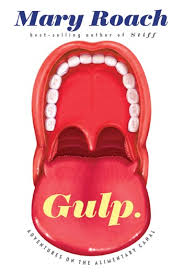
[READ: Summer 2013] Gulp

Yes, that date is correct, I read this book over a year and a half ago.  I meant to write about it then, but I loaned it out to someone and I like to have the book nearby when I write about it.  So I put it off and put it off and now that I have the book back, I will do my best to remember whatever I can about it.

But the thing about this book is that it was so memorable, I won’t have much trouble writing about it anyhow.

Mary Roach investigates the physical properties of eating from pre-digestion through to the end.  And she does it with thorough research and a boatload of humor (sometimes gross out humor, although she warns that that is not her intent–“I want you to say, ‘I thought this would be gross, but it’s really interesting.’  Okay, and maybe a little gross.” (19).

She begins with the nose.  Most people know that the nose contributes tremendously to your sense of taste.  But Roach really explicates how much.  She speaks to a woman, Langstaff, who is a professional sniffer and who is currently staffing the Olive Oil taste Panel at the Olive Center.  She is training novices to be be better at tasting flavors.  But Langstaff herself for instance rarely drinks beer for pleasure even though she is an expert at tasting it.

The most amusing (or not, depending) information here is that there are people who were paid to taste cat food.  Yes.  And that humans prefer cat food with a tuna or herbal flavor over those that taste “rancid,” “offaly,” “cereal” or “burnt.”

Fortunately, the second chapter shows that it is actually dogs who test the dog food.  It turns out that dogs and cats really shouldn’t enjoy dry dog food (cats and dogs are not grain eaters by choice).  Dry dog food was created as a means of convenience for people (and as a way to stop tinning food during the war).  As for your pets, “pet foods come in a variety of flavors because that’s what we humans like, and we assume our pets like what we like.  We have that wrong.  ‘For cats especially…change is often more difficult than monotony.'” (43).  Some other pet observations: cat’s can’t taste sweet (although dogs can and rodents are slaves to it).   (more…)

Read Full Post »

peach SOUNDTRACK: FOALS-Holy Fire (2012).

I foalsloved Foals’ debut album Antidotes, it was a modern rock/prog rock/dancable mashup with angular guitars and all kinds of weird time signatures.  Then Foals returned with a new album which I haven’t heard anything of, except to have heard that it was very different.  Then I heard “Inhaler” from this album and I loved it.  It was easily in my top ten songs of 2012.

But it was so different from the Foals of Antidotes that I wasn’t sure what to make of it.  And in fact, that Foals, with all of their angularity, has been replaced by this much dancier version of the band.

“Prelude” is like an extended intro to “Inhaler.” It’s 4 minutes of intro music with chatter and noises.  Then comes “Inhaler,” a slow building song that rises and falls, rises again then falls again and then bursts into a big rocking chorus.  It’s fantastic, it feels louder than is possible for such a song.  “My Number” introduces some of that unusual staccato song style but in a far more dancey framework. The synths are louder and bolder.  I really like this song.   “Bad Habit” is a far slower song, but it’s a nice tempo changer.  And the chorus is still catchy.

“Everytime” brings in more shoegaze elements (so let’s see, there’s angular punk, shoegaze and dance music here).  This song even has a discoey chorus.  “Late Night” and “Out of the Woods” feel even more dancey than the earlier tracks–with a kind of earlier 80s British alt rock flavor–spiky guitars and exotic percussion.  I hear some of the guitar sounds of early U2 as well, especially on the intro of “Milk & Black Spiders” (the rest of the song sounds nothing like U2.

“Providence” brings back some of that louder guitar, coupled nicely with a combination of shoegaze and screamy vocals.  The heavy guitar plays a very nice counterpoint to the picking of the second guitar.  It’s the last great song on the record.  “Stepson” is a slow song, the slowest on the disc, and I fear that it rather runs out of steam.  “Moon” continues the slow drifting sense of the end of the album.  It’s pretty song, but it feels so far removed from “Inhaler” that it seems to be from a different record.

So I’m not entirely sure what to make of this record.  It has a few great songs, and then a number of songs that seem to want to go in a different direction, but what direction that might be remains unclear.

[READ: September 6, 2014] “The Happy Valley”

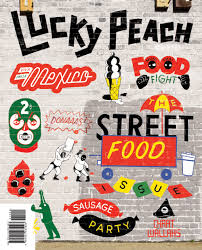
Lucky Peach 10 is “The Street Food Issue,” and it is a fun issue with all kinds of interesting food you can buy on the street (and recipes to try them at home).

Like food in tubes.  Take “Sausage Quest” (what the locals do with their various sausages all around the world), or “I Went to Thailand and All I Got was a Sausage Stuffed in My Mouth” (I can’t wait to make sausage blossoms).  Beyond sausages there’s a list of the most compelling street foods around the world from New York to Naples to Tunisia. We look at street food vendors in Malaysia and South East Asia.  And then we meet the Lucha Doughnut Man of East LA (Mexican donna vendor by day and masked wrestler by night).

Then there’s some articles that are not about food.  Like the surprising article about the microbiology of used cigarette butts (no butts were eaten).  Or the very interesting history of charcoal (which dates back to Henry Ford).  I had no idea charcoal came from trees.   There’s an essay about rapper Jibbs and his song “Chain Hang Low” which was apparently ubiquitous in 2006 although I don’t know it).  The essay discusses how it used “Turkey in the Straw” as a motif.  Most likely, he took it from the ice cream trucks that he heard as a kid, but there is a whole history of racism packed in to that song, let me tell you.

I enjoyed the idea (throughout the issue) that if you’re in a new place, sometimes you can’t always trust reviews for what’s good, you just have to trust your gut (and your nose).

Then there’s several articles about corn.  Making tortillas or masa–the whole process of nixtamilization.  (more…)

Read Full Post »

lp12SOUNDTRACK: OXFORD DRAMA-“Asleep/Awake” (2014).

dramaOxford Drama is, unexpectedly, from Poland.  Their lyrics are in English, although their Facebook site is all in Polish.

“Asleep/Awake” is a slow, synthy track with Małgorzata Dryjańska singing in a breathy whispery voice.  Her voice feels delicate even if the lyrics are somewhat empowering (and she has no discernible accent).  The instrumentation (all synth and electronic drums) is by Marcin Mrówka.  I like the way he throws in some occasional bass lines to add more texture to his simple beats.

The song feels very much like a 90s British trip hop sound.  Although on the more mellow side of trip hop. It’s quite pretty and dreamy.  It’s interesting to hear this kind of music coming out of Poland (although why shouldn’t it, honestly?).  I rather hope they break through in the states.

Their 4 song EP is available on bandcamp.

[READ: September 7, 2014] “Trilobites”

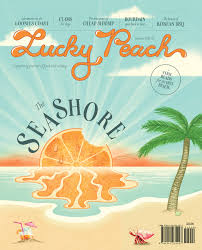
Lucky Peach issue 12 is all about “The Seashore.” And thus there are lots of beach-related foods under discussion. Lisa Hanawalt has a wonderful story about hanging out with otters (if she weren’t so hilariously vulgar (she’s wearing a shirt that says “Every day I’m not covered in otters is a piece of shit”) I’d have my kids read it because it is so cute). There’s a brief article explaining the particular smells of the seashore.

Chris Ying has a hilarious article about sea cucumbers (and just how hard it is to make them appetizing). And there’s a wonderful little section that compares the “sea” version of things to their “land” counterparts. Like the Sea Anemone, the Sea Cow and the Sea Horse and how different they are from the land based creatures with the same names.

There’s an amusing tribute to the Goonies (a movie I haven’t seen in 30 years); and a lot of talk about Crayfish. Perhaps the most interesting of these articles was the seaweed farmers—who basically say that any seaweed is edible, so next time you’re in the ocean, chow down.

And then there’s the clams and abalone and whatnot. This includes a brief explanation of the edibleness of 8 different bivalves. There’s also Robert Sietsema’s trip down the Atlantic Seaboard going to as many clam houses as he can.

There’s also an article about sushi—but not the sushi itself, rather the stuff that comes with it. Like Krab, which is not crab at all, but various fish pieces minced up and dyed to look like crab! Or the wasabi that you get, which is not real wasabi (real wasabi is super expensive ($100/lb)). That green paste is actually horseradish, mustard oil, citric acid and yellow and blue dye.

And what beach/resort issue would be complete without s tory about the Harvey Wallbanger (I enjoyed this history quite a bit).

The issue is also chock full of recipes and then it ends with this piece of fiction

“Trilobites” is set on a downtrodden farm in the South. I wonder if the South gets tired of their fiction depicting fathers as brutal drunks. In this case, there’s this instance of the father whipping the narrator: “One time I used an old black snake for a bullwhip, snapped the sucker’s head off, and Pop beat hell out of me with it.”

He is also not too fond of his mom. Once Pop died, his mother was interested in selling the fam. She’d like to move to Akron where she has family. He has no interest in the farm but doesn’t want to leave either. This exchange, in which they laugh at the funny phrases Pop used to say sums up his attitude:

I think back. “Cornflakes were pone-rakes,’ and a chicken was a ‘sick-un.’
We laugh.
“Well,” she says, “he’ll always be a part of us.”
…I think how she could foul up a free lunch.

The trilobites in the story are in Company Hill, a former river bed that is now home to fossils. The narrator has never been able to find a trilobite.

The narrator pines for his love from high school, Ginny. In her yearbook he wrote “We will live on mangoes and love.” But she left for Florida.

Now she’s back in Charleston on break and asked to visit. But as with many stories full of desperation, especially in the South, nothing good can come from anything.

He has to deal with the man who wants to buy the farm. He can’t really communicate with his mother. The girl who is still around (who is super cute) is jailbait. Even his “date” with Ginny is a disaster. She has a boyfriend back in college, she tells him. But she wants to have fun with him while she’s back. They fool around, but it is ugly and ends with Ginny mad. And even the trilobites don’t come out.

I just didn’t really get this story. I know I am out of my depth in a story like this as the boy huntsfor a “turkle” in the water (which I guess is a turtle). His father used to like “turkle in a mulligan” whatever that means. This is just not my kind of story.

Read Full Post »

lp11SOUNDTRACK: AMASON-“Älgen” (2014).

amasonI was delighted when I heard this song on NPR because of the unexpectedness of it.  It starts out fairly simply with a fast shuffle drum and swirling guitars.  Then comes in a deep, very synthy sounding keyboard playing a simple and straightforward riff.   All of this instrumental section lasts nearly a minute and a half (of a 4 minute song).  Then the vocals come in.  A very deep (and wholly unexpected) voice sings a few words and is quickly followed up by a female voice singing quicker vocal lines, almost speeding up the song.

Amason is a Swedish band (with members connected to nearly every Swedish alt rock band you’ve ever heard of).  And like a lot of Swedish music, it is super catchy but somehow just a little different, which keeps it interesting.  I want to hear more from them (although when you search them, you have to keep saying, no I am not looking for “Amazon”).

[READ: September 6, 2014] “Lobsters”

Lucky Peach 11 was the “All You Can Eat” Issue. So the issue focused a lot on buffets (don’t feel compelled to get your money’s worth, you’ll only get sick). But there was also some interesting twists about all the things you could eat if you were so inclined.

My favorite article was from Mark Ibold, about Pennsylvania Dutch cooking and the amazing buffets you can find in Lancaster. He recommends the popular but for worth it Dienner’s on Lincoln Highway East (next to a fake revolving windmill!). Lisa Hanawalt’s illustrated stories have also become a favorite. This one is set in Las Vegas, with all that that implies.

There’s a tremendous article on Quebec and the stunning foods of the French Canadians, and a very funny article called “Decision Fatigue Related Eating” how as you get tired your food choices suffer as well (WINGS Fri-DAAAAY!”). There’s a lengthy article about crashing weddings in the country of Georgia (where you will likely be invited to a wedding even if it’s your first day there).

There’s several recipes with the main ingredient of celery. Peter Meehan opens with a very funny set up “There are things one can never seem to buy in appropriate quantities at the grocery store…. Celery’s natural packaging comes in one size: more than you can eat…. It’s cheap and it last forever so you buy a whole head…. be honest: isn’t there always a nearly complete head of celery heading toward middle age in the crisper?” This is followed by some possibly good celery recipes. (more…)

Read Full Post »

mewanSOUNDTRACK: “WEIRD AL” YANKOVIC-Mandatory Fun #1 (2014).

way1So, yeah I’ve spent the last few weeks talking about the songs from Mandatory Fun.  What could I possibly have left to say?

Well, only that I think it’s pretty awesome that Al’s viral campaign worked and that his album made it to #1 on the Billboard charts.  (Of course, I have my disclaimer that I really don’t care about charts and usually have no idea what is number one, but I’m always pleased when a band I like can get that honor).  I think it’s pretty cool that he’s been doing this forever (and I’ve liked him since “Another One Rides the Bus”), and that he is not only still successful, but is even more successful than ever.

I’ve also enjoyed seeing him all over the media lately.  It’s interesting to see how smartly he deals with stupid interviewers and how much he enjoys the intelligent interviewers.  I met Al once and he was a very nice  person (as far as celebrities go).  He seems to genuinely appreciate his fans, and so I’m glad he’s collecting more fans.

Clearly, the album sales will plummet after this #1 accomplishment (it’s not like people are going to start buying the album as if they were unfamiliar with it), but while it lasted, it was pretty cool.  And this scene on the Tom Green Show (who even knew he had another show?) when he was presented with this plaque was quite touching.

[READ: July 29, 2014] Meanwhile

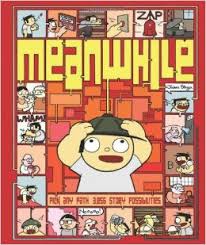
This book is like a culmination of cleverness from Jason Shiga.  As the cover states: Pick Any Path.  3,856 Story Possibilities.  And while I did not count them all, I did run through all the possibilities.  And it is a crazy, time bending, mind-swapping fun ride.

And is it really a choose your own adventure?  Indeed it is.  Each page has a tab and each panel in each cartoon has a tube. The tube runs from one panel to another, sometimes going to a tab so you go to another page.  The author’s note at the beginning of the book says it began as a series of 7 increasingly complex flowcharts, then he used an algorithm to determine the most efficient way to make each story line.  And wow, what a doozy.

The story starts simply enough with the main character getting an ice cream.  And your choices are chocolate or vanilla.  The choices lead down a series of deepening paths, bringing you to a scientist who has created the Killitron 2000 (which does what it says), the SQUID (which transfers memories between people) and a time machine.  As you can imagine each of these thing leads to very different results. (more…)

Read Full Post »

karl2SOUNDTRACK: BRASS BED-Tiny Desk Concert #339 (February 24, 2014).

brass bedI expected Brass Bed to be a goofy band because of the snapshot image of them singing into toy microphones.  I was initially disappointed by how normal they were, but I was soon won over by their interesting floating sound. They have this overall trippy underwater vibe (which seems to be accomplished by a bowed slide guitar). This is especially notable on “Yellow Bursts of Age” their best song in the set.  Later the guitar solo is echoey and also underwatery. It’s a very wild sound for a fairly simple song.

They tell a funny story about being from Louisiana and encountering Washington DC snow and (of course) not having an ice scraper (although they did have bag of sand).

“Cold Chicory” is an upbeat sounding song musically although it is kind of a bummer lyrically, but again there’s the great sound of the bow on the slide guitar and the echoey lead guitar. “Please Don’t Go” is a slow song—with more interesting effects from singing into that slide guitar.

The plastic mikes do come out in the last song “Have to be Fine” in which they sing into the echoey mikes for the intro (with very nice harmonies).  They sing the intro for about a minute, and then the slide guitar player takes lead vocals on this simple but pretty song (I don’t know any of their names).

At the end, the NPR folks gave them an honorary NPR ice scraper.

[READ: June 24, 2014] My Struggle Book Three

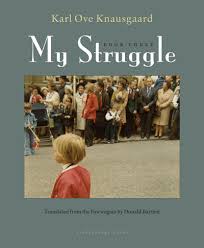
boyhoodI read an excerpt of Book Three just a few weeks ago.  And in the post about it I said I wouldn’t be reading this book for quite some time.  But then the book unexpectedly came across my desk and I couldn’t resist grabbing it while it was here.  So it appears that I will now have to wait well over a year before Book 4 (which is, I think about 1,000 pages–yipes).  I also see that Book Three is fully called “Boyhood Island” in Britain.

At the end of Book Two, Karl Ove was more or less caught up to the present–writing about what he was then up to (with a few years gap, of course).  So it makes sense that this book is about his childhood–showing us how he came to be the man he is.

The book, amusingly enough, starts off with memories that he cannot possibly remember, and he even says as much.  He is using memories of his parents and piecing together pictures from when he was an infant.  In 1970, (Karl Ove was born in 1968) his family moved to the island of Tromøy tromo(and check out the idyllic picture that Wikipedia had).  This is where Karl Ove spent his (rather traumatic) formative years.  Their island is small, so he knows everyone in his school, but there are some amenities around like the Fina station and the B-Max, and there’s lots of soccer to be played and bikes to be ridden.

Things seem normal at first–he runs and plays with his friends, there is ample green space to run around in, and they have boats to sail on.  And we meet two of Karl Ove’s earliest friends: Geir and Trond (so many people are named in the book, I’m very curious to know if any of them remember him).  In an early scene they chase the end of a rainbow looking for a pot of gold (and have a discussion about what happens to it when the rainbow vanishes (the boys even play a prank on Karl Ove that they actually found the pot,a dn while he doesn’t initially fall for it, he is compelled to go back and they tease him).

But the looming figure here and throughout the book is Karl Ove’s father, who, at least according to Karl Ove’s memory, is pretty much a monstrous dick.  He is demanding and exacting, unforgiving and seemingly uncaring.  He is either bipolar or a drunk, jumping from goofy to outright rage in a mater of seconds.  Karl Ove and his brother Yngve fear him unconditionally and, by the end of the book they both seem to hate him.  The scene where their dad tries and fails to teach Karl Ove to swim is heartbreaking, especially when the dad goes home and tells their mom right in front of him “He’s frightened of water.”  There are dozens of instances of fear and intimidation (often accompanied by a wrenching of Karl Ove’s ear).  Like when Karl Ove turns on the TV for his grandparents (he wasn’t allowed to touch the TV but he wanted to do something nice for them).  After a few minutes, the TV fizzed out and, naturally, he was blamed for it and sent to bed without supper (after some minor physical abuse). (more…)

Read Full Post »

hiro2SOUNDTRACK: ASAF AVIDAN-“One Day/Reckoning Song (Wankelmut Remix)” (2012).

wankelYesterday I talked about Asaf Avidan and his song “Reckoning Song (One Day).”  His (live) version has 15 million views on YouTube.  But the remix by Wankelmut (which Avidan had asked Wankelmut to take down, but he refused) has almost 150 million hits.

The first song is a slow keening lament.  The remix adds a dancey beat and speeds up the vocals (mostly removing pauses, not really speeding up his voice at all–it’s high enough as it is).  And now that I’ve listened to both versions a few times, I’m totally hooked).

I think I like the verses better in the remix (the drum beat helps), but I like the chorus of the original better–the power comes through a lot more in the chorus of the original.  I’m glad the remix left in the yodelly aspect of his voice in the chorus, though.

I imagine that this remix has introduced a lot of people to Avidan, and that’s a good thing too.

You can see both below, first the original,

then the remix:


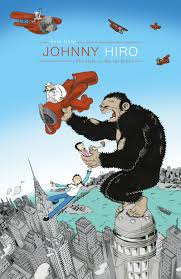
[READ: June 20, 2014]  Johnny Hiro Book 2

This book continues the exploits of Johnny Hiro and his beautiful girlfriend Mayumi.  There’s no listing of “originally published” so I don’t know if these came out as individual books, like the first collection of story did. So I’ll just assume that these were first published in this book.

The first story gives us a peek into Johnny’s past when Mayumi is having lunch with a coworker (and Johnny is hauling ass to get to the lunch date on time).  When he skids up to the table, he realizes that he knows the other woman–in fact, he almost moved in with her.  But just as things get really uncomfortable (Johnny never told Mayumi about her), King Kong reaches across the patio and pulls her away.  And, just as Johnny had to save a woman from Gozadilla in book one, he has to save woman from King Kong.

Which means more chases through New York City, a fascinating (if not sad) backstory about King Kong and another hilarious save via Mayor Bloomberg (wonderful to see him again). The connection to L.A. about King Kong is fantastic.

In the second story, the owner of the house that Johnny and Mayumi are staying in comes back for a few weeks, this introduces a new person to play off of, with new concerns–it;s a nice addition.  The only bad thing is that Alex curses like a storm–I don’t recall there being any curses in the first book–so that puts this book squarely into the older teen area (which isn’t really a bad thing, since there is talk about romantic relationships and some behind closed door scenes that kids might have to many questions about–but I feel like the big monsters might entice kids into reading it). (more…)

Read Full Post »

hiro1SOUNDTRACK: ASAF AVIDAN-Tiny Desk Concert #340 (March 2, 2014).

asafAsaf Avidan is a 33-year-old, Israeli singer, formerly with a folkish rock band called Asaf Avidan & The Mojos.  He has since gone solo and is touring the States.   His voice is the most notable thing about this performance—it’s feminine, but not in a conventionally feminine way.  It’s got a husky Janis Joplin vibe or maybe that weird Billie Holiday thing that she does.  And yet Asaf Avida is (clearly) a man and when he belts out songs, his voice is incredibly powerful.

And yes indeed, he knows how to use his voice very well.  His voice would be unconventional even if he was a woman—it’s creaky and crackly, it warbles and rises and swoops and yet it is very powerful nonetheless.  And I can see it being very polarizing.  I didn’t like it at first but it really won me over.

“My Latest Sin” is a slow finger plucked song (the guitar is beautiful) and most of the song is pretty quiet, but man can Asaf belt out the lines when he wants to. “Different Pulses” is a more robust song musically (even though it is just him on guitar). When he sing the “oh ho” part, he hits some real falsettos, but is still very powerful.

The way he mixes up his incredibly high pitched voice with the gravelly and growly makes this an incredibly engaging performance.

As he introduces the third song, “Reckoning Song,” he explains that it was remixed as an ambient song–which he hates.  He had asked the remixer to take it down, but the guy refused.  And it has since hit 150 million hits.  He’s grateful for the attention, although he still hates the remix. His version is quiet and powerful with some beautiful catchiness.

I’m very intrigued by this fellow and want to hear more.

[READ: June 20, 2014]  Johnny Hiro Book 1

This book collects the first three Johnny Hiro stories (from 2007-2008).  It was originally published by AdHouse books with the cover that you’ll see below.  This Tor reprint is identical (as far as I was willing to investigate).

I was immediately intrigued by the cover and the title.  I loved the play on Hero and Hiro and when I saw that a Godzilla type monster attacks them on the first page, I was sold.

So Johnny Hiro is an average Japanese American kid living in New York.  He has a bad job as a sushi chef, but he has a beautiful Japanese girlfriend who loves him very much.  Of course, when the first story opens and Mayumi is pulled away by “Gozadilla,” things aren’t looking that good for him.

But here’s some wonderful things that do happen in the story: Johnny rescues her while wearing her Hello Bunny slippers (she’s concerned that he will stretch them out); we learn that Gozadilla is mad at her because her mother stopped him in 1978 from trying to rampage Tokyo (so this is a revenge mission) and, best of all, they are saved because Mayumi calls Mayor Bloomberg for help (she got his number from the phone book because of an article in the New York Times).  Oh and the monster attack has left a huge hole in their exterior wall. (more…)

Read Full Post »

nycSOUNDTRACK: TOM BROUSSEAU-Tiny Desk Concert #347 (April 12, 2014)

brousseauI only know of Tom Brousseau from NPR–both All Songs Considered and WNYC’s Soundcheck have played him a lot.  Of course, I had no idea what he looked like (an didn’t expect what he does look like either).  His voice is a little high-pitched (the Tiny Desk site says people think he’s a woman, although I don’t really hear that), but it’s very compelling.  Mostly you listen to Brousseau for the storytelling lyrics.

“Cradle Your Device” is a very funny song about how technology can interfere with your romantic life.  The second song “Stuck on the Roof Again,” tells a true story about the octogenarian newspaper columnist Marilyn Hagerty, who got stuck on the roof of her home in Grand Forks, N.D., after a heavy snowstorm.  He introduces the song with a lengthy story about Hagerty and her food critic reviews (of The Olive Garden of all things) which have suddenly gained her fame.  There are some pretty harmonies by his accompanist Sean Watkins

Brousseau is a charming and earnest storyteller, and it’s fun to hear what he has to say as much as what he has to sing.  The third song is “Today is a Bright New Day.”  He says it’s early in the morning for him to hit the high notes, and he does struggle some.  But he gives a great performance nonetheless of this pretty, earnest song.

I’m not sure if I’d want to hear a lot more of him, but I enjoyed this set quite a lot–maybe a live record is the way to go.

[READ: June 18, 2014] NYC Basic Tips and Etiquette

I found this book at work and couldn’t pass up reading it.  The fact that it’s small and has few words meant I read it in about 20 minutes.  But don’t let the brevity fool you, there’s a lot of useful information for novice New Yorkers, tourists and maybe even some old school New Yorkers (although they won’t admit it).  The audience seems to be primarily those who have just moved to the City, although as I say, tourists will find it useful, too.

There are two components to this book: Tips and Etiquette. I have worked in NYC so I am certainly familiar with the City, but I found some of the tips (especially subway tips about unfamiliar areas) to be very helpful.  Even simple things like mnemonic devices for streets in the Village or recognizing buildings or bridges (Manhattan made of metal; Brooklyn built from bricks) were quick and easy devices.  And he lets us know that even if NYC is much safer than in days of old, we should still be aware of some common scams.

But the bulk of the book is about etiquette.  It is designed for people n New York, but at least 80% of the etiquette is useful anywhere.

The more specifically New York based items are things that remind you that New Yorkers are often in a hurry–oftentimes they are not being rude, they are simply commuting and need to get where they are going.  So, you should a) be decisive and b) be assertive.  People are probably waiting behind you and they will certainly try to go around you if you are too slow.  So order your food quickly and move up a line quickly.  The one etiquette thing I liked best was his comments about not looking at your phone while you are on the streets. Not only are you distracted and might bump into someone, but you might miss your soulmate. (more…)

Read Full Post »

« Newer Posts - Older Posts »