Feeds:
Posts
Comments

Archive for the ‘Fire’ Category

storiesSOUNDTRACKPOLYPHONIC SPREE-Tiny Desk Concert #259 (December 21, 2012).

The Polyphonic Spree performs a Tiny Desk Concert.I really enjoyed Polyphonic Spree’s first album (and their strange robes and cult-like following (apparently even within the band).

They put out a Christmas album some time ago, and since we have a big pile of Christmas albums, I grabbed that one.  I didn’t love it, but it was a fun addition to our collection.

This Tiny Desk Concert is notable for just how many members of the band are behind (and on the side of) the Tiny Desk (perhaps 18?).

And the band is suitably musical–trombone, trumpet, keys, drums, bass, cello, violin and a ten (or so) piece choir.

Interestingly, I find that the weak link in this whole thing is leader Chris DeLaughter.  It’s just that his voice is really not that interesting. It’s especially notable on “The Christmas Song” where he sings some high notes unaccompanied.  When the choir comes in (and they change the melody) it sounds really cool.  I especially love the way they make “reindeer really know how to fly” into a high note.

The first song is “Happy Xmas (War Is Over)” which I feel is the Christmas song they might be best known for.  It’s pretty traditional to the original, with the choir filling in for the kids.  The addition of horns really adds a lot to it.

“Silver Bells” gets a pretty rocking treatment–the buildup at the beginning is pretty cool.  They change the main melody to an almost circus-like waltz. I love the way it sounds when everyone joins in–and when the choir is singing along to the rocking end (with a very different melody) it sounds great.  But once again DeLaughter’s voice doesn’t seem up to the task of leading this larger group.

But it’s festive and fun, especially with everyone in red robes (and DeLaughters green one).

[READ: December 2016] Christmas Stories (1854-1864)

Last year, I started reading some Charles Dickens Christmas Stories in December.  I imagined that I’d finish the whole book this season (all 750 pages of it), but I didn’t come close.  I enjoy these stories but they are not quick reads by any standard.

The fascinating thing with a lot of these stories is that they appeared in All the Year Round, a Victorian periodical founded and owned by Dickens and published between 1859 and 1895 throughout the United Kingdom.  But just because these stories came out for the Christmas issue doesn’t mean they have anything to do with Christmas directly.

I thought I’d be reading a whole chunk of the book in a row, but I wound up skipping around a bit.  Maybe next year I’ll finish the remaining stories. (more…)

Read Full Post »

slowstormSOUNDTRACK: ANDY SHAUF-Tiny Desk Concert #533 (May 20, 2016).

shaufI was unfamiliar with Andy Shauf although once he started playing, I thought his songs sounded familiar.  One of the more interesting thing about him is his singing enunciation (which reminds me a bit of SOAK for a recent comparison–although she is from Northern Ireland and he is from Saskatchewan).

It’s interesting to me that Shauf plays only rhythm guitar–all of the melody lines and solos come from his keyboardist.  It’s also interesting how motionless Shauf is.  He stands quite still and doesn’t even really move as he sings (his voice is mellow but not exactly quiet).

“The Magician” has as some great riffs from the keyboard and some interesting chord changes as the song draws to and end.  And of course, Shauf’s calming, delightful voice (complete with do do do dos) make the song quite lovely.

“To You” sounds similar to the first–same basic tempo and tone, with nice little fills that elevate the song from a simple chord structure.

His final song, “You’re Out Wasting” is “an older song” from his last album.  There’s another great melody running through this song and it’s a bit more uptempo.

I’m not sure if it’s his hair or his posture but he looks uncomfortably hunched-over while playing.  But that doesn’t stop his voice from sounding great and his songwriting from being really enjoyable.

[READ: February 2, 2016] Slow Storm

I really like the way Novgorodoff works with watercolors to create cool backgrounds. However, I don’t really like the way she uses her pen–I don’t care for the look of her characters.  And I don’t love the hand lettering all that much either.

This story is one that I wouldn’t read if it weren’t a First Second book.  And while I’m glad I read it and I found the convergence s of characters to be really interesting, it was a rough road getting thee.

The story begins with no words, just a series of images that juxtapose a tornado/storm and the Kentucky Derby.  The storm is hitting a barn where horses are kept, so these horses are also running, but hey are frightened of course (I especially didn’t like the style of the frightened horses).

Then we see a man get hurled by the tornado into a barn. (more…)

Read Full Post »

ninthSOUNDTRACK: Thee Silver Mountain Reveries-The “Pretty Little Lightning Paw” E.P. [CST030] (2004).

lightpawAfter three albums, it was time to make an EP under yet another variant of the band’s name.  This is a fun release (which is interesting to say about a band who is typically quite serious).  What made this “fun” is that many of the band members switched instruments for this recording. Violinist Sophie Trudeau plays bass guitar.  Guitarist Ian Ilavsky, usually one of the band’s guitarists, plays drums.

Also when they finished recording, was complete, the EP was played on a boombox and re-recorded from that.  I can’t tell that it was recorded in this way, so who knows if that made any difference.

There are four songs, “More Action! Less Tears!” is the first.  It begins with Aimee shouting “Hello!  Hello!” and then messing up and laughing.  So she begins again, “The name of this song is More Action.  The name of this song is Less Tears.”  It sounds unlike anything that SMtZ have done so far.  The guitar that opens it is distorted and plays a fairly conventional riff while the violins play a suitable melody over the top.  The strings build and the songs oars.

“Microphones in the Trees” opens with a guitar melody that’s quickly joined by the same melody on upright bass.  Efrim begins singing (his voice is distorted and echoed and sounds almost more like an instrument than a voice, although you can hear the lyrics: “microphones in the trees, cameras in the sky.”  The choir starts singing along with him until about three minutes when a wash of noise over takes the song. This lasts for a few minutes and then fades, allowing the words to continue.  About half way into the song a rather shambolic chorus sings “we are the flood.”  The last two minutes or so are simply feedbacky noises wafting around.

“Pretty Little Lightning Paw”is the ten-minute title track.  It opens with bass notes and chimed notes.  The strings follow Efrim’s vocal lines (which sound ragged and quiet).  And then after a minute or so new strings come in, slightly unsettling sounding.  About three minutes in the 4 voice choir begins singing an alternate melody above Efrim’s repeated mantra.  The song continues in this vein for pretty much the rest of the song, only modifying at the end where the sounds and feedback resemble birdsong.

“There’s a River in the Valley Made of Melting Snow” is 5 minutes long and is basically a solo song from Efrim.  He plays guitar, sings and plays “toybox.”  The melody is fairly simple and his voice sounds pretty good–not too shrill.  It may be the most conventional song that SMtZ has recorded.

While this EP doesn’t deviate drastically from the band’s normal sound, it is fun to see them mix things up a bit.   For this recording, the band was

  • Thierry Amar – violin, bass guitar, vocals, pianohandle
  • Ian Ilavsky – drums
  • Efrim Menuck – guitar, piano, organ, vocals, feedback, toybox
  • Jessica Moss – violin, vocals
  • Sophie Trudeau – bass guitar
  • [Beckie Foon is absent]

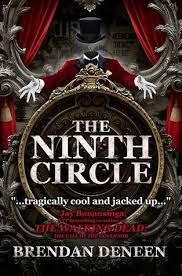
[READ: May 5, 2016] The Ninth Circle

Brendan and I went to college together.  In fact, I knew Brendan from his submissions to both the newspaper and the literary magazine.  He was a major talent back then (I still remember details from the story he submitted twenty some years ago) and continues to be one now.  He works in comics and has written for Flash Gordon, his own book Scatterbrain and something that I can’t wait to find a copy of: Charlie Sheen: Vatican Assassin Warlock.  Check out his output on Goodreads.

This is his first published novel, I believe. And I was hooked from the first chapter.

The story is about 16-year-old Dan.  His family is a disaster–his brother is obsessively mean to him, his father is an alcoholic, his mother is probably sleeping with someone else, and neither parent gives him the time of day.  For his 16th birthday they take him to the circus, even though he never said he wanted to go to the circus.  His brother promises to get revenge for having to go to this lame spectacle.

Dan’s not even sure that he’s going to like it, but he winds up being mesmerized from the moment he walks in.  The trickster tricks him, the freaks entice him (he finds the bearded lady especially enchanting) and the whole show is truly amazing.  Later that night, while lying in bed thinking about his crappy life, Dan decides to take action. (more…)

Read Full Post »

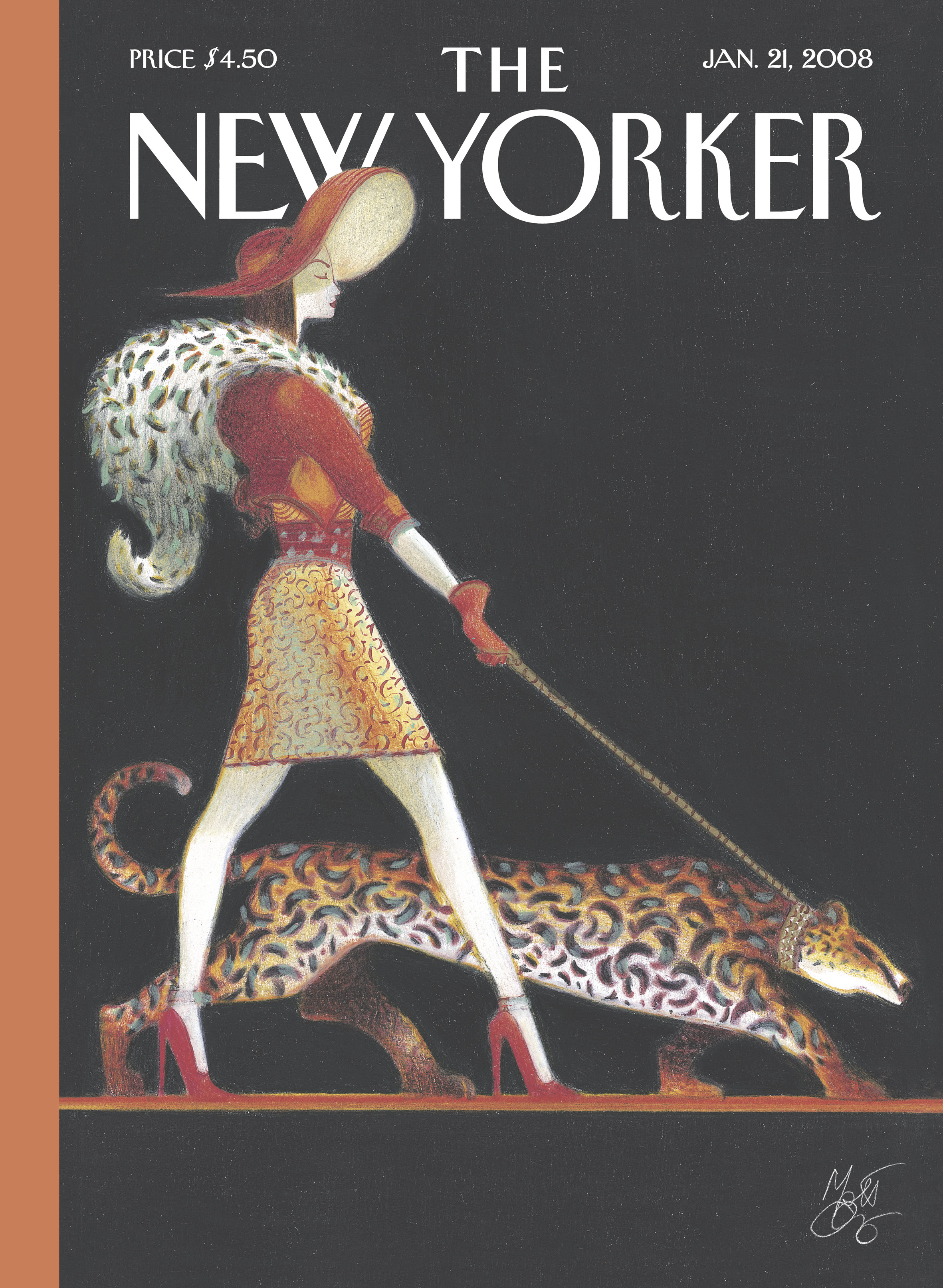
S2008_01_21OUNDTRACK: BASIA BULAT-Tiny Desk Concert #106 (January 24, 2011).

basiaFor some sad reason, this video cuts off about half way through the second song, so you need to watch it on YouTube instead.  Basia Bulat is a Canadian singer of Polish descent.  She’s adorable and plays weird instruments.  What’s not to like?

The first song “The Shore” is done entirely on a pianoette–she may be the only singer to play one.  The pianoette is a zither-like instrument with a strummed section and a hammered section.  Her voice is low and breathy.  And when, during the second verse, her backing band’s harmonies come in, it’s quite breathtaking.

The second song is done on guitar. It’s a Polish folks song–she says it was a big hit in the 60s in communist Poland.  She sings it in Polish and says it was a great way to learn her Polish words and pronunciations.  “W Zielonym Zoo” means “In The Green Zoo.”  It’s cute how happy and smiley she is as she explains this song.  It begins with just her on guitar and it’s quite a delight when Holly Coish on ukulele, Allison Stewart on viola and Ben Whiteley on bass join in.

pianoetteHer brother Bobby Bulat joins her on percussion for “Heart Of My Own.”  This song is louder and more dramatic and a lot of fun. The final song  “In The Night” is one she normally plays on the autoharp (see, unusual instruments) but she didn’t have it so she plays a rollicking guitar version with the full band (there’s some great violin solos in it).  Just before it starts she says that if it sucks, don’t use it.  It doesn’t suck at all.

I really like Bulat’s music a lot and this is a great way to witness it up close.  And here’s a picture of a pianoette.

[READ: January 8, 2015] “Ash Monday”

I wasn’t sure how much I would like this story (same old intro from me) because I didn’t like the main character (or one of the two main characters).  Dill is a delinquent.  He’s 13 and with a car (well, he has the car, he just cant drive it).  And hes loves the smell of gasoline.

When his mother tells him to goes outside to light the grill (as he does most nights–his mom doesn’t cook in the house apparently), he puts gasoline in it to light it up.  On this night he discovers a rat in the grill, so he takes the opportunity to dose the rat with the gasoline and set it on fire.  (If you’re squeamish, there is also the death of hundreds of chinchillas although that is from natural causes).

We don’t learn much about Dill’s mother except that her husband is gone and she is looking to date someone new.

The scene cuts to the next door neighbor, Sanjuro Ishiguro (Dill calls him “Itchy-goro” and once called him a motherfucking gook).  Ishiguro is a respectable businessman.  He works long hours often getting to work before everyone else.  And although he gets along with his workmates, he is definitely not one of them.  They like to ask him about sports when they know he knows nothing about it. (more…)

Read Full Post »

pipbartrSOUNDTRACK: TURTLE ISLAND QUARTET-Tiny Desk Concert #111 (February 26, 2011).

turtleTurtle Island Quartet (there’s no explanation for their name) are a quartet who play an interesting hybrid/jazz crossover. This is most evident in cellist Mark Summer’s playing.  Half the time he bows the strings but the other half he plays like an upright bass (including a percussive elements when he slaps the strings).

“Model Trane,” the opening tune is a John Coltrane-inspired piece, propelled by Summer’s running bass lines Despite the more classical set up (and three violins) it feels very jazzy.  It runs about 4 and a half minutes.

The band leader is David Balakrishnan who has written most of the songs.  He describes the second song, “Monkey Business,” as “loosely based on a sardonic view of Darwin’s theory of evolution.”  I don’t quite know what that means (it’s an instrumental after all), but it’s neat the way the music is all over the place stylistically.  The most notable moment comes when they quote (and fugue) “Strangers in the Night.”  Although other parts of the song remind me of the music in Bugs Bunny cartoons.

The final song has the funny title “Groove in the Louvre.” He says it was inspired by Django Reinhardt.  I don’t know enough Django to know if that is evident here, but there is plenty of soloing going on.  There’s jazzy fiddles (Balakrishnan plays a baritone violin on this song).  There is very jazzy bass (and even a bass solo on the cello) as well as classical elements.  The song is 8 minutes long.

They are definitely an unexpected quartet.

[READ: June 1, 2015] Pip Bartlett’s Guide to Magical Creatures

Pip Bartlett is a young girl (yes I was surprised that Pip was a girl, especially since it didn’t say so until nearly the end of the Prologue).  She can speak to magical creatures–unicorns, silky griffins, fuzzles–but no one believes her (because no one else can).  This is a drag because she loves magical creatures and her Aunt Emma is a veterinarian of magical creatures (people know magical creatures exits, they just don’t think people can talk to them).

The Prologue sets up that Pip loves unicorns but she never really encounters them.  Pip is an authority on magical creatures because she has read (and carries with her) Jeffrey Higgleston’s Guide to Magical Creatures.  She has actually been annotating it as she learns more stuff than is in the guide.  (The guide is good it’s just incomplete).  Then on field day, a classmate brings in four of her show unicorns.  Pip talks to them and discovers that they are incredibly vain and show-offy.  One of them demands that she ride her so that she can show off as much as the other unicorns.  So Pip does (against her better judgment) and all chaos reigns.  Pip is then sent to live with her Aunt for the summer.

As mentioned, Aunt Emma is a vet for magical creatures, and Pip is pretty excited to see them all.  Emma’s daughter Callie is less than thrilled.  She works in the vet’s office for long thankless hours.  And she is crabby when Pip sees her.  Within a few minutes, a couple of exciting things happy, though. (more…)

Read Full Post »

paintedSOUNDTRACK: THE DECEMBERISTS-Long Live the King EP (2011).

220px-The_Decemberists_-_Long_Live_the_KingLong Live the King is an EP that was made of outtakes from their previous (and so far final) LP The King is Dead.  In the style of that album–straightforward folk songs with country tinges, this EP makes a fine companion.  “E. Watson” is a classic storytelling Decemberists song.  It has a great chorus and really wonderful harmonies.  There’s a pedal steel guitar on “Foregone,” which adds a neat sound to this really catchy song.  In fact, the chorus is one of the catchiest things they’ve done, and it’s hard to believe they tucked it away on this EP instead of the album.

“Burying Davy” (which I had been mishearing as Burying Babies, such is the darkness of Colin Meloy that that was a real possibility) is a much creepier song.  The melody is dark and minor chord and yet it’s somehow still catchy and strangely fun to sing along to.  “I 4 U & U 4 Me” rumbles along with a great Smiths-esque bass line.  This version is a home demo (although there’s no non-demo version that I know of).  “Row Jimmy” is a cover of Grateful Dead song that I do not know.  It’s the slowest and most shambolic song on the EP.  I don’t especially like it, but I do like the way he sings “Get Down and” before some choruses.  “Sonnet” is a pretty straightforward folk song.  It’s done on acoustic guitar and features Meloy’s falsetto at certain times.  But just as the song seems to be a pretty standard acoustic guitar ballad, a whole bunch of horns blast in and play along.

Even though this is an EP of predominantly folk songs, there’s some cool headphone stuff going on in this album as well (especially the guitars on “Burying Davy”), so turn it up and tune out for 25 minutes or so.

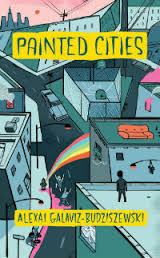
[READ: October 18, 2014] Painted Cities

Painted Cities is a collection of stories (I assume they are all short stories although the early ones read a bit more like essays) that are all set in the Pilsen district of Chicago.  Evidently AG-B grew up there and these stories are about the people and gangs in this largely Latino neighborhood (the fact that his name is Alexai Galaviz Bidziszewski, which conjures up so many different nationalities, although few of them Latino has certainly confused me, although I have no doubt that these are all based on reality).

There are fifteen stories in the book.  I enjoyed the first couple, then I got a  little tired of the gangland/macho tough guy aspect of the stories.  But just as I was a bout to give up on them, he threw in one with magical realism that I really loved, and the rest of the book was equally interesting.   I will say that this region of the country is completely unknown to me and while I don’t typically like gang related stories, these stories did not dwell in the heartache of gangs, but used them as a periphery around which to establish the stories. (more…)

Read Full Post »

burnoutSOUNDTRACK: “WEIRD AL” YANKOVIC-“Mission Statement” (2014).

missionThis was the final video pre-release from “Weird Al”‘s new album.  I’m not sure why he didn’t make videos for the other four songs, but whatever.

Man, do I love this song.  This is a style parody of Crosby, Stills, Nash (and Young, I guess).  It’s not exactly meant to be “Suite Judy Blue Eyes,” but that’s probably the biggest touchstone, especially after the middle and end parts kick in.  Aside from the music (and harmonies) being perfectly spot on what is so genius about this song is the lyrics.

The lyrics themselves are four and a half minutes of corporate mission statements.  I have been involved in two companies’ creation of mission statements, and while non has been as ponderous and jargony as this one (I haven’t actually tried to parse if there is actually anything being said at all here).  But to throw this corporate nonsense as a CSN&Y song is just outstanding.  If the hippies every sold out, this is what they would have made.  And it is stellar.  I hope he plays this live, because I can’t imagine how hard it would be to memorize these lyrics since they don’t actually say anything, but are actual English words.

I love the idea of CSN&Y harmonzing “monetize our assets.”

The video is a hand drawn (you can see the hand) hippie cartoon.  It’s funny and spot on to the theme of the song.

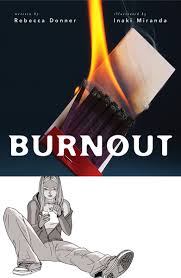
[READ: July 15, 2014] Burnout

This was one of my least favorite Minx books in the short series.  I was poisoned against it right from the start because I don’t particularly care for stories about, well, about divorced mothers getting mixed up with trashy/drunken men who abuse their sons and intimidate the divorced mom’s daughters.   I don’t know how common a trope that is, but this felt pretty story-of-the-week right from the get go.

Danni and her mom are moving to Elkridge, Oregon (pop. 460) to move in with her mom’s boyfriend.  As in all stories where the new boyfriend is a jerk, he’s a jerk right from the start (even yelling at her adorable dog) and the mom tries to convince Danni that he’s not so bad.  The one unexpected thing is that she is forced to share a room with the guy’s son.  (Given their ages, I wouldn’t think the mom would like that).

So the son is hot (in a Danzig sorta way) and has things up all over his room about the environmentalists who are waging war against the loggers.  He also has a locked chest full of stuff (inexplicably right in the center of the room).  That first night he sneaks out the window (on a grappling hook). Did any reader not see that he was doing anti-logging things?  Why can’t characters put two and tow together?  Anyhow, this part of the plot was interesting (even if it could have been handled better) and I was really surprised to have the story turn into a kind of discussion vis a vis the rights of loggers vs the rights of environmentalists. (more…)

Read Full Post »

slippageSOUNDTRACK: PHISH-Farmhouse (2000).

farmhouseThis album has a very acoustic feel to it and I really enjoy this disc.  It is one of their most “mature” records and I feel a lot of fans don’t enjoy it as much, but I think the songs are really pretty.

“Farmhouse” is another one of my favorite Phish songs.  I love the harmonies and the melody is beautiful.  The end of the song with the two singers doing different lines of vocals is just beautiful.  “Twist” is a live favorite although here it opens with percussion only before Trey starts singing.  But then the song proper starts and it is just a riot of fun. Woo!

“Bug” is a mellow contemplative song about God.  It a little long and I must admit, a little dull.  “Back on the Train” is usually much faster live—it sounds like a slow train here.  “Heavy Things” returns the album to excellence, it’s a wonderful uptempo song that is fun to sing along to.  “Gotta Jibboo” is a silly dancey song with horns.  It’s a long jam about 5 minutes most of which is instrumental.  “Dirt” is a piano ballad.

“Piper” is a wonderful round with a melody that circles around the song, I really enjoy this song live and it’s fun to hear how fast they do it here.  I love the way the “words and words I say” gets cycled through.  “Sleep” is a 2 minute gentle ballad.  And “The Inlaw Josie Wales” is a pretty acoustic guitar/piano instrumental.  “Sand” is a funkier number that brings up the tempo.  Of all the songs on the album, I don’t know this one all that well, but it is very Phish like.  “First Tube” ends the disc with a staccato guitar riff that sounds very much like Santana to me.  It’s got a great beat and is very cool.

Perhaps I’m showing my age but I so is Phish, and I think this is a really solid album.

[READ: November 4, 2013] The Slippage

I knew Ben Gereenman from Superbad, a McSweeney’s book.  I liked it a little—but it was more trickery than story telling.  I had gotten it in my head that The Slippage was a good novel (I’m not sure why), and when I saw it at work on Friday, I grabbed it in hopes of reading it before I got back to work on Monday.  And I am pleased to say that I polished off this 288 book in a weekend (and suffered for my lack of sleep).  But I didn’t only finish it because of a self-imposed challenge, I really got into the story.

For this book Greenman’s style is simple and straightforward (a far cry from his earlier, more deliberately challenging work) and the story itself is also rather simple.  But it is engaging, funny and emotionally exhausting.  So the simple story is one of suburban discontent.  The blurb that stayed with me was “If Emma Bovary had lived in the ‘burbs, she would have left a novel like this in her wake.”

The main characters in the story are William Day, his wife Louisa and her brother Tom.  Indeed, the book is really about William and how he handles suburban discontent.  We meet all of the Day’s friends.  In addition to these people there is Emma, the woman who William has an affair with. (more…)

Read Full Post »

corin SOUNDTRACK: THE DISMEMBERMENT PLAN-“No One’s Saying Nothing” (2013).

IDismembermentPlan_CVR-a71cdf7d3b8dde6270c3a01bb56278949eddb5fa-s1 thought I knew The Dismemberment Plan, but I must have them confused with someone else, because this song doesn’t sound anything like what a band called The Dismemberment Plan ought to sound like (which is noisy and chaotic and probably death metal).  This song has big vocals, organ and piano.  Nevertheless, it is rather raucous and is quite fun (and has what sounds like a drill sound effect in the beginning and middle).

Lyrically, the song is odd–“If you press the space bar enough, cocaine comes out.  I really like this computer.”

But it has a very fun devil-may-care, throw in everything attitude that I really like it.  The entire album was streaming on NPR, and I’m looking forward to hearing more from them–including their back catalog work, to see if they ever sounded like what I thought they sounded like.

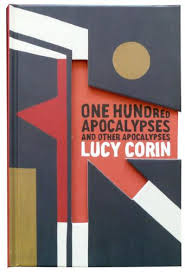
[READ: October 1, 2013] One Hundred Apocalypses and Other Apocalypses

I was excited to get this book because I thought the title was quite intriguing (and the crazy way the cover is cut out was also interesting).

There are four “stories” in the book.  The first three are about twenty pages each while the fourth is over 100 and is comprised of the titular 100 apocalypses (I didn’t count them).

“Eyes of Dogs”
This story contained marginalia (which is sort of like footnotes but not attached to anything specific). In this story a solider meets a witch and she tells him how to get money—climb down a hole and encounter three dogs.  He must wink at the first, blink at the second and hold his eyes closed for the third.  The story seems to be going along sensibly like a fairy tale but then it grows introspective and stops.  I was disappointed in this one.

“Madmen”
This story was utterly bizarre and yet by the middle of the story the bizarreness was explained and by the end I enjoyed it very much.  The premise of this story is that when children grow old they are given a madman to take care of (it is told matter of factly which makes you have to wonder if madman is code for something else.  When boys reach a certain age and when girl;s have their first period (which is an unfair division of genders) they get to go to the asylum and pick which madman (or woman) they want to bring home and care for.  The bulk of the story is at the asylum with the girl “interviewing” the candidates and her mother being mad at her choices.  Ultimately the story turns onto a nice moment between the girl and her dad, who may or may not have married his own madman.  As I said very weird, but satisfying.

“Godzilla versus the Smog Monster”
This was the most “real” of the four stories and it was my favorite.  A fourteen year old boy is watching “Godzilla vs the Smog Monster.”  He found the unlabelled video of it in his father’s sweatshirt drawer and assumed it was porn.  He’s bummed that it turns out to be this Godzilla movie.  In a parallel story, when the boy goes to school his class is watching live footage of California burning—and this burning is uncontainable.  The whole state is slowly engulfed in flames.  This fire, which seems to be some kind of attack obviously changes the minds of everyone in the story, including Sara, a girl who Peter thinks is pretty but who never talks to him.  But when she crashes her car in front of his house, he helps her and they go for a ride to a cave.  Images of the smog monster crop up in interesting ways.  Things get weird and less tangible, but because the beginning was so real it made the ending okay.

“A Hundred Apocalypses”
So this selection disappointed me because it proved to be 100 (I assume) flash fiction pieces.  And I have more or less come down against flash fiction these days.  Especially the kinds of stories that make an interesting “sketch” but aren’t really stories The other problem is that all 100 seemed to be about “apocalypses” which is a useless words when tossed around so much and which loses all meaning when there are 100 that seem to be about actual apocalypses.  Or something.  I also just learned that apocalypse means un-covering or revelation, not really the end of the world, but whatever.

There were probably 6 out of the hundred that I really enjoyed.  Sadly, I didn’t mark them and I don’t remember which ones they were.  The rest were okay or worse.

I am ready for flash fiction to go away.  And I fear that my beloved McSweeney’s is one of the prime generators of the genre, so perhaps they could knock it off for a bit.

Read Full Post »

june 2013SOUNDTRACK: VAMPIRE WEEKEND-“Blurred Lines” (2013).

vampblurRobin Thicke’s “Blurred Lines” is a huge hit (with a NSFW video).  And I gotta say that I find it insanely catchy, too.  It’s pretty irresistible.  So why not cover it?

Vampire Weekend’s new album is less formal than their first two–relaxing styles and adding a bunch more humor to their sound.  And they make a surprisingly good cover of this song.  Their version is quite faithful to the original (even mimicking the sound a lot).  But at the same time, the band is having a lot of fun with the song as you can tell primarily from the backing vocals.

You can tell hear it’s Vampire Weekend, but it also doesn’t quite sound like them–a neat trick.

Check out their cover (which is not a live concert track, but was recorded for BBC’s Live Lounge (so it sounds good)) at Stereogum.

[READ: July 15, 2013] “Firebugs”

This was, I think, the longest story I’ve seen published in The Walrus.

It begins with several paragraphs describing fire–physical, psychological, intense descriptions.  Since I didn’t realize the story was so long, I actually wondered if the whole story would be like that–if there were going to be no characters in it.  But there are, and quite a few.  And the story is focused on two of them.

Blake Kennedy Jr was a firebug as a kid.  Then he became a fireman (seems this is not so uncommon of a history for firemen and may stem from the desire to control fire).  After many good years, he was injured during training and had to get a desk job. Now he investigates suspicious fires.  Perhaps coincidentally, there was a rash of arson during the year he was born.  Those fires were technologically set–the arsonist used the spark from a telephone to ignite a can of gasoline. Of course, the killer would place the call when he was far enough away.  And he was never found.

This year’s arsonist’s is much more simple–a milk jug of gasoline with a homemade wick left on the front porch.  It is a slow burn, with the gasoline not exploding.  It’s actually the fumes that catch fire, not the liquid.  So, when the wick burns down, the whole thing doesn’t ignite until the milk jug melts and the gas spills out.

Blake is investigating the death of Detta, an older woman who tried to run out during the fire (the state of her feet must have been incredible, he determined). (more…)

Read Full Post »

« Newer Posts