Feeds:
Posts
Comments

Archive for the ‘Film & TV’ Category

lou_reed-620x412 SOUNDTRACK: LOU REED-Metal Machine Music (1975).

mmmfrom Wikipedia:

Metal Machine Music is generally considered to be either a joke, a grudging fulfillment of a contractual obligation, or an early example of noise music. The album features no songs or even recognizably structured compositions, eschewing melody and rhythm for an hour of over-modulated feedback and guitar effects, intricately mixed at varying speeds by Reed himself. In the album’s liner notes he claimed to have invented heavy metal and asserted that Metal Machine Music was the ultimate conclusion of that genre.

I don’t know how many people have actually listened to this album all the way through.  There are four 16-minute tracks.  Each one is, on the surface, exactly the same: feedback and more feedback.  In truth, the album is a bit more complicated than that.

There is a guitar in the left speaker and a guitar in the right speaker and each one is feedbacking in very different ways.  Indeed, if you listen to only one speaker at a time, you get a very different experience (I haven’t done that with the whole album, although that’s only because I really only found out about that recently, I did for a few minutes and it was pretty fascinating).

And fascinating is what this release is.  It was unlistenable in 1975, there is no question.  Just as something like Slayer would have been unlistenable in 1975.  But twenty years later, when Sonic Youth was riding high, Metal Machine Music seemed a lot less outrageous (indeed, their 1998 release Silver Sessions was essentially the same structure of feedback).

And now MMM seems very forward thinking.  Whether or not it was a joke or some kind of payback to the label or whatever (liner notes suggest he just really enjoyed enveloping himself in feedback), it’s a remarkable record.  If you can actually sit through it, there are some really interesting moments in it.  There are times when the squall and noise turns eerily beautiful, when the ringing notes take on chime-like status.

And unlike the aforementioned SY album in which they just turned up their amps and left, it sounds like Reed was actually hanging around and manipulating the sound.  You can hear times when new notes/strumming comes in and changes the mood.  And of course, Reed had to edit it for the album.

One of the more interesting moments comes right at the end of the disc.  On the vinyl release, he made a locked groove so the final rotation would keep repeating over and over until you had to get up and manually lift the needle (as if the album wasn’t difficult enough).  On the CD, they repeat that section for about a minute.  And that little repeated section is noteworthy for the rough distorted guitar and chiming feedback that all sounds very cool.

All of this is not to say that this album is enjoyable.  It’s really not.  It’s brutal and harsh and best handled in small doses (even Reed admits that in the notes).  But it is noteworthy and fascinating.  And it may have inspired as many feedback based bands as the Velvet Underground inspired droning bands.

[READ: November 2, 2013] “I loved Lou Reed more than you”

I was sad at the passing of Lou Reed, although I’ve never been a huge fan.  But of all of the eulogies, I knew that Neal Pollack would write the best one.

Neal Pollock is a wonderfully pompous “character” (who is the main character in most of the writing of his that I have read).  This article—while much briefer than most of Pollack’s short pieces—is an honest eulogy of Reed, but is also a hilariously over the top profession of fandom.

When Pollock heard the news of Reed’s death, he was polishing the acetate of his producer’s cut of Metal Machine Music.  He wept, mostly for himself but also “on behalf of all cultured people everywhere.” (more…)

Read Full Post »

witmis4SOUNDTRACK: PANIC-Requiem for Martin Heidegger (1978).

13+LP+Hoes++VoorkantPanic was a Dutch punk band.  Their album 13 came out in 1978 and “Requiem for Martin Heidegger” was the final track.  I love the album cover (and no I had never heard of this band either).

The lyrics are wonderfully simple (and no you won’t learn a thing about the man) with the completely singable chorus of “Hi-Degger, Hi-Degger, Hi-Degger, Hi-Degger, Hi!”

There are some other lyrics (including ein, zwei, drei, vier) and “Is he in heaven, is he in hell, where has he gone?  no one can tell.”

There’s some introductory chatter which I think is in German, but may be in Dutch.  But that’s all irrelevant, because this is three minutes of classic 70s punk.  And the video is a hoot too.

[READ: October 30, 2013] Wittgenstein’s Mistress p. 120-180

Although I read the first half of this book rather quickly, I took some time off before reading this section.  The good news is that this book does not require constant attention.  The bad news is that because there are so many details in the book (whether “relevant” or not) it’s easy to forget if she has talked about the different pieces before.  And that is kind of the point from her a well, since she constantly questions whether she has talked about something or not.

I’m breaking from my normal summary for a minute because I wanted to bring up something that struck me as I was reading this.  Several times throughout the book I found myself searching the web for ideas and facts that she mentions.  And it struck me that, while yes, in her world, the internet wouldn’t be working anyhow—there’s no electricity even—but she would not even have the concept of being able answer her questions with a few clicks.  This book wasn’t written that long ago, but when it was, the internet as we know it didn’t exist.  So our narrator does not know that she could have answered all of her questions in just seconds.  If this book was written now, it might even be seen as a “point” that the world no longer has such easy access to information.  But that is not an issue in this book.  Rather, our narrator simply knows that unless she is willing to dig through boxes or really wrack her brain to be able to remember where she found the information (and we know that’s not going to be successful), she simply won’t “know” what she knows.  And it’s interesting to imagine what it was like to read this book back in the 1980s without being able to quickly confirm  that indeed Wittgenstein said this or Heidegger said that or even that any of the artists she mentions really did what she says.   And I find that really fascinating.

Vaguely connected to this idea is her wondering about some details of the Savona soccer jerseys and then saying “One is scarcely about to return to Savona to check on this, however.” (122). (more…)

Read Full Post »

underwSOUNDTRACK: OZOKIDZ-“Germs” (2013).

ozokidsThis song is also on the WXPN Kids Corner CD.  Ozokidz is related to the band Ozomatli, who I don’t know all that much about.

The music in this song is very upbeat reggae with the main melody done on kazoos (I suspect this is all one person, but i don’t know for sure).  There’s also some kids’ instruments playing along.  The beat is fast enough that I might consider this ska.

This song is a lesson about germs.  It begins by telling us how to prevent germs from causing us trouble (washing your hands, mostly).  The second half talks about how some germs—some bacteria—are good for us (bacteria is rhymed with healing ya).  But certainly the most memorable part of the song is when he rhymes food with poo (and the song stops so a tiny voice can say “ew, he said poo”).

The message is a good one, and the delivery method is more fun than anything else.  Although it seems a little half-baked of an idea to me.

[READ: August and September 2013] The Underworlds series

I was delighted when I saw that Tony Abbott had a new series and I couldn’t wait to start reading it to the kids.  T. has been asking me to read the Droon series to her like I did for C.  But it is such a long series that I was happy to find something shorter to start with.  It turns out that this Underworlds series is aimed a little older than Droon.  It gets pretty dark, and I was a little worried about some of the concepts in it (the Underworlds are the realm of death after all–and hmm, she has been talking a lot about death lately…).  But in pure Tony Abbott fashion, this was an exciting series where nothing less than the fate of the world is at stake.  And there’s humor as well (although somewhat less than in his other series).  But what really sold me on this series was the way he uses classical mythology (accurately) to generate the basis and conflict of this story.

And even better than using these mythologies, Abbot merges them so that the different cultural underworlds run into each other and even join forces.  It is a great way to learn some mythology if you don’t know it (there are handy maps of the Underworlds) or to gain a more in-depth understanding of the mythologies.  By the end of the series, the kids will have encountered the Greek, Norse, Egyptian and Babylonian gods of the Underworld as well as some of the major scary guys that come out of the Underworld. (more…)

Read Full Post »

sep2000SOUNDTRACK: PHISH-Rift (1993).

riftRift has a kind of story to it (albeit it’s not a real concept album) and you can tell by the full cover (see the bottom) that the story is complex–thank you gatefold sleeves).  The album starts with “Rift” a fast guitar spiral that opens with a harmony vocals on the opening lyric and then a call and response between I believe, Page and Trey as they each take a line of the verse—it’s a cool and surprising opening.

“Fast Enough for You” is a slow country-tinged song (with slide guitar).  This is the first song of their early records that I really don’t know that well.  So it must not get played very much.  It’s a pretty song.  “Lengthwise” is a cute little a capella song (with snoring and clock ticking) which I think about whenever I am alone in a bed: “When you’re there I sleep lengthwise and when you’re gone I sleep diagonal in my bed.”

“Maze” is one of my favorite Phish songs and it sounds great here.  I love the bomp bomp at the end of the verses and the fugue vocals at the end of the song.  This version is fantastic.  “Sparkle” also features fugue and barbershop type vocals (with Mike’s deep voice added in) in a funny silly roping song.  It’s another highlight.  “Horn” has a great opening guitar line (that reminds me of Pearl Jam for some reason).  I’ve always enjoyed this one.  It sounds great here (because you can actually hear what the harmony voices are saying (something you usually can’t in the live setting).  “The Wedge” is a mid tempo song that sounds different from their live versions.

“My Friend My Friend” is a pretty dark song (“My friend, my friend he;s got a knife”) but the opening is a beautiful instrumental with lovely guitar sequences until at 2:30 when the piano takes over and the song becomes slightly menacing.  “Weigh” is a weird song that I rather like.  It’s very piano heavy and very boppy despite the crazy lyrics:  “I’d like to cut your head off to weight it, whaddya say?  5 pounds, 6 pounds, 7 pounds.”  “All Things Reconsidered” a nice NPR joke.  This is a 2 and a half minute instrumental of guitar and keyboards that sort of plays with the NPR “All Things Considered” music.

“Mound” starts with some wonderful out of time signature riffing—4/4 drums and bass and then super fast guitars that don’t quite match until the drums and bass then catch up.  It’s hard to believe that that unusual opening leads to the big catchy bouncy chorus: “And it’s time, time, time for the last rewind.”  “It’s Ice” is a little slower here than live but I kind of like it in this slightly slower version (you can really hear the riffs).  This is another song with fugue-like vocals (they do all of their vocal tricks very well).  “The Horse’ begins as a beautiful Spanish style guitar piece and morphs into a simple acoustic song (it’s al of 90 seconds) which bleeds into “Silent in the Morning,” another highlight from their live shows and a standout here.

Rift might just be my favorite Phish album.

[READ: October 23, 2013] “Escanaba’s Magic Hour”

Once I found out that Tom Bissell had written a number of articles in Harper’s I decided to read them all, especially since some of them already appeared in his book Magic Hours.  This was his first piece for Harper’s and it is the one I remembered most from the book.  So I enjoyed reading it again.

I’m also glad I read the Harper’s version because although I don’t think it varies from the book version at all (and I’m not willing to check), it had pictures from the movie and from Escanaba, which brought a bit more reality to the article.

So, what’s this about a movie?

Well, this article is about Jeff Daniels making a movie in Escanaba, Michigan called Escanaba in da Moonlight (which I haven’t seen, but as I said after reading this the first time, I now feel invested enough in it to want to watch it–reviews are mixed).  And it sounds kind of interesting.  I also really enjoyed the comment that Daniels’ appeal “has something to do with the fact that many men, if asked to cast their lives without undue conceit, might settle on Jeff Daniels to play themselves.” (more…)

Read Full Post »

SOUNDTRACK: PHISH-Live Bait 04 (2011).

bait04This Live Bait free sampler is compiled of songs from some of their summer tours (all songs are from June-August).  And it’s a fun collection of mostly long jams.

“Scent of a Mule” dates from 1996 and has a very “old” quality, like the band doesn’t sound as full as normal (the vocals also have an unexpected country feel). There’s a bit of “Sunshine of Your Love” from the guitars while Page is doing an elaborate solo.  Indeed there’s a lot of piano on this track—much more than usual (and some of it is crazy).  There’s a Jewish music section done on both guitar and voice which abruptly ends when the song returns to “Scent”.

“You Enjoy Myself” is one of my favorite Phish songs.  This version clocks in at almost 25 minutes.  At around 21 minutes the song devolves into them making a bunch of silly rhythmic noises, which must be very fun to see.  The next track is “The Landlady” (from 1993), a wonderful instrumental that morphs into “Tweezer” which has a pretty wild and raucous jam component.  There’s also a repeated guitar motif (which I don’t recognize) that seems to be a cue for the band to do things (play loud and fast or really slow—including their impossibly slow rendition of The Simpsons theme song.  It’s a neat trip.

The next track is “Mike’s Song.”  It opens a 36 minute jam that devolves at around 18 minutes into real silliness with spacey effects and controlled laughter.  At about 20 minutes, it morphs into the simple song “Contact” and eventually into “Weekapaug Groove.” Which starts in an unusual way—instead of Mike only playing the bass, the band joins the song in progress.

“Split Open and Melt” has some loud bass—I hadn’t really noticed the bass so much before, and in this version in particular Mike seems like maybe he’s mixed a little louder and he’s playing some really funky stuff (and making quite a few errors, it must be said).  Next comes the silly “NO2” (from 1999), which duplicates the effects of the record pretty well, and the guitar solo at the end of very pretty.  “My Friend My Friend” is a pretty dark song but it starts with the very pretty guitar work until the minor keys take over.  It slowly morphs into “McGrupp and the Watchful Hosemasters,” a lyrically insane but musically great song.  Page gets a lot of solo time in this song, too.

The next song is “Twist” always a fun and energetic live track.  There’s a very slow jam in the middle of the song (which in total is 29 minutes) before it turns into a very echoey “Slave to the Traffic Light.”

The next song is a nearly 20 minute, joyous “Free”.  It morphs into a beautiful “What’s the Use” yet another or f Trey’s gorgeous rising melodies.  “Axilla” is a fast almost punky version as is the near barbershop quartet riot of ”My Sweet One” which is the fastest I’ve heard it done.  And “Run Like an Antelope” is as frenetic as I’ve heard it—the pace of this segment (from 1993!) is insane.

“David Bowie” begins but then pauses as Trey sings “Catapult” a short piece that I don’t think I’ve ever heard played before.  Then “David Bowie” resumes for the remaining 10 or so minutes and it is a fast and furious cut as well.  This great free set ends with a 15 minute “Divided Sky,” which sounds as good as ever.

Phish releases a lot of concerts, so it’s nice that they throw these free compilations to us once in a while.

[READ: October 15, 2012] “Puppy”

This story is included in George Saunders’ new collection Tenth of December.  But since I was able to find it at the New Yorker, I figured I’d read it now (this means that of all of the stories in the collection I have only not read two).

This story is dark.  Although it doesn’t seem so at first.

The story begins by looking at a married woman who has their two kids in the car with her.  She is trying to get them interested in the beautiful autumnal day but they have heard it all before.  And besides, her son is deeply engrossed in his video game Noble Baker “Not now, Mom, I’m Leavening my Loaves” (ha).  Which is better than the game he wanted, Bra Stuffer.  We go into the woman’s head and (at least in my case) pity her a little bit for trying so hard with kids who clearly aren’t interested.  Like when she read the instructions to her son’s video game so she could offer him tips while he played (and he swats her away, but at least it is “affectionately”).

She keeps her spirits up.  But every example seems more sad than nice.  When she thinks about her husband who says “Ho HO!” to anything that comes up.  Like all of the animals that they own, and how few of them are actually played with by the children.

The other day she spoke of their dog as a puppy and her daughter cried because she didn’t remember it.  So of course she had to get them a new puppy.  She saw an ad for a puppy and decided to go check it out. (more…)

Read Full Post »

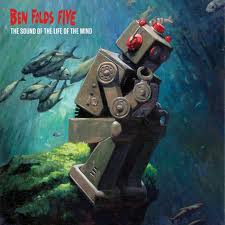
febSOUNDTRACK: BEN FOLDS FIVE-The Sound of the Life of the Mind (2013).

bffThe first Ben Folds Five album in over a decade opens with a big noisy sound and then quickly shows the diversity of the band by pulling back and showing a mellow verse with Ben’s piano and occasional bass.  But then the chorus comes in and Robert Sledge’s bass is once again masterful.  While Ben is clearly the leader of the band, there is something about the BFF’s bass that is so notable.  And this album rocks in BFF’s unique way–rollicking piano, and noisy buzzy bass.

“Michael Praytor, Five Years Later” has some great harmonies (the kind that BFF do so well).  “Sky High” is the kind of social commentary ballad that Ben excels at. And the title track is a fast moving rocker that has more great harmonies.

“On Being Frank” is a Sinatra inspired song with strings.  While “Draw a Crowd” continues Ben’s humorous vulgarity in a very unexpected way: “if you’re feeling small, and you can’t draw a crowd…draw dicks on a wall.”  “Do It Anyway” the single, which inexplicably wasn’t huge, gets more and more fun with each listen–to scream along with “OKAY!” is very cathartic.

“Hold That Thought” is one of those mellow but speedy numbers that I love from Ben.  And when then bass plays that high solo bit near the end (oh that bass), the song kicks into new levels of excellence.  “Away When You were Down” is another string-filled mellow song.  The final track “Thank You for Breaking My Heart” reminds me of “Boxing”, a mellow piano ballad which is, obviously, heartbreaking.

This is a great return to form.  There’s some heavy rockers and some pretty ballads. It’s nice to hear the Five back together again.

[READ: October 5, 2013] 3 book reviews

This month Bissell reviewed three books.

The first book is a biography of Flavius Jospehus called A Jew Among Romans jar by Frederic Raphael (who also wrote the screen play for Eyes Wide Shut).  I had never heard of Flavius Jospehus but evidently without him we would have no historical accounts of time from around the beginning of the Common Era.  His writings are pretty much the only works that have survived.

And his story itself is interesting too. In 70 A.D. the Romans destroyed Jerusalem. This attack has had more impact on current life than can be explained.  Judaism lost the Second temple, Jewish Christianity soon disappeared beneath the waves of Gentile Christianity, even Islam was shaped by this because a Mosque now stands where the Second Temple was.  And nearly all modern forms of anti-Semitism can be traced back to this attack in some way.  Flavius Jospehus chronicled this time as a Jew in a reasonably impartial way (which led many to call him a traitor).  His books Jewish Antiquities and The Jewish War are the sources for almost all of our knowledge of that era, including about Pontius Pilate. (more…)

Read Full Post »

corin SOUNDTRACK: THE DISMEMBERMENT PLAN-“No One’s Saying Nothing” (2013).

IDismembermentPlan_CVR-a71cdf7d3b8dde6270c3a01bb56278949eddb5fa-s1 thought I knew The Dismemberment Plan, but I must have them confused with someone else, because this song doesn’t sound anything like what a band called The Dismemberment Plan ought to sound like (which is noisy and chaotic and probably death metal).  This song has big vocals, organ and piano.  Nevertheless, it is rather raucous and is quite fun (and has what sounds like a drill sound effect in the beginning and middle).

Lyrically, the song is odd–“If you press the space bar enough, cocaine comes out.  I really like this computer.”

But it has a very fun devil-may-care, throw in everything attitude that I really like it.  The entire album was streaming on NPR, and I’m looking forward to hearing more from them–including their back catalog work, to see if they ever sounded like what I thought they sounded like.

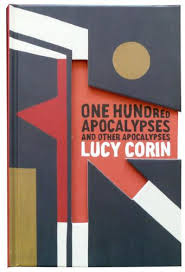
[READ: October 1, 2013] One Hundred Apocalypses and Other Apocalypses

I was excited to get this book because I thought the title was quite intriguing (and the crazy way the cover is cut out was also interesting).

There are four “stories” in the book.  The first three are about twenty pages each while the fourth is over 100 and is comprised of the titular 100 apocalypses (I didn’t count them).

“Eyes of Dogs”
This story contained marginalia (which is sort of like footnotes but not attached to anything specific). In this story a solider meets a witch and she tells him how to get money—climb down a hole and encounter three dogs.  He must wink at the first, blink at the second and hold his eyes closed for the third.  The story seems to be going along sensibly like a fairy tale but then it grows introspective and stops.  I was disappointed in this one.

“Madmen”
This story was utterly bizarre and yet by the middle of the story the bizarreness was explained and by the end I enjoyed it very much.  The premise of this story is that when children grow old they are given a madman to take care of (it is told matter of factly which makes you have to wonder if madman is code for something else.  When boys reach a certain age and when girl;s have their first period (which is an unfair division of genders) they get to go to the asylum and pick which madman (or woman) they want to bring home and care for.  The bulk of the story is at the asylum with the girl “interviewing” the candidates and her mother being mad at her choices.  Ultimately the story turns onto a nice moment between the girl and her dad, who may or may not have married his own madman.  As I said very weird, but satisfying.

“Godzilla versus the Smog Monster”
This was the most “real” of the four stories and it was my favorite.  A fourteen year old boy is watching “Godzilla vs the Smog Monster.”  He found the unlabelled video of it in his father’s sweatshirt drawer and assumed it was porn.  He’s bummed that it turns out to be this Godzilla movie.  In a parallel story, when the boy goes to school his class is watching live footage of California burning—and this burning is uncontainable.  The whole state is slowly engulfed in flames.  This fire, which seems to be some kind of attack obviously changes the minds of everyone in the story, including Sara, a girl who Peter thinks is pretty but who never talks to him.  But when she crashes her car in front of his house, he helps her and they go for a ride to a cave.  Images of the smog monster crop up in interesting ways.  Things get weird and less tangible, but because the beginning was so real it made the ending okay.

“A Hundred Apocalypses”
So this selection disappointed me because it proved to be 100 (I assume) flash fiction pieces.  And I have more or less come down against flash fiction these days.  Especially the kinds of stories that make an interesting “sketch” but aren’t really stories The other problem is that all 100 seemed to be about “apocalypses” which is a useless words when tossed around so much and which loses all meaning when there are 100 that seem to be about actual apocalypses.  Or something.  I also just learned that apocalypse means un-covering or revelation, not really the end of the world, but whatever.

There were probably 6 out of the hundred that I really enjoyed.  Sadly, I didn’t mark them and I don’t remember which ones they were.  The rest were okay or worse.

I am ready for flash fiction to go away.  And I fear that my beloved McSweeney’s is one of the prime generators of the genre, so perhaps they could knock it off for a bit.

Read Full Post »

[WATCHED: October 11, 2013] Pearl Jam interviews

lightning bowlToday is the release date for Pearl jam’s new album, Lightning Bolt. I have heard two songs from it (the fast and furious “Mind Your Manners” and the gorgeous “Sirens”) and I’m quite excited to hear the whole thing.  For the release of the album, Pearl Jam has decided to do some interviews.  But not with the usual suspects.  Rather, they have done four exclusive interviews with surfer Mark Richards, NFL player Steve Gleason, all around awesome lady Carrie Brownstein and director Judd Apatow.

The Mark Richards interview is available in excerpted form here.  I’m not sure how long the whole interview is.  But from the edited down video, we see that he interviewed all five of them for a bit (and then Stone, Jeff and Mike) and then Eddie.  A surfer seems like a reasonable person t ask them about their music and they clearly feel very comfortable with him.  (The video above is about 5 minutes). (more…)

Read Full Post »

harper juneSOUNDTRACK: VOIVOD-Kronik (1998).

kronikVoivod in the E-Force era released two proper albums.  But they also released their first live album and this hybrid collection. So at this point, there were almost more albums with this in retrospect least popular lineup of the band.

Kronik, with the least inspiring album cover of all (the fact that Away doesn’t seem to have anything to do with it even calls into question the “realness” of the release) has eleven songs on it  The first three tracks are remixes.  It’s fascinating to hear these really really heavy songs remixed in a techno way.  I know by this time there was a lot of really heavy techno bands, so this isn’t totally unusual, and Voivod has been experimenting with industrial beats on the last two albums as well.  It’s just fun to imagine these as dance remixes and to speculate who these remixes were made for.  “Forlorn” sounds a bit like Helmet here.  E-Force’s voice is so manipulated as to be almost unrecognizable.  The solo section is also manipulated in a weird way, making this song sound, if not very different from at least somewhat different. There also appears to be some throat singing thrown on to the end of the mix.  “Nanoman” gets the royal treatment—skittery beats, sounds dropping out and a major techno drum beat placed on top of it.  “Mercury” is given a very fast electronic drumbeat but not much else.  But in this version it sounds very classic industrial.

The next three songs are outtakes from the E-Force era.  “Vortex” has a pummeling guitar riff and some massively screamed vocals.  “Drift” opens slowly with some spacey guitars and distant rumbles of drums.  After 90 second the screaming noise kicks into high gear.  “Erosion” has a some steady heavy sections in between the bludgeoning.  They basically all sound like the could have come from Phobos.

The next song “Ion” appeared on the soundtrack to Heavy Metal 2000 the movie and was unreleased until this album.  It has some very cool moments in it and is a little less brutal than a lot of their music from this era.  I rather like it.

The final four songs are live.  “Project X” and “Cosmic Conspiracy” are tracks from the E-Force era, and they sound very close to the studio versions.  I actually prefer E-Force’s voice here, as it is more natural sounding.  “Nuclear War” comes from the very first album. E-Force’s screams are not too dissimilar to Snake’s, although I miss Snake’s pronunciations.  But the music sounds better than on the album.  And then there’s “Astonomy Domine.”  This is the first live recording of the band (and the only song form the pre-E-Force era that’s on a live record.  So it’s exciting to hear them playing this more complex song.  The recording quality is not great, sadly.  But the problem (once again) is E-Force’s voice.  The first verse sounds fine, but as the song moves along he starts screaming a lot more.  And this song just doesn’t lend itself to screaming.  It’s shame.

So this collection is for die-hards and for people who love the heavier period of Voivod (which is not a majority I would guess).

[READ: September 30, 2013] Room 237

This article looks at The Shining, the film by Stanley Kubrick.  It briefly mentions the book by Stephen King, but only briefly.  And actually this article doesn’t so much look at the film as it looks at a film about The Shining called Room 237.  And, actually, Room 237 is more about the people who have obsessed over The Shining for years and who have come up with very detailed theories about the movie.

Some of the theories that these fans have (and which appear in the movie) include: (more…)

Read Full Post »

yodaSOUNDTRACK: PINBACK-“Fortress” (2004).

pinbackMy friend Jay just introduced me to this band.  I’m surprised I didn’t know them since they have been on Touch & Go Records and now Temporary Residence, two labels that I like.

He didn’t suggest any particular songs to start with, but this was the first one that came up with a search.

Over a simple guitar line a quiet voice sings near-whispered lines.  The bridge moves up an octave or so, but keeps the gentle sway of the song.  The chorus adds an angular dimension to the vocals but doesn’t change the gentle guitar melody–it’s an interesting example of contrasts working well together.

It’s a very pretty song and what I like about it is that based on just this one song, their other songs could go in any direction from here–more angular, more mellow, even heavier.  I’m looking forward to hearing more from them.

[READ: September 29, 2013] The Strange Case of Origami Yoda

Clark brought home the second book in this series (Darth Paper Strikes Back) and seemed to enjoy it.  I didn’t really know anything about the series so I decided to check it out, especially since we enjoyed Angleberger’s other books so very much.

This is a fairly simple story of some kids in 6th grade.  Tommy is a sort of uncool kid.  He’s shy and has no luck with girls.  He’s not picked on (I liked that this story never got really nasty), but he’s certainly not a cool kid or a jock.  He’s the perfect underdog character.  For this book, he is assembling a case file about Origami Yoda.

Origami Yoda was created by Dwight.  Dwight is a weird kid.  We hear from his neighbor that she used to see him digging holes in his back yard and then sitting in them for hours.  Dwight doesn’t seem to care about much–he wears crazy clothes, doesn’t do great in school and, weirdest of all, he wears an origami Yoda puppet on his finger.  Seemingly all the time (possibly even in the bathroom).

But the thing is that people have been asking Yoda questions and he (well Dwight, with the worst imitation of Yoda ever) answers them.  And, weirder still, the advice seems to be very good.  Which is especially weird because Dwight is not very smart and doesn’t seem to follow any of the advice that Yoda gives to others.  So what gives? (more…)

Read Full Post »

« Newer Posts - Older Posts »