Feeds:
Posts
Comments

Archive for the ‘Fears’ Category

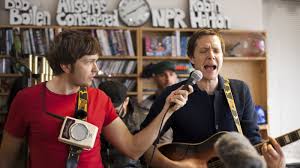
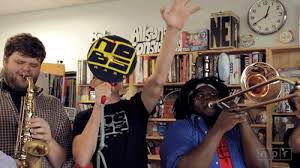
SOUNDTRACK: OK GO-Tiny Desk Concert #278 (June 3, 2013).

I love OK Go’s music videos.  They are stupendous. I have watched all of them several times.  And yet I can’t remember a single song.  But that doesn’t diminish my appreciation for them.

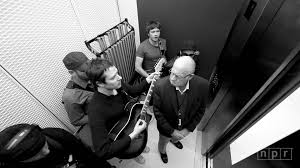
When NPR was moving offices, they made a “Tiny Desk Concert” of the band proceeding from their old location to the new one.  And in OK Go fashion, they made a great video to go with it.  The music is live (I believe), even though they must have shot the footage hundreds of times.  It’s sort of a stop motion video, except that it’s not single frames but short 2 second clips spliced together.

You can watch as the old office is dismantled, as they walk through the halls to the moving truck.   As they play on the truck in the streets of D.C. and then as they enter the new building.  There are cameos from NPR colleagues: Ari Shapiro, Audie Cornish, David Greene, Guy Raz, Scott Simon, Alix Spiegel, Susan Stamberg and more.  There’s a hilarious moment with Karl Kassel who gives them a dirty look.  And then they march through the offices, the news room and into the new Tiny Desk location where they finish the song.

The song is fun and catchy and even has new lyrics that reference the NPR move.  It has to be seen to be appreciated.

And if you like figures here are some details from the shoot:

  • Number of video takes: 223
  • Number of seconds Carl Kasell spent in the elevator with OK Go: 98
  • Number of times Ari Shapiro played the tubular bells: 15
  • Number of days it took to shoot: 2
  • Number of cameras: 1

Incidentally, NPR and I are out of sync with our counting of Tiny Desk Concerts.  I can’t figure out what happened.  The reason mine is correct is because I have written down every concert and numbered them.  So I feel that for them one doesn’t count?  They say this was number 277.  Someday they’ll read this and we’ll get to the  bottom of everything.

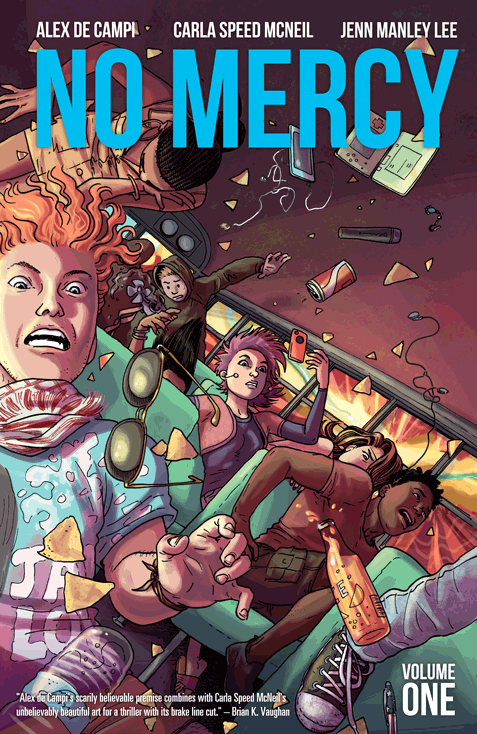
[READ: April 1, 2016] No Mercy Vol. 1

Because of the way books are being handled at my work now, I don’t get to see as many books as I used to. So i was pretty delighted to get this graphic novel on my desk.  Even if I didn’t quite know what it was about, I wanted to read it.  And boy did I enjoy it.

I had no idea that the cast was a group of aspiring Princeton University students on a per-freshman trip to an underprivileged county (I like the t-shirts that say Building Bridges Helping Hands with a kinda Princeton P on the front.

We meet the cast in a cool way–each one steeping forward a bit in the crowd and giving a bit of information about themselves…mostly through text messages. Oh and I loved the way the opening colophon pages looked just like Facebook (or whatever) with a timeline photo and then on the right side–sponsored images with drawings of the author and the illustrators and an ad for an other Image comic by Alex de Campi called Valentine–genius layout idea.

There’s also a comment under the photo which says “OMG how sad, they were also young.”  So you know something bad is going to happen these poor kids. (more…)

Read Full Post »

SOUNDTRACK: NICK HAKIM-“The Want” NPR’S SOUTH X LULLABY (March 24, 2017).

It’s always interesting to hear someone with a big hairy beard sing in high falsetto, and that’s just what Hakim does here.

This song is very simple with twinkling synths and programmed beasts all underneath Hakim’s delicate voice.  The blurb introduces Hakim to those of us who don’t know him:

Nick Hakim begins with a bit of a fake-out — languorous strings like something out of a Stars Of The Lid record rumble from a sampler, somber and hesitant. But as he begins to sing in a heartbroken falsetto, surrounded by optical fibers hanging from the ceiling of SXSW’s Optic Obscura installation by Raum Industries, the ambient intro morphs into a quiet, psychedelic croon.

“The Want” will appear on Hakim’s full-length debut, Green Twins, but for now, this solo version is only backed by Mellotron and the reverb’d rhythms of what sounds like a Casio preset. It’s soul music for outer-space, performed in a room that looks like outer-space.

This blurb makes this song sound a lot more trippy than it actually is.  To me, the only psychedelic bit is one harp line.  Otherwise it sounds like a very spare, echoing, simple song.  The end does add some interesting layers of sound, but maybe the recorded version is more trippy.

[READ: June 1, 2016] The Good Neighbors: Kith

I didn’t really love book one in this series.  I enjoyed the premise, but found the execution flawed–both in the “script” and to an extent in the drawings–there a bunch of characters who all look vaguely similar.  But I did like it enough to want to read Book 2.

There’s a handy recap that catches us up.

Then we see Rue sad because of her sullen boyfriend who might be breaking up with her.  But he’s a dick anyhow as are most of the characters, frankly.

About 30 pages in something interesting happens when they discover a knife in a tree. (more…)

Read Full Post »

SOUNDTRACK: PHOEBE BRIDGERS-“Smoke Signals” NPR’S SOUTH X LULLABY (March 22, 2017).

Bridgers’ “Smoke Signals” is a beautiful haunting song that reminds me a little of Liz Phair in her delivery.  I had heard this song before and really liked it–I especially loved the arrangement, which had echoing guitars that reminded me of Twin Peaks.

“For this Tiny Desk, Bridgers and percussionist Marshall Vore came to Bob Boilen’s hotel room just before midnight to play the striking ‘Smoke Signals.'”  The music is great with Bridgers’ open chords, and Vore’s suitcase percussion, children’s toy bells and vocal harmony.  The cho and vibe are removed in this version which means you must really listen to the words–which are pretty intense.

I like how she talks about musicians in such an interesting way:

Singing ‘Ace of Spades’ when Lemmy died / nothing’s changed LA’s alright

and then later

Its been on my mind since Bowie died/ just checking out to hide from life

The toy bells and harmonies are a really nice touch, but again, it’s those lyrics:

I went with you up to
The place you grew up in
We spent a week in the cold
Just long enough to
“Walden” it with you
Any longer, it would have got old

This song is a little too slow for my preferences, but it’s very beautiful. I’d like to hear more from her.

[READ: February 5, 2016] The Good Neighbors: Kin

This book was on the new shelf at my library.  And since I like Black and Naifeh I was grabbed it.  Then I saw that it actually came out in 2008. Whatever.

It also turns out that my library has book two of this trilogy but neither had book 3 (which came out in 2010).  What gives?

Holly Black is best known (by me anyway) as having written The Spiderwick Chronicles.

This story is actually a YA graphic novel and it definitely skews older.  But like Spiderwick, it deals with a normally unseen world coming into contact with out own. (more…)

Read Full Post »

SOUNDTRACK: DAKHABRAKHA-“Kolyskova” NPR’S SOUTH X LULLABY (March 21, 2017).

I loved DakhaBrakha’s Tiny Desk Concert.  It was mesmerizing and beautiful.  And so the performers came to SXSW and did a lullaby.  And as the blurb says, they brought their “cello, keyboard, accordion – and tall, wool hats! — to the balcony of the Hilton Austin hotel.”

This lullaby of “Kolyskova” quiets things down a bit.  The song opens with simple keyboard notes.  One of the women sings, and when they reach the end of the verse, the male accordionist sings a falsetto that matches the women’s tone.  The woman on drums makes a strange sound–like a baby crying or animal yelping.

Then he winds up singing lead on the second verse in that falsetto with the women singing backing vocals.  Then the cello and drums kick in to build the sound.   The third verse is sung by the cellist as the keys play a pretty melody.

The song is upbeat with lots of bouncy vocals, even though the lyrics seem rather dark.  ‘The band only ever calls it “Lullaby.” It’s a quiet, contemplative song that the band says is a “connecting of several lullabies” with “philosophical lyrics that [say] we have time for everything — time to laugh and cry, time to live and die.’

I love at the very end as the song slows down to just the keyboardist singing because the drummer adds a very cool breathing as a kind of percussion accompaniment.  And then as the camera pulls back the two attack the keyboard making a cacophony of fun notes.  I bet they’re a lot of fun live.

[READ: June 2 2016] Explorer: The Hidden Doors

This is the third (and I assume final) in a series of graphic novel short stories edited by Kazu Kibuishi, the creator of Amulet.

I really enjoyed the first one a lot and was pretty excited to read the rest. As with the other two I was delighted by the authors involved and the quality of these stories.

The three books are not related to each other (aside from thematic) so it doesn’t matter what order you read them in.

This book revolves around the theme of “hidden doors.”  I like the way each author takes a concept that seems like it would be pretty standard and turns their stories into things that are very different indeed. (more…)

Read Full Post »

SOUNDTRACK:  NINA DIAZ & Y LA BAMBA’s LUZ ELENA MENDOZA-“January 9th” & “Living Room” NPR’S SOUTH X LULLABY (March 20, 2017).

I was intrigued by this pairing because Luz Elena Mendoza has a shirt buttoned up to her neck and, from the angle of the first song, it appears that she has her long sleeves down, while Nina Diaz (originally from Girlfriend in a Coma) is wearing a sleeveless T-shirt with tattoos showing up and down her arms.  They seem somewhat mismatched.  Until they sing.  (And also during the second song when it becomes obvious that Luz Elena’s arms are covered in tattoos as well).

The two have never played together, but after NPR Music paired them in the courtyard of St. David’s Episcopal Church for a late evening performance, we’re beginning to wonder why not. They’ve both played the Tiny Desk (Diaz twice, once with Girl In A Coma) and both navigate complex emotions and notions of identity in their music. Also, they just sing beautifully together, Mendoza’s yodel swirling in Diaz’s gritty croon.

Luz Elena’s song “Living Room” is first.  She plays guitar and sings. It’s a short song with Nina’s nice high harmonies over Luz Elena’s deeper voice.  The blurb also notes: Mendoza shares a brand-new song here, “Living Room.” When the two harmonize its confession — “I feel like I’ve been undressing all my thoughts in front of you” — it is, in tandem, starkly intimate and separate.

Nina Diaz’ song “January 9th” is a bit more fun (partially because I know it from her Tiny Desk Concert, but also because it’s a bit more upbeat).  I like Diaz’ singing quite a bit.  Mendoza’s backing vocals add nicely to the “bad one/sad one” part of the chorus.  The blurb adds: “It’s a bluesy ballad with a through line of ’60s pop, a tribute to her late grandmother, cooed and howled into a warm Austin evening.”

Future collaborations should be called for.

[READ: June 27, 2016] Explorer: The Lost Islands

This is the second in series of graphic novel short stories edited by Kazu Kibuishi, the creator of Amulet.

The three books are not related to each other (aside from thematic) so it doesn’t matter what order you read them in.

This first one is all about “lost islands.”  What was neat about this book was that since the premise of an island is so broad, the stories were all very different. (more…)

Read Full Post »

SOUNDTRACK: L.A. SALAMI-“Day To Day (For 6 Days A Week)” NPR’S SOUTH X LULLABY (March 17, 2017).

L.A. Salami’s full name is Lookman Adekunle Salami.  I really enjoyed Salami’s song “Going Mad As The Street Bins.”  His delivery is great and there were some rather unexpected chords.

For this performance of “Day to Day,” he is standing on the balcony of the Hilton Austin hotel overlooking the downtown skyline.

I usually try to pair kid-friendly songs with books, but there’s some curses in this song).

The music is basically the same for 7 minutes (although it does build by the end), which means you must focus on the lyrics. And they are pretty dark.  It talks about boredom on public transportation as well as gruesome deaths on the news.  There’s talk of mental health, like this section:

Went to work for the NHS –
Mental health, people depressed.
Met Joanne – Scared of living,
Afraid of dying, terrified of being.
Then met Paul, a schizophrenic,
Shaking limbs, paranoid fanatic –
Unwashed 10 days in a row –
So afraid almost paralytic.
I tell them that I do the same –
In certain moods, on certain days…
But despite the sane ways I can think
I could not do much to convince them…

But mostly I enjoy his delivery which has his slightly accented voice and charming mannerisms.  The first time I heard this I wasn’t as drawn to it as I was his other song, but each listen unveils something more to like about it.

[READ: June 1, 2016] Explorer: The Mystery Boxes

This is the first in a series of short graphic novel short stories edited by Kazu Kibuishi the creator of Amulet.

Sarah brought these home for the kids to read and they were sitting around our house for a while so I picked one up.  When I flipped through it and saw all the great authors in it I knew I had to read them.

The three books are not related to each other (aside from thematic) so it doesn’t matter what order you read them in.

This first one is all about “mystery boxes.” (more…)

Read Full Post »

tyrantSOUNDTRACK: CHRISTINE SALEM-Tiny Desk Concert #326 (December 14, 2013).

As with many artists behind the Tiny Desk, I had never heard of Christine Salem.  So who is she?

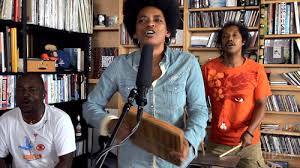
Christine Salem sings songs that are old: They’re work songs and chants from the maloya tradition on Réunion Island in the Indian Ocean. I first heard her in New York City as she shook a flat board called a kayamb, made of cane reeds, with two percussionists flanking her to provide rhythm.

Salem makes powerful, strongly focused music in which all the elements are essential, with nothing superfluous. She says it feels like the spirits move through her when she plays, and though you may doubt her if you’re a nonbeliever, you’d be hard-pressed to deny her your attention once you hear her.

And that’s pretty spot on.  She sings like a woman possessed–but in a good way–serious catharsis for these intense pieces which are amazingly musical for songs with no instruments except percussion.

“Listwar” showcases her strong, powerful voice when she sings by herself but the whole thing grows amazing when the other voices come in.  But even that doesn’t even prepare you for the wonders of the percussion that come next—that kayamb is mesmerizing, the big drum is so deep and the percussive sticks (which seems like he’s hitting what might be a lectern) all work perfectly.  All of the melody comes from their voices.  The backing guys also seem possessed by the music and the drummer is even laughing he’s so filled with joy.

“Alouwe” begins with claps and rhythmic chanting, which is pretty cool, but again, when the drums come in its even better. Halfway through the tempo picks up and she grabs that kayamb again and the intensity ratchets up.  There’s chanting from the men with lots of laughing and clapping at the end.  The final song is “Komor Blues.”  For this one, she is just by herself playing the drum.  While not as big as the other songs, it is just as intense, especially when the pace speeds up about halfway through.

I have no idea what she’s singing about, but I was mesmerized by the whole thing.

[READ: May 15, 2016] Tiny Tyrant

I read this book last year, never even imagining that it could somehow be comparable to our then highly unlikely leader.  Reading back on it now, I can’t get over the similarities between this fictional character and our television-inspired president.  I mean, look at how King Ethelbert is described: “Selfish, short-tempered, unscrupulous, stubborn, and willing to do anything to get what he wants.”

This book collects all of the Tiny Tyrant stories into one volume (Volume One: The Ethelbertosaurus & Volume Two: The Lucky Winner) were published by First Second with six stories each).  They were originally collected into four books in French (and translated into English by Alexis Siegel).

First Second had a lot of books by Lewis Trondheim in their earlier publication days but that seems to have gone by the wayside somewhat this decade.

Perhaps it is because his books are hard to classify.  They are basically kids books but they are pretty dark kids books–there’s usually death and blowing up and horrible things happening to people.

Tiny Tyrant is one of the sweeter Trondheim books that I’ve read.  Because even though the Tyrant is a tyrant, he is mostly unsuccessful  in his demands and nobody blows up [let’s hope we are so lucky with our country’s current wanna-be-dictator]. (more…)

Read Full Post »

2010 SOUNDTRACK: ANTIBALAS-Tiny Desk Concert #243 (October 4, 2012).

antibAntibalas (Spanish for “bulletproof”) is a Brooklyn ensemble.  Eleven members turned up for the Tiny Desk.  And they are quite the ensemble.  There are trumpets, saxophones, two guitars, a bass and a ton of percussion.  There’s a percussionist/keyboardist wearing a lucha libre mask (!) and the lead singer (singing in English and some other language) has what looks like tribal paint on his face. (He also plays conga and cowbell).

The blurb states:

There just aren’t many bands like Antibalas. These are jazz players making dance music: Their music is big and fun, and their guiding spirit is Fela Kuti, the brilliant big-band leader and Nigerian Afrobeat pioneer. Afrobeat is a musical style featuring nearly endless songs, mixing funk and jazz, grooves and riffs, with the rhythm carried by not only the drums, but everyone. Everyone — horn players, bass players, guitarists — plays rhythm in Afrobeat music.

It’s one thing for a big group to make a big sound — and, sure, Antibalas does that — but what stands out is the subtlety of this ensemble; the way the horns weave in and out of each other, sometimes complementing and at other times inspiring and creating musical conversation between players. That extends to all the players, from vocals to guitar. When you start to listen to that conversation and you hear that build in a rhythm, it’s so powerful, so full of joy. If they come to your town, drop what you’re doing and go see them. Wear dancing shoes.

They play two songs, but they are long and full of rhythm.  “Dirty Money” runs just under 6 minutes. I really like the way the horns seems to echo and answer each other during the slow sections.  While the whole band sings the backing voices.  And when the masked guy switches from percussion to keyboards, it’s got a  groovy 70s sound coming out of that machine.   All of it is anchored by the bass, keeping a steady rhythm.  One of the trumpeters switches to trombone for a solo as well.

“Him Belly Go No Sweet” has an even funkier feel–lots of percussion and staccato horns slowly working with each other to create a big sound.  Even though there’s plenty if music in this song it’s impressive how much they use silences—things are never quiet (there’s always a bass line or percussion) but for such a big outfit they can really get things to quiet own.  The end half of the song sees the band singing “go up  go down” while the lead singer seems to improvise a whole bunch of stuff.

It is, indeed, hard not to dance to this.

[READ: July 10, 2016] “Baptizing the Gun”

This was a very dark story and, if nothing else, it made me never want to go to Lagos, Nigeria.

The story is told in first person by a priest.  He is not wearing his collar and is driving a borrowed VW Beetle through the traffic of Lagos.

As the story opens, a woman is screaming because a thief just pulled an earring out of her ear–tearing her earlobe. He is caught and, astonishingly, “ringed with tires, doused in petrol, and set ablaze.”  Even though there is barely any fuel to be had “there’s always enough for the thief.”

The priest believes his trip was a success and many parishes have promised his parish in the Niger Delta money and materials.

But on his way back (at 18:03) the car dies in traffic. (more…)

Read Full Post »

dressSOUNDTRACK: IMANI WINDS-Tiny Desk Concert #277 (May 29, 2013).
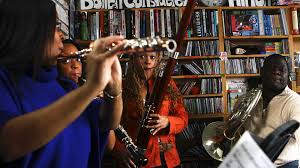
windsFor some reason this video and audio has been removed from the NPR site (no explanation is given).  But I found it elsewhere and was able to really enjoy it.

But they have left up the blurb:

When Igor Stravinsky began composing The Rite of Spring, his ballet for vast symphonic forces, he could hear the music in his head but couldn’t quite figure out how to write it down. It was just too complicated.

Today, 100 years after The Rite‘s premiere, the fearless musicians of Imani Winds make it all sound remarkably easy, given that they’ve condensed Stravinsky’s massive walls of sound down to just five instruments: bassoon, clarinet, flute (doubling on piccolo), oboe and French horn.

Make no mistake: Many of the jagged rhythms and crunching chords remain viscerally intact, albeit on a more intimate scale. As the group huddled behind Bob Boilen’s desk, bassoonist Monica Ellis noted the opposing ratios, saying, “It’s apropos in some strange way that we are playing one of the most massive pieces in some of the smallest instrumentation in one of the smallest settings that it could possibly be played in.”

The setting might be small, but in this clever arrangement by Jonathan Russell, we learn that a wind quintet, when called upon, can make a mighty and sonorous wail. Just listen to how the Imanis cap off “Dances of the Young Girls” with the entire quintet in full cry (at about 4:30 into the video). The bassoon repeats a fat bass line while the clarinet runs its snaky scales. The piccolo, in piercing chirps, serves as a foil to a frenzied oboe and snarling “whoops” from the French horn.

But not everything in The Rite is all pound and grind. Stravinsky’s transparent introduction, almost impressionistic, is a fluttering aviary of winds — even in the original — with individual colorings for each instrument. It’s all rendered beautifully here by Imani Winds, musicians brave enough to play David to Igor Stravinsky’s imposing Goliath.

This concert is fascinating to watch (and listen to) because even though this piece is familiar (to me) in theory, it’s apparent that I don’t really know it.  And I can see why this piece was so controversial when it came out–it is weird and chaotic and almost random at times.  I imagine that seeing it as a ballet might make it more cohesive, but it’s still pretty out there.

I love that the bassoon seems to be the primary instrument–one that doesn’t typically take center stage.

The group breaks up their selections into three primary chunks.

Selections from The Rite of Spring:

For “Introduction” the bassoon is the primary instrument playing the initial melody.  Then the clarinet and oboe give the whole thing an unsuaul sound–to say the least.  The French horn actually works as the the bass for this part.  It’s also neat watching the flautist switching between flute and piccolo.  I’m not sure when the second part “Augurs of Spring” begins, but I assume it’s when the bassoon repeats that initial melody and then the French horn plays a staccato bass note. The music sounds kind of threatening but whimsical at the same time.

Somewhere in here “Dances of the Young Girls”  begins.  I assume once the piccolo starts chirping and swooping.   And then the band grows very loud before abruptly stopping.

The second segment she describes as incredibly picturesque. “Ritual of Abduction” begins nosily with almost total chaos from all the instruments–the piccolo stands out as sharp and piercing.  As with the other segments, I’m not sure when “Spring Rounds” begins, but I have to wonder if this is when the music seems to go circular and then slow down. There are low notes from the French horn while someone is playing accent notes that sound, not off, but dissonant–providing stark contrast with the rest of the slow movement.  There are some blares of music from the French horn as well.

I’m guessing that “Dancing Out of the Earth”  begins with the fast bassoon melody: up down up down up down up down with trills and swirls from the flutes and clarinet.  It rises and rises very dramatically and then stops.

They tell us that it’s not possible to play the entire ballet so they have taken the “greatest hits” and for this show it’s the greatest hits of the greatest hits.  Consider it a deconstruction with five instruments. But it still evokes the spirit of this sacrificial dance.

She talks about how controversial this was in 1913, “when ballet was meant to be about… I was going to say flamingos…. fairies swans, the other water animals.”   This is the final moment the virgin who sacrifices herself dances herself to death.  And they are going to exemplify trombones and timpani and all that loud stuff (the French horn player laughs and says “Grr I am trombone”).

“Sacrificial Dance: The Chosen One” begins with a three note melody–again it is somewhat threatening.  There’s lots of little fast runs by the French horn with accents from everyone else.  It stops dramatically at one point and then resumes with so many different melodies.  And then comes the surprise ending with a rising flute line and then a low end from the horn.

Without taking away anything from Imani Winds, I ‘m sure this performance doesn’t do the whole thing any justice.  But it is amazing to imagine how much more there is to it.  And it is amazing that these five instruments can evoke so much.  It’s an uncomfortable and somewhat shocking first listen.  It’s amazing that is over 100 years old, although it sounds so contemporary.

I don’t know why it’s not on NPR any more. I found it on YouKu (whatever that is).  I have been able to watch it twice but on two other times I was unable to watch it.  So keep trying, it’s worth the effort.

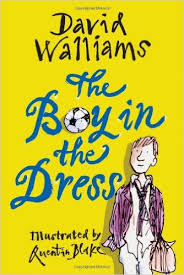
[READ: May 5, 2016] The Boy in the Dress

David Walliams is best known (if he is known at all) as the tall one on the sitcom Little Britain.

I had no idea he wrote books (he has done over half a dozen children’s books), and I was happy to start with this, his first one.

This book is illustrated by Quentin Blake, who is best known (if he is known at all) as the illustrator for the Roald Dahl books.  So his simple, somewhat sloppy, style might look familiar.

The story is, as the title suggests, about a boy who wears a dress.  And the story is very funny–not because it makes fun of him for wearing a dress, oh no.  In fact, I love the story for going out of its way to show that it is normal that a boy might want to wear a dress. (more…)

Read Full Post »
sahrakSOUNDTRACK: NO BS! BRASS BAND-Tiny Desk Concert #280 (June 15, 2013).

nobsWith a name like No BS! Brass Band, you think you know what you’re getting: brass and lots of it.  And while that is true, the Band goes way beyond what I anticipated a brass band would sound like (nothing like the far more traditional Canadian Brass for instance).

The blurb states:

Funky and danceable, the NO BS! Brass Band takes after the full black-music continuum you hear in groups like Rebirth or the Hot 8. But it’s also proggy, and a bit brutalizing, and full of pride in a different Southern outpost. The group’s new album is called RVA All Day, after all.  [I don’t know what that last line refers to].

Recently, Koehler, Pace and nine other musicians piled into a bus and journeyed up the freeway to NPR Music’s Tiny Desk in Washington, D.C. They blasted us with songs from the new album — it was so loud, you could hear the music on the other side of the building, a floor down.

The band includes:  Lance Koehler, drums ; Reggie Pace, trombone ; Bryan Hooten, trombone/vocals ; John Hulley, trombone ; Dillard Watt, bass trombone ; David Hood, alto saxophone ; Marcus Tenney, trumpet ; Sam Koff, trumpet ; Ben Court, trumpet ; Taylor Barnett, trumpet and Stefan Demetriadis, tuba.  And they play three super high energy largely instrumental songs that are obviously jazzy but which also have elements of the most fun marching band you’ve ever heard along with some rapping, some chanting and lots and lots of clapping.

The first song is all about “RVA All Day.”  And yet since that’s all they chant, I still don’t know what it means.   While the whole band plays loudly and powerfully, there’s a few solo moments as well.  First a trombone solo followed by a sax solo, then a trumpet and a super wild trombone solo (he gets some truly great, crazy sounds from that thing).  And then a huge surprise, midway through the song is a rap through a megaphone.

“Run Around” has a sing along to begin the song (and again, vocals through the megaphone).  It is also lively and a lot of fun.  The final song, “Infamous”sounds a lot more jazzy/big band.  It’s got a really nice groove.  The middle has a section with just tuba and trumpet where the rest of the band claps and shouts “Ho!” and it sounds great.  It’s also interesting watching how the different players “store” their instruments in different ways while clapping.

No BS! Brass band will totally make you wiggle your hips.

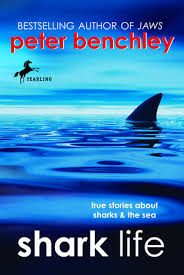
[READ: August 20, 2016] Shark Life

C. had to pick a book for summer reading and he chose this one.  He enjoyed it so much, that he encouraged me to read it too.  And I’m really glad I did.  Although it wasn’t until writing this that I realized that this book was adapted for young people by Karen Wojtyla.  And yet I can’t find any mention of a grown up version of this book anywhere.  So who knows.

Anyhow,  Peter Benchley (who died in 2006) is the author of Jaws, and this book is full of stories of his life in and on the sea.  For, in addition to being an author, Benchley was a diver and explorer.  And his tales are both exciting and full of conservationist ideas.

The book opens in 1974. After the success of Jaws, Benchley had been invited to Australia to be on The American Sportsman.  He was going to be swimming in a cage with sharks feeding around him.  They put him in the cage, strapped all kinds of good food to it and left him there (okay they were close by).  But a few things went awry and suddenly things weren’t quite as safe as they could be. The shark got caught in Benchley’s air line and then panicked.  And a panicking shark is never a good thing. (more…)

Read Full Post »

« Newer Posts - Older Posts »