Feeds:
Posts
Comments

Archive for the ‘Essays’ Category

may5SOUNDTRACK: THE FAMILY CREST-Tiny Desk Concert #379 (August 4, 2014).

familycerstI first heard The Family Crest on this Tiny Desk Concert back in 2014 and I immediately fell in love with them.  I received their album for Christmas, and it’s quite fantastic.

The band plays a wonderful mix of over the top chamber prog rock mixed with healthy doses of jazz.

There are seven people in the band, which is centered around guitarist and (amazing) vocalist Liam McCormick.  Their instruments include violin, cello, upright bass, flute, trombone, drums, and guitar but this band rocks hard (and McCormick can wail like the best of them).

The set begins with the jaw dropping “Beneath The Brine” which opens with a great cello riff and is quickly accompanied by violin and flute.  When the full band kicks in, grace notes are added to the riffs to really fill out he song (from the flute and the drums) and it builds until Liam starts singing.  His voice is powerful and strong with a great sense of melody.  The drums, by the way are playing wonderful jazzy patterns and accents.  But it’s around 2:30 that Liam shows just what he can do with his voice as he hits some amazingly powerful high notes.  As the song romps to an end, you can hear all of the instruments adding to the music before the final quite coda.  It’s fantastic.

“Howl” is inspired by jazz.  Liam was trained in opera (which explains a lot) and the band is full of classical fans, so he was excited to add Charlie the jazz drummer “hey man wanna listen to Miles David and drink whiskey?”  The song opens with a big trombone riff before settling into a snappy jazz song.  This song has a number of loud and quiet moments that work well together.  It’s even got a great “ba ba ba ba ba ba” section that is fun to sing along with.

 They ask “one more?”  And Bob says “or stay all day.”  So they play the final song, “Make Me a Boat.”  If you can forgive the little GoPro ad, it’s neat that this relatively unknown band has been embraced by the camera company.  “Make Me a Boat” doesn’t seem like the most obvious choice for a video since the beginning is kind of slow, bit the middle section is really pretty and has a great flowing feel that would work well with a video.  And in this live version Liam does some great improv singing of powerful high notes that really flesh out the melody which the rest of the is playing (no wonder he’s so sweaty by the end).

The album fleshes out the orchestral sense of the band with a 30 piece orchestra which makes these songs even more grand.  The Family Crest was a great find.

[READ: February 22, 2016] “Letting Go”

Sedaris is one of the funniest writers when the topic is smoking.  He is (or was, I suppose) and inveterate smoker.

And I love that he starts the essay with this paragraph:

When I was in fourth grade, my class took a field trip to the American Tobacco plant in nearby Durham, NC.  There we witnessed the making of cigarettes and were given free packs to take home to our parents. I tell people this and they ask me how old I am, thinking, I guess, that I went to the world’s first elementary school.

He starts this essay talking about how much he hated smoking when he was a kid.  His mother smoked all her life and he just hated it.  Not the smoke so much but the smell–he found it depressing “the scent of neglect.”

Of course then he started smoking himself.  He talks about trying to decide which brand to use–the brand you chose was a statement back then.  He chose Viceroy.  And he started smoking them when he was in Vancouver. (more…)

Read Full Post »

may16SOUNDTRACK: MARISA ANDERSON-Tiny Desk Concert #374 (July 19, 2014).

marisaMarisa Anderson may be the most unassuming guitar wizard I’ve ever seen.  There’s nothing flashy about her or her look, but man can she make those guitars sound great.  And she plays an old-timey bluegrass style of guitar with slides and lots of picking.

For this set she plays 5 songs (on four different guitars).  She doesn’t sing, she just lets the music do all the work.

“Hard Times Come Again No More” is done on a hollow-bodied electric guitar.  It’s noisy, and fuzzy.  She plays finger-picks the main melody in the high notes and then in the middle of the song she plays big open string chords–buzzy and noisy–while still playing the melody.  She says the song “gets stuck in my head if I’m driving through snow.”

“Sinks and Rises” is about a swimming hole in Kentucky.  She went there in a car, but she wasn’t driving and she’s never been there since but it was the best swimming day of her life.  For this song she plays a lap steel guitar that looks to be made of ivory.  It’s so much fun to watch her slowly moving that slide up and down the neck (sometimes only playing one note) while her picking hand goes like crazy.

For the third song she plays a different hollow body guitar.  “Hesitation Theme and Variation Blues” was inspired by her favorite guitar player Rev. Gary Davis.  She says this is a deconstruction of his “Hesitation Blues.”  She doesn’t sing so she took it apart and put it back together.  It begins with an almost classical theme before launching into a very cool blues.

Then she switches back to guitar #1.  She says she plays in settings didn’t allow cover songs, she didn’t want to do just originals so she played songs from public domain–like the national parks if we don’t use them we’ll lose them.  In 2013, she released an album that was all songs in the public domain.  “Canaan’s Land Medley” is a medley of three gospel songs.  She plays the melodies with her fingers and a slide on her pinky–which adds some cool textures to the song.

For the final song, “Galax,” she brings out guitar #4, a Fender Strat (or knock off). She says she went to a bluegrass festival and was overwhelmed by all of the good songs being played in the parking lot–she’s not even sure if she got to the show.  This song is about all those songs being played at once.  There’s some really fast guitar playing and slide at the same time.  It sounds great and is even more fun to watch.

Anderson is really a marvel–totally soft-spoken and seemingly shy, but main is she amazing to listen to.

[READ: July 13, 2016] “Call Me Crazy”

The May 16, 2016 issue of the New Yorker had a series called “Univent This” in which six authors imagine something that they could make go away. Since I knew many of them, I decided to write about them all.  I have to wonder how much these writers had to think about their answers, or if they’d imagined this all along.

Of the six articles, Brownstein’s was certainly the funniest.  It’s also the most contemporary and almost the most obvious thing to complain about.  But it suits her comic style very well.

She wants to uninvent the conference call.  She assumes that we all agree that the conference call is a bad idea, but in case we need convincing she offers this example. (more…)

Read Full Post »

CoverStory-KadirNelson-ADayattheBeach3-879x1200-1467305948SOUNDTRACK: LYDIA LOVELESS-Tiny Desk Concert #369 (July 1, 2014).

lovelssI want Lydia Loveless to be a punk singer–Her name is like a combination of Lydia Lunch and a last name that conjures up an asskicking punk.

But not the country singer that Loveless is (even if she is ass-kicking herself). Loveless is a new breed of alt-country which is pretty explicit with noticeably rocking guitar solos.  But her voice is so twangy it’s hard to not call it country (and in fact it’s a bit too much for me to take sometimes).

“Head” features this rather memorable chorus “Don’t stop getting undressed /Don’t stop giving me head.”  It seems especially surprising since Loveless looks like she’s about 12 (she was 23 at the time of this recording).  The buzzy solo is lengthy and more or less runs throughout the song.  Although at some point when Loveless takes her own solo the whole sound seems to fade out and get a little anemic.

Her band is fun with her bassist being very tall and having very long hair playing a very tall upright bass.  And then there’s another guy playing guitar and lap steel.

“Verlaine Shot Rimbaud” has a title that begs for an awesome song.  It’s not an epic masterpiece or anything.  In fact its closer to a pop song, The slide guitar and Loveless’ heavy accent on the chorus place it firmly in the country camp.

“Mile High” has a fun folk riff.  It sounds a lot like The Byrds and the chorus is super catchy.  If I could get her to sing less twangy I would love this song much like I love the punk country of X, or at least the Knitters.

[READ: December 29, 2010] “Who are All These Trump Supporters”

[This essay in the New Yorker also came under the heading “Trump Days.”]

So the title of the essay is a question I myself have been asking as I watch the hatred and vitriol bubble over during the convention.

If there was anyone I wanted to write this piece it would be George Saunders and he is actually the only reason I read it in the first place (I plan to read all of his contributions to the New Yorker eventually, but I’m glad to have read this one when it was timely–I hope it will be utterly irrelevant by the time I get to the rest of his works).  He self identifies as a liberal (although he was a conservative who loved Ayn Rand way back in the Reagan era).  He is a thoughtful and not prone to anger–a perfect foil for the crowd.  And he’s got a great way with words.

So great in fact that I’m just going to be quoting him a lot.  I could have pulled more excellent quotes from the essay, but really you should read the whole thing. (more…)

Read Full Post »

may16 SOUNDTRACK: SUZANNE VEGA-Tiny Desk Concert #336 (February 10, 2014).

vegaSuzanne Vega is practically a one hit wonder except that she has released a half-dozen great albums that are full of wonderful songs.  I stopped listening to her some time in the mid 90’s, so I missed her 2000s comeback, but this four-song show from 2014 has her two most famous songs and two songs from her then about t o be released album Tales from the Realm of the Queen of Pentacles.

As the Concert opens, she asks “for real?” and the hits the Tiny Desk gong (with quite a flourish).

Then she launches into “Luka.”  She plays acoustic guitar and sings.  Her voice sounds pretty much exactly as it did twenty years ago.  In part, sure, it’s because her singing voice is practically a whisper, but it’s amazing how good she sounds.  She has a second guitarist, Gerry Leonard, with her (on electric guitar) who plays a great sounding solo in the middle of the song.

The first new song is “Crack in the Wall.”  She says that it  describes when a crack appears allowing you to see into the spiritual world.  In this version (I don’t know the studio version), it sounds a lot like an old song–stripped down and simple, with Vega’s interesting gentle acoustic guitar chords and voice.  There’s also a cool echoed electric guitar solo.

For “I Never Wear White” she takes off the acoustic guitar.  It’s just her singing and Leonard playing.  And his guitar his rough and distorted.  It is pretty shocking for a Vega song, but it works really well with her voice.  I really like this song a lot.

She ends with “Tom’s Diner.”  She was going to say the one and only, but says they’ve done so many different versions of it.  So this is their latest.  She sings parts a capella but the guitar plays some wonderful washes of sounds (looped) with different parts layered.  He also plays a percussive sound that makes the song kind of danceable.  And when she mentions the bells of the cathedral, Gerry plays some cool harmonic notes that are echoed and sound like clock chimes.  It’s very cool.

Vega’s speaking voice sound a little like Hillary Clinton’s (especially during the thank yous at the end).  But it’s nice that her singing voice still sounds the same and that 2014 album seems like it might be interesting.

[READ: July 6, 2016] “High Maintenance”

The May 16, 2016 issue of the New Yorker had a series called “Univent This” in which six authors imagine something that they could make go away. Since I knew many of them, I decided to write about them all.  I have to wonder how much these writers had to think about their answers, or if they’d imagined this all along.

I’ve never read Mary Karr, I only know her peripherally as connected with David Foster Wallace.  This may not have been the best introduction to her, although since she mostly writes memoirs, maybe this is the perfect introduction.

Mary Karr would like to uninvent high heels.  And while she does speak of this with some humor, the entire article just reeks of vanity and foolishness.  (The fact that she even mentions she can still squeeze into a size 4 should tell you all you need to know about this essay). (more…)

Read Full Post »

may16 SOUNDTRACK: SOFIA REI-Tiny Desk Concert #338 (February 22, 2014).

sofiaSofia Rei is an Argentinian singer.  For this Tiny Desk Concert she has two accompanists: drummer Franco Pinna incorporates a drum from the Argentine Pampas into a traditional drum set and guitarist/bassist JC Maillard plays a pretty guitar and a modified saz bass.

In profile Sofia looks a bit like Polly Jean Harvey but when she sings it’s very different.  Her voice is sultry and influenced by Argentinian jazz.

I love the way the first song, “La Gallera” starts with slow verses but the chorus are just wild and crazy and full of rhythms and some great chords.  And of course, that drum is an integral part of the solo that fills the middle so the song.

“La Llorona”  is a beautiful slow ballad with Rei’s voice floating above the percussion and gentle modified saz bass (more on that in a moment).  The song builds over five minutes with her voice getting louder and more impassioned.  And just as the song really builds and seems as if its going to rock out, it ends–leaving us wanting more.

“Todo Lo Perdido Reaparece” (“Everything That Has Been Lost Reappears”) brings her back home to Argentina.  The song starts quietly with Rei singing some syllables and noises before the song proper starts.  It is a slow ballad filled with percussion.  Midway through the song while Maillard is doing a wonderful guitar solo, Rei picks up a charango and plays lovely high notes.  The chord progression during this and the following section with vocals is fanatic–catchy but also unusual.

At the end of the show, Maillard talks about his modified saz bass.  He says it is based on the Turkish instrument but it was made for finger picking rather than plectrum.  His is the first ever made.  With eight strings, it has bass strings for thumb picking and high notes for the other fingers.  It also has a lot of “empty” spaces to make interesting percussion sounds. I love seeing new instruments and this little demonstration is very cool.

[READ: July 11, 2016] “Bad Character”

The May 16, 2016 issue of the New Yorker had a series called “Univent This” in which six authors imagine something that they could make go away. Since I knew many of them, I decided to write about them all.  I have to wonder how much these writers had to think about their answers, or if they’d imagined this all along.

Ted Chiang says he never learned anything in the Saturday morning Chinese school he was forced to attend as a child.  But that’s not why he wants to get rid of the Chinese character-driven alphabet system.

He says that he is a fan of literacy but that Chinese characters have been an obstacle to literacy for millennia. You have to learn three thousand characters and you can’t use pronunciation to help you–it’s all memorization.  Even highly educated Chinese speakers regularly forget how to write the characters that they use infrequently.

He also decries the technological obstacles that Chinese poses–computers and smart phones are impossible to use.  And even dumbed-down solutions like Pinyin just cause more work.

Interestingly, even though he wants to do away with the written characters the last couple of paragraphs of this essay talk about the virtues of this system.

Pronunciation changes over the centuries, so as language evolves, older works are harder to understand (take Beowulf).   This is why “Classical Chinese remains readable precisely because the characters are immune to the vagaries of sound.”

Chinese culture is notorious about tradition.  He says this is not because of the Chinese characters but there must be some influence.  He speculates that if the English language had not evolved since the days of Beowulf, that maybe English culture would be more Anglo-Saxon.

Conversely if China didn’t have the language it does, it too may have evolved over the years and might be less resistant to new ideas.  Perhaps the country would be better able to deal with modernity.

Regardless of whether that would be better or not, he’d love to live in a  world where he wouldn’t have to hear the misconceptions about Chinese characters “that they’re like little pictures, that they represent ideas directly, that the Chinese world for ‘crisis’ is ‘danger’ plus ‘opportunity.'”

That’s a bit anticlimactic of an ending, but the overall essay was interesting.

Read Full Post »

may16 SOUNDTRACK: FANFARE CIOCARLIA-Tiny Desk Concert #335 (February 8, 2014).

fanfareFanfare Ciocarlia (pronounced “fan-FAR-eh cho-car-LEE-ah”) is a 12 piece Balkan brass band from the Romanian village of Zece Prăjini.  They are frenetic and wild, who knows what they are singing, but boy are they having fun playing.

On the left side we have four men in black all with big brass instruments–sousaphones and baritone horns and the like.  On the right side we have eight men in red shirts.  The far right have trumpets and saxophones or and down the middle are the percussionists and the singer.  And when they play, everyone is in motion, including the audience.

“Sirba De La Monastirea” is a super fast instrumental–the tempo is insane with the red shirted guys’ fingers flying up and down the horns.  It’s practically like a punk klezmer song.  Hard to dance to but impossible to sit still during.

“Lume, Lume” has vocals. It opens with a fast section but the song slows down to some gentle washes of bass horns–slow and mournful.  After some verses, a sax solo (which sounds like a clarinet for some reason) plays over the horns.  But once the solo is over, the song picks up with a clap-along that grows faster and faster until it once again hits breakneck speed.

“Asfalt Tango” opens with a lot of bass–low horns and drums.  And then that sax/clarinet comes in and wails around.  There are times when the song sounds somewhat mariachi (especially with the red suits).  The trumpets take over which is pretty magnificent.  After a few minutes (the whole song is about 9 minutes long), the band drops away and the sax plays a real solo–just him–until a trumpet and bass horn take over with the melody of “Summertime” while the rest of the band dances or claps along.

The band is having such a good time.  They are lots of fun, cheering and clapping and raising their hands in praise.  Whatever these songs are about, this they area  lot of fun.

[READ: July 6, 2016] “Dance, Off”

The May 16, 2016 issue of the New Yorker had a series called “Univent This” in which six authors imagine something that they could make go away. Since I knew many of them, I decided to write about them all.  I have to wonder how much these writers had to think about their answers, or if they’d imagined this all along.

Brooker, while serious, certainly has fun with his uninvention.  He would like dance to be eradicated.  “I’d sooner defecate on live TV than dance at your wedding.”

He says he is awkward at the best of times so any kind of  attempt to make him coordinate his body with music is astronomically cruel. (more…)

Read Full Post »

may16 SOUNDTRACK: ROBERT GLASPER EXPERIMENT-Tiny Desk Concert #332 (January 20, 2014).

glasperI am unfamiliar with Robert Glasper, but he is a whirlwind on the keyboard and a n excellent improviser.  He’s also pretty funny.  Before the show starts he made a few jokes including picking up a nearby phone and whispering that they were about to do a concert.

The band plays three songs.  I hated the first one, but really enjoyed the second two.

Glasper is classified as neo-soul or R&B.  He typically has a core band and many guests.  The first song is “Trust” which features Marsha Ambrosius on vocals and it is everything I dislike in R&B.  While she has a lovely voice, she does all kinds of trills and vibratos and frippery that turns the 6 minute song into an endless excursion (although everyone else in the room loves it, so it’s obviously just me).

The other two songs are instrumental and fare much better.

The first is called “NPR Tiny Desk Jam (Part 1)” and is an improvised piece. He talks to the other guys and they agree to “Make up something funner than playing something we know.” I love the bass sound on this song.  And for much of it bassist Derrick Hodge, is playing the main part (Hodge has his own albums out too).  When Glasper throws in the little splashes of keys they work really well too.  And the drummer Mark Colenburg, is doing some amazing things with just a snare drum and some bells.  It’s a great 7 minute jam.

  The final song”F.T.B. (Gonna Be Alright)” is one that he has done as an instrumental and with vocals.  Thankfully this version is instrumental.  Although after the opening notes he sings “hey, yeah” which makes the rest of the band laugh and stop.  As the song starts off, much to Bob Boilen’s delight, Glasper grabs the Tiny Desk gong and the drummer uses it in the song.   It’s another good jazzy song with some more excellent bass playing.  I might wind up calling this the Derrick Hodge Experiment instead.

[READ: July 6, 2016] “Seeing Double”

The May 16, 2016 issue of the New Yorker had a series called “Univent This” in which six authors imagine something that they could make go away. Since I knew many of them, I decided to write about them all.  I have to wonder how much these writers had to think about their answers, or if they’d imagined this all along.

This uninvent essay is about mirrors.  I enjoyed the opening of the essay in which Kleeman talks about the superstitions behind mirrors–things I didn’t really know about.  A Victorian superstition claims that a mirror captures a portion of one’s soul, which is why breaking a mirror is bad luck–it injures the soul.

And after someone died, mirrors were covered to prevent the soul from becoming trapped.

But Kleeman is more concerned with the surface level engagement we have now because of mirrors. (more…)

Read Full Post »

may16 SOUNDTRACK: AFRO BLUE-Tiny Desk Concert #331 (January 13, 2014).

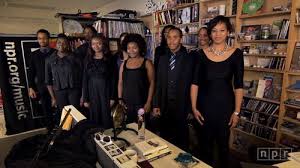
afroblueAfro Blue, a nine-member a cappella troupe from Howard University in Washington, D.C.

They sing three African American spirituals.  “Swing Low Sweet Chariot” is done very slowly, and you can really hear the power in the words of this often ill-used song.

“Motherless Child” I know from Richie Havens, but this version is much slower and impassioned.  The chorus is much different from any version I’ve heard before.

“Ain-a That Good News” is a song I didn’t know.  It has their most powerful chorus of vocals and ends the Concert in a great way.

[READ: July 6, 2016] “Telling Tales”

The May 16, 2016 issue of the New Yorker had a series called “Univent This” in which six authors imagine something that they could make go away. Since I knew many of them, I decided to write about them all.  I have to wonder how much these writers had to think about their answers, or if they’d imagined this all along.

Child says that he saw his 92-year-old father who was in very poor health.  Lee told him that he had been a good man (which was not true).  He says that his father probably said the same thing to his own father (which may or may not have been true).

He says that it is language (and syntax and grammar) that helped us become what we are–we could now plan and theorize and speculate. (more…)

Read Full Post »

naughty SOUNDTRACK: GEM CLUB-Tiny Desk Concert #181 (December 16, 2011).

gem clubGem Club is a quiet band.  During this set there are three members:  Christopher Barnes on keyboards and lead vocals, cellist Kristen Drymala and vocalist Ieva Berberian (who is eerily silent and still for much of the performance).

The first song, “Animal” features Barnes on keyboards, playing a simple melody and Drymala, playing a low and loud cello to accompany (when her first note comes in, it’s really striking).  She also sings a wonderful harmony vocal.  Barnes’ voice is almost a whisper, but between his voice and the vibrato on the keys, it sounds really big (but still quiet).  I really enjoyed the way the only “melody” she played on cello was at the very end of the song–a brief riff to signal the end.

“Breakers” opens with some rough cello playing and then a gentle echoed keyboard.  Ieva Berberian didn’t do anything in the first song, she just hovered mysteriously in the background. But for the second song she hits occasional tambourine notes (which sound practically like explosions amid the delicate echoing keyboards).  Perhaps the most interesting part of the song is watching Drymala tap on some  colorful bells with her foot to create a lovely melody.

For the final song, “252” Barnes says it is kind of a beast, (although it doesn’t sound any more complex than the previous two to me).  The piano is echoed and Ieva Berberian finally sings backing vocals.  Her voice is a little haunting and it works very nicely with Barnes’ voice.  The melody is beautiful.

Incidentally, the blurb says that this is the first time they’ve amplified a singer’s voice (they ran his voice through a chorus pedal to give it that otherworldly echo).  I have been listening to a lot of loud music lately, and this was a perfect counterpoint.

[READ: December 20, 2015] History’s Naughty Bits

This is the kind of book that promises to be very funny.  And then it turns out to be mostly funny but also rather scholarly.  Which is not bad thing, it’s just not as raucous as one might have imagined.

Dolby begins by dismissing the idea that “naughty” things are a recent invention and then proceeds to go through the history of human culture to show examples of things that would certainly be considered naughty today (some are quite shocking).

She starts with Classical Greece where women were expected to remain chaste, except for hetairai, high-class courtesans, who were well-educated and respected.  That’s some choice.  Adultery was considered less of a sin if was committed with a prostitute. (more…)

Read Full Post »

june10SOUNDTRACK: GABRIEL KAHANE-Tiny Desk Concert #178 (November 26, 2011).

kahaneWhen I saw Kahane a few months ago, he looked very different from the fellow here.  (More hair and a beard will do that).

I found Kahane’s music to be really enjoyable even if it was never really that catchy.  His songs are complex and thought-inducing, with many layers.  Although I found that after listening to his songs a number of times, I could really find the hooks in there.

His voice has a kind of soft quality to it–not quiet, but very much not harsh, which allows his enunciations to be heard quite easily.

For “Charming Disease,” Kahane plays keyboards.  He’s accompanied by strings and a guitar (I love the coloration of the guitar).  Since he also writes classical music, his pop songs have a distinctly classical feel (even without the string quartet to back him up). So the piano lines that he plays are simple chords, they are full lines.  And there are times when the guitar plays beautiful counterpoint to his chords.  This song is about an alcoholic (“I took you home and took away your keys”), but you’d never know the darkness of the lyrics from the melody which is bright and cheerful.  I love the middle section of the song–the chord progressions during the “Wine Dark Sea” are, in my mind anyway, very Kahane, and they’re what I love about his music.

For “Where Are the Arms” he switches to acoustic guitar.  You know the song isn’t going to be simple when he counts of “1, 2, 3, 4, 5, 6”  I love that he plays a continuing picked section while the guitar and strings play chords behind him, really fleshing out the song.

As they prepare for the final song, one of the violinists knocks over her music stand and he jokes, how did you fit an 11 piece band back her but we can’t get a string quartet.  Someone shouts that it’s the strings–the bows.  Kahane says, yes, “One string is two humans–ego and otherwise.”  To groans from the band.

For “Last Dance” I love that he sings his vocal melody along with the guitar melody (something Frank Zappa used to do–it’s complex and interesting).   And while there is certainly a melody there, he really complicates it with all of the single notes.  The strings come in and the song modifies somewhat until his voice seems to resume the complex singing style.  But then in the middle of the song (“she begins to sing”) it switches to a very catchy section with a refrain of “sex and cigarettes.”  It’s the most immediate thing in the show and shows how poppy Kahane can be.  even if the ending is quite abrupt.

He really deserves repeated and close listening.

[READ: February 5, 2016] “Learning to Look at L.A.”

I know Gabriel Kahane from when he opened for Punch Brothers this past summer.  I really enjoyed his set and found his album charming and eccentric but very literary.

Turns out that at the time of the release of The Ambassador he wrote this piece for the New Yorker as well.  It explores the themes that he delved into for his album, especially architecture in L.A.   He even opens with a discussion of Die Hard.  Like his song “Villains (4616 Dundee Dr.)” which contains the lyric:

I’ve been thinking a lot
About action movies of the 1980’s
Particularly Die Hard,
Which seems to illustrate
So many of the anxieties
Central to a time + place:
Japanese capital
The waning of the cold war
Pride in a downtown
What did they build it for?

He says that his “affection for this film is one hundred-percent unironic.” (more…)

Read Full Post »

« Newer Posts - Older Posts »