Feeds:
Posts
Comments

Archive for the ‘Death’ Category

sculptorSOUNDTRACK: ESMERINE-Dalmak [CST096] (2013).

dalmakI really enjoyed Esmerine’s previous record–it was a delightful surprise from a band I didn’t know.  Since then, they have put out two albums.  Dalmak is a Turkish verb with many connotations: to contemplate, to be absorbed in, to dive into, to bathe in, to rush into, to plummet.

The album was recorded in Istanbul and after laying down the basic tracks, they added local musicians who contributed some great sounding Middle eastern and Turkish instruments–bendir (a drum), darbuka (another kind of drum), erbane, meh, barama and saz (a stringed instrument)–on tracks 2, 3, 4, 6, and 7.

“Learning to Crawl” opens the disc and consists of 3 minutes of beautiful swirling cellos and violins that create a wonderful atmosphere.  “Lost River Blues Pt 1” comes in next and it changes the whole tenor of the album with the first of the Turkish instruments.  The marimba keeps a musical rhythm as the other droning instruments play layers of music–creating an unexpected tension.  The repetitions of the rhythm is a wonderful undercurrent to the lovely cello and violin that play washes of music over the top.  Their melody adds a great deal of drama.  It is a 7 minute song and once it’s over it jumps right into “Lost River Blues Pt 2.”

Part 2 opens with some stringed instruments playing a great middle eastern melody alternating with some loud choruses of instruments.   The song grows quiet in the middle and the flute like instrument (the meh?) plays a melody before all of the drums kick in again (there are so many drums) the song grows more intense.

“Barn Board Fire” opens with some Middle Eastern strings again (the saz, I gather) and a simple two note bass to back in up. When the drums kick in the song really feels full.  There’s a cello solo that runs throughout the song and it’s quite lovely.  When the cello matches the rest of the music, there’s few measures that play with loud and soft and it’s quite cool.  It builds to a raucous ending before echoing out

“Hayale Dalmak” opens with some waves of keyboards, almost like a new age song.  it works as something of an intermission before the intense cello melody of “Translator’s Clos Pt 1.”  This time the first part is the shorter one, as the drums and cello play a great melody and rhythm together.  Again, it’s so scenic and evocative.  It builds to a great closure before switching to Pt 2 which opens with a great percussion intro (I need to know how they made those popping sounds).  This part is a little slower than the first, although the drums are still pretty intense.  In fact, even though there is a lot of cello in this song, the drums are really the highlight with all kinds of awesome percussion going on.  The middle of the song introduces the first vocals on the record–I assume they are in Turkish or Persian.

“White Pine” sounds like a western melody played on an Eastern instrument and a mournful violin played over the top.  It’s a neat twist. The final track “Yavri Yavri” opens with glockenspiel and strings.  The song swirls around before vocals come in again.  It stays like this for five or so minutes–always remaining somewhat mellow but never easy.

I really enjoyed this album.  And it gets better with each listen–the combination of Western and Eastern instruments works so well in these songs.  And of course, Becky Foon and Bruce Cawdron write some amazing melodies as well.

[READ: February 20, 2016] Sculptor

I know Scott McCloud from his excellent Understanding Comics, which does a great job in explaining how comics work to novices but also shows keen insight for fanboys as well.

I never really considered that he had created his own comics (even though the above book is also full of his drawings).  He had created a series called Zot!, but really not all that much more.

The premise of this book is fairly simple, but the details and twists and the psychological depth are really staggering.  As is the beauty of McCloud’s drawing. (more…)

Read Full Post »

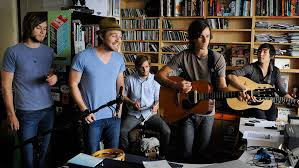
deogrataisSOUNDTRACK: JOSH RITTER-Tiny Desk Concert #119 (April 11, 2011).

ritterNot too many performers mention the actual day that they are performing their Tiny Desk Concert.  But Ritter mentions Valentine’s Day twice during his set so I thought I’d post it on Valentine’s Day even if the actual date of the posting is much later.

I don’t really know Ritter, I’ve heard of him, but I’m not too familiar with him.  Nevertheless, I was quickly won over by him.  He is charming and polite and is certainly having a good time (he even laughs at some lines in his songs).

His first song “The Temptation Of Adam”sounds vaguely familiar.  The melody is very catchy and his voice is strong and excellent.  Lyrically the song is quite interesting.  I especially loved this section: “We passed the time with crosswords that she thought to bring inside/ ‘What five letters spell apocalypse?’ she asked me/ I won her over saying, W.W.I.I.I.’/ She smiled and we both knew that she misjudged me.”

“Lark” is a faster song, but still very folksy and clever.  I love that although the melody is fairly simple, the way he plays it (with very fast fingerpicking) makes the song sound more complicated.  “Rattling Locks” is a dark minor chord song, louder and heavier than the other two.

The site says there is an audio only track called “Pale Blue Eyes,” but I can’t find it.  For the last track, his 2003 song “Kathleen,” he introduces the song by saying, “I think Valentine’s Day is the most awkward self-imposed holiday — even worse than New Year’s — so this is an awkward song.”  It’s a louder song, with Ritter’s voice reaching great intensity.  It’s a great way to end the set.

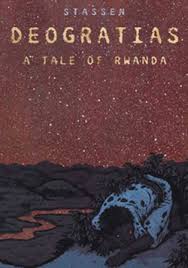
[READ: February 14, 2016] Deogratias

Here’s another story that I would never have read if it were not for First Second’s #10yearsof01 challenge.  The thought of reading a story about the genocide in Rwanda just seems to depressing to undertake.  And yet in the spirit of reading things outside of your comfort area, I decided to read this this weekend.

And I am incredibly glad that I did.

I feared that this story would be one of rampant genocide–struggle and death and mutilation and everything else that I could imagine.  But rather, what Stassen has done is created a story about how the toll of genocide can impact one person.  Yes, it affects him directly and the story is incredibly sad, but it was a very different story than I expected, and it was so personal that it made it more tragic without having the oppressive unreality of millions of dead people in the plot.

The introduction alone is worth reading, as translator Alexis Siegel gives a brief summary of the Rwandan tragedy.  I’ve always found the conflict to be really hard to grasp.  Hutus and Tutsi, a privileged minority, a brutal majority.  The back and forth was so hard to grasp, and the names of the tribes were similar as well.  It is hard for a lazy person to keep straight.

But I found Siegel’s explanation to be succinct and very effective. (more…)

Read Full Post »

aboveSOUNDTRACK: DO MAKE SAY THINK-& Yet & Yet [CST020] (2002).

DmstandyetandyetAfter the previous album, keyboardist Jason McKenzie departed the band.  I’m not entirely sure how this impacted the band, but this album is warmer and a little more delicate feeling.  It’s also their first album that was recorded all in the same place (in band member Justin Small’s house).

The disc opens with static and effects before a jazzy drumbeat comes in.   “Clasic Noodlanding” is mellow with a complex (for them) riff on the guitar and nice washes of keyboards.  It is primarily atmospheric until about two minutes in when it suddenly changes with the introduction of a great bass line.  And then this atmospheric song turns really catchy. The five and a half-minutes feel too short in this song.

“End of Music” opens with jazzy drums and keyboards.  It’s a slow piece that stretches to nearly 7 minutes.  About half way through the song, the drums come crashing in and a brighter, noisier melody takes over.  This end section is really catchy with some great chords and excellent drumming.

“White Light Of” opens with a cool slow bass line and drum pattern.  As the song grows in complexity I like the new bass rumble that is added and the way the guitar lines seem to intertwine. About half way through horns get added to the mix, quietly at first and then they slowly take over the song. About five minutes in the song comes to abrupt halt with some interesting echoed effects on the drums. It resumes again with a stranger version of the song—it feels unsettled and really interesting, with a nice riff interspersed with one that feels off somewhat.

“Chinatown” opens unlike any DMST song.  The bass sounds electronic and skittery with some interesting keyboard sounds over the top (it actually sounds a bit like later period Radiohead).  The song is slow and moody for all of its 5 and half minutes with keyboard washes and skittery guitars.  There are quotes thrown in throughout the song but I can’t tell what they are saying.  This song was features in the film Syriana.

“Reitschule” is one of two songs that are 9 minutes long. It opens with a slow meandering guitar line interspersed with another guitar playing an interesting counterpoint.  A cool bassline comes in around 2:30 which takes the song in a new direction.  Horns propel the song along until about 4 minutes when a jangly guitar takes over the song. It builds with some abrasive guitar chords until everything washes away except the bass.  And then it rebuilds as something else.  Distant horns play in the back as the guitars play overlapping lines.  It’s an epic song that demonstrates how much this band can do.

“Soul and Onward” has a pretty conventional melody line. It’s warm and friendly It also features wordless vocals by Tamara Williamson. I love the little tiny guitar lick that works as a bridge between the two sections.  This is my favorite song on this record.

“Anything for Now” is the other 9 minute song. It is slow and pastoral to start with a beautiful multi-guitar piece with gentle drums. At around 4:30 all the instrument vanish except for a single organ note. It plays for a bout a minute and it seems like the disc will end that way but then the chords build up again from the drone.  An acoustic guitar lick begins around 7 minutes in and runs through the end of the song.

Overall this album is more mellow than their previous discs, and there are some amazingly beautiful sections of music on this album.

[READ: February 8, 2016] Above the Dreamless Dead

I’m continuing with books that I wouldn’t normally read, to celebrate First Second’s #10yearsof01 challenge and to read something out of my comfort range.

This is a collection of poetry about World War I, written before during and just after the war.  Each of the poems is illustrated by a different contemporary artist.

As you can imagine, the book is pretty gloomy.  But the poetry is pretty spectacular and the illustrations were really interesting.  Obviously this book is not going to be a happy one.  But some of the artists do add a more positive spin on the poems (while some are just brutally violent as well). (more…)

Read Full Post »

aug24SOUNDTRACK: IVAN & ALYOSHA-Tiny Desk concert #109 (February 7, 2011).

ivanIvan & Alyosha are a five piece (no one is named Ivan or Aloysha) consisting of Tim Wilson (lead vocals) Ryan Carbary (guitars) Pete Wilson, (Tim’s brother), Tim Kim (acoustic and electric guitars) and drummer Cole Mauro).  They play bouncy folk (I assume that their non-Tiny Desk sound is bigger than two acoustic guitars and a tambourine).

“Beautiful Lie” is the first song.  The lead singer has a gentle falsetto and the other guys add nice harmonies (especially during the oooooooohs).

As they introduce “Easy to Love” Wilson says they recorded it at 2AM in their last half hour at the studio.  And it wound up being the song people like most.  It’s easy to like, with a fun clap-along and a simple electric guitar solo.  Again, I assume the actual song is bigger than this.

“I Was Born To Love Her” is a good jam (their words).  It completes that folks sound with two guitars and lovely harmonies.  They’d be a great opener for Band of Horses.  I’d see that tour.

Incidentally, the band name comes from Fyodor Dostoevsky’s The Brothers Karamazov.

[READ: February 3, 2016] “These Short, Dark Days”

I was planning on saving this story to put it sequentially with the other New Yorker stories that I’ll be posting in the weeks to come.  But this story is set on February 3, so why not post it on that short, dark day, since it is that day, anyhow.

This story begins with a suicide.  A man sees his wife out the door, then covers the windows and door gaps, pulls the gas hose off the stove and brings it with him into the bedroom (who knew the hose would be that long).

The next section of the story jumps to much later as we see a nun, Sister St. Savior, walking down the street.  She is tired and aching from begging all day. But she smells the smell of an extinguished fire and she knows in her heart that she must go there and help.  I love that when she arrives, everyone defers to her.  One of the men even acts as if he has sent for her, when clearly she came of her own design. (more…)

Read Full Post »

june2015SOUNDTRACK: THE ARCS-Tiny Desk Concert #504 (January 25, 2016).

arcsOkay so the Tiny Desk folks make a pretty big deal out of this being their 500th show and I am stating that it is their 503rd show.  I have to guess that they post some shows out of order because I have counted twice and gotten the same number.  So we will choose to disagree with our numbering system, but I will also agree that this was their 500th episode because, why would they lie?

The Arcs are a band that I wished I liked more.  Everyone seems to enjoy them, but I really don’t.  Of course, I don’t like The Black Keys either, so this is no surprise, really.  Nevertheless, Dan Auerbach, who is in both bands, has a great voice and writes some interestign songs, I just don’t care for his arrangements–the very soulfulness that attracts fans, I guess.

They are accompanied by three members of  the Mariachi band Flor de Toloache, who did a Tiny Desk Concert a few weeks earlier (although I’m guessing it was the same day, hint hint).  They play a great accompaniment–sometimes all of them play, sometimes just one, and they add interesting elements to the songs.  They also sing backing vocals.

The band plays three songs from their album.  “Pistol made of Bones” which I like in this version (I don’t know the original, I don’t think).  I especially like the way the horn and violin play along with the melody and give it a very Mexican feel.  It removes some of the soul that I don’t really like about the songs.

The other two songs are the two singles from the album and I find that I like them less (I guess I’m a deep cuts kinda guy).

“Stay in My Corner” is a fine song.  I like the guitar lines and the way he sings it.  It’s just not my thing.  I really enjoy the backing vocals by drummer Homer Steinweiss, who has this hilarious style of tapping out these beats while leaning (practically asleep) on the drum machine–totally low key.

I really enjoy Auerbach’s singing delivery in “Outta My Mind.”  I just wish the song would do more.  I want it to be…something else.

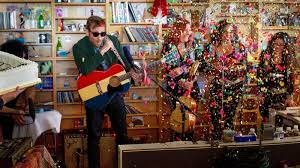
So the 500th (ish) episode was probably a lot more fun in the Offices than it was for me.  Although I enjoyed the confetti cannons.

But congratulations anyway!  Here’s to 500 more–but take a break for a few weeks so i can play catch up, okay?

[READ: January 4, 2016] “Interesting Facts”

I hadn’t been reading all that many short stories at the time that I read this because I had been focusing on graphic novels and books.  So jumping back into the short stories at Harper’s has been a real treat.  And I really enjoyed this one.

Although I’m always leery of stories that center around a main character with cancer, I thought the way this was done was clever and interesting and it absolutely drew me in to the story.  Plus it was funny (at least at the beginning).

I loved the way it started: “Interesting fact: Toucan cereal bedspread to my plunge and deliver.”  It doesn’t even fully make sense by the end of the story but an essential part does and I enjoyed the way it was presented like this.

The story is told from the point of view of * a woman who developed breast cancer a few years back.  She says that “I’m going to discuss the breasts of every woman who crosses my path.”  And indeed she does. (more…)

Read Full Post »

bpSOUNDTRACK: GRIMES-“Kill v. Maim” (2015).

grimesI don’t know Grimes very well at all.  When I first heard this song I didn’t really know what to think, but after repeated listens, I think it’s great.

It opens with a synth riff (and air horns) and one of Grimes’s many voices (this one is kind of childlike).  But by the end of the second line, she screams “they don’t know me” and that seems to set up the various personas in this song.

It’s the pre-chorus that I find so catchy–sung like the cheerleader chant “B-E-H-A-V-E aggressive.  B-E-H-A-V-E nevermore.”  And then the super fast chorus (with her voice lifted to an incredibly high pitch).

There’s a slower section with what I assume is her natural voice (which is quite lovely).  But it’s soon back to the fun chorus.  I need to hear more from her, but if this is her only good song, that’s okay.  It’s angry and you can dance to it.  Welcome to 2016!

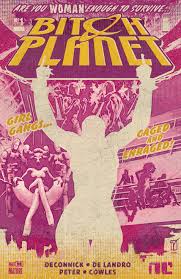
[READ: December 20, 2015] Bitch Planet

This series is a great manifesto for the new year–don’t take shit from anybody.

Kelly Sue DeConnick is a force to be reckoned with.  In addition to presenting Captain Marvel as a woman (in the amazing series of that name) and making some other cool looking series that I intend to read, she has created this feminist masterpiece.  Bitch Planet addresses violence and injustice against women and the whole “prison culture” that is always titillating for men.  It pushes Orange is the New Black to even further extreme that a comic book can.

Designed in a retro style by Valentine De Landro, the book comes complete with ads for “crap” in the back of each issue.   Which you may actually be able to buy. (more…)

Read Full Post »

[LISTENED TO: December 2015] Heck

heckI read this book several years ago.  I remember enjoying it but not loving it.  But when we were looking for an audio book and I saw that this was narrated by Bronson Pinchot, I knew we had to listen to it.  And the kids liked it a lot (although Tabby didn’t love the ending, which is sad, but is more of a set up for volume 2).

The premise of the book is that Heck is where you go when you die if you’re under 18.  They’re not quite sure where you’re going to wind up, so you have to go through Heck, which is basically school, until they can sort out which layer of Hell you’re going to wind up in.  Needless to say Heck is full of bad kids (and bad demons).

Our two bad kids are Milton and Marlo Fauster.  Marlo is a troublemaker from way back.  She is a petty thief and is always up to no good.  Milton is a good kid.  He never did anything bad in his life, and he always gets abuse from Marlo.  As the book opens, Milton and Marlo are sprinting down the corridor of a mall where Marlo has just stolen something. She is planning on wreaking havoc with Grizzly Mall’s centerpiece: The State’s Second-Largest Bear-Themed Marshmallow Statue (that cracked me up).

The kids run to the center of the mall where they are cornered by security.  Marlo is trying to think of an escape plan when Milton notices his classmate Damian.  Damian torments Milton every chance he can get.  And now, he is standing at the top of the marshmallow bear with matches.  Milton also notices a fuse sticking out of the bear.

One explosion later, the kids find themselves no longer attached to their bodies, as they are rapidly sliding down to Heck.  Marlo deserves to be there, she’s a bad egg.  But what about Milton?  It turns out that Marlo had slipped an item into Milton’s backpack, and therefore he technically stole something as well.  A technicality but true nonetheless.

The rest of the book shows the kids in their gender-segregated classes.  The boys learn physical education from Blackbeard the pirate and ethics from Richard Nixon (the Nixon bits were hilarious, and yet I can’t imagine many kids getting the jokes).  The girls, meanwhile, learn home ec from Lizzy Borden (do kids know who that is?) and singing from an angel who is on a teacher exchange program. (more…)

Read Full Post »

books SOUNDTRACK: MATT WILSON’S CHRISTMAS TREE-O-Tiny Desk Concert #99 (December 20, 2010).

trreoMatt Wilson is a jazz drummer.  And he joined forces with Paul Sikivie on bass and reedman Jeff Lederer on saxophone, clarinet and piccolo.

Wilson is a great drummer and he normally plays standard (if wild) jazz.  But for this group (the name is an indicator of the silliness), they play a spirited and fun set of Christmas songs–some of them crazy and unrecognizable and others simply fun and jazzy.  And despite the fact that Wilson does some amazing things with just a snare and a cymbal, it’s hard not to say that the show belongs to Lederer.

“Hark the Herald Angels Sing” starts out pretty straightforward.  The initial melody is present and then Lederer goes off on a lengthy solo in the middle.  “O Come All You Faithful” is a sing-along in which Lederer plays a very slow staccato line on clarinet for the audience to sing along with.  It’s Sikivie’s steady bass that keeps the crowd in line.  Meanwhile Wilson is playing his brushes on everything–his snare, a desk, anything that comes along.  It’s good fun with everybody really getting into it by the end.  “O Come, O Come, Emmanuel” starts out slow with Lederer’s sax laying down a smooth melody line and then drifting into his own space.  It’s quite pretty if unusual.

“Angels We Have Heard on High” is audio only and it begins with a rattling of jingle bells and Lederer’s skronking sax (I’d actually like to see that part–it seems like the most interesting visual songs are the ones left off the video).  Then he starts playing a sax melody (although nothing like “Angels” normally sounds).  There is some notation of “Angels” by the end, but it’s very minimal.  The most unlikely Christmas song ever (well, until what comes next).

The final song is a version of Handel’s “Hallelujah Chorus” and it is completely unrecognizable.  It opens with skronking sax noise and martial drums.  Aside from a few seconds where the bass plays a part of the familiar melody, the rest is mostly noise.  As the song draws to a close Matt starts playing the four note “ha – leh – lu – jah” on the snare, he then starts hitting that rhythm on everything–the rim, the bookcase, he even grabs a mug off the shelf and plays it on that.  It’s pretty funny and clear that Wilson is having a grand old time.

This nonsense ends when Lederer picks up the piccolo and plays a fun if silly version of “We Wish You A Merry Christmas,” which is very slow despite Matt’s super fast drumming.

It’s a funny, silly good time and an unexpected way to sing Christmas carols.

[READ: December 18, 2015] The Battle of Life

This book is the third of four in the collected Christmas Books.  This book is very tangentially related to Christmas (although he did publish it as a Christmas book) as one section takes place at Christmas time.

The thing that I really caught on to while reading this is that Dickens’ stories were really written for a very different time.  His books unfold slowly.  I find that I like to read fast (as many others do, I suspect), and I think the reason people dislike Dickens is because he really forces you to slow down.  But if you do slow down, you can really appreciate his descriptions and his humor.

This story begins on a battlefield.  And Dickens tells us all about the battle that took place here and all the people who died here.  For several paragraphs he goes on about it.  And then you learn that the battle has nothing to do with the story–except as an underpinning to the attitudes of people who live there.

Rather, the story is set on the battlefield many many many years later (and has nothing to do with the battle).  For this is a love story, after all. (more…)

Read Full Post »

[LISTENED TO: December 18, 2015] A Christmas Carol

gaimanchristmasJust like two years ago when we saw A Christmas Carol, a few days later I listened to the audio book.  This year, I found a different reading of it by Neil Gaiman.  This one comes from the New York Public Library podcast, and is available on Soundcloud and iTunes.

What makes this reading unique (and now different from Patrick Stewart’s awesome reading and from the McCarter production (which is different from the book as well) is that the version Gaiman read was hand-edited by Dickens for his own performances.  What?

Yes, evidently Dickens performed this story live a few times.  As the NYPL site explians:

Charles Dickens could not only write a crackling good story, he could perform it. And so in 1853, he took his Christmas Carol show on the road, first in Britain and then in the United States. Audiences loved it. Dickens didn’t simply read from his book. He transformed it into a stageworthy script—cutting, pasting together pages of excised passages, adding stage cues for himself, rewriting, then cutting some more…. Indeed, there is only one such copy of A Christmas Carol, created by Dickens himself, and The New York Public Library has it.

Gaiman read the “as the great author intended, following edits and prompts Dickens wrote in his own hand for his unique readings 150 years ago.” (more…)

Read Full Post »

olymmp SOUNDTRACK: TORRES-Tiny Desk Concert #461 (August 10, 2015).

torresI’ve really enjoyed a lot about Torres’ music this year.  Mackenzie Scott has an interesting delivery which reminds me of certain aspects of PJ Harvey, and her songs are angry but measured.

Her songs seem to have a lot of low-end in them (without being bass heavy exactly–in fact in this Tiny Desk, there is no bassist).  And her singing voice is often rather low (and sometimes growly).  There’s a moment in the first song “New Skin” in which the music drops out and then Mackenzie Scott starts playing her guitar anew and it’s a sound unlike any in the song before (even though she has been playing all along).

Guitarist Cameron Kapoor adds cool sounds to what I think is her best song, “A Proper Polish Welcome.”  Erin Manning provides wonderful harmony vocals along with keyboards on this song which is as powerful as it is understated.  The song gives me chills.

“The Harshest Light” is a slow song that has glimpses of light as she sings slightly higher notes in the chorus.  And when her voice breaks near the end, you can hear the intensity in her singing.

It’s a great three song set that only leaves you wanting more.

I had resisted getting this album, but realizing just how good these songs are might tip the tables to a purchase.

[READ: Summer 2015] Olympians 1-6

While I imagined that I might read all of the First Second books this year, I paused about mid way through (more for me next year).  But one of the last things I read from First Second was this series of outstanding mythologies about the Greek Olympians.  It also turned out that a few years back I got these books for C., not realizing they were under the First Second imprint.  I was intrigued by them then, but I’m really glad that I read them now.

George O’Connor is a massive geek and Greek scholar.  He has done lots of research for these books, including going to Greece and visiting sites and antiquities as well as comparing all manner of ancient stories to compile the most interesting pieces. He explains that since these stories were orally passed down, they were modified over the years.  He doesn’t change the myths, he merely picks the story lines that are most interesting to him.  And then he adds a lot of humorous modern touches (and dialogue) which keep it from being at all stuffy.

O Connor’s drawing style is also inspired by superhero comics, so his stories are presented in a way that seems much more like a super hero than a classical hero, which is also kind of fun.

Each book ends with an author’s note which is hugely informative and gives plenty of context.  It also has a bibliography, but more importantly, it has a list of notes about certain panels.  Do not skip these notes!  In addition to providing a lot of insight into the myths of the characters themselves, there are a lot of funny comments like “Greeks raced in the nude (point and laugh)” which really bring new depths to the stories. (more…)

Read Full Post »

« Newer Posts - Older Posts »