 SOUNDTRACK: BLACK FLAG-Damaged (1981).
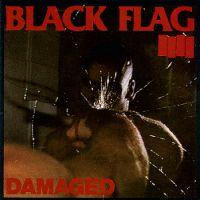 I’ve liked Black Flag since I bought Loose Nut on vinyl way back when (1985, the year punk broke for me). And those four bars were iconic to me even before I had heard a note (although I just learned they are supposed to represent a flag waving).
And this is where their legend really took off. So a few things I never knew about this album until I looked them up recently. 1) That’s Rollins on the cover punching the mirror. 2) He didn’t really punch the mirror (it was smashed prior and the blood is fake). 3) I knew that Black Flag existed for a while before Rollins’ arrival and that they’d had a series of singers before him. But I didn’t realize what a their first EP (Nervous Breakdown–Keith Morris on vocals) came out in 1978, their second EP (Jealous Again–Ron Reyes on vocals–credited as Chavo Pederast (he left the band in the middle of a live show, so they changed his name to that rather offensive one)) came out in 1980. Their third EP (Six Pack –Dez Cadena on vocals) came out in 1981. Rollins joined a few months after that and Damaged–their first full length–came out in December 1981.
“Rise Above” is a wonderfully angry song. The gang vocals of pure empowerment work so well with the chords. It’s still effective thirty years later. “Spray Paint” goes in the other direction: rather than an uplifting, catchy chorus, it’s a deliberately angular chorus that’s hard to sing along to (even for Rollins).
“Six Pack” represents the more “popular” side of the band. And it is a wonderfully funny single. I just can’t decide if it’s serious or ironic (see also “TV Party”). These two dopey songs are great to sing along to and are simply awesome. (Fridays!)
The rest of the album turns away from the lighthearted tracks. “What I See” is a really dark moment on this album. And the negativity is unusual especially given Rollins’ later penchant for lyrics about fighting back. True, Rollins didn’t write these lyrics.
“Thirsty and Miserable” is a blast of noise with some of Ginn’s first real guitar solos (which Guitar World says is as one of the worst guitar solos in history…and I say really? that’s the solo they pick? Ginn has done some pretty outlandishly bad solos over the years…of course the whole list is questionable at best). “Police Story” is a simple but effective description of the punks vs cops scene at the time.
“Gimme Gimme Gimme” seems childish, but that’s clearly the point. “Depression” is a super fast track. (Trouser Press considered Black Flag America’s first hardcore band). “Room 13” is an odd musical track, with pretty much no bass. It’s just some roaring guitars and drums and Rollins’s screams. This track stands out because Chuck Dukowski’s bass propels most of the songs here.
“No More” sounds “typically” hardcore: very fast with the chanted chorus of “No More No More No More No More.” “Padded Cell” is also fast (and is pretty hard to understand) except for the “Manic” chant, but the following track “Life of Pain” features what would become a signature Greg Ginn sound…angular guitars playing a riff that seems slightly off somehow. Compelling in a way that’s hard to explain.
It’s funny that a band that plays as fast as they did also released some pretty long songs. “Damaged II” is almost 3 and a half minutes long. It has several different parts (and a pretty catchy chorus). And the final song “Damaged I” is a kind of crazed rant from Rollins; It’s one of his scariest vocal performances; he sounds really deranged. Especially when it sounds like he just cant think of anything else to say so he just screams maniacally. But his vocals are mixed behind the music as if he’s trying really hard to get heard. There’s very little else on record like it.
It’s a wonderful end to an intense disc, and the beginning of a brief but powerful career.
[READ: March 25, 2011] The Life of Polycrates
I’ve been reading Connell for a few years now. In fact, the first time I posted about his work came with a blistering dismissal of his story “The Life of Captain Gareth Caernarvon” in McSweeney’s 19. That story is included here, and upon rereading it, I learned two things:
- One: context is everything.
- Two: I was totally and completely wrong in that original review, and I take it back.
But before I explain further, some background about this book. This is a collection of eleven stories, eight of which have appeared elsewhere. Unfortunately there’s no dates of publication included so I don’t know how old any of these stories are.
The other thing I’m fascinated about is Connell himself. I’m not the kind of reader who wants to know a ton of details about the author, but I like a little bit of bio (or a photo) when I read someone. The only bio that is consistently presented about Connell is that he was born in Santa Fe, New Mexico. I’m fascinated by this because so many of his stories are set in Europe. So I have concocted a master biography about Connell’s life and how he has lived and toured extensively in Europe, studied theology (and found it wanting) and investigated all of the world’s darker corners.
It’s this latter aspect that really altered my perception of Connell’s writing. I’ve liked the last few things that he’s written, but I fear that I was not looking at him through the proper lens. And this relates back to bullet point one above.
Connell writes in a world not unlike H.P. Lovecraft–a world that is unconventional, dark and more than a little twisted. And yet, unlike Lovecraft, there is very little of the fantastical in his stories. Rather, his characters reside in our own world (with a little chymical help from time to time), but they are all real. They’re just not characters most of us choose to associate with. So, reading that first story in McSweeney’s, where it was so different from all those others, I found it really distasteful. In retrospect, I’m not going to say that it is meant to be distasteful, although some of his stories are, but it was certainly not a pleasant story by any means.
The other fascinating thing to note about this book is that all of the stories are written in short, Roman Numeraled segments. So the title story has 35 segments. But even some of the shorter ones has twelve or thirteen segments (sometimes a segment is just a few lines long). I actually enjoy this style (especially when the segments introduce something totally new into the story–which many of these do). (more…)


 songs, hushed vocals, just very pretty.
 I Just Read About That...