Feeds:
Posts
Comments

Archive for the ‘North Korea’ Category

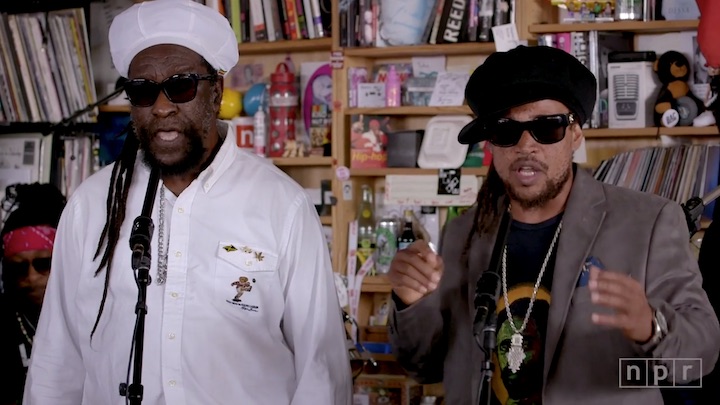
SOUNDTRACK: BLACK UHURU-Tiny Desk Concert #917 (November 29, 2019).
I don’t have a very good overall feeling about reggae.  As a person who listens to a lot of music that people have said “all sounds the same,” I can’t help but admit that to me all reggae sounds the same.

Or, perhaps all of Bob Marley’s reggae sounds the same and that’s the only reggae I’ve really been exposed to.

Because this Black Uhuru concert is clearly reggae, but it sounds new and exciting to me (even if the band has been around for 40 years).

I’ve been aware of Black Uhuru forever–they always seemed to be in the Columbia House 20 albums for a penny ads back in the day (along with Boz Scaggs, another artist I’ve heard of since I was a kid but have never actually heard a note from).

Considering the state of global politics, there’s never been a better time to get reacquainted with the righteousness of Black Uhuru. The iconic reggae band, whose name means “Black Freedom” in Swahili, is still going strong after more than 40 years, and they brought their much-needed songs of solidarity to the Tiny Desk. Fittingly, the set begins with “Here Comes Black Uhuru,” a telling and literal re-introduction to the group’s legacy for audiences that may be unfamiliar with their extensive catalogue.

This song is clearly one that I needed, as I didn’t know anything about their music.

While most-known for their late-’70s and early-’80s classics — years defined by a game of musical chairs within the group as played by founding members and/or collaborators Michael Rose, Garth Dennis, Don Carlos, Sandra “Puma” Jones, Sly Dunbar, Robbie Shakespeare and even Junior Reid — this incarnation of Black Uhuru, with frontman and co-lead Andrew Bees, has been touring and recording since about 1997 or so, longer than any of the configurations that precede it.

“Here Comes Black Uhuru” has some groovy bass from Daniel “Axemon” Thomson (who plays a white five-string Steinberger).  The verses feature some cool synth sounds from Horace “King Hopeton” Campbell and the drums are chock full of fun percussion from Rolando “Phanso” Wilson.  The biggest surprise to me was the ripping guitar sound from Frank Stepanek.

The vocals are shared between Derrick “Duckie” Simpson and Andrew Bees, with additional backing vocals from Elsa Marie Green.

This song has simple but catchy riff and it ends with a big powerful rocking sound.

“As The World Turns” comes from their new album of the same name.  “As The World Turns, is an album that was mired in issues around its master recordings, was finally released in 2018 — six years after it was recorded — and earned a Grammy nomination for best reggae album.” The song opens with the stereotypical Egyptian riff while Duckie and Elsa Marie Green sing the main verses.   I love that there’s spacey effects from the keys and Stepanek plays a blistering solo (twice).

“I See You,” is a love song “led by Derrick “Duckie” Simpson, a co-founder and the only steady member of the group since its beginnings in the early ’70s.”  It has the most conventional reggae sound and I like the way Andrew Bees works as a kind of hype man in this song,

“What Is Life” is their most well-known song.  It

explores the hopelessness endemic to those who are economically and socially disadvantaged, and explores the complexities of the human experience — what life could be, versus what it is. Despite being written and recorded in 1984, you can probably recognize the endurance of its themes.

Andrew Bees sings lead which adds a very different tone to the song.

While I really liked the first two songs, the second two weren’t quite as exciting to me.  Maybe I don’t need more reggae in my life, but I’m glad that there are different style out there.

[READ: February 1, 2020] DPR Korea Tour

I was really surprised to see this book at work.  I didn’t realize that North Korea sent propaganda to English-speaking countries  I assume this isn’t meant for American eyes specifically, more likely to European eyes, but who knows.

The book is written in English, Chinese and Cyrillic, but the writing is all just captions for the photos.

And I have to say that the landscape of North Korea is absolutely gorgeous.  I had no idea their land was so lovely.

Mt Paektu shrouded in clouds is striking.  And Lake Chon underneath the mountain is crystal clear and beautiful.  Taehwa Peak on Masikryong Pass has chair lifts that look like they are thousands of feet in the air (no people on them in the picture though).  It is a large skiing mountain–I didn’t know they skied there.

There are also wondrous waterfalls like the Hyongje Falls at Mt Paektu and the Rimyongsu Falls with a mansion atop them. Isonnam Falls is peaceful and serene while the Saja Falls are roaring (its hard to get a sense of scale though).  I’m also very impressed by Kuryong Pool and Eight Pools Under It. (more…)

Read Full Post »

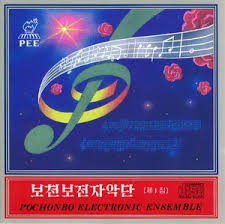
SOUNDTRACK: POCHONBO ELECTRONIC ENSEMBLE-“Where Are You, Dear General?”

One thing the book does not mention is this song which is played every morning in Pyongyang at 6AM.

There’s a clip of the song being broadcast in front of Pyongyang Station here.

In this clip, the music is creepy and empty, played through exterior speakers and bouncing off of government buildings.  As one person commented, if this music had a color, it would be grey.

This recorded version, by North Korea’s most popular act, is a little different.  It’s much warmer with soft synth not unlike synthy new age from the 70s/80s.

Here’s some detail about the creators of this music (according the BBC):

The Pochonbo Electronic Ensemble were formed by Kim Jong-il in the early-80s and were the first North Korean band to use electric guitars, synthesisers and saxophone, drawing on Korean folk music, but also Chinese, Soviet and, to a smaller extent, Western pop. They take their name from the 1937 Battle of Pochonbo, in which a group of guerrillas were led by Kim Il-sung in an attack on occupying Japanese forces (yet, despite this, they have toured in Japan). They’ve released over 150 CDs.

After 2 minutes of spacey intro, the vocals come in–a big chorus of voices asking “Supreme Headquarters. Where are you? Lead us to you.”

At 3 minutes the lead vocals come in, sung by Hyon Song-wol.  The music stays much the same (with echoing sounds and trippy synths) but Hyon Song-wol’s voice soars over the top and is quite lovely as she sings unabashed propaganda wonder where their supreme general is and when he will keep them warm and safe.

For a longer essay about this mysterious wake up alarm, check out this article from nknews.

[READ: December 29, 2019] Pyongyang

I really enjoyed Delisle’s A User’s Guide to Neglectful Parenting.  It was very funny and I really liked his drawing style.  Delisle has written several other books (published by Drawn & Quarterly) and I was really excited to see this one come across my desk (it’s a 2018 printing although it doesn’t look like there’s anything added).

The introduction by director Gore Verbinsky sets the stage for what this book is.  In 2001, Delisle was allowed into North Korea to work on an animated cartoon for two months.

In animated movies, there are “key frames” which are sort of the highlight moments.  In between these key frames are where the North Korean animators draw–the in-betweens.  Canadian and Europeans (and some American) directors then supervise the completion–often trying very hard to get the animators to understand simple Western ideas.

Verbinsky says that Delisle “reduces the amplitude to get underneath the narrative and break down a belief system into something infinitely relatable.  He looks at the daily life of people existing in these “in-betweens” and looks at the citizens who “exist in a bubble of fear.”

The book was translated by Helge Dascher.

Delisle’s self-portrait character is a simply drawn man with a big nose, tiny eyes and a very expressive face. As the story opens he is at customs where they ask about the book he brought (1984–with a funny scene about that later) and his music Aphex Twin.  His driver picks him up from the airport–you don’t go anywhere in North Korea without an escort.  Delilse is shocked that the driver is smoking in than air conditioned car with the windows closed:  “Great.  I can’t breathe and I’m cold.” (more…)

Read Full Post »

SOUNDTRACK: WÜRST NÜRSE-Hot Hot Hot (2018).

I wanted to find a soundtrack that would go with a book about wurst.  I found this fantastic Australian band with a hilariously appropriate name who also happen to be a band that rails against sexism.

In fact, one of the members of the band is in the fantastic feminist band Camp Cope!

Their story:

In 2016, five nurses with a sick-of-your-shit attitude put down their scalpels to pick up their instruments and Würst Nürse was born!  Würst Nürse are ripping out the stitches of the patriarchy with their dominating & satirical lyrics.  The band consists of Georgia McDonald (Camp Cope) as singing nurse, Anna Stein & Stephanie Butigan as guitar nurses, Morgan Sterley as bass nurse & Abbie Laderman as drummer nurse. Since Würst Nürse’s Fürst Rehürsal they have been administrating sludgey fever-inducing riffs & a power pop energy hot enough to send you into heart block.

This EP has four songs and is 13 minutes long.

It is musically brash with catchy melodies and sing-along choruses.  But its the biting lyrics that are so much fun

Like on “Hot Doctor” which is three chords and a sing along chorus of:
Hot Doctor
Hot Doctor
He’s gonna pay my bills
He’s gonna pay my rent
Hot Doctor
Hot Doctor
Gonna quit my job
Never have to work again

Although the verses are a bit more subversive

I give the wrong meds to get your attention
I want your hot beef injection
Hot Doctor
So, it turns out I didn’t even need that bachelor’s degree anyway
When I saw you walking down the hallway
Oh, Hot Doctor are you coming back to my place?
Your blue scrubs they rub up the right way

“Hot Surgeon” is very different from “Hot Doctor.”  There’s no big chanting chorus, but the lyrics are very different:

I wanna drill into your head
You’re such a hot surgeon
I bet you give great head
I know you’ve got your doctorate
Hot Surgeon
Know your way around a woman
I could help you out in theatre
You could help me put in a catheter
You, me and the Hot Doctor could get it on after hours

Okay maybe not that different.  But it turns out that they are connected:

I wanna get with the hot surgeon
Nobody tell the hot doctor
I don’t wanna ruin my chances

“Hot Brown Rain” is very different from the other “hot” songs because it is a hilariously revolting song about, well, being “number 8 on the Bristol stool chart” [The chart only goes up to 7, ew].  “from your underwear, how did it get in my hair?”  The chorus is surprisingly catching or catchy.

“Dedication Doesn’t Pay The Rent” has big stomping verses and much more pointed lyrics:

Knowledge learnt
Is money spent
And I still owe
The government
And they cut
My pay again
Those suit wearing white men

The chorus is very satisfying too:

No dedication don’t pay the rent
If you cut my pay
I’ll cut your oxygen

Of course I don’t want to see Camp Cope end, but I sure hope Würst Nürse releases more music.

[READ: Summer 2019] The Wurst of Lucky Peach

I really enjoyed Lucky Peach magazine.  It was often exhausting to read them since they were so packed with content (not unlike a sausage).  I was bummed when the magazine folded.  But in addition to several great issues, they also left behind some of these really fun and interesting cookbook-type collections.

This book is more than a series of recipes that I will likely never make or eat.  It is a fun history of the sausage that travels from Europe to the Americas to Australia and beyond.

Chris Ying says he loves sausage.  He says he might be in the world’s best lobster restaurant, but if there’s sausage on the menu that’s what he’s getting.  This book is fill of sausage history, sausage based humor (they tried to limit the number of dirty jokes, but failed often and with gusto). (more…)

Read Full Post »