Feeds:
Posts
Comments

Archive for the ‘Canadian Music’ Category

SOUNDTRACK: RUSH-“You Can’t Fight It” (1973).

This is the B-Side of the first single Rush ever released (The A Side: a cover of “Not Fade Away”).  It was released briefly but has been long out of print.  Thankfully, people on the internets have access to all kinds of things. It’s pretty clearly Rush–Geddy sounds right, and it sounds like an Alex solo, so I think it’s fair to say that this is genuine.

It’s a pretty decent hard rock song from the 70s.  It sounds like it could be from any of the second tier bands back then.  It’s got some boogie and some swagger and it seems like it’s not about anything important (rock n roll, apparently).

While I’m obviously glad that Rush went on to bigger and better things, it’s fun hearing how confidently they fit into the context of music by their heroes.  This song has a cool riff, it’s quite heavy and it shows promise.

For a band that never releases B-sides or rarities or anything like that, I’ve been pretty surprised to see what is in their internet closet.

Enjoy!

(By the way, I’m not advocating the visuals of the video–I haven’t actually “watched” it–just the audio).

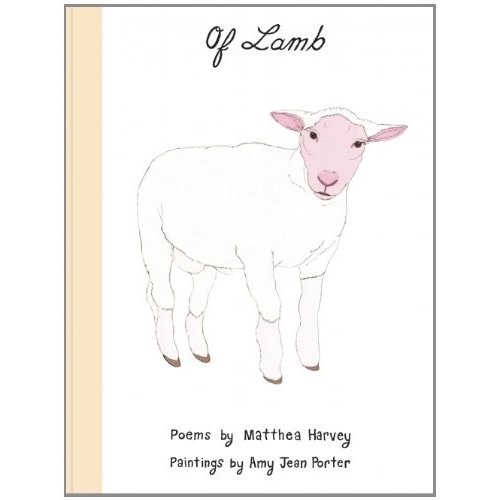
[READ: August 25, 2011] Of Lamb

This book is sort of subtitled: Poems by Matthea Harvey, Painting by Amy Jean Porter.

It’s the “poems” part that I have a hard time with, actually.  But let me get to that in a moment.

This book takes a nifty idea (an idea very similar to one that Jonathan Safran Foer is using in Tree of Codes, which, see tomorrow’s post) and fully realizes it.  But what’s funny is that she doesn’t tell you what this idea is until the afterword of the book.  So while I was reading it I wasn’t really sure what I was seeing.  The afterword made me say Oh, I get it now.  But I don’t feel that I can review it without explaining what she has done.  So, if you don’t want to know anything about the “secret” behind the book, skip the next paragraph.

[Spoiler?  Maybe.]

Okay, so essentially what Matthea has done is, she has taken a book at random (literally one she bought for $3 at a used book store), in this case, A Portrait of Charles Lamb, and she has created her poems out of that book.  In other words, on every page, she would find the words that she wanted to keep and she whited-out everything else (you can see an example in the book).  But rather than presenting the work like that, she had Amy Jean Porter make weird and cool paintings to go with every page’s worth of text (I assume Porter did the lettering as well?).  Since the book is about Charles Lamb, it was very convenient that his sister’s name was Mary.  So there was a Mary and a Lamb on almost every page.  Hence this sort of update of the Mary Had a Little Lamb story.

[end possible spoiler warning] (more…)

Read Full Post »

SOUNDTRACK: RUSH-“Garden Road” (1974).

So the bootleg that I mentioned yesterday was in fact incomplete.  On the Up the Downstair site, the track list includes “What You’re Doing” and “Garden Road.”  When I wrote to the cool host of Up the Downstair, he said that these two songs were available on You Tube and that he’d try to find them and add them to the site.

So in the meantime, I got to listen to the song on YouTube.  This is a song that the band wrote but which they never recorded (same is true for “Fancy Dancer”).  I have to imagine that they wrote these songs for their second album (along with “In the End” which they kept) around the time that Neil Peart joined the band.  Once they realized that Neil could write better lyrics, they scrapped these two heavy rockers.  Both songs have great riffs, even if lyrically they’re pretty poor.

The song rocks pretty well, although the solo seems to have been put to better use in “Working Man.”  I enjoy how the song breaks for the shouts of the Garden Road chorus (kind of like “Bad Boy”–perhaps it was a “thing” for them).  I rather like this song, and I think I like it better than a couple of the songs on Rush.

Check it out.

Maybe it’s time to release these old chestnuts for the fans?

[READ: August 10, 2011] Life After God

After the success of Shampoo Planet, Douglas Coupland wrote several short books (which were really short stories).  They were compiled in Life After God.  To me this book also stands out as another odd one from DC, because it is very tiny.  Not in length, but in height.  It’s a small book, about the size of a mass market paperback.  But it makes sense that it was made this short because it is written with lots of short paragraphs that lead to page breaks (kind of like Vonnegut).

For instance, the first story contains at most two paragraphs per “chapter” about–16 lines of text and then a page break.  At the top of each page is a drawing from DC himself which illustrates to a small degree the information on the page.  It leads to incredibly fast reading and even though the book is 360 pages, you can polish it off pretty quickly.

But what’s it about?  Well, mostly the stories seem autobiographical (even though they are classified as fiction.  And actually, I don’t know anything about DC’s personal life so I don’t know if they are based on anything real, although I do know he doesn’t have any kids, so those can’t be true at any rate).  There are eight stories.  They are all told from the first person and are more or less directed at “you.”  They all seem to deal with existential crises of some sort.  They are honest and emotional.  To my ear, sometimes they seem a little forced, maybe it’s contextual, but it’s hard to write this kind of massively introspective piece and have it sound “real.”  (But maybe I’m not very introspective about things like this myself). (more…)

Read Full Post »

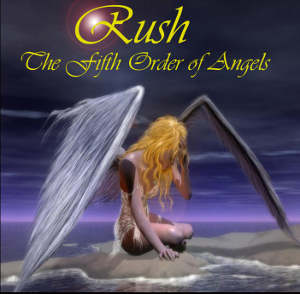
SOUNDTRACK: RUSH-The Fifth Order of Angels (bootleg from the Agora Ballroom,Cleveland, 26 August 1974) (1974).

I have mentioned this concert before, but I played it again today, and was struck by a couple of things.

1) According to the liner notes, Neil Peart had been in the band about two weeks.  How did they decide that their new drummer was going to be doing a drum solo during the show?  I mean, by now, everyone knows that the solo is its own song.  But, he’s been in the band two weeks.  It’s obvious he’s a good drummer, better than their original drummer, but a drum solo?  Is that just what rock bands did back then?

2) I’m struck by how much this show sounds like early Kiss.  I never really thought that  their first album sounded like Kiss, but in this live setting, a number of the songs, or perhaps just  the way they are recorded make me think of early Kiss.  In particular, during the crazy “one, two, three, FOUR!” of “In the End,” when the guitars kick back in, it sounds like a Kiss show from circa Alive!.

3) It’s amazing how guitar-centric the band was back then.  The mix is a little rough so it’s not entirely clear how insane Geddy is on the bass (when he gets a few solo notes, the bass sounds really tinny).  But the concert is like a showcase for Alex’s solos.  True, the whole first album really demonstrates what a great soloist he is, but it’s really evident here that Alex was the star.

4) Their earlier songs are really not very good.   I mean, every Rush fan knows that the first album is almost not even a real Rush album, but it’s shocking how pedestrian these songs are compared to even what would show up on Fly By Night.  Still, circa 1974 I’ll bet this show kicked ass.

It’s available here.

UPDATE: The missing content has been added!

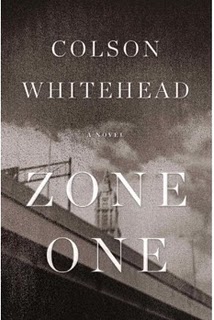
[READ: August 9, 2011] Zone One

After reading the excerpt from Zone One in Harper’s I decided it was time to read the book (which is due to be published in October).

I admit I haven’t read Whitehead’s other works, but I have read excerpts, and I thought I knew the kind of things he wrote.  So it came as a huge surprise when the excerpt ended the way it did. I didn’t want to spoil anything when I wrote the review of the excerpt, but since the entire book is set in the dystopian future and since it explain what has happened right on the back, I can say that Zone One is set in the aftermath of a kind of zombie apocalyptic plague.  And I can’t help but wonder if the rousing success of McCarthy’s The Road has more or less opened up the field of literature to more post apocalyptic, dare I say, zombie fiction.  [I haven’t read The Road, so there will be no comparisons here].

Actually there will be one.  Sarah read The Road and complained that you never learned just what the hell started the end of the world.  Indeed, in this book you don’t either.  There is an event called Last Night, and after that, there’s simply the current state of affairs.  I suppose you don’t really need to know, and since the story is all about dealing with the zombies, I guess it doesn’t really matter how it all started, but I think we’d all like to know.

Now what makes this story different from the typical zombie story is that for the most part there aren’t all that many zombies (or whatever these undead people are called) in the story.  There are some of course, and they are inconvenient to the main characters, but unlike a story like Zombieland, (which was awesome) or the more obvious Night of the Living Dead, the story isn’t really about fighting zombies, it’s more about the rebuilding of the country in a post-zombie world. (more…)

Read Full Post »

SOUNDTRACK: THE DEARS-Degeneration Street (2011).

I’ve loved The Dears for a long time now.  And yet with every new album I feel like I have to prepare myself for what’s to come.  And with every release I’m a little disappointed when I first play it.  Maybe for the next release I’ll realize what my problem is–The Dears do not stand up to cursory, casual listening.  They demand attention.  If you put them on as background music, you miss everything.  So when I finally gave Degeneration Street some attention, I realized how great it is.

The Dears write emotional songs that are fairly straightforward.  But the magic of their music comes in the layers of ideas and sounds that they put on each track.  And of course, there’s Murray Lightburn’s voice.  He sounds like Damon Albarn if Damon Albarn could sustain a note for a long time–could emote with his voice.  Now I happen to like Damon Albarn quite a lot, but Lightburn can really just out-sing him.  It’s wonderful.

“Omega Dog” opens with an electronic drumbeat, eerie keyboards and skittery guitars.  When the vocals come in–falsettoed and earnest, you don’t anticipate the full harmonies in the forthcoming chorus that lead to an almost R&B sound.  Not bad for the first 80 seconds of a song.  That the song is actually 5 minutes long and by minute 3, it sounds like an entirely different song is even more testament to the versatility of The Dears (check out the harpsichord solo that more or less ends the song).

“5 Chords” is a chugging anthem, a song with potential to be a hit (but which of course never will).  I find myself constantly singing the infectious chorus of “Blood”: “Since I was a baby I have always been this way; I could see you coming from a million miles away.”  Or the excellent chorus of “Thrones” “Plucking our eyes out, turning to stone, give up on heaven, give up the throne.”

“Lamentation” mixes things up with a slower pace and backing vocals that come straight out of Pink Floyd (any era really, but probably more of their later albums).  It adds an amazing amount of depth.  “Galactic Tides” has more Floydian stuff–the guitar solo (and the instrumental break) are really out of mid 70s Floyd–more backing vocals again).

Follow all of this intensity with the super poppy “Yesteryear”. It’s got an upbeat swing to it: happy bouncy chords and an inscrutable chorus: “What’s the word I’m looking for; It starts with ‘M’ and ends with ‘Y'”  It’s followed by the more sinister “Stick w/Me Kid,” in which Lightburn shows off his bass range.  There’s an awesome guitar riff in “Tiny Man,” simple and mournful that sticks with you long after it’s over.

The last couple of songs don’t really live up to the excitement of the first ten or so.  But the final song brings back the drama, with a swelling chorus and soaring vocals.  The Dears have managed to do it again, an emotional album that comes really close to being a concept album yet with none of the pretensions that that implies. 

[READ: July 13, 2011] Five Dials Number 16

Five Dials Number 16 is a brief Christmas Present from Five Dials.  The issue even seems longer than it is because the last ten pages are photos from the Five Dials launch party in Montreal.  The photo essay, titled In Montreal, includes local scenery and (unnamed) people photographed by ANNIKA WADDELL and SIMON PROSSER.

That leaves only 7 pages of text: The Editor’s Note, a look at London, a Christmas Poem and a short story from Anton Chekov.  And there’s another cool illustration from JULIE DOUCET

CRAIG TAYLOR-Letter from the Editor
Taylor thanks Montreal for their warm welcome (despite the crash course in what Wind Chill actually means).  He also hopes we enjoy the Christmas offerings contained within: the traditional Christmas poem and the Chekov story. (more…)

Read Full Post »

SOUNDTRACK: SLOAN-“Cars” (2011).

When Sloan went to the A.V. Club to record their cover, they were disappointed by the selection.  Of course, that’s the game, so suck it up Sloan.  But they decided to do Gary Numan’s “Cars.”

Now, I feel compelled  to say that Gary Numan’s “Cars” may be my least favorite song of all time (it’s very close to Billy Idol’s “Eyes without a Face”).  I understand that “Cars” was “groundbreaking” or whatever.  But gah, it is boring and monotonous and just awful (and I say that while admitting that I like Phillip Glass, so i know from monotonous).  While I will admit that the riff is pretty great, everything about the song, from the performance to its endlessness (it’s like 8 minutes long, right?) drives me nuts.

And that may be why I love this cover so much.  It keeps the riff but it adds music to it.  All of that horrible “one guy with a cheap keyboard” sound is taken away.  It’s replaced by a great full-sounding band bringing live joy to the song.  I love that the whiny keyboard is replaced by a guitar and that the drummer rocks the hell out of the ending.  I mean really rocks the hell out of it.  Well done, Sloan.  You’ve been a favorite for years, and you’ve now redeemed my most hated song.  I think Billy Idol just peaked on my list.

You can watch it here.

[READ: July 20, 2011] “The Money”

Junot Díaz’ story in the New Yorker’s Fiction Issue is also a Starting Out piece.  This story is about how his mother always sent money home to her family.  No matter how little money they had, she would always scrimp and save and stash away until she had a few hundred dollars to send every six moths or so.

From Diaz’ other work, we assume that he was not a model citizen as a youth, but even he knew not to tamper with his mother’s money.  (Stealing from her purse was one thing, but the wrath of stealing from the “to be sent money” was unfathomable).

Then one week when they go on vacation they return to see that their house has been robbed!  Some of Junot’s things were taken as well as the money.  The Money!   (more…)

Read Full Post »

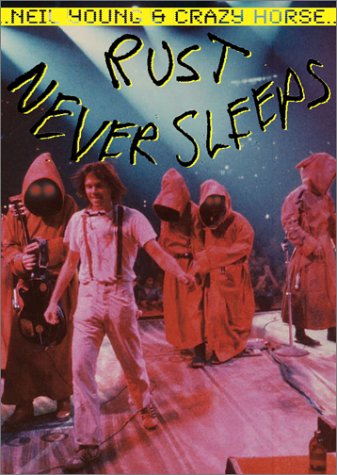
SOUNDTRACK: NEIL YOUNG AND CRAZY HORSE-Rust Never Sleeps (DVD) (1979).

Back in 1979, Neil Young had a huge hit on his hands with “Hey Hey My My” and the album Rust Never Sleeps.  This is a film of that concert (in the Cow Palace, San Francisco).

The set sounds great and the selection of songs is top notch.  On a technical note, some of the darks don’t hold up well and get terribly pixellated, but what do you expect from (what I assume is a) cheapie film from the 70s.

The weird thing about the film (and the concert as well) is the “extras” that he built into the show.  I’m curious what the audiences thought back then, because now, it’s kind of funny, but also more than a little weird.  Throughout the set he has his roadies (who he calls “road eyes”) “setting up” the stage.  The roadies are wearing robes and look an awful lot like the Jawas from Star Wars (which had just come out, so I assume they are meant to look like them).  The stage is a backdrop of oversized amplifiers and the road eyes are scrambling around carrying an oversized microphone and harmonica and other silly things.  The road eyes are having a great time dropping the mic (they even hit Neil in the head with it accidentally).   Another road eye comes out with an oversized tuning fork while the band is tuning.

There’s also some guys in lab coats and another professorial-looking guy who makes an announcement that everyone should put on their rust-o-vision glasses to see the band rust on stage (no idea what happened/how this worked/if there were even glasses, but during the song, they shine a rust colored light on the band).

These moments in the movie are weird.  They certainly break up the flow of the show.  But at the same time, at most concerts, the roadies setting up the show is dull or put behind a curtain so you don’t have to see it.  I think it was cool of Neil to give the audience something to watch during the transition stages (even of they do go on for a while). During all of the roadeye moments, he plays snippets of audio from Woodstock–we hear Hendrix’ “Star Spangled Banner”–and The Beatles (!) (Did they have to pay rights for things like that in 1979?).  We also hear a lot of the announcements from Woodstock (brown acid, no rain! no rain!–strangely, it appears that he has set up the stage to actually rain on the audience.  It’s not filmed very closely so it’s a little unclear, but it does appear that water is actually coming from the ceiling.

As for the arc of the movie (because it is a movie after all), the fist part of the show stars with Neil solo–he wakes up in a sleeping bag and wanders around in overalls singing and playing.   I gather there are wireless microphones attached to his harmonica (!)–I didn’t know they had wireless mics back in 1979).  After he plays a few songs, the roadeyes set up and Crazy Horse comes out (including what to me is an iconic outfit–Frank “Poncho” Sampedro in his Canadiens jersey (#19, Larry Robinson)).

The band bashes through a number of great songs and they all sound great (there’s a few flubbed notes so you know it’s all live but the harmonies are spot on).  It’s odd to me that the band leaves briefly and Neil does one or two more solo songs (none on piano though) before the band comes back again.

The major weird thing about the set is Neil’s almost total lack of interaction with the crowd.  At the end of the show he even seems a bit angry (although he does have a naturally scowly expression), so he doesn’t engage much with anyone.  This seems especially weird given the lightheartedness of the stage show (they lower an organ from the rafters and it has wings on it).  But then again, not everyone has to be nice, right?

The DVD is comprised mostly of songs that appear on the Young’s Live Rust album (confusingly, not the Rust Never Sleeps album) although the album has recordings from different shows.

It’s a strange artifact, definitely an item of the late 70s.  It doesn’t hold up especially well, but you can always fast forward over the slow bits.

[READ: April 11, 2011] “Big Ticket”

The Walrus has published two Two Act plays over its existence.  This is the second one.  Act one appeared in the magazine but you have to go online to see the end.  Unlike with the previous play, both Acts One and Two are online.

Act One of the play is terribly exciting. It starts out in a weird way with a woman looking to pay a man to abduct and terrify her husband.  The man (a garage mechanic) shows her the “cage” that he’s going to lock her husband in.  And then things start to get all Penthouse-y.  The woman (Annie) starts asking the mechanic (Dave) if he’s ever done anything, you know, naughty, in the cage (she’s obviously an unhappy wife).  Dave does the metaphorical look around the room and then climbs in the cage with her. (more…)

Read Full Post »

SOUNDTRACK: CBC Radio 3’s Sloan 20 Anniversary Podcast (2011).

2011 sees the 20th anniversary of Halifax’s Sloan.  I’ve liked Sloan since their first single, “Underwhelmed” broke through American radio (more like MTV’s 120 Minutes, I suppose) eighteen years ago.  The band’s profile faded in the US since then, but they have been producing steadily great albums over all of these years.

CDC Radio 3 has created a twenty year best of Sloan Podcast.  (And the band has all of their songs streaming online as well).

The Podcast has brief shoutouts from a bunch of fans (famous and non-) and a favorite selection from each of their nine albums (“Underwhelmed” is not included).  There were even a couple of tracks that I wasn’t familiar with (some seriously buried tracks from those early records).

Perhaps the funniest moment for me comes when the DJ admits that he didn’t know “Delivering Maybes” from Between the Bridges.  I was listening to that album just yesterday, and that’s one of my favorite tracks on the disc.  But really, they have so many great songs, it’s hard to choose.

Twenty years.  Good on ya, Sloan.  Looking forward to the new record The Double Cross.

[READ: June 2, 2011] “Noisemakers”

This story has a suprise appearance by a foley artist.  I love foley artists and am totally fascinated by them and would secretly love to be one.  So, even though the foley artist is almost drowned, I liked this story quite a bit.

It opens with Peter and his wife, Sarah, riding a boat in a lake. There’s some tension between them, but everything changes when she has to quickly turn the boat to avoid hitting something in the water.  It turns out to be a body.

The body happens to be of Lucy (the foley artist) who was Peter’s ex girlfriend.  Sarah hates Lucy (there is some background given about them and how Lucy seems to have been involved with Peter since he got married–but I feel like the given details are too vague to justify his current wife’s hatred of Lucy).  Sarah believes that Lucy being here is some kind of connection to Peter, but realilstically, they are quite far from their cabin, and she is floating in a lake…. (more…)

Read Full Post »

SOUNDTRACK: BROKEN SOCIAL SCENE-World Cafe March 2, 2006 (2006).

Broken Social Scene played at the World Cafe not long after their release of Broken Social Scene (their 3rd album).  This download is primarily an interview between World Cafe’s David Dye and BSS’s Kevin Drew & Brendan Canning, but there’s also three songs that the band played for the session (it’s impossible to know how many songs they played in total, because the songs were recorded prior to the interview–I’m not even sure how many members played live as they were never introduced.)

The songs sound interesting in this recording.  I haven’t listened to the album in a long time, so I don’t recall if these versions sound like the disc; however, these three tracks are fascinating for how quiet they seem to be, despite the fact that there are so many people in the session.  “Something for the Holidays” has at least one violin, a horn section, guitars and several vocalists, and yet it’s rather quiet.  Not mixed quiet mind you, but like everybody is whispering (even the horns).  It makes for an amazingly intimate session.

“Major Label Debut” is a bit more stripped down, but there are clearly a lot of people playing.  The final track, “Ibi Dreams of Pavement” really sounds like a Pavement song in the beginning.  The slightly out of tune violins work perfectly, and whoever is singing has a Stephen Malkmus thing down quite well.

The interview is fascinating (and quite lengthy).  They discuss the origins of the band, how fifteen people can play and tour together and the amazing success that so many of the individuals of the band have had (Feist, Metric etc).  There’s also an explanation about the origin of the title and the sounds of “Ibi Dreams of Pavement.”

It’s a good session and is certainly going to get me to listen to their discs again.

[READ: April 4, 2011] “The Counterpart”

This bizarre story can certainly be called Kafkaesque, if for no other reason than that the narrator, Aleksey, wakes up from a night of drinking to find out that his nose is gone.  Not torn off, not bloody, not broken, just gone.  His face is now flat with two holes for breathing.

This bizarre incident no doubt stems from his childhood hatred of his large Semitic nose (despite his being a Christian) and the years of abuse he received about it.  First he thinks his lover, Tatiana, is somehow responsible.  But when she comes over she is just as surprised as he.  Nevertheless, she is insistent that he must carry on as normal, for he must improve his lot (and thereby hers).

Because Aleksey is not faring so well (nose aside).  He has not been given tenure, his wife and child have left him and he is stuck translating poor Russian works into English.  Tatiana has set up a job interview for him and the interview is today.  But how can he go with no nose? (more…)

Read Full Post »

SOUNDTRACK: MARTHA WAINWRIGHT-Live at the 9:30 Club (2006).

This show had Martha Wainwright opening for Neko Case (a nice bunch of Canadians, eh?)  I’m not sure if the set is truncated or not (she claims to be hungover) but it’s only 30 minutes.  I guess that’s not terribly short for an opening act, but it seems on the brief side–although it is 9 songs.

Martha is a bit cranky as the set opens, (or maybe that’s just her speaking voice) but she kind of warms up and is a funny chatterer.  Seven of the songs come from her debut self-titled full length (which I don’t own). One song is new (“So Many Friends” which appears on I Know You’re Married…) and one comes from an EP (“New York, New York, New York”).

Martha has a unique voice that I find hard to describe.  It can easily polarize listeners–some will find it way too exotic.  It comes as a special surprise after she has just bantered with the audience in her low gravelly voice when it busts out with her higher (perhaps nasally) voice. I think once you get used to her voice it brings a special resonance to the lyrics.

She is also not afraid of the four letter word.  The final song, crowd favorite “Bloody Mother Fucking Asshole” is just one of the obscene things that she sings here.  The funny thing is that she never sounds angry when she’s singing these lines.  He voice is charming (and yes odd) but never angry.  It’s a weird mix, but one that I like.

This is a good introduction to her music (and Neko Case on the same page).

[READ: March 18, 2011] “The Smell of Smoke”

Unlike “What He Saw” which was erotically charged but hard to believe, this Walrus story–which is even more erotically charged and, on the surface utterly unlikely–was easier to believe as a story.

Green is a fourteen year old boy.  Maggie is his twenty-one year old neighbor.  As happens in a story like this, she seduces him.  And they spend most of the summer having crazy sex.  This all seems really unlikely, but I’ll throw in the detail that it’s 1968 and her parents are away quite a lot (which also seemed to happen a lot then).

The story is told in third person from Green’ point of view.  And, despite the horny teenage fantasy story that this really is, the writing is tender and sweet and fairly believable.

For me the nice thing about the story was that although it eventually had to end, it never ended because they got caught or had any kind of scandal.  Rather, she went off to college.  But it doesn’t just end there. (more…)

Read Full Post »

SOUNDTRACK: STARS-Tiny Desk Concert #108 (February 3, 2011).

Stars are a wonderful Canadian band who play pop songs with a very dark undercurrent.  They’re the kind of band that’s so easy to sing along to until you realize just what you’re singing.

This is the shortest Tiny Desk show that I’ve heard so far–it’s barely ten minutes in total.  The performers are singers Amy Millan and Torquil Campbell with an acoustic guitar accompaniment.  And they sound wonderful.

They play two songs from their newest album The Five Ghosts (which I have only streamed online and have to admit I didn’t love as much as their earlier discs).  The songs sound wonderfully impassioned in this strip down format.  (Perhaps I didn’t give Ghosts a fair listen).  They also play one old, classic song, “Your Ex-Lover is Dead” which sounds great as well.

It’s a nice little dose of unplugged Stars.

[READ: March 17, 2011] “What He Saw”

This was a very short (less than three pages) story and the whole process seemed to be so effortless, that I wound up being disappointed by it.

It’s a very simple story of a couple on vacation.  They have a fight (again) and she storms off the beach into the water leaving Gus by himself with his sketches (he’s an artist).  She swims out as far as she can–to the rope that cordons off the yachts that are docked there.

When she reaches the rope, she sees a couple on a buoy by the boats.  She swims to the couple and starts chatting.  She learns a bit about them and then sees that not only is she topless (it is Europe after all), but that they are both bottomless as well.  She has clearly interrupted something, but they don’t seem to mind.  Indeed, the man seems to be encouraging her to come closer to them. (more…)

Read Full Post »

« Newer Posts - Older Posts »