Feeds:
Posts
Comments

Archive for the ‘Canadian Content’ Category

SOUNDTRACK: TOM WAITS-Heartattack and Vine (1980).
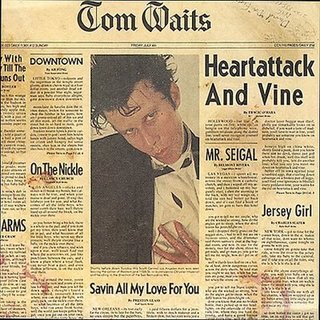
This is the final album Waits made before switching labels and starting over as a new, far more artsy artist.  The album cover is crazy, it looks like a newspaper (with all the lyrics to printed like articles on the cover).  And there’s a picture of Waits in a tux, hair askew, looking like the most stricken man alive.  It’s not a pretty cover, but it sure conveys a lot.

“Heartattack and Vine” is agreat noisy bluesy song.  It’s very simple and focuses on Wait’s lyrics and delivery: “I bet she’s still a virgin, but its only 20 after nine”).  Oddly, after that great vocal delivery song, we get the instrumental “In Shades.”  This has a lot of organ (which is a fairly new instrument in his repertoire) that he shows off his skills on, but it’s nothing that spectacular (and it’s recorded live apparently).

“Saving All My Love for You” is a sloppy kind of ballad (not as nice as most of his ballads), but then judging by the cover image, this is not going to be a sweet album.  See also “Downtown,” another rough track like the title song.

Of course, all of the talk of gruff nastiness is rendered false by the beauty of “Jersey Girl.”  Most people know the Springsteen version of this song, but (aside from the strings, which may be a bit much) I think this version exudes more real emotion.   “Jersey Girl” is a really wonderful song (especially if you’re married to a Jersey girl).  But what’s really great about it is that despite all of the sappy emotion (“My little girl gives me everything, I know that some day she’ll wear my ring,” there’s some great reality as well: “I see you on the street and you look so tired, I know that job you got leaves you so uninspired, When I come by to take you out to eat, You’re lyin’ all dressed up on the bed baby fast asleep, Go in the bathroom and put your makeup on, We’re gonna take that little brat of yours and drop her off at your mom’s.”

Sonically the shift from the guitar based blues noise of “‘Til the Money Runs Out” to the string laden ballad “On the Nickel” is pretty jarring. “On the Nickel” is one of Waits’ lullabies that’s not quite a lullaby.  But it’s got that mournful permanence that is hard to beat from Waits (he even performed it in the 2009 concert from NPR).  “Mr Siegel” is a barsy blues song (although it doesn’t sound like his earlier albums at all) and the album ends with the mournful ballad “Ruby’s Arms,”  which Waits sings in his best downtrodden voice. 

This album really showcases the breadth of his talents at this stage of his career.

[READ: September 24, 2o11] “The Ring Bin”

Who could even imagine what the title of this story means?  It’s weird, and it has so many possibilities.  By the time the answer is revealed, the story has gone in so many directions, you almost forget that you cared what the title meant in the first place.

First off, the tone of the story is bizarrely cool.  After a brief, confusing introduction (we’re at a celebrity gala of some sort), the story gives us this: “That’s when our heroine’s cellphone rings.”  It’s a kind of jarring intrusion by the narrator.  But before we can muse on this, the crowd is appalled at her break in etiquette.  And the story continues, “If these people knew the whole truth, they’d be more than annoyed.”  What is going on here?

And then the narrator gives up any pretense of disinterestedness: “I should step back a moment and describe for you the big picture.”  By now, as a reader you are reeling from all oft he broken rules.  

And then we find that this wonderful setting, this gala, is attended only by white people (which makes them all a little uncomfortable) but that the people onstage are a veritable United Nations and that the topic of the gala is tolerance.  Well, who knows what to think. (more…)

Read Full Post »

SOUNDTRACK: TOM WAITS-Live Glitter and Doom tour, Atlanta GA, July 5, 2008 (2008).

I downloaded this concert–which was recorded at the Fox Theater in Atlanta Georgia from NPR.  In the introduction, Bob Boilen says the concert is over two hours, but the page says (and the download comes in) at about 1 hour and 45 minutes, which is still plenty of Tom Waits.

This is a great show.  Although it focuses on the more recent albums, the show covers quite a span of his career: from Real Gone (“Hoist That Rag”) and Bone Machine (the album that introduced me to Mr Waits), all the way back to Heartattack and Vine (“On the Nickel”) and even three songs from Rain Dogs.

His band sounds great, tight as a drum, even playing Waits’ off musical assortments with no problem (is Casey Waits on drums Tom’s son?). There’s clearly some visual stuff going on that we are not privvy to here–the band has a good time towards the end of the set with some musical jokes.  And there’s some fun vamping and a number of good Waits stories (including the “pastika” one from the live album, see below).  He doesn’t play “Day After Tomorrow,” one of the most moving war songs I’ve ever heard, which I think is good.  It is so emotionally charged (unlike his other ballads which are moving but not quite so powerful) that I thin it would bring the whole set down.  Rather, this is more of a rumpus-filled show.  And we’re all the better for it. 

All in all, this is a great document of Waits’ live shows.  His voice sounds great and the band (including a few special guests) is fantastic. 

Later in 2009, Waits released Glitter and Doom Live, a document from this tour.  What’s nice in terms of this show is that the setlist is different for this show than it is for the album.  The album has songs from various venues on the tour, so you get different performances anyhow, but quite a lot of the songs are new here.  So even if you have the album, this is a unique experience.

Also, check out this amusing video interview:

[READ: September 20, 2011] “Dear Life”

This kind of piece is one of the reasons I don’t write about nonfiction that much.  How do you review someone ‘s life?  More specifically, how do you review a short excerpt about someone’s childhood (is this leading to a full length memoir?).  Nevertheless, I love Alice Munro, and this look into her childhood in Wingham, Ontario is fascinating.  I never really conceptualized that Munro is 80 years old.  She grew up with an outhouse and what seems like a one room schoolhouse.

What’s more interesting is that the town where she grew up more or less disappeared once people started building houses on the other side of the river (higher up the hill).  All but the poorest people moved to the new higher elevations, thereby evacuating the town and leaving only the tiny school left (the school she was so excited to get away from!).  Munro remembers many of the bad things in her life–getting whipped by her father for disobeying, walking to school and being teased and even not being allowed to go to a new friend’s house because the friend’s mother was prostitute!  But unlike in a full length memoir, Munro is able to skip past these memories pretty quickly by talking about how when she got older things were smoother (and the room where the whippings took place was converted into something else). (more…)

Read Full Post »

SOUNDTRACK: RA RA RIOT-Live at the Black Cat, Washington DC,  October 12, 2008 (2008).

I really like Ra Ra Riot’s album The Rhumb Line, and this concert is basically a showcase for that album.  There’ s an interview at the end of the show (all downloadable from NPR), in which the  band says that critics raved about their live show as much as their album.

I don’t really hear that the show is more energetic than the album (maybe visually they are wild), but it did sound fantastic.  It’s amazing to hear a rock band that is dominated by strings–the cello and violin are often louder than the guitar (but not in a competing/drown you out kind of way,  more of a strings do the melodies and the guitar adds bulk to the sound).

I always enjoy hearing a band that is grateful to their audience for showing up (this is most evident in young bands, who seem so much more genuine about their love of the audience) and Ra Ra Riot are certainly that .  They seem genuinely surprised at the turn out, and they play a great set accordingly.

There are two songs that aren’t on the album here “A Manner to Act” and the encore “Everest.”  They both feel like they came off the album, which bodes well for their second album, Orchard, which just came out in May.  Ra Ra Riot also do a great cover of the obscure Kate Bush song “Suspended in Gaffa.”  At the end of the show they tack on a cover of “Hounds of Love.”  Lead singer Wesley Miles has a wonderfully strong voice and he can reach some pretty high notes–not soprano or anything like that, just strong enough to be able to pull off a Kate Bush cover.

This is a great show.  And when you read about the tragedy they suffered just as they were starting to take off, their obsession with death may not be so surprising.  I’m looking forward to Orchard.

[READ: 1995 and August 18, 2011] Microserfs

After reading Life After God and thinking about Microserfs, I looked up Coupland’s bibliography and saw that indeed Microserfs came next.  And I was really excited to read it.  I have recently watched the JPod TV show and I knew that JPod was a kind of follow-up to Microserfs, so I wanted to see how much of it rang true.  And I’ve got to say that I really rather enjoyed this book.

While I was reading this, I started taking notes about what was happening in the book.  Not the plot, which is fairly straightforward, but about the zeitgeisty elements in the book.  And, since I’m a big fan of David Foster Wallace, I was also noting how many zeitgeisty things this book had in common with Infinite Jest.  I’m thinking of tying it all together in a separate post, maybe next week.  But I’ll mention a few things here.

My son also loved the cover of this book because it has a Lego dude on it and he has been really getting into Lego lately.

So Microserfs is the story of a bunch of underpaid, overworked coders who work for Microsoft.  The book is written as the journal of Daniel Underwood (Coupland still hadn’t really branched out of the first person narrative style, but the journal does allow for some interesting insights).  The story begins in Fall 1993.  I felt compelled to look up some ancient history to see what was happening in the computer world circa 1993 just for context.  In 1991, Apple released System 7.   In 1993, Windows introduced Windows NT, Intel released the first Pentium chip, Myst was released and Wired magazine launched.  In 1994, Al Gore coined the term Information Superhighway.  Yahoo is created.  The Netscape browser is introduced.  So we’re still in computer infancy here.  It’s pretty far-seeing of DC to write about this.

Daniel works at Microsoft with several friends.  Daniel is a bug tester, Michael (who has an office, not a cube) is a coder, Todd (a bodybuilder) is a bug tester.  There’s also Susan (smart and independent), Abe (secret millionaire) and Bug Barbecue (an old man–he’s like 35).  The five of them live in a house on “campus.”  There’s also Karla (a type A bossyboots who doesn’t like seeing time wasted) who works with them but lives up the street.

As the story opens, Michael has just received a flame email from Bill Gates himself and has locked himself in his office.  This leads to a very funny scene and ongoing joke in which the office mates feed slide two-dimensional food under his door and he vows to eat only things that are flat. (more…)

Read Full Post »

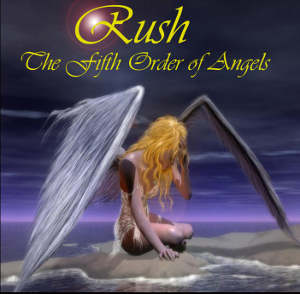
SOUNDTRACK: RUSH-“Garden Road” (1974).

So the bootleg that I mentioned yesterday was in fact incomplete.  On the Up the Downstair site, the track list includes “What You’re Doing” and “Garden Road.”  When I wrote to the cool host of Up the Downstair, he said that these two songs were available on You Tube and that he’d try to find them and add them to the site.

So in the meantime, I got to listen to the song on YouTube.  This is a song that the band wrote but which they never recorded (same is true for “Fancy Dancer”).  I have to imagine that they wrote these songs for their second album (along with “In the End” which they kept) around the time that Neil Peart joined the band.  Once they realized that Neil could write better lyrics, they scrapped these two heavy rockers.  Both songs have great riffs, even if lyrically they’re pretty poor.

The song rocks pretty well, although the solo seems to have been put to better use in “Working Man.”  I enjoy how the song breaks for the shouts of the Garden Road chorus (kind of like “Bad Boy”–perhaps it was a “thing” for them).  I rather like this song, and I think I like it better than a couple of the songs on Rush.

Check it out.

Maybe it’s time to release these old chestnuts for the fans?

[READ: August 10, 2011] Life After God

After the success of Shampoo Planet, Douglas Coupland wrote several short books (which were really short stories).  They were compiled in Life After God.  To me this book also stands out as another odd one from DC, because it is very tiny.  Not in length, but in height.  It’s a small book, about the size of a mass market paperback.  But it makes sense that it was made this short because it is written with lots of short paragraphs that lead to page breaks (kind of like Vonnegut).

For instance, the first story contains at most two paragraphs per “chapter” about–16 lines of text and then a page break.  At the top of each page is a drawing from DC himself which illustrates to a small degree the information on the page.  It leads to incredibly fast reading and even though the book is 360 pages, you can polish it off pretty quickly.

But what’s it about?  Well, mostly the stories seem autobiographical (even though they are classified as fiction.  And actually, I don’t know anything about DC’s personal life so I don’t know if they are based on anything real, although I do know he doesn’t have any kids, so those can’t be true at any rate).  There are eight stories.  They are all told from the first person and are more or less directed at “you.”  They all seem to deal with existential crises of some sort.  They are honest and emotional.  To my ear, sometimes they seem a little forced, maybe it’s contextual, but it’s hard to write this kind of massively introspective piece and have it sound “real.”  (But maybe I’m not very introspective about things like this myself). (more…)

Read Full Post »

SOUNDTRACKSUPERCHUNK-Superchunk (1990).

Some time ago, I reviewed all of the Superchunk EPs.  After progresing to their most current music, returning to their first album is a bit of a shock.  Superchunk’s first full length album is incredibly raw, with lots of screaming (two vocalists at once, even) and a very grungy attitude.  It has a DIY aestethic, in keeping with the undeground scene at the time.

The first four songs fly past in a pretty quick blur of adrenaline (the longest is just over 3 minutes).  The fifth song, the aptly named “Slow” slows things down and strecthes things out with a five minute track of slow distorted chords and a long solo.

Of course, the pinnacle comes with the next song “Slack Motherfucker” one of the best grunge anthems of all time. 

The last four tracks speed things up again with the bratty attitude that Superchunk is so good at (see especially “Down the Hall”).  But it’s not all just blistering speed.  The band has some dynamics down and there are a couple of tempo changes as well.

The album is a lot of fun to listen to, especially if you’re lookig for grunge before it became Grunge.  Although there’s very little indication that they would become the indie superstars that they eventually became you can clearly hear proto-Superchunk chunks–Mac’s voice is as it ever was and the noise is present but not overpowering.  There are even hints of melody (although nothing as catchy as later albums).  And yet for all that it sounds like a criticism, the album is really quite solid.

[READ: June 15, 2011] The Hollow Planet

Yes, THAT Scott Thompson, from The Kids in the Hall.  I found out about this comic book from my good friend Jessee Thorne at The Grid.

The backstory is that Scott Thompson had been working on this story for years and years.  He imagined it as a movie (starring him, of course).  When that didn’t pan out, he decided to sell it is a comic book.  And while he was recovering from cancer, he worked on it extensively with Kyle Morton–character likenesses and whatnot.  And now we have a cartoon rendering of Scott Thompson!

This story focuses on Scott’s character Danny Husk…

The book opens with Danny and his wife and kids at a carnival.  After a few moments, Danny’s son gets lost on the merry-go-round.  In the next scene we see just how much his wife is estranged from him (she may even be cheating on him), and how little his daughter thinks of him.  Soon after, Danny goes to work, inserts a disc into his laptop and more or less brings down his company.

So far nothing out of the oridnary for this type of  story–henpecked husband on a quest for revenge that he doesn’t know he wants yet.

Then Danny visits with his old friend Steve.  They talk, they bond over Danny’s concern about his wife.  And Danny feels better.  Until he gets home.  After a scene which I won’t spoil, the story suddenly takes off with a high speed car chase (no kidding) and with Danny entering the titular hollowness of the planet. (more…)

Read Full Post »

SOUNDTRACK: FOO FIGHTERS-Wasting Light (2011).

The Foo Fighters are huge.  Duh.  But when I think of that, it amazes me that a) the Foo Fighters are the band from “the drummer from Nirvana” and that b) while Dave Grohl knows his way around a melody, he is a metal dude at heart, and some of his most popular songs are really heavy.  He can scream with the best of them.

I’ve enjoyed the Foos for many years, but I didn’t listen to their previous discs all that much (or at least I didn’t listen to the mellow disc from In Your Honor and I don’t remember anything off of Echoes…), but this new one is fantastic.  There’s not a dull song on the disc, and Grohl has hit new heights of catchiness and singalong-ness. 

I also like how noisy the disc is.  It opens with some great discord before turning in a majorly heavy rifftastic scream fest in “Bridge Burning.”  Despite the screaming and noise of the opening, the chorus is super catchy.  “Rope” was said to be inspired by Rush.  Knowing that, I can hear a lot of little Rush-isms in the track: The main riff is very Rush-like, there’s a cymbal tapping that reminds me of Neil Peart in the verses, as well as a little drum solo in the middle (with a cowbell!) and the solo is very Alex Lifeson. (It also feels longer than 4 minutes).

“Dear Rosemary” features Bob Mould on backing vocals (but you can hardly tell it’s him).  It’s got a great chorus as well.  “White Limo” is a wonderful punk song, completely incomprehensible lyrics and all.  Meanwhile “Arlandria” (whatever that means) is another totally catchy track (I find myself singing it a lot).

“These Days” should be the next single: catchy and easy on the ears.  I wonder why it hasn’t been released yet.  “Back and Forth” has another great noisy riff.  One thing that I like a lot about the Foos is that they put different things in the same song:  so “A Matter of Time” has a very simple verse and a catchy chorus, but there’s some really buzzing heavy guitars too.  “Miss the Misery” has a kind of sleazy feel which I think is new for the Foos.  And “I Should Have Known” is a kind of angry ballad (I’d like to see Richard Thompson cover it). 

The final track, “Walk” is a fast rocker that sums up the album really well.  Bravo Dave Grohl.  I can’t get enough of this disc, regardless of how popular it is.

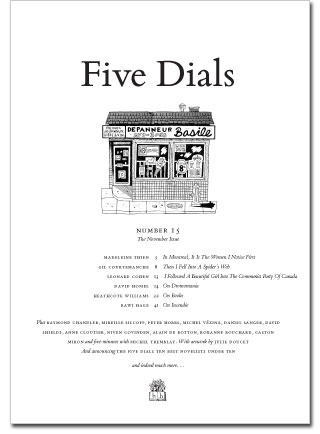
[READ: July 2, 2011] Five Dials Number 15

After the brevity of Number 14, Five Dials Number 15 comes back to a fuller size.  It’s strange to me that the issue is titled The November Issue, in part because they never tell us when the issues were published, but even more because this is actually the Québec Issue.  Most of the authors are Quécbecers and the issue release party was in Québec as well.

I’d like to point out that while I was looking something up about this issue (more later) I discovered the Five Dials News Page.  There are currently 43 pages worth of posts.  But most of them are short.  If there are any especially noteworthy ones, I’ll add them to reviews of future issues, but for the most part so far they’re just announcements of how well received their books are (I’ve already made notes to read two of them).  They also give release dates for the issues, which is how I have been able to retroactively attach dates to some of them.

There are many Québecois writers included in this issue (thoughtfully translated into English), as well as some standard features by Alain De Botton and frequent contributors David Shields and Raymond Chandler.

CRAIG TAYLOR-On Our Québec Issue, and Young Novelists
Taylor’s introduction discusses many Canadian’s attitudes about Québec and their (seemingly perennial) vote concerning separation from the country (“so, let them go”).

creepy beard

The confusing thing here is that it appears that Taylor is Canadian (or at least lived there in 1995/6).   But surely he is British, no?

There’s lots of information about Québec in here but no grand statement (except that Celine Dion’s husband’s beard is still creepy).

He also introduces a new section called “Our Town” which is all about London.  The final section of the note says that

we are releasing our second Five Dials list of Top Ten Novelists Under Ten (or ‘Ten Under Ten’,or ‘Ten-Ten’, or as some of the writers themselves call the list: ‘Tintin.’) As you know, many of the writers we chose for our first Ten Under Ten list went on to things such as high school.

This is how I discovered the Five Dials News page, because there certainly was no Ten Under Ten section in a previous issue of the magazine.  Of course, nor is there any mention in the news that I have seen.  So I can’t decide if the whole thing is just a big joke or what.  I assume it is (but I’d hate to not give credit to the waaaay precocious kids at the end of the issue). (more…)

Read Full Post »

SOUNDTRACK: POTTY UMBRELLA-4 Tracks on MySpace (2007).

The internet is a fascinating thing.  While looking up Basia Bulat, I stumbled upon a Polish music website.  That site featured a review of an album by Noël, Pleszyńskiego, Maćkowiaka.  It turns out that Artur Maćkowiak was also in a band called Potty Umbrella.  And Potty Umbrella have a MySpace page with 4 songs on it from their 2007 album Forte Furioso.  

Potty Umbrella is a (mostly) instrumental band that plays pretty great alternative/psychedelic/ jazzy rock.  I suppose they’re a jam band, although the Polish language SavageSaints blog (technically called … którędy pójdą dzicy święci) describes them as “New wave of Polish post-jazz.”

The songs are wonderful.  “Gone” opens with the waving guitar and delicate riffs of an Explosions in the Sky song.  But it soon shifts with the propulsive bass of a jazz song.  It’s a wonderful medley of the two styles.  And when the keyboards come over the top, it adds yet another layer of musical stew to this mix.

“Jet Lag” continues the manic fun with a 6 minute  (actually most  of the songs are 6 minute) blast of energy.  Crashing drums open a sinister spy-movie theme (with wicked-sounding guitar lines).  By the middle of the song, wah wah guitars and super fast keyboards have converted this into a cool jam.

The track “Dr. Pizdur” is wonderfully wild, with some great keyboard sounds over the top of the funky guitar/bass lineup.  And the live track “Nymph’s Song” (sung in rather forced English) rocks really hard.

Potty Umbrella will never have a big following in the States (although there are YouTube videos of them playing in Canada), but the underground fanclub can start right here.

[READ: June 24, 2011] “Gravel”

Readers here know that I love Alice Munro.  I think that she is one of the best short stories writers around.   Of course, if you know what other kinds of writers I like you might be surprised by this declaration–because I love florid prose.  But Alice Munro is the antithesis of that.  She writes succinct stories, with very little in the way of flourishes.  Sometimes they have action, but usual there’s very little and, like in this story, the action is not the point of the story.  And yet for all of that, the stories are quite powerful.

This is the story of a young girl (written from the point of view of the girl when she is an adult).  When her parents separated she, her mother and her older sister Caro moved to a trailer park (with their dog Blitzee).  The reason her parents separated is because her mother became pregnant.  And she told everyone that the baby was Neal’s.  Neal was an actor in the town’s summer theater troupe (he drifted from job to job but always had enough to get by).

Caro was a headstrong girl, but since this is her sister’s story we see Caro’s actions from her sister’s perspective.  On two occasions, Caro sneakily brought Blitzee to their old house (where their father still lived)–pretending that he had run back to the house.  The parents were amazed and perplexed at first, but caught on when it happened again so soon. (more…)

Read Full Post »

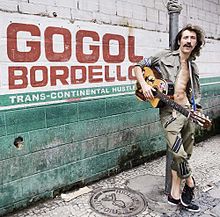
SOUNDTRACK: GOGOL BORDELLO-Trans-Continental Hustle (2010).

When I first heard Gogol Bordello, they were touring for this album (thanks NPR).  Consequently, I knew this album pretty well when I bought it.  At first I felt that it didn’t have the vibrancy of the live show (how could it?).  But after putting it aside for a few weeks, when I re-listened, I found the album (produced by Rick Rubin) to be everything I expect from Gogol Bordello: loud, frenetic fun, a bit of mayhem, and some great tunes that sound like traditional gypsy songs, but which I assume are not.

While I was listening to the album, I kept thinking of The Pogues.  They don’t really sound anything alike but they have that same feel of punk mixed with traditional music.  For The Pogues, it’s Irish trad, and for GB it’s a gypsy sound–I’m not sure if it is attributable to any specific locale.  But they have a common ground in a kind of Spanish-based trad style.  From the Pogues, you get a song like “Fiesta” which is overtly Spanish.  From GB, you get songs like “My Companjera” or “Uma Menina Uma Cigana.”  Singer/ringleader Eugene Hutz has been living in Brazil, and he has really embraced the culture (and the accent).  He also sings in a kind of drunken tenor (his accent is probably more understandable than MacGowan’s drunken warble, but not always).

I’m led to understand that previous albums were a bit more high-throttle from start to finish.  This disc has a couple of ballads.  At first they seem to not work as well, but in truth they help to pace the album somewhat.

It’s obvious this band will not suit everyone’s tastes, but if you’re looking for some high energy punk with some ethnic flare, GB is your band (and if you like skinny guys with no shirts and big mustaches, GB is definitely your band.  It is entirely conceivable that Hutz does not know how to work a button).

[READ: June 20, 2011] All the Anxious Girls on Earth

I’ve really enjoyed Zsuzsi’s stories in recent issues of The Walrus.  So much so that I wanted to get a copy of her new book.  It wasn’t available anywhere in the States yet, so I went back and got her first collection of short stories.

This collection felt to me like a younger, less sophisticated version of Zsuzsi’s later works that I liked so much.  This is not to say that I didn’t like them.  I just wasn’t as blown as w.

“How to Survive in the Bush”
I had to read the opening to this story twice for some reason.  The second read made much more sense and I was able to follow what was going on (I think there were a few terms that I didn’t know–a 1941 Tiger Moth, East Kootenays–that were given context after a few pages.  It transpires that this is a story o a woman who has given up her life to move to the boonies with/for her husband.  The whole story is written in second person which while typically inviting, I found alienating.  It made the story harder to read for me, but once I got into the groove of it I found it very rewarding. (more…)

Read Full Post »

SOUNDTRACK: TINDERSTICKS-35 Rhums (2008).

This is a charming and very French sounding soundtrack. A delightful melody runs throughout the disc (which totals just over 25 minutes).

When Sarah first heard it, she said, “What’s this French music you’re listening to?”  And indeed, it is very French-sounding. There are very simple instruments: melodica, acoustic guitars, piano.  And that melodica is a prominent sound–giving it a sense of intrigue as well as a sense of solitude (the melodica can sound so yearning).  But it’s not all melodica and intrigue; for instance, there’s some delicate xylophone on “Night Time Apartments.”

There are also several snippets from the movie online.  Here’s one clip (with Tindersticks score underneath):

Of the new soundtracks releases this one is my favorite.  And it’s one that I could see listening to for fun.

[READ: June 16, 2011] “The Rules of Engagement”

This is the final story in The Walrus‘ Summer Reading issue.  As I mentioned, the intro states: “We asked five celebrated writers to devise five guidelines for composing a short story or poem. They all traded lists–and played by the rules.”  Alexi Zenther was given rules by Sarah Selecky (which I posted below).

I really enjoyed this story, despite the immoral behavior.  Susan and her friends from high school (it’s ten years after high school now) are enjoying a foreign vacation for a week.  The first thing we see is a man seducing Susan.  They call him “Fork” because after a few hours of flirting, he asked, “And now we fork?”  Amusingly, for someone who made a living seducing women, he was bad in bed.

The other women also meet and bed these professional gigilos.  After sex, one of them simply walked over to the woman’s wallet and took money when he was ready to leave.  She notes that he took “probably less than I would have given him if he had asked.”

The women are in various stages of relationships, one woman is divorced, another is serially monogamous and a third is married (that’s the immoral part).

There’s a wonderful diversion in the story that flashes back to Susan’s grandfather Bert.  Bert had a U-pick apple stand and the girls worked there for many summers.  There’s an especially tender moment in which Susan and Bert are wandering the island and they see a wild horse.  And the scene fills Susan (and the reader) with a sense of wonder at her grandfather. (more…)

Read Full Post »

SOUNDTRACK: TINDERSTICKS-Claire Denis Film Scores 1996-2009: L’Intrus [CST077] (2004).

This score comes from Claire Denis’ 2004 film L’Intrus.  The soundtrack was done by Stuart Staples.  In the booklet he talks about how conventional scoring just didn’t seem appropriate for the film, so he chose this rather noise-filled style.

It is a noisy, menacing work (L’Intrus means The Intruder, so that makes sense).  The sounds are clanky and squeaking, creating an ominous atmosphere.

But what’s most interesting about the score is that despite this limited collection of sounds, he creates a musical work out of it that is interesting to listen to on its own.  The track “Horse Dreams” is full of discordant notes and screeches.  While “The Black Mountain” features a solo horn over the noises.  It’s not easy listening, but it is certainly evocative.

This score is also very short about 25 minutes or so).  The movie is 130 minutes.  I wonder what other sounds are in the film?

[READ: June 15 2011] “Madame Poirer’s Dog”

This is the second story in The Walrus’ Summer Reading issue.  As I mentioned, the intro states: “We asked five celebrated writers to devise five guidelines for composing a short story or poem. They all traded lists–and played by the rules.”  Kathleen Winter was given rules by Alexi Zenther (which I posted below).

I didn’t enjoy this story all that much.  More specifically, I enjoyed the story within the story, but the full, proper story was a little too indistinct to me: It felt kind of all over the place.  In some ways this is appropriate as the story is set in an old folks’ home.  The titular dog comes into play throughout the story and the hard and fast facts of the dog’s tale give some grounding to the story.

The dog’s story is told in a just-the-facts, not-the-details style.  And the dog’s story is a funny story.  It involves a chastity belt (for the dog), and another dog’s skill at the belt’s removal.  But  the funniest part came at the end when the narrator criticized her son’s wife because she would be the kind of person who would ask for details “that no one cares to remember: what exactly does it look like, a chastity belt for digs, and of what material is such a thing made?”

The bookend parts that surrounded the story just kind of fade from my memory.

The five rules from Alexi Zenther: (more…)

Read Full Post »

« Newer Posts - Older Posts »