Feeds:
Posts
Comments

Archive for the ‘Bookstores’ Category

SOUNDTRACK: .

[READ: February 21, 2025] One the Calculation of Volume I

I received this book as part of New Directions “membership” where they sent me a new book each month for a year.  I had never heard of Solvej Balle, who is a Danish author.  This might be her first book translated into English.  Barbara Haveland did the translation.  I was certain I had read something else she had translated, but I guess not.  Her phrasing is excellent and made this book an easy, enjoyable read.

This book is part of a seven-volume set (this book was only 161 pages) and given the scope of this volume, I’m unclear what might happen in the others–maybe they’re entirely unrelated?  Turns out that Book 2 is already out, although 3 and 4 are coming out in the fall of next year.  And I just checked, book 2 continues the story.

And the story is this.

Tara Selter went to a conference on November 18th.  She went to bed and when she woke up, it was November 18th again.

Yup, it’s Groundhog Day, the movie.  But it’s not that at all, because Tara does not find it funny.  Also, and I don’t think this is a spoiler, she does not try to kill herself (like in the movie) only to find that she comes back.

The book starts on day #121 of her repeated November 18ths.

She returned from the conference and her husband wondered why she was back so soon.  She explained everything and (fortunately for the book) he believes her.  They go through the whole day, wondering what happened and what to do about it.  And when she woke up the next day, the world had reset to November 18th, but she continued.  I really appreciated the way Tara had a burn on her hand and we see it heal as the days move on. (more…)

Read Full Post »


SOUNDTRACK: FLEETWOOD MAC-“The Green Manalishi (With the Two Pronged Crown)” (1969).

I know this song from Judas Priest, who made a killer cover that they played for years.  Rob Halford’s voice on the song (in their live version from 1976) is incredible.

I didn’t even know there was an “original” until a decade or so ago.  It seemed out of character that Judas Priest would cover a trippy Fleetwood Mac song (of course they also covered Joan Baez, so…).  But wow, this song is a trip.

I mean, the lyrics alone are the stuff of legend at this point.  There’s dozens of places where you can read about the song.  Here’s a few paragraphs from Uncle Stylus.

Peter Green said it’s a song about the corrupting influence of money, which he equated with the devil. In 1969, the huge success of Fleetwood Mac had brought them a considerable income and Green had agreed with the band that they would would give it all to charity. One can imagine that “morning after” moment when he demanded they made good on their idealistic rush of blood. A massive quarrel ensued, and Green never forgave the other bandmembers for reneging on the idea and claimed that this was what inspired the song.

Manalishi is a word that Peter Green made up for the song. The sound of it rolling around the tongue is exotic and menacing, suffused with the mystery of demons and gremlins from a medieval Italian dark night.

Listening now it’s clear that he was really, whether consciously or unconsciously, telling us about his depressive schizophrenia and even the dark persona unleashed within him when he took certain drugs, the “green” of the manalishi being Green himself. It reads like the beginning of a story by Edgar Allan Poe.

The Judas Priest cover doesn’t really follow the original all that much (the ending wailing is so much cooler the way Halford does it).  But the riff here is pretty spectacular (understandable why they’d want to cover it).  Also, it was a big hit in England when it came out, so it’s not like the band was crate-digging for rarities.  I had just never heard of it.

There is something some sinister about the slow menace of the Fleetwood Mac version.  It’s incredible to think that this is the same band who put out Rumours (although really it isn’t, but whatever).

Check out the live from Boston version for some real heaviness.  And marvel that this weird song was a hit.

[READ: November 2022] Collectibles

Evidently Lawrence Block has created several of these anthologies all loosely based around a theme.  This is the first one I’ve read, although I see another one called Playing Games is on the horizon.

This collection is about collectibles.  Most but not all of the stories are crime or mystery based.  A couple have a touch of the supernatural as well.  The term “collectible” is pretty broadly defined from one story to the next, but it’s a decent prompt to let you know what you’re getting.

Lawrence Block – The Elephant in the Living Room (An Introduction)
This is an essay about the book which includes an amusing story about Lawrence’s Uncle Jerry who ha a collection of giraffes.  There were presently none in the collection because he hadn’t found one up to his standards. (more…)

Read Full Post »

SOUNDTRACK: LANG LANG-Tiny Desk (Home) Concert #11 (April 17, 2020).

Lang Lang is a superstar pianist whom I have never heard of.  But I agree with the blurb that it’s neat to see a fantastic pianist playing at home.  He seems relaxed and loose.  And the camera angle allows us to see his fingers (and his whole swaying body) pretty clearly.

Here’s something unique: a chance to eavesdrop on the superstar pianist Lang Lang at home.

The 37-year-old pianist, who typically plays sold-out shows to thousands, says he’s taking his recent solitary time to learn new repertoire at home in Shanghai, China. And home is where he thinks we should all be.

He opens with Chopin’s calming “Nocturne No. 20 in C-sharp minor.”  I loved watching him slowly and deliberately play that last note.  It seems like he holds his finger above it for minutes, but it fits in perfectly.

Lang Lang’s latest passion is Bach – specifically the Goldberg Variations, a 75-minute-long cycle of immense complexity grounded in the composer’s durable beauty. Lang Lang offers the “18th and 19th variations,” pieces that in turn represent the strength of logic and the joy of the dance. It’s music, Lang Lang says, that “always brings me to play in another level of artistic thinking.”

These pieces are just magical.  Even if I don;t know them well, I can tell pretty immediately that they are Bach.  Lang Lang’s fluidity is wonderful, as is the way his whole body seems to be absorbing the music as he plays.

[READ: April 11, 2020]: Carnet de Voyage

From March 5 thru May 14, 2004 Craig Thompson was on an international book tour celebrating the success of his (fantastic) book Blankets.

This journal was his visual diary (no cameras were used, only his memory) of his trip.  His editors thought it would be interesting for him to document his trip (and it is).

He flies into Paris then a 2 hour plane trip to Lyon.  He draws pictures of where he has been and the people he has met (and some of their fascinating stories).  There’s some wonderful sketches of rooftops from hotel windows.

He does interviews for radio and magazines. He laughs that one of the photos shoots was in the streets of Paris, where he is all dressed up.  But really he’s a county bumpkin from Wisconsin. The drawing of himself as a glamorous guy and his bumpkin alter ego together is pretty hilarious.

On March 15 he left for Marrakesh, Morocco and this exotic location rally sets the stage for most of his artwork and what is sort of the only “plot” in the book.

He had also just broken up with his girlfriend which weighs on his mind quite a lot on the tour. (more…)

Read Full Post »

SOUNDTRACK: KING GIZZARD AND THE LIZARD WIZARD-Flying Microtonal Banana (2017).

2017 was a massive year for KGATLW as they pledged (and kept that pledge) to release five albums in the year.  This was the first.

Flying Microtonal Banana starts with the same sort of relentless frenzy that Nonagon Infinity had.  Just witness the stomping, grooving repetition of “Rattlesnake,” a catchy, 7 minute song whose lyrics are primarily “rattlesnake.”

The difference comes in the title of the record.  It’s not banana, it’s microtonal.  The banana in question is the yellow microtonal guitar that Stu Mackenzie uses on the album (and live).  It’s a custom-made guitar modified for microtonal tuning, which allows for intervals smaller than the semitones of Western music.  Since the new guitar could only be played with similarly tuned instruments, the rest of the band got their gear tricked out with microtonal capabilities.

This gives many of the songs a distinctly Middle-Eastern sound.  As does the inclusion of the zurna, a wind instrument which is almost constantly loud, high-pitched, sharp, and piercing.  Not an inviting description, but the instrument adds some interesting sounds and textures to the disc.  “Rattlesnake” is so catchy, though, that the zurna just feels like one more component.

“Melting” lets up the intensity with a wonderful guitar/vocal melody and some great synth accents.  As the song grooves along there’s some cool sounds and textures throughout the vocals and background sounds.  The solo comes from a slightly distorted synth–the ever-rising melody is catchy but leaves you wanting more.  The microtones really come out in the middle of the song, where the guitar/vocal melody experiments with all the various microtones that their instruments could achieve.

“Open Water” has a ringing guitar melody and a sinister chorus about open water.

Open water
Where’s the shore gone?
How’d I falter?
Open water
Height of the sea
Will bury me
And all I see is
Open water

There’s a very cool microtonal guitar solo throughout the middle of the song.   When the zurna comes in it brings a whole new kind of tension.

The rest of the album is made up of shorter songs.  They don’t exactly segue into each other, but they do feel like a suite of sorts.  Except that each one focuses on a different style (not at all unusual for KGATLW).

“Sleep Drifter” is sung in a near whisper, almost comforting, as it follows the nifty rising chorus melody.  The interstitial guitar riff is really cool, too.  “Billabong Valley” returns to their Western style from earlier albums.  It is sung by Ambrose in his very different vocal style.  There’s a staccato piano and an interesting western-inspired microtonal riff.  “Anoxia” slows things down with a twisty guitar.  The zurna contributes to a trippy ending.

“Doom City” sounds like early Black Sabbath with deep notes and a strangely hippie tone with lots of echo.  Then it picks up speed and adds some wild zurna tones.  There’s even some high-pitched laughs giving an even weirder feel.  I love that the speed jumps between slow and ponderous and speedy and hurried. “Nuclear Fusion” has a staccato rhythm.  For this one, not only does the lead vocal follow the interesting guitar melody, but there’s a deep harmony voice following along as well.   I always love when they add organ sounds to the song, like this one.  And the deep voices as the beginning and end are pretty awesome.

The final track is the instrumental title song.  It explores all manner of microtonal solos both on guitar and zurna.  It opens with bongos and congos and just takes off from there with the screeching zurna melody.  It’s catchy and weird like t he rest of the album and it ends with the winds blowing things away.

That’s the banana itself on the right.

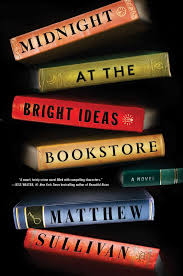
[READ: January 2019] Midnight at the Bright Ideas Bookstore

I was attracted to this book because of the title.  I knew literally nothing about it, but the blurb called it a smart, twisty crime novel.  I typically don’t read crime novels, but I’ve had pretty good luck with books set in bookstores, so it seemed worth taking a chance.

And, wow, what a delightfully convoluted story.  It was absolutely full of surprises and puzzles.  In the past I would have tried to figure out he puzzles myself, but since the answers to the puzzles were given right after the puzzles were shown, I got lazy and let the book do the work for me.   And what a fascinating bunch of characters Sullivan has created.

Lydia Smith works at the Bright Ideas Bookshop in Denver.  She has been there for a while, but she’s keeping a low profile.  She grew up in Denver and had a reasonably good childhood.  Then, suddenly something horrific happened and she and her father moved into a remote cabin outside of Denver where neighbors were nowhere near.  Her father, who was once a loving librarian too a job at a county prison and became a hardened policeman.

The event is hinted at in the beginning.  In the middle we get a vivid description of her perception of the event.  The rest of the story unpacks it.

After living in the woods, Lydia left her father, without saying a word.  She returned to Denver and hadn’t spoken to him for years.

She loves the security of the Bright Ideas Bookstore.  The store is populated by the Book Frogs, old men mostly, who spend hours and hours here browsing books.  They are all eccentric in some respect, but they are harmless–and most are thoughtful.

But as the book opens, one of the younger Book Frogs, Joey Molina, her favorite one, hangs himself–right upstairs in Western History.  She tried to take him down, to save him, to do something.  But she was too late.  As she was trying be helpful, she saw that he had a picture in his hand.  It was a picture of her when she was a little girl.  A picture she had never seen before.

What a great opening chapter! (more…)

Read Full Post »