Feeds:
Posts
Comments

Archive for the ‘Books about writers’ Category

SOUNDTRACK: MOGWAI-EP +2 (1999).

There’s a fascinating release history behind this EP (which mostly means fans wind up with three copies of “Stanley Kubrick.”  First it came out as EP with 4 tracks (which I ordered on import).  Then it was released in the US as EP+2 with two songs from the Fuck the Curfew EP (which was not released in the US) and finally in 2000 it was reissued again as EP+6 with ten songs in total (compiling 1997’s 4 Satin, 1998’s No Education = No Future (Fuck the Curfew), and 1999’s EP–I didn’t buy this version because by then I had the original imports).

“Stanley Kubrick” is a slow burner with a great repeated mournful guitar.   It’s one of their best songs. “Christmas Song” is a slow, upbeat track with a very pretty melody.  “Burn Girl Prom Queen” opens with some really quiet guitar.  After about 90 seconds, a brass band kicks in adding amazing horns over the simple guitar melody.  It’s my favorite track on the disc.  “Rage: Man” is the first song on the album where Mogawai’s noise tendencies really come to the fore.  Once again, it’s a simple slow melody (with piano).  About two minutes in, the song is bombarded with noise guitars that take over the song but don’t obscure the melody.  There’s also a noisy guitar solo played over the noise.  Soon enough all the noise ends, and the simple, harmonic’d guitar comes back and the song ends peacefully.  It’s a great example of Mogwai dynamics.

The other two tracks, “Rollerball” and “Small Children in the Background” come from the other EP as I mentioned.  It’s odd to squeeze in songs from a different release, but Mogwai don’t sound terribly different on these early EPs, so these songs work well together.

Despite their length, Mogwai EPs are pretty uniformly wonderful.

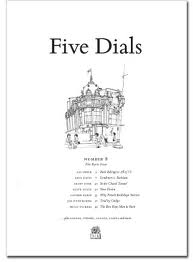
[READ: June 1, 2011] Five Dials Number 8 bis

After publishing Five Dials Number 8, they quickly rushed out this addendum to the issue, which they’ve called Five Dials 8 bis.  According to the introduction: “The definition of ‘bis’ is a passage to be repeated, so here is a small bis for our eighth issue.”

It’s only 9 pages long and really only contains one long piece.  Primarily, this is a memento of their Paris-issue release party, which they held in Paris (duh).  The opening pages includes scans of postcards (“One of our volunteers waded into conversations and asked attendees to write down their own thoughts on Paris. We’ve reprinted five of our favourites.”)  The editor’s letter, which explains all about the party and this issue, is not credited to anyone, so I can’t so who is responsible.  [This lack of proper crediting is the one major flaw with this publication–just saying illustrations by, and then not saying which is whose, or not including the date of publication is maddening].

The big article is by Guy de Maupassant (translated by Siân Miles). (more…)

Read Full Post »

SOUNDTRACK: AUDIOSLAVE-Audioslave (2002).

Despite the pedigree of this band: Rage Against the Machine + Chris Cornell, I wasn’t all that interested in the band when they came out.  I was over Rage and was bored by Cornell’s solo stuff.  But then recently, someone donated a copy of this album to th elibrary, so I thought I’d see what all of the fuss was about (nine years ago).

There are times when this album is really superb.  The Rage guys get an amazingly full sound out of their instruments (the choruses of “Show Me How to Live” are so full).  And when it works, and Cornell’s amazing voice is in full force, this seems like a genius pairing.

But there’s a lot that feels kind of clunky here (and there’s some really bad choices of guitar solo work by Tom Morello–the weird noises that compriose he solo of “What You Are”–in Rage the noises were weird but exciting and inflammatory, these are just kind of dull.  Worse yet, is the, well, stupid solo in “Like a Stone”–boring and ponderous at the same time).  Although he redeems himself somewhat with the cool solo on the otherwise dull “Intuition”.

The biggest surpise comes in “Like a Stone” which is insanely catchy and mellow–something one assumed Rage didn’t know how to do).  Lyrically the song is pretty stupid (as are most of the songs), but the combination of melody and Cornell’s great vocal lines really raise this song high–shame about the solo).  Also, a song like “Shadow of the Sun” seems to highlight Cornell’s more mellow moments (and shows that the Rage guys can actually play that slow), and they all seem to be in synch.

And there are several songs that rock really hard, sounding at times like Rage and at time like Soundgarden, but working on all cylinders together.  “Cochise” and “Set It Off” are simply great riff rock songs.

But ten or so years later, and twenty years since Badmotorfinger (my favorite Soundgarden album), it’s nice to hear Cornell rocking again.  Although man, the record is too long!

[READ: June 1, 2011] Five Dials Number 8

For Issue Number 8, Five Dials went to Paris.  And so the whole issue is given over to French concerns and ideas.  For a magazine that didn’t need a change of pace, it’s a delightful change of pace.  The feel of the magazine is different, and there’s an air of vacation about it (which is not to suggest that it is slacking off in any way), and it feels really vibrant.

I don’t know a lot about France in general.  I mean, I’ve been there, and I keep up with things, but I am not a Francophile by any means. So a lot of this stuff was simply new to me, which is always fun.  What I especially liked about the issue was that they were not afraid to show some of France’s uglier sides as well–it’s not just a tourism booster.

It even starts out differently than the other issues. (more…)

Read Full Post »

SOUNDTRACK: BEN FOLDS/NICK HORNBY-Lonely Avenue (2010).

As the cover of this album notes: “Ben Folds adds music and melody to Nick Hornby’s words.”  And that is true. The only surprising thing about this combination is that Folds is quite a good lyricist himself, so it’s surprising that he would sacrifice his words.  But regardless, the fit is a good one.

Sometimes it seems like Hornby is challenging Folds to come up with melodies for some of his more difficult lyrics which Folds lives up to).  But they have such similar sensibilities that (aside from occasional references to British things) the words could have come from Folds himself (although, Hornby’s a better writer, so Folds wouldn’t have written exactly the same things).

The big surprise is the diversity of musical styles on the disc.  Folds of course does play lots of different types of music on his previous discs, but I guess since the cohesion is Hornby’s words so Folds can really let loose.

The opener, “A Working Day” is a keyboard pop confection, a surprisingly 80s sounding synth song with some wry lyrics about being a writer/performer (“some guy on the net thinks I suck and he should know, he’s got his own blog”).  “Picture Window” is a beautiful downer, a string-filled song that seems like a companion to Folds’ “Brick” (“You know what hope is, hope is a bastard”).  It’s just as sad but the melody is gorgeous.

“Levi Johnson’s Blues” is a strangely topical song (in fact, it took me a minute to remember who he was when I first listened to the song.  Anyhow, it’s a silly song about what happened to the father of Sarah Palin’s grandchild.  And yet, despite the novelty of it, it’s actually a somewhat sympathetic portrait of the guy (sure he’s a redneck, but he’s just a normal guy thrust into a ridiculous spotlight–the liner notes say the chorus came from Levis (redacted) Facebook page).

“Doc Pomus” feels like a classic piano song.  While “Young Dogs: is a fast romper (with great vocals) and more keyboards.  “Practical Amanda” is a slow ballad (and Hornby says it’s not autobiographical at all).  While “Claire’s Ninth” is a story about a young girl of divorced parents who hates having two birthdays.  (With sweeping choruses!) Hornby states that this was his first accepted short story (modified for the song, of course) but the magazine that accepted it stopped publishing before his appeared.  D’oh!

“Password” is a wonderful song which only makes sense when you know the name of it (which I didn’t at first, as I usually don’t look at titles right away).  Throughout the song Ben spells words which leads to a cool conclusion–it’s wonderfully clever writing and it’s done in a fascinating R&B-lite style.

“From Above” is a jaunty rocker about people who never meet, although their paths cross quite often.  “Saskia Hamilton” is the “single” from the record.  It’s another great 80’s keyboard fueled romp.  Since I have a friend named Saskia (hi, Saskia) I’m fond of this song–her name is fun to say.  They have a bunch of fun in the recording too.

The final track, “Belinda” is designed like a classic 70s piano ballad (there’s a lengthy email printed in the notes that explains the construction of the song–reading that makes the song even more impressive).

It’s a great Ben Folds album.  It’s not as tidy as some of his other ones–but all of that experimentation leads to some new avenues of melody. It’s a risk that paid off.

[READ: May 10, 2011] Five Dials Number 7

This issue of Five Dials was primarily about Memoir.  Typically, I don’t like memoirs, but I’m finding (and this coincides with what one of the memoirs below states), that I just don’t like celebrity memoirs.  Or perhaps I just like three page accounts of an incident in someone’s life (which these are).

Each of the writers below is given an introduction in which they summarize WHY they write memoirs.  It’s interesting to see that many of them do, in fact, take other people’s feeling into consideration (not as seriously as Mark Twain who waited 100 years for the publication of his), but they try to do something or other to spare people’s feelings.  I was intrigued also that several of the writers also talk about finding themselves through writing.  One or two of them make the exercise of writing memoir sound obnoxiously solipsistic (which of course it is), but it’s nice to read ones that are interesting and not too self-centered.

CRAIG TAYLOR-A Letter from the Editor: “On Audio Detective Work and Memoir”
This letter explains the extent of the audio detective work that went into the interview (presented later) between Raymond Chandler and Ian Fleming.  Since I love playing with audio software, this was of especial interest to me.  And it made me really look forward to the interview. (more…)

Read Full Post »

SOUNDTRACK: PEARL JAM-East Rutherford, NJ 6.3.06 (2006).

This concert was a free download with the purchase of Backspacer. I chose this because this is the show that I should have gone to.  [How many concerts have I seen at the Meadowlands–or whatever it is called now?].  Not to mention, this is the last concert date of the first leg of the tour, and the last concerts are usually a little longer, a little wilder, a little more fun.

And there’s a number of reasons why this is true during this show.

The first is the technical flaw.  Midway through their fifth song, “Animal” there is some kind of power failure (the flaw with audio from concerts is that you have no idea what’s really going on).  The song shuts down, there’s some crowd chanting and then the power comes back on.  This gives Eddie Vedder a chance to make a Springsteen joke (did he leave for tour without paying the electric bill) and the band resumes, even more intense than before.

There are a number of Springsteen moments during the show.  They thank him for introducing them to the Community Food Bank of New Jersey–where proceeds from this night’s show go).  Later, Eddie’s explains that his failure to figure out the chords to Springsteen’s “Atlantic City” led to his creating the song “Gone”.  And Eddie’s “Pre-Opener” (sadly not on the download, but you can hear it here) is a cover of Springsteen’s “No Surrender.”

Springsteen aside, this is a great show.  The download is three discs long (the first disc is 25 minutes or so and comprises the audio from up to the power failure).  But even with the confusion, the band sounds wonderful.  They run through all kinds of songs from throughout their career, “Even Flow,” “Alive,” “Why Go,” “Black,” “Porch,” and “Garden” from Ten.  “Animal,” “Rats” and “Leash” from Vs. “Last Exit,” “Whipping” and “Corduroy” from Vitalogy, “Habit” and “Lukin” from No Code, “In Hiding” from Yield. “Love Boat Captain” and “I am Mine” from Riot Act, and about half of the songs from Pearl Jam.  There’s also a whole bunch of songs from Lost Dogs: “Hard to Imagine,” “Yellow Ledbetter,” “Last Kiss” and “Don’t Gimme No Lip” and even “State of Love and Trust” and “Crazy Mary.”

The show is a pretty rocking show overall.  In fact, as you can see above they don’t even play their more crowd pleasing ballads (“Betterman,” “Daughter”).  And the set in no way suffers from it.

This show also has a special guest and a special announcement.  Vedder explains that June 3 is West Memphis 3 Recognition Day.  Wikipedia says The WM3 are three teenagers who were tried and convicted of the murders of three little boys in West Memphis, Arkansas in 1993 by a prosecution team that put forth the idea that the only purported motive in the case was that the slayings were part of a Satanic ritual. In July 2007, new forensic evidence was presented in the case, including evidence that none of the DNA collected at the crime scene matched the defendants, but did match Terry Hobbs, the stepfather of one of the victims, along with DNA from a friend of Hobbs’ whom he had been with on the day of the murders.

The WM3.org site shows that many musicians are behind them, offering support and free music.   A new trial date has been tentatively set for October 2011.  If they are found not guilty they would have spent eighteen years in jail for nothing.  Damien Echols (who was sentenced to death) co wrote “Army Reserve” with Vedder, and Echols’ wife says a few words on stage.

Another great moment comes in “Crazy Mary” when Boom Gaspar and Mike McCready have a kind of dueling organ vs guitar solo.   It goes on for several minutes and Gaspar’s Hammond sounds great.  Later in the show, Vedder toasts the crowd for being great.  It may also be the only toast to incorporate the phrase “fucking assholes” (as in if people don’t think you were amazing, they’re fucking assholes).

One of the great things about Pearl Jam shows is that they pack a lot of music into them.  I was especially mindful that when they came out for their second encore, they played nine more songs for about 30 minutes.  Not a bad encore at all.

This is a great set if you’re looking for live Pearl Jam.

[READ: May 24, 2011] Breakfast of Champions

I read this whole book during my trip to BEA.  I read it while on the bus (two and a half hours total) and then while waiting on line for various author signings.  I don’t know that I’ve ever read a book in such a short period before.  It’s not a long book by any means and it is full of illustrations (more on that later).  It was an ideal book to choose for a day of book reading.

So the novel is actually set up as a story within a story.  The Preface explains that the story is written by Philboyd Stuge (Vonnegut has a lot of fun with names).  It explains that “Breakfast of Champions” is a trademark of General Mills and he is neither  associated with GM nor disparaging them by using the phrase so much (it doesn’t occur frequently until much later in the book).  Stuge explains some of the background information about ideas in the book (that people are actually robots and how Armistice Day was a better name for the holiday than Veterans’ Day).  He also explains that he is writing this book as a 50th birthday present to himself (Vonnegut was born in 1922).  And for his 50th birthday, he is going to act childishly and draw illustrations in the book.  So I found this picture from the novel
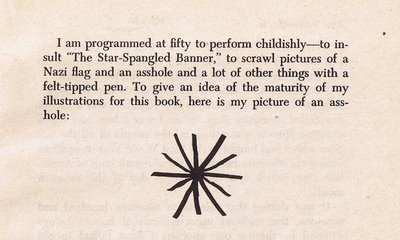
That may give you an idea of what to expect inside (although most of the illustrations are “better” than that one).

What is especially helpful about the story is that it tells you what will happen as it goes along.  So the novel starts:

This is a tale of a meeting of two lonesome, skinny, fairly old white men on a planet which was dying fast.

One of them was a science fiction writer named Kilgore Trout.  He was a nobody at the time, and he supposed his life was over.  He was mistaken.  As a consequence of the meeting, he became one of the most beloved and respected human beings in history.

The man he met was an automobile dealer, a Pontiac dealer named Dwayne Hoover.  Dwayne Hoover was on the brink of going insane.

And that is literally the story.  So why is the book 297 pages long then?  Vonnegut is really out to talk about contemporary society:  America mostly, but not exclusively.  And does he ever. (more…)

Read Full Post »

SOUNDTRACK: FIREWATER-Performance from KEXP, July 3, 2008 (2008).

I loved Firewater when their first two albums came out and I even saw them once open for Letters for Cleo (a great show by both bands).  Then I more or less lost touch with them.  And it turns out that lead Firewater dude Tod A. had been out of the country for a while.

The interview (and concert) with them details his distaste for the Bush administration and his decision to get the hell out of the country for a while.  So he spent three years traveling around India, Turkey, Pakistan and then returned with this album.  I wasn’t aware of any of that, or even that they had a new album out in 2008.

Firewater had a very cool (and reasonably original) sound when they came out back in 1996.  They had a middle eastern vibe even back then which they blended nicely with theatrical pomp and a whole lot of punk.  They threw everything together into a rollicking good time (even if the lyrics were very dark indeed).

The 2008 album The Golden Hour seems a bit more upbeat (touring the world did him good) although it hasn’t changed the overall style of the music.  This live set includes several new musicians for Firewater, and their array of skills (and instruments) is great.  But the most surprising thing to me is how friendly and jovial Tod A. is.  As I said, I knew the band as being kind of angry, so hearing him be fun (and inviting the KEXP volunteers to sing gloriously chaotic backing vocals on “Beirut”) is really cool.

In total the band does four songs: “Hey Clown,” “Electric City,” “6:45,” and “Borneo.”  I think the biggest surprise for me is how short the songs are.  Not punk short, but more like pop song length.  And super catchy as well.

It’s a welcome return to a great band.  Although I see they haven’t released anything else since 2008.

[READ: April 4, 2011] “The Principles of Exile”

This was a fascinating and very sad story which had multiple layers and went in many unexpected directions.  It was really great.

As the story opens, Manny is sent to get some “special” cheese from a shop.  The cheese is called halloumi, and the best kind is made in a bucket behind their counter.  He is sent for this cheese because his mother is making a special dinner.

The dinner is in honor of Monsieur Sarkis’s new book.  There was a fatwa leveled against Sarkis for his previous book.  And that previous book (naturally) went on to be a best seller.  Well, Manny’s father had the publishing rights to the book (normally his publishing house was on the verge of bankruptcy, so a huge best seller was a big deal for them).  They didn’t even mind the fatwa.

Until it started to affect them personally. (more…)

Read Full Post »

SOUNDTRACK: BATTLES-“Ice Cream” (2011).

My friend Lar told me about Battles way back in 2007.  I listened to the concert he sent me, and it was great. But my memory of the band was that they were really heavy (the drummer was in Helmet and Tomahawk for cripessakes).

But they’re not so much heavy as noisy and crazy.  And this track is a head-spinning amalgam of keybaords, unsettling rhythms, processed guitars and singing from Argentinean techno producer Matias Aguayo.  The lyrics sound like they are not English, but they are (with heavy effects on them).

The song is weird, indeed. But after just one listen, I was totally hooked.  It’s catchy and bouncy and very sunny and it’s a real joy to listen to.   I absolutely must go back and check out their debut Mirrored.

Listen at NPR.

[READ: April 28, 2011] Five Dials Number 6

Five Dials Number 5 was an excellent issue that I enjoyed immensely.  They followed it up with Number 6, which deals with a subject that I was very passionate about in the early 90s: censorship/obscenity.  When I was in high school and college, the PMRC was the big bogeyman for advocates of free speech (of which I am one).  I still advocate passionately for freedom of speech (now that I’m in a library, the issue can be part of my daily life), but it seems like there are so many more important issues in the world, that stickers on a record seem kind of silly.

Nevetheless, as this issue reminds us, those who control what is said control what we hear.  And that’s true for music and books, as well as our everyday news.  So, free speech should never be taken lightly.  Although this issue looks largely at obscenity in England, they also pull up some good information from Jello Biafra as well.

CRAIG TAYLOR-A Letter from the Editor: On John Mortimer and Obscenity
John Mortimer appears later in the issue. He was the lawyer who defended Lady Chatterly’s Lover against accusations of obscenity.  And Taylor points out that Mortimer’s attitude was that he “understood the silliness of censorship.”  And with that attitude, he was able to work to convince juries of that silliness.  The rest of the issue looks at important cases of censorship over the years, from The Dead Kennedys to NWA (it’s nice to be reminded about how “dangerous” they were when they came out).  He also laughs at the lame attempts at putting adult content on network TV (Fudge you!). (more…)

Read Full Post »

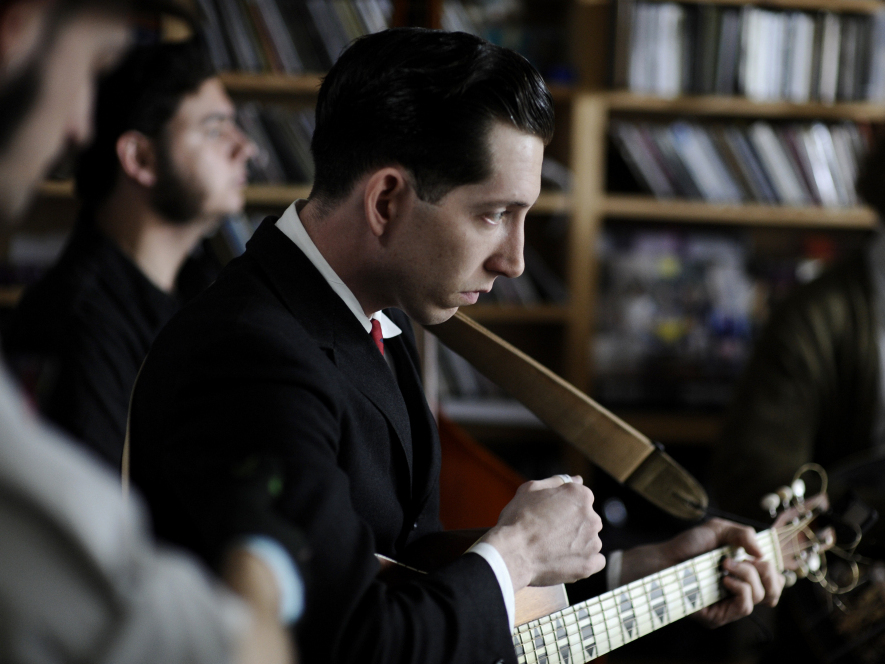
SOUNDTRACK: POKEY LaFARGE-Tiny Desk Concert #122 (April 20, 2011).

I had never heard of Pokey LaFarge before this Tiny Desk concert was sitting in my download folder.  In fact, the notes on the page say that they had never heard of him before they saw him wandering around SXSW.  And then he climbed onstage and played a great set.

LaFarge plays an old-timey style of music.  It’s a kind of Squirrel Nut Zippers retro sound.  As with the Zippers, I love their music in small doses.  And so, this Tiny Desk set is a perfect little sample of LaFarge’s music: happy, bouncy, jazzy.  There’s an upright bass solo, songs about being happy and singing “La La La” and other upbeat stuff.  It’s quite satisfying.

Especially if, as the notes say, you use it as a kind of antidote to the raucous music that you generally listen to.  A Pokey LaFarge song will perk you out of any self-inflicted gloom.  I just don’t need to hear more than three.

[READ: April 15, 2011] 2 book reviews

It looks like Zadie Smith has become a regular fixture at Harper’s.  I’m undecided if I’m going to review all of her book reviews from now on (perhaps I’ll lump some together in one post).  But in the meantime, I’m mentioning this one primarily because she reviews the story that I mentioned in yesterday’s post: Edouard Levé’s Suicide. (more…)

Read Full Post »

SOUNDTRACKMETRIC-Fantasies (2009).

I was hooked by the song “Gold Guns Girls.”  I liked it so much, I bought the disc, and I was absolutely not disappointed.  This disc reminds me of all of the best things about late 90s alt rock (one of my favorite musical periods).  There are echoes of later period Lush, or of Garbage or some other slickly produced commercial alt-rock.

I’m led to understand that this disc would merit cries of sell-out from older fans (their earlier stuff it a bit rougher, I gather), and yes, this is a pretty commercial release, but I don’t mind.  The songs are all top-notch: great songwriting, catchy choruses, wonderful production.  And there’s something slightly uncommercial about the lyrics which I think is what keeps this album from being too slick for its own good.

I have listened to this disc dozens of times at this point and I never get tired of it.  And, there’s no reason why I shouldn’t go back and get some of their earlier releases too.

[READ: May 15, 2011] Fraud

I’ve seen Rakoff on the Daily Show, and his name has been cropping up in various places lately.  So I decided to read his actual published work to see what he was all about.

Fraud is his first book.  It is mostly funny, although it also dwells on serious matters by the end of the book.  In many ways Rakoff is like a slightly wilder, slightly edgier version of David Sedaris (the two have a long history of friendship and working together, so this may not be totally surprising).

I’m not going to compare him to Sedaris in any meaningful way, just to say that there are similarities of temperament and style; I don’t think either one of them is hilarious, but that I enjoy both of them and often laugh pretty hard at their material.

I’m also not going to review each essay in this book.  It seems to be constructed in a vague sort of narrative arc.  Well, actually, the second half of the book has the narrative arc (I suspect that the essays that were published previously were modified slightly and that the new essays allude to some of the incidents mentioned there.

The first few essays of the book are the funnier ones (insert joke about Woody Allen’s early funny movies here), and they stick more to the idea of Rakoff as a “Fraud.”  In them, Rakoff, a Canadian ex-pat (he’s from Toronto), somewhat neurotic, gay, New York Jew goes to different locations where he is an atypical person and then reports on them. (more…)

Read Full Post »

SOUNDTRACK: PJ HARVEY-Live at the Warfield Theater, San Francisco, April 14, 2011 (2011).

NPR was given permission to share this PJ Harvey concert.  However, they were only allowed to share about half of it.  The show is fairly short to begin with (about 75 minutes) but the downloadable portion is barely 40 minutes.  It turns out that NPR was given the rights to all of the songs from the new album, Let England Shake.

Now, I have no idea how things like this work, why they are only given access to these songs as opposed to the other ones, or why an artist (or management) would not let her fans hear the ten or so other songs she played that night.  Legal restrictions are weird and usually stupid. But as I’ve mentioned before, you shouldn’t complain about free stuff.

So, what we get here is a spliced together concert (it sounds seamless, although they have removed all of the banter (if there was any)).  The album is played in its entirety (although we were not given “Written on the Forehead” which happens to be the song they are playing the most on the radio here), but it’s not played in order.  It was also interspersed with older songs “The Devil” and “Silence” from White Chalk, “The Sky Lit Up” and Angeline” from Is This Desire, “Pocket Knife” from Uh Huh Her, “Down by the Water” and “C’mon Billy” from To Bring Her My Love, (I’d like to hear how she handles the older songs, now that’s she’s singing primarily in the higher register).  And, “Big Exit” from Stories from the City.

It’s pretty clear that Harvey is no longer the young woman who made those first couple albums.  And she sounds strong and confident here.  It’s a great set; the autoharp never sounded better.

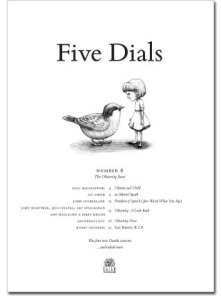
[READ: April 20, 2011] Five Dials Number 5

I have been enjoying all of the Five Dials, but this issue is easily my favorite so far.  The “theme” of this issue is translation.  Translators are the unheralded workers in literature, and while I have been trying to give them credit in my posts, I don’t always pay them enough attention (except when a translation is awkward or clunky).

But in addition to the theme (and the really cool interviews with some translators, I thought the fiction was outstanding and I loved Alain de Botton’s Advice column.  The whole issue was great. (more…)

Read Full Post »

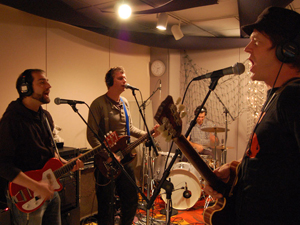
SOUNDTRACK: THE HEAD AND THE HEART-KEXP in Studio, September 14, 2010 (2010).

My saga of The Head and the Heart continues.  Sarah had ordered me the disc for Christmas, but the self-released CD had gone out of print.  This is because Sub Pop was going to re-release the record sometime in the new year.

Well, NPR loved the album, so why wouldn’t they have more recordings by them?  (This is one of the great things about enjoying new bands…they are far less likely to restrict listening and downloading abilities online).  So, this session (September) was recorded shortly after they released their album (July).  I have still yet to hear the actual album, but I have fallen in love with these songs.

This set (which has some very brief interview portions) is five songs. The band sounds great, with wonderful harmonies.  The first two songs “Cats and Dogs” and “Coeur d’Alene” meld together seamlessly, and it works wonders.  “Lost in My Mind” is an amazingly catchy single: the “whoo whoos” (which sound not unlike a train) are wonderfully catchy (in a Mumford and Sons kind of way).

They also play “Ghosts” (another catchy catchy song) and the non-LP song “Down in the Valley” (which has the slightly uncomfortable opening lyrics: “I wish I was a slave to an age-old trade”).

This neo-folkie revival has generated some great bands, and The Head and the Heart are yet another one.

[READ: April 14, 2011] “A Withered Branch”

This is a very brief short story (a page and a half) translated by Anna Summers.

A young woman hitchhikes into Vilinus.  She is picked up by a trucker and is unbothered until they get to a rest stop.  While they are having dinner, one of the drivers wonders who she will sleep with that night.

But that is the prelude to the story.  When she arrives in the city, she meets a woman of about fifty who, when the narrator asks if there is any place to stay, offers her own house to the (dirty and sweaty) stranger/narrator. (more…)

Read Full Post »

« Newer Posts - Older Posts »