Feeds:
Posts
Comments

Archive for the ‘Authors’ Category

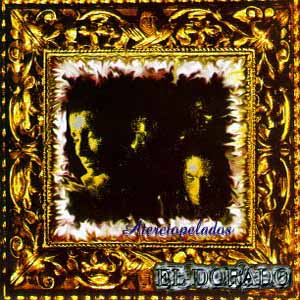
SOUNDTRACKATERCIOPELADOS-El Dorado (1995).

One of the other Rock en Español bands I bought in the 90s was Aterciopelados (the hardest to pronounce).  Aterciopelados come from Colombia and they play a variety of styles of music.  They also feature a female vocalist (Andrea Echeverri) who has a great voice in a variety of styles.

The opening song “Florecita Rockera” is a heavy blast of punk.  “Suenos del 95” is a kind of a lite pop song.  “Candela” is a latin-infused song that sounds not unlike a more psychedelic Santana track.  And “Bolero Falaz” is a winning acoustic ballad.  Meanwhile “Las Estaca” is a sort of county/cowboy song that breaks into a fun rocking chorus.

“No Futuro” starts as a slow balald and builds and builds to a heavy rocker.  I would have liked this song to go a bout a minute longer to get really crazy.  The rest of the disc works within this broad framework: ballads that turn into heavy rockers (“De Tripas Corazón”), hints of punk and latin accents.  And then there’s a song like “Colombia Conexión” which reminds me a bit of The Dead Milkmen: simple sparse verses with heavy punk choruses.  Meanwhile “Pilas!” is straight ahead punk.  The final song “Mujer Gala” has some ska-lite aspects as well (and I have to say that it seems like No Doubt may have been inspired by them).

Although for all of the different styles of music, the disc is really a venue for Echeverri’s voice.  She’s not a rocker or a screamer and she could easily sing pop ballads, but because she chooses to sing over so many styles, she really showcases the multifacted nature of her voice.  She can hold a note for quite a while and although she never really shows off, it’s clear that she’s got a powerful voice.  She even sings beautifully over the punkier tracks, never devolving into a scream, but never losing her edge either.

Aterciopelados is a hard band to pin down (especially with this one disc).  Of the rock en Español bands, Aterciopelados had one of the longer lifespans.  They released several albums with very different styles.

El Dorado suffers from weak production, some more highs and lows would really makes the listening experience better, but it’s a solid disc overall.

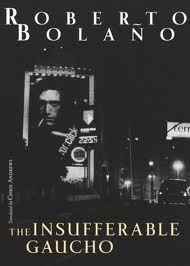
[READ: December 10, 2010] The Insufferable Gaucho

This is a collection of five short stories and two essays.  Two of the short stories appeared elsewhere (which I read previously).  This is the first time I’ve seen the essays translated into English.  The fabulous translation is once again by Chris Andrews, who really brings Bolaño’s shorter books to life.  They are vibrant and (in light of The Savage Detectives, this is funny) visceral.

“Jim” is a four page story which focuses very specifically on a man named Jim.  As the story ends, we see Jim locked in an existential struggle.  For such a short work, it’s very powerful.

“The Insufferable Gaucho” (which I had read in The New Yorker) was even better after a second read.  I find this to be true for much of Bolaño’s work.  He tends to write in a nontraditional, nonlinear fashion so you can’t always anticipate what is going to happen (quite often, nothing happens).  In this story, a man in Buenos Aires, feeling that the city is sinking, heads out to his long neglected ranch in the country.  He spends several years there, slowly morphing from a cosmopolitan man to a weather-beaten gaucho who doesn’t shave and carries a knife.  But there is much more to the story.  The countryside is virtually dead: barren, wasted and overrun by feral rabbits.  The rabbits offer an interesting metaphor for the wilderness as well.  His interactions with the few other people he encounters are wonderfully weird, and the ending is thought-provoking.  It’s a wonderfully realized world he has created.

“Police Rat,” is that strangest of Bolaño stories: a straight ahead narrative that works like a police procedural.  I assumed from the title that it would be something about a metaphorical rat in the police force.  Rather, this is a story about an actual rat who works on the rat police force.  Bolaño spends a lot of time setting up the story (details are abundant) making it seem like perhaps there would be no plot.  But soon enough, a plot unfurls itself.  And although the story is basically a police story, the underlying reality behind it is fantastic and quite profound.  The story is beyond metaphor.

“Álvaro Rousselot’s Journey” was published in The New Yorker.  This story was also better on a second reading.  In many ways this story is a microcosm of Bolaño’s stories: a man goes on a quest for an elusive man.  Unlike the other stories, he actually catches up to the elusive guy.  But, as if Bolaño were commenting on his other stories, actually catching the guy doesn’t really solve the crisis.

This basic premise is that a writer believes that a filmmaker is stealing his ideas for his films (even though he is from a different country).  But more than just the simple plot, when Álvaro Rousselot leaves the comfort of his homeland things change fundamentally within him.

“Two Catholic Tales” is, indeed, two tales.  I had to read this piece twice before I really “got” the whole thing.  There are two separate stories (each story is a solid block of text but there are 30 numbered sections (which don’t seem to correspond to anything so I’m not sure why they are there).  The first tale is of a young boy who desires to be like St. Vincent, with designs for the priesthood.  As the story ends, he is inspired by a monk who he sees walking barefoot in the snow.  The second tale (we don’t realize until later) is about the monk himself.  It rather undermines the piousness that the boy sees.  On the second reading I realized just how dark of a tale this turned out to be.  It’s very good.

“Literature + Illness = Illness”
This is the first non-fiction by Bolaño that I have read.  It is a meditation about his terminal illness.  The essay is broken down into 12 sections about Illness. They range in attitude from the realization that when you are gravely ill you simply want to fuck everything to the fear that grips you when you finally accept your illness.  Despite the concreteness of the subject, the essay retains Bolaño’s metaphorical style.  Each subdivision is “about” an aspect of illness.  “Illness and Freedom,” “Illness and Height,” “Illness and Apollo,” “Illness and French Poetry.”  But it’s when he nears the end and he’s in a tiny elevator with a tiny Japanese doctor (who he wants to fuck right there on the gurney but can’t bring himself to say anything), and she runs him through his tests showing how far advanced his liver failure is, that the reality of his illness really sinks in.

“The Myths of Cthulhu” is the other essay in the book and I have to say it’s the only thing in the book that I’m a little frustrated by.  About midway through, he reveals that this is a speech and I wish that an introductory note would have given context for this speech, or indeed, indicated whether it was really a speech or not.

One of things that struck me about it (and also about “Literature +Illness=Illness” is how frequently he is unspecific about his research (and just never bothered to go back and fix it).  For instance:

For books about theology, there’s no one to match Sánchez Dragó.  For books about popular science, there’s no one to match some guy whose name escapes me for the moment, a specialist in UFOs.

Because I don’t know his non-fiction and I don’t have context (and I’ve no idea who Sánchez Dragó is) I don’t know what to make of that unspecific recommendation.  As for Sánchez Dragó, in the speech he’s noted as a TV presenter (Wikipedia confirms this).  But why the uncertainty in a written piece?  Laziness or deliberate commentary?

This essay has many elements of local information that are completely lost on me.  However, by the end, he brings it back to folklore and literature.  He also makes some biting criticisms of George Bush, Fidel Castro, Penelope Cruz (!) and Mother Teresa. Actually, I’m not sure if he’s mocking Penelope Cruz, although he is definitely mocking Mother Teresa.

The ending is general moaning about the state of Latin American fiction.  Even though I didn’t follow all of what he was talking about, there’s something about his delivery which is so different from his fiction. It’s honest and fast and kind of funny and enjoyable to read.

——

This may be something of a minor work, and yet the stories are really wonderful and are certainly a treat to read.  The essays definitely need more context, but it is interesting to finally have a chance to read the “real” Bolaño.

Read Full Post »

SOUNDTRACK: DUDLEY MOORE & PETER COOK-“Bedazzled” (1967).

I learned about this song when John Lydon was a DJ on NPR’s All Songs Considered.   His collection of songs included Black Sabbath’s “Paranoid,” Jimi Hendrix’ “All Along the Watchtower” and Planxty’s “The Well Below the Valley.”  The other song was this Dudley Moore/Peter Cook number from the movie Bedazzled (the Brendan Frasier movie was a remake which Lydon says was a travesty compared to the original).

This song is wonderfully bizarre.  It’s got a groovy 60’s beat with female singers seducing Peter with their come on lines.  And after each line from the women, Peter deadpans a line about how disinterested he is.  As Lydon says, the best couplet is:

THE GIRLS: You drive me wiiiiild
PETER: You fill me with inertia.

Obviously the song is comic, but the music is cool and slinky and fun in a completely retro sort of way.   I’m only disappointed that I’ve never heard it before.  Thanks Mr. Rotten.  Oh, and I see the soundtrack just got a reissue!

Hear the song (and all of Lydon’s) DJing here. http://www.npr.org/templates/story/story.php?storyId=126559893

[READ: December 9, 2010] “On the Show”

I don’t really care about carny stories (and yet I’m surprised by just how many there are).  But this story was interesting because of the twist that sucked me into the carny.

The story opens with the narrator describing his carny boss.  And what I loved about this set up is that the carny boss is a tough-guy, braggart, asshole.  [He knocked out Steve Martin on the set of one of his movies].  And the stories are wonderful precisely because we hear them through the ears of the narrator who thinks this guy is full of shit.  I realize that I dislike tough guy stories in general, but you could tell me a tough guy story and have the guy he’ talking to say he’s a jerk and I’ll think it’s okay.  Call me the anti-Hemingway.

We flashback to how this narrator, who we don’t know all that much about, got here.  Turns out the flashback is about twelve hours ago (which is also pretty funny).  The narrator is a young college kid who was home for the summer.  His stepfather really doesn’t like him and they have a huge fight (which gets physical) so he runs off and, yes, joins the circus. (more…)

Read Full Post »

SOUNDTRACK: THERION-Theli (1997).

I bought this disc when I was living in Boston and I immediately fell for it.  I seem to recall I was doing a lot of driving at the time, and this mix of extreme metal, orchestral accompaniment and twinned vocals was very captivating.  It was also really fun to play very loud on a dark highway.

I’d read a very good review of this disc that claimed it was a big step forward in styles of thrash/black metal (and if you Google reviews for this album they are pretty universally great).  The disc is exemplified by the track “To Mega Therion” which is almost entirely a full choir singing what I guess is the chorus.  The verses are populated by a guy screaming in a guttural voice who is answered by an almost mechanically twinned voice which sounds great but is even harder to understand.  Follow this with a beautiful piano (!) solo not unlike something Randy Rhoads put together for Blizzard of Oz, and add a pounding double bass drum all the way through (truth be told the album could be a little heavier in the bass) and you get a crazy mix of styles which is catchy and creepy at the same time.

It’s hard to match a song like that.  And, admittedly, the band doesn’t quite manage to do so, but the rest of the album keeps up this orchestral death metal throughout.

Reading about Therion has taught me that this album is something of  touchstone for a new genre of metal, called variously symphonic or operatic metal (I suppose we have this to blame for the Trans Siberian Orchestra?).

In addition to the choirs and guitars there are a lot of keyboards. They are disconcerting when you’re thinking death metal and yet really they add an even fuller sound, even if at times they are not as grand or powerful as anything else.  At times the album seems cheesey, but that may have more to do with thirteen years distance than the music itself.

Anyone who has seen The Exorcist knows that choirs can be spooky.  And when you mix it with the heavy guitars and guttural vocals, you get a really cool sinister yet catchy (and possibly uplifting) album.  There are certainly a lot heavier albums, but this one is pretty stellar.

[READ: Summer of 2010, finished December 12, 2010] Lords of Chaos

My brother-in-law gave me this book for my birthday this year.  I was familiar with it as it is fairly well-known in heavy metal circles as a fascinating read.  And so it was.

This book is basically a history of black metal in Norway and how some bands’ antics went beyond music into burning churches and even murder.  The authors present a pretty neutral account of the story.  They let the main participants (criminals) have their say and the interviews don’t comment on their answers, they just let them tell their side of the story.  The authors also know a lot about the music scene.  Of course, in the end, the authors (thankfully) disapprove of the violence.  It makes for an interesting and somewhat conflicting read. (more…)

Read Full Post »

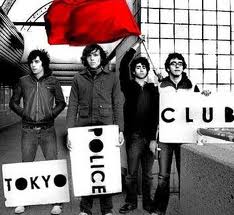
SOUNDTRACK: TOKYO POLICE CLUB-“Bambi” (2010).

I loved the first couple of Tokyo Police Club albums, but I missed this one when it came out.  My friend Al said it was one of his favorite albums of the year and that this song was one of his favorite songs.

I was disconcerted when I started listening to this because TPC is all about short, heavy, punk blasts of music.  And this song starts with…keyboards.

But it’s clear that this is still TPC, just with new bits and pieces added.  The keyboards are strangely out of pitch–they sound off somehow–and they add these bizarre little accents to this super catchy song.  The aggressive punk guitars are gone, but the attitude remains and this is a fantastic tune. One that I’ll listen to a lot more.

[READ: December 8, 2010] “Emptying the Skies”

I didn’t think it would happen, but I reached my Franzen saturation point with this article.  This is his third article about the disappearance of birds.  Originally, these articles came several years apart, so they wouldn’t seem so overwhelming.  But reading them all within a few days of each other, I’ve about had it with the doom and gloom.

These articles are devoid of Franzen’s usually charm and wit.  Obviously, a story about the disappearance of the earth’s birds should not have charm and wit, so he did his job well.  But man, I’m overwhelmed by the devastation of Europe’s migration paths.

The essay looks at three Mediterranean countries and their (reprehensible) attitudes towards birds: Cyprus, Malta and Italy. (more…)

Read Full Post »

SOUNDTRACK: TIJUANA NO!-Transgresores de la Ley (1994).

In the mid 90s, when I was living in Boston, I discovered MTV Latino, and the Rock en Español resurgence.  Since I’m always interested in new music, I bought a few CDs by these Spanish-singing bands.  For most of my life I’ve thought about the rabid Japanese audiences who loved bands that sand in English.  Did they understand the lyrics?  And did it matter?  Well, here was a test for me.

Tijuana No! was the first band I bought and I really liked it (and still do).

The disc opens with a rollicking ska rocker “Goples Bajos” which features a wonderful horn filled breakdown and ends with a blistering guitar solo.  The title track, “Transgresores de la Ley” opens with a military beat and a military sounding flute before taking off with a heavy verse and, more impressively, a punk/shouty chorus.

My favorite song is “Tu y Yo,” it’s funky all over the place and has a super heavy midsection.  And “Borregos Kamikazes” has a wonderful juxtaposition of speedy, almost loco lyrics in the verses with some great group vocals in the chorus.

The first surprise (for me) comes with “La Esquina del Mundo” because suddenly there’s a female vocalist on lead.  She sounds great (her voice has a cool echo on it) and although she doesn’t quite convey the heaviness of the rest of the track, it’s an interesting juxtaposition.

The second surprise is that the track “Conscience Call” is mostly in English (I got so used to not understanding the lyrics that I was quite surprised to hear words I understood).

The final surprise comes with the penultimate track: an excellent cover of The Clash’s “Spanish Bombs.” Again sung by the female vocalist, her voice works wonderfully with the track.  The chorus, sung in Spanish, is really perfect.

So, in answer to the question, do you need to understand the lyrics to enjoy the music?, I’d say no.  Although it is nice once in a while.

[READ: November 20, 2010] The Savage Detectives

This was the Bolaño novel that I had initially wanted to read because the reviews were so glowing (amusingly enough it turns out to be virtually the last book of his that I read).  And now that I have read almost all of his books, it’s obvious how this book fits into his larger scheme of writing (I wonder what I would have thought if I hadn’t read the other books, too.  In fact, I wonder if I would have liked 2666 more at the time if I had read this one first.  As it is, I think I enjoyed this more having read 2666 first).

[DIGRESSION: When I was reading 2666 I found a fantastic review of 2666/The Savage Detectives by Daniel Zalewski, which reviews 2666 and The Savage Detectives in context of Bolaño’s life].

In a previous post I noted how Bolaño doesn’t really write conventional novels.  And this one is no exception.  Part I is the diary of Juan Garcia Madero, a 17-year-old aspiring poet.  It covers from November to December 31, 1975 .

Garcia Madero talks about his introduction to the visceral realists, a group of Mexican poets whose legacy is more or less unknown to us now (in the book–in reality there was no such group).  The two main visceral realists are Arturo Belano and Ulises Lima, and we will follow or look for these two for the rest of the book.

As with other Bolaño books, there is a massive obsession with sex.  At first Garcia Madero is a virgin and thinks about sex a lot.  Then he finally has sex with first one woman and then many women.  And he writes about them in his diary and spares no details.  (Many entries reveal him having sex with one of his girlfriends 5 or 6 times a night).  And there are of course whores and other deviant sexual individuals (including a guy who carries a large knife by which he measures his penis–we never see this, it’s all hearsay, but it’s in there).

And during this time, he is writing poetry as well–a fully welcomed member of the visceral realists.   (more…)

Read Full Post »

SOUNDTRACK: SPOON-Transference (2010).

The first thing I think of when I think of this disc is staccato.  I’ve read that the disc sounds like a demo, which I don’t quite agree with, although it does sound very raw and spare (in the way the Peter, Bjorn and John’s Living Thing does).

Although the opener “Before Destruction” has a lot of guitars washing around, the dominant sound is a loud short chord and drum combination.  And from the second song on pretty much, things get very chunky.

“Is Love Forever?” has a riff based on tight military beat with guitar chords that match.  There’s very little in the way of extended notes or washes of sound.  “Mystery Zone,” an insanely catchy little ditty, has a similar staccato/spare sound.  Britt Daniel’s voice is pretty much the only instrument that holds a note for more than a beat.  (That’s not literally true, but it seems like it).  Meanwhile, “Who Makes  Your Money” is all drum beats and single keyboard notes.

It’s surprising that this spare musical accompaniment works so effectively, but it does.  Especially on “Written in Reverse” a predominantly pizzicato piano track that rocks in a maniacally-echoed fashion.  Or even more so on the 5 minute “I Saw the Light” which is basically drums and a propulsive bass.  There’s occasional guitar chords which build until the 2 minute mark, when a  3 minute minor chord piano & drum coda takes over.

“Good Night Laura” is a simple piano ballad (again with pizzicato piano chords), while the final song “Nobody Gets Me But You” is full of cacophonous piano runs, most of which sounding precariously on the verge of being random and out of tune, but which always manage to be weird and cool.

Spoon’s last album had a pretty big hit with “Don’t Make Me a Target” which was similar in style to these songs but which had more orchestration.  These songs feel like an attempt to strip away as much as possible and see what remains.  And I guess it’s a testament to the quality of the songs that it works.

[READ: December 1, 2010] This Isn’t What It Looks Like

Is it the nature of children’s books in the 21st century that they are all parts of a series?  Do authors write singular books with no plan of a sequel?  I don’t know.  And I’m not sure that I mind all that much.

This is the fourth book in the “Secret” series, and Bosch hasn’t lost any steam or quality for this part of the saga.  When we last left our heroes, Cass was in a “coma,” induced from eating a time traveling chocolate bar.  Max-Ernest has more or less given up speaking (which is impossible for him) because he feels so guilty about encouraging Cass to eat the chocolate.  And, Yo-Yoji, their erstwhile third member, is off in Japan with his family.  What is M-E to do?

Luckily for M-E, an old friend has returned to school, and he’s causing quite a stir.  Benjamin Blake (the awkward synesthetic artist from the first book) has returned from his finishing school.  He is polished and refined, he uses words like “chum,” and people seem to be well, interested, in him.  And most interesting of all (as only M-E knows), he seems to be able to read people’s minds!  And that’s just what M-E was hoping to do with Cass while she’s in the coma.

For Cass, you see, is “living” in the past.  In our time, she is in the coma, but her mind has traveled back in time to meet The Jester, the man who holds “The Secret” and the man who is her great- great- great- (etc) grandfather.  She is fully conscious in Renaissance times.  The big difference, though, is that she is invisible!  And, in a wonderful publishing joke (the kind of thing that Bosch does so well) all of the chapters that are about Cass are listed as negative (so the book starts with Chapter “-Ten”).  M-E’s chapters start at one, mind you, so you have positive and negative chapters which all converge at a hilarious interlude called Chapter Zero.

The bit about the Renaissance also works very well because their school is having its annual Renaissance Faire (I wish I went to THAT school!) which is sponsored by a theme restaurant which features jousting and medieval times (but which is not Medieval Times, ha ha–I love that everyone says how bad the burgers are but they love the experience).  The Ren Faire is a wonderful plot set-up because with Cass lost in “real” Renaissance, the parallels to the Ren Faire are very clever and often very funny.  (I also love that M-E keeps trying to explain that there is a big difference between Renaissance and Medieval but no one will listen).

And, indeed, cleverness is the word of the book (and the series).  Bosch is having continued great fun with word play (and footnotes!).  He also has some clever puzzles to solve.  The biggest one is the “Hint to the Secret” that the Jester leaves for Cass (and which even a fortune teller tells her about).  I was convinced I had the puzzle sorted out but I was wrong (and it was so obvious when it was revealed!).  And, there’s also a revelation as to the true identity of Pseudonymous Bosch (not the real life author, but the “author” of the books).  I had put a little of this together myself when reading the dialogue in M-E’s head.  But I won’t spoil the revelation of that.

The only secret I will reveal is to say that this is not the final book in the series.  For awhile it seemed like it was heading towards a conclusion.  But as we dramatically learn, there will be more adventures to come.  And that’s pretty cool.

I love an exciting series, but I especially love an exciting series that doesn’t talk down to its readers.  The footnotes and clever games are very fun and thought-provoking (there’s even two emails that are written in code that you need to decipher (unless you cheat and look in the appendix).  And speaking of the Appendix, there’s also a one-way staring contest and directions on how to make a camera obscura (which features in the book and seems like a fun project).

I honestly have no idea how nay books Bosch plans to write in this series (and I have no idea who Pseudonymous Bosch (the author) is for real.  It’s all part of the mystery that I enjoy quite a lot.

Read Full Post »

SOUNDTRACK:BELLE AND SEBASTIAN-Live in Glasgow, TODAY! December 21 at 4PM eastern: NPR simulcast (2010).

It’s very rare that I have news before it happens, especially on this blog. But I do. Today at 4PM Eastern time, NPR is simulcasting Belle and Sebastian’s live show from Glasgow.

I don’t know if it will be downloadable (I do know that I am at work…boo!).  But I have to assume it will be pretty great.

Get details here.

[READ: December 6, 2010] “The Way of the Puffin”

After a few years away from lengthy New Yorker articles, Franzen returns with this 13 page (!) article about China.  The last article that we saw from Franzen was about his birding passion.  That passion has not subsided at all, and his co-passion of environmentalism is what sends him across the globe to the Yangtze Delta.

Franzen receives a Puffin-shaped golf club head cover, which he finds quite adorable.  But when he sees that it’s made in China, he wonders about the environmental impact of this adorable item.  He calls the company that makes the puffins (Daphne’s Headcovers), and is told that they use environmentally conscientious Chinese labor.  She also tells a (heartwarming) story about karma and how a good deed will get repaid manifold.  She tells Franzen about the workers in China and invites him to go check them out.  This leads to Franzen’s most “reporter”-like piece, and probably his least personal.

At first I wasn’t that interested in the piece.  I feared it was going to be a long slog through environmental degradation and depression.  And while it was that, Franzen also humanizes the story through the efforts of that rarest of birds: the Chinese environmentalist. (more…)

Read Full Post »

SOUNDTRACK: BAD BRAINS-I Against I (1983).

I don’t remember buying this album, but I remember getting it because of the connection to SST records (not because Bad Brains were an amazing hardcore band–I didn’t know that yet).

All of these years later, this album is still pretty astonishing.  The heavy punk blends so well with the reggae-inspired jams.  Perhaps the biggest band where Bad Brains influence is evident is Fishbone (especially their later metal songs).  But you can hear t hem in Faith No More and many other mid 90’s bands as well.

The disc opens with a great off-beat instrumental (“Intro”) which leads into the amazing yell-along “I Against I.”  “House of Suffering” follows with some more speedy hardcore.  Then it all slows down with “Re-Ignition,” the first indication that this is an album unafraid to take risks.  Although the thumpy riff and heavy beats are still there, the vocals are more of a reggae style (especially towards the end).  “Secret 77” follows with a kind of funk experiment (but those drums are still loud and stark–Earl is a maniac!).

Darryl’s bass work is tremendous throughout the disc, and Dr. Know’s guitar is amazing–speeding fast soloing, heavy punk riffs and delicate intricate reggae sections intermingle with ease.  And, of course, we can’t forget about H.R.’s vocals.  He has several different delivery styles from the speedy punk to the reggae deliveries and the all over the place (including high-pitched shrieks on “Return to Heaven”).

The second half of the disc experiments with more diversity, and it is somewhat less punk sounding (although not by much).

Historically, it’s hard (for me) to place exactly how influential they were.  Listening to  the disc today (which doesn’t sound dated in any way) it sounds utterly contemporary in stylistic choices.  Did they come up with the mosh break?  They certainly are the first punk band the embrace Jah (that’s a trend that never really took off though, eh?), but their funk metal sound predates the popular Faith No More style by over a decade.

[READ: November 21, 2010] “The Kids Are Far-Right”

I know I subscribed to Harper’s when this article was published (I distinctly remember the jelly bean portraits of Reagan), but I’m pretty sure I didn’t read it then because the whole idea of it sounded depressing (the subtitle: “Hippie hunting, bunny bashing, and the new conservatism”) was just too much for me in 2006 (and was almost too much for me in 2010).

And so our correspondent (not long after his trip through the Bush/Cheney volunteer minefield) heads out to the twenty-eighth National Conservative Student Conference.  He meets exactly what you would expect: right-wing campus types (several from ultra-religious schools) who are there to learn to hate liberals even more than they already do (and boy do they).

Wells’ article is full of details about all of the speeches and programs, as well as biographical information about some of the attendees.  Most of them just want to get rid of liberals on campus, but some want to go into politics themselves someday (they are viewed with suspicion here).  Many also hate George W. Bush because he raised taxes.  In hindsight what we have here is the origins of the tea party.

The only comforting news to come from the article is that only 400 people attended (but they were willing to spend a few hundred dollars and give up a week of their summer vacation, so it’s still a pretty high number). (more…)

Read Full Post »

SOUNDTRACK: SWANS-“I Crawled” (Live in Dublin 22 October, 2010) (2010).

My friend Lar posted this video on his blog (he was lucky enough to see the show in question).  I have yet to fully digest  the new Swans album, although I found it to be slightly less abrasive as their earlier work (but more abrasive than their later period stuff–it’s as if they picked up just before when Jarboe joined the band).

I wondered how intense a Swans show would be these days.  Well, this video goes a pretty long way to showing that it is pretty intense (although I’m sure it was more intense actually being there–Lar’s review of the show is pretty great).

So, “I Crawled” comes from their 1984 EP Young God, back in the day when they were heavy and slow and scary.  The original is slow, ponderous and whispered (I’d love a beats per minute calculation on this one).  As the song continues, the intensity picks up, even if the speed doesn’t.  And after 5 minutes you’re ready to submit.  (And that’s only the first song).

The live version is a bit more lively.  It’s not quite as heavy, and the vocals are a bit clearer, but it is no less menacing.

It’s telling that the cameraperson keeps going back to the two drummers, as they are really the most intense action in the song.  Between the kit drummer keeping the beat (with a maraca on the largest tom drum I have ever seen) and the by now beloved shirtless, long-haired percussionist named Thor who adds dimensions of noise to the proceedings.  He also adds an amusingly tiny melodica which, contrary to expectations, adds a portentous eerieness that is not present in the original version.  Swans are back and they are not mellowed out at all.

Check out the video here.

[READ: November 7, 2010] “To The Measures Fall”

This is a strange little story.  It opens with a girl riding a bike through Cotswold (and begins with the words “First read through”.  She is a young literature student studying abroad in England.  While riding her bike she stops at a used bookstore and buys a copy of To The Measures Fall by Elton Wentworth (the book/author is not real, I checked–although there’s some great blog posts about him already).  The book costs more than what she could pay for 6 LPs, but she decides to buy it anyway.

The rest of the story shows this woman grow up through the sixties and Vietnam, a failed marriage, a new marriage, a failed PhD and a new career.  The story arc finally ends around the present time.  And all through that time she has kept this book with her, whether intentionally or not. (more…)

Read Full Post »

SOUNDTRACK: STEREOLAB-“Everybody’s Weird Except Me” (2010).

I was able to listen to another track from the upcoming Stereolab album Not Music.  This song is just fantastic.  It’s a faster, uptempo track.   Laetitia’s voice is backed by some other female singers (I wonder who they are, is it just Laetitia multitracked?).  And the propulsive beat is infectious.  The backing track of the music sounds like their earlier experiments with “space age” sounds.  Yet the guitar over the top is warm and inviting.

The song drops out at about the 90 second mark and offers a very cool respite from the bopping around that the song is doing.  After the break, the song seems to jump back and forth between this new mellow bit and the bouncy earlier part.  It’s a great track and a welcome opening to their last CD before going on hiatus.  Because, yes, according to the information on the NPR page, Stereolab is going on hiatus.

This CD is full of songs that were created around the time of their previous disc Chemical Chords, and it’s also packed with mixes, remixes and seemingly alternate version of some of those songs.  I haven’t heard the whole disc but it sounds like they’re going out with a winner.

[READ: November 15, 2010] “A Good Death: Exit Strategies”

I’ve mentioned before about my reader-relationship with Vollmann–I feel that I ought to read a lot more of him, yet I haven’t brought myself to do it (those books are huge!).  Nevertheless, I’ll keep reading the new pieces that I stumble upon.

So this piece is a nonfiction essay.  I’m tempted to say it’s more personal than the other pieces that I’ve read because it concerns the death of his father.  Yet from the little Vollmann I have read, it feels like he takes all of his writings very personally and invests himself pretty much bodily into them.

So, this piece, as I said, is sort of about the death of his father.  He died just a few months ago and Vollmann wants to find out a number of answers about death: should he be afraid of it, will he suffer, what should he expect?  So he interviews several “experts” in different fields:  coroners, funeral directors and many religious people of different faiths (Vollmann and his companion/translator are agnostic).  He’s given a vast array of answers, some of which are comforting to him and others just kind of piss him off. (more…)

Read Full Post »

« Newer Posts - Older Posts »