Feeds:
Posts
Comments

Archive for the ‘Jim Ottaviani’ Category

SOUNDTRACK: mafmadmaf“Rapture” (SXSW Online 2021).

I never intend to go to SXSW–I find the whole thing a bit much.  But I also appreciate it for the way it gives unknown bands a place to showcase themselves. NPR featured a half dozen artists online this year with this note:

This year, the South by Southwest music festival that takes over Austin, Texas every spring happened online. Couch By Couchwest, as I like to call it, was an on-screen festival, with 289 acts performing roughly 15-minute pre-recorded sets across five days in March.

This list was curated by Bob Boilen.  He also notes:

 I didn’t enjoy hearing loud, brash music while sitting on a couch the way I would in a club filled with people and volume, so I found myself engaging in more reflective music instead.

I’m going in reverse order, so mafmadmaf is next.

mafmadmaf is a Chinese modular synthesizer artist. I’m not sure I ever saw his face onscreen, but it didn’t matter: This seductive and spellbinding set was perfect in my living room. Seeing his modular synthesizer and its many patch cables set up in a beautiful garden was more entertaining than simply watching some knob-turning on its own. Artfully done.

Anyone who knows Bob knows he loves modular synths.  I really have no sense of how they work, so this is all a mystery to me.  But I agree that the setting is wonderful.  And the music is very cool.

This piece is 13 minutes long and while it is mostly washes of synth sounds, there’s some melodies (synthesized sounds of water drops and chimes).

The song morphs in interesting ways, especially after 4 and a half minutes when the musicians enters the screen and you start to see him do something to his setup.  This adds new sounds and even a pulsing almost-beat.

At around ten minutes things slow way down.

[READ: July 15, 2021] Naturalist

I saw this book in the library and grabbed it because I love Jim Ottaviani’s work.  He has written and illustrated a number of non-fiction graphic novels and they have all been terrific.  I love his drawing style–very clean lines and excellent detail.  I also love his ability to compact big ideas into small digestible chunks.

But I had never heard of Edward O. Wilson, which, after reading this, surprises me. He is not only a Pulitzer prize winning author, an innovator in the field of biology and a writer of a massive book about ants, he is also controversial (as we see later on) and a devoted environmentalist.

The book opens with a young Wilson growing up in Alabama.  From when he was little he was obsessed with ants.  There were lots of fire ants where he grew up and there are few things more fascinating than fire ants (the book is chock full of all of the scientific names for all of these ants).

When he was still young, playing around in nature, he went fishing and when he pulled a fish out of the water its spines poked him in the eye giving him a traumatic cataract–he wound up with full sight in one eye only.   But this seemed to get him to focus more minutely on smaller things–ants.

Staring in fourth grade  his father was shuffled around the country a lot so Edward made his home in many places around the south, eventually settling in Florida.

There he met a friend who was obsessed with butterflies–they were two budding entomologists. (more…)

Read Full Post »

SOUNDTRACK: CHIKA-Tiny Desk Concert #959 (March 13, 2020).

I’ve never heard of Chika, but she proves to be really fun and funny (while rapping some serious topics).

Her band is jazzy and stripped back:

Chika was also the first hip-hop act to anchor her set with just a Peruvian cajón instead of a full, hard-hitting kit. The surprisingly stripped-down performance allowed her lyrics, with all their nuance, to take center stage — and the result was remarkable.

In addition to the band, were her terrific backing vocalists

The impressive harmonies from Chika’s four backup singers brought all the feels right out of the gate.

She starts with “Industry Games.”  Lovely ooohs from the backing vocalists then David Levitan plays an echoing guitar (“both catchy and eerily haunting” that I found reminiscent of the Close Encounters melody).  Up comes that cajon with gentle thumps from Dominic Missana.  Then she starts rapping.

Moving seamlessly between rap verse and melodic hooks, Chika showcased her unusual tonality, multi-cadence delivery and vocal range, with an effortless, double-time lyrical bounce.

She has a fantastic fast flow (smiling as she goes).  It’s interesting hearing the gentle backing vocals that repeat her (sometime harsh) final lines.

She even starts giggling in the middle.  She explains later “I say ‘tightest around’ and they sing ‘hottest around’ and it is hysterical to me.”

Before the next song she says, “Everyone brings nice things to the Tiny Desk, like lights…  I didn’t bring anything, or so you thought.  I brought this Chapstick and I’m gonna place that right here.  Fuck anyone who underestimated me.”

She says that “Songs About You.”  No shade to anyone.  It’s not about y’all. its about you.  The song features more nice backing vocals and then a grooving bass line from Chris McClenny.

Before the third song she sends a shout out to her sister who is there.  “Shout out to our parents… genetics!”  She asks, “What kind of shows are you wearing?”  “Puma…”  “You should have been wearing ‘Balencies,’ which is the name of the next song. She pauses and waits for the laughter.  Then says, “I’m funny.  We’re not gonna argue about that.  You all didn’t want to laugh… something about that felt racist.”

The backing vocals are wild and weird as it starts, Danielle Withers sounds like a perfect loop of an eccentric vocal line.  It’s pretty magnificent–I really hope she goes somewhere with a distinctive voice like that (I see that she has sung with some pretty big names already).

The other singers are (l-r) Jabri Rayford; Darius Dixson and Rachel Robinson (she’s standing on a box).

“Crown” has some great lyrics

I got a habit of rapping ’bout tragic sh-
I think I’m just passionate
Tryna steer the way while in the dark
Hope I ain’t crashin’ it (Woah)
Now my little hobby turned to cashin’ out
Thinking ’bout who I’d be if I listened to doubt
Said I’d never do it, well look at me now

Okay
This is for the kids with depression
The one’s whose parental expectations got them stressin’ (Woah)
The one’s who would rather persevere, bust they ass, tryna make it ’cause-
They ain’t really livin’ in the present

The set ends, oddly enough with “Intro” which is a very quiet song.  Gentle guitars and  a quiet rap.

This was a really satisfying set.  her songs were short and to the point.  The lyrics were powerful and affecting and the music was a nice accompaniment.

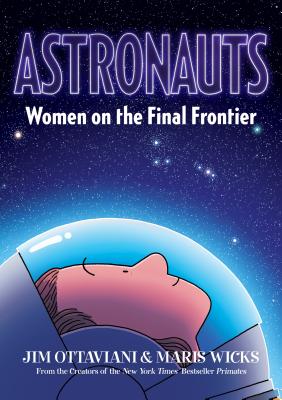
[READ: April 2, 2020] Astronauts: Women on the Final Frontier

Jim Ottaviani & Maris Wicks worked together on the awesome book Primates.  Now they are back sending some primates into space.

I just love Wicks’ artwork.  She manages to do such amazing things with such simple-seeming drawings.  Her eyes are (mostly) dots, the faces are almost all simple shapes and yet everything she draws is so expressive and conveys exactly what she wants.  It is a pleasure to look at anything she draws.

Ottaviani did a lot of research for this book (obviously) and the end is chock full of resources that you can look at to learn more.

As for the book itself, it is “told” by astronaut Mary Cleave.  It starts with young Mary being told (by the President) that she was too young for the Astronaut Corp.  The letter (from President Eisenhower) did not go on to say that no women were accepted into the Corp, she had to find that out herself.

She was already a practicing pilot at age 14, but that wasn’t good enough.  She then jumps over to another girl her own age over in the Soviet Union.  Valentina Tereshkova was jumping out of planes and training to be a pilot, because the Soviet Union did not have a sexist component in their system.

But in 1959, even though women like Jerrie Cobb were certainly (physically) capable of becoming astronauts, women simply weren’t chosen.  Jerrie Cobb and Janey Hart testified before Congress where sexism (and simple, painful examples are provided) ruled the day.  They were even shut down by Jacqueline Cochran, a director at an airline, who said women should not even be pilots because they get married and leave after two years. (more…)

Read Full Post »

SOUNDTRACK: LYDIA AINSWORTH-“Afterglow” NPR’S SOUTH X LULLABY (March 23, 2017).

I was unfamiliar with Lydia Ainsworth, but I was instantly struck by the setting of her lullaby.

We asked Lydia Ainsworth to perform in Raum Industries’ Optic Obscura installation. Surrounded by dim, long-hanging optical fibers that look like an infinity room of cat’s whiskers, she sings a stripped-down version of the slow-burning “Afterglow,” accompanied only by an upright bass and light percussion.

I’m not sure what the original song sounds like, but this version is moody and intense.  The upright bass opens the song as Lydia’s whispered, sensual vocals come forth.  She has a beautiful voice and it is especially haunting in this setting.  It reminds me a bit of someone else although I can’t decide who.

The starkness of the silence when she stops singing is intense.  And I really like the way the song ends, not abruptly exactly, but rather unexpectedly.

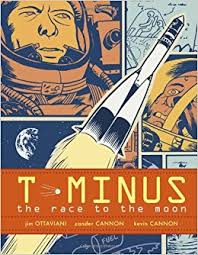
[READ: March 21, 2016] T-Minus

Jim Ottaviani did the amazing graphic novel Feynman, and in the blurb about him in that book, it said that he also wrote T-Minus.  Coincidentally I had just brought T-Minus home for Clark and I to read.  He read it quickly and said it was very good.  It took me a little longer to read (I’m sure he didn’t read all the details) because Ottaviani jam packs this book with interesting facts.

As the title says, this is about the race to get a man to the moon.  It begins 12 years before the actual date occurred.  And it toggles back and forth between the United States and the Soviet Union.

On the margins of many pages there are drawings of all of the various attempts each country had to get a rocket into the air.  The drawings show the design and then at the bottom it states the duration of the flight, the date and some other details.  The USSR’s first rocket (1957) lasted all of 20 seconds before exploding.  The U.S’s first rocket lasted about 7 seconds.

We meet a handful of people who were instrumental in the design and origination of these rockets.  (Ottaviani explains that many of these people are composites of real people involved–if he wanted to include everyone, there would be 400 people in every panel). (more…)

Read Full Post »

feynman SOUNDTRACK: LARA ST. JOHN-Tiny Desk Concert #530 (May 9, 2016).

laraWhen Lara St. John released her first CD it made ripples because of the way she appeared on it (presumably topless).  But if that was a stunt to get people to listen, it was a good one because the music on it was phenomenal (and the disc sold very well).  St. John is masterful on the violin and has released a dozen or so CDs of herself playing.

I have never seen her play before and it is a marvel watching her fingers  fly (and slide) all over the neck of the violin (including some absurdly high and fast notes).

The first piece is “Czardashian Rhapsody.”  It is an amazing mashup of two songs by Martin Kennedy: Czardas, the most familiar Hungarian melody for violin and Hungarian Rhapsody No. 2, the most familiar Hungarian melody for piano.  He merged them into a real barnstormer.  It’s 6 minutes of switching back and forth between the familiar melodies and very gypsy-esque sections (and some very long held notes).

The song is 6 minutes of musical acrobatics.

Although this is billed as St. John’s show, much recognition must go to her pianist Matt Herskowitz who is also magnificent.

St. John clearly has a sense of humor since she named her new album Shiksa.  She says the album actually has ten different titles because every culture has a word for “big Canadian chicks” like herself.

The second piece is “Sari Siroun Yar” by Serouj Kradjian.  She says it was the first song she heard when she went to Armenia in the lat 1980s.  It is a bittersweet Armenian troubadour song.  While this song is much more mellow than the first, it still showcases some amazing playing on both musicians’ parts.  The opening notes she plays high on the fret board which gives the violin a very different sound–almost breathy.  And the main melody is quite lovely.

The final song is once again a wild one.  “Oltenian Hora” is one that St. John arranged herself.  It plays off a catalog of violin tricks, St. John explains, practiced by traditional Romanian gypsy fiddlers: rapid-fire whistles, bird calls and slithery harmonics, all in a variety of off-kilter rhythms.  I’ve never seen some of the things she does on the violin (those bird calls are amazing).  And by the end she is bowing so hard the bow seems about to break.  It is way intense and really awesome.

I’m not sure I’ve ever seen a violinist get out of breath from playing so hard before, but she deserves all of the applause.

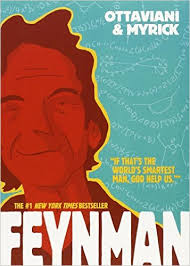
[READ: March 15, 2016] Feynman

This is a graphic novel biography of Richard Feynman.  Ottaviani worked as a nuclear engineer, programmer and reference librarian, so you can trust him.

I have respected Richard Feynman for years.  I have a few of his books, although I can’t say I have read them intensely.  I knew that he was considered an amazing professor–making really intense subjects easier for the layman to understand.  And many of his lectures are available as audiobooks.

But there was so much about him that I didn’t know.  And this biography (which runs nearly 300 pages and is jam packed with information) covers nearly all of it.  Including excerpts from his own publications and attaching a massive bibliography for more works by and about Feynman. (more…)

Read Full Post »

primatesSOUNDTRACK: OTIS TAYLOR-Tiny Desk Concert #120 (April 13, 2011).

otisOtis Taylor is a big, burly, bearded man who plays the banjo. His band consists of fiddle, drums and electric guitar and bass.

The songs are bluesy without being like the blues, and they are folky without really being like folk music.  And the way he plays the banjo is unlike any typical banjo song I’d heard before.

The blurb explains what makes his songs sound so different:  He plays a style of music he calls trance blues.

Taylor’s music is trance-inducing, and he achieves that effect by playing songs that are modal: Sometimes, they sit on one chord for the entire song. Taylor says that by doing that, by eliminating chord changes, you also eliminate reference points, so songs can run as long as 10 or even 15 minutes in length.

And it’s true.  The basic melody of he first song, “Ten Million Slaves” (which is only 4 minutes) stays the same throughout the song.  It’s the fiddle (played by Anne Harris) that throws the new notes and riffs into the song that keep it so interesting,

He does throw in a simple but affecting solo at the end of “Ten Million Slaves” but it’s more fun to watch him rock out the end of the song.  That song also appeared in Public Enemies, the Michael Mann movie.

He calls his music trance blues music, came from Mali and Mississippi Hill Country.

The main riff of “Ran So Hard The Sun Went Down” is instantly familiar and a little dark.  I love the middle jam section where it just seems to gets bigger and bigger (I guess that’s the trance).

For the third song, “Talking About It Blues,” Taylor switches to acoustic guitar.  This is a fairly simple blues song, but I love the guitar riff that punctuates the verses.  The verse is simple enough “my daddy cut down a tree, make a guitar for me.”  This song features a lengthy solo by J.P. Johnson.

The drums (by Larry Thompson “Bryant Gumball of the drummers,”) and bass (by new bassist Todd Edmunds) are really simple but they sound great and really punctuate the song.

It’s a short song that segues into the final song, “Think I Won’t” which has a heavy five note riff to open with.  I love that it takes him forver to end this song.  Saying one more time even though they do more than one more time.

I don’t really like blues songs that much.  But this band is really tight and the addition of the fiddle really makes these songs stand out. Plus after those cool droning blues songs I was hooked.

[READ: December 15, 2015] Primates

I had been planning to post magazine stories this week.  Then I learned that it is First Second’s ten-year anniversary and they are trying to promote it with the cool hashtag #10yearsof01.   Since I’ve read a bunch of First Second books in the last couple of months, I’m going to give them a deserved shout out by posting a few in a row and including that hashtag.

This is a non-fiction graphic novel from First Second and it is outstanding.  In a wonderfully kid-friendly style, it talks about the incredible work done by Jane Goodall, Dian Fossey, and Biruté Galdikas.  And the man behind their success, Leonard Leakey.

The story opens on Jane Goodall.  After visiting a friend in Kenya, she spoke to Dr Leakey (who tells of his childhood growing up in Kenya).  Through their meeting, Leakey gained funding and sent Goodall to Gombe to study chimpanzees in 1957.  She soon discovered them using tools and eating meat.   Her work caused them to, as the book puts it, “redefine tools, redefine Man or accept chimpanzees as human.”

Then she went further and learned so much more about chimpanzees, using techniques that were not exactly scientifically approved (sifting through dung, setting up places for them to eat) but wound up being amazingly effective.

Jane married Hugo, her photographer and then they were visited by Dian Fossey. (more…)

Read Full Post »