Feeds:
Posts
Comments

Archive for the ‘George Saunders’ Category

braindeadSOUNDTRACK: JIM WHITE-Tiny Desk Concert #8 (November 7, 2008).
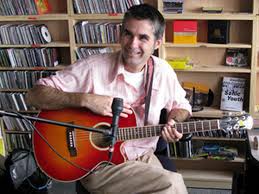
jim whiteI didn’t know who Jim White was before this Tiny Desk Concert.  And I’m still not entirely sure who is he.  But he’s a gifted songwriter and storyteller.

Bob explains how he and Jim tried to work together for All Songs Considered, but that every time Bob asked Jim to do a 3 minute piece, he’d hand in a 15 minute piece.  And then somehow Jim would edit it into a 17 minute piece.  Jim admits that anything can set him off on a tangent (most of which are thoroughly engaging).  He also says that he writes songs not a bout “you” but about “me.”

So with him and a drum machine, he sings some really pretty songs.  “Jailbird” is a slow ballad that is quite beautiful.  I enjoyed that he played his harmonica solo without playing the guitar at the same time (I don’t know if the guitar was prerecorded or looped, I think prerecorded).

Then he gives a funny story about working with the guitarist for P.M. Dawn.  “Turquoise House” is a boppy little number about not fitting in.  It’s a wonderful song.  “Stranger Candy” is a darker song (full of lessons).  He says that it took him several tries to get the music right for this one.

There’s a fascinating story about a gift that Jim sent to Bob.  The story goes on about a racist incident in which his daughter rises above racism.

“Somewhere in the World” is a gentle ballad about finding the person you are waiting for.  I like it (except for that falsetto note at the end).  Then he talks about how for his old songs (like the previous one) he was kind of bummed.  But he has grown up and is happier.  And that has made his songwriting much more difficult.

The final song is called “A Town Called Amen.”  It’s another boppy little song, charming and sweet.  And Jim White seems about the sweetest, nicest musician in the world.

I came away from this Tiny Desk Concert really enjoying Jim White and wanting to hear more from him.

[READ: December 15, 2013] The Braindead Megaphone

This is Saunders’ first collection of essays and non-fiction.  At some point, I stated that I thought I would enjoy his non-fiction more than his fiction.  That is both true and not. I enjoyed his “reporting” essays (from GQ) quite a lot.  But I found his shorter, sillier pieces to be a but too much.  Nevertheless, he is an inquisitive reporter, looking for truth and traveling far and wide to find it (even braving the depths of FOX news). It’s a good collection and only slightly dated.

The Braindead Megaphone
This essay seemed a bit like a blunt instrument hitting a soft object.  Although 2007 is seven years ago, I feel like the subjects (dumb newscasters) were pretty soft even then.  However, it’s entirely possible that people who were apolitical or just simply not that interested in what obnoxious outlets like FOX were doing may not have been entirely aware that the Braindead Megaphone (ie. all news outlets) were not doing us any favors with their spouting of nonsense and being incurious about where stories are really news worthy or even accurate.  I imagine this is mostly just preaching to the converted.  I was a little worried that the whole book would be just as unsubtle, but that proved to be a foundless worry.  This is not to say that I didn’t agree with everything he said in this essay.  He was spot on.  And often he was pretty funny too. (more…)

Read Full Post »

[LISTENED TO: November 21, 2013] “You Must Know Everything” podcast

podcastIn the fourth New Yorker fiction podcast, George Saunders reads Isaac Babel.  I know Saunders very well, although I knew next to nothing about Isaac Babel.

Saunders sets up this story very briefly before diving in to the read.  There’s something fantastic about the way Saunders read the story–full of emotion and affect.  He absolutely made the story come to life and his commentary at the end made the story even better.

Babel was 21 when he wrote this story (he was amazingly prolific–his Complete Works is over 1,000 pages), and Saunders is blown away by the amount of depth such a young writer fits into the story.  Saunders says that for him Babel is a combination of Hemingway and Kerouac–Hemingway because Babel edited his storied very intensely and Kerouac because he wasn’t afraid to add the occasional poetic touch.

In the story, a young boy is going to visit his grandmother.  As the story opens, he explains that he was always very observant.  He knew everything about the streets of his city, Odessa.  He knew the stores and the anomalies in the buildings.  He observed every new window.  Until someone teased him for looking in a lingerie store. (more…)

Read Full Post »

SOUNDTRACK: PHISH-Live Bait 04 (2011).

bait04This Live Bait free sampler is compiled of songs from some of their summer tours (all songs are from June-August).  And it’s a fun collection of mostly long jams.

“Scent of a Mule” dates from 1996 and has a very “old” quality, like the band doesn’t sound as full as normal (the vocals also have an unexpected country feel). There’s a bit of “Sunshine of Your Love” from the guitars while Page is doing an elaborate solo.  Indeed there’s a lot of piano on this track—much more than usual (and some of it is crazy).  There’s a Jewish music section done on both guitar and voice which abruptly ends when the song returns to “Scent”.

“You Enjoy Myself” is one of my favorite Phish songs.  This version clocks in at almost 25 minutes.  At around 21 minutes the song devolves into them making a bunch of silly rhythmic noises, which must be very fun to see.  The next track is “The Landlady” (from 1993), a wonderful instrumental that morphs into “Tweezer” which has a pretty wild and raucous jam component.  There’s also a repeated guitar motif (which I don’t recognize) that seems to be a cue for the band to do things (play loud and fast or really slow—including their impossibly slow rendition of The Simpsons theme song.  It’s a neat trip.

The next track is “Mike’s Song.”  It opens a 36 minute jam that devolves at around 18 minutes into real silliness with spacey effects and controlled laughter.  At about 20 minutes, it morphs into the simple song “Contact” and eventually into “Weekapaug Groove.” Which starts in an unusual way—instead of Mike only playing the bass, the band joins the song in progress.

“Split Open and Melt” has some loud bass—I hadn’t really noticed the bass so much before, and in this version in particular Mike seems like maybe he’s mixed a little louder and he’s playing some really funky stuff (and making quite a few errors, it must be said).  Next comes the silly “NO2” (from 1999), which duplicates the effects of the record pretty well, and the guitar solo at the end of very pretty.  “My Friend My Friend” is a pretty dark song but it starts with the very pretty guitar work until the minor keys take over.  It slowly morphs into “McGrupp and the Watchful Hosemasters,” a lyrically insane but musically great song.  Page gets a lot of solo time in this song, too.

The next song is “Twist” always a fun and energetic live track.  There’s a very slow jam in the middle of the song (which in total is 29 minutes) before it turns into a very echoey “Slave to the Traffic Light.”

The next song is a nearly 20 minute, joyous “Free”.  It morphs into a beautiful “What’s the Use” yet another or f Trey’s gorgeous rising melodies.  “Axilla” is a fast almost punky version as is the near barbershop quartet riot of ”My Sweet One” which is the fastest I’ve heard it done.  And “Run Like an Antelope” is as frenetic as I’ve heard it—the pace of this segment (from 1993!) is insane.

“David Bowie” begins but then pauses as Trey sings “Catapult” a short piece that I don’t think I’ve ever heard played before.  Then “David Bowie” resumes for the remaining 10 or so minutes and it is a fast and furious cut as well.  This great free set ends with a 15 minute “Divided Sky,” which sounds as good as ever.

Phish releases a lot of concerts, so it’s nice that they throw these free compilations to us once in a while.

[READ: October 15, 2012] “Puppy”

This story is included in George Saunders’ new collection Tenth of December.  But since I was able to find it at the New Yorker, I figured I’d read it now (this means that of all of the stories in the collection I have only not read two).

This story is dark.  Although it doesn’t seem so at first.

The story begins by looking at a married woman who has their two kids in the car with her.  She is trying to get them interested in the beautiful autumnal day but they have heard it all before.  And besides, her son is deeply engrossed in his video game Noble Baker “Not now, Mom, I’m Leavening my Loaves” (ha).  Which is better than the game he wanted, Bra Stuffer.  We go into the woman’s head and (at least in my case) pity her a little bit for trying so hard with kids who clearly aren’t interested.  Like when she read the instructions to her son’s video game so she could offer him tips while he played (and he swats her away, but at least it is “affectionately”).

She keeps her spirits up.  But every example seems more sad than nice.  When she thinks about her husband who says “Ho HO!” to anything that comes up.  Like all of the animals that they own, and how few of them are actually played with by the children.

The other day she spoke of their dog as a puppy and her daughter cried because she didn’t remember it.  So of course she had to get them a new puppy.  She saw an ad for a puppy and decided to go check it out. (more…)

Read Full Post »

febSOUNDTRACK: BEN FOLDS FIVE-The Sound of the Life of the Mind (2013).

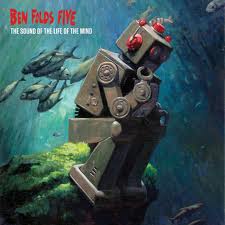
bffThe first Ben Folds Five album in over a decade opens with a big noisy sound and then quickly shows the diversity of the band by pulling back and showing a mellow verse with Ben’s piano and occasional bass.  But then the chorus comes in and Robert Sledge’s bass is once again masterful.  While Ben is clearly the leader of the band, there is something about the BFF’s bass that is so notable.  And this album rocks in BFF’s unique way–rollicking piano, and noisy buzzy bass.

“Michael Praytor, Five Years Later” has some great harmonies (the kind that BFF do so well).  “Sky High” is the kind of social commentary ballad that Ben excels at. And the title track is a fast moving rocker that has more great harmonies.

“On Being Frank” is a Sinatra inspired song with strings.  While “Draw a Crowd” continues Ben’s humorous vulgarity in a very unexpected way: “if you’re feeling small, and you can’t draw a crowd…draw dicks on a wall.”  “Do It Anyway” the single, which inexplicably wasn’t huge, gets more and more fun with each listen–to scream along with “OKAY!” is very cathartic.

“Hold That Thought” is one of those mellow but speedy numbers that I love from Ben.  And when then bass plays that high solo bit near the end (oh that bass), the song kicks into new levels of excellence.  “Away When You were Down” is another string-filled mellow song.  The final track “Thank You for Breaking My Heart” reminds me of “Boxing”, a mellow piano ballad which is, obviously, heartbreaking.

This is a great return to form.  There’s some heavy rockers and some pretty ballads. It’s nice to hear the Five back together again.

[READ: October 5, 2013] 3 book reviews

This month Bissell reviewed three books.

The first book is a biography of Flavius Jospehus called A Jew Among Romans jar by Frederic Raphael (who also wrote the screen play for Eyes Wide Shut).  I had never heard of Flavius Jospehus but evidently without him we would have no historical accounts of time from around the beginning of the Common Era.  His writings are pretty much the only works that have survived.

And his story itself is interesting too. In 70 A.D. the Romans destroyed Jerusalem. This attack has had more impact on current life than can be explained.  Judaism lost the Second temple, Jewish Christianity soon disappeared beneath the waves of Gentile Christianity, even Islam was shaped by this because a Mosque now stands where the Second Temple was.  And nearly all modern forms of anti-Semitism can be traced back to this attack in some way.  Flavius Jospehus chronicled this time as a Jew in a reasonably impartial way (which led many to call him a traitor).  His books Jewish Antiquities and The Jewish War are the sources for almost all of our knowledge of that era, including about Pontius Pilate. (more…)

Read Full Post »

SOUNDTRACK: THE AIRBORNE TOXIC EVENT-Live at KEXP July 23, 2008 (2008).

The Airborne Toxic Event’s “Sometime Around Midnight” was huge back in 2009.  It seemed to be on the radio every time I turned it on.  The ATE put out a new album in 2011, although I didn’t hear much from it.

This show was recorded in 2008, about a year after their debut (with that song on it) album came out.  The set features four songs from the debut.  This was the second time that the band appeared on KEXP (the first time they played three different songs from the debut and “Innocence” which I guess must have been their planned single?).

The band sounds very good live, as a poppy yet downbeat alternative band.  I could see a number of these songs having been huge.  It’s interesting to me that the DJ, who didn’t seem to know the band yet, says that “Sometime Around Midnight” could be on a soundtrack.  The fact that he singled that song out is either prescient or they were already pushing that one.  Although as I say, they played “Innocence” in both sets so I assume that was supposed to be the breakthrough.

Anyhow, I’m not a huge convert to the band, but this was an enjoyable set.  And the band seem like nice guys.

[READ: October 17, 2012] “The Semplica-Girl Diaries”

One never really knows what to expect from George Saunders.  This story is a diary.  And it started off being very irritating to me because of the voice he chose to write the diary in.  “Having just turned forty, have resolved to embark on grand project of writing every day in this new black book just got at OfficeMax.”  I hate this clipped way of speaking/writing and I don’t believe anyone would use it.  And it never lets up.

The other thing that bugged me about the narrator was that he is supposedly writing the diary for future historians to dig up and discover things about whenever this takes place.  And I know that this is a funny trope and that many people imagine that their stuff will be discovered as historical artifacts.  And it’s kind of funny in that he wonders “Will future people know, for example, about sound of airplanes going over at night, since airplanes by that time passé? Will future people know sometimes cats fought in night? Because by that time some chemical invented to make cats not fight?”  For who hasn’t wondered about what will be around in the future.  But these examples (which are preposterous) set a tone which does not match the rest of the story.  And that whole future generation trope gets discarded after a few entries.  I’m not sure if that’s another joke because he explains things like cars and books but not what Semplica Girls are, but I found it very disjointed.

So the first (obvious) joke is that he says he will write for 20 minutes a day and he misses the very next day.  But we learn the situation that the diarist is in–he and his family are in trouble financially.  Their car bumper has fallen off, they have huge debt, and their daughter’s birthday is approaching.  They had just gone to the daughter’s friend’s house where opulence and grandeur are the norm.  This immediately makes the narrator uncomfortable.  This is also the first sighting of the SG in the yard. (more…)

Read Full Post »

SOUNDTRACK: QUEENSRŸCHE-Queensrÿche EP (1983).

Back in high school, I spent many a night listening to M-m-m-m-metal Shop on the radio.  When I first heard “Queen of the Reich” I was blown away.  It was heavy, with blistering guitars and, amazingly, that Voice.  Many is the argument that my friends had about just how great Geoff (Jee-oph) Tate’s voice was. 

But this EP came out before most people had heard of them.  At this state they were a speed metal band from Seattle.  And, yet, despite all of the accolades they would later receive and the huge hits they would have and the prog-metal sound they would develop, for me this EP is the purest Queensrÿche.

I am particularly in love with the wild soloing that happens at the end of “Blinded.”  The guitars are sailing and wailing way.  Then the voices begin chanting and Tate’s voice is screaming (then hitting a minor note) and then screaming again until it just–

Opens the awesome “Lady Wore Black.”  Queensrÿche (yup umlaut on the y, thank you much) have done ballads throughout their career and this is where it started (true, nothing original about a song that starts slow and builds to heavy, but man how heavy this song gets).  The solos are also stellar.

My version of the vinyl has only 4 songs.  The CD added an extra track and the remastered version added like ten more songs.  But to me, these 4 songs are quintessential heavy metal.

[READ: October 27, 2011] “Tenth of December”

This was a surprisingly moving and reasonably dark story from “humorist” Saunders.  I really enjoyed it quite a lot and was very engaged with the whole thing.  And, yes there was a funny line or two in it, but it can hardly be called a funny story.

There are two main characters in the story: Robin, an overweight boy who spends most of his time playing with imaginary friends and Eber, an old man who is slowly losing his faculties.  While they have nothing to connect each other, it soon becomes apparent that their stories will intertwine.

Robin is playing a game in the woods–it’s the kind of game that I think is wonderful for kids to play, and I have to say that I didn’t think it was sad that he had such a creative imagination and played with imaginary friends–of course, since he doesn’t seem to have any friends in real life, I guess it is pretty sad.  (more…)

Read Full Post »

SOUNDTRACK: SPARKS-“Good Morning” (From the Basement) (2008).

I’ve enjoyed Sparks for a long time.  But I never got around to getting the album that this song comes from (Exotic Creatures from the Deep–which has two wonderful song titles: “Lighten Up, Morrissey” and “I Can’t Believe That You Would Fall for All The Crap In This Song.” 

“Good Morning” was the first single from the album.  It features a very bouncy keyboard opening which reminds me of Strangeways-era Smiths.  And then Russel Mael’s crazy falsetto comes pounding in on top of the whole thing. 

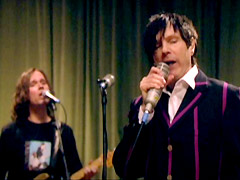
Visually, Sparks are fascinating because Ron Mael looks exactly the same as he has since day one: slicked back hair, thick glasses and a crazy little moustache.  This band is doubly fascinating because the two guitarists and bassist all have shoulder length hair and are wearing T-shirts with the new album cover on them.  In fact, the bassist and one guitarist look like they could be twins (the other guitarist is wearing a hat, so he messes with the identical-ness).  It’s an amusing scene to see.

This is a strange song, it’s catchy in its repetitiveness, but it’s got a cool bridge that breaks up the song into different parts (and the backing guys hit the high falsetto notes perfectly–I think I would have assumed they were women!).  This seems like a strange choice for a single and I can see wh it wasn’t a big hit.  (Most Sparks songs are kind of strange, so who knows which of their songs will catch on).  Of course, I don’t know the rest of the album so I don’t know if there was a more likely choice.  Nevertheless, I may have to investiagate this disc a bit more.

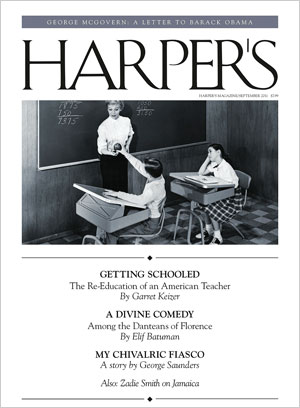
[READ: August 31, 2011] “My Chivalric Fiasco”

This is the second Saunders piece in a couple of weeks in two different publications (this seems to happen to him a lot–do I smell a new book coming out?).  This is one another of Saunders’ more corporate-mocking pieces.  He plays around with name brands and has a lot of trademarked and capitalized words.

But it starts off very unlike that whole realm. It seems to be set at a Ren Faire or some such thing.  On TorchLightNight the narrator sees Martha running through the woods saying, that guy is my boss.  Don Murray comes out of the woods after her, and it clear that something has gone on between them.  When Ted, the narrator, asks them what’s going on, they admit to a “voluntary” fling.  Then Don tells Ted that he has been promoted out of Janitorial; he is now a Pacing Guard.

The next day, Ted is given some KnightLyfe, a pill that helps him with medieval improv.  Until the pill kicks in, Ted is horrible in his role, but once it does, he (and the story) switch into a  kind of crazy Ren Faire “Olde” English: “Quoth Don Murray with a glassome wink, Ted you know what you and me should do sometime?” (more…)

Read Full Post »

SOUNDTRACK: RHEOSTATICS-Calling Out the Chords Vol 1 (2005).

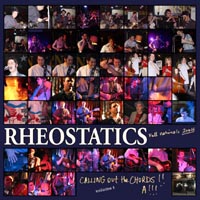
In addition to the Rheostatics’ main catalog, the cool label Zunior has released a couple of “official” bootlegs.  Calling Out the Chords Vol. 1 (no Vol. 2 has been released as of yet) is a collection of 2004 live recordings from The Legendary Horseshoe Tavern.  The Rheos do multiple nights at the Tavern, and this is a selection of songs from those shows.

It’s an interesting mix of essential live recordings and weird tracks that die-hards will appreciate but that newbies may scratch their heads at.  Some essential recordings are the wonderful version of “California Dreamline” that segues into a blistering version of “Horses.”  The version of “Mumbletypeg” with The Fall National Horns adding brass is also pretty great.

But there’s a number of songs here that are peculiar.  Great for fans, but perhaps hard to explain otherwise: an instrumental version of the 1996 song “Four Little Songs.”  I’m not sure why they went instrumental, as the lyrics are pretty essential, but there ya go.

There’s a crazy song “We’re All Living in a Chemical World” sung by special guest Ford Pier.  The intro says that this was one of Tim Vesely’s first songs, and it’s written in their early synth pop style (Pier is an insane vocalist too).  It’s quite a surprise.  And speaking of guests, there’s a lot of music from special guest Kevin Hearn (who has been with Barenaked Ladies since 1996–Hearn is a touring machine, apparently).  Anyhow, he contributes two songs to this disc “Who is that Man and Why is He Laughing?” and “Kevin’s Waltz” and he helps out on “I am Drummstein” and “Weiners and Beans.”   “I am Drummstein” and “Weiners and Beans” are unusual tracks as they come from their children’s album and their tribute to the Group of 7.

The final track is “Legal Age Life at Variety Store,” one of their staple live songs.  But this one has a twist contest in the middle.  Audience members are invited onstage to twist.  It is quite long (and without the actual visuals, it’s a bit hard to listen to more than once or twice) but it’s a fun way to hear the band interact with the audience and it shows what a fun live show they put on.

This is a great recording and a bargain for $5.55.

[READ: August 31, 2011] “Home”

I read this story twice.  The first  time, I didn’t really like it, I found it to be  kind of jumbled and confused.  I don’t know if that’s a typical reaction to this story or if I was feeling lazy, because the second time through I followed it okay and I enjoyed it quite a bit.

It’s a social commentary from Saunders, although exactly what the comment is is a bit unclear to me (even after the second reading).  The main character is a veteran who has just returned from one of the wars we’re fighting, “…the one that’s still going on.”  When he gets back home, his mother has shacked up with an unemployable guy, his sister won’t let him see her new baby and his wife has taken their son and has shacked up with some asshole he knew in high school.

And every time someone finds out he just got back from the war (like the sheriff who is evicting his mom), they all say, amusingly, as if by rote: Thank you for your service. (more…)

Read Full Post »

SOUNDTRACK: MOGWAI: GovernmentCommissions: BBC Sessions 1996-2003 (2005).

It’s unlikely that Mogwai will ever release a greatest hits (well, someone probably will, but the band themselves don’t seem likely to do so).  As such, this compilation of BBC Recordings will certainly work well as one.

As I’ve mentioned many times, the BBC recordings are universally superb.  The quality of the recordings is unmatched.  And, typically the band takes the sessions very seriously.  The major different between these sessions and the official studio release is that the band is playing these songs live.  They are mixed well and sound great but they are live, so you can catch occasional subtle differences.

Mogwai, despite their seemingly improvised sound (all those noises and such) can recreate everything they do perfectly, and their live shows are tight and deliberate (except for the occasional moments where they really let loose).

The ten songs here span their career and are not played in chronological order.  This allows all of these wonderful songs to play off the tensions of each other.  And it shows that their later songs, which are less intense than their earlier ones, are still quite awesome and in a live setting don’t really lack for intensity after all.

The highlight of this disc is the scorching eighteen minute version of “Like Herod.”  The original is intense and amazing, and this live version allows them to play with the original in small ways, including allowing the quietness to really stretch out before they blow the speakers off the wall with the noise section of the track.

Even though I’m a fan of Mogwai, I don’t hear a radical difference between these versions and the originals.  Or should I say, it’s obvious which song they are playing.  There are some obvious subtleties and differences as befitting a live album, but unlike some live discs you don’t immediately notice that this version is “live.”

And that works well for both fans of the band (because as you listen and you hear the subtleties) and for newcomers–(because you’re not listening to weird, poorly recorded versions or versions that are for fans only).  And so, you get ten great Mogwai tracks.  Just enough to make you want to get some more.

[READ: June 11, 2011] The Burned Children of America

I found this book when I was looking for other publications by Zadie Smith.  This book kept cropping up in searches, but I could never really narrow down exactly what it was.  As best as I can tell, it is a British version of a collection of American authors that was originally published in Italy (!).  Editors Marco Cassini and Martina Testa work for minimum fax, an Italian independent publisher.  In 2001, they somehow managed to collect stories from these young, fresh American authors into an Italian anthology (I can’t tell if the stories were translated into Italian or not).

Then, Hamish Hamilton (publisher of Five Dials) decided to release a British version of the book.  They got Zadie Smith to write the introduction (and apparently appended a story by Jonathan Safran Foer (which was not in the original, but which is in the Italian re-publication).  This led to the new rather unwieldy title.  It was not published in America, (all of the stories have appeared in some form–magazine or anthology–in America), but it’s cool to have them all in one place.

The title must come from the David Foster Wallace story contained within: “Incarnations of Burned Children,” which is one of his most horrific stories, but it sets a kind of tone for the work that’s included within (something which Zadie addresses in her introduction): why are these young successful American writers so sad?  So be prepared, this is not a feel good anthology (although the stories are very good).
Oh, and if you care about this kind of thing, the male to female ratio is actually quite good (for an anthology like this): 11 men and 8 women.

ZADIE SMITH-Introduction
Zadie Smith was a fan of David Foster Wallace (she wrote a  lengthy review of the ten-year anniversary of Brief Interviews with Hideous Men which is republished in her book Changing My Mind), so she is an ideal choice to introduce this book.  Especially when she provides a quote from DFW’s interview in 1995 about how living in America in the late 90s has a kind of “lostness” to it.  With this in mind, she sets out the concerns of this collection of great stories: fear of death and advertising.

Zadie gives some wonderful insight into each of these stories. The introduction was designed to be read after the book, and I’m glad I waited because while she doesn’t exactly spoil anything, she provides a wonderful perspective on each piece and also offers some ideas about the stories that I hadn’t considered.  And it’s funny, too. (more…)

Read Full Post »

SOUNDTRACK: GOGOL BORDELLO-East Infection (EP Extra) (2005).

I learned about Gogol Bordello from some live shows available on NPR.  I enjoyed their sets so much I decided to check out their albums as well.  And I love them.  The albums are full of frenetic energy (they give Sarah agita, she says).  But everything that I love about fun, spirited, gypsy music is present here.

The band is essentially a band of gypsies, headed by wonderfully-mustachioed Eugene Hutz.  And their live show (as demonstrated by the included video) is a wild circus of fun (curtains and dancers and fire buckets and bowling pins and musicians jumping out of boxes), it’s like a wild party.  The video is for “Never Young Again” which would appear in full on their next album. It’s a fun song that reverses the age-old lament of wanting to be young again.  But mostly you watch this for the live footage.

This EP is probably not the best place to start as an introduction to Gogol Bordello (but it was really cheap so I bought it first).  Although it does offer many of the different aspects of Gogol’s music.  The EP features 6 songs and the video.  The songs are intense, hyper, crazy and wonderful.  “East Infection” opens with some nonsense lyrics (“Lee lee lee lee lee, la la la la la”) and morphs into what may be more nonsense, although there’s actual lyrics here.  “Ave B.” (which is also on their following album Gypsy Punks) is a more acoustic-based song, but it still has loud parts to it.

“Mala Vida” is a cover of a song by Manu Chao.  This version is a super fast punky track sung in Spanish (despite Eugene Hutz’ origins in the Ukraine, he has lived in Brazil for years and sings many songs in Spanish).  The original is very similar in temperament, although GB version is a bit more frenetic.

“Copycat” is the odd track on the disc, it’s a kind of dub track with big fat bass and a very slinky sound.  It and “Mala” were produced by Steve Albini.

“Strange Uncles from Abroad” is to me a very typical GB song: lots of violin, lots of dah dah dahs and a great melody.  It has a total gypsy feel, and goes through some loud and quiet moments.   The final track, “Madagascar-Roumania (Tu jésty fáta)” is the longest track by far (6 minutes).  It sounds like a demo and lacks the punch of the rest of the disc, but it showcases the softer side of the band (and yes there is one).

So, maybe this EP is a good place to start after all.  It’s certainly not throwaway material.  And the EP cover alone is pretty outstanding.

[READ: June 14, 2011] Five Dials Number 10

This is the issue of Five Dials that introduced me to the publication.  It is a special issue devoted to the memory of David Foster Wallace.  The entire issue is comprised of the eulogies given at the DFW memorial.  [The details are a little sketchy here…I’m not sure if these are all of the eulogies or just the eulogies from well known people.  I’m not even sure who would have been in the audience for this memorial.  The notes say “These tributes were given on 23 October, 2008 at the Skirball Center for the Performing Arts, New York University” and yet the Jonathan Franzen entry says “here at Pomona.”  So… details are sketchy].  Nevertheless, the tributes are heartfelt, informative and very moving.

Of course, I’m not going to ‘critique’ them, I’ll just try to summarize them.  But really, they’re all worth reading if you’re a fan. (more…)

Read Full Post »

« Newer Posts - Older Posts »