Feeds:
Posts
Comments

Archive for the ‘George Saunders’ Category

bythewaySOUNDTRACK: KAYHAN KALHOR-Tiny Desk Concert #203 (March 24, 2012).
kayhanWhy not continue February’s Resistance with an Iranian performer?

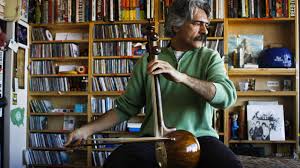
Kayhan Kalhor plays the kamencheh, a four-stringed fiddle-like instrument.  The piece he plays is a 12 minute improvisation.  It is otherworldly and unlike anything I’ve heard–although the blurb makes it sound like a fairly common instrument in his native country.  I don’t have much to say about the piece, so I’ll let the blurb do most of the talking:

For Persians, the New Year comes not in the dead of winter, but right at the vernal equinox. As spring renews the earth, people celebrate this fresh beginning as Nowruz, a joyous 12-day festival to celebrate beauty and abundance. We were lucky enough to have a master musician and composer from Iran, Kayhan Kalhor, visit us in time to celebrate with his gorgeous and deeply moving music.

As one of our interns observed during Kalhor’s mic check, Kalhor’s instrument does the dancing as he kneels with his legs folded beneath him. (This performance actually marks a Tiny Desk Concert first: having a musician perform on top of Bob Boilen’s desk, covered for the occasion by a rug, as Persian tradition dictates.) As Kalhor plays, his bowed, four-stringed kamencheh, a spiked fiddle, spins this way and that, swaying gracefully from side to side.

Before Kalhor played for us, I asked him what he was going to perform. He told me that it was to be an improvisation: “I don’t know yet where I’ll start, or where I’ll end up,” Kalhor said simply. That humble comment aside, Kalhor is a great master who embodies the core principles of this style of music: the ability to perform, entirely by heart, a huge amount of music composed over centuries — but then to take that tradition to new places through the art of improvisation. For us, he then proceeded to spin out a soulful, contemplative and beautifully moving improvisation in the mode of Nava.

The piece has been given the title: “Improvisation In Dastgah Nava.”

As the screen goes black, Kalhor asks: “Was this enough for you? I wanted to go on but I wasn’t sure how much time you had.”

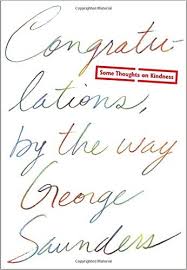
[READ: February 1, 2017] Congratulations, By the Way

Children’s books will commence shortly. But as hatred continues to spread in Washington, one more post on kindness.

Have you ever read George Saunders’ convocation speech at Syracuse University for the class of 2013?  It is stunning and moving and profound.  And yet at heart it is so simple–be kind.

This book, much like David Foster Wallace’s This is Water, is a padded-out book version of Saunders’ speech.  (With illustrations of stars by Chelsea Cardinal).  I am generally opposed to this sort of cash grab book ($14 list price for content that is freely available), but as with Wallace’s book, the speech is so great that any way it can get into people’s hands is a good thing.

There’s not much I can say about the speech, because it is all true and beautiful and doesn’t bear me summarizing.  But I wanted to compare the wisdom of this speech with our horrifying new President and his band of hate-spreaders.  As you read this and know it to be true, wonder what in the hell happened to the people currently running our country that they have fallen so far from the common decency of this speech.

I was thinking how we are taught as children not to lie (Trump lies daily, egregiously) to study hard (Trump is unqualified and none of his cabinet picks are qualified–half of them are downright simpletons), to be kind and obey the golden rule (Trump is literally harming / hurting / damaging / ostracizing / potentially killing people every day with his executive orders).  How did a wicked liar actually win?  Why aren’t the good guys coming to take him out?  I am prepared to RESIST, but it get harder every day with every evil thing he and his minions do.  And watching our spineless elected officials (on both sides, but especially Democrats who were pushed around for eight years) cave to this dictator’s dreams is the most disheartening thing I have ever experienced.

And so, it takes someone liked George Saunders to lift you up.  To believe that somehow this will all be made right.  And to espouse try to kindness where you can.  Because it sure isn’t coming from anyone elected.

The full content of the speech is below.  Read it all, it’s worth it.  Share it with everyone.

(more…)

Read Full Post »

manner SOUNDTRACK: BEN GIBBARD-Tiny Desk Concert #251 (November 19, 2012).

benBen Gibbard is the voice of Death Cab for Cutie.  His voice is instantly recognizable and his melodies are surprisingly catchy.

This Tiny Desk Concert (they say it’s number 250, but I count 251) is just him and his acoustic guitar.  I didn’t know he did solo work, but apparently he does (in addition to being in The Postal Service and All-Time Quarterback).

Gibbard just released a solo album, Former Lives, which he’s said is a repository for material that didn’t work as Death Cab for Cutie songs; from that record, only “Teardrop Windows” pops up in his Tiny Desk Concert. For the rest, he draws from Death Cab’s most recent album (“St. Peter’s Cathedral,” from Codes and Keys) and, of all places, last year’s Arthur soundtrack (“When the Sun Goes Down on Your Street”).

As mentioned he plays three songs and his voice is so warm and familiar I felt like I knew these songs even if I didn’t.

I knew “St. Peter’s Cathedral.” It is a lovely song with very little in the way of chord changes.  But the melody is gentle and pretty.  And the song appears to be entirely about this church.  Which is interesting because the second song is also about a building in Seattle.  “Teardrop Windows” is a surprisingly sad song about an inanimate object.  It’s written from the building’s point of view as he mourns that no one uses him anymore.  And such beautiful lyrics too:

Once built in boast as the tallest on the coast he was once the city’s only toast / In old postcards was positioned as the star, he was looked up to with fond regard / But in 1962 the Needle made its big debut and everybody forgot what it outgrew

The final song “When the Sun Goes Down on Your Street” was indeed for the Russel Brand movie Arthur.  Somehow I can’t picture those two together.  It’s a lovely song, too.

I prefer Gibbard’s more upbeat and fleshed out music, but it’s great to hear him stripped down as well.

[READ: January 2017] “My Writing Education: A Time Line,” “The Bravery of E.L. Doctorow,” “Remembering Updike,” and “Offloading for Mrs. Schwartz” 

I had been planning to have my entire month of February dedicated to children’s books.  I have a whole bunch that I read last year and never had an opportunity to post them.  So I thought why not make February all about children’s books.  But there is just too much bullshit going on in our country right now–so much hatred and ugliness–that I felt like I had to get this post full of good vibes out there before I fall completely into bad feelings myself. It;s important to show that adults can be kind and loving, despite what our leaders demonstrate.  Fortunately most children’s books are all about that too, so the them holds for February.

George Saunders is a wonderful writer, but he is also a very kind human being.  Despite his oftentimes funny, sarcastic humor, he is a great humanitarian and is always very generous with praise where it is warranted.

The other day I mentioned an interview with Saunders at the New York Times.  Amid a lot of talk with and about Saunders, there is this gem:

Junot Díaz described the Saunders’s effect to me this way: “There’s no one who has a better eye for the absurd and dehumanizing parameters of our current culture of capital. But then the other side is how the cool rigor of his fiction is counterbalanced by this enormous compassion. Just how capacious his moral vision is sometimes gets lost, because few people cut as hard or deep as Saunders does.”

These first three pieces are all examples of his love and respect for other writers–both for their skill and for their generosity.

“My Writing Education: A Time Line”

“My Writing Education” comes from a book called A Manner of Being: Writers on Their Mentors.  Saunders’ mentor was Tobias Wolff.  And for this essay, his admiration takes the form of a diary.  (more…)

Read Full Post »

2008_03_24-400SOUNDTRACK: MILAGRES-Tiny Desk Concert #198 (February 27, 2012).

milagresI hadn’t heard of Milagres before this set.  Bob mentions how they are a band with many layers of music–practically a wall of sound.

The big sound of Milagres is built from small, simple elements: the boom of the kick drum, the clack of the claves, the repetitive tap-tap-tapping of a piano. This is a band of selective minimalism — which, in the end, somehow gets me thinking about the big sounds Phil Spector made. It’s all about attention to detail, and Milagres is a band that cares.

And yet for this Tiny Desk:

Frankly, I worried more when the band’s list of gear didn’t include a single amp and its members said they didn’t need to use our keyboard. They came armed with a red toy piano, an autoharp, a shaker egg, a melodica, a glockenspiel, a few acoustic guitars and not much else.

But in the end, that same attention to detail made this a great Tiny Desk Concert. In spite of the tiny sound, the songs were big and strong — delicately built, yet sturdy enough for the emotive sounds of Kyle Wilson’s voice.

Wilson’s voice is kind of  loud whisper, but the band, with all of their funny gear sounds really full and the elements come together very nicely.

“Hard to Stay” starts out nicely, but when the band adds the lovely “ooohs” during the first verse it sounds amazing.  And you can hear all of the instruments perfectly balanced—the authoharp, the melodica and then the xylophone.  Couple that with some lovely lyrics

All the leaves are glowing green / as the seasons rage all the birds seem to sing in the key of A

“Halfway” opens with a toy piano—which doesn’t sound cheesy.  Wilson hits lots of delicate falsetto notes that work perfectly with the piano and xylophone.  The chorus “Halfway, halfway, I could be halfway” is all sung in gentle falsetto.  And then add more of those beautiful ooohs during the second verse.  I also really like at the end when he keeps playing his chords higher and higher up the neck–getting kind of noisy–until it all abruptly stops

“Glowing Mouth” opens with shaker and melodica and again, the sound is nice not cheesy.  he sings wonderful falsetto “haaas” in the middle and the autoharp returns with the great sound.   He play a simple but pretty riff on the acoustic guitar as the song ends (its fun to watch his fingers playing it close up).

The band really won me over with their sound here and now I’m very curious to hear what they’re “supposed” to sound like.

[READ: January 27, 2017] Y’all Torture Me Home”

I am astonished that this essay had to be written at all back in 2008.  But I am even more upset that now, 8 years later, issues of torture are being considered again.  Really the only word that should be coming up regularly is impeachment.

When I was in college I wrote a humorous piece for my college newspaper that was all about Deconstruction.  There had been a debate going back and forth about it (seriously), with the people who were opposed to it saying that it led to a belief that nothing had meaning–which could cause a spiritual crisis.  (Ah, the 90s).

Since no one was winning this argument, I jumped in with my piece which was all about “de construction” at “da University” (our school was expanding and there was orange construction fencing everywhere).  It was hailed and enjoyed (at least by one of the professors in the philosophy department).

I bring this up only because Saunders takes a similar mis-understanding approach in the essay, which, sadly, is timely once again.  His piece begins:

I was overjoyed that Congress refused to override President Bush’s veto of a bill outlawing the washboarding of prisoners, a technique that some have described as torture—a ridiculous notion if I’ve ever heard one.

[After you unpack the negatives, the ruling was that “washboarding” can continue]

And thus begins Saunders detailed account of his own experience with being washboarded. (more…)

Read Full Post »

rand SOUNDTRACKPISTOLERA-Tiny Desk Concert #199  (March 1 2012).

pistolPistolera is the brain child of a woman from Brooklyn who wanted to showcase music made in Mexico. [RESIST THE WALL].

The motivation was a longing for Mexican music on the part of the band’s principal songwriter and lead vocalist, Sandra Velasquez, a California native who was studying music in New York. Her solution: to form a band that played the music of her youth.

Sandra plays acoustic guitar and sings.   She is accompanied by a five string bass, accordion, electric guitar and percussion.  She has a delicate voice and sings everything in Spanish.

“Polvo” is pretty song.  She plays a lovely finger-picked guitar while everyone else adds flourishes to flesh out the song–never overpowering her voice or guitar.  The song has a louder moment with some oh oh oh ohs before growing quiet again.  It ends as prettily as it began with the delicate finger picking.

“Ponle Frenos” means put on the brakes.  She wrote this after having her first child when she realized that she needed to rest from time to time.  It is upbeat and bouncey with a reggae feel in the verse.  And there’s a fun refrain of what I hear as “beep beep beep.”

“La Despedida” is the final song, appropriately translated as “The Goodbye.”   This song feature “the symbol of the dessert,” the donkey jaw.  It is a quiet and slow ballad with bongos as the featured percussion.  There is great work from the (mostly unseen) electric guitar–nothing fancy but adding great textures and melodies over the main acoustic guitar.  He also adds a beautiful, lonesome-sounding guitar solo.  About 3 minutes in, the percussion starts playing the jaw bone along with the bongos.  He just hits it with his fist to make the rattle sound,  And then, she walks “off stage” with her guitar—standing in the audience watching.  And then the accordionist puts her instrument down and walks off—leaving just bass guitar and percussion. Then the bass departs.  After the last chords ring out the guitarist leaves just the bongo and donkey jawbone.  After a measure or two, he gets up and walks through the audience with the jaw.  It’s a great ending to the set.

It’s wonderful hearing music from other cultures, especially one that is so close to us, yet which we tend to spurn.  RESIST THE WALL.

[READ: January 27, 2017] “I Was Ayn Rand’s Lover”

This story was written near the election of Obama’s first term when Paul Ryan was a weasel with bad ideas but little power.  Now, sadly he is a weasel with worse ideas, no spine whatsoever and access to a lot of power.  But this essay is at least a fun way to make fun of him.  It begins like this:

Many of my Republican friends have said to me, “George, why are you voting for Barack Obama?” They assume it is because I believe in his radical socialist agenda of being fair to everyone, even the poor. But that’s not it at all. I could actually care less about the poor. We have some living near us, and pee-yew. They are always coming and going to their three or four jobs at all hours of the day and night. Annoying! No, the reason I am voting for Obama is more complicated.

The reason is that back in 1974, when he was just 17 and she was an internationally famous author, he and Ayn Rand were lovers: (more…)

Read Full Post »

922SOUNDTRACK: SAUL WILLIAMS-Tiny Desk Concert #565(September 16, 2016).

saulSaul Williams sings three songs in this Tiny Desk Concert.  He is accompanied by two guys on acoustic guitars.  But his songs are so much more than the few chords played guitars.

I was unfamiliar with Williams before this Concert.  He is a rapper, poet, activist, writer and much more.  All of his songs include impassioned spoken sections in which he (presumably) free verses eloquently.

He opens the set with a series of statements/accusations.  And when he announces the title of the song, “Burundi” he tells us that the song is called… an astonishing list of cities that have similar problems.  He explains that the chorus contains stanzas from the Sufi poet Rumi: I’m a candle, you can chop my neck a million times but I still burn bright and stand.  The middle of the song is a lengthy spoken section in which he talks about everything that is going on in the world.  And he ends with this excellent thought: “The voice and vision that counters power cannot be wiped out.”

For “Think Like They Book Say,” one of the guitarists plays out a rhythmic tapping on the body of the guitar while the other plays the melody.  It’s a menacing sort of melody and it is dedicated to Chelsea Manning.

Before the final song Saul grabs Bob Boilen’s James Brown doll.  He cradles the doll, kisses his forehead and then has his guitarist play a lullaby “Down For Some Ignorance.”  It begins as a very mellow song.  And then mid way through the song, he presses a button on his computer and the song turns into an electronic wildstorm of sounds and samples.

During the end of the song, he recites a phenomenal list of grievances.  And as the song ends, you can see that he has brought a tear to his own eye.

It’s a very powerful Tiny Desk.

[READ: March 10, 2016] “My Gal”

I’ve mentioned before that I really like George Saunders’ work, and I find his funny pieces to be especially funny.

What’s odd about this piece (which was in Shouts and Murmurs) is that it was topical.  Nothing odd about that exactly, except that reading it nearly 8 years later, in another election cycle, it seems almost quaint.  Especially since Trump has replaced Sarah Palin as the Republican’s (and now the country’s) biggest idiot and liar.

This essay is by a guy who loves Sarah Palin–she’s his gal. (more…)

Read Full Post »

CoverStory-KadirNelson-ADayattheBeach3-879x1200-1467305948SOUNDTRACK: LYDIA LOVELESS-Tiny Desk Concert #369 (July 1, 2014).

lovelssI want Lydia Loveless to be a punk singer–Her name is like a combination of Lydia Lunch and a last name that conjures up an asskicking punk.

But not the country singer that Loveless is (even if she is ass-kicking herself). Loveless is a new breed of alt-country which is pretty explicit with noticeably rocking guitar solos.  But her voice is so twangy it’s hard to not call it country (and in fact it’s a bit too much for me to take sometimes).

“Head” features this rather memorable chorus “Don’t stop getting undressed /Don’t stop giving me head.”  It seems especially surprising since Loveless looks like she’s about 12 (she was 23 at the time of this recording).  The buzzy solo is lengthy and more or less runs throughout the song.  Although at some point when Loveless takes her own solo the whole sound seems to fade out and get a little anemic.

Her band is fun with her bassist being very tall and having very long hair playing a very tall upright bass.  And then there’s another guy playing guitar and lap steel.

“Verlaine Shot Rimbaud” has a title that begs for an awesome song.  It’s not an epic masterpiece or anything.  In fact its closer to a pop song, The slide guitar and Loveless’ heavy accent on the chorus place it firmly in the country camp.

“Mile High” has a fun folk riff.  It sounds a lot like The Byrds and the chorus is super catchy.  If I could get her to sing less twangy I would love this song much like I love the punk country of X, or at least the Knitters.

[READ: December 29, 2010] “Who are All These Trump Supporters”

[This essay in the New Yorker also came under the heading “Trump Days.”]

So the title of the essay is a question I myself have been asking as I watch the hatred and vitriol bubble over during the convention.

If there was anyone I wanted to write this piece it would be George Saunders and he is actually the only reason I read it in the first place (I plan to read all of his contributions to the New Yorker eventually, but I’m glad to have read this one when it was timely–I hope it will be utterly irrelevant by the time I get to the rest of his works).  He self identifies as a liberal (although he was a conservative who loved Ayn Rand way back in the Reagan era).  He is a thoughtful and not prone to anger–a perfect foil for the crowd.  And he’s got a great way with words.

So great in fact that I’m just going to be quoting him a lot.  I could have pulled more excellent quotes from the essay, but really you should read the whole thing. (more…)

Read Full Post »

282016SOUNDTRACK: MONSIEUR PERINÉ-Tiny Desk Concert #512 (March 4, 2016).

perimne I feel like it’s been a while since NPR’s Felix Contreras has had a Tiny Desk for a band playing Latin American music.  And Monsieur Periné (French name and all) plays some really fun Latin American music.  They are from Colombia, which is evidently known for its Afro-Colombian cumbia.

But they don’t play strictly cumbia.  Their long set plays around with tempos and styles.  It is fun, fun, fun with a lot of swing and big horns.  There’s some great electric guitar and electric upright bass and two fantastic drummers. There’s even a 1920s jazz feel to some of their music (the guitars especially)

This is all set behind the lead singer’s beautiful voice (and the guys’ harmonies).  And the great riffs from the saxophone nad trombone.

The first song “Nuestra Canción” (Our Song) opens slowly with several different tempos.  I love that once the singing starts,  the two guitars play very different things that works so well together.  I like watching the drummer and percussionist playing the same rhythms.  And it’s especially interesting when this six-minute, very jazzy-feeling song (albeit it sung in Spanish) takes a turn in the middle of the song to sound very cumbia.

“Sabor A Mi” (Taste of Me) is a bolero–very dancey.  The guitarist has switched to a twelve string instrument with a very small body.  I assume it’s a guitar but who knows. The lead guitar is actually played on an acoustic guitar outfitted with a pick up.  The sax player has switched to clarinet and the clarinet and trombone y play a great melody together.

“La Muerte” is 7 minutes long with a spoken introduction.  This made me very curious because the introduction is in Spanish for a song that she sings in part in French (and in Spanish).  The horns sound great on this song.  And the guitar solo comes in it a has very surf guitar sound while still saying very Latin American.  There’s a long instrumental section that slows things down and then they come blasting out with their great riffs.

This band is a lot of fun and would be great at a party.

[READ: February 4, 2016] “Mother’s Day”

I have really been enjoying the work of Saunders lately.  I particularly enjoy his darker comic pieces, but there’s something about his non funny pieces that is also pretty grand.

It’s never clear if you’re going to get funny Saunders or not when you start a story.

This one even seems like it might be funny as we slowly learn more and more about one of the Mothers featured this Mother’s Day.

The story is told in that strangely detached way that Saunders has where it seems like what seems like a third person may actually be the inner monologue of the narrator.  But told at a distance?  “Paulie had flown in and Pammy had taken her to Mother’s Day lunch and now was holding her hand.  Holding her hand!  Right on Pine.  The girl who once slapped her own mother for attempting to adjust her collar.” (more…)

Read Full Post »

[LISTENED TO: August 2015] The Organist

organistFor the second season of The Organist, they switched formats from the once a month 45-55 minute long amalgam of stories of last year to a one story an episode, once a week format.  The length hovers around 20 minutes now with some shows being much longer and others being much shorter.  It doesn’t make too much of a difference if you listen all at once as I did, but I can see that if you’re listening when they come out that a weekly podcast would be more satisfying.

However, they have also opted to have an “encore” episode every fourth episode in which they take one of the segments from an earlier episode and play it on its own.  How disappointing would it be to tune in and get a repeat?  And why on earth would they repeat things if all of the previous episodes are available online?  It’s very strange and frankly rather disappointing.  I mean, sure, it’s nice to have the new introductions, but it’s not like you’re getting some kind of special version when they repeat it.  It’s exactly the same.  And, boy, they tend to repeat some of my least favorite pieces.

Also the website now gives a pretty detailed summary of the contents of each episode, so you get a good sense of what’s going to happen. (more…)

Read Full Post »

[LISTENED TO: August 2015] The Organist Season 1

organistGiven my love of the McSweeney’s empire, it seems logical that I would have listened to The Organist sooner than this.  But I didn’t.  It has been on for a couple of years, so i assumed I’d never catch up.  But then I saw that there were only 50 episodes and most of them were quite short.  So it was time to see what it was all about.

And, since it is more or less in conjunction with The Believer, it should come as no surprise that it is sort of an aural equivalent to that magazine–longish pieces about esoteric subject, but geared specifically to “radio.”

The Organists first season was done as a monthly podcast starting on Feb 1.  Each episode was about 50 minutes long and covered a variety of subjects with fun guests and other ephemera.

Episode 1: (February 1, 2013)
The inaugural episode kicks off with Nick Offerman spouting some hilarious nonsense about podcasts.  The rest of the show includes an interview with George Saunders talking about the voices of his fiction; Greil Marcus discusses the impact of the first Bikini Kill EP now that it is reissued.  Perhaps the most unusual and interesting piece is when Amber Scorah tells the story of her defection from the Jehovah’s Witnesses while working as a missionary in Shanghai; In short pieces, Brandon Stosuy editor of Pitchfork, presents five five-word record reviews of interesting new guitar rock and then musicians Matmos take a song from their new album apart, piece by piece, revealing its brilliant, pulsating innards.  Basically they used thought control to get people to “create” a song for them.  It’s a really neat process even if the final result doesn’t really sound like the sum of its parts. (more…)

Read Full Post »

june23SOUNDTRACK: MONTY PYTHON-“Rock Notes” (1980).

mpThis skit (more of a monologue) comes from Monty Python’s Contractual Obligation Album, the first Python album I ever bought.  It’s not my favorite bit from them, but it’s short and wedged in the middle of the rest of the album which means that I know it by heart.  Now, the skit is most famous for naming Toad the Wet Sprocket (Eric Idle says he tried to come up with the most absurd name he could think of and there it was).  The band featured Flamboyant Ambidextrous Rex who fell off the back of a motorcycle.

What I tend to forget is that the rest of the joke is all about one band Dead Monkeys who have just broken up again.  They were together for ten years, but for nine of those years the band had other names.  Primarily, the names are fishy: Dead Salmon, Trout, Poached Trout in a White Wine Sauce, Dead Herring.  Then they ditched the fishy references for Dead Loss, Heads Together, Dead Together and ultimately Helen Shapiro.

This extended riff is rather silly and I’m not even sure it’s appropriate for a joke on bands.  I can’t think of many bands who have broken up and reformed under new names (I mean, yes, there’s a couple, but not enough to warrant this extended joke).

And yet, I still remember the joke, so it must be something, right?

What do I think of Dead Duck? or Lobster?

[READ: September 16, 2014] “Liner Notes”

This Shouts & Murmurs piece begins so strongly that I was super excited to read it.  Saunders riffs on liner notes in albums, specifically failed albums.  His liner notes are for the album 2776: A Musical Journey Through America’s Past, Present & Future which is just another attempt to “engage with the vast sweep of American history” via the musical epic.

The best joke is citing Meat Loaf’s “Ben Franklin Makes Love in a Foggy Grove of Trees” (which failed to translate to live performance).  [I would totally listen to that song].  He then talks about a Tim Rice-Andrew Lloyd Webber production of “Johnny Tremain” which was too intellectual for a nineteen-seventies audience.  But I feel like Saunders goes off track when, instead of staying with the slightly absurd realism, he jumps the shark by saying that the songs were too risqué “for a staid culture that, at that time, still believed that babies came when you left a pastel turtleneck rolled up in a wad overnight.”  It broke me right out of the exaggerated realism into the realm of outrageous farce.

Which is a shame because returning to real artists like Tom Waits making a biography of Jesse James called “A White-Trash Rambling Christ Figure Just Shot Your Brother, Amigo” is pretty darn funny. (more…)

Read Full Post »

« Newer Posts - Older Posts »