Feeds:
Posts
Comments

Archive for the ‘Don DeLillo’ Category

SOUNDTRACK: WILD FLAG-Wild Flag (2011).
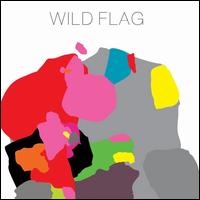
For reasons unclear to me now, I wasn’t psyched when I heard about this band.  Despite the fact that it was 2/3 of Sleater-Kinney and the force behind Helium joining together, I didn’t jump for joy.  But now that I have listened to the album a million times, I can say that it is one of the best albums not only of that year, but of many years.  Man is it good.

Sleater-Kinney was a great band, they were melodic and tuneful but also abrasive and occasionally off-putting.  Who knew that the majority of the adhesiveness came from Corinne Tucker (well, she was the screamer, admittedly).  It’s pretty clear that Carrie Brownstein is bringing a ton of melody (and a wee bit of amativeness) to the mix.  Mary Timony always included trippy imagery and a weird kind of whispered/loud singing voice.  The tunes are so catchy so strong, so singalongable.

There’s little moments in each song that are amazing.  The backing vocals (and the pitch shift in the chorus) in “Romance”.  The way “Something Came Over Me” sounds so different from “Romance” (and is clearly a Timony-sung song).  I absolutely love the guitar “solo” that begins each verse and how it stands out but fits in so nicely as a baritone guitar sound (I assume from Carrie?)  “Boom” is just a full-on rocker with some great guitar pyrotechnics and Carrie’s more extreme vocals.  And man is it catchy.

“Glass Tambourine” is a cool trippy psychedelic workout  that’s still catchy and interesting.  “Endless Talk” has a strange British retro vibe.  (Carrie seems to be singing with a kind of punk British voice).  And there’s lot of keyboards.  It’s great that the album has so many different sounds, but still sounds cohesive.  “Short Version” has some great guitar soloing in the front and back.  “Electric Band” is like a perfect pop song–great backing vocals, great poppy solos and a cool video to boot.  “Future Crimes” is another amazing tune, with a keyboard solo!

“Racehorse” is probably my least favorite song on the disc.  It’s got some cool parts and some interesting swagger (and I like the live versions where they really jam) but the album version feels a little dragged out (although the chorus is really hot).  The disc ends with the wonderful “Black Tiles” which could easily be a Helium song, but which still sounds very Wild Flag.

And, I can’t say it enough, Janet Weiss is amazing on drums.  I feel badly because I tend to leave out the keyboardist–because I don’t know who she is or the band that she came from.  But her keyboards play an essential role in the music.  They fill out the spaces that the two guitars don;t always fill.  They even introduce the opening of the album.

If you go back through previous posts you’ll see I’ve mentioned them 3 times already because they have special bond with NPR and three of their concerts are available there.  I can’t wait for more from them.

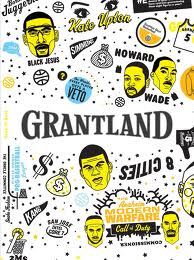
[READ: May 8, 2012] Grantland 2

I was surprised at how much I enjoyed Grantland #1.  So I was pretty excited to get Grantland #2.  #2 has all of the elements that I loved about #1–non-sports articles about entertainment (video games, music, TV), and sports articles that are short and digestible for a non-sports fan.  This issue also features a number of really long articles about basketball.  I like basketball fine, but I can’t say I paid any attention to the lockout.  Thus, much of this was lost on me. It probably doesn’t help that I don’t know any sports people either.

I may have said this last time, but I will reiterate for Issue #3–for those of us who don’t follow sports, or those of us who may not remember back to September when most of these articles were written, or heck, for people who are going to read this in ten years’ time:  For certain articles, can you give us an epilogue about what happened after the article was written.  If you speculate about  the lockout. Have an epilogue to say about how the lockout turned out.  If you talk about a game 5 of a series and the series didn’t end, have an epilogue that tells us how the series ended.  It doesn’t have to even fit the style of the article, just a few words: so and so ended like this. It can show how prescient the writers were.  And it can help us complete the stories.

So, despite a few articles that I thought were too long, (although probably aren’t if you love basketball) I really enjoyed this issue of Grantland, too. (more…)

Read Full Post »

SOUNDTRACK: ULVER-A Quick Fix of Melancholy (2005).

This EP came two years after Teachings in Silence (with a movie soundtrack and “greatest hits” collection in between).  This first track, “Little Blue Bird” is a simple soundscape with echoey keyboards.  When Garm starts singing, his most emotional side comes through (even if I really can’t understand him most of the time).

“Doom Sticks” belies its name and the EP title by being somewhat upbeat.  There are kind of squeaky keyboards that pulsate through the track.  After about a minute and a half, distorted drums keep a martial beat.  But it quickly morphs into a twinkly section that makes me think of the Nutcracker or some other kind of Christmas special.

“Vowels” is similarly upbeat (the music on both of these two tracks has a vaguely Christmastime feel somewhere in there–not that anyone would think these were in any way Christmas songs, or maybe it’s because I’m listening in mid-December).  For this, we get a return of Garm’s choral voice: deep, resonant and hard to understand (although I undertsand the lyrics are from a poem by Christian Bok).   But the poem quickly makes way for some dramatic staccato strings. 

“Eitttlane” begins with some menacing keybaords and staccato notes, creating a feel of a noir movie.  But when the vocal choir comes in, it gets even more sinister.

These Ulver EPs are really true EPs–stopgap recordings for fans.  Their larger works tend to be more substantial, but these EPs allow them to play around with different styles.

[READ: December 1, 2011] “Laureate of Terror”

Two authors I admire in one article, how about that!  In this book review, Martin Amis reviews Don DeLillo’s first collection of short stories and gives a summary of DeLillo’s work.

Amis opens the article by undermining my plans for this blog.  He states point blank than when we say we love an author’s works, we “really mean…that we love about half of it.”  He gives an example of how people who love Joyce pretty much only love Ulysses, that George Eliot gave us one readable book and that “every page of Dickens contains a paragraph to warm to and a paragraph to veer back from.”  Also, Janeites will “never admit that three of the six novels are comparative weaklings (Sense and Sensibility, Mansfield Park and Persusaion).  [I still hope to read all of the books by the authors I like].

Amis says he loves DeLillo (by which he means, End Zone, Running Dog, White Noise, Libra, Mao II and the first and last section of Underworld).  And he also seems to really like The Angel Esmeralda: Nine Stories,(well, much of it anyway), DeLillo’s first (!) short story collection

His main assement is that these pieces are a vital addition to DeLillo’s corpus.  (more…)

Read Full Post »

SOUNDTRACKPEARL JAM-Austin City Limits (2009).

Pearl Jam records (and sells) most of their shows and they occasionally videotape them as well.  But they don’t do TV all that much (excepting the recent Late Late Show episodes).  There seemed to be something special, or at least different, about Pearl Jam on Austin City Limits.  Think of it almost like Unplugged Updated.

It opens slow with Eddie on an acoustic guitar and strings behind him.  In fact, the whole set seems less heavy than many of their sets.  But that’s not to say that the band doesn’t rock out, because they do.

The first six songs of the set come from Backspacer.   And then they bust out “Army Reserve” (which makes sense given who is in the audience, see below).  Then there’s a wonderfully raucous version of “Do the Evolution” (one of my favorite PJ songs).

After that riotous track, they bring the strings out for one more song.  It’s a rather funny little joke because it’s just the strings and Eddie on acoustic guitar playing “Lukin,” the 80-second song that is so fast you can barely hear the words.

For an extra treat, touring mate Ben Harper comes out to play slide guitar on “Red Mosquito” (which is always a treat).  And the set ends with an amazing version of “Porch” with a super long guitar solo in which Mike McCready really shows off his chops.  There’s even a moment where Mike and Stone are riffing off each other, classic rock style.
The set ends the Eddie talking about playing for the wounded veterans in the audience and how it was quite moving for him given all they have done for us.  Over the closing credits you see the band mingling with the veterans (including a guy who has lost a leg).  It’s all surprisingly touching for a rock show.

[READ: November 20, 2011] “Perchance to Dream”

A while back I read all of the Jonathan Franzen articles that were published in The New Yorker.  I thought I had read everything he’d published until I realized I had forgotten to read this piece (possibly his most famous) that was published in Harper’s.  It fits in well with this weekend’s theme because it was mentioned in Evan Hughes’ article that I talked about yesterday and because David Foster Wallace is mentioned in it.

As with most of Franzen’s non-fiction, it’s not easy to write about critically unless I want to argue with him, which I don’t necessarily want to do.  So instead, I’ll try to summarize.  Of course, this is a long and somewhat difficult article, so let’s see what we can do with it.

The first surreal thing is when you see the byline: “Jonathan Franzen is the author of two novels, The Twenty-Seventh City and Strong Motion, and is writing a third.”  It’s hard to imagine he got a huge article in Harper’s before he wrote The Corrections.

The second surreal thing comes in the text: It opens with “The country was preparing for war ecstatically, whipped on by William Safire (for whom Saddam Hussein was ‘this generation’s Hitler’) and George Bush, whose approval stood at 89 percent.”  And it is only a few paragraphs later when he mentions Patriot missiles that it clicked that this was written in 1996 and not 2001 and that he was talking about the 1991 Iraq invasion.  He mentions this as a prelude, saying that he was trying to sequester himself in order to start writing again.

Then he talks about Paula Fox’s novel Desperate Characters as a benchmark in terms of insight and personal conflict, even if it is so crazily outdated (that someone would throw an inkwell!).   He talks about this book quite a bit. I’m, not sure I found it compelling enough to want to read, but it’s always interesting to hear a fan write about a book I’ve never heard of.  He will return to this book throughout the essay. (more…)

Read Full Post »

SOUNDTRACK: PUBLIC ENEMY-Fear of a Black Planet (1990).

NPR recently broadcast a PE show from the All Tomorrow’s Parties Festival.  I didn’t know that PE was still touring, so that was a surprise to me.  The show was largely a celebration of Fear of a Black Planet, which meant that I had to go back and listen to the original.

Man, is this a solid album.  The lyrics pack a punch even twenty years later and what is perhaps more amazing is that the sound collages that Terminator X created, which were something of an oppressive sonic assault are now fairly mainstream-sounding (forward thinking or what?).

What I like about this (and most PE) albums, is that  they have little skits between songs, but unlike most rap skits they’re not one-not jokes that you listen to once and then skip every future time.  A wonderful skit (for lack of a better word) is “Incident at 66.6 FM” in which we hear an amazing amount of racist epithets thrown at PE apparently on the radio.  Or the rather disturbing “Meet the G That Killed Me.”  “Anti-Nigger Machine” is a great collage of samples like “Think” and James Brown and a dozen more songs.

“Can’t Do Nuttin for Ya, Man!” is a (sort of) comic song from Flav that is catchy as anything. While “Reggie Jax” is a confusingly titled song that has nothing to do with baseball, but everything to do with funk.

Of course, this disc has some of PE’s best songs as well.  From the awesome “911 is a Joke” to one of the best rap songs ever, “Welcome to the Terrordome” (my favorite story of this song is when I was wearing a  Welcome to the Terrordome shirt and my philosophy professor asked me quite pointedly, “What in the hell is a terrordome.”  That was a fun conversation).  “Terrordome” is still amazing–powerful, musically intense and for all of its lyrical acuity, it still has funny moments….boing.

And of course, “Burn Hollywood Burn” is an amazing critique of the movie industry (and it’s catchy too).  I got Black Caesar back at the crib, right Lar?

I’ve always been a little confused by “Pollywannacracker.”  Not lyrically, but vocally, as Chuck’s (is it really Chuck?) voice is treated in a surprisingly tinny way.  I liked the song more on this listen than any other, I guess in the past it just kind of snuck by me.

The album is a little front loaded with greatness.   “Power to the People” is another powerful song, but it’s not quite as memorable as the other tracks.  “Fear of a Black Planet” has some really cool sounds on it (where did they get that “black man, black woman, black baby” sample?).   “Revolutionary Generation” is a great track in which Chuck and Flav stand up for black women: “R-E-S-P-E-C-T, my sister’s not my enemy.”  Not your average rap subject.

And the last couple of proper songs, “B Side Wins Again” and “War at 33 1/3” are fast paced and furious, but they don’t really have much in the way of a hook.  Nevertheless, lyrically they are really great, and I love to hear Chuck D flow that quickly.

The biggest surprise for me is the censored version of “Fight the Power” (the song that got me into PE in the first place, thanks Spike).  It’s really surprising to me that PE allowed their music to be bleeped–unless it was just for a deliberate radio play (which I can accept).  Although they also list a title as “Leave This Off You Fu*Kin Charts” (did I buy a Columbia House version or something?)

This is an amazing album, one that still sounds fresh and sadly, is still relevant.

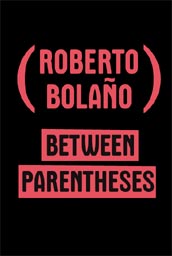
[READ: October 15, 2011] Between Parentheses

I never expected to get so addicted to Roberto Bolaño.  And despite his death, there is no shortage of works coming out in English (that is one of the advantages to reading a translated author–even death doesn’t cease the available materials).  Indeed, this year alone, New Directions is publishing Between Parentheses, and Tres and FSG is publishing The Third Reich (a collection of non fiction, a collection of poetry and a novel respectively).

When I really get into an author, I fall for his or her works, not necessarily him or her as a person (heck, some author are downright jerks).  But there are some authors that I want to know about, personally.  Bolaño is a pretty polarizing figure–he seems obnoxious, his works don’t shy away from very specific opinions, and sometimes it’s unclear what kind of views Bolaño himself has in his works (or if he’s even telling the truth about his so-called truths).  One thing in particular is the constant use of the word “faggot.”  It is used often in 2666 (and I know that is a translator’s choice, but still) and used derogatorily.  Now, clearly the context is everything for something like that.  But it seems to speak badly of Bolaño.  And yet, when reading these essays he is not homophobic in the least.  He is obviously well aware of institutionalized homophobia in Latin America, and he is obviously not supportive of it.

But that’s just one interesting thing about this book.  So let me back up. (more…)

Read Full Post »

SOUNDTRACK: GOGOL BORDELLO-East Infection (EP Extra) (2005).

I learned about Gogol Bordello from some live shows available on NPR.  I enjoyed their sets so much I decided to check out their albums as well.  And I love them.  The albums are full of frenetic energy (they give Sarah agita, she says).  But everything that I love about fun, spirited, gypsy music is present here.

The band is essentially a band of gypsies, headed by wonderfully-mustachioed Eugene Hutz.  And their live show (as demonstrated by the included video) is a wild circus of fun (curtains and dancers and fire buckets and bowling pins and musicians jumping out of boxes), it’s like a wild party.  The video is for “Never Young Again” which would appear in full on their next album. It’s a fun song that reverses the age-old lament of wanting to be young again.  But mostly you watch this for the live footage.

This EP is probably not the best place to start as an introduction to Gogol Bordello (but it was really cheap so I bought it first).  Although it does offer many of the different aspects of Gogol’s music.  The EP features 6 songs and the video.  The songs are intense, hyper, crazy and wonderful.  “East Infection” opens with some nonsense lyrics (“Lee lee lee lee lee, la la la la la”) and morphs into what may be more nonsense, although there’s actual lyrics here.  “Ave B.” (which is also on their following album Gypsy Punks) is a more acoustic-based song, but it still has loud parts to it.

“Mala Vida” is a cover of a song by Manu Chao.  This version is a super fast punky track sung in Spanish (despite Eugene Hutz’ origins in the Ukraine, he has lived in Brazil for years and sings many songs in Spanish).  The original is very similar in temperament, although GB version is a bit more frenetic.

“Copycat” is the odd track on the disc, it’s a kind of dub track with big fat bass and a very slinky sound.  It and “Mala” were produced by Steve Albini.

“Strange Uncles from Abroad” is to me a very typical GB song: lots of violin, lots of dah dah dahs and a great melody.  It has a total gypsy feel, and goes through some loud and quiet moments.   The final track, “Madagascar-Roumania (Tu jésty fáta)” is the longest track by far (6 minutes).  It sounds like a demo and lacks the punch of the rest of the disc, but it showcases the softer side of the band (and yes there is one).

So, maybe this EP is a good place to start after all.  It’s certainly not throwaway material.  And the EP cover alone is pretty outstanding.

[READ: June 14, 2011] Five Dials Number 10

This is the issue of Five Dials that introduced me to the publication.  It is a special issue devoted to the memory of David Foster Wallace.  The entire issue is comprised of the eulogies given at the DFW memorial.  [The details are a little sketchy here…I’m not sure if these are all of the eulogies or just the eulogies from well known people.  I’m not even sure who would have been in the audience for this memorial.  The notes say “These tributes were given on 23 October, 2008 at the Skirball Center for the Performing Arts, New York University” and yet the Jonathan Franzen entry says “here at Pomona.”  So… details are sketchy].  Nevertheless, the tributes are heartfelt, informative and very moving.

Of course, I’m not going to ‘critique’ them, I’ll just try to summarize them.  But really, they’re all worth reading if you’re a fan. (more…)

Read Full Post »

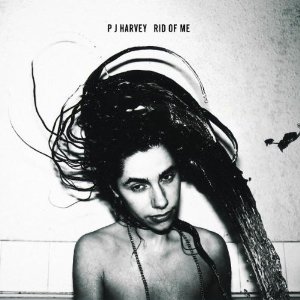
SOUNDTRACK: PJ HARVEY-Rid of Me (1993).

For Rid of Me, PJ Harvey jumped to the big leagues (relatively) by enlisting maniac Steve Albini as a producer.  And he takes the rawness of Dry one step further into a sound that is both raw and sharp.  He really highlights the differences between the highs and lows, the louds and quiets.  And man, when this came out I loved it.

Like NIN’s “March of the Pigs,” the opening of “Rid Of Me” is so quiet that you have to crank up the song really loud.  And then it simply blasts out of the speakers after two quiet verses.

“Legs” turns Harvey’s moan into a voice of distress, really accentuating the hurt in her voice.  And Harvey hasn’t lightened up her attitudes since Dry, especially in the song “Dry” which has the wonderfully disparaging chorus: “You leave me dry.”

“Rub Til It Bleeds” is a simple song that opens with a few guitars and drums but in true Albini fashion it turns into a noisy rocker.  “Man Size Quartet” is a creepy string version of the later song “Man Size” (I’ll bet the two together would sound great).  And the wonderful “Me Jane” is a great mix of rocking guitars and crazy guitar skronk.   Albini really highlights the high-pitched (male) backing vocals, which add an element of creepiness that is very cool.

For me the highlight is “50 Foot Queenie”.  It just absolutely rocks the house from start to finish.  The song is amazing, from the powerful…well…everything including the amazing guitar solo.  “Snake” is a fast rocker (all of 90 seconds long) and “Ecstasy” is a song that feels wrung out, stretched to capacity, like they’ve got nothing left.

It’s not an easy record by any means, but it is very rewarding.  This is a CD that really calls for reamastering.  Because it is too quiet by half, and could really use–not a change in production–just an aural boost.

[READ: end of February and beginning of March] A Supposedly Fun Thing I’ll Never Do Again

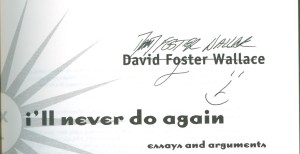
This is a collection of 7 essays that DFW wrote from 1990-1996.  Three were published in Harper’s, two in academic journals, one in Esquire and the last in Premiere.  I devoured this book when it came out (I had adored “Shipping Out” when it was published in Harper’s) and even saw DFW read in Boston (where he signed my copy!).

click to see larger

[Does anyone who was at the reading in Harvard Square…in the Brattle Theater I THINK…remember what excerpts he read?]

The epigram about these articles states: “The following essays have appeared previously (in somewhat different [and sometimes way shorter] forms:)”  It was the “way shorter” that intrigued me enough to check out the originals and compare them to the book versions.  Next week, I’ll be writing a post that compares the two versions, especially focusing on things that are in the articles but NOT in the book (WHA??).

But today I’m just taking about the book itself. (more…)

Read Full Post »

[SOUNDTRACK: RADIOHEAD-Live, August 28, 2008 (NPR download) (2008).

This was the first concert that I realized was free to download from NPR.  (Which started me on a downloading frenzy!)  I was really psyched to see it because Radiohead has been one of my favorite bands for years but I’ve never seen them (and only really know their live stuff from the Live EP.  This concert is essential listening for any fan of later Radiohead (they play all of In Rainbows).

I was thinking about Radiohead’s history.  They had a sort of left-field grunge hit with “Creep” and seemed like they would be destined to play their one hit in every show until they retired.  Then The Bends was released and it had a whole bunch of hits, solidifying that they were not just a one hit wonder band.  Then OK Computer blew everyone out of the water and Radiohead were easily the best band of the 90s.

Even though “Creep” was a huge smash, it would seem weird to hear them play it now.  Their discs since Kid A have turned Radiohead into a hugely different band.  So during this set when someone shouts out “Anyone Can Play Guitar” it’s almost as unexpected as hearing someone shout “Smells Like Teen Spirit.”  (They didn’t play it…although they did play “The Bends”, which sounded kind of, but not totally, out of place).

The rest of the set includes 4 songs from Kid A, 3 songs from Hail to the Thief and 4 songs from OK Computer (and one from Thom Yorke’s solo album).  Nothing from Amnesiac.

The band sounds great, they have such a wonderful sense of mixing techno drums and squiggles with rocking guitars.  And the songs from Kid A forward are really great.  “The National Anthem” from Thief substitutes the crazy horns from the disc with wonderful samples from commercials, which works wonders.

The songs from OK Computer sound good but rather different, as if the band has a different set of instruments or technology.  “Lucky” sounds great as do the simpler tracks of “Karma Police and “No Surprises.”  The only song that I was vaguely disappointed in was “Paranoid Android” (one of my favorite tracks ever).  It sounds good, just different.  And that song is so complicated with so many bits and pieces that hearing it in a stripped down to an almost acoustic version is unsettling.

What I did like about “Paranoid” and many other tracks was the backing vocals.  In my studio experience the only voice we hear is Yorke’s, but live, someone is doing some great backing vocals, remaining faithful to Yorke’s original sound but just different enough to be really interesting.

We obviously miss a lot by not seeing the visuals of the show, but the audio is great.  The quality of the recording is fantastic and any Radiohead fans would be foolish not to download it.

[READ: December 23, 2010] “Hammer and Sickle”

I feel like DeLillo is a such an influential author, I can’t believe that he’s a) still alive and b) publishing stories in the New Yorker.  This story starts in such a mundane setting that I was worried it was going to be a run of the mill tale of  life in a minimum security prison.  We see the narrator dressed in an orange jump suit on the side of the road with a group of other prisoners.  He is thoughtful as the traffic whizzes past.

But the scene quickly switches back to the prison and this is where DeLillo becomes “DeLillo.”  In the central prison room, the prisoners begin watching a show every day.  The show consists of two teenaged girls reading the financial news.  Except that their news is more like free-form poetry.

“The fear is Dubai. The talk is Dubai.  Dubai has the debt. Is it 58 billion dollars or 80 billion dollars?”
“Bankers are pacing marble floors.”
“Or is it 120 billion dollars.”
“Sheiks are gazing into hazy skies.”
“Even the numbers are panicking.”

“The world’s only seven-star hotel.”
“The world’s richest horse race.”
“The world’s tallest building.”
“All this in Dubai.”

“But where is the oil?”
“The oil is in Abu Dhabi.  Say the name.”
“Abu Dhabi “

And the prisoners (most of them guilty of financial fraud of some kind) love it.  Even the Elder Prisoner (sentenced to over 700 years…his fraud caused some MAJOR international problems), the man who controls the remote, has deemed it appointment TV.  (more…)

Read Full Post »

SOUNDTRACK: AZTEC CAMERA-“Jump” (1984).

This is a wonderfully twisted covered of Van Halen’s “Jump.”  VH’s version of “Jump” is bouncy, lively, fun, it makes you want to yes, Jump!  It was many years after the release of VH’s “Jump” that I heard the Aztec Camera version (even though it was released the same year).  The first time I heard it I assumed it was a joke.

I didn’t know much about Aztec Camera (and actually still don’t–looking at their Wikipedia page I don’t recognize the names of any of their singles).   But I have grown to love this cover of “Jump.”  In fact I prefer it to the original.

The opening chord structure makes me think it’s going to be the Rolling Stone’s “Waiting on a Friend” but instead of Jagger’s ooh oohs we get Roddy Frame’s deep voice practically whispering the lyrics that David Lee Roth made famous.  And it stays with this delightfully mellow acoustic style and pacing throughout.  The guitar work in the bridge is actually much more interesting than the bridge in the Van Halen version (ouch).

The chorus seems kind of odd with his very mellowly saying “jump” (although David Lee Roth doesn’t scream “jump” either, it’s the backing vocals that do the exciting part).  I feel like the original VH version hasn’t held up that well, but the Aztec Camera version shows that it’s quite a good song.

Check it out here.

[READ: Week of November 8] Consider David Foster Wallace [first three essays]

I lied.

I said that I wouldn’t feel up to writing posts about all of the articles in this book on a regular basis.  As it turns out, I don’t have a lot to say about these essays, but I had a few thoughts about each one.  Since there’s a group reading going on, I thought it might be fun to post these thoughts now while people were still speaking about the articles instead of waiting until the end.

Before I say anything about this articles, I want to preface that I’m not going to repeat things that were said in the group read (for a couple of reasons).  Everything here is going to be things that I felt about the article and maybe, if something another reader says really sticks with me, I’ll mention it as an influence on me.

Having said that, in one of the comments, author Clare Hayes-Brady says that her article is a part of a longer thesis.  I found this to be a very useful thing to know, and I assume that she is not the only one who had to compress her article because of size and time constraints.  With that in mind, I’m going to accept that if it seems like the author could/should say more about a certain thing within the article that there is probably a larger version of the piece.

And finally, because I don’t have a lot to say about the pieces, I’m only going to mention things that I found puzzling/confusing.  But be assured that if I don’t mention the vast majority of the article it’s because I found it interesting/compelling/believable.  I don’t feel comfortable paraphrasing the articles’ argument.  Besides, what would be the point of that?

(more…)

Read Full Post »

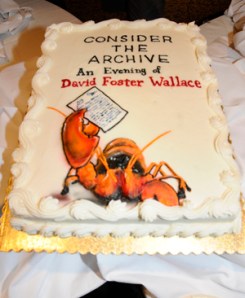
[LISTENED TO: September 27, 2010] Consider the Archive

On September 14, 2010, The Harry Ransom Center at the University of Texas commemorated David Foster Wallace through an evening of his readings and (I love this) Wallace-themed refreshments.  It was also the opening of the Wallace archives at the Center.

[UPDATE: November 8, 2010: The research archives have gone online, details are available here.]

There was a live videocast of the evening, which included excerpts from several of his books. I didn’t get to watch it, but I was able to get an audio copy of the event.

The evening’s readers were:

  • Molly Schwartzburg –Introduction
  • Wayne Allen Brenner, L.B. Deyo, Kurt Hildebrand, Shannon McCormack–The Broom of the System (Grand Ohio Dessert excerpt)
  • Doug Dorst, L.B. Deyo–Correspondence with Don DeLillo
  • Owen Egerton —Infinite Jest (1960, Jim’s Dad)
  • Jake Silvertstein and Kurt Hildebrand–A Supposedly Fun Thing (skeet shooting excerpt)
  • Elizabeth Crane–Infinite Jest: (Avril & Mario)
  • Chris Gibson–Commencement Speech (This is Water) (more…)

Read Full Post »

SOUNDTRACK: SERENA MANEESH-“Sapphire Eyes” (2005).

I used to keep a list of songs and albums that I would try to find.  On this list was a single or a B-Side by Serena Maneesh.  I’ve lost the list, but someone just donated their debut album to our library.  So I’m excited to check it out.  In the meantime, I found the video for this track so I’ll start there.

For years people waited for the follow up to My Bloody Valentine’s Loveless.  And if David Shields ever does release a disc under that name again, it will be more scrutinized than Chinese Democracy (and possibly less inspired).

So, why not let someone else take up the reigns of shoegazing music some fifteen years later.

This track displays many traits that made MBV so great.  It opens with a slightly distorted female vocalist.  She starts singing before a throbbing bass and noisy, distorted (seemingly backwards) guitars bring in a wall of noise.  But that wall only lasts for a short time before it breaks away and the song builds again, slowly, with more and more parts (the video shows a violin although I can’t hear it).

And then about half way through the song it does what MBV always made me do, pick up my head and go, yes, this is great.  A mildly distorted amazingly catchy bridge peeks out through the noise and grabs on to you.  Then more noise and a little backwards vocals and its over.

Other reviews of the album suggest that this isn’t the only kind of music they play, that they are also heavier and darker; I’m looking forward to the rest of the disc.   First impressions (five years late) are very good here.  Check it out here.

[READ: June 25, 2010] A Reader’s Guide

Despite my fondness for Infinite Jest, I had not read any of the supplementary books about it.  I’d heard of them, of course, but I didn’t feel compelled to get any of them.  Then I saw that this one was very cheap.  And I decided to get Elegant Complexity while I was at it (a few cents to the Fantods).  Complexity is a big honking book, and I don’t have time for it right now, but this reader’s guide is very short and a very quick read.

I had an idea of what to expect from the book, but I didn’t really know who the intended audience was.  So, I was very surprised to see the way it was set up.  The first chapter is a biographical account of DFW including his place in the new writers anti-ironic camp.  It was a good summary but nothing new, and I worried about what I had just bought. (more…)

Read Full Post »

« Newer Posts - Older Posts »