Feeds:
Posts
Comments

Archive for the ‘David Means’ Category

11SOUNDTRACK: THE ANTLERS-Live at the Black Cat, Washington DC, May 11, 2009 (2009).
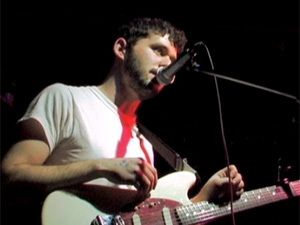
antlersI mentioned that I was uncertain about my appreciation of this band.  And I wondered how they would hold up to a longer show.  The answer is surprisingly well.  The sound quality of this set isn’t great–the levels seem way too loud (not sure if that’s the band or the recording) and I really can’t understand the words, but the music is very moody and evocative and I like it quite a lot.

This set comes from the album Hospice, which is a concept album about a person dying of bone cancer (with lyrics like “they told me that there was no saving you” and song titles like “Kettering”).  Earlier descriptions made me think the album was a major drag to listen to– I mean the subject alone is exhausting–but musically it’s a different story.  There’s lush strings and interesting guitars.  And, at least live, the band can make a holy racket.

I’m a little surprised by the number of keyboard errors in “Atrophy.”  I mean an occasional bum note is fine, but there’s a bunch in that track.  It’s very weird.  But that is made up for by the vocals which are angsty and impassioned, especially on the final song “Cold War.”  The NPR site has three tracks available for viewing and I must say that watching the band is more exciting than just listening to them.  But I have really gained an appreciation for The Antlers.

Check out the show here.

[READ: December 16, 2012] McSweeney’s #11

This crazy title for this Issue/Post comes because the cover and spine of the book are all text.  Indeed, the book is gorgeously bound in black leather(ish) with shiny gold print.  Each author gets a summary of his or her work and a note that he or she is free (see each story below).

I did not read Issue #10 yet because it came out as a thrilling paperback, and I’ve been putting it off for a reason even I can’t quite fathom.  I anticipate reading that one last.  Again, no idea why.  In some ways, Issue #11 picks up where Issue #9 left off.  There’s lots of text on the cover, there’s letters and everything else that makes it look like McSweeney’s.  But as I said this one seems more somehow.  It’s the hardcover.  And, it’s also the DVD that accompanies the book.  I have a hard time believing I’ve owned this book for almost ten years and never watched the DVD but I finally got around to it.  More on that soon.

This issue contains letters, fiction, non-fiction and a play that picks up from Issue #9 (more…)

Read Full Post »

SOUNDTRACK: BOOKWORM-Jeffrey Eugenidies: The Marriage Plot (December 1, 2011) (2011).

Since “Just Kids” mentions  Eugenides’ book, and since Eugenides happened to appear on Bookworm at around the same time as I read this article, it seemed like a good pairing.

Obviously, from the title of the episode you can tell that this is all about Eugenides’ new book, The Marriage Plot.  Michael Silverblatt raves about this book like no other book I have heard (granted I haven’t listened to all that many episodes of Bookworm, but still).  In fact while listening to this episode, I put The Marriage Plot on hold at the library.  I always planned to read it but figured I’d just get around to it some day.  Now I feel more of a sense of urgency.

They talk at length about the state of marriage in the 21st century.  Not as in its decline but in how it differs so much from classic literature in which women had to get married by 21 or risk spinsterhood.  Eugenides set out to write a book about people getting married without having the trappings of classical literature.

It sounds wonderful.

The reason I mention this interview at all is because in the article below, Hughes talks about contemporaries of DFW using DFW as the basis for a character in their books.  So, in Franzen’s Freedom, there is character who is very much like DFW (I haven’t read Freedom yet so I can’t say). 

And in The Marriage Plot, there is a character who resembles DFW.  When I read the excerpt of this story in The New Yorker, I had to admit he did seem an awful lot like DFW–a tobacco chewing, bandanna wearing philosopher.  Eugenides had been mum about it for a while, but now, under the gentle nudging of Michael Silverblatt, he comes clean. 

He admits that there are some characteristics of DFW in the character.  However, he says that he didn’t know DFW all that well and the character has been kicking around since he went to college (long before he knew DFW).  Tobacco chewing was rampant at Brown in the 80s apparently.  But it’s a nice revelation and it ties in very well with the article.

You can listen to the show at KCRW.

[READ: December 7, 2011] “Just Kids

I have always grouped together certain authors in my head.  When there were a bunch of Jonathans publishing, I kind of lumped them together.  I think of Mark Leyner and Bret Easton Ellis in the same breath.  It’s fairly common, I suppose.  But I never really thought of David Foster Wallace in terms of a group of authors.  He seems so solitary that it’s funny to even think of him as having friends.   But according to Hughes, many of today’s established authors prove to have been a part of a kind of nebulous writer’s circle.  A kind of 1990’s update of Dorothy Parker’s vicious circle.  But more insecure.

The article bookends with Jeffrey Eugenides.  In 1983 he and Rick Moody drove to San Francisco with the intent of being writers.  Five years later with no written works, Eugenides moved to Brooklyn, alone.  In that same summer, Jonathan Franzen was in Queens, also feeling alone (even though he was married–unhappily) and desperate for friends and peers.  And then Franzen got a fan letter from David Foster Wallace (that’s after he had written Broom of the System, but before Girl with Curious Hair) praising The Twenty-Seventh City

Franzen and DFW became friends.  To this friendship was added William T. Vollman, and David Means, also Mary Karr (whom DFW dated) and Mark Costello (who co-wrote Signifying Rappers with DFW).  Later they would connect with Eugenides, Rick Moody and Donald Antrim.  (more…)

Read Full Post »

SOUNDTRACK: THE FLAMING LIPS-Live at Summer Stage, Central Park, NY, July 26, 2010 (2010).

This was a cool show that the Flaming Lips played in Central Park.  It came during the Embryonic tour and the setlist focuses on that album, but they play tracks from many of their more recent discs.  We get “The Yeah Yeah Yeah Song,” “Yoshimi Battles the Pink Robots” and “Do You Realize??” as well as “She Don’t Use Jelly” (has the band ever not played this song?).

Wayne Coyne is in good form, enjoying the weather and ranting or raving when appropriate.  The dis of George Bush that introduces “The Yeah Yeah Yeah Song” is rather cathartic.  And the lengthy but enjoyable intro/explanation of “I Can Be a Frog” is really great–drummer Cliph gets to give examples of the proper sound effects for a motorcycle, the breeze, a bumblebee and a sneeze.  And multi-instrumentalist/godlike figure Steven Drozd just plays the hell out of everything–I can’t imagine what the show would be like without him.

I have two problems with this show–I’m spoiled by the NPR downloads, so this bootleg recording from about fifteen rows out isn’t crystal clear.  NYCtaper did a great job setting up in a close location, but while the music sounds good, as he points out:

I recorded this set with my best mobile unit from literally within the first fifteen feet of the crowd — great for atmosphere, but not so good for avoiding much crowd participation. I was so close as to literally be underneath Wayne’s bubble during “Fear”. The listener should understand that this recording was captured from a prime experience location at this show. With that caveat, enjoy!

As I said, the music sounds great, and you can really hear all of the instruments and effects quite well, but Wayne’s voice is not so clear.  There are some bits where you can hardly hear him at all (but hey it’s a free bootleg so shut up), and two–the Lips are one of the most visually stunning bands around, so hearing a live show with no visual, where you know something awesome is happening onstage is a major bummer. I know this is true for every concert that you listen to, it just feels moreso here–I mean, I didn’t even know that he walked around in the bubble during the intro to the set. 

I read some complaints about the setlist–that there were only 13 songs played.  I can see the complaint, but what you’re getting during the show is extended versions of lots of the songs.  Many of the songs have codas at the end or interactive introductions, so “The Yeah Yeah Yeah Song” comes in around 7 minutes and “The Sparrow Looks Up At The Machine” clocks in about 9 minutes total (that’s a combined time of 4 or 5 songs usually).  And yes, Wayne does tend to chat a lot.  But he’s so sincere and his emotions are so genuine, it’s hard not to get wrapped up in them.  When I saw them live about eight years ago, it was one of the most joyous concerts I had ever seen.  And I’m sure they are only more so now (man I’m bummed I missed them with Weezer this summer).

[UNFINISHED: August 23, 2011] “El Morro”

It’s very rare that I don’t finish a story.  I was educated as a reader to carry on and to finish things.  You cant’ criticize something, I was told, if you don’t watch/read/see the whole thing.  But you know what, sometimes you just don’t likes a story. So why should I have to devote time to something if  I’m not enjoying it?

All this is leading to me saying that I didn’t like this story and I didn’t finish it.

I read about two pages of it and I will say this for it: I really liked the dramatic structure and the dramatic risk that Means took.  He has two characters in a car.  One of them won’t stop talking (about the same 4 topics) the other one is sick of him talking.  By the second page, she is actually putting her fingers in her ears to block out the man’s voice.  That’s brave writing because we hear a lot of what this man is saying.  And, while I’m not entirely sure why she didn’t want to hear it, I didn’t want to read it because it was really dull. (more…)

Read Full Post »

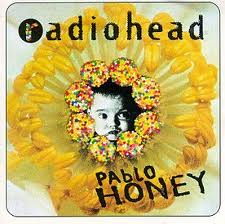
SOUNDTRACK: RADIOHEAD-Pablo Honey (1993).

I haven’t listened to Pablo Honey in years.  I think of it as an almost proto-Radiohead release with one huge single.  But as I was listening to it again recently I remembered that I used to listen to this disc a LOT, and I know all the songs very well.  I’m also really impressed with how well the album stands up to the mayhem that they unleashed later on.  It’s also pretty crazy that the album is named after a Jerky Boys skit (and not a particularly inspired one at that).

True, the album is very simple: a guitar band in the grunge era.  And yet, despite the grunge inflections of “Creep,” it’s quite apparent that there’s a lot more going on here than slacker anthems.

On first listen (17 years ago (!)), a song like “Thinking About You” sounded like a conventional ballad that goes along with this type of album, revealing a softer side to a grungy band.  But really, it’s a complicated mellow song placed right in the middle of the album and the break in styles is very nice.  Conversely, a quick rocker like “How Do You?” is certainly a simple song, and yet it shows another dimension that the band would later investigate (it also samples the Jerky Boys deep in the mix, which I never noticed before).  Even the opener “You,” is intricate and complex, with wonderful guitar riffs and solos, easily foreshadowing some of the great stuff that Jonny Greenwood would produce later on.

The more memorable songs also reveal things all these years later.  “Stop Whispering” has a real Pavement feel to it (and who knows if Radiohead had even heard Pavement (who only had one album out) at that time, but it’s some cool foreshadowing of their indie rock style).  And “Anyone Can Play Guitar,” a truly great song, is like a stripped down version of “Paranoid Android,” but with a really really catchy chorus.

By the end of the disc, it seems like Radiohead has run through its tricks although the oddly titled “Lurgee” points to future greatness as well.  It’s easy and lazy to say that this album is a blueprint for the future Radiohead, and yet it’s surprisingly true.  Not the techno stuff, obviously, but the song structures and intricacies easily foreshadow what was to come.  Yet who would have ever guessed that the “you’re so fucking special” band would turn into what they did.

It’s also foolish to dismiss this record as an early version of the band, because although the album has some slow moments, it holds up very well, and actually revealed somethings that I’m sure I missed a decade and a half ago.  Oh, and “Creep” is still awesome.

[READ: December 21, 2010] “The Tree Line, Kansas, 1934”

This is the story of two FBI agents on a stake out.  The story gets into the head of the older agent (Lee) as he listens to the endless droning of the younger agent (Barnes).

The two have been on the stake out for several days waiting for the criminal Carson to come back to his uncle’s farm, where a boot full of loot is waiting him.  They have been keeping utterly still, noting the uncle plow the barren field, taking occasional smoke breaks and really just watching the grass grow,

Barnes says t the whole stake out is futile, there’s no way that Carson is coming back here, he’ll know there are agents there, etc.  Lee, on the other hand, believes the Bureau is correct, believes that Carson will return.  I enjoyed the digression into Lee’s head about how a feeling in your gut turns into a hunch. (more…)

Read Full Post »

SOUNDTRACK: Thee Silver Mt. Zion Memorial Orchestra-Kollpas Tradixionales (2010).

Silver Mt. Zion are back!  And they are noisy!

This disc continues their fine output of haunting, rambling epics.  The opener is a 15 minute slow builder called “There is a Light” and the finale is a 14 minute story called “‘Piphany Rambler.”  In between we have  a couple of multi-part tracks: “I Built Myself a Metal Bird” and “I Fed My Metal Bird the Wings of Other Metal Birds” which are some of the fastest tracks they’ve recorded.  The other “suite” is 3 versions (and spellings) of the title track.

The one consistent thing about Silver Mt . Zion (in whatever version of their name they employ) is that they write incredibly passionate music.  It’s often raw and it swells and ebbs with feeling.  I especially enjoy the (multiple) climaxes that fill all of the longer songs.  And when the band brings in the horns and the strings and the whole group sings along, it’s very affecting.

The one thing that I’m still not totally on board with is Efrim’s voice.  On previous releases, I bought it because he sounded very angsty, but I’m starting to think that the tenor of his voice just doesn’t work with the bombast of the music.  When the backing singers chime in, the sound is glorious, but I find his voice to be simply the wrong sound.  There’s a few parts on the disc where he sings in a lower, softer register, and I found them really moving.  I think if he sang all of the parts like that, they would impact the songs more strongly (and maybe even be more understandable).

I realize that the vocals are an essential part to the disc, and I definitely get used to them after a few listens, I just feel like the whole disc (and not just the music) would be amazing if Efrim used that deeper register more.

Nevertheless, the music is really fantastic, and if you buy the LP, you get some great artwork, too.

[READ: May 13, 2010] McSweeney’s 34

After the enormous work of Panorama, (McSweeney’s newspaper (Issue 33)), they’ve returned with a somewhat more modest affair.  Two slim books totaling about 400 pages  Each is a paperback. The first is a collection of short stories artwork, etc.  The second is  nonfiction work about Iraq.  Both books are bound together in a clear plastic slipcover (with a fun design on it).  [UPDATE: I cannot for the life of me out the books back in the cover.  They simply will not sit without ripping the plastic.  Boo!]

The first collection opens with a Letters column, something that we haven’t seen in years!  And, as with the old letters column, the letters are absurd/funny/thoughtful and sometimes just weird. (more…)

Read Full Post »

SOUNDTRACK: BLUE ÖYSTER CULT-The Revolution by Night (1987).

After the amazing Fire of Unknown Origin, BOC, returned (retreated?) into keyboard-fueled tracks.  And we know that where BOC is concerned, keyboards=crossover attempts.  Now I don’t know if it’s just my own preferences, but I feel like the lightweight pseudo-metal here is better than their earlier stabs at lightweight pseudo-metal (Mirrors, etc).  I assume it’s because I grew up listening to metal around this time, so even if it’s not terribly original, it’s at least comfortable.

It opens promisingly enough with the keyboard heavy but rocking “Take Me Away”  And the 7 minute “Shooting Shark” is kind of catchy (in that BOC ballady sort of way).  But by the time we get to “Veins” we’re in full-fledged keyboard heavy pop metal (has there ever been a poppier song about veins in my eyeballs and veins in my skull?).

“Shadow of California” has a cool sinister angle on the keyboards which leads to a good riff-heavy track.  It emphasizes the slick metal sound from Fire.  “Feel the Thunder” also sounds like a typical late 80s metal song (but there is something distinctly BOC about it). “Let Go” is definitely a child of the 80s, complete with chantings of B.O.C.!

This CD sold poorly, which explains that Columbia-dominant cover design.  It seemed like BOC’s star had faded.

[READ: March 9, 2010] “The Knocking”

By about the third paragraph of this story, you just know that there’s not going to be any kind of “ending” to this piece.  (It’s not even really a story, per se). (more…)

Read Full Post »

« Newer Posts