
Feeds:
Posts
Comments

Archive for the ‘Christian Bok’ Category

SOUNDTRACK:

[READ: October 31, 2025] “The Extremophile”

It has been six years since Ghost Box III came out….

After years of demand, the Ghost Box is back! Patton Oswalt’s much-beloved spooky-story anthology returns for a fourth edition, with the same trademark production details—magnetized box lid, anyone?—that Ghost Box fans have come to expect.

As always, working with Patton on Ghost Box IV was a dream, and we can’t wait to show you the nightmares that he’s wrangled and stuffed into the box this time around.

I don’t know very much about Christian Bök except that he wrote the poetry series Eunoia which is a remarkable piece of art and poetry:

 Each poem uses only one vowel, creating sentences like: “Hassan can, at a handclap, call a vassal at hand and ask that all staff plan a bacchanal”

It’s worth checking out.

I didn’t know if he did anything since, but apparently he has been working on something called The Xenotext which Wikipedia says

Xenotext consists of a single sonnet (called “Orpheus”), which gets translated into a gene and then integrated into a cell, causing the cell to “read” this poem, and in reply, the cell builds a protein — one whose sequence of amino acids encodes yet another sonnet (called “Eurydice”). The cell becomes not only a durable archive for storing a poem, but also an operant machine for writing a poem. The gene has so far worked properly in cultures of E. coli, but the intended symbiote is D. radiodurans (“the dire seed, immune to radiation”) — an extremophile, able to thrive in very inhospitable environments, deadly to most life on Earth.

I quoted that because it uses the word extremophile, which is the name of this story.

This story is quite short and it is, simply, a list of conditions that this entity can survive in.  It’s fascinating but not terribly interesting and, indeed, not very scary.  Especially since nothing happens in the story.  I mean, the ending is “It awaits your experiments,” which I guess is an interesting setup and given some of that background above it does make it slightly more compelling, but as a story, well, meh.

Read Full Post »

beelievrSOUNDTRACK: BECK-“Beercan” (1994).

I beercanhad forgotten how much I liked “Beercan” as a song until I played Mellow Gold again.  It’s incredibly catchy, has some wonderfully weird elements (like the sample of the girl saying “I’m Sad” over flamenco music), and deserved to be heard more.

The B-sides for this single really run the gamut of everything Beck does.  The first track “Got No Mind” is a reworking of “Pay No Mind.” It’s done as a very simple folk song.  The words are largely different and the music is played differently, but the chords are the same.  It’s an interesting conceit to redo a song almost entirely like that.  The second song “Asskiss Powergrudge (Payback ’94)” is just a dirty slow abusive song. The guitar strings are totally muted, just making noise.  The vocals are slowed and sludgy.  And it’s just heaps of abuse.

“Totally Confused” is also on the “Loser” single and is such a pretty, mellow folk song (with Anna and Petra from That Dog singing backing vocals).  And the final song, “Spanking Room” is just a pile of sheer noise and feedback.  It is loud and crazy and goes on for some 5 minutes.  There’s a “bonus” track of which I have learned is called “Loser (Pseudo-Muzak Version).” It’s Loser sampled and played behind some weird keyboard “muzak.”  It sounds like it was done live in a small club.  Really weird.

[READ: February 28, 2014] Some Instructions

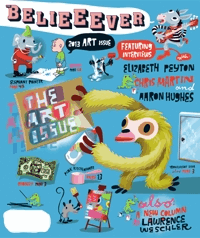
This little booklet came with the Believer 2014 Art Issue.  It is called “Some Instructions.”   It is inspired by George Brecht, a Fluxus artist who is credited with creating the written form of performance art (called the “event score”).  Brecht was bored by didactic instructions in art so his creations were utterly open to interpretation.  The example they give is his “Three Chair Events” which is in its entirety:

  • Sitting on a black chair. Occurrence.
  • Yellow chair.  (Occurrence.)
  • On (or near) a white chair.  Occurrence,

–Spring 1961

This is the kind of thing that I think i would have enjoyed in college, being pretentious an d obnoxious, now I realize it is just navel gazing and (in many of the examples below) barely even thought out.  You can kind of see what Brecht was getting at (although why he needed to do more than one or two is beyond me), as a kind of thought-provoking questioning of what we know of as art.  But some of these below are just, well, stupid. (more…)

Read Full Post »

SOUNDTRACK: ULVER-A Quick Fix of Melancholy (2005).

This EP came two years after Teachings in Silence (with a movie soundtrack and “greatest hits” collection in between).  This first track, “Little Blue Bird” is a simple soundscape with echoey keyboards.  When Garm starts singing, his most emotional side comes through (even if I really can’t understand him most of the time).

“Doom Sticks” belies its name and the EP title by being somewhat upbeat.  There are kind of squeaky keyboards that pulsate through the track.  After about a minute and a half, distorted drums keep a martial beat.  But it quickly morphs into a twinkly section that makes me think of the Nutcracker or some other kind of Christmas special.

“Vowels” is similarly upbeat (the music on both of these two tracks has a vaguely Christmastime feel somewhere in there–not that anyone would think these were in any way Christmas songs, or maybe it’s because I’m listening in mid-December).  For this, we get a return of Garm’s choral voice: deep, resonant and hard to understand (although I undertsand the lyrics are from a poem by Christian Bok).   But the poem quickly makes way for some dramatic staccato strings. 

“Eitttlane” begins with some menacing keybaords and staccato notes, creating a feel of a noir movie.  But when the vocal choir comes in, it gets even more sinister.

These Ulver EPs are really true EPs–stopgap recordings for fans.  Their larger works tend to be more substantial, but these EPs allow them to play around with different styles.

[READ: December 1, 2011] “Laureate of Terror”

Two authors I admire in one article, how about that!  In this book review, Martin Amis reviews Don DeLillo’s first collection of short stories and gives a summary of DeLillo’s work.

Amis opens the article by undermining my plans for this blog.  He states point blank than when we say we love an author’s works, we “really mean…that we love about half of it.”  He gives an example of how people who love Joyce pretty much only love Ulysses, that George Eliot gave us one readable book and that “every page of Dickens contains a paragraph to warm to and a paragraph to veer back from.”  Also, Janeites will “never admit that three of the six novels are comparative weaklings (Sense and Sensibility, Mansfield Park and Persusaion).  [I still hope to read all of the books by the authors I like].

Amis says he loves DeLillo (by which he means, End Zone, Running Dog, White Noise, Libra, Mao II and the first and last section of Underworld).  And he also seems to really like The Angel Esmeralda: Nine Stories,(well, much of it anyway), DeLillo’s first (!) short story collection

His main assement is that these pieces are a vital addition to DeLillo’s corpus.  (more…)

Read Full Post »

believerA few years ago I was visiting my friend Roman.  He asked me if I read The Believer.  I told him I hadn’t heard of it.  He silently reproved me, knowing that it would be right up my alley and being quite displeased that I wasn’t keeping up with the hip.  I was very impressed with what I saw.

The Believer is put out through McSweeney’s.  It seems to have filled in for the non-fiction niche that McSweeney’s slowly removed from its pages.

And since then, I have become a devoted follower.  At some point (probably around issue ten or eleven) I decided that I was going to read every word in every issue.  And so, (this was pre-kids) when I went to an ALA conference with Sarah, I spent a lot of the down time reading all of the back issues’ articles that I hadn’t read.

Since then, I have read every issue cover to cover.  The thing that I love about the magazine (in addition to all of the stuff that I would normally like about it) is that every article is so well written that even if I don’t care about the subject, I know I’ll be interested for the duration of the piece.  Whether or not I will go on to read anything else about the person or topic is neither here nor there, but when I’m in the moment I’m really hooked. (more…)

Read Full Post »

22.jpgSOUNDTRACK: ARCADE FIRE-Neon Bible (2007) [update].

neon.jpgI’ve decided my previous review was a little harsh. There are some tracks that do stand out. In fact, the first four tracks are really great. With “Intervention” being perhaps even better than “No Cars Go.” Then the ending is very solid. The middle tends to meander a bit, I’m afraid. And, I still stand by my comment that the highs and lows just aren’t here. The way to really notice this is to hear how great the highs and lows of “Intervention” and “No Cars Go” are. You really miss them on the rest of the album!

It is excellent to drive at night to, though.

[READ: April 2007] McSweeney’s 22.

Since I had been remiss in reading my McSweeney’s issues, I decided that I would start (more…)

Read Full Post »