Feeds:
Posts
Comments

Archive for the ‘Artists’ Category

woolfSOUNDTRACK: SHAMIR-Tiny Desk Concert #458 (July 31, 2015).

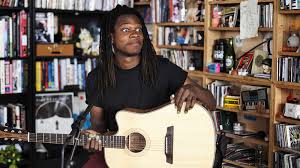
shamirShamir has an amazing voice–a high countertenor that is unsettling and pretty at the same time. He usually creates dance music, but in this Tiny Desk it’s just him and his guitar (on a stool).

The notes say that they asked the interns and staff to sit around him like at a campfire since he looked so alone up there by himself (and after the first song he says he is quite nervous).

He sings three songs. I don’t know the originals (I only know the one dance song from his record “On the Regular” which he doesn’t play here). But these versions are so different from that one that it’s quite shocking.

“In for the Kill” has a lot of intensity in his delivery and the chord structure (even if he plays he guitar rather softly).

The story of his writing “Demons” is very funny.  He was at work at Ross’ and he ran to the changing room when this melody came to him to write it down.  So he was hiding tin the dressing room plinking out notes and humming to himself while trying to get it down before he forgot.  I really like the twist in a song about demons: “If I’m a demon, you’re the beast that made me.”

I’m not sure I’d ever get his record, but I enjoyed hearing this acoustic version of such a dancey singer.

[READ: June 4, 2015] Virginia Woolf

This book comes from a series called Life Portraits.

This is a very brief (128 pages, but mostly one sentence per page) biography of Virginia Woolf.  But the real “selling” point of the book are the beautiful illustrations/paintings by Nina Cosford.  They are lovely watercolors that do a great job illustrating whatever detail is listed on the page.

Although the biography is short it is still quite comprehensive–skimming over many details in her life to get to the heart of the matter.

We get basic birth details–born Virginia Stephen on 25th January 1882.  We learn about her parents (ferociously intellectual father and philanthropic mother).  There’s even an illustrated family tree.

Then we learn that death followed her everywhere.  Her mother died when Virginia was young.  And that a few years later her half-sister and her father also died.  She remained with her sister Vanessa and her brother Thoby as companions. (more…)

Read Full Post »

murakamiSOUNDTRACKRHEOSTATICS–The Media Club, Vancouver, BC, (October 23, 2004).

media clubEvery year, the Rheostatics would perform what they called Green Sprouts Week in Toronto.  In 2004 they did a West Coast version. Five nights in a row at The Media Club (with each show being crazier than the last).  There aren’t always recording available for these shows, but on this leg there are recordings from the third, fourth and fifth nights.

This recording is the best of the 3 available shows.  Although in the notes, Tyson reveals that he had technical difficulties and was only able to record about an hour of the show.  In addition to the songs he missed for technical difficulties, there were also some quieter acoustic songs “Don’t Say Goodnight and “Joey” which he couldn’t get.

And yet, this is an amazing set of music–outstanding by any barometer, with great sound quality (aside from a few drop outs) and an amazing collection of songs. The final night of a run is usually really long, so it’s fun to imagine how much more they would have thrown into this set.

The 7 songs included are “Shaved Head” which is slow and amazing.  A raw and raging “Feed Yourself” with a dash of The Jam’s “Eton Rifles” and The Tragically Hip’s “Bobcaygeon” thown in.  “Saskatchewan” is broody but also great.  “Horses” is intense and goofy at the same time, with someone on the voice modulator doing a computerized “Play that funky music, white boy” recitation.

Torben Wilson from the Buttless Chaps plays drums on “Claire.”  “A Midwinter Night’s Dream” is one of those rare songs that the band throws out once in a while, and it sounds great here.  They invited the crowd on stage to sit around campfire style.

And “Fan Letter to Michael Jackson” is great here too.

It’s a fantastic collection of songs, leading me to think the entire show must have been amazing.

[READ: May 11, 2015] The Strange Library

I saw this book when we were in a bookstore in Denver.  I mentioned it to Sarah and she clearly bought it then and gave it to me for my birthday.

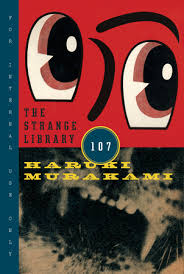
It wasn’t exactly risky because it is by Murakami with art direction and design by Chip Kidd (how could you go wrong?) but the book was shrink wrapped in the store, so you couldn’t flip through it.

Imagine my surprise when the slipcase proved to be not a slipcase at all, but a double flip cover that does not get removed but opens up like a secret document.  And every (or every other) page is chock full of art from Kidd.  My guess is that all of the art is found (rather than created) by Kidd as it appears to be old Japanese pictures and designs.  And they reflect (more or less) the action of the story.

The story itself is one of Murakami’s more surreal ones. (more…)

Read Full Post »

[LISTENED TO: August 2015] The Organist Season 1

organistGiven my love of the McSweeney’s empire, it seems logical that I would have listened to The Organist sooner than this.  But I didn’t.  It has been on for a couple of years, so i assumed I’d never catch up.  But then I saw that there were only 50 episodes and most of them were quite short.  So it was time to see what it was all about.

And, since it is more or less in conjunction with The Believer, it should come as no surprise that it is sort of an aural equivalent to that magazine–longish pieces about esoteric subject, but geared specifically to “radio.”

The Organists first season was done as a monthly podcast starting on Feb 1.  Each episode was about 50 minutes long and covered a variety of subjects with fun guests and other ephemera.

Episode 1: (February 1, 2013)
The inaugural episode kicks off with Nick Offerman spouting some hilarious nonsense about podcasts.  The rest of the show includes an interview with George Saunders talking about the voices of his fiction; Greil Marcus discusses the impact of the first Bikini Kill EP now that it is reissued.  Perhaps the most unusual and interesting piece is when Amber Scorah tells the story of her defection from the Jehovah’s Witnesses while working as a missionary in Shanghai; In short pieces, Brandon Stosuy editor of Pitchfork, presents five five-word record reviews of interesting new guitar rock and then musicians Matmos take a song from their new album apart, piece by piece, revealing its brilliant, pulsating innards.  Basically they used thought control to get people to “create” a song for them.  It’s a really neat process even if the final result doesn’t really sound like the sum of its parts. (more…)

Read Full Post »

raslSOUNDTRACK: METHOD OF THE W.O.R.M.-Cicatrix (2015).

motwormMETHOD OF THE W.O.R.M. is the project of one guy–known as Grimm.  Cicatrix is a collection of songs that spans decades (“begun long before the present digital day”) and recently remastered and released.

The blurb on CdBaby (where you can download the disc–it’s also on iTunes) notes that Method of the W.O.R.M. is “an industrial hard rock with a trip hop edge, intelligent grown up lyrics delving into the microcosm and macrocosm of our world. Influences run the gamut of NIN, Massive Attack, Cop Shoot Cop, Swans, Coil, Tricky, Skinny Puppy, Tom Waits and many others.”

There’s quite a diversity in that list even if the bands are similar, and you can hear the melding of influences.  And you can hear most of them in the songs. But what sets MotWORM apart from these bands is a keen sense of melody in the vocals.  Most industrial music tends to bury the vocals with distortion or just under the music.  But Grimm’s got a good (even pleasant) singing voice which elevates the songs above the din of lesser industrial bands.

While it’s not like pre-digital technology was all tape manipulation, it also wasn’t as easy as it is now.  And the complexity in these songs shows a lot of skill and attention to detail.

“No Flesh” opens the collection.  After some interesting noisy samples (steel drums?), a slow bassline enters (which also sounds sampled—it’s got a very 70’s sound).  The song slowly builds with more and more layers of sound until the vocals come in–a gentle singing that also builds.  There’s a Skinny Puppy feel in the music, but the vocals are very different from Puppy’s style.  “Purge” is the first of many songs with sampled dialogue, but it’s the sounds around the dialogue that are so interesting–squeaks and buzzes, radio tuners? who knows where they come from.  Once the verses start, the main music in this track is more synthy–a compelling riff that wends through the mix.  When the distorted guitars kick in, it takes the song to an entirely new level.

“Burned” showcases the vocals up front in the mix over a simple layered melody.  But there are actually a lot of vocals in this song, including a fascinating sample that opens and closes the track.  Grimm adds layers of vocals–harmonies (or not exactly)–distorted vocals and clean vocals.  I particularly like when the higher voice sings a new (very cool) melody in the middle of the song (the sampled voice melds nicely if creepily with this too).  This song is a real highlight.

“Tragic Rabbit” has some more interesting samples and a pulsing synth line with cool swirling sounds over the top of the vocals.  “As If a Dream” is a slow trippy number with an excellent processed sample.

“A Viral Method” introduces live drums (which sound great and were provided by Swans’ Phil Puleo).  It also has a great live guitar sound playing a fast riff and harmonics.  There’s more great harmony vocals. And a wild riff for the bridge (do I dare say a bit prog rock?).  Although I love the cool samples and layers in the earlier songs, this live instrumentation adds an excellent urgency to the music.  The only problem with this song is that it’s so short.

“Absolution” starts off quietly but after the distorted guitars, the chorus is super catchy–the way it seems like it’s going to end but rebuilds itself.  It’s really well crafted.  “A Moment of Silence” opens with a retro-sounding synth bass.  It’s a fairly minimal song with the vocals really taking over as that synth line drifts to the background and new sounds bubble up.  “Wasted” opens with distorted guitars kind of like a Ministry song, but the vocals are much cleaner, which brings an unexpected quality to what could have been a typical heavy song.  Especially the chorus which is musically bright (even if it’s lyrically dark).

“Freak-O” (what a great title) opens with some loud jackhammer type drums.  The song creeps along menacingly (with a great sample of someone shouting “You are one ugly son of a bitch!”).  I like the simple melody that simmers up from the noise by the end of the song.  “Miscreant” opens with quieter acoustic guitars before the drums kicks in and a menacing synth line takes over.  The vocals are quietly sung with an interesting effect placed on them.  The middle of the song has some wild sounds–I’m not entirely sure what’s happening with them, but it makes for an unsettling ambiance.

“I Love You Goodbye” is my favorite song on the disc.  It starts out simply with big guitars but quickly retreats into a much quieter verse.   There’s a great riff that throws in a slightly dissonant harmonic note that is just great.  But as the song builds into a unexpected bridge with horns, the song adds an dark carnivalesque atmosphere (and that harmonic note returns in a more prominent role).  It’s such an unusual riff and really bodes well for the interesting direction MotWORM might be heading (if they ever release anything else).

This is a real fun disc full of interesting sounds and samples.  If you like industrial music this is a disc totally worth checking out.

[READ: July 31, 2015] RASL

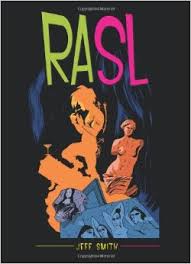
Jeff Smith is creator of Bone, one of my favorite comics ever.  As far as I can tell he hasn’t done a lot since Bone, but he sure did his research for this book.

The title is unfortunate (and is explained satisfactorily in the last few pages, but it’s still awkward and hard to manage).  But the work inside is extraordinary.  The story concerns dimension jumping, art theft and a whole lot of information about Nikolai Tesla.  It’s also more mature than Bone, in that there are a couple of (non-explicit) sex scenes.

In a nutshell, RASL (real name Dr. Robert Johnson) and his partner Miles are scientists.  They grew up together and studied the works of Tesla.  Miles married Maya, a beautiful scientist who has assisted them with their work over the years.  They delved deeply into the research that Tesla undertook (Resonant frequency, remote control, the earthquake machine, wireless communication) and used his ideas to create a machine that is something like a transporter/dimension hopper. They are working for the military but hope to be able to use the device to end wars (idealist scientists as they are).  Their small tests has been successful, but RASL believes that they need more testing to see if there are any effects when you use it on bigger subjects.

So he takes the machine and hops.  It turns out that each hop between dimensions takes its toll on his body and also tends to confuse matters.  (In one dimension, he checks his iPod and sees that Blonde on Blonde was recorded by Robert Zimmerman (I love that detail)).

We learn that RASL (who as the story opens has shaggy hair and cuts and bruises, unlike the composed scientist we see in flashbacks) has been jumping from dimension to dimension to steal precious works of art as a way to make some money.  There is also a really creepy-looking man whose face looks almost amphibian (Smith has some really disturbing characters in this book) chasing after him.  This man kills everyone that RASL knows in different dimensions because he is after something 9and he believes that the people in other dimensions are not real).  It is slowly revealed why RASL has been reduced to this state. (more…)

Read Full Post »

herecoverSOUNDTRACK: CHRISTOPHER PAUL STELLING-Tiny Desk Concert #453 (July 6, 2015).

cpsSomehow after 450 some Tiny Desk Concerts I feel like I’ll know anyone that comes along.  But here’s yet another performer who I’d never heard of.  Christopher Paul Stelling plays an old beat up guitar (it ha a hole in it from where it has been worn down.  According to the NPR site:  That guitar, bought in Asheville, looks like a well-worn friend, with its dark bruised wood and his initials hand-carved into its body. Stelling marked the instrument a year after he bought it, when he made New York City his home in 2007.

Stelling plays some amazing fingerpicking and he backs it up with some catchy songs and interesting lyrics.  His voice is rough and reminds me a but of The Tallest Man on Earth.

He plays four songs.  The first “Castle,” is a really enjoyably folky song. His guitar work is amazing and almost as interesting as his lyrics (there’s some nice little twists i the words he sings). I was also amazed at how good the guitar sounded with the holes and carvings and all.

“Scarecrow” is more mellow, a bit sadder.  And when he tunes it up you can hear the resistance in the tuning pegs–that guitar has been through a lot.

“Horse” is a much faster completely intense song.  As the NPR site describes it: “Watch him lean in as if he’s about to lunge, his eyes bugged out, sometimes rolled back in his head revealing just the whites, skin blood-red, voice like a preacher on fire.”  The song is majorly intense, althouhg he kind of reminds me a bit of Chris Pratt’s character on P&R (but not in a funny way).  After the song he he says you see why I didn’t play that first

“Warm Enemy” reminds me of the guitar style of RT. A wild picking song, with some great runs throughout the piece.

It’s always cool to hear of a new artist who is really impressive.

[READ: May 10, 2015] Here

I read about this book when Five Dials devoted an entire issue to it.  And I’m so glad they did, because I probably wouldn’t have heard it about it elsewhere.  And it is fantastic.

In the Five Dials issue they talked about how McGuire had first created a version of this book many years ago–it was 8 pages and ran in Raw Magazine.  Now in 2014, he has redesigned and thoroughly expanded the book, adding color and a ton more information.  And it is really astonishing.

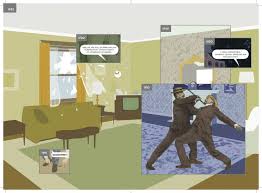
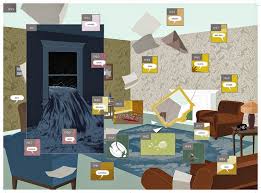
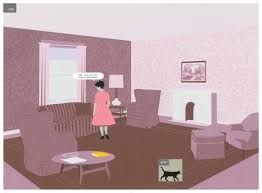
The book itself is quite simple.  We see a scene in a house.  It is a living room.  There is a window to the left, a fireplace to the right and various pieces of furniture.

The first page in the upper left corner says 2014.  There is a couch and little else.  Then there is a bookshelf.  And then the scene jumps back to 1957.  Same location, same angle, but (nearly) everything is different.  The furniture is chanced, there is wallpaper on the walls, there is a playpen in the center of the room.  Then the next page jumps back to 1942: the color scheme is maroon.

here3After a few pages it heads back to 1957 and we see our first person.  A woman saying “Now why did I come in here again?”  And then, the first break with the style–in the bottom right is a tiny box that says 1999 and there’s a cat in it.  And then the next page plays with things even more.  The woman from 1957 is still there as is the cat (who is licking her paw now), but the background is 1623 and the “house” is simply the woods.

The next page shows a scene from 1989 and in 1999 the cat leaves the room.

here2I’m not going to tell every page, obviously, but suffice to say that the next page goes all the way back to 8,000 BCE (while leaving the scene from 1989 in the book).

We see shots from 1763 (a lumberjack) and 1764 (a house being built).  And then in 1775 a colonial scene with, I believe, Ben Franklin.

here5Occasionally, there are a series of frames that show time passing in sequence like the children sitting on the couch in 1959, 1962, 1964, 1969, 1979 and 1983.  Or the one that shows Halloween parties from several years all on one page

The book also goes into the future with a small box showing 2017 and then 2050 with some interesting technology.  And then later forward to 10,175 with a strange creature in a wasteland,

The book is really amazing.  So much fun to look at and imagine the lives that were in this house.

For there is no plot. There is virtually no dialogue.  It is just snapshot after snapshot of a place and what people and creatures have done to it throughout history.  It is such an interesting idea (the original was quite revolutionary at least according to cartoonists) and while similar pieces have been made they don’t compare to the scope of this one.

Incidentally, the house is in Perth Amboy, New Jersey (and I believe is his childhood home).  It offers actual historical data as well as imagined information.  But he based many of his designs on photos from his family’s albums.

I’m so happy I got to look at the book.  And when I read it again, I’m going to try and read it in a vaguely sequential style just to see if there is a “story” to it.

Read Full Post »

reject2SOUNDTRACK: ODDISEE–Tiny Desk Concert #451 (June 26, 2015).

oddisee Oddisee is a positive rapper.  That photo of him smiling really conveys the tone of his songs–well, that and the fact that the first song is called “That’s Love.”  He raps really quickly.  He also gets a wonderful call and response going on “That’s Love” where he has the NPR staff sing along to his chorus.  (The opening scene shows him practicing with the audience).  And he really gets everyone going.

I don’t know what his recorded output sounds like, but in this Tiny Desk, he’s with only a keyboardist and a drummer.  The live drummer is a great addition.

“Contradiction’s Maze” has a few sung choruses (he has a good singing voice too).  They don’t really modify the keyboard sound for the songs, which isn’t all that interesting.  It sets a nice background for all the songs, but it does make things sound a little samey.  “Belong To The World” is similarly uplifting, but I honestly had a hard time distinguishing it from the previous song.

Despite that, his positive attitude and generally upbeat personality were quite infectious.

[READ: July 24, 2015] The Rejection Collection 2

The Rejection Collection is back!  Presumably the first collection was successful enough that Diffee was prepared to do another one.  He gathers many of the same cartoonists (although at least a half a dozen did not return) and he gathered some new folks as well (for a total of 38 this time).

Returning: Leo Cullum, Pat Byrnes, Sam Gross, Mike Twohy, C. Covert Darbyshire, Drew Dernavich, Christopher Weyant, Kim Warp, John O’Brien, Marisa Acocella Marchetto, Danny Shanahan, Mick Stevens, Mort Gerberg, Michael Crawford, P.C. Vey, Gahan Wilson, Glen LeLievre, Alex Gregory, J.C. Duffy, Carolita Johnson, Ariel Molvig, Michael Shaw, Eric Lewis, P.S. Mueller, David Sipress, Jack Ziegler.

New additions include:  Paul Noth, Roz Chast, Marshall Hopkins, Nick Downes, Robert Leighton, Julia Suits, Zachary Kanin, Harry Bliss, Jason Patterson, J.B. Handelsman, Sidney Harris, Jack Ziegler, Robert Weber. (more…)

Read Full Post »

reject1SOUNDTRACK: HOP ALONG–Tiny Desk Concert #450 (June 22, 2015).

hopNot too long ago a friend asked if there were bands that we wanted to like but didn’t.  Some people just said no, of course not, you either like a band or you don’t.  But I knew what he meant.  There are a lot of bands that I’d like to like.  And Hop Along is one of them.

Lead singer Frances Quinlan has the kind of raspy voice that is practically iconic (think Janis Joplin after a rough day).  And their music, which is kind of folky, also has a rawness that should combine with her voice to make me listen all the time.

And yet, for all of that, I really don’t like her voice.  It should be right up my alley but it, well, isn’t.  And that goes a long way to me not really liking the band.

They play three songs and although the blurb about the band talks about the music being more than her voice, I really can’t get past it.

None of the songs is bad, although they all sound a bit the same to me (her voice again).  “Horseshoe Crabs” has a folky feel and some soft/loud sections.

“Well_Dressed” has some unusual dissonant chords thrown into the mix. It’s especially interesting given the pleasant acoustic guitar that accompanies this song.

“Sister Cities” has some lyrics about shooting your dog which is a bit of a turn off.

So yes, I would like to like Hop Along more, but I just don’t.

[READ: July 20, 2015] The Rejection Collection

I heard about this book because it was listed under Matthew Diffee’s books in his bibliography.  I enjoyed his Hand Drawn Jokes for Smart Attractive People so much that I wanted to see what else he’d done.  Well, I didn’t quite understand the premise of the book.  Instead of it begin a collection of his rejected cartoons, he had edited a collection of cartoons that were rejected by thirty of the New Yorker’s regular contributors.

Which means there’s a lot more variety and a lot of funny stuff in here.

He gives us some context: each issue of the New Yorker has about 15-20 cartoons.  There are some 50 cartoonist vying for these spots.  Each of these 50 artists brings 10 cartoons each week and the editor pick the few that will make it (and those that are chosen are the only ones who get paid).

So that means that there are dozens of really good cartoons that just aren’t going to make it.  Many of those cartoons will be saved by their creators and submitted somewhere else or even back to the New Yorker in case the editors have a change of heart.

There are many reasons why cartoons are rejected.  Some aren’t very good, some aren’t appropriate for the magazine, and some just aren’t as funny as others this week (but may seem even funnier in two weeks’ time).

If you’ve read the new yorker (or ever been in a cubicle) you have seen the work from most of these people (even though you probably don’t know their names):

Leo Cullum, Pat Byrnes, Sam Gross, Mike Twohy, C. Covert Darbyshire, Drew Dernavich, Christopher Weyant, Kim Warp, William Haefeli, John O’Brien, Marisa Acocella Marchetto, Danny Shanahan, Tom Cheney, Mick Stevens, Mort Gerberg, Michael Crawford, P.C. Vey, Barbara Smaller, Arnie Levin, Gahan Wilson, Glen Le Lievre, Alex Gregory, J.C. Duffy, Carolita Johnson, Ariel Molvig, Michael Shaw, Eric Lewis, P.S. Mueller, David Sipress, Jack Ziegler.

(more…)

Read Full Post »

handdrawnSOUNDTRACK: STRAND OF OAKS–Tiny Desk Concert #449 (June 15, 2015).

soaI didn’t know anything about Strand of Oaks when I first heard them last year.  I assumed from the bio info that I’d heard that he, Timothy Showalter, had been in a a band and that this was his solo project.  But no.  His history is actually far more interesting.

The Wikipedia summary is pretty simple and shocking:

While Showalter was on tour, his wife had an affair. Escaping his detrimental relationship, he moved back to Wilkes-Barre, Pennsylvania in 2003. A couple of months later, he came home to find his house burned down.  [WHAT??].  Showalter spent his nights in hotels and on park benches with a borrowed guitar while working at an orthodox Jewish day school. Despite the turmoil, he was able to find inspiration to continue writing music that would later be released.

He released three self-produced albums and then made Heal.  Which ALSO has a shocking tale attached to it:  On Christmas Day in 2013, Showalter and Sue were driving back to Philadelphia from Indiana when they hit a patch of ice and crashed into two semi trucks. Showalter suffered a concussion and broke every rib on his right side. The near-death experience gave Showalter a boldness during mixing sessions while creating HEAL with John Congleton, just days after the crash.

Yipes.  I don’t know his earlier records, but I really like Heal.  It’s got an interesting sound, with some great guitar work.

For the Tiny Desk, he plays three songs.  The first is the single from his album, “Goshen ’97”.  This version is just him on his black electric guitar with lots of echo.  It’s very slow and kind of broody.  I prefer the original, but this is a very interesting version.  And his voice sounds really good in this stripped down style.

After the first song he says how nice it feels to play this gig–just what he imagined it would be like. He says he could play there a long time and when someone says “Ok” he say they’d get sick of him: “Oh that bearded guy is still here.”

“Plymouth” has even more echo on the guitar–this one a hollow bodied steel string guitar.  It sounds lovely and since I don’t know the original as well, I like this slower more meditative version.

“JM” is for Jason Molina and for this track, he switches its back to the black electric.  I love the album version of this song a lot, as the soloing is just fantastic.  This version is quite different.  Again, it’s slow and broody, and really good. I still like the album version (because of the solos) but this is good too.

I’m fascinated by Showalter now, and plan to see what his earlier albums sound like.

[READ: June 15, 2015] Hand Drawn Jokes for Smart Attractive People

Although I was unfamiliar with Diffee’s name, I was familiar with his cartoons from the New Yorker.  Diffee has three other books out (under the Rejection Collection moniker–he’s great with book titles).  I certainly loved the title of this book.

There are 16 chapters in the book–each is devoted to a particular topic and has a rather amusing introduction in which Diffee goes off on that subject: Medical Professionals, Lumberjacks, Relationships, Pet Owners, Old People, Utensils, Real Jobs, Indians and Eskimos, Food, Sex, Prison, Religion, Wealth, Children, Sports and Tattoos.

What I really enjoyed was that the cartoons that fill the introductory sections look very different from his more “official” style (which I recognized immediately from the magazine).  It’s cool that he has a distinctive style but is not pigeonholed into that style.
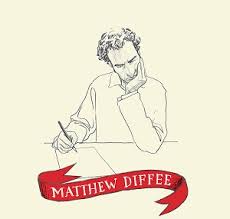
matthewOccasional cartoons have an accompanying silhouette (presumably himself) with an extra bonus joke tangentially related to the topic.  Sometimes these are funnier than the original cartoon.  (Does a polygamist refer to his wives as his “better eighths?”).

It’s hard to mention favorite cartoons without describing the cartoon, which is never funny, but there are few punchlines that work with out a visual, like:

“Therapist: “These feelings of inadequacy are common among the inadequate.”

Waitress: “Sorry, we don’t serve the Lumberjack breakfast to accountants.”

Drug sniffing dog: “I’m starting to really like the smell of cocaine.”

And this one which is not from the New Yorker: “Wade Greenberg, wearing his hemp blazer, inadvertently became the life of the party when he stood too close to the menorah.”

He also really loves to hate sporks: (50% spoon, 50% fork, 85% useless).

All of these are funnier with the accompanying cartoon of course, and I really like his drawing style.

By the way, the section on tattoos was capped off by “knuckle tats you’ll never see” like FLAU TIST or ALAN ALDA.

I enjoyed this book a lot and will certainly look for his previous collections.

Read Full Post »

dotaSOUNDTRACK: ASIA-Asia (1982).

asiaI’ll finish off this run through Yes with one final offshoot project–Asia.  Geoff Downes (who had only been on Drama) and Steve Howe joined forces for this pop outfit with a hint of prog.  Indeed, this is an album that is just chock full of poppiness–despite all of the trappings of prog rock–synths, connections to Yes, a cover by Roger Dean and Carl Palmer from Emerson Lake & Palmer on the drums.

This album was huge in 1982 & 1983.  They had so many hits from it (okay well, only 3 singles, but surely everyone knows this entire album, right?).

“Heat of the Moment” opens with nice big ringing guitars.  And while the drums aren’t fancy, they are quite distinctive.  The synth isn’t too dated sounding, and the middle part with the guitar slide still sounds cool.  And of course, the chorus is practically irresistible.  “Only Time Will Tell” has a totally recognizable keyboard riff.  While the riff itself hasn’t been copied, the sound has and yet at the time, Asia made it seem fresh.  This song is so simple as it starts with just keys and drums and John Wetton’s voice.  There’s great harmonies in the chorus and dramatic keyboard splashes.  And once again, Carl Palmer’s drums are big and loud yet understated.

“Sole Survivor” opens with some darker chords nut some interesting noodling going on, too. (I always thought t was interesting that Blue Oyster Cult released a song called “Sole Survivor” the year before).  Despite the darkness of the lyrics and the music the chorus is also very catchy (I also like how nearly every verse ends with a different keyboard sound or riff).  This song also has an interesting break where things get quiet and feel very wasteland like.

“One Step Closer” has a some interesting riffs and another catchy chorus.  This is probably my least favorite track on the disc even if it’s got a good chorus.  “Time Again” has a cool dramatic opening and then a nice speedy bassline to start off with.  I like the way the chorus leads to some quieter moments of unusual guitar and keyboard sounds.

Side two has some slightly longer, sightly less poppy songs. And yet to me all the songs on this side are really good as well.  “Wildest Dreams” is a song that is a bit over the top (as all prog should be).  I remember loving the dramatic “We fight” section.  It seems a but silly but it was still fun to sing along to.

“Without You” is a slower darker song but with another big chorus.  It also has the most prog rock sounding keyboard solos of the 1980s.  There’s some time changes and even a big bell!  “Cutting It Fine” opens with some mellow guitar and then a really interesting guitar sequence.   It moves along quickly and dramatically and then stops for a quiet piano solo section (with a build up of strings, martial drums and horns–the drama seems like it is leading to something big but it just kind of fades out, which is a bummer.

“Here Comes the Feeling” ends the disc in more dramatic fashion.   I love the way the bridge builds and builds (with the “now i can…” section that leads to the long held sung notes.).   The solo section has some very yes-like moments from Howe and over all ends the disc with some wonderful prog moments.

As with apparently every progressive rock band of the era, this one was full of lineup changes too (don’t even get me started on King Crimson).  The four stayed together for the next album, Alpha, but Steve Howe left after that and then various other incarnations have toured in one form or another to this day (in fact they’ve released about 20 albums over the years.  Who knew?).

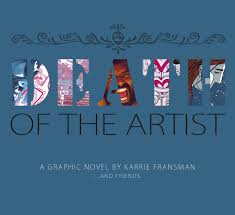
[READ: May 29, 2015] Death of the Artist

I grabbed this book from work because it looked interesting.  And it was.  I was more than a little confused as to how much is true.  And that was clearly the point.  Fransman totally pulled the wool over my eyes and I love her for that.

The premise of this book is that five artists are getting together for a weekend of debauchery.  They were friends in art school in Leeds when they were in their 20s.  Now, ten years later, they are reuniting in hopes of sparking creativity again.  Of the five only one is still doing anything “creative,” and they are all looking to reignite that spark.

And this book is the result of their week.

All five artists draw (or something) a story inspired by that weekend.  And in what turns out to be a pretty cool twist, Fransman has shaped the stories into a narrative. (more…)

Read Full Post »

shadowSOUNDTRACK: ANDERSON BRUFORD WAKEMAN HOWE-Anderson Bruford Wakeman Howe (1989).

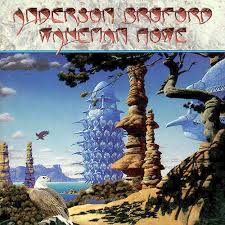
The band with an amazing pedigree created a band with a preposterous name and an equally preposterous album title.  But who cares, right?  After the pop frenzy of Big Generator, why shouldn’t the “real” members from Yes (excepting Squire) form a band?  They even brought Bruford back (he has said that he didn’t realize all three other guys were part of it, he thought it was a solo recording).  Perhaps the most insulted person should be Tony Levin.  Not only did I not know he played bass on the album (Bruford brought him over from King crimson), but I can’t even hear him on it!  I have listened to this record a couple times recently and I can’t hear any bass at all.  It’s like the anti-Chris Squire album!

I remember when this came out I was pretty excited.  I remember drawing the album cover (look, kids, Roger Dean is back!), and I remember joking about the preposterous “Teakbois.”  But when I listened to it again (first time in probably twenty years), I didn’t recognize a lot, and I liked even less.

abwhThe album opens with “Themes,” a six-minute, three-part mini epic which should hearken back to Yes of old.  There’s an interesting slow circular keyboard piece and a pretty piano melody and then it gets funky, sort of.  About 4 minutes in, it changes to a new thing altogether but again the sounds are so…bleah,  the guitars sound pretty good (some great guitar work from Howe) while those keys just sound….  You know I said that Wakeman would never play the sounds on 90125 & Big Generator, but he went even blander on this song.

Track two is only 3 minutes long.  It’s dramatic and angry with some good keyboard sounds.  It’s probably the best thing on the album.

“Brother of Mine” is another three-part mini epic that runs over 10 minutes.  The guitar chords and style remind me of mid 80s Rush. There’s lots of interesting elements and the main verse reminds me of maybe early Genesis or Marillion.  Although the solo and other sections seem…obvious instead of groundbreaking.  The middle part is pretty good, with a very classic Yes feel.  But the final section sounds exactly likes something from a Disney movie, perhaps The Little Mermaid (which came out the same year).

“Birthright” starts off ominous with some interesting percussion.  Although all the percussion on this album is rather disappointingly electronic.  Not that’s there’s anything inherently wrong with electronic drums, it just seems wasted on someone as amazing as Bruford.  It feels vaguely like a Peter Gabriel song.  It’s pretty good but it gets a little melodramatic by the end.

“The Meeting” is a treacly ballad.  It sounds nice but is nothing special.  “Quartet” is the third mini epic.  This one is nine minutes and four parts.  The first part is folky and reminds me of Simon and Garfunkel.  Part 2 references tons of old Yes songs in the lyrics (which seemed to make reviewers of the album giddy) but which really just shows how weak this song is compared to those other songs.

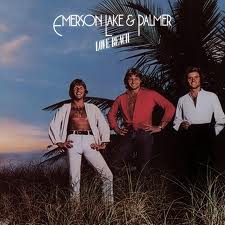
elp“Teakbois” has got to be the biggest WTF recorded.  I’m all for bands embracing other cultures and it’s awesome that after Paul Simon released Graceland other bands added multicultural elements to their sound, but this 7 minute monstrosity sounds like AWBH went to the Caribbean and joined a tourist band.  I don’t know if they released many band photos for this album, but this songs makes it seem like this could have been their cover.  There is a chorus near the end of the song in which they sing “cool running” and I was relieved to find out that the film with that name came out four years after this song.

“The Order of the Universe” is another 9 minute, four-part epic.  Just thinking of this song makes me think of the closing credits for The Lion King (which came out five years after this at least) or something.  There are some interesting parts to it.  But the “Rock Gives Courage” section is dreadful and Anderson sounds like he’s singing a pop metal band

“Let’s Pretend” closes this album.  It’s only 3 minutes long and is co-written by Vangelis.  It’s a fine song, completely inoffensive.

So what is up with this disc?  Am I imposing a 21st century attitude on it?  Am I missing that it was actually really influential (on Disney songwriters anyhow) and that it’s not their fault that other people have poisoned the sound for me?  I understand that musicians change and grow, but with these four names, you’d expect something a lot bigger and better than this.

Maybe when I listen to it in another 20 years I’ll actually like it again.

[READ: May 10, 2015] The Shadow Hero

I really enjoy the stories that Gene Luen Yang creates.   And this one (which I later found out is actually meant to be an origin story of an already extant character) was really interesting.

The story begins in China.  In 1911 the Ch’ing Dynasty collapsed and soon after the Spirits who were born with China and watched over her had to decide what to do.  The Dragon, the Phoenix, the Tiger and the Tortoise came to a council.  Later, the tortoise left the country with a man who was too drunk to know why he was even on the ship he was sailing on.

Then we see that the story is told by a first person narrator when he says that his mother came to America a few years later.  She had high hopes of the prosperity and beauty of the country, but her hopes were dashed by the realization of the ghettos and slums of Chinatown.

His father (the drunk from above) owned a grocery store and Hank (the narrator) helped out.  His mother, the stronger-willed of the two was a driver for a rich woman and took no crap from anyone. (more…)

Read Full Post »

« Newer Posts - Older Posts »