Feeds:
Posts
Comments

Archive for the ‘Artists’ Category

walrus huneSOUNDTRACK: Rheostatics Tribute Show (AGO, September 3, 2015).

06Sep2015Almost exactly one year ago, my family traveled to Toronto as a mini-vacation.  The impetus was my scoring tickets to see The Rheostatics live for the first for me (and potentially–but not in reality–last) time.

They had called it quits 8 years earlier and were reuniting for the 20th Anniversary of their Group of 7 album–a soundtrack of sorts that was created to celebrate the works of the great Group of 7 artists.  They were scheduled to perform three nights at the Art Gallery of Toronto.  The night before their first show, Thursday the 3rd, there was a tribute show.

As the Rheostatics live site explains:

Thursday night was sponsored by First Thursdays at the AGO. The theme was Music Inspired by Rheostatics and featured a band of musicians comprised of Paul Linklater (Guitar), Thom Gill (Guitar), Phil Millotson (Drums), Charles James (Bass), and a series of guest vocalists including Laura Barrett (The Hidden Cameras), Terra Lightfoot, Casey Mecija (Ohbijou), Mike O’Brien (Zeus), Chris Cummings, Sandro Perri, plus a special performance by Canadian folk legend Mary Margaret O’Hara.

The site has the show available for download with the caveat: “Sound for both shows is a bit crackly in places and lots of crowd noise.”

So yes, the sound isn’t great (the AGO isn’t meant for concerts, anyhow), but it’s still a fun listen.  Although as a friend of mine once said about tribute albums–they sure do make you appreciate the original band more.

And that’s definitely the case here.  It’s hard to know if the lack of intensity is from the recording or if the band was simply playing more delicate versions of the songs.  The energy is missing on a lot of the versions–or maybe they just couldn’t do what the band can.

They start with “Who,” an unexpected but delightful choice.  Their version is a little slow, as most of the songs seem to be, and they leave off those last two drum snaps, but it’s still a fun thing to hear.  Then the guest vocalists proceed. Terra Lightfoot, no relation to Gordon, sings over a rather slow and somewhat undramatic version of “Northern Wish.”  In the original, I love when they really rock, but that doesn’t ever seem to happen here.

Casey Mecija sings “Claire.”  There are some interesting vocals and I like the way the song seems to start new wavy at first, but it turns a little smooth jazzy by the end.

“We Went West” is sung by Mike O Brien.  It’s quite similar to the original, although I actually like it a little better somehow–the words are a little clearer, I think.  Chris Cummings plays the unexpected Martin Tielli solo song “From the Reel.”  It is quite lovely and his voice is deeper than Martin’s allowing you to hear the words a little better.

Laura Barrett plays “Stolen Car” with amazingly operatic vocals.  It sounds great in the “I’ll be okay!” line but it seems to take a lot of the intensity out of the song because it doesn’t rise and fall like the original.

Mary Margaret O’ Hara comes out to thunderous applause.  MMOH is pretty crazy in general and she walks out and says.  “You people smell…nice.”  I would love to hear a better recording of this version of “Rock Death America” (and would have loved even more to have seen it).  She seems to be channeling her old spirits as she wails the lyrics.  She slips in a chorus or two of “They dont give a fuck about anybody else.”  Then she starts ranting about “the land of the free and the home of the brave amerikkkkkkkkkkkkah.”  It’s intense and I can only imagine how great it was to see.

Then Constellation guitarist Sandro Perri plays a sweet and slow “Take Me in Your Hand” apparently with MMOH (although I don’t hear her).  They play the melody on a penny whistle at the end, which is fun.

And then MMOH stays out to do a kind of long version of “Bad Time to Be Poor” (she seems to be mostly doing backing vocals and keening).  The version is a little too slow for my tastes, but is otherwise cool.

At the end of the set, someone mentions that the Rheos are going to come out and test out a few songs on everyone.  Lucky bastards.

Since the whole family was with me, I wasn’t going to go to this tribute show, although I have to admit it would have been very cool to see MMOH (who I assume I’ll never see) and to get the surprise Rheos show.

[READ: August 19, 2016] “The Rainbow Festival”

The last few stories that I’ve read in The Walrus have been real downers.  And this story had as a summary blurb: “in which a family waits for the joy that never comes”  What the hell The Walrus?

But with such a dour hint, this story wasn’t as miserable as it could have been.  I do wish that that line hadn’t been there though, because it did spoil the truth (which was not the end, but whatever).

This story is about a little boy who grew up in small town which was sometimes very large.  He lived in Malin a town that hosted the Malin Hering-Gutting Festival every June.  And during that festival their small town was overrun with fishermen and tourists.   His mother turned their house in to a B&B and she seemed really happy when the house was full of people.  (Her husband had died on a fishing boat some time ago and their house was way too big for just her and her son). (more…)

Read Full Post »

dawnSOUNDTRACK: BANKS-Tiny Desk Concert #401 (October 30, 2014).

banksI’d never heard of Banks before this Tiny Desk Concert.  The blurb says that “Banks’ terrific full-length debut, Goddess, is constructed out of layer upon layer of electronics, beats, samples and other means of submerging the singer’s voice in swirling accoutrements…. On record, she’s placed at the center of lavish productions, each suitable for throbbing remixes and banks of swirling lights.”

In this version, it is just a keyboard and a drum box, so her voice is exposed.  But I actually found her voice was a little annoying.  Especially during the verses, where she uses too much vibrato.

On the first song, “Beggin For Thread,” I enjoyed the choruses where she sang loudly and with less affectation.  Although it was during “Alibi” that I particularly didn’t like her voice–too much yea yea yea with a ton of vibrato.

For “Brain,” the accompaniment is acoustic guitar rather than piano.  It has a very different feel although I liked it even less.  I’m curious to see what their record sounds like with her voice buried, but I’m not going to find out.

[READ: June 1, 2016] Dawn Land

Dawn Land was a novel that Joseph Bruchac wrote in 1993.  The novel (as explained in the afterword) details the oral traditions of his people as filtered through a fictional story that he was inspired to write over a burst of about six weeks.

I may have enjoyed this graphic novel more if I’d known the original story first (I also didn’t know that Bruchac was Abenaki Indian, so I wasn’t sure what to think about the story in the first place–appropriation is such a hot topic these days.  Of course having said that, I’d never heard of the Abenaki Indians before either (they lived in what is now New England).

I found the story a little confusing.  But before getting into the story, I loved the artwork.  In black and white, Will Davis conveyed so many amazing scenes and scenery–perfect depictions of people and animals and yes, giants. (more…)

Read Full Post »

sweater SOUNDTRACK: ÁSGEIR-Tiny Desk Concert #397 (October 18, 2014).

asgeirÁsgeir Trausti Einarsson is an Icelandic singer songwriter.  He has a beautiful soft soaring voice.  He released his debut album Dýrð í dauðaþögn in Icelandic (it became the biggest-selling debit in Icelandic music history).  A year later he reissued it in English (with translation help from John Grant who was living in Iceland) as In the Silence and finally (the version I have, as a 3 disc set with the Icelandic and English discs as well as a selection of bonus songs.

“On That Day” is a pretty, guitar based song (Ásgeir plays the main melody line and has guitar accompaniment (and backing vocals) from his childhood friend Julius Róbertsson.

For the final two songs, Ásgeir switches to piano.  “Torrent” has gorgeous vocal harmonies. It’s interesting how much more deliberate this song feels–not quite staccato, but the piano chords don’t really ring out, letting each note stand on its own.

For this Tiny Desk, he stripped down the songs, getting to their core.  They’re not flashy, they’re just lovely.

The final song he plays, “Higher” is the first song on the record (interestingly “On that Day” is the final song on the record).  It has a very slow, delicate piano melody and is also soothing and beautiful.

And in a cool synchronicity at the end of the show Bob tells Ásgeir  that he’s playing at the same piano that John Grant played on a few months earlier.

[READ: July 2, 2016] Sweaterweather

Back in 2003, Sara Varon published her first book called Sweaterweather.  This collection includes all of the original 8 stories as well as a few more.  Each story gets a brief introduction from Varon which makes me like her even more (she’s quite funny).

Most of the stories are short(2-3 p[ages) and most don’t seem to have a title.  The contents page is actually thumbnails from each story.

When I first saw Varon’s style, I wasn’t sure what to make of it.  It is so innocent and childlike.  And I have really grown to love it–especially when these sweet animals characters (they’re pretty much all animals) tackle some intense feelings. (more…)

Read Full Post »

bourbonSOUNDTRACK: RAQUEL SOFIA-Tiny Desk Concert #395 (October 11, 2014).

raquelRaquel Sofia has been a backup singer for Juanes and Shakira and has no come out front to make really catchy songs about breaking up with people.

She sings in Spanish (although her English is excellent) about love and loss and the blurb correctly notes “it’s hard to believe that feeling bad can sound this good. ”  Her songs are all acoustic, but with a fiery punk flair (to match her partially shaved head).

Of the first song, “No Me Importas,” she says she wrote this song about a guy who didn’t call me.   It is a rollicking fun song which starts out with a big HEY! before rocking out.  Her voice is awesome–loud and powerful and for this blow off song, she’s got a great sense of bite in her voice.  And again, for a break up song it’s really fun and even has a with a clap along section

“Agridulce” (which means Bittersweet) is a more mellow ballad.  She says she was in a relationship and was about to get dumped.  Too much damage had been done to say she was sorry so she had to write a song.  She says it’s her next single.  It’s a pretty song and at he end, she says that the look on his face when she told him she wrote the song made the trouble worth it.

She says she wrote “Te Amo Idiota” which means “I love you, Idiot” in the darkest, darkest hour of her life.  It’s an impassioned song.  Not quite as fun as the others, but really good.  The end is really great.

She wasn’t expecting to do a fourth song, but they ask her to and she plays “Hombre Como Tú.”  She says she was mad at a guy and was sure she was never going to see him again.  So she wanted to make sure he knew exactly what she thought about him.  We never find out what he thought of that one.  She says it’s her next single (even though the other song was also her next single).  It’s incredibly catchy and even if you don’t know what she’s saying.

Hearing how great her songs are, it make me want to have a bad break up with her so she can write some more great songs (especially since I wouldn’t know what she’s saying).

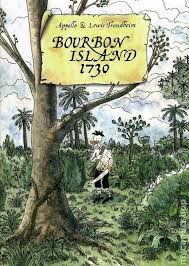
[READ: June 11, 2016] Bourbon Island 1730

I joked with Sarah about the disclaimer at the beginning oft his book which says that “Bourbon Island 1730 is not intended to be a historical account.  It is a fictional narrative, freely inspired by historical events.”  And I joked because one of the main characters is a bird and the other looks like a dog or something.  So clearly not historically accurate.

But I soon learned that this is a more or less accurate account of piracy  and slave trading around Bourbon Island in the 1730s.

Although as with a lot of Trondheim’s books I found this one to be lacking focus somewhat.

I wasn’t always sure exactly what was happening.  And one of the problems to me especially was that the book deals with racism and slavery, but it wasn’t always clear who was who because the characters were animals–how do you depict racism with animals if the animals don’t seem to conform to a race? (more…)

Read Full Post »

solomonSOUNDTRACK: RYAN KEBERLE & CATHARSIS-Tiny Desk Concert #393 (October 4, 2014).

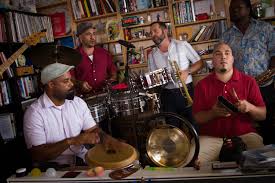
keberleWhen Trombone Shorty played the Tiny Desk I said that I was surprised to see that the leader of the band was a trombone player.  Well, perhaps it’s not that unusual as Ryan Keberle is a trombonist as well.  But unlike many recent jazz performers, Keberle & Catharsis aren’t showing off. As the blurb puts it, “he’s not after any high-concept framing. He’s just targeting the sweet spot where a nifty arrangement meets a solid groove.”

This band plays pretty traditional jazz (complete with upright bass solos and everything). Although, interestingly, their first song is a cover of  Sufjan Stevens song (turns out that Keberle toured with Stevens).  “Sister” is my favorite of their three songs.  I really enjoyed when the full band kicked in after the intro riff from Keberle.  The band has a vocalist, Camila Meza, who mainly does wordless vocal sounds.  As the song nears its end she does sing lead vocals, and it’s quite pleasant.

Her vocals work pretty well for this song, but I didn’t like it is much later.  That could be because “Sister” is a catchy pop song, where the other songs are jazzy.  And I find her singing style to be a little lite-Fm for my tastes.

“Gallop” is a bit faster than the first song.  It moves along at a nice clip and then stops for a bass and drum solo–very very jazzy.  There’s a trumpet solo in the middle of song too (no trombone solos which is interesting, I guess).  The other guys in the band are Michael Rodriguez on trumpet, Jorge Roeder on bass and Eric Doob on drums.

“Zone” opens with two contradicting three note riffs on both trombone and trumpet which is pretty cool.  Then the song settles down to just bass drums and voice and Keberle playing the melodica (beloved instrument of Tiny Desk Concerts) which works but sounds odd in the mix.  It seems like the song is going to end as the music fades to just bass, but it soon picks up again with anew trumpet solo.

I don’t love mellow jazz like this, but these players are excellent.

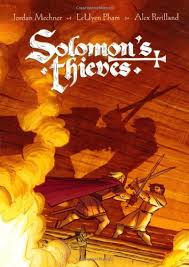
[READ: April 13, 2016] Solomon’s Thieves

I had this book on hold for quite some time.  When it finally came in, I thought, hey this art looks familiar.  And then hey, this book is about the Templar knights, what a strange thing that First Second would have two book about the Templar Knights.   And then as I flipped through it I realized the author and artists were the same.  And for a split second I though, they wrote two books about the Templar Knights?

And then it came to me that the first part of Templar was called “Solomon’s Thieves.”  And that this is indeed the First Part published long before Templar actually came out in full.

So even thought I had read the whole of Templar not too long ago, I decided to read this as well   As far as I can tell it is exactly the same as the first part of Templar.  Although it’s possible that there are some minor changes, I wasn’t sure if things that I didn’t remember were just because I can’t remember everything, you know?

Perhaps because I had read the full book not too long ago, I really enjoyed this run though again.  Since everything looked familiar, it was fun to pick up on things I missed the first time, and to see how things made a little more sense once I could tell who everyone was and what their roles were (there is something to be said for re-reading).

I’m including what I wrote about the first part of Templar here because it’s the same, but if you want more about the whole book or background about the Templar Knights check out the full post.

As the story opens we see Martin, a Knight, looking longingly at a woman, Isabelle.  We learn that he had been “dating” her (or whatever they called it back then) and then one day he found out that she left to be married to the brother of King Philip.  So he joined the Knights.  As they march through the city, we see that they are drunkards and carousers.  They get in all manner of trouble.  And one evening they were heading back to Paris when suddenly the above dictum was established–all Knights were to be arrested.  And Martin is one of them.

But through some excellent machinations (and good fighting) he escapes.  And he soon joins together with a very unlikely band of merry men, including Brother Dominic (a real priest with the tonsure and everything) and Brother Bernard, a loutish drunken man who is not above thieving from people.  Martin is offended at the thought of working with him, and they wind up at odds with each other from the start.  Before the end of the first book, we see that they have a letter revealing where all of the Templar gold and jewels are hidden.

There’s a great bit of accounting work done in which the bookkeeper shows on his ledger that rooms were empty when in fact it appears that the gold was taken out on hay carts.  The bookkeeper, even under torture, swears he knows nothing of the fortune’s whereabouts.

Mechner tells a really exciting story with humor and sadness.  The fact that it’s linked to history is just a bonus.  Another winner for First Second and their #1oyearsof01 anniversary.

Read Full Post »

stuffedSOUNDTRACK: BIO RITMO-Tiny Desk Concert #392 (September 29, 2014).

bioritBio Ritmo is a nine-piece band that has played salsa music for 23 years (as of 2014).  The back beat and rhythm is pure salsa–there’s a drummer (who has that classic salsa drum sound) and two bongo players.  There’s shakers and scrapers and timbales and congas and a cowbell.

The four horns players (two trumpets, sax and trombone) punctuate all o the right notes to get you moving along.

The first song is “La Via.”  The main driving force seems to be the keyboard, which was unexpected–it adds a kind of Latin jazz feel to the proceedings.  I love the way the keyboards shift from a Latin feel to a more groovy 70s feel before the vocals start.  There’s a cool break in the middle of the song when it stops and we get a few pounding notes before the song resumes.  Classic salsa.

“Picaresca”has fun dancey rhythm and a lengthy trumpet solo, giving it another interesting salsa/jazz feel.  The keyboard solo sounds a little cheesey here–like they need better sounds on that program, but it’s the drums “solo” in the middle that makes this song so much fun.  It’s a great instrumental.

“Perdido” goes through many different genres.  He explains that it begins like a Puerto Rican dance from the 1800s and then goes “into other stuff.”  The opening does indeed sound like an old song and after a few verses it morphs into modern salsa once again.

I really enjoyed this set a lot.  Most salsa music sounds the same to me, but I really like it when I hear it. On the downside, this is the first Tiny Desk Concert where I felt like the band wasn’t mic’d effectively.  The vocals are really quiet (almost inaudible at times), and when the trombonist does a solo it’s also a little too quiet.  But the main focus is the percussion and that’s plenty loud!

[READ: May 10, 2016] Stuffed

I have had to interlibrary loan a lot of the rest of the First Second books because my library system doesn’t have them.  Usually if a library doesn’t have an older book it’s because not many people read it any more so they got rid of it.  That doesn’t necessarily mean the book is bad, but it doesn’t  give you a ton of confidence about it.  But this book defied every expectation and wound up being outstanding!

I assumed this title would be a cautionary tale about someone eating too much.  I had no idea what I was actually in for!

As the book opens, we meet Tim. He works for a benefits department of an insurance company (it sounds awful).  He gets a call that his father is dying.  He rushes to the hospital just in time  to see his father insult him once more before breathing his last.  His father’s estate is to be split between himself and his half-brother, Ollie.  No one has seen Ollie in ages.  When they do track him down, he is now known as “Free Spirit.” (more…)

Read Full Post »

moonmoth SOUNDTRACK: TRAMPLED BY TURTLES-Tiny Desk Concert #387 (September 3, 2014).

trampleI love the name Trampled by Turtles and it conjures up something very specific in my head.  And a bluegrass folk band is not it.

Although their first song on this set, the super fast “Come Back Home” does rather convey what their name does.  Bluegrass can be fast (often is, in fact) but, man, this song scorches and the violin solos that flow through the song are totally intense.

So I was a little bummed that the next two songs are really mellow ballads.  For “Winners” the band’s harmonies are spot on and I do like the sliding bass line.  In fact all of the instrumentation (mandolin, violin, guitars, bass) is really nice.  And I think if this didn’t follow that first song, I might like it more.  Perhaps they should have ended the set with “Come Back Home.”

Before beginning “Lucy,” they ask if they are doing one more.  Bob says yes unless they want to stay longer.  The singer asks if they’ve got beer and Bob says they can work something out.  The band is not ready to head back to New York yet–they came from New York just to play the Tiny Desk (which elicit’ awww’s from the audience).

“Lucy” opens with some cool staccato strumming.  It too is a pretty song that makes great use of all of their instruments9espeicoally the mandolin).

I have recently begun to enjoy bluegrass a lot more and I could see Trampled by Turtles being a gateway into more bluegrass.  But I need more fast songs like the first one.

[READ: May 10, 2016] The Moon Moth

This First Second graphic novel opens with a lengthy essay called “The Genre Artist” by Carlo Rotella.  In this essay Rotella sings the praises of unheralded genre master Jack Vance (whom I’ve never heard of–which is the point of the essay).  Rotella says that Vance has been described by his peers as “the greatest living writer of science fiction and fantasy.”  He has been writing for six decades and has won many awards.  But this success has mostly kept him in the genre ghetto.  Other writers have suggested that if he was born South of the border he’d be up for a Nobel prize [which is a strange thing to say, in my opinion].

The essay talks about how so many other writers love Vance (and the list of writers who contributed to a tribute volume is impressive). So after all of this hagiography, I expected to be blown away by this story.  And I wasn’t.  Although that might have been because of the illustrations.  The illustrations aren’t bad–they’re not my style, but they’re not bad.  However, the story is fairly complex, or shall I say it may not lend itself to visuals because so much of the beginning is about sound.

Although while I was confused by the beginning of the story (and maybe I’d have been confused if I read it too), by the end, Vance totally sold me on what was happening. (more…)

Read Full Post »

muashSOUNDTRACK: BRANDY CLARK-Tiny Desk Concert #542 (June 20, 2016).

brandyCountry is pretty much the only genre I really don’t like, and, sadly for me, the genre seems to be seeping over into areas that I like (such as what happened in the alt-country movement in the 90s).  The one saving grace, (and actually major draw), of a lot of this new country is that the songwriters are exploring new lyrical territory.  And in particular, the women are writing sassy, funny, ass-kicking songs.

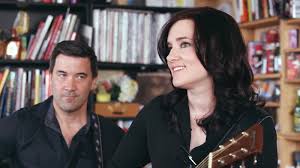
Brandy Clark (in black leather pants no less) has written for many other singers and finally decided to do her own stuff.

The entire lyric of “Daughter” is hilarious.  It’s an awesome revenge fantasy which, as the blurb suggests, “knows that fate is likely to do more damage to a cad than a key would ever do to his car’s glossy paint job.”

It’s got the great chorus:

I hope you have a daughter and I hope that she’s a fox / Daddy’s little girl just as sweet as she is hot / she can’t help to love them boys who love to love and leave them just like her father / Yes karma’s a bitch so I hope you have a daughter.

The second song is a sentimental song about her dead father.  The melody is very pretty, but I don’t need to hear songs like this.

But it’s back to the funny with the really sassy “Girl Next Door.”  It takes to task another cheating man:

If you want the girl next store then go next door… [much faster] and go right now and don’t look back and don’t turn around don’t call me when you get bored, yeah if you want the girl next door then go next door.

It’s a genius line and I really like the tone of her voice in this song (less twangy and more angry).  It could make me like country more.

[READ: April 1, 2016] Mush!

The title of this book promised a very funny story.  I really didn’t expect the “issues” to be quite so existential.

This book is broken into 10 chapters, with the first one opening on a man and his sled dogs mushing across the frozen tundra (actually Alaska).  We are introduced to The Boss and his Mate and the six dogs (from the dog’s perspective).  And then we see the dogs talking to each other. The crux of their conversation is that they are bored and wish they were running.  The lead dog, Dolly, loves to run, although she is unsure is she is qualified to lead the other dogs.

For some reason Buddy has a really big nose and is rather dumb.

Then we jump inside the house and see some intense friction.  The man of the house is a loner, a rebel, Dottie.  He hates society and doesn’t even like going into the city to get supplies.  His mate, meanwhile, loves him and wants to be with him–she knows the risks and troubles of doing it off the grid, but she also likes to go into town from time to time.  And she misses apricots.  Frankly, he is such a dick that I can’t imagine why she stays with him. (more…)

Read Full Post »

chocolateannaSOUNDTRACK: CHICK COREA & GARY BURTON-Tiny Desk Concert #540 (June 13, 2016).

chickI have known of Chick Corea for decades, although I never really knew anything about him.  I’m sure I’ve heard him play at some point (he’s been around since the 1960s), but never so specifically.  And Gary Burton is an unknown quantity to me (although apparently he has played with Corea for years–they recorded their first album together 44 years ago!).

Corea plays a beautiful, fluid jazz piano.  And while his work is really special, it’s actually Burton who I focused on more (at least at the beginning).  Burton plays the vibraphones–with four mallets!  I don’t think I’ve ever seen vibraphones so up close in action before  Apparently the bar can be lifted (which must account for the vibe).

They play two songs, “Love Castle” which is from 1976 and “Crystal Silence” which is from their debut album (1973).

“Love Castle” begins with some great piano and fun soloing on the vibes.  It’s mesmerizing watching Burton hit these bars.  After 5 minutes of intense vibe playing, Corea takes over for solo section for almost 2 minutes before Burton returns (this time providing more background where as the earlier section was more soloing from Burton).  The song is just the two of them for about ten minutes and it’s really something.

“Crystal Silence” is the first song they ever played together.  It opens with some great vibes and then soars and swirls for another t en minutes.  It’s a really cool piece and the crowd is appropriately jazzily appreciative.

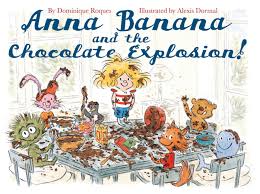
[READ: March 1, 2016] Anna Banana and the Chocolate Explosion

This is another First Second picture book (as opposed to graphic novel).  It’s the second in the Anna Banana series.  Once again, I thought the cover illustration was a little sloppy compared to the inside of the book–for many graphic novels I like cover illustrations better than the interior. But this is a picture book so maybe the rules are different.  Nevertheless, both parts are drawn by Alexis Dormal.

Anna is a little girl with a lot of friends: Pingpong the penguin, Grizzler the bear, Zigzag the bunny, Foxface the fox, Whaley the whale and Fuzzball the, well, fuzzball.

Anna’s friends want her to make them a chocolate cake.  But she says she will teach them how to make their own instead. That sounds like a great idea. (more…)

Read Full Post »

maha SOUNDTRACK: MASHROU’ LEILA-Tiny Desk Concert #543 (June 24, 2016).

mashrouMashrou’ Leila is a band from Beirut.  And because I love this kind of thing, here is their name in Arabic script: مشروع ليلى

They are on their second ever tour in the U.S.  They sing in Arabic but their music is full of rock and indeed dance motifs.

There are five members of the band: singer and lyricist Hamed Sinno, violinist Haig Papazian, keyboardist and guitarist Firas Abou Fakher, Ibrahim Badr on bass and drummer Carl Gerges.  And the band make up is rather diverse:

Sinno is openly gay, and Mashrou’ Leila is well acquainted with the targeting of LGBT people. The band has faced condemnation, bans and threats in its home region, including some from both Christian and Muslim sources, for what it calls “our political and religious beliefs and endorsement of gender equality and sexual freedom.” And yet, when Mashrou’ Leila performs in the U.S., its members are often tasked with representing the Middle East as a whole, being still one of the few Arab rock bands to book a North American tour.

Their set took place on the morning after the dead club murders in Orlando (June 12), and since the band has had direct experience with this, they modified their intended set list.

I want their music to speak for itself, because it’s really good.  But since it’s sun in Arabic, some context helps

“Maghawir” (Commandos), is a song Sinno wrote in response to two nightclub shootings in Beirut. In the Beirut incidents, which took place within a week of each other, two of the young victims were out celebrating their respective birthdays. “Maghawir” is a checklist of sorts about how to spend a birthday clubbing in the band’s home city, but also a running commentary about machismo and the idea that big guns make big men.

It begins with a low menacing bass (keyboard) note and some occasional bass (guitar) notes until the echoed violin plays some singularly eerie notes.  Sinno’s voice is really interesting–operatic, intense and not really sounding like he’s singing in Arabic exactly.  He has rock vocal stylings down very well, and the guttural sound of Arabic aids the song really well.  I’m really magnetized by his singing.  And the lyrics:

“All the boys become men / Soldiers in the capital of the night,” Sinno sings. “Shoop, shoop, shot you down … We were just all together, painting the town / Where’d you disappear?” It was a terrible, and terribly fitting, response to the Florida shootings.

For the second song, “Kalaam” (S/He),Sinnos says it’s about the way “language and gender work in nationalism.  In Arabic, words are feminine or masculine and it’s about being in between while trying to pick someone up at a bar.”

Sinno dives deep into the relationships between language and gender, and how language shapes perception and identity: “They wrote the country’s borders upon my body, upon your body / In flesh-ligatured word / My word upon your word, as my body upon your body / Flesh-conjugated words.”

There’s interesting percussion in this song.  And more of that eerie echoed violin.  But it’s when the chorus kicks in and there’s a great bass line (which comes out of nowhere) that the song really comes to life.  There’s a cool middle section in which the keyboards play a sprinkling piano sound and there some plucked violins.  All along the song is catchy but a little sinister at the same time.

The final song, “Djin,” is based on Joseph Campbell’s archetypes.  Sinno describes the comparison between Christian and Dionysian mythologies but it’s also about just about “getting really messed up at a bar.”

“Djin,” is a perfect distillation of that linguistic playfulness. In pre-Islamic Arabia and later in Islamic theology and texts, a djin (or jinn) is a supernatural creature; but here, Sinno also means gin, as in the alcoholic drink. “Liver baptized in gin,” Sinno sings, “I dance to ward off the djin.”

It has a great funky beat and dance quality.  The way the chorus comes in with the simple backing vocals is great.

There’s some pretty heady stuff in their lyrics, and that works on the level of their band name as well:

The most common translation of “Mashrou’ Leila” is “The Night Project,” which tips to the group’s beginnings back in 2008 in sessions at the American University of Beirut. But Leila is also the name of the protagonist in one of Arabic literature’s most famous tales, the tragic love story of Leila and Majnun, a couple somewhat akin to Romeo and Juliet. Considering Mashrou’ Leila’s hyper-literary bent, it’s hard not to hear that evocation.

I hope they get some airplay in the States. Sadly their album is only available as an import, but it is downloadable at a reasonable price.

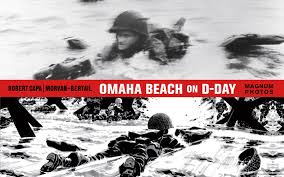
[READ: June 10, 2016] Omaha Beach on D-Day

Nobody picks up this book for fun.  I mean, look at that title. You know this isn’t going to be a laugh.  But it is an amazing book and I think  perhaps the title does it a bit of a disservice.

This book is not exactly about the massacre that was Omaha Beach on D-Day.  It is about that certainly, but the book is really about Robert Capa, the photographer who took the most iconic photos of Omaha Beach on D-Day.  This book is far more of a biography of him than an account of the war.  And in typical First Second fashion, they have made a gorgeous book full of photorealistic drawings that really exemplify the work that the book describes.

The book opens in Jan of 1944 with Capa carrying bottles of champagne amid the burned out wreckage of war.  He is bringing the celebratory drink to his fellow reporters who have been hiding out for a few days. Capa says he is leaving for London. (more…)

Read Full Post »

« Newer Posts - Older Posts »