Feeds:
Posts
Comments

Archive for the ‘Dogs’ Category

SOUNDTRACK: RHEOSTATICS-Mowat Collegiate, Scarborough, ON (1982).
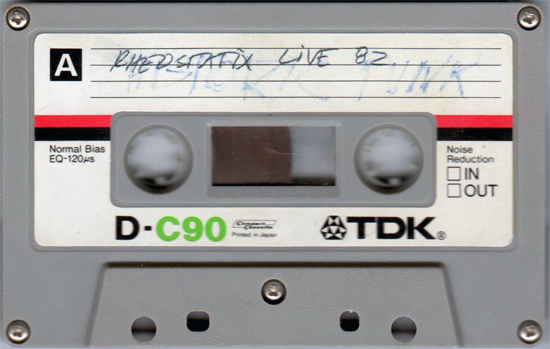
This is (as of June 2017), the oldest Rheostatics show on Rheostatics Live.

And indeed, “Considering it is 34 years old it sounds remarkably good for a show probably taped off of a tape recorder”

This is in their very early days when they were a lot more funk and new wave.

There’s also a big distinction in that the guitar (or maybe keyboard, although I don’t hear any) is played by David Crosby (not that one) rather than Martin Tielli.  This was before Tielli joined the band.

There’s a note that this cassette may have been two sets on one night but it seems more likely that it was two different nights.  Same set list both sets.

The show opens with a recording of “O Canada” that seems to gets stuck as they launch into “National Pride.”  I can’t get over how many bootlegs there are of them playing this song and yet it never made it onto a release.  I feel like the ending using a twisted “Star Spangled Banner” is new (or I guess actually old).

This is one of the first occasion I’ve heard them play The Kinks song “Well-Respected Man.”  Their version is incredibly different and I wouldn’t have even recognized it except for the lyrics:

And he’s oh, so good,
And he’s oh, so fine,
And he’s oh, so healthy,
In his body and his mind

It’s all funk and slaps and a wholly different melody.  The guitar solo is very rudimentary as well–angular and noisy.  They also play Sly and the Family Stone’s “Thank You” with their own flavor to it–again nothing like the original.  It’s so far from the original that the subtitle is “(Falettinme Be Mice Elf Agin).”  It feels like every song is pretty much all slap bass –I can’t actually tell who is singing these songs Dave or Tim.

There’s an original “Satellite Dancing” and a cover of “Louie Louie” done in a new wave style with some really high angular guitar chords and a bass solo.

Clark describes “1984 For Those Who Believe” as a political song about “Poland and Russia and the Middle East an all of those fun things that happen in the world today.”

There’s a story that I can’t make out but the end is “We’re the Rheostatics and we’d like you to dance, okay” which segues into a seven minute “Shake Yer Body Thang,” which also has a lengthy funk bass section.

They introduce their “single released three months ago,” “My Generation.”  “It’s a dancing song, too.”  This song did get official release and it also sounds nothing like the original  “Girl in My Magazine” about Nancy Reagan–he keeps it under his bed at night.  It’s got a massive ska feel.  “Man of Action” funky bass and scratchy guitars (and maybe a keyboard?).  It gets cut off before the end.

The second set doesn’t have “O Canada,” but something else as an intro.  But they still open with National Pride and in this version you can really hear him sing,”Can’t live in the USA / too many enemies / can’t live in the USA / that place is not for me.”

“We’re the Rheostatics from Toronto, Ontario, this is a song dedicated to Russ Jones.” It’s called “Thank You (Falettinme Be Mice Elf Agin).”

“Satellite Dancing” from our single: dance and have fun which i hop you all will.  This set seems more fun than the previous one: chants of “dancing!” and a rowdier crowd.

“It’s called ‘Louie Louie’ and its a dance song.”

“1984 For Those Who Believe” is “dedicated to the National Guard, Mr Reagan and all his friends in blue.”  I wish I could hear the words better, I, curious what they’re singing about.

“This is called ‘Shake Your Body Thang’ it’s new and everybody dances, alright?”  There’s cowbell and other percussion during the funk breakdown.  They want to turn the whole building into one big rhythm section–“bang any two things together.”  “We’re going to keep doing this until you get it right…you shouldn’t smoke anyways, eh?”  It’s hard to tell from this recording if the crowd is into it.

A much shorter “My Generation” it feels like a bratty punk version of the song.  “Girl in My Magazine” it’s about Nancy Reagan–he keeps the dirty books in his closet so no one will find them.  And once again, “Man of Action” gets cut off.

It’s hard to believe that this band evolved into Rheostatics.  I wonder what they’d be doing now if they hadn’t morphed so much.

[READ: September 12, 2016] “Pet Seminary”

This piece is actually four excerpted sections from William’s Ninety-Nine Stories of God.

I have had a real problem with Williams’ stories–they just don’t do anything for me.  So having four even shorter ones is not the most exciting prospect.

#29 is a first person account of the narrators childhood in which his class was supposed to visit a slaughterhouse.  Cooler heads prevailed and they did not actually see into the abattoir, by the smell was unforgettable.  Later they learned of a pig who saved a man from drowning.  The owner said that pigs are more intelligent than dogs but are not omniscient. (more…)

Read Full Post »

[LISTENED TO: June 29, 2016] No Girls Allowed (Dogs Okay) 

Scab McNally is a clever fourth-grade kid who is always inventing things. But he’s also kind of selfish and pretty mean to his sister.  Isabelle is his twin but because she really uses her brain (She is smart times ten) she has been bumped up from 4th grade to 5th grade.

Isabelle doesn’t understand Scab’s brand of cleverness (and mischievousness) and so she writes a daily news report about all of the things that Scab has done to her (and done at school) through the day.  She reads this to her parents every night.  It’s pretty hard for Scab to catch a break at this point.

But obviously, the more Isabelle tells on him the more things he does to her.  He puts cheese in her underwear drawer and dead bugs in her room.

This is all some background to the fact that more than anything else Scab wants a dog.  (There seem to be a lot of books about kids who desperately want a dog).  Scab’s best friend has a dog, Oscar–a wiener dog.  And Scab is super jealous but always happy to help out with Oscar.  Of course, since Isabelle is always attaining on him, his parents don’t think he is responsible to own a dog. (more…)

Read Full Post »

SOUNDTRACK: MAREN MORRIS-Tiny Desk Concert #603 (March 6, 2017).

Maren Morris is hugely successful, but I had never heard of her.  It turns out that

Four days before the 26-year-old strolled into NPR’s offices, she’d pulled off a mighty duet with Alicia Keys during the 59th annual Grammys ceremony and taken home the evening’s award for Best Country Solo Performance.

Despite the “big, crossover-friendly gestures on her major-label debut,” she’s out of my musical area.  But I can see why people like her–she has major pop leanings in her delivery and its sprinkled with pop country that everyone seems to like.

And that first song is really fun.  Of course, the music sounds so much like Steve Miller’s “The Joker” that that may be why it feels so catchy.  There’s a weird almost hip hop delivery to the song despite its obvious country bass.  I mean check out the words:

Boy I’d be rich, head to toe Prada
Benz in the driveway, yacht in the water
Vegas at the Mandarin, high roller gambling
Me and Diddy drippin’ diamonds like Marilyn
No I wouldn’t be covered in all your IOU’s
Every promise you made me would have some real value
‘Cause all the little lies rolling on your lips
Is money falling from the sky (ka-ching, ka-ching) shit I’d be rich

The blurb continues:

She’s cultivated a soulful, irreverent pop-country aesthetic that trades in trucks, bros and beer for a vintage Mercedes, female friendships and boxed wine — and which owes much of its charm to details that shine in a stripped-down setting. Take, for instance, the cash-register ka-ching that punctuates the chorus of the oh-so-sick burn “Rich,” or the intimate, after-hours raggedness in her voice as she sings of jaded heartache in “I Could Use A Love Song.”

So I can respect that.

“I Could Use A Love Song” feels country but her delivery has a massive pop song styling (that’s the crossover appeal, I guess).

She jokes that this is the quickest show she’s ever done.  She sounds genuinely shocked that she won a Grammy the other night.

The final song “My Church,”  is very country sounding (that bass) and singing that she “cussed on a Sunday.”

It’s my least favorite of the three.  I particularly dislike the R&B inflections at the end which puts my two least favorite musical genres together.

But overall she is adorable and charming and she looks to be about 12 years old up there with those two larger musicians supporting her.  And even if I won’t listen to her, I wish her success because she seems really sweet.

[READ: January 11, 2017] “Most Die Young”

I enjoyed this story quite a lot.  I loved how it was structured and the surprising twists it had.

The title comes from a statement by Professor Cruze: “young” means under the age of 38.  Cruze was referring to a Malaysian tribe known as the Pawong.  The Pawong, she explained, have no defenses or weapons.  They are an easy target.  It doesn’t even occur to them that they could respond to attackers.

The narrator first heard about this tribe from her ex-boyfriend Glauber (Glauber is a name, in case you’re wondering).  He mentioned the Pawong tribe as an insult to her saying that she was ruled by fear and could be made a God of the Pawong tribe.

Professor Cruze explained that shyness, fear and timidity are highly valued among the Powang.  To be angry is not to be human; but to be fearful is. (more…)

Read Full Post »

SOUNDTRACK: SAN FERMIN-Tiny Desk Concert #315 (October 28, 2013).

When I first heard San Fermin I was immediately grabbed by the female lead voice (the song was “Sonsick”).  It was so powerful and gripping. I didn’t realize then that the female leads were the lead singers of Lucius (who I also didn’t know at the time).  San Fermin is the creation of Ellis Ludwig-Leone.

Since then I have enjoyed other songs by them as well, although I find that the songs sung by Allen Tate to be somewhat less exciting to me– I feel like his voice could one day hit me as amazing but it’s almost a little to understated for me.  And yet musically I love the orchestration and chamber poppiness.  As Bob writes:

San Fermin’s music bursts with ambition, talent and extreme joy. Its self-titled debut is charged with great storytelling and amazing vocals by both Allen Tate and Lucius singers Holly Laessig and Jess Wolfe. Then there are the arrangements: little gems that turn these songs into cinematic vignettes using trumpet, sax, keyboard, violin, guitar and drums.

San Fermin is the musical vision of Ellis Ludwig-Leone, who wrote these songs with Tate’s dark, rich voice in mind. Here at the Tiny Desk, Rae Cassidy makes the album’s female vocal parts her own.

So it’s interesting that the songs were meant for Tate.  I want just some more oomph from him.  especially here in this set.  And that’s because Rae Cassidy absolutely rules this set.

“Oh Darling” begins with a gentle piano and Cassidy’s pretty, delicate voice.  After a verse from her, Tate’s voice comes in and it’s almost comically low and formal (and actually perhaps a bit too quiet).  But when they all come in and sing it is just beautiful–the women in particular.

For “Sonsick” Cassidy sings lead with just drums.  As the song builds there’s a great chorus where the backing vocals (including Tate) sing in falsetto.  This version is quite stripped down compared to the recorded version and it really allows Cassidy’s voice to shine.  When she hits those incredibly high notes with such power, it gives me chills.

In the final song, “Renaissance!” Tate sings lead over a slow piano and violin.  The women sing backing vocals.  I like the way that the song builds in intensity with more instruments, but his voice is a little too flat for me–although he does kick in extra at the end.

There’s a really stunning version of the first two songs with the band singing live in a street and cafe and France.

Incidentally, Cassidy has since left the band and gone solo, and I wish her much success.

[READ: December 28, 2016] Humans of New York Stories

Sarah got me this book for Christmas.  I knew of Humans of New York, of course, but I wasn’t a follower of it.  So while I knew of it I didn’t really know that much about it.

There’s a brief introduction to this book (which is his second HONY book) in which he explains that HONY grew from five years of experimenting.  It evolved from a photography blog to a storytelling blog.  His original inspiration was to photograph 10,000 New Yorkers.  But then he decided to start including quotes from some of them.

He started interviewing people and found their stories became the real heart of the blog.  Of course, he thanks the community of readers and participants, because without them, he has nothing.

The rest of the book–425 pages–collects the photos and the stories. (more…)

Read Full Post »

SOUNDTRACK: AGNES OBEL-Tiny Desk Concert #599  (February 15, 2017).

Agnes Obel recently played a show near me, but it wasn’t until after I watched this show that I realized I should have gone to see her.

Agnes Obel, a Danish singer and writer of deeply alluring music, brought her work into what you could call its opposite — an office in the daylight. While the setting is a bit contrary to her carefully plotted, vocally dense songs, she mapped out a strategy which included her own reverb and monitor mix in the (successful, I think) hope of giving the Tiny Desk an aesthetic more suitable to these focused and powerful songs.

Obel plays three songs from Citizen of Glass alongside her band, keeping it sonically spare.  “It’s Happening Again” opens with fairly standard-sounding piano chords.  Then Obel’s voice kicks in and it’s unique–not weird, but with a cool almost detached delivery.  Accompanying her is a cellist and keyboardist.  They each sing backing vocals (along with a third backing vocalist).  When they all sing together, it is magical–sometimes creepy, sometimes beautiful.  The song builds to the end with all of the strings growing louder as the cello plays some wild, sliding sounds.  It is quite striking.

For “Golden Green,” the cellist switches to percussion (which is a kind of clacky ball that she throws in the air).  The main melody comes from the mellotron.  Once again when the backing vocalists kick, in everything is magical, especially the way the final note ends with a dramatic rise in pitch from all of the singers.

On “Stone,” the mellotron player switches to (electric) ukulele.  The melody comes from the uke and it is quite quiet until the chord when the cello and keyboard adds some deep bass notes that seem to overwhelm the room–quite dramatic and quite lovely.

[READ: December 1, 2016] Bandette Volume Three

Bandette Volume Three is just as much fun as books one and two.  It opens with Bandette getting shot at as she gives her little dog Pimento an important note for Daniel.  Daniel calls her and she proceeds to tell him about an upcoming heist (while she is still being shot at).  She says that there is a fabulous emerald on display.  An emerald that was once owned by Madame Presto: fabulist, mesmerist, woman of impudent morals.

And later that night (after she easily dispatches the bad guys) she goes to that special event and steals… a film about Madame Presto.

The next night several people (and a dog) are hit with sleeping darts from a new villain–Dart Petite. (more…)

Read Full Post »

  SOUNDTRACK: DANA FALCONBERRY-Tiny Desk Concert #292 (July 29, 2013).

This Tiny Desk Concert introduced me to Dana Falconberry:

Dana Falconberry’s songs are gentle, almost invariably delicate, sometimes mysterious and frequently feather-light. But her music’s sweet, intricate softness never stands in for strength: This is a confident songwriter, whether she’s ambling through six- and seven-minute epics (“Leelanau,” “Dolomite”) or chirping sweetly in the bouncy “Crooked River.”

The compositions on Falconberry’s most recent album, last year’s Leelanau, are sturdy enough to be stripped down for a space like Bob Boilen’s desk at the NPR Music offices. But each benefits immeasurably from the broad assortment of lovely flourishes she re-creates here with the help of five instrument-swapping backing players. What makes Falconberry stand out in a crowded field of singer-songwriters is her music’s unfailing impeccability, and this Tiny Desk Concert finds her and her crack band hitting every immaculately crafted mark.

I tend to agree with the blurbs, but this one really is spot on: delicate, impeccable, sturdy.  These are words I would absolutely use to describe these songs.  I would also use fantastical–not suggesting that there might be fairies floating around during these songs, but it wouldn’t surprise me if one made an appearance.

“Dolomite” is a beautiful 7 minute song with many different sections.  Falconberry’s delicate (but not wimpy, it must be said) voice works perfectly with the capoed guitar she’s playing.  After the first verse, she’s joined by a cello, banjo and backing vocals, and the song builds.  Then after almost 2 minutes the bass and drums jump in and the song, while staying basically the same, gets a whole new feel (the bassline is staccato and unexpected while everything else is so smooth).  At around 3 and a half minutes the keyboards start adding these pretty little runs that make the song seem even more magical.  The middle of the song has the three female singers rotating through a  series of oohs and ahs as they make a cool-sounding fugue.

For “Crooked River,” the bassist switches to melodica.  Once again there’s a great sequence where each of the female singers sings one note in a very complex melody–it’s quite enchanting.  The cello is plucked giving the whole song a very different feel from the first.

Before the final song Bob asks if she has had any desk jobs.  She says she has had her fair share.  “I currently have a desk job…I hope. We’ll see when I get home.”

For Leelanau, the keyboardist switches to accordion, and there is prominent banjo and delicate melodica.  The verse is really quite catchy, and after the verse there is a gently rocking section where everyone joins together–it bursts forth in contrast to the rest.  It is repeated a few times throughout the song, and each one is more fun than the previous.  The middle has a kind of slow break down with the cello scratching and the melodica and accordion sounding like they are running out of breath.  Dana even hit’s Bob’s gong.  The accordion is even “breathing” without making a musical note.  The song returns to that super catchy verse and jam section and just as you think its going to fade to an end, there’s very cool chime that echoes and then a huge buildup to the conclusion.

I was so entranced by Falconberry’s music that I need to hear more of it.

[READ: September 19, 2016] Bandette 2

Two years ago I wrote about Bandette Volume 1: “The book was very exciting and sweetly charming as well.  I’m looking forward to Volume 2.”  And I waited and waited for it to come out.  I even saw Vol 1 the other day and wondered when we’d get volume 2.  Well, apparently this has been out since 2015, but the library just acquired it.  So I’m happy to say it’s not my fault it took two years for me to get around to reading it.

Even though I didn’t exactly remember how book 1 had ended, Tobin & Coover added a helpful “Previously” section to get us caught up.

The wit and charm of the first book is back in spades. Bandette continues to be seemingly immune to the world around her–she says what she wants and does what she wants and no resistance will get in her way–whether it is verbal sparring or her uncanny gravity-defying stunts.  Her love of chocolate remains as well, of course.  And the tone retains that agelessness.  It feels like this book could have been written in the 1950s but for the cell phones and scooters.

Chapter One reminds us that Bandette is a civilizan as well  She has dark hair and a love of pastries–she even gives the bakery owner priceless urn (from where) as payment for the delicious sweets. (more…)

Read Full Post »

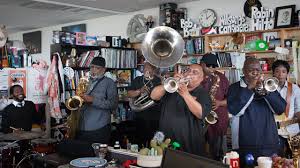
 SOUNDTRACK: DIRTY DOZEN BRASS BAND-Tiny Desk Concert #601 (February 28, 2017).

I have, of course, heard of the Dirty Dozen Brass Band. I’ve probably even heard them on a record or two that I own.  But I don’t really know much about them (in this Concert there are only 7 of them, I don’t know if they ever actually have a dozen members).

But nevermind, because man, do they swing.  And they swing with a big chunk of funk.

“Use Your Brain” is catchy as anything–with a great funk sound.   I love that the bass is all done by the sousaphone (Kirk Joseph).  I love the squeaky trumpet solo that gets played at the end of the song by Gregory Davis.  And I love everything in between.  A cool thing is that there is a guitar (played by Takeshi Shimmura) in the song which you can barely hear except during the moment when the horns are quiet and then you hear it do a great little funky chord riff.  It’s not prominent, but it is essential.

“Best of All” has a very different style (an almost Latin feel)–with Efrem Towns the “vocalist” doing r-r-r-r-r-r-r-r- vocal rolls.  I’m intrigued that for most of these songs the saxophone Kevin Harris (tenor sax) and Roger Lewis (baritone sax) play the main riff most of the time and the trumpets are often silent (until they totally take the song higher).  Like the great high note in the middle of the song.  The guitar is playing lots of little riffs that you can hear every one in a while–rounding out the song very nicely.  And the sousaphone makes some great rumbling sounds.  This song has a drum solo and I love that the drummer (Julian Addison)is placed up at the front of the band so you can really see him–his playing is fluid and that solo is funky and not showoffy.

“Tomorrow” has a funky bass–all coming from the sousaphone–and a real ska feel (especially as the guys sing the chorus “Tomorrow yeah yeah yeah yeah”).  There’s a great rollicking solo from the baritone sax.  Whenever Towns sings, he’s barely audible over the music of the horns–which is fine because hearing his voice is fun even if you can’t really hear what he’s saying.

For the final song, “My Feet Can’t Fail Me Now” Davis says:

This is the song where you all participate –you all been a little bit stiff, not moving.  (someone says , well it is NPR).  For this song we want you to participle. Don’t just stand there and clap like that, you know… move. Put your back into it.  Put your wiggle in the wiggle.  Drop it like it’s hot.  All that stuff you do behind closed doors do it now–well not all you do.

The song is super fun and dancey with a big chorus chant of “feet can’t fail me now, feet can’t fail me now.”  There’s some great horn and a cool wah wah guitar throughout the song.

The Dirty Dozen Brass Band show just how much diversity you can get with “just a brass band.”  This was a super fun concert.

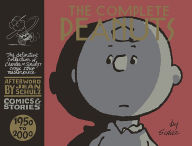
[READ: February 13, 2017] The Complete Peanuts Comics and Stories

This is the final book in the Complete Peanuts series from Fantagraphics.  It took 13 years–2 books a year–and here is the odds and ends collection to tie the series up.

There is an introduction by the editors of the series who explain just what this volume is:  The content has to be Peanuts, drawn by Schulz himself, and (when possible) with verification from Schulz’s widow, Jean.  Material that had not been seen before or was not in print in the twenty-first century got preferential treatment (no Happiness is a Warm Puppy, which is frequently reprinted).  So you’ll see dozens of strips not seen in any book and ones not printed in more than half a century. Six complete books are here– four story books, two volumes on life’s lessons.  Seven comic book stories, lots of single panel gags and lot of ads!

Then there is a Designer’s Note by Seth.  Seth has been behind all of these books (imagine dedicating 13 years of your life to something like this).  He says that he wanted these books to look and feel dignified and maybe even a bit sad.  He also wished to pay a personal tribute to Charles Schulz in his design.

He says that it was Schulz who first set him on the cartooning path.  He was the first artist Seth ever noticed: “Who is this magical person who signs his name in the last box of Peanuts?”  He never met the man and he’s not sorry about that–he has all he needs from the work itself.  He wants to think of this compete set as a monument to Schulz. (more…)

Read Full Post »

SOUNDTRACK: THE WESTERLIES-Tiny Desk Concert #576 (November 2, 2016).

The Westerlies call themselves “an accidental brass quartet,” (two trumpets and two trombones).  I don’t know if a brass quartet has a “standard make up,” but having only two instruments seems to make for an unexpected sound–one that feels more like a marching band than a swing or big band, but which is clearly not playing marching band music.  “Trumpeters Riley Mulherkar and Zubin Hensler and trombonists Andy Clausen and Willem de Koch can blow hard — after all, this is a brass band — but the surprise comes in their soft tones and subtle phrasing.”

The band doesn’t only play standards either.  For this Tiny Desk, they play three originals:

Clausen provides two tunes, beginning with “New Berlin, New York,” which sports a snappy theme, standing out like a bright tie on a smart suit. A scurrying pattern of interlocking notes furnishes the underlying fabric.  [I really like the staccato trombone notes which are really fast and bouncy.  Mulherkar  gets a pretty cool solo in the middle of the piece, but it sounds best when the two trumpets play together.  And yet there is another moment later on where it’s just one trumpet and one trombone and it sounds very cool.  I love watching the trombone play all of those fast notes].

Hensler’s “Run On Down” evokes the calm beauty of Washington’s San Juan Islands, north of the band’s former home base. [I love that he can get a different sound out of his trumpet without seeming to do anything different in his playing style. The song opens with two lonely sounding trumpets.  Midway through Clausen plays a sound like a person talking or humming.  I didn’t know you could change the tone and sound of a trombone like that].

Clausen ‘s closing number, “Rue Des Rosiers,” conjures up the circus-like vibe of a Parisian street scene. A whimsical theme gradually coalesces from fragments and grows into a rollicking amusement. [He introduces the piece by saying it was “inspired by a crazy old man riding a tricycle down the street of Paris. It was a giant tricycle and was wearing a beautiful bejeweled vest and there were windmills and horns and was something straight out of the circus.”  And boy, does this ever evoke circus music with the opening bass notes and the screaming trumpet.  The song slows down before building up into a rollicking circus piece.  And when one trumpet and one trombone put a mute on the sound gets all the more wild.  The piece ends with a variation on the traditional circus music before concluding].

[READ: June 2, 2016] Copper

After enjoying Kabuishi’s Explorer series I saw this book by him.

Copper was his first “comic strip” creation.  The story follows a boy named Copper who is quiet adventuresome and his dog Fred who is practical–and tries to keep him out of trouble.

In the introduction, Kabuishi says that the first comic (called Rocket Pack Fantasy) reflected his inner life at the time.  This proved to be his first published comic.  It was pretty dark (and black and white).  In that first one, he imagines wearing a rocket pack and then dropping bombs on a city.

But after a few more strips, Copper became more optimistic and Fred was there to question that optimism.  Kabuishi also added color. (more…)

Read Full Post »

SOUNDTRACK: KEATON HENSON-Tiny Desk Concert #293 (August 3, 2013).

Keaton Henson is a quiet guitar player.  He plays delicately (although his amp is turned up pretty loud so we can hear everything clearly).  He sings quietly as well.

After the first song, he even speaks quietly and apologizes for bringing everyone down on a Friday afternoon.

The blurb jokes:

The day before Keaton Henson arrived to play the Tiny Desk, we hosted a group called The No BS! Brass Band, a nearly dozen-piece horn section with an almost brutal (and totally amazing) sound. It was one of the loudest and most thrilling, heart-pounding Tiny Desk sets we’ve ever had.

Keaton Henson’s performance could not have been more unlike the show the day before. When a cozy crowd of curious listeners showed up the next day to see him play, I asked everyone to get as close as they could, without freaking out the admittedly shy singer from London. Don’t let the presence of this fantastic recording (by our engineer Kevin Wait) fool you. Henson’s voice was so fragile and hushed, if you were 10 feet away you would have barely heard a peep from him.

Remarkably, Henson has only been playing music for a couple years; he took up the guitar to help heal his broken heart after a failed relationship. He’s also a poet and illustrator who’s released one graphic novel called Gloaming and is already at work on another. For this Tiny Desk performance, Henson performed three songs from his new album, Birthdays.

“You Don’t Know How Lucky You Are” opens with some pretty, vibratoed harmonics before the guitar strumming comes in properly.  “Sweetheart What Have You Done To Us” has a very cool section in which the chords shift up by a half step which changes the tone of the song quite a bit.  It’s interesting that he’s recorded so closely and loudly that you can hear everything–mildly errant strings or unexpected note playing (he uses his thumb as a pick).  You can also hear how carefully he is miked for this set because you can practically hear the water going down his throat as he drinks it.  “You” plays with a rising and falling melody as it rumbles under Keaton’s delicate voice.

[READ: June 20, 2016] Sidekicks

I recognized Santat’s style from the fun picture book Oh No!  Sarah brought home this book and I thought it looked really fun.  And it was.

The premise is by now familiar (although since he did it 5 years ago, this book might be more original than it seems).  And it does take the whole idea of superheroes at home in a rather new direction.

The book opens on Roscoe, a large dog, waiting for his master to get home.  His fellow pet, a hamster named Fluffy, is chowing down on snacks while they watch TV.  Roscoe gets mad at Fluffy since Harry will be home soon and they are just sitting around.  Then Harry appears on the TV, crashing to the ground.  For Harry is in fact Captain Amazing.  He ensures the TV viewers that everything is under control.

But then he sees that he has crashed into a Nuts cart.  And he freaks out because he is allergic to peanuts (a hilarious premise for a superhero weakness). (more…)

Read Full Post »

SOUNDTRACK: LILA DOWNS-Tiny Desk Concert #591 (January 13, 2017).

This is yet another example of musicians, artists who are bridging the divide that certain politicians have been trying to wedge int our country.  Between the translated works of Zambra and the multilingual works of Lila Downs, it’s pretty obvious that cultural racism is just stupid.  #ITMFA

The blurb tells us

Downs has spent her career exploring the furthest reaches of Mexican folk music. With a voice that borrows heavily from opera, Downs performs the kind of full-throated mariachi singing that would fit right in at Mexico City’s Garibaldi Square — ground zero for mariachi.

She can also coax the most tender moments from romantic boleros. But Downs is at her best when she and her band gather all of those influences to create cross-cultural expression that breaks down musical barriers. Entertaining and inspiring, she’s as much a storyteller as a singer, and her between-song banter lays bare the Mexican soul, only to have it punctuated in song.

She plays four songs and dedicates the first “Humito De Copal” to “all the journalists in the line of fire.”

Even though this song has many components of traditional Mexican folk, the size of the bad (nine pieces) and the big sound she creates transcends folk and makes it sound really catchy for all.  I love it when midway through, the song takes off in a fun fast dancing section

She is really striking and her voice is amazing.  She’s also playing a cool scratchy/grater item.

“La Promesa” comes from a series of song about he ritual and the offering of the Day of the Dead.  She asks, “what does the homeland mean to us as Latin Americans as Mexicans and as Mexican Americans. It begins with a great electric guitar sound and cool organ accompaniment.  And then she sings in quite a low voice holding notes for amazingly long (about 18 seconds).  It turns into a bluesy song with a lengthy bluesy guitar solo.

The third song, “Viene La Muerte Echando Rasero” was written by a campesino, a farm worker, about rich and poor and young and old being taken by death.  He says “even hit men are going to die.”  She switches to a jarana, a small eight-stringed guitar-like instrument.  After a slow intro the song picks up a bit with a kind of reggae feel.  There’s already a big echo on the mic already but in the middle she cups her hands and gives the whole sound a much bigger echo.  It has a catchy ending with everyone singing along.

She introduces the final song, “La Patria Madrina” by saying “In Mexico, you wake up and put on the news and see a lot of depressing things and you wake up and hope today will be better…and it isn’t.  But despite all of this everything will be better tomorrow.”  It’s a slower song with more reggae sounds and dramatic flourishes.  This time there’s a kind of slide guitar running through the song.

The band consists of : Lila Downs (vocals, jarana); Paul Cohen (sax); George Saenz, Jr. (trombone); Hugo Moreno (trumpet); Marcos Lopez (seated percussion); Yayo Serka (seated drums); Rafael Gomez (electric guitar); Leo Soqui (jarana); Luis Guzman (bass).

[READ: August 28, 2016] “Reading Comprehension: Text No. 3” 

I’ve enjoyed a lot of Zambra’s works and this one is no exception.  I’m particularly intrigued by the “quiz” portion at the end of the piece which really takes the story in a different direction.

The structure of the story is similar to other stories I’ve read by him–I have to assume that he is being reasonably autobiographical about his youth and his life with the woman who would be his son’s mother.  If not then he has really appropriated this character.

A man is writing a letter to his son.  I loved the way the beginning started with the narrator telling his son to forget all of the thing that he has said or done: “mitigate my shouting, my inappropriate remarks, and my stupid jokes.” (more…)

Read Full Post »

« Newer Posts - Older Posts »