Feeds:
Posts
Comments

Archive for the ‘Birds’ Category

1973SOUNDTRACK: LUCINDA WILLIAMS-Tiny Desk Concert #412 (December 20, 2014).

lucindaI set tiny, manageable goals for this blog.  They often change over the course of the year, but I like to see if I can complete them.  One such goal was to write about all of the Tiny Desk Concerts from 2014.  And here’s the final one.  (Another such goal is to write about the remainder of the 2016 shows, which is doable).  I also want to write about all of the rest of the First Second Graphic Novels (there’s about 20 of them left).  Insignificant goals that I find satisfying to complete.

I’ve never been a fan of Lucinda Williams.  Although, while I’d certainly heard of her, I obviously didn’t know any of her music. The blurb talks about her distinctive voice.  And it is certainly that.  About 20 years ago a sort of friend of mine saw her open for somebody else and she dismissed Williams as trying to sound like a different singer (wish I could remember who it was).  The irony that Williams has been around since the late 1970s was not lost on me.

But Williams has changed her style over the years.  She originally sang country and has morphed into more of a folk and now a blues style.  This Tiny Desk Concert focuses on her bluesy songs.  I know she’s something of a legend, but I found her demeanor through the whole show off-putting until the end, when she loosened up a bit.

She sings four songs.  “Something Wicked This Way Comes” is rocking blues song.  And I have to say I was pretty shocked by her voice–rough and raspy and sounding not a little hungover.  Her lead guitarist was really the start for me, effortlessly playing some great groovy licks.

For “Cold Day in Hell” (she laughs at saying the title) she straps on an acoustic guitar and then sings like Tom Waits.  That seems like a joke, but the structure of the verses is pure Tom Waits–I would have even suggested he wrote the song.

The third song is the more bluesy “Protection.”  There seems something so inauthentic about this song.  I just don’t believe her rendition of it–I don’t believe that she actually needs protection.  It’s really disconcerting.

She finally smiles after this song and says “Now I’m kinda getting used to this … I’m not a wake yet, that’s what the thing is.  She straps on her guitar and says this is based on the story of the West Memphis Three.  It’ my favorite song of the four–she seems to really get into it.

But all the same, I really don’t like her voice all that much–she’s got a weird drawl and sounds like there are some marbles in her mouth. It’s very strange.  I listened to a bit of a song from a live show from 1989 and her voice was quite pretty–deep, yes, but very pretty.  By 2007, her voice has changed–it’s deeper, with a pronounced drawl.  At a show in 2013, she sounded kind of pretty again.  So, I don’t know what to make of it.  I’ll have to just go back to not listening to her.

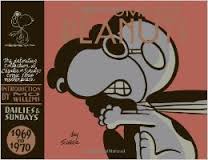
[READ: June 8, 2016] The Complete Peanuts 1973-1974

I really enjoyed this volume a lot.  There were a lot of really funny jokes and the characters are really nicely distributed by now.  I don’t want to say that Schulz hit his stride around this time, because he’s been pretty solid right from the start, but this book was easily my favorite so far.  Possibly because it contained so much of Marcie and Patty who have easily become my favorites.

The year starts off somewhat inauspiciously with the anticlimactic return of Poochie.  She shows up, realizes that Snoopy isn’t a cute puppy anymore and leaves.  Never to be seen again.

More interesting is that Linus decides that since Charlie has been their manager for so long and worked so hard that they ought to throw him a commemorative dinner. They plan it for a couple of weeks and when he finally hears about it, his smile is awesome.  They even get Joe Schlobotnick to agree to come. Of course, then Marcie starts saying that they’d all be hypocrites if they actually showed up and said nice things about him since he’s a terrible manager.  And so they cancel it at the last-minute–while Charlie is there. (more…)

Read Full Post »

1971 SOUNDTRACK: DAVÍD GARZA-Tiny Desk Concert #405 (November 15, 2014).

garzaI first heard of Garza back in 1998 with his minor hit “Discoball World.”  I really liked it.  And then I assumed he just went away.  But apparently he didn’t.

The first song, “Texas is My Hometown” is a slow jazzy song about how much he loves Texas.  He sounds like an old-timey crooner, except that he references all kinds of contemporary musicians.

And then he plays “Discoball World.”  It sounds quite different because it’s all acoustic guitar (although his strumming is pretty intense).  I prefer the original, but he’s really intense while singing this version.

He says he was walking around DC and he ran into his favorite singer in the whole world.  Then he invites Gaby Moreno to sing the final song, an old Spanish song their grandparents used to sing.  And indeed, with wonderful flair, he plays a beautiful Spanish guitar.  Gaby sings lead (in Spanish) on the whole song and her voice is really amazing.  She can hold a note for a really long time and then really powers through a loud note.  He does backing ooohss when needed, but Gaby is the star of this song.  Until, that is, he plays some great guitar at the end, very percussive, very powerful.

It’s a good set.

[READ: June 1, 2016] The Complete Peanuts 1971-1972

I took some time off from my Peanuts reading–I needed a break after fifteen years.  And it was fun to come back to the strip really looking forward to the 1970s.

There seem to be three big consistent ideas in these two years.  Woodstock becomes very prominent, Sally gets to complain about school a lot and Peppermint Patty comes into her own, with strips about her and Chuck, her and Franklin and her and Marcie (who is finally named!).

1971 starts off auspiciously with Charlie saying that this is going to be his year of decision–he’s going to start making changes.  But Lucy interrupts saying that she is going to spend the whole year regretting the past-“Forget the future!” (more…)

Read Full Post »

lioSOUNDTRACK: RHEOSTATICS-El Mocambo, Toronto ON (November 1987).

ElMo-Nov1987After re-listening to some of the Rheostatics most recent shows, I checked the Rheostatics Live site and found out that he has added some really old shows.  This show is the oldest show on the site, dating back to 1987.  A brief Rheos history shows that in the earlier incarnation, it was Dave Bidini, Tim Vesely and Dave Clark.  They were joined by the Trans Canada Soul Patrol and played mostly R&B and funk.  Around 1985 the Soul Patrol left and Martin Tielli joined.  Around the time of this show, they had released Greatest Hits.  And then they broke up (circa 1988).  Then they reformed in 1991 with an entirely different sound.

So this is from what I guess you’d call he Mach II era: no Soul Patrol but before the breakup.  Interestingly, only two songs from this how appeared on their debut album, although many appeared on earlier demos.

They play 11 songs, including what I assume is an improvised rap from Dave Clark (the really silly one of the band).  And the songs are dominated by a smooth guitar sound and often times a funky bass.  Perhaps the most amazing thing about this set is the prominence of Tim.  He sings many of the songs and Dave includes him in many jokes.  Martin is almost non-existent.

“National Pride” dates back to 1983 and starts as a kind of goofy rap song but then turns into the funky version from the demo.  Martin Tielli also released a solo song called “National Pride” which is nothing like this.  They follow this with the “Greensprouts Theme Song” (which they played at the AGO almost 30 years after this show).  Dave Clark calls it the “silliest song ever written,” although in the years hence they have made a few challenges to that claim.

“Good on the Uptake” is a song I’ve heard in a few places before.  Tim sings lead and there’s a kind of funky bass line with lots of guitar harmonics.  I think Martin is singing backup (and probably playing the harmonics).

Tim breaks a string and Dave Clark shouts, “This song is called Rheostatics learn how to string their guitar.”  With a broken string they play an impromptu version of “Red Dog Ray” taught to them by Reverend Ken and the Lost Followers “about the beer strike in 1983.  We were all pissed off because we had to drink Old Milwaukee and Rolling Rock and all that shit.”  This song has come up in their sets in the early 2000s.

It segues right into “Ditch Pigs” from Greatest Hits and sung by Martin.  The middle section devolves into a chant of “I want an egg salad sandwich and a glass of Coke.”

For “Four Upright Walls” Bidini introduces David Clark as the Poet Laureate of Etobicoke.  This is a rap of sorts in which the band does response to Dave’s rap (with all kinds of crazy sound effects and even some beatboxing (!)).

“Crystal Soup” is very much a Tim song–it sounds a lot like a song he would write now–there’s a surprise guitar riff in the middle of the verses that sounds a bit like Rush.  At the end of the song Dave introduces “Mr. Nigel Tufnel,” although I’m not sure to whom he is referring.  “Sue’s Mining Song” (also sung by Tim) has a kind Rush feel although the lyrics are very un-Rush (“woman,” “girl” and a line about “buzzards on your Steely Dan”).  It also features Tim screaming a high note!  It’s a pretty heavy song (especially at the end).

It’s funny that they follow-up with “a nice song,” Martin’s sung “Crescent Moon” a very, very new wavey song that Bidini wrote, and which leads of Greatest Hits.  They follow with a fun and fast rocking “People’s Republic of Dave” in which Dave encourages Tim to make silly faces.  And Tim growls that he wishes his name was Dave.  This seems like a great show ender, but they’ve got one more song.

“Chemical World,” has a kind of discoey guitar opening and lots of slap bass.

[READ: January 5, 2016] Zombies Need Love Too

I prefer to read series like this in order, but sometimes you can only get the books that you can get (and you don’t get upset).  For reasons I don’t understand, my library only had the first two books (which were also collected in Liō’s Astonishing Tales which they also have) and the two most recent books.  There’s maybe two books in between, as far as I can tell.

The good thing is that there’s not a lot of forward narrative in these stories–except perhaps for the new pets that Liō acquires.

So after four years what is Tatulli writing about?  Well, largely the same stuff, which is fine with me. (more…)

Read Full Post »

janfeb2016SOUNDTRACK: GODSPEED YOU BLACK EMPEROR!-“lift yr. skinny fists like antennas to heaven!” [CST012] (2000).

330px-LiftyrskinnyfistsSo far GYBE had released an album and an EP, so why not follow up with a double album/double CD.  This collection has either 4 songs with multiple parts or many many songs.  (The CD release suggests 4 songs–two per disc each over 20 minutes).

Although on the accompanying sheet, there’s a diagram in which Efrim has mapped out each of the four tracks and indicated where each part (with its own title) begins.

The first song “Storm” opens slowly.  Part one “Lift Yr. Skinny Fists, Like Antennas to Heaven…” has strings and simple, quiet guitar riff which build for about three minutes.  Then the guitars kick in and the song soars to majestic heights.  The guitar riff continues through this section and then horns add to the music to make it feel even bigger.  It’s an amazing start to a disc.

“Gathering Storm/Il Pleut à Mourir [+Clatters Like Worry]” slows things down as the last cymbal crashes fade and a violin remains the sole sound.  Then a new guitar riff begins, slow and sweet, once again with a kind of nod to “Amazing Grace” in the melody. Then the strings swell and take over.  When the bass line begins, it heralds the arrival of the drums and the song rocks along.  After a few minutes, the strings bring in the real tension of the storm.  The drums really come to the fore with lots of pounding and cymbal crashes.  The intensity begins to slow down until it thuds to silence.

     “‘Welcome to Barco AM/PM…’ [ L.A.X.; 5/14/00]”  opens with a staticky voice welcoming you to Barco and then lets you know not to associate with people washing windows or soliciting.  This track is about a minute before the piano begins indicating the start of the final part “Cancer Towers on Holy Road Hi-Way.”  Behind the piano are simple mournful chords, although the staticky voices continue until the end of the song.

Track two “Static” opens with “Terrible Canyons of Static.”  There are truck horns and train noises followed by ominous chords.   The noise and static continues through “Atomic Clock,” and the recording “at the tone 3 hours, 21 minutes according to universal time.”  This merges into “Chart #3” which contains a clear speaking preacher (who says ‘penetrate’ a lot) with a very sad violin melody.  A guitar starts playing a different melody which indicates the beginning of “World Police and Friendly Fire.”  A bass line takes over and is accompanied by a violin and guitar.  There’s tension in the music as it builds and builds.  But the drum beat means the start of a new violin melody complete with glockenspiel.  This staccato rhythms keep up for a time until it is replaced by a loud feedbacking guitar solo.  It’s followed by a fairly conventional section of drums and bass complimented with strings.  This section feels like it is building to something and it all coalesces in the cathartic crashing of the start of “[…+The Buildings They Are Sleeping Now]” (this particular release is outstanding as they really drag out the climax).  The riff for this is fast and heavy with more screaming guitar.  It only lasts for a minute or so, but it’s fantastic.  The rest of this section is primarily feedback and silence.  There’s some percussive sounds and moments of louder noises, but at over 5 minutes this section is a little too long.

Disc Two, track 3 “Sleep” has only three parts.  “Murray Ostril: ‘…They Don’t Sleep Anymore on the Beach…'” is a one-minute opening with a man (Murray?) talking about how Coney Island used to be so amazing.  “Monheim”  opens with some slow guitar and mournful strings playing over the top.  When the violin fades, a new guitar melody, more upbeat, begins.   The song stays pretty quiet until about 7 minutes in when the drums enter and an interesting guitar section continues to build in waves, but stays fairly mellow and upbeat.  Around 8 minutes the same motif grows to supersize.  And the wavery guitar? violin? that runs through this whole section grows louder and louder as the music swells and swells until a martial beat takes over and the melody is repeated (albeit much faster) which acts as an unexpected and satisfying conclusion to all that tension.  This section starts to deconstruct, leaving only a siren like guitar and lots of static which indicates the beginning of the third part, “Broken Windows, Locks of Love Pt. III.”   Out of the noise comes a simple two note pattern.  The song grows more complex with as the rhythm is kept by a single chime.  When the drums kick in (all of a sudden) the song gains momentum.  And the cool bass line that propels the rest oft he song (complete with horns) is great.  At about 18 minutes the song quiets down with just the guitar and drums keeping things afloat for a bit until it settles down into a very pretty string melody.  Soon enough, the rest of the band kicks in and the song starts to build again.  But rather than reaching a huge crescendo, it begins to fade out, leaving just a hi-hat and some feedback to fill out the last minute.

“Antennas to Heaven” is the shortest piece at only 18 minutes.  It opens with “Moya Sings ‘Baby-O’…” which is (I assume) Mike Moya (who is not credited on the record, I don’t think) singing “Baby-O” and playing the acoustic guitar.  As that fades, waves of noise swell as the 58 seconds of “Edgyswingsetacid” rumbles through.  It is then replaced by the 47 seconds of “[Glockenspiel Duet Recorded on a Campsite In Rhinebeck, N.Y.]” which sounds otherworldly.  The final short section is “‘Attention…Mon Ami…Fa-Lala-Lala-La-La…’ [55-St. Laurent]”  which is one minute long and consists primarily of children chatting ion French.

The main body of this track is the nearly ten minute “She Dreamt She Was a Bulldozer, She Dreamt She Was Alone in an Empty Field.”  It begins with gentle waves of music pulsing in and out.  After about 90 seconds of this, the song bursts into a rocking section–drums and electric guitar playing a propulsive beat.  This doesn’t last long though as the sound of wind howling takes over the song and an ominous almost metallic ticking sound rings out.  This resolves into a two note motif with strings.  It turns onto more of a song proper with all of the instruments supporting a pretty guitar solo.  As the song fades to just violins, “Deathkamp Drone” picks up with various unsettling washes of sounds.  The final section “[Antennas to Heaven…]”  is a strange screechy-sounding guitar solo that echoes through to the end.

This disc is very big and very long, but aside from a few moments where the noise or drones lingers a bit too long, there’s just so much going on that the music never gets dull.  It’s quite an achievement.

Godspeed You Black Emperor has had a few lineup changes over the years.  For this double LP, they added a new guitarist (and a lot of supporting musicians), they changed violinists and lost the french horn. 

  • Thierry Amar – bass guitar
  • David Bryant – electric guitar
  • Bruce Cawdron – drums
  • Aidan Girt – drums
  • Norsola Johnson – cello
  • Efrim Menuck – guitar
  • Mauro Pezzente – bass guitar
  • Roger Tellier-Craig – guitar [replaced Mike Moya]
  • Sophie Trudeau – violin

[READ: January 26, 2016] “The Shomer and the Boreal Owl”

I find that Stephen Marche likes to really push boundaries.  And I find that some of his stories I like and others I simply do not.

And this one I did not.

The whole premise is weirdly unsettling.  Ephraim wakes up one day and finds that he gets really turned on by wild animals. He gets an erection when he sees a deer running through the woods.  What the fuck?

We meet this man who has had many troubled events in his life–the death of his daughter, his divorce soon after, the loss of his job and livelihood.  And now this. (more…)

Read Full Post »

silentSOUNDTRACK: HOSPITAL SHIPS-Tiny Desk Concert #177 (November 23, 2011).

hospital shipsHospital Ships is a band created by Jordan Geiger, who was in the band Shearwater, among others. In 2011 he released his second album as Hospital Ships.  The blurb describes the album as “packed with poppy folk songs and brash rockers enhanced with instrumental flourishes and bursts of guitar feedback,” but for this recording, they strip everything down to the basics: a guitar, banjo, ukulele and a drum with a towel over it to muffle the sound.

Geiger has a rather high-pitched, delicate, almost talking-singing voice and his songs are rather pretty.  The band plays 3 songs in just over ten minutes.  The first one, “Phantom Limb,” (once my lover, now my friend, you are my phantom limb) has a recurring motif of them saying/singing “ha ha” which is rather catchy.

“Carry On,” features a four-letter word (technically a seven letter word), which might be one of the first times on a Tiny Desk Concert that such a word is uttered.  It’s especially funny given how sweet the band sounds.  The sentiment of the song is nice though: “To all the women I’ve loved, When I was with you I would say I was better off….  And when I’m gone, carry on, carry on.”  There were harmonies in the first song, but they are more prominent in this one (three part) and are quite nice.  The banjo player also does a whistling solo.

“Let Me In” made me laugh because he uses the word baby a lot (which Ben Folds said in his Tiny Desk that he has never said in real life, so why would he put in it a song?).  But this song is very gentle and sweet–just Geiger on his guitar singing “baby, let me in.”

Geiger’s voice reminds me of a few different people–Ben Gibbard from Death Cab for Cutie especially on the final track; perhaps the Mountain Goats or the Weakerthans.  And his songwriting is very good.

[READ: December 26, 2015] Silent But Deadly

I really enjoyed the first Liō collection, and was pretty excited that I could find the second collection so quickly (my library doesn’t have any more collections for some reason, so I’ll have to track the rest down elsewhere).  This book collects the strips from February 25, 2007 – December 2, 2007.

Not much has changed from that book to this one, but I think Tatulli’s comic chops have gotten even better.

The strip won me over immediately with the first one in the book. Lio draws a monster and it comes to life.  He looks at the marker and it says “magic marker” and he gets a big grin and goes back to work.  So simple yet so funny.

It is that big grin–wide open-mouthed just unfettered mischievous delight that occurs in nearly every strip. (more…)

Read Full Post »

lio1 SOUNDTRACK: JOE HENRY-Tiny Desk Concert #176 (November 21, 2011).

joe henryI had never heard of Joe Henry, so imagine my surprise to find out that he was releasing his 12th album in 2011.  For this Tiny Desk, it’s just him at a stool playing his guitar.  He has a very easy vibe, telling stories between songs and playing them with very little fuss.

He opens the show by saying this is, “not exactly like Woody Guthrie playing for the union members but you are working people.”

He plays four songs, “Sticks and Stones,” After the War,” “Odetta” and “Piano Furnace.”

Between the first two songs, he says he first became aware of Tiny Desk Concerts when his friend Vic Chesnutt was on the show (amusingly, he was the second person on the show).  He says he has a song on his new record about Chesnutt (Chesnutt had recently died).  He doesn’t play it though.  At first it seems like he might not be allowed to play it, but then it seems like maybe he just doesn’t get to it.

Rather he plays “After the War” where his guitar sounds like it has an incredible echo on it.  That echo is also present on the third song.  After which Bob asks him about his guitar.

Joe says he’s had the guitar for 6 years.  But the guitar dates back to 1932.  He says that he heard things differently with this guitar.  It’s got a smaller body and was actually sold as a budget guitar by Gibson (for $19 in 1932).  He also jokes that it’s black and looks a bit like a World Wrestling Federation belt.

Then someone asks him about Sam Phillips.  Joe says he sold her husband a guitar about 20 years ago.  She and her husband have split and Sam got the guitar and has been playing only that guitar for the last 20 years.  He says that he loves that she doesn’t plug in her guitar.  She plays into a microphone where you can hear the whole guitar and which makes the other players lean in to hear her.

I love the chords he plays in the final song, “Piano Furnace,” even if I don’t know what the song is about.  Henry’s voice is familiar.  I think he sounds a bit like a number of different singers.  And overall, nothing really stands out in his performance, except that everything sounds great and hiss songwriting is really solid.  That’s not a bad thing.

[READ: December 20, 2015] Happiness is a Squishy Cephalopod

Mark Tatulli is the author of the Desmond books.  I liked the stories, but I didn’t love the drawing style so much.  Imagine my surprise to find out that Tatulli has been drawing comics featuring this little boy Liō since 2006 (going forward, I’m leaving off that line over the o, because it’s a real pain).

And even more surprising is that I like the drawing style in the comic quite a bit–it is slightly refined over the Desmond books and is all the better for it.

I am also really surprised to find out that this strip appeared in newspapers across the country.  I’ve certainly never heard of it (but then I don’t read newspapers anymore, either).

So Lio is strip about a boy named Lio.  Lio is a dark, dark kid.  He has a pet squid, he loves monsters and he’s delighted by chaos. (more…)

Read Full Post »

fableSOUNDTRACK: CALLmeKAT-Tiny Desk Concert #152 (August 29, 2011).

callmekatKatrine Ottosen is CALLmeKAT and she is from Copenhagen.  I’m unclear what her sound normally is–if it’s fuller than it is here–but for this show, it’s her on a couple of synths and a drummer.

I like the interesting synth sound she gets in the beginning of “Tigerhead,” but, despite the two synths, the whole song feels a little thin to me. Nevertheless, she hits some admirable high notes.

She wrote the second song, “Going Home” at Newark airport—she says always miserable there, it’s “so depressing” (no argument there).  She samples herself on a tiny keyboard (Bob asks her what she’s doing singing into the tiny Casio–this has to have been before everyone was looping everything).  The song is very pretty but feels very slight again–even more so because there is no percussion.

The third song, “Glass Walls” also has a sample of her voice–the sample is just an “ooooooh” note.  She says she wrote this one in the Copenhagen airport (which must be nicer than Newark)  This song is a bit more robust.

I liked her voice but the whole show I wanted a bit more oomph, which is not a typical reaction from a Tiny Desk where I know things are usually stripped down somewhat.

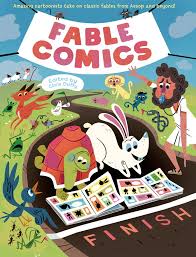
[READ: February 15, 2016] Fable Comics

Following up on First Second’s 2011 collection of Nursery Rhyme Comics, comes this new collection of Fable Comics, also edited by Chris Duffy.

Duffy says that for this collection they wanted to use mostly Aesop’s fables (because they are the most widely knows).  But the book also includes a sampling from other traditions.  He says that cartoonist were allowed to embellish the stories but we asked that the lesson remained.

And so there are 28 fables and the artists are pretty much a who’s who of contemporary comics.  I’ve broken down the Fables by their creators:

Aesop

The Fox and the Grapes-James Kochalka modernizes this a bit with a jet pack, which is hilarious.

The Town Mouse and the Country Mouse-Tom Gauld is back, and it’s great to see his work as he keeps the story fairly traditional

Hermes and the Man Who Was Bitten by an Ant ; Hermes and the Woodsman ; The Frogs Who Desired a King ; Hermes and the Sculptor. George O’Connor is responsible for the First Second Olympians series, so it’s no surprise that he tackles these stories about Hermes.  He remains faithful to the original and keeps up his very cool drawing style.

The Belly and the Body Members–Charise Harper has a wonderfully stylized look for this story about how the body parts need to work together or it can’t do anything.

Lion +Mouse–R. Sikoryak’s Mad Magazine style works very well for this familiar story about a mouse helping a lion (he has modified it somewhat of course).

Fox and Crow-Jennifer L. Meyer’s style is gorgeous.  This fable has a fantastic look to it with pale colors and circles of details.  I could look at it for hours.

The Old Man and Death–Eleanor Davis’s art is boxey and stark.  It works very well with this dark and Communist-looking story.

The Boy Who Cried Wolf–Jaime Hernandez.  I love when Hernandez does kids’ stoires because his characters are so perfectly cartoon and his colors are bright and fun.  His telling of this story is very good.

The Crow and the Pitcher–Simone Lia  I didn’t know this fable.  And I don’t really know how the beginning sets up the end. It shows crow as being very smart for others but the end has the crow being extremely smart for himself.   It’s a weird fable although it rings rather true.

The Dog and His Reflection–Graham Chafee does an awesome job of showing greed in others and leaving the dog’s story to be un-narrated.  He witnesses greed and acts accordingly.

The Dolphins, The Whales and the Sprat–Maris Wicks.  I was completely unfamiliar with this fable.  I’m also curious about how much Wicks has added.  I love that she adds some very funny factual details like that dolphins are actually a type of whale and that there are detailed asides about all of the animals throughout this story.  The moral is that they’d rather die than take advice from a sprat.  Still true today.

The Milkmaid and Her Pail–Israel Sanchez  This fable was also unfamiliar.  Sanchez’ drawings are stark and work well to tell this story of greed.

The Great Weasel War–Ulises Farinas.  This comes from a longer fable called The Mice and the Weasels.  I love Farinas’ art in this story.  The colors are spectacular and the creatures are great   And I love the moral is that they build these giant machines that cannot fight against nature.

The Sun and the Wind–R.O. Blechman. This fable was in Ava and Pip, so its funny to read it there and then see it here. Blechman’s simple drawings complement the story well.

The Hare and the Tortoise–Graham Annable’s art is great for this.  The tortoise is so crabby looking.  I’m unfamiliar with the deus ex machina that happens though.  It’s funny how many of these fables we may know without knowing them in total.

The Grasshopper and the Ants–John Kerschbaum’s art is so busy and full of detail, it’s really wonderful.  I’m unfamiliar with the ants asking the grasshopper to play for them at the end of the story tough.

The Thief and the Watchdog–Braden Lamb & Shelli Paroline. I really enjoyed the way these two created this fable.  The art is great–angular and simple but really powerful.  Having the dog explain why giving him meat won’t work is a great idea.

Demandes and His Fable–Roger Langridge.   I love Langridge’s clear lines and distinctive colors. He tries to get people’s attention and only succeeds by telling them a fable about Demandes.  I’m intrigued that his fable gets interrupted by himself.

The rest of the fables’ origins are mentions in parentheses after the title:

Leopard Drums Up Dinner (Angolan Fable)–Sophie Goldstein makes a fun visual of this story about animals trying to capture others with music.  I wonder how closely this aligns to the original, as its pretty crazy.

The Hare and the Pig (Indian Fable)–Vera Brosgol.  I didn’t know this fable at all.  Rabbit and Pig are arguing about who is best.  Leave it to fox to make the declaration.

The Demon, The Thief and the Hermit (Bidpai)–Keny Widjaja illustrates this amusing tale of a thief trying to join with a demon to rob a hermit

The Elephant in Favor (by Ivan Krilov)–Corinne Mucha.  I love that Corine modernizes the fable (the lion says Dude).  This is all about how everyone talks about the elephant.  He works slow but gets a raise. What makes him so great?  All the other animals speculate.  But it turns out that his ears are the real reason–for reasons other than the obvious.  This may be my favorite fable of all.

The Mouse Council (medieval European fable)–Liniers. This is the story of putting a bell on a cat and how no one wants to risk their life for the good of all.  Liniers’ art is spectacular.  I love the subtle shading of his drawings and then the rough drawings by the mice.

Man and Wart (Ambrose Bierce)–Mark Newgarden.  I love Ambrose Bierce but had no idea he wrote fables.  This one about people’s need for privacy and not belonging to a club is pretty strange.

The Hen and the Mountain Turtle (Chinese Fable)–Gregory Benton. I was unfamiliar with this story about a wise turtle saving a farm.

These collections of short pieces are quite wonderful. I wonder what genre First Second will tackle next.  #10yearsof01

Read Full Post »

1969  SOUNDTRACK: ABIGAIL WASHBURN-Tiny Desk Concert #101 (January 3, 2011).

abigailAbigail Washburn had plans to study law at Beijing University in China.   Before she left, she bought a banjo—she wanted to take something to China that was American.  Then Washburn went on a road trip to study the banjo and to learn some tunes. She found her way to the Augusta Heritage Center in West Virginia, then to North Carolina and then Kentucky to the International Bluegrass Association. It was there that she sat down with a few women to play music, and right then and there was offered a record deal. She blew off China ans has made a career as a banjo player–typical story.

In the ten years since then, she has been to China (with her banjo) where she learned Chinese folk music.  She now mixes American bluegrass and folk with Chinese folk music.  For this Tiny Desk, she plays three songs with her band Rob Hecht on fiddle, Jared Engel on bass, Jamie Dick on drums and Kai Welch on keyboards and trumpet.  She uses two different banjos, a normal sized one and, om the final track, a great big-bottomed one.

The first song “City of Refuge” she says is done in hop high tuning (in case you were interested).  It’s fun seeing how fast her right hand is moving while her left hand is fairly still and her vocals are fairly slow.

“Taiyang Chulai” is a traditional Chinese song meaning “The Sun Has Come Out and We Are So Happy.”  She sings in Chinese (and plays no banjo).  Her Chinese sounds amazing (and it’s really funny to see her speaking/singing it).  She says that taught American folk music in China and learned that she needed to do arm gestures since all Chinese folk songs have accompanying arm movements.  She also wore armbands which her grandma made for her.

“Bring Me My Queen” is the final song.  I found it interesting that her songs are rather slower than the Chinese song, at least in tempo.  This song is even slow for a banjo song.  But it’s quite beautiful.  In addition to being a great banjo player, Washburn has a lovely voice, too.

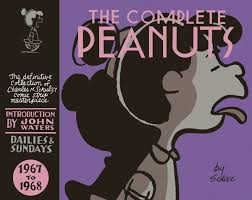
[READ: December 8, 2015] The Complete Peanuts 1969-1970

I was excited to get to this book to see which strip was published on my birthday (it’s sort of like seeing the headlines from the New York Times on your birthday).

Well, sadly, my strip was kind of boring–part of an annual be kind to animals or national dog week or something like that.  Nothing life-changing or earth-shattering.   Good grief.

I also decided that I’m taking a break from Peanuts for a time.  I have really enjoyed what I’ve read, but I need a breather.  I have read twenty some years of the strips over the last few months and, even if Schulz never rested, he didn’t condense twenty years into a few months either.  So sometime later in 2016 I’ll resume the books.

This book is notable for revealing Woodstock’s name!  I feel like that was the last big revelation that we’ll see for a while.  I am curious to see if the 70s added any new characters. (Well, there is Marcie.  I wonder when she comes along).

1969 starts out with Lucy saying that this is her year, “it’s all mine.”  Although a few days later she asks for a refund.  Lucy finally gets fed up with Schroeder and not only kicks his piano but throws it into the kite eating tree.  In March of 1970, Lucy says “I’m a new feminist.”

There’s a lot of Lucy/Snoopy rivalries.  In May 1969 we see the first an only reference so far to tether ball–Lucy is great at it (until Snoopy beats her).  There has been a somewhat recurring joke about Lucy beeping Snoopy on the nose (which he hates).  She does it in April and says it has been 384 days since she did it last (I wonder if anyone confirmed that).  In June, Charlie and his family go on vacation and Lucy is in charge of Snoopy (and she is particularly harsh).

Los of things happen to Snoopy this year.  As is per usual, Snoopy is skating in the winter time.  He is planning to win trophies (skating with Peppermint Patty–although she has to break the news that she is not interested).  He is also in preparation (in March 1969) to be the first beagle on the moon (wearing an astronaut helmet).  Surprisingly, there is no acknowledgement when the first man does land on the moon.

In April 1969, Snoopy goes on a two-week journey looking for his mom (but doesn’t find her).  In July of 1969 Snoopy takes up roller derby (for a very brief time).  In September of 1969 Snoopy finishes his first novel and submits it for publication. But he is rejected!  In Sept 1969 there are a lot of football jokes involving Snoopy and the little bird (the bird being too small to move a football of course).  March 1970 shows the return of the Easter beagle.

1969 sees a lot of talk of “Head Beagle.”  First Frieda reports Snoopy to the Head Beagle for not chasing rabbits.  Later Snoopy is appointed Head Beagle but can’t handle the workload.

In the summer of 1970, Snoopy goes to give a speech at the Daisy Hill puppy farm and a riot breaks out with tear gas!  And in September 1970 Snoopy wears a cooper bracelet to cure his arthritis.

In July 1970 Snoopy reveals a good truism “If you think about something at three o clock in the morning and then again at noon the next day you get different answers.”  Also in July is the first mention of “The Six Bunny-wunnies” fictional series of books.

For a few weeks in August of 1970 Snoopy pretends to be a grocery clerk (butter 28¢, bread 39¢, eggs 59¢, tea 79¢).

Lots of things seem to happen on the baseball field this year.

And in April 1969 Charlie Brown’s team wins two games in a row–neither team could make it so they both forfeit (Franklin is on one of those teams).  Later in June of 1969 Snoopy wins the Rookie of the year award for the baseball team.

In March of 1969 Linus make a sports drink which “replaces the body stores and prevents and diminution of vitally needed electrolytes and nutrients.”  (Gatorade was invented in 1965 and became popular with athletes in 1967).

Some great moments in this book:

In May of 1969 (on the baseball mound, of course) the team is talking about the costs of college “it can cost almost sixteen thousand dollars to go to college.”  The joke comes that Charlie is hoping for a baseball scholarship and every one busts out laughing.

In May of 1969 the school nurse is going to weigh them and Linus says he’s going to as about his hurting shoulder, “never pass up a chance to get a little free medical advice.”

In August, Linus’ gramma says she’ll donate $10 to his favorite charity, “ten dollars is a lot of money.”  (He ultimately decides not to accept).

In July of 1969 the little red-haired girl moves from Charlie’s street!  And Charlie never says anything to her.  Later in December 1969 Linus Charlie and Snoopy go skiing (on a school ski trip).   Charlie sees the little red-haired girl and falls off the ski lift.

Charlie makes a funny joke when he offers to shovel Lucy’s snow.  He asks for a quarter and she says “What if it snows tomorrow and covers up our walk again.  Do we get our quarter back?”  He replies, “No by then I will have spent it on riotous living.”

Peppermint Patty gets a lot of strips in these two years.  In Nov 1969 she talks about school: “I signed up for Folk Guitar, computer programming, stained glass art, shoemaking and a natural foods workshop.  I got spelling, history, arithmetic and two study periods.  I learned that what you sign up for and what you get are two different things.”  (I would TOTALLY sign up for those classes too).

She returns a lot in 1970–she’s a great character allowing Schulz to explore all different kinds of kids and ideas.  In the beginning of 1970 she is called to the principals’ office because she’s not allowed to wear sandals to school any more.  She cries and calls Charlie Brown for advice.  It takes Snoopy to kiss away her tear to snap her out of it.  The strip series ends with Franklin saying, “All I know is any rule that makes a little girl cry has to be a bad rule.”

Patty also says that she got an F on a test because she has a big nose–if a teacher doesn’t like your looks there’s nothing you can do.  Franklin looks at the paper and says “you turned in a blank test paper.”  She sighs, “there’s nothing you can do.”

In December 1970 Peppermint Patty invites Snoopy to a “turn about dance” (where the girls ask the boys).  They have a good time until a boy asks who her weird-looking friend is.  She punches him out and feels guilty about it until Snoopy says he had a great time and he’s the one who bit the chaperone.  Their friendship is great.

In Sept 1970 Patty has a crisis–thinking she’s not beautiful  (then Snoopy gives her a kiss).  The following week her dad gives her a dozen roses and says that the boys will be calling on her when she grows up and he wants to be the fist one in her life to give her a dozen roses.  It brought tears to my eyes.

In June of 1970, Peppermint Patty asks to borrow Charlie Brown’s glove for a kid on her team named “Thibault.”  Which leads to Charlie asking “Thibault?” at least twice.  Then Thibault (who has sideburns), refuses to give the glove back.  But Charlie Brown is happy by this because Thibault accuses him of “thinking you’re better than us.” And Charlie gleefully says “Me?  Better than someone else?”

1969 ends for Charlie when he buys a ticket to a sports awards dinner.  He gets a seat right next to Joe Shlabotnik…who never shows up.

This strip really sums up why Charlie Brown is so likable.  On October 26 in which Linus describes an amazing football game in which a team makes an amazing come from behind victory with seconds left in the game .  He describes the great plays and then Charlie’s response is “How did the other team feel?”

Sally is starting to become a more fully developed character–opinionated but often horribly wrong.  In May of 1970 she buys a fish tank saying “This is the age of aquariums.”  And she has no tolerance for school.  In Sept 1970 she asks why they have to learn all of these things in school.  Why does she have to learn the names of rivers?  “I’ve never even seen a river!  They could at least take me to see a river.”  Later she writes a theme for school, “If I had a pony:”  “If I had a pony I’d saddle up and ride so far from this school it would make your head swim.”  Then she crumples it up and says “That’ a good way to get a D-minus.”  In Nov she shows the class a document that is written by “an actual caveman.”  The punch line: “Show and Lie is my best subject.”

The best Great pumpkin joke comes in Oct 1970 when Lucy says “Santa Claus has elves to help him…what does the great pumpkin have, oranges?”

There are a couple of topical jokes.  In July 1970, when it rains during a game Lucy starts singing “Raindrops Keep Falling on My Head” (which was a hit in early 1970).  And in December 1970, the kids use a Ouija board which had been released as a game earlier that year.

And then on June 22, 1970 the little bird reveals his name to be Woodstock!  (strangely it was a year after the concert).  With a name he acts no differently.  In Nov 1970 Woodstock tries to fly south but gets lost.  So Snoopy walks with him.  After a week they get grabbed by a girl who say “Ma, I found a stray dog!”  Then Snoopy is tied up for a few days while Woodstock tries to rescue him.

The year ends with Sally doubting whether you really have to be good for Santa to bring you presents “the old rascal is bluffing…I know that [he] will bring me presents whether I am good or not.”  Then on Christmas Day, ”I was right!”

This was a great book, with some excellent strips and character developments.

Mo Willems, beloved children’s author, wrote the foreword.  Mo says he started his career by selling black market drawings of Snoopy and Charlie Brown in second grade.  He learned that even bullies liked Charlie Brown.  He says he could utterly relate to Charlie’s world, “For me, an immigrants kid, recently plopped into the middle of a small school in the insular world of uptown New Orleans, Charlie Brown was the only one who understood how confused and unhappy I felt.”

He says he aspired to Linus-ness: to be wise and kind and highly skilled at making gigantic structures of playing cards.  But he knew he was always a Charlie brown.  “Sometimes when I am in a deep funk and feel like my life if is an uphill battle…I try to stop and imagine someone reading the comic strip of my frustrated life and laughing.”

All of his characters are an homage to Schulz in some way.  And the greatest lesson her learned from Schulz, is “never let the characters know they are funny.”

He concludes by saying that Peanuts isn’t Art… it’s better.  He toured the Charles M. Schulz Museum and Research Center and held an original comic but he found it anti-climatic.  They were too precious to be enjoyed…they became Art.  The magic that you get from having them in a book or newspaper was missing.

Read Full Post »
1967 SOUNDTRACK: JULIAN LAGE TRIO-Tiny Desk Concert #140 (July 7, 2011).

lageJulian Lage is a jazz guitar prodigy.  he normally plays with a quintet but for this set he brought only a trio which includes bassist Jorge Roeder and percussionist Tupac Mantilla.

This was my first exposure to Lage and he does some really impressive lines and riffs.  He plays a hollow-bodied electric guitar that sounds an awful lot like an acoustic guitar. He does some phrasings that are really pretty or really interesting

But I was more impressed with Mantilla on percussion.  He uses thick brushes, he uses his hands on bongos and cymbals.  He uses his hands on his body–playing his lap and chest).  He even uses little dusts brooms (which must be unwieldy).  He’s also got some kind of drum (perhaps a loose snare?) with a great sound and even a bell.

They play three songs.  “Welcoming Committee” is a new song not recorded as of then.  At the end of the song, they all laugh as an office phone rings the end.  Julian is a sweet funny guy with some interesting stories about his songs.

“However” is an upbeat bouncy song (with some less noodling).  Interestingly, it was written by their saxophonist who is not playing in the trio today.

Before introducing the final song “Untitled (No. 24)” he says he started a blog for inspiration–to get people to bounce ideas off each other–healthy peer pressure with incentives for song writers.  The most recent one was a song a day for 30 days.  This was number 24.  (Hhe jokes that the first 23 sucked).  It’s a really fun piece that doesn’t feel incomplete at all.

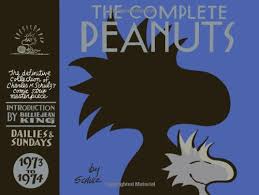
[READ: December 8, 2015] The Complete Peanuts 1967-1968

It’s 1967 and Schulz has had huge success with Snoopy’s Red Baron plots.  In December 1966 The Royal Guardsmen made a song called “Snoopy Vs the Red Baron” which made it to number 2 on the charts.  So The Red Baron plot takes over a lot of this year.  And while I enjoy seeing him like that and I get how it’s funny, I don’t really like it all that much–the jokes are too samey for me.  But despite all of the Red Baron excitement there are other things going on this year too.  Like the introduction of the Easter Beagle.  And of Franklin!

The kids get involved in many different sports this year.  In Feb 1967 Lucy begins arm wrestling (and beating) everyone.  She even takes on the Masked Marvel (Snoopy).  In Oct 1967 Snoopy plays hockey for the first time (I think).  He references Bobby Hull).  Later in Jan 1968 all the kids play hockey together.  Lucy beats everyone up and say how much she likes the game.  And at one point Snoopy smiles and is missing teeth.  In Oct 1968 Snoopy shoots and scores (on his doghouse) and says “they’re not sleeping well in Montreal tonight.”

In December 1967 Snoopy considers going to the Olympics in France for his ice skating.  He says he misses skating with Sonja Henie).  In April 1968 Snoopy is going to the Masters in Augusta.  When that doesn’t work out (we never see him there), later in April Snoopy is a wrist wrestler who is going to go to Petaluma for the world competition.  (There are many jokes about Petaluma).  Snoopy is disqualified because he has no thumbs.

In August 1968 Snoopy says “jogging is my thing.”  And in Nov 1968 we learn that Snoopy has a pool table but that Minnesota Fats won’t play him.

And of course there is baseball.

Peppermint Patty comes back in March 1967 to play against Charlie’s team.  She has a new player, Jose Peterson, who doesn’t really hang out in the strip for very long, but who is an awesome slugger.  In November of 1967, there’s a reference to the lousy New York Mets.  I didn’t realize it but at the time of this strip, the New York Mets were a recent expansion club with a terrible record.

In summer of 1967 Charlie and snoopy return to camp and they see Peppermint Patty is there.  Patty strikes out Charlie a whole bunch and says she considered letting him hit one but he wouldn’t want that, right?

In march of 1968 snoopy takes over as manager and is really mean.

And of course, Snoopy has a lot going on too.  We learn that August 10 is Snoopy’s birthday.  He also says a lot of things are gauche.

In a very funny skit, in May 1968 Snoopy watches a bird chomp a worm and then says “I’m going to be very very very very very very very very sick.”

June 1968 introduces Lila again, and how Snoopy pines for her.  Then in August she writes to Snoopy again.  And finally on Aug 24 we meet Lila for the first time.  Lila is a girl in the hospital.  But it’s not until the end of the month that we learn that Lila was Snoopy’s previous owner who lived in an apartment and had to get rid of him.  AND THAT’S ALL THAT’S SAID ABOUT IT!

On a lighter note, in March Snoopy pretends to be a piranha for a few strips.  In April 1967 there’s some Cheshire cat jokes from snoopy (who is only a smile)  April 1968 sees the first mention of the Easter Beagle (Lucy doesn’t believe Linus who is the only one to see him).

Linus and Lucy pop up a lot of course.  They revisit a lot of the same ideas with variations.  In August Linus’ grandma agrees to give up smoking to get Linus to give up his blanket.  He thinks she’ll never do it, but he goes through the real withdrawal.

In Dec 1967 Lucy ups her psychiatrist booth’s price to 7 cents (winter rates).  And then as the book ends in Dec 1968, Linus is taking shorthand notes for her.

Father’s Day this year had Peppermint Patty writing a card.  She says that her dad calls her a “rare gem,”  This phrase is used as a joke in the strip and then a few more times.

It seems like summer is a good time for new things as well.  There are two weeks of strips starring Peppermint Patty at camp!  She is a counselor of littler kids.  There is a little girl who looks like Marcie but isn’t (her name is Clara).  And then later that week another little girl, Sophie, calls her “Sir.”

And then July 31, 1968 introduces Franklin!  He and Charlie play at the beach for a few days.

Religion pops up from time in the strips, especially with quotes from the Bible.  But in March 1967, Violet asks Charlie if they go to church.  He says yes, but she says her family “used to…now they belong to a coffee house.”  And in April Schulz revisits the “here’s the church gag.”

[From the Peanuts wikia] On February 8, 1963, Sally watches while her big brother uses his hands to illustrate that old rhyme: “Here’s the church…here’s the steeple…open the door…and see all the people!” After carefully examining his closed fingers, she announces, “It looks like a rather small congregation!” Four years later, on April 8, 1967, Sally watches as Linus delivers the same rhyme…and then she provides an almost exact response: “Sort of a small congregation.”

Most of the strips are totally timeless, with me even thinking that I read some of them when I was much older than I did.  I can’t say as I remember a lot of specific strips, but I always remember the one from Dec 5, 1968 (which is from before I was born, so I obviously read it in a collection).  Peppermint Patty says that it snowed last night Her dad says that “when it snows you should always take a slice of bread out for the birds.”  She places a whole slice on the bird’s head.

I think the timelessness of the strips are what make reading these volumes so much fun.

In May 1967, Charlie asks Linus if he wants to be the first man on the moon.

In July 1967, the bird (unnamed yet) has “long hair” and Snoopy calls him a bird hippie.

Charlie writes to his pencil pal in Nov 1967 and says, “According to what I read, your country hates my country and my country hates your country.  I don’t hate you, and I don’t think you hate me.  I think about this a lot.  It makes sleeping at nigh very difficult.”

In Jan 1968, the girls are going to have a “crab-in.”

Dec 18 1968 Snoopy has a sled and Charlie looks at it and says “Rosebud?”

In June 1968, Snoopy says he thinks he is in love with Twiggy.

In August, Snoopy says that you never hear anyone sing “Chloe” anymore (although which song that is, I’m not sure.  Perhaps the Al Jolson one).

In Nov, Snoopy says he is feeling groovy (the Simon and Garfunkel song came out in 1966).

There are references to the election year with the birds holding ups signs that say ? and !!  Snoopy say he’ll vote for the one with the paw print on it.

My two favorite jokes in the book have to do with math.

Sally is trying to learn her times table and guesses answers like “Four-thousand six? elventy-twelve? fifty quillion? overly-eight?  twiddelty-two?”  Then she  asks “Am I getting close?” And Charlie responds, “Actually it’s kind of hard to say.”

In Dec 1968, Peppermint Patty says she loves numbers.  “Twos are sort of gentle, threes and fives are mean, a four is always pleasant.  I like sevens and eights too, too but nines always scare me.  Tens are great.”  When a classmate asks if she has prepared her division homework, she says “Nothing spoils number faster than a lot of arithmetic.”

~~~~

In my edition the May 1 strip is repeated instead of the May 3rd strip! (The missing strip will apparently be printed at the end of the next book).

John Waters give the best foreword yet.  He actually references strips in this book!

He says he became obsessed with peanuts when he had mono in 6th grade.  He loves the depression paranoia and delusions.   But John was all about Lucy.  He loves her politics, her manners “Get out of my way!” her narcissism and her rants.   He says he has a niece named Lucy and Schulz got the expression perfect when she yells “No” on page 61.

He also says that for the most part the strips don’ age at all (with a few exceptions).  He talks about Lucy shouting “police brutality” at Charlie as a crossing guard!  He also says that Schulz was criticized for including the minority characters (which is shocking).  Waters is also fascinated by characters like Roy who are rarely if ever heard.

Pig-Pen was an inspiration for Dingy Dave in A Dirty Shame; Divine cutting up her daughter’s jump rope in Female Trouble is inspired from a Peanuts strip.

He sums up with the attitude that Peanuts presents:

You are dealt a hand.  Deal with it.  But most importantly he teaches all ages that if you can learn to laugh at the things that cause you the most pain, you will be the strongest of all.

Read Full Post »

skin SOUNDTRACK: LOS LOBOS-Tiny Desk Concert #90 (November 10, 2010).

loslobosI don’t really know all that much about Los Lobos.  I frankly got sick of them because of “La Bamba” (which came out 20 years ago!) and I don’t think I’d ever heard much else by them.  So I wound up enjoying this Tiny Desk much more than I anticipated.

The one big problem with this tiny desk is that the drummer is playing one of those plastic mail bins and it sounds awful.  Especially on the first song.  I think anything would have had a better drum sound than that.

I really enjoyed the first song “Burn It Down.”  It has a propulsive minor key structure and an excellent bass line.  I would never have guessed it was Los Lobos, but that may be because it’s not the singer I most associate with them (he sings on the next two songs).

“Yo Canto” is a cumbia, sung by a different guy (in Spanish) who also plays lead guitar.  The mail bin sounds better on this song because of the placement (and use of) a cowbell.  The singer sounds amazing.  I rather like the riff that underlines the song.

Those two songs are from their then latest album.  And the band sounds really good all these years on.

The final song is “Don’t Worry Baby.”  It has the same singer as the middle song (this time in English) although it is a pretty standard blues song that I found just okay.  It also features a bunch of saxophone.  I didn’t realize that it was from their major label debut in 1984! and is something of a classic.

So three songs, all of them enjoyable, from a band I didn’t really think I’d enjoy.  The funniest part is just before the show stops and someone asks, “Okay, where’s the beer?”

[READ: October 1, 2015] How to Skin a Lion

This book sounded awesome–I love outdated things that we can laugh about now (because I’m a superior git, of course).

But this book proved to be not all that funny.  The outmoded advice wasn’t treated comically exactly (well, some was), rather it was looked at rather seriously–some as good advice that still stands, some as crazy advice that is way outmoded and a few things that are, yes, just comical.

Cock-Starkey (insert joke here) says that this is a collection of materials from the vast archives of the British Library.  It culls from medieval manuscripts, Victorian manuals and self-help guides from the early 20th century.  She explains that the book aims to reveal the secrets of lost arts, remind us of how modern conveniences have changed our lives, recall the complexities of etiquette, highlight changing attitudes and beliefs and furnish us with still useful tips and guidance.

Although she also points out that readers should be advised that some pieces of advice contained herein have stood the test of time better than others. (more…)

Read Full Post »

« Newer Posts - Older Posts »