Feeds:
Posts
Comments

Archive for the ‘Adventure’ Category

SOUNDTRACK: AL ATKINS–“Victim of Changes” (1998).
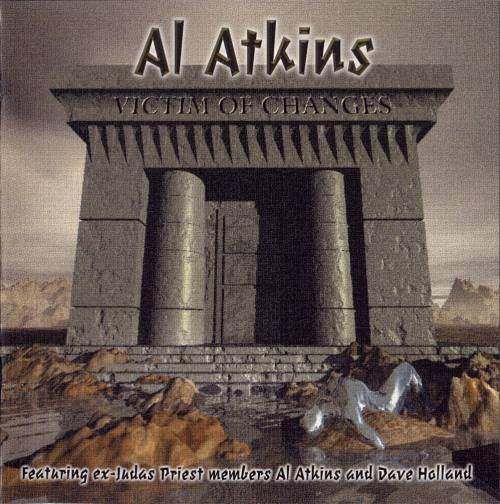
Al Atkins wrote “Victim of Changes,” one of Judas Priest’s greatest songs.  And then he left Priest to get a real job.  In 1998, he released the album Victim of Changes which contained a number of early JP songs, primarily ones from Rocka Rolla, but also this title track.

This version is quite faithful to the JP version (which is interesting because the early notes say that “Victim of Changes” was a melding of two songs).  It’s fascinating, in hindsight to wonder if this is how the song really sounded (there are a few differences in it) or he is now covering the JP version.  But the big difference of course if Atkins’ voice.  In the middle, slower section he sounds quite a bit like Rob Halford.  But he just cannot hit any of the notes that Halford brought to the song.  And there’s really just no way to compete with that (even with multitracked and over-processed vocals).

It’s really hard to compare this (and other songs from that album) to the original.  I mean, he wrote them, after all.  But man, the Priest version is just so much better.  Atkins has a strong, gruff voice.  It works well for the style of the songs, but it just isn’t anywhere near as compelling as Halford’s.  The other problem is the music–the guitars are full of cheesy pyrotechnics that overshadow the songs (I like guitar pyrotechnics if that’s what the song is supposed to be about, but not when it’s meant to “embellish” a song).  It sounds like he is trying way too hard here.  Atkins has his own solo career and his own band, he really needs to get past the JP thing, especially since he left of his own accord.

This is the version of “Victim of Changes” from Victim of Changes:

But for heaven’s sake, don’t listen to the more recently recorded version of “Victim of Changes” (yes a second recording–he’s got to let it go) from his 2007 release Demon Deceiver (available on Spotify!)–his voice is lower and gruffer (almost cookie monstery) and guitar solos are just covering all of the song.

Yipes.

[READ: September 12, 2011] The Viper’s Nest

When I finished the fantastic Book Six of the 39 Clues, I put it down and immediately picked up Book Seven.  It opens with a dramatic rescue from an exploding volcano.  When the ash settles, Dan and Amy find themselves on Irina Spasky’s boat.  And in this boat they find Irina’s bag, which contains all kinds of spy stuff (like IDs for every one involved in the 39 Clues search and fake fingerprints and whatnot).

They also find a letter with what looks like lyrics.  I have to credit Peter Lerangis with the wonderful work on this clue.  The clue is a line from a song: “I’m with you and you’re with me and so we are all together.”  Nellie (who is still under suspicion, but seems to have been given a free pass) says that she never guessed Irina would be so cool as to listen to the best song ever by Velvet Cesspool (on the album Amputation for Beginners).  It’s track three, “The Tracks of My Spit” and it goes: “I’m with you and you’re with me and so we are all together….  We are marching to Peoria!”  The kids are all set to go to the exotic locale of Peoria, Illinois when, through a series of events, they realize that the song Irina was referring to was a traditional folk song called “Marching to Pretoria.”  And that they are actually headed for South Africa.  [Incidentally, I just learned that the opening line of “I am the Walrus,” “I am he as you are he as you are me and we are all together” is actually a reference to this folk song].  Check out this video of “Marching to Pretoria” by a guy who has not doubt gotten a lot of hits because of this book.

Anyhow, this book spends most of its time in South Africa.  And Dan, the non-reader of the family, finally finds a book worth reading.  It’s all about Shaka the warrior of the Zulu nation.  Dan reads a lot of information about the man and his military techniques.  Which is a good thing because the kids find themselves in the center of a Tomas family stronghold (the Holt family are the members, so you know their speciality is tough fighting).  The details are quite fascinating.  In the end, they are able to find a clue and to create some wonderful battle scenes in the process.  (more…)

Read Full Post »

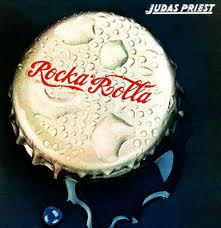
SOUNDTRACK: JUDAS PRIEST-Rocka Rolla (1974).

Unlike Sad Wings, Judas Priest’s debut album is more of a curiosity than a cool surprise. I love this original cover–the new release has a crazy drawing on them that doesn’t make any sense with the title.  Admittedly the title is kind of dumb, but the riff on Coke works.  With the new cover, see below, the title just sounds dumb now.

The album is mostly heavy blues songs.  Although the title track has some bizarre disco elements thrown in as well (including the lyrics).  The chugga chugga in the choruses is not the chugga chugga of metal, but the chugga chugga of disco.

The biggest surprise comes with the third track, the oddly titled, “Winter/deep freeze/winter retreat/cheater.”  It’s 9 minutes long and is not so much an epic as multiple weird little pieces thrown together.

“Never Satisfied” is the closest they get to their future metal sound.  But it owes a big debt to Black Sabbath (down to the guitar sound which has the little high note in the chords that Iommi plays on parts of “Paranoid”–a sound I was always confused by but which seems to have inspired K.K. Downing).  Nevertheless is rocks pretty hard.

“Run of the Mill” has the potential to be a good rocker.  But the 8 minutes of it are rather unfocused and there’s a trippy jam in the middle.  (Again with a major Black Sabbath debt underway).  “Dying to Meet You” also has a cool sinister sound.  Both of these tracks would be well served with a better producer. The second half of this nearly 7 minute song is probably  the most metal sounding of the whole disc, although the guitar solo sound has a very Allman Brothers feel to me.

The final track “Caviar and Meths” is a two-minute instrument that is very reminiscent of trippy” Planet Caravan” style Black Sabbath.  It’s rather groovy and I’ve always liked it.  The reissue has  the band’s cover of “Diamonds and Rust.”  Because all metal bands should cover Joan Baez!

Wikipedia explains something about this album which make me feel better about it.  Apparently the band was really unhappy with the production.  Several heavier tracks were left off the album by the producer (they were later recorded for Sad Wings).  And that odd little 2 minute instrumental “Caviar and Meths” was originally a 14 minute epic written by the guy who preceded Rob Halford.  (He evidently recorded a 7 minute version of the song).  Indeed, many of the songs were written by Halford’s predecessor and Downing, so they are lacking Halford’s input. (the page was very helpful for me).

[READ: September 11, 2011] In Too Deep

Since Book Five was so awesome, I couldn’t wait to move on to Book Six.  Book Six is the first book written by an author who has written a book already (Watson wrote Book 4 as well).  At first I feared that Watson was going to squash my enjoyment of the series; it felt like there was a lot of recapping going on (I know that in a series like this a recap is necessary for people who pick up book 6 instead of book one, but it can be frustrating when you know all that backstory already).  However, at the same time, Watson also started the story in the middle of a scene, so everything was brand new, fast paced and a little disorienting.

I’m happy to say that once the story got going Watson really pulled out all the stops and this made Book Six the most exciting book so far.  In this book they travel to Australia.  As anyone who has looked into Australia knows, most of the deadliest animals on the planet live in Australia (woo hoo!) so that makes Dan quite excited.  Australia is also a much looser place to explore than some of the tightly controlled areas they have recently visited–there’s no guards in the outback.  And, when the kids hook up with an old friend of the family, Shep, they have access to tasty waves, tasty barbie, and…most awesomely, a plane.

They also have access to Isabel Kabras.  Isabel is the mother of Ian and Natalie Kabras–two teens who are rich, spoiled and ruthless.  They tried to kill Dan and Amy once, and Ian, who is a hottie, has some kind of sway over Amy–especially when Isabel tells her that Ian secretly likes her.  Isabel tells Amy that she has information about how Dan and Amy’s parents died.  She will tell her all about it if they can meet in private.   And so, for the first time in the series that I can recall, Dan and Amy are separated.  She meets the Kabras, and Isabel is looking for a trade.  Amy is suspicious, of course, and that leads to the first of many deadly animals.  It’s safe to say that Amy survives but I won’t say how–it’s very cool. (more…)

Read Full Post »

SOUNDTRACK: JUDAS PRIEST-Sad Wings of Destiny (1976).

Before Judas Priest were the force behind “Breaking the Law,” they were still pioneers of heavy metal.  Except that their metal was tinged with all manner of odd progressive embellishments.  Like “Victim of Changes,” an 8 minute (!) multi-sectioned (!) epic. It’s got a great heavy riff and, damn, if Rob Halford’s vocals aren’t the highest-piched in music (I mean, we know he has a powerful voice, but the notes he hits–good grief man!).  The middle section is a delicate ballad that mellows out with breathy sighing and with very sixties-era backing vocals until Halford bursts out of that with his piercing wail.

It’s followed by “The Ripper” a classic metal song.  The best known version comes from Unleashed in the East, so it’s interesting to hear this earlier version where, for instance, “You’re in for a shock,” is followed by a different person’s scream, not Halford’s wail of the word “shock.”  It sounds a little slower but somehow a little more creepy (especially the quiet middle section).

“Dreamer Deceiver” is a creepy quiet song which seems to herald the vocal acrobatics of King Diamond, but this song has a lot more emotion to it, even if it is pretty trippy (like a cooler version of Black Sabbath’s “Planet Caravan,” perhaps).  The piano at the end is a really nice touch and leads into the confusingly named “Deceiver,” a very chugga chugga metal song with more great high notes. 

“Prelude” opens with more piano (technically this song opened the album when it was on vinyl…the cds all seem to have sides A nd B reversed so now this prelude is in the middle. It’s a dramatic near-orchestral opening (that many bands would imitate much later) to the killer track “Tyrant.”  “Tyrant” sounds just as menacing here as it does on the live album except for the backing vocals that sort of slouch through the word “tyyyyyrant”–in the live version Halford crams it all into one breath.   It’s followed by “Genocide” a brutal song that has withstood all of these years as an awesome metal track.

Unlike “Epitaph,” which is a completely strange ballad about a dying man.  It is all piano, it is quite poetic and is indeed quite sad (especially the final line reveal).  But the middle ‘upbeat” section sounds not unlike an Elton John track.  It’s quite peculiar, especially when it ends and the chugging riff slowly builds out of the ashes that turns into the stunning “Island of Domination.”  This is a disturbing track with really creepy lyrics but with awesome music.  The middle section (again with the middle section–did bands just forget about doing cool middle sections in the 80s?) slows the track down with all kinds of echoed vocals.

Although it sounds dated, it still holds up remarkably well as a precursor to later metal albums.  It’s one of my favorite Priest releases and one that I come back to time and time again.

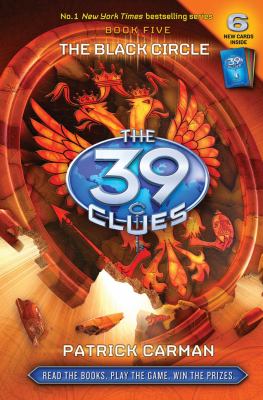
[READ: September 8, 2011] The Black Circle

I haven’t read a 39 Clues book in a couple of months.  It’s not that I was losing interest, I just had other things that I wanted to read more.  But I will admit that a ten-book series (and now a second series) can be a bit daunting.  I’d also never read anything by Patrick Carman before, so I wasn’t chomping at the bit to get into the story again.  Well, Patrick Carman has completely revived my interest in the series.  The first nice thing was that the book is only 168 pages (sometimes a short book can really pick you up).  But aside from that, Carman brings all kinds of cool elements into the story and has more than enough intrigue to keep you guessing and turning pages.

But I was initially concerned about reading this book because Carman reintroduces my least favorite nemeses in the book: the boring and doltish Holt family.  They are big, tough, meat- heads with ridiculous political first names like Eisenhower, Hamilton and Reagan.  And every time we’ve seen them, they’ve been brutish and mean and not terribly clever (and this series is chock full of cleverness, so these guys really stand out like a sore thumb).  But Carman does a wonderful thing with the Holts: he forms a (temporary) alliance between Dan and Amy and the Holt family.  And although it is an uneasy alliance, about midway through the book, we see Dan and Hamilton (the Holt’s son) bonding over driving big powerful trucks and flying helicopters.  It’s nice to see Dan have a “friend,” however tenuous. (more…)

Read Full Post »

SOUNDTRACK: METRIC-Live at the 9:30 Club, June 18, 2009 (2009).

I love the new Metric album and this tour supported that disc, so, it’s a win-win for me!  Metric sound great live, and the notes on the NPR page where I downloaded this give a fascinating history of the band.  Evidently they burnt out in 2005 while touring for Live It Out.  So they made solo records and kind of went their separate ways.  Then:

in March 2008, Haines was on stage, in the middle of a live solo performance, when she had an epiphany: She was tired of being sad. While playing one of the standout cuts from her gloomy but beautiful album Knives Don’t Have Your Back, Haines stopped, turned to the audience and said, “I don’t want to play these songs anymore.” Instead, she spent the rest of the show performing her favorite Metric tunes.

The band reunited and made Fantasies, the poptastic album that I love so much.

This show plays pretty much all of the album (except “Collect Call” and “Blindness”) and they rock the house!  The only odd part for me is the opening track, “Satellite Mind.”  The band chose to have the first half of the song performed with just the keyboards, so it has no bottom end at all.  It sounds kind of tinny and weird.  Then when the guitars and bass kick in (for the rest of the show, thankfully), the band sounds whole again.

The other weird thing is Emily Haines’ banter.  I like chatty lead singers (–The Swell Season’s banter is great, Wayne Coyne’s banter is emotional but enjoyable), but there’s something about Haines’ musing that are just kind of…lame.  She’s very earnest, but her thoughts are kind of, well, vapid.  So, I just skip past all the chatter and enjoy the music.

It’s a really great, rocking set and the crowd is very into it.

[READ: August 25, 2011] Atlas of Remote Islands

If you need an unusual but doubtlessly cool book, my brother-in-law Ben is your man.  For my birthday and Christmases he often gets me books that I have never heard of but that are weird and interesting.

This book is no exception.  As the subtitle states, this is a book about fifty remote islands that virtually no one lives on.  True, some are inhabited, but many are not.  And a goodly amount of them are little more than icebergs (I wonder how they will survive global warming).  There’s even one that the accompanying story implies was created from bird droppings. (more…)

Read Full Post »

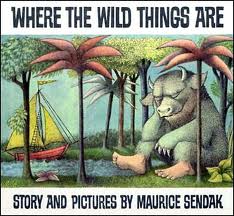
SOUNDTRACK: President Obama reading Where the Wild Things Are (2009).

A President who is literate!

Apparently my video won’t fit here unless I space this section out better.

I don’t really have anything to say, except that I enjoyed hearing him read this.

And it’s fun to watch the Secret Service pretend to be invisible.

One more line should do the trick.

See the video here.

[READ: August 24, 2011] Wild Things

Okay, so this is a novel.  It is based on Where the Wild Things Are, the film by Spike Jonze and Where the Wild Things Are, the book by Maurice Sendak.  Obviously, Sendak’s book came first.  But, it’s only got about 60 words in it.  So, how do you make a film based on it?  Eggers and Jonze worked together for a long time to craft a screenplay and then (as Egger’s Acknowledgments explain) Jonze more or less took over the film and Eggers went off to write this book.

Hence, the book is fully titled:

The Wild Things: A Novel by Dave Eggers Adapted from the Illustrated Book “Where the Wild Things Are” by Maurice Sendak and Based on the Screenplay “Where the Wild Things Are” co-written by D.E. and Spike Jonze

I had read Egger’s except “Max” that was printed in the New Yorker ages ago and I liked it well enough, but it seemed so much like WTWTA, that I wasn’t sure what the point was (I didn’t realize it was an excerpt and, strangely enough, it’s an excerpt from several sections).  And since I had seen the film not too long ago (and honestly was kind of bored by it) I wasn’t really that excited about reading this.

But since I loved Zeitoun and this fur-covered book has been sitting near my bed for a couple of years now, I decided it was time.  And I really enjoyed it.

Well, here’s the thing.  This book is not a novelization of the film.  You notice that right away because the first chapter (which is awesome) is not in the film at all.  In it, Max rides his bike to his neighbor’s house.  His friend is not home but his mother is and when she sees Max all by himself and on his bike without a helmet she freaks out (even though they live about four houses apart).  His reaction and her overreactions are really very funny.

There are scenes from the movie in the book, of course.  It is adapted after all.  Indeed, it is more or less the same as the book, but there are many scenes which Eggers has added that really help to flesh out the story and give depth to everyone involved.  As a matter of fact, Max doesn’t reach the Wild Things’ Island until page 100 (out of 285 pages). (more…)

Read Full Post »

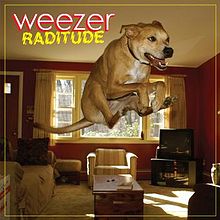
SOUNDTRACK: WEEZER-Raditude (2009).

I didn’t buy this Weezer album when it came out because I had heard really bad things about it (like the “guests”), but when I saw it cheap I decided to check it out.  This has to be the most polarizing Weezer album of them all.  I listened to it twice yesterday.  The first time I thought I had been too harsh on it.  The second time I thought it was godawful.  It’s amazing what a couple of hours can do.

It opens with a wonderful bit of poppy wordplay ala Cheap Trick: “(If You’re Wondering If I Want You To) I Want You To.”  It’s catchy as anything and is a wonderful start to the album, even if it is probably their poppiest song ever.  From there though, the album really degenerates.  And mostly it’s because it’s so dumb.  I mean the album title should tell you what you’re in for, but who would have expected the moronic sub-pop-metal of “The Girl Got Hot” or even the reprehensible lyrics of “I’m Your Daddy” “You are my baby tonight And I’m your daddy.”  It’s just creepy.  Or gah, a song about the mall?  “In the Mall.”  It’s not even worth mocking.  And really, try to picture Rivers Cuomo in a mall.  Any mall.

But nothing could prepare anyone for “Can’t Stop Partying.”  Unlike Andrew WK’s ouvre, which is so sincere about partying that you can’t take it seriously, this song really seems to be about the guys partying.  It’s laughable.  The anemic rap but Li’l Wayne certainly doesn’t help.

Even the collaboration with Indian musicians on “Love is the Answer” (yes, seriously) doesn’t really work.  It feels like they wrote the song and then said, “Hey let’s throw some sitar on it.”  It’s not enough to be exciting but too much to ignore.

This is not to say that these songs aren’t catchy.  I mean, geez, I still have “Can’t Stop Partying” in my head while I’m listening to something else.   Rivers knows how to write a pop trifle.  And the more he writes songs like this, it makes me thing that Pinkerton was the fluke.  Which is fine. The music world needs poppy songs, right?

[READ: early August 2011] various nonfictions

I thought about doing individual posts for all of Arthur Bradford’s non-fiction that’s available on his website (that’s right,  yet another author that I have read short uncollected pieces by without having read any of his bigger works–I’m looking at you Wells Tower).  Bradford has links to all of his nonfiction ( I assume) on his website.  There are 12 links in total.  One is to his blog (which I’m not reviewing).  The rest are for articles covering a pretty broad array of topics from a pretty broad variety of sources.  (more…)

Read Full Post »

SOUNDTRACKSUPERCHUNK-Superchunk (1990).

Some time ago, I reviewed all of the Superchunk EPs.  After progresing to their most current music, returning to their first album is a bit of a shock.  Superchunk’s first full length album is incredibly raw, with lots of screaming (two vocalists at once, even) and a very grungy attitude.  It has a DIY aestethic, in keeping with the undeground scene at the time.

The first four songs fly past in a pretty quick blur of adrenaline (the longest is just over 3 minutes).  The fifth song, the aptly named “Slow” slows things down and strecthes things out with a five minute track of slow distorted chords and a long solo.

Of course, the pinnacle comes with the next song “Slack Motherfucker” one of the best grunge anthems of all time. 

The last four tracks speed things up again with the bratty attitude that Superchunk is so good at (see especially “Down the Hall”).  But it’s not all just blistering speed.  The band has some dynamics down and there are a couple of tempo changes as well.

The album is a lot of fun to listen to, especially if you’re lookig for grunge before it became Grunge.  Although there’s very little indication that they would become the indie superstars that they eventually became you can clearly hear proto-Superchunk chunks–Mac’s voice is as it ever was and the noise is present but not overpowering.  There are even hints of melody (although nothing as catchy as later albums).  And yet for all that it sounds like a criticism, the album is really quite solid.

[READ: June 15, 2011] The Hollow Planet

Yes, THAT Scott Thompson, from The Kids in the Hall.  I found out about this comic book from my good friend Jessee Thorne at The Grid.

The backstory is that Scott Thompson had been working on this story for years and years.  He imagined it as a movie (starring him, of course).  When that didn’t pan out, he decided to sell it is a comic book.  And while he was recovering from cancer, he worked on it extensively with Kyle Morton–character likenesses and whatnot.  And now we have a cartoon rendering of Scott Thompson!

This story focuses on Scott’s character Danny Husk…

The book opens with Danny and his wife and kids at a carnival.  After a few moments, Danny’s son gets lost on the merry-go-round.  In the next scene we see just how much his wife is estranged from him (she may even be cheating on him), and how little his daughter thinks of him.  Soon after, Danny goes to work, inserts a disc into his laptop and more or less brings down his company.

So far nothing out of the oridnary for this type of  story–henpecked husband on a quest for revenge that he doesn’t know he wants yet.

Then Danny visits with his old friend Steve.  They talk, they bond over Danny’s concern about his wife.  And Danny feels better.  Until he gets home.  After a scene which I won’t spoil, the story suddenly takes off with a high speed car chase (no kidding) and with Danny entering the titular hollowness of the planet. (more…)

Read Full Post »

SOUNDTRACK: THE DECEMBERISTS-Tiny Desk Concert #135 (June 20, 2011).

NPR has loved the Decemberists for years, so it’s no surprise that they made it to Bob Boilen’s office for a Tiny Desk concert.  And yet they are probably one of the biggest bands to appear at the Tiny Desk, so I was quite excited to hear this show.  They play 3 songs, all from The King is Dead: “Down by the Water” (naturally), “Rox in the Box” and “The June Hymn.”

Colin is in good chatty form (after almost getting hit in the face by a violin bow) and makes a very funny comment about thinking that everyone would be working while they played.  He also—I think a first in Tiny Desk history—screws up a song (“The June Hymn”) and has to restart the whole thing—it’s a very minor flub, only noticeable if you listen a few times, but he noticed and clearly felt bad (and didn’t curse either).

The songs sound great even if they’re not radically different from the recorded version (the harmonica solos are the big “improv” moments).  And this set confirms what a solid bunch of songs The King is Dead is.

[READ: July 7, 2011] Wildwood

I had this book signed by Colin and Carson at BEA.  I was so psyched to see that they were signing there, that I got up super early, took the bus into Manhattan and got to the convention center before it opened (I thought they were signing at 7:30, but it was actually 8:30). Of course, I didn’t see the fine print that said I needed a ticket to meet the author and illustrator.  In fact, I didn’t even realize that people were holding tickets until I was next on line. I asked the nice BEA worker if I could still go.   She said they wouldn’t sign a book, but that I could say hello.

I told Colin and Carson that I loved their stuff and I gushed over them like a little fanboy (even mentioned having a Tarkus album) and they gave me a copy of the book anyway (signed by them both).  How cool!

So this book is an older children’s book (I would say on a level of The Mysterious Benedict Society–which the book reminded me of because Carson did the illustrations for that series as well, although the books are nothing alike in content).

I have always loved Colin’s lyrics (yeah, he signed my book, we’re on a first name basis now). They are fantastical and fantastic, and he has a great vocabulary, pulling out obscure words for rhymes.  There’s a generally accepted tenet in writing that poetry is more powerful than prose because poems are typically honed with perfect word choices, whereas prose tends to be a bit lazier because there’s so many more words to play with (ideally, prose should also be finely honed, but it’s much more noticable in poetry).  And so given this, I guess it’s no surprise that Wildwood is not as impactful as Colin’s songs.  There are couplets from Decemberists songs that run through my head all the time, but there weren’t any great phrases in the book that really stuck with me.  Of course, at 540 pages you wouldn’t expect too many phrases to jump out at you (images and scenes and chracters yes, but phrases, no).

All of this is a long way of saying that I really enjoyed the story, but I wasn’t blown away by the language of the book.

The story follows Prue McKeel, a young girl who is pretty ordinary.  She lives in Portland (the Wildwood of the title is in Oregon, not New Jersey, which isn’t surprising since they’re from Oregon, but a Jersey kid can hope), goes to school and has a pretty happy home life.  Her mom and dad are nice (I love that her parents are suffused with all the trappings of hippie Oregon–it’s like Portlandia in print!) and her baby brother, Mac, is pretty okay too.  The image that will stick with me is of Prue taking her brother for a bike ride: she transports him through the most peculiar (and reckless and dangerous) way I can imagine–she attaches a Radio Flyer wagon to her bike and plops him in the wagon.  I just have to ask–how did he not fall out??

The story immediately announces itself as fantastical when a murder of crows swoops down out of the sky and grabs Mac from the ground and flies away with him.  Now, Prue was supposed to be watching Mac, so although it’s not her fault a bunch of birds grabbed Mac and flew away with him, it is her fault, you know?  So Prue hops on her bike and follows the birds through the city (a very exciting scene of reckless bike riding).  She skids to a halt when she sees them fly into The Impassable Wilderness. (more…)

Read Full Post »

SOUNDTRACKMETRIC-Fantasies (2009).

I was hooked by the song “Gold Guns Girls.”  I liked it so much, I bought the disc, and I was absolutely not disappointed.  This disc reminds me of all of the best things about late 90s alt rock (one of my favorite musical periods).  There are echoes of later period Lush, or of Garbage or some other slickly produced commercial alt-rock.

I’m led to understand that this disc would merit cries of sell-out from older fans (their earlier stuff it a bit rougher, I gather), and yes, this is a pretty commercial release, but I don’t mind.  The songs are all top-notch: great songwriting, catchy choruses, wonderful production.  And there’s something slightly uncommercial about the lyrics which I think is what keeps this album from being too slick for its own good.

I have listened to this disc dozens of times at this point and I never get tired of it.  And, there’s no reason why I shouldn’t go back and get some of their earlier releases too.

[READ: May 15, 2011] Fraud

I’ve seen Rakoff on the Daily Show, and his name has been cropping up in various places lately.  So I decided to read his actual published work to see what he was all about.

Fraud is his first book.  It is mostly funny, although it also dwells on serious matters by the end of the book.  In many ways Rakoff is like a slightly wilder, slightly edgier version of David Sedaris (the two have a long history of friendship and working together, so this may not be totally surprising).

I’m not going to compare him to Sedaris in any meaningful way, just to say that there are similarities of temperament and style; I don’t think either one of them is hilarious, but that I enjoy both of them and often laugh pretty hard at their material.

I’m also not going to review each essay in this book.  It seems to be constructed in a vague sort of narrative arc.  Well, actually, the second half of the book has the narrative arc (I suspect that the essays that were published previously were modified slightly and that the new essays allude to some of the incidents mentioned there.

The first few essays of the book are the funnier ones (insert joke about Woody Allen’s early funny movies here), and they stick more to the idea of Rakoff as a “Fraud.”  In them, Rakoff, a Canadian ex-pat (he’s from Toronto), somewhat neurotic, gay, New York Jew goes to different locations where he is an atypical person and then reports on them. (more…)

Read Full Post »

SOUNDTRACK: KANYE WEST-My Beautiful Dark Twisted Fantasy (2010).

Before buying this album I really only knew of Kanye West as a loudmouthed guy who tweeted a lot and told off George Bush.  But then everyone was raving about this album (Pitchfork gave it a 10 out of 10!).  So I decided to check it out.  And I can’t get over how great an album it is.

Now I’m going to start this review by mentioning a few things I dislike about rap as a genre.  1) I dislike all of the “guests” that appear on a record–I bought the album because for you, not your friends.  2) I dislike excessive use of “unh” and “yeah” at the beginning of a track; when you have nothing to say–let the backing music flow, save your voice for actual words.  3) Rap is still terribly misogynist and vulgar–I’ve nothing against vulgarity per se (I do have something against misogyny) but excessive use is lazy, and it stands out much more in a rap song since you’re saying the words not singing them.

The Kanye West album is guilty of all three of these things, and yet I still think it’s fantastic.  The first reason is because it goes beyond a lot of rap by introducing real musical content into the songs.  This is not an “all rap is just a beatbox” dismissal of rap, it’s an observation that rap tends to be more about the lyrics and the musical accompaniment can get kind of lazy.  West’s songs have (beautiful) choruses, strings, and samples that augment the rest of the song, as opposed to samples that ARE the song.  And Kanye West’s voice is great.  His delivery is weird and twisted, a little cocky but more funny, with a twisted attitude that is really cool–and to my rather limited palate of rappers, it’s original.

The opening of the disc “Dark Fantasy” has a chorus singing “Can we get much higher” which is catchy and cool (and is used in the promo for The Hangover 2).  The switch from this opening to the rapping works well (aside from the FOUR “yea”s).  Although I don’t love the yeahs, I love his delivery, and that he occasionally ends lines with these weird “hunh” sounds, that are wonderfully emphatic.

The guests start showing up on track 2, but even the guests can’t detract from the excellent guitars of the song (and the cool solo). And I’ll say about the guests that I like some of them, but for the most part I’d rather hear Kanye.

“Power” samples King Crimson’s, “21st Century Schizoid Man”; anyone who samples King Crimson is alright with me.  But to use it so perfectly, to make it part of your song is real genius.  It works musically as well as within the overall concept of the album.

“All of the Lights” (with the pretty piano intro) features scads of guests including John Legend, The-Dream, Elly Jackson, Alicia Keys, Fergie, Kid Cudi, Elton John (!), and Rihanna.  I can hear some of these people but not Elton John (why would he agree to be on a track where you can’t even hear him?).  It is a beautiful pop track nevertheless.

“Monster” is a monster of tracks with yet more guests (I like that some of these guests break with the typical guest, like Bon Iver (!)).  And I really like Nicki Minaj’s verse.  [I’m not familiar with her work at all (in fact I keep wanting to say Minja instead of Minaj) but her verse with the wonderfully crazy vocal styling she displays is weird and cool and very powerful–I would like to check out her solo album, but the samples I heard weren’t that interesting].  It also has a great repeated chorus of being a “motherfucking monster.”

It’s followed by the even more catchy “So Appalled” (with FIVE guest rappers–some of whom I’ve never heard of but who do a good job.  I love Cyhi da Prince’s lyrics: “I am so outrageous, I wear my pride on my sleeve like a bracelet, if God had an iPod, I’d be on his playlist”  or  “So call my lady Rosa Parks/I am nothing like them niggas baby those are marks/I met this girl on Valentine’s Day/fucked her in May/she found out about April so she chose to March” or this line, “y’all just some major haters and some math minors.”

“Devil in a New Dress” opens with a bunch of “unhs” (which I dislike) but this is nice ballad in the midst of all of the noise (and it has some clever lyrics).  It morphs right into “Runaway” one of the more audacious singles I can think of.  The piano melody is so simple (a single note to start) and the lyrics show Kanye as a loser in relationships.  It’s a surprisingly thoughtful song for a song with a chorus that goes: “Lets have a toast for the douchebags, let’s have a toast for the asshole; a toast for the scumbags every one of them that I know.  You been putting up with my shit for way too long…runaway fast as you can.”  It gets even more audacious when you realize the last 4 minutes of the song are a solo with distorted voice.  And the video…the video is 35 minutes long!

The sentiment of that song is erased by the next one, “Hell of  a Life”.  It opens with a great distorted guitar riff and lyrics about sex with a porn star.   “Blame Game” is a surprisingly honest song about being nasty to your girlfriend (“I’d rather argue with you than be with someone else”).  It features a sample of Aphex Twin’s (!) “Avril 14th”.  And it’s quite a sad but lovely track.  It ends with a very long skit by Chris Rock.  I like Chris Rock, but this dialogue is kind of creepy because the woman who Rock is talking to (about the great sex she gave him) seems to be a robotic sample–why not have an actual woman talk to him?

The final track, “Lost in the World” has a lengthy intro by an auto-tuned Bon Iver.  It’s one of my favorite tracks on the disc, especially the end, where the processed vocals get even weirder but accent the beat wonderfully.  This track morphs into what is the actual final track, “Who Will Survive in America” which is basically a long recitation from Gil-Scot Heron.  It works great as an album closer.

So, despite several things I don’t like about the disc, overall, it’s really an amazing release.  And I can overlook the few things I dislike because the rest is so solid.  I can’t decide if it’s worth looking for his earlier releases.  How can they live up to this one?

[READ: May 6, 2011] McSweeney’s #37

This is the first McSweeney’s book where I’ve had to complain about the binding.  The glue peeled off pretty quickly from the center cover.  Fortunately, the back cover held up well.  I’m guessing it’s because there’s an extra book tucked into the front cover which prevents the book from closing nicely when it’s removed.

But aside from that, the design of the cover is very cool.  It is meant to look like a book (duh), but actually like a 3-D book, so the bottom right and top left corners are cut on diagonals (this makes for a very disconcerting-looking book inside–with triangles cut across the top).  The artwork inside is also cool.  In keeping with this appearance, each two page spread looks like a book with a spine drawing in the gutter of the pages).  And the bottom of each page has lines making it look like the bottom of a book.  (The illustrated margins are by SOPHIA CARA FRYDMAN and HENRY JAMES and there are interior paintings by JONATHAN RUNCIO).

The front matter is wonderful.  Although it gives the usual publishing information, the bulk of this small print section is devoted to counteracting all the claims that the book is dead.  It offers plenty of statistics to show that not only are the public reading, they are reading more than ever.  The introduction also goes a long way towards arguing against the idea that people are reading less now than in the past.  When was this “golden age” of readers?  There’s also the wonderfully encouraging news that 98% of American are considered literate.

This issue opens with letters. (more…)

Read Full Post »

« Newer Posts - Older Posts »