Feeds:
Posts
Comments

Archive for the ‘18th Century’ Category

SOUNDTRACK: PHISH-Live Bait Vol 3 (2010).

This selection of free Phish songs is notable because of a couple of items.

  1. All of the songs were recorded at the Worcester Centrum in Worcester, MA.  Although the first three songs were recorded in 1993, the fourth song was recorded in 1997 and the final track was recorded in 1991.
  2. The first three songs were recorded on New Year’s Eve–technically on New Year’s Day.  The first track actually counts down the seconds until midnight, when the band bursts into Auld Lang Syne
  3. Probably the biggest deal of all: the band plays a version of “Runaway Jim” that lasts 58 minutes and 48 seconds.  That’s right, nearly an hour on one song.  I think if I went to see them live and they did that I’d be pissed, but it sounds great on this recording.  “Runaway Jim” is not one of my favorite songs, but this extended jam is really good–they break into several different sections and it doesn’t feel like a long version of this song so much as a bunch of different jams thrown together.  At one point it almost seems like the band thought they began with “Weekapaug Groove,” but they push back against that.  I’m very curious to know what happened after that song was over, but the end of the disc takes on an early recording of “Llama, ” a song I like quite a lot.

This is yet another great addition to the free Live Phish pantheon of music–I mean, an hour version of one song, how cool!

[READ: August 1, 2012] “Volumes of Knowledge”

Encyclopedias date back thousands of years–Pliny the elder tried to write everything he knew in Historia Naturalis and a Chinese emperor created a similar book Emperor’s Mirror in 220 A.D.  But the art and craft of creating books that contain all the world’s knowledge flourished in the 1700s.  Increased wealth and education in the French bourgeois, a flood of information and a decline of interest in religion all led to the desire to learn more.  The printing press helped to disseminate the information.

It was Denis Diderot, a French enlightenment polymath who best explained the concept of the encyclopedia:

the purpose of an encyclopedia is to collect knowledge disseminated around the globe; to set forth its general system to the men with whom we live, and transmit it to those who will come after us, so that the work of preceding centuries will not become useless to the centuries to come; and so that our offspring, becoming better instructed, will at the same time become more virtuous and happy, and that we should not die without having rendered a service to the human race in the future years to come.

But Diderot recognized the limits of a one-author encyclopedia: “I do not believe it is given to a single man to known all that can be known.”   From 1751 to 1772 he and his assistants edited more than 70,000 articles from 140 authors to create his first Encyclopedie.  Of course having many authors had drawbacks–differences in style, length and quality.  But Diderot shied away from nothing and in many locations the book was banned.  Some of the ideas in the book shook the very foundation of accepted ideas.  And many of the authors hoped to change the world.  Diderot himself even hoped to usurp religion with his knowledge: “It is not enough for us to know more than Christians, we must show them we are better.” (more…)

Read Full Post »

SOUNDTRACK: DEER TICK-“Main Street” (Field Recordings, July 18, 2012).

NPR created a bunch of Field Recordings at Sasquatch Music Festival.  I picked this one [Deer Tick Among the Honey Buckets]  primarily because it featured Deer Tick front man John McCauley singing front of a bunch of porta potties.

I actually don’t know much about Deer Tick, so I don’t know if they normally sound folky or what.  But this song, in its acoustic setting is very good.  John McCauley’s voice works great here.  There’s even a nice shout out to MCA.

There’s not a ton to it, and this alone won’t make me a fan, but I’ll certainly check out more by them.  It’s also a nice video to watch, especially for the amusing encore.

[READ: August 1, 2012] “The Use of Myth in History”

Most of the articles in Colonial Williamsburg have to do with, well, Colonial Williamsburg.  This one, however, talks about myths that we as Americans have created and continue to believe, from colonial times to more days.

The article opens by explaining that Patrick Henry’s famous “give me liberty or give me death” speech was written down forty-two years after the fact by William Wirt.  And he wrote it down from memory, so who knows what words Henry actually spoke.  But no doubt Wird got the gist right.  So the Henry speech is a myth–not necessarily wrong but not exactly true either.

Klein explains that some historians would like to remove the myths from history and focus only on the facts, but stories like Henry’s are so popular, so ingrained in our memories, that removing them would do more damage than the beloved myths do.  Indeed, some historians believe that myths are very important.  Micheal Gerson wrote, “We know that myths are not the same as lies” and John Thorn said “Historians have an obligation to embrace myth as the people’s history”

Klein writes that America’s mythology was largely created by writers from the early 1800s.  Pressure was building towards the War of 1812 and they needed support.  The mythology was designed to get people to forget about the ugly Revolutionary War.  And so stories were created just in time for the birth of public education in America to disseminate the stories.  And so mythological stories like George Washington and the cherry tree or the midnight ride of Paul Revere or Plymouth Rock or even Pocahontas became enshrined in textbooks.  Now, most myths are based on facts, but the truths were embellished and made more romantic and given a moral.  So, yes Patrick Henry did give a speech, the Pilgrims settled in Plymouth and Paul Revere did ride into the countryside to warn of the British invasion. but probably not exactly as we think they did.  So nineteenth century writers made George Washington the symbol of our country–a unifying power to embody a nation. (more…)

Read Full Post »

SOUNDTRACK: METRIC-“Synthetica” (Field Recordings, June 20, 2012).

After playing the Sasquatch festival, Emily Haines and James Shaw of Metric went behind the stadium and played a beautiful acoustic rendition of the title song from their latest album.  This Field Recording [Metric In A Non-Synthetic Situation] is just so wide open as to be inconceivable–especially since they’d just played a festival.

Metric make beautiful music which is rocking and usually full of all manner of electronic noises.  To hear Haines’ voice stripped from any effects shows just what a great and interesting voice she has.   It’s always nice to hear the song underneath the song.  This is a great version of the song.  Watch it here.

[READ: July 25, 2012] “Putting the Red in Redcoats”

Have you ever thought about how the redcoats’ coats became red?  No, me either.  Well, amazingly, it came from the Cochineal, the same bug that is still used today to color foods.

Cochineal bugs are pretty bizarre.  The female lives her entire life on a prickly pear cactus.  When she hatches, she clamps onto the prickly pear and starts feeding.  She grows to the size of a head of a pin. but never leaves the spot.  The male flies around, but only lives for a week.  The female lays eggs and the babies continue the process.

Although she is immobile, she is also armed with carminic acid, which predators don’t like.  Carminic acid is a vibrant red colorant.  Aztecs first mined this amazing color, which naturally impressed Spanish conquistadores who wanted to take it for themselves.  And they made a lot of money selling it to Europe.  But the Spanish never told anyone that the color came from bugs–they kept the secret for themselves.

Of course pirates and privateers would often hijack ships (one score captured 27 tons of cochineal!). (more…)

Read Full Post »

SOUNDTRACK: NOW, NOW-“But I Do” (Field Recordings, August 8, 2012).

This is an NPR Field Recording, [Now Now at Graffiti Park]which means they brought equipment to Graffiti Park in Texas and recorded Now, Now playing this song live.  You can watch the video here.

The video opens with the band lugging their gear into the weird little foundation of space.  (This explains why there are no drums, clearly).  And so the band with two guitars and a xylophone (and a shaker) play their song and sound great doing it.  This is something of a stripped down version of the bands usually more shoegazery sound, but even in this format the band sounds great–the song is catchy, the melody is pretty and their harmonies are great.

I haven’t heard the original of this, but this is now the third Now, Now song that I’ve really enjoyed.

[READ: August 1, 2012] “Mecklenburg’s Declaration of Independence”

The previous issue of Colonial Williamsburg surprised me with several articles that I found really interesting.  Although this issue was filled with a little more about current local happenings (bulldozers and updates) they still managed to pack in a number of interesting articles.

According to this article, in 1775 Captain James Jack delivered a document to the Second Continental Congress.  On May 19, 1775, select officers from North Carolina, seeing the kind of fighting that was happening against the British in Massachusetts made up several resolves.  The fist stated:

We hearby absolve ourselves from all allegiance to the British Crown, and abjure all political connection, contract, or association, with that nation, who have wantonly trampled on our rights and liberties, and inhumanely shed the blood of American patriots at Lexington.

This “declaration of independence:” preceded Thomas Jefferson’s Declaration of Independence by fourteen months.  The document never reached its destination in the intended form and it was almost forgotten.

But then in 1819, the editor of the Raleigh Register and North Carolina Gazette wrote about this “Mecklenburg Declaration.”  The news surprised John Adams who had never heard of the document.  Adams praised the document (Adams didn’t really like Jefferson).  But Jefferson called it questionable: “I believe it spurious.”  This led to an intrastate rivalry with Virginia claiming the Declaration of Independence as the true one and North Carolina claiming the Declaration of Independence a plagiarism!  Jefferson even went as far as to question the patriotism of North Carolinians.

The controversy is complicated by a document from May 31 a facsimile of which seems to show signatures cut from court records and imitations of the designer’s handwriting.

It’s all somewhat moot as the Continental Congress applauded the intention of the letter but felt that adopting the Mecklenburg resolves was premature.  And therefore it was not a usurper of the actual Declaration of Independence.  But in North Carolina, the document is held up as official.  It became a page of official North Carolina history in 1831 and in 1861, the state voted  to add the date to the state flag.

American history caught up in 1954 when President Eisenhower acknowledged the men who signed the “Mecklenburg Declaration.”  Who knew?

Read Full Post »

SOUNDTRACK: ST. VINCENT AND THE NATIONAL-“Sleep All Summer” from Score! 20 Years of Merge Records: The Covers (2009).

This cover is by The National with St. Vincent singing a duet with The National’s singer.  The original, by Crooked Fingers, is also a male/female duet, so this works nicely.  Indeed, having listened to the original, there’s not a lot of difference between these two versions.

The singer from The National has a distinctively deep voice.  And I really like St Vincent, although on this song, she’s not really doing anything amazing, she’s just singing (very nicely, but she could be anyone).

It’s a perfectly nice song, in both versions.  The original is a bit more interesting musically, but I like the vocals in the new version better.

[READ: March 15, 2012] “Gentleman’s Servant”

If you have read my other three posts about articles from Colonial Williamsburg, you have seen the cover of this magazine.  And, man, does it make me uncomfortable.  About as uncomfortable as I feared this article was going to make me.  I almost didn’t read it.  In the previous article I mentioned how the photos look…wrong.  And none look more wrong to me than the series of pictures for this article.

However, this article was not about slaves exactly.  It was more about servants or valets.  The article immediately puts us at our ease by telling us that there are schools today that teach how to be a valet, primarily in England.  And they make it out to be not such a bad gig.  It puts me in mind of Jeeves and Wooster, and what a lark it must all be.

Of course in the 18th century things were quite different (although it is described as similar duties–caring for the master and the master’s clothes and horse and such).  This paragraph tucks in a key phrase as it tries to make it all seem casual: (more…)

Read Full Post »

SOUNDTRACK: RYAN ADAMS-“Like a Fool” from Score! 20 Years of Merge Records: The Covers (2009).

I don’t particularly like Ryan Adams’ songs, so I was surprised how much I liked this cover of a Superchunk song.  The cover has an interesting vibe, a kind of Pearl Jam (in the guitars) meets Radiohead (in the vocals) sound.  It’s not too different from the original, although, as with many of these covers, I like the recording quality better.  I know I love my lo-fi world, and I love Superchunk but these newer versions just sound better.

Adams has a good voice, and he adds just enough orchestration to make the song a wee bit more interesting than the original.

[READ: March 15, 2012] “Department of Deportment: Stances and Dances Made the Eighteenth-Century Man–and Woman”

This article was intriguing but wasn’t quite about what I wanted it to be about.  Also, what was weird about this article–not so much with the others in the magazine so far, is that the photographs look simply too modern.  Usually for period pieces there is a hint of aging done to the film.  Obviously for the magazine they want the best possible quality photo, but it just looks really…fake?  Obviously modern people in old homes and dress.

The other thing that is odd to me about this article is that it begins with the idea that the reader doesn’t know what deportment means, or  that we misunderstand its meaning.  The true meaning–upright behavior and moral uprightness–doesn’t seem that hard to grasp.

However, despite these criticisms the article has some interesting history to impart.  The idea was that Gentlemen and Ladies were educated and would act with honor.  And part of that honor was the way one stood and acted.  Thus, Gentlemen had to maintain deportment.  Etiquette books also taught how to treat people of equal–and lower–standing.  Some people tried to appear gentlemanly by quickly learning deportment–but rules were complex and fakers were easily caught.  And those who were caught were punished by being thrown out of  a party or by public ridicule. (more…)

Read Full Post »

SOUNDTRACK: QUASI-“Beautiful Things” from Score! 20 Years of Merge Records: The Covers (2009).

I’ve had this CD for a pretty long time just waiting for me to devote some time to listening to it.  The collection is a compilation of non-Merge label bands covers songs by Merge bands.

Quasi was a great band (I guess they are still together, so they are a great band).  I have their records from around the turn of the century (I love writing that!).  Sam Coombs and the wonderful Janet Weiss comprise the band (there’s a bassist, Joanna Bolme, added in 2007). And they sing wonderful, political alt-pop.

This is a cover of a song by the New Zealand band The 3Ds.  I don’t know the original (although I do know (and like) a few songs by them–mostly from the Topless Women Talk about Their Lives soundtrack.  This version has heavy keyboard prominence, but he sweet verses (sung largely by Janet with Tom doing backing vocals) are interspersed with some cool buzzy guitar solos.

  I just found the original online, and the cover is pretty accurate–although the Quasi version is a bit more dynamic.  Nevertheless, it makes me want to listen to The 3Ds a bit more.

[READ: March 15, 2012] “A Cup of Hot Chocolate, S’good for What Ails Ya”

Have you ever wanted to read about the history of hot chocolate?  No, of course not.  No one has.  And yet, when I started flipping through this article, Theobald introduced plenty of ideas that I found not only interesting but compelling.

Theobald explains how the Aztecs called this (at the time) very hearty, spicy and bitter) drink cacahuatl.  The Aztecs got the drink from the Mayans, who got it from the Olmecs.  The first Europeans to try this drink loathed it (one even called it a drink for pigs).

It was the conquistadors who mixed cacahuatl with sugar to make what we now know as chocolate.  Chocolate was a luxury back then–time consuming and difficult to make.

The Spaniards found the drink very hearty–hearty enough to be considered a meal.  This put Catholics in a tizzy about the state of the item.  They feared that if it was food it could not be consumed on fast days–it was ultimately deemed a drink.  The drink made its way through Europe and into England.  The first known English recipe called for sugar, long red pepper, cloves, aniseed, almonds, nuts, orange flower water and cacao. (more…)

Read Full Post »

SOUNDTRACK: BEN FOLDS-Free Folds Five E.P. (2011).

With the purchase of Ben Folds’ Imitation of Myself, I received a free download of this E.P.  It contains five tracks: three demos and two live tracks.

The demos are for “Underground” (1992), “Stevens Last Night in Town” (1994) and “Song for the Dumped” (1994).  Demos are a strange thing.  For fans of a song it’s interesting to hear an original version, especially if it is radically different.

These demos are not radically different although there are certainly some differences.  “Underground”‘s opening spoken bits sound more comical and less sung (it’s clearly just not mixed well).  And “Steven” has a strange spoken word section during the instrumental break.  It’s also less manic than the official release.

The most drastic change is in “Song for the Dumped” in which the chorus ends not with the humorous “and dooooooon’t forget my black T-shirt” but with the more abrasive (and Ben said harder for him to sing) “you fuuuuucking whore.”  So these demos are interesting for knowing that these songs were pretty much always meant to sound a certain way (and that even Ben has limits for how much he’ll curse).  But the official releases are better.

The live versions are both from solo shows.  “Narcolepsy” (1999) and “Dr Yang (2008).   Ben live is always a fun prospect.  He puts on a fun show and often stretches the songs out with fun jams.  “Narcolepsy” is notable for the incredibly buzzy bass guitar that they’re playing.  Neither one of these songs features any jams, but they both have a heavier, more intense feel than the studio versions.

Since the Imitation of Myself included live songs and demos, these make a nice addition to the set.  Although they’re certainly not essential.

[READ: March 15, 2012] “ΦΒΚ: Love of wisdom, the guide to life”

My family has traveled to Colonial Williiamsburg for our last few vacations.  We don’t spend all of our time there (Busch Gardens is just down the road, after all), but we have really enjoyed the history.  So last year I sent them a nominal fee and got some kind of membership coupon.  And then about a week ago, we received this magazine.  I don’t know why it took so long to get to us and I don’t know how many more we’ll receive.  I wasn’t even sure if I was going to read anything in it (I like Colonial Williamsburg, but probably not enough to read a whole magazine about it).  But I was delighted by the content of the magazine.  And I’ll mention a few of the other articles in the near future.

This one is about the origins of ΦΒΚ, Phi Beta Kappa.  It’s something I never even thought about, but once I started reading it, I found it really interesting. (more…)

Read Full Post »

SOUNDTRACK: ULVER-Themes from William Blake’s The Marriage of Heaven and Hell (1998).
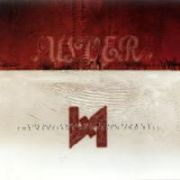
Suffice it to say, if it were not for this album I wouldn’t have read this piece by Blake.  I have been aware of it through the “doors of perception” quote that created the band name The Doors, but I never had any compelling reason to read it before.

Of course when I first listened to this, I had no idea that it was literally the entire work of Blake’s piece set to music.  And I had no idea that there would be so many diverse styles of music on the album.  I’m going to focus more on the music, as I’ll address the “lyrics” later. 

The first song starts out in a kind of synthy way–maybe early Depeche Mode.  But it quickly become more sinister, with a heavy guitar section and then a spoken word over industrial keyboards like early Nine Inch Nails.   Track two, simply called “Plate 3” is a mournful guitar solo which plays behind a woman reciting plate three.  Strangely enough, this plate is split in two parts where Blake references the bible and so Ulver end the spoken part in the middle but keep the ominous music going for the final two minutes of the track.  The next track picks up with “Plate 3, Following,” a slower piece with creepy echoey male vocals that echo the female lead.

“The Voice of the Devil, Plate Four” is a very delicate guitar part.  The female voice introduces the piece and the male voice recites the statements .  It;s the most easily understood of all the tracks (the vocals are crystal clear).  When the parts are done, the song turns in to a heavy metal guitar solo over some heavy chords. It’s a really great mix.  “Plates 5-6” is also a very clearly spoken/sung track.  Over a classical guitar with occasional heavy beats, the voice narrates (with amusing mispronunciations (there are many thoroughout the piece, but hey English isn’t their first language)).

“A Memorable Fancy (Plates 6-7)” is the first of five fancies.  This one has a very electronic feel (later period Nine Inch Nails).  This one even creates its own chorus by repeating “fires of hell” where the words do not belong.  “The Proverbs of Hell” is probably the most complex and multifarious musically.  It goes through many different musical and vocals styles.  The opening is barely audible while later parts are spoken clearly.  Other lines are hidden under a fog of noise.  Musically it’s very engaging, but it’s a shame to miss out on the poetry without a lyric sheet.

“Plate 11” also opens virtually inaudibly, with a crazy echo placed on the female vocals.  Half way through the voice become clearer and the music, which was quiet and mellow, picks up, but retains the simple melody it had.  “Intro” is an instrumental, an odd thing to include if they are following the book so specifically, as there is no intro.  It is simple, repeated waves of chords which grow louder for 3:30.   It ends with some maniacal drumming .  However, it is a nice breather as we head into “A Memorable Fancy Plates 12-13,” which opens with a very slow piano.  It turns into a largely drum-based song with a clear spoken word.  Until about half way through when the voice is heavily distorted until the end.

“Plate 14” is a percussion heavy electronic track with heavily distorted vocals (this is where “the doors of perception” bit comes from).  It leads to “A Memorable Fancy (Plate 15)” which opens with more low rumblings (like “Intro” above).  When the vocals come in, after 3 minutes, they are distant and tinny, but very clear.

Disc 1 (did I mention there were two discs) ends with “Plates 16-17.”   It opens with quiet music that slowly grows louder and more electronic.  The vocals are echoed and distorted and hard to understand.  The end of the track picks up the electronic beat for about a minute.

Disc two opens with the eleven minute “A Memorable Fancy (Plates 17-20)”.  It opens with a cool beat and a dark tone with vocals that are mostly understandable.   After a couple of minutes, the song settles into a late period Depeche Mode style–distorted guitars and vocals that sounds not unlike Dave Gahan’s.  By the end, it’s a pretty standard heavy metal chugging guitar (with a simple but interesting solo).

This is followed by another “Intro,” this time a rather pleasant guitar solo over picked guitars.   “Plates 21-22” is quite enjoyable as the vocals are clear and emphatic over a standard heavy metal song.  It feels like comfort food after all of the different styles of the disc.

“A Memorable Fancy Plates 22-24” has a great weird keyboard style (kind of Marilyn Manson).  The penultimate track is another “Intro.”  This one has some swirly minor-key guitars that sound  a bit like the guitar outro to Rush’s “Cygnus X-1.”   It goes through several iterations before ending in distorted waves that lead to “A Song of Liberty Plates 25-27”.   There are three guest vocalists on this track: Ihsahn and Samoth from Emperor and Fenriz from Darkthrone.  The interesting thing about this is that Garm (the male vocalist on all the tracks) has so many different styles of singing/speaking throughout the album that it’s hard to even notice that there are guests.

It start as mainly electronic piece with heavily distorted vocals (Ihsahn sounds like he is being strangled).  In the second part, the vocals are clearer.  The drums gets louder (sounding like the Revolting Cocks, maybe).  By the third part (Fenriz) the song turns into a guitar solo and the style of recitation reminds me of Allen Ginsbregr’s Howl.  His section ends with a distorted voice chanting the final lines and then twenty minutes of silence (the track is listed as 25 minutes, but there’s only 5 minutes of song and then 30 seconds at the end).  The final “Chorus” of the book is pretty well inaudible.

Despite the complexity of the album and the hard to follow lyrics and all of that, the entre work is really something. It is powerful and complex and runs through so many wonderful pieces and movements.  I have no idea how to classify it as it has pieces of metal and electronica as well as classical.  Perhaps it’s safe to just call it a soundtrack.

I’ve spent a lot of time talking about this CD, but I barely scratch the surface of what could be said about it.  Check out this amazing review from Encyclopaedia Metallum who go into wonderful depth and a thorough comparison of the music to the text.

[READ: November 27, 2011] The Marriage of Heaven and Hell. 

The Blake piece is available online in several places, although I got my copy from the library.  Mine contained several critical essays which I looked at briefly but decides they simply weren’t all that compelling, especially since Blake’s work (aside from details that simple footnotes might hep to clear up) is pretty understandable. 

In total, Blake’s work is 27 plates long. Each plate is hand written (in a fancy script) and many have illustrations (also hand drawn and colored).  There are allusions to many different things and it helps to be familiar with the Bible and with Emanuel Swedenborg’s theological work Heaven and Hell which is directly referenced several times.  Indeed, this work is clearly a response to that one; the opening states “and it is now thirty-three years since its advent” when Swedenborg’s book was published 33 years before Blake’s.

The gist of Blake’s piece is that God did not intend for man to separate the sensual and physical from the spiritual and mental.  It is basically a plea to hedonism, although not even seemingly to excess.  More like an “if it feels good, do it” attitude.  And he lays out these ideals pretty clearly in many of the passages.  True, there are many passages that are inscrutable (like the crazy opening–don’t be put off bu Rintrah), but when he gets to his main points, he is quite clear.  Blake attacks established religion but does not condemn God or endorse atheism.  So we get quotes like this:

“Attraction and Repulsion, Reason and Energy, Love and Hate, are necessary to Human existence.
From these contraries spring what the religious call Good & Evil. Good is the passive that obeys Reason. Evil is the active springing from Energy.
Good is Heaven. Evil is Hell.”  And shortly after: “Energy is Eternal Delight.”  Blake cites Paradise Lost as a history of the separation of these two ideas and concludes “that the Messiah [Reason] fell, & formed a heaven of what he stole from the Abyss.” (more…)

Read Full Post »

SOUNDTRACK: QUEENSRŸCHE-The Warning (1984).

Queensrÿche fulfilled the promise of their debut EP with this album.  It takes the blueprint of the EP and expands it wonderfully.  They introduce some cool low vocal chants to compliment Tate’s soaring alto (like on “En Force”), they also introduce some wonderful effects and riffs and scales (also on “En Force”).

There’s also some really great, odd “keyboard” bits thrown in as kind of sound effects or jarring moments (“Deliverance”).  “Deliverance” also has great backing vocals, and I love the way the “Deliver Us” part of the song is quite different from the soaring of the rest of the vocals.  The back and forth of “No Sanctuary” also showcases the bands skills very well.

The band even shows signs that they’re not sticking to standard heavy metal.  On “N.M. 156” there’s some sci-fi chanting and the really cool section of the song in which Tate sings “Forgotten…Lost…Memories” and the “Lost” part is a completely unexpected note.   They were taking chances from the beginning.

“The Lady Wore Black” is updated with the stunning “Take Hold of the Flame,” a slightly more progressive version of that first song.  “Before the Storm” was the first song I heard from this album and it has always been my favorite on the record (this is one of those few albums where the better songs aren’t front loaded).  “We watch the sun rise and hope it won’t be our last” (they were always happy guys).

“Child of Fire” opens with a wonderful riff and the compelling, “the souls that are damned by the pain that you bring send you higher.”  The song settles down into a slow part and Tate growls “Damn you and the pain they must feel” and you can tell he means it (whatever else the song is about).

All this time I don’t think I ever realized that “Roads to Madness” was nine minutes long.  It is definitely foreshadowing the kind of epic work they would do later.  And it closes out the album in a cathartic blast.  It’s wonderfully pure metal from the mid-80s.

[READ: October 20, 2011] Celebrations of Curious Characters

I had never heard of Ricky Jay before getting this book, but apparently he is a reasonably well know radio personality (on KCRW), he is also an actor on Deadwood, and he’s a magician.  This book is a collection of his KCRW radio show broadcasts along with accompanying pictures from his vast collection of obscure ephemera.

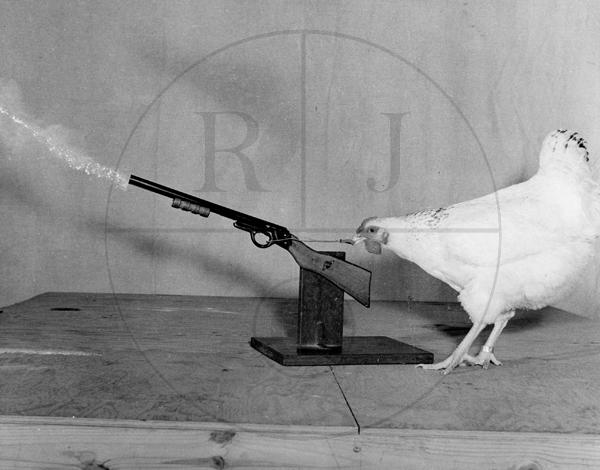
There are forty-five entries in the book–each one is a page long (it’s an oversized book and they are two columns each).  Each essay is Jay’s take on a particular subject or, as the title says, curious character.  Jay is a collector of esoteric information, especially that related to magic and, for lack of a better word, freakish behavior.   One of the most enjoyable parts of the book are the pictures that accompany each entry.  The pictures come from Jay’s collection and each picture’s provenance is given in the back of the book.  So we get pictures like “The little Count Boruwlaski, engraving by A. van Assed ([London]) Borowlaski [sic], 1788). or Lithograph of Chung Ling Soo (Birmingham: J. Upton, c. 1912) or Frontispiece portrait from George Devol, Forty Years a Gambler on the Mississippi (Cincinnati: Devol & Haines, 1887).  Some of these photos you can see on his website.  Or you can enjoy this picture of a chicken firing a gun that is not in the book (it comes from his site). (more…)

Read Full Post »

« Newer Posts - Older Posts »