 SOUNDTRACK: KING GIZZARD AND THE LIZARD WIZARD-Oddments (2014).
 After the psychedelia of the previous album, KGATLW released this varied collection of songs. Indeed, none of the 12 songs sound anything like the others. It’s hard to say if this is a collection of leftover songs or an attempt to make a varied record. After all, they had released four and a half albums in three years.
Nothing is really more than 3 minutes except “Work This Time.” Everything goes by so quickly it’s hard to know what to think.
“Alluda Majaka” opens this record with an instrumental that has every style of music thrown into it–funky bass, organ, Indian music, there’s also sound effects and clips from a movie or two and really loud drums. It’s a crazy opening for a crazy album.
“Stressin'” slows things down with a falsetto vocal and a gentle groove including a warbly wild guitar solo. It’s followed by “Vegemite,” a nonsensical ode to vegemite with a great beat and an easy to sing along chorus (sung by Ambrose, I believe): Veg-e-mite…I like.
“It’s Got Old” is slower simple rocker (complete with flute and handclaps) and somehow is followed by the trippy, synthy swirls of “Work This Time.” It opens with a rumbling wild drum intro and then becomes really gentle with more soft falsetto vocals.
“ABCABcd” is 17 seconds of garage rock nonsense before the sweet rocking acoustic guitars of “Sleepwalker.”
“Hot Wax” sounds like an old(er) KG garage rock song. There’s creepy vocals from Stu and a simple riff and a chorus that literally repeats chorus from “Surfin Safari” but with their own muffled, fuzzy garage rock chords. “Crying” has an old soul sound with its simple three note melody. It even has spoken word parts (the way you act, girl) and everything.
The end of the disc throws in even more craziness in the last five or so minutes. “Pipe Dream” is a one minute instrumental that doesn’t really do anything except evoke a psychedelic moment. It fades out just as a riff begins. But it’s not the riff to “Homeless Man in Addidas” which is a quiet acoustic folk song that sounds an awful lot like “April She Will Come” by Simon & Garfunkel. The disc ends with “Oddments,” a 25 second piece of silliness that’s like a commercial for the disc which even chants out the disc name.
Unlike their more cohesive albums, this is not a necessity exactly, but it is a fun opportunity to see just how much KGATLW can do in 30 minutes.
[READ: November 2018] Cluetopia
This is a brief history of the crossword puzzle as broken down by year.
David Astle (whose name must be a crossword answer) is a crossword maniac. What makes this book especially interesting to me is that he is from Australia, which means he has a very different perspective on the crossword puzzle than someone like Will Shortz. For there is a great American/British (and Australian) divide when it comes to crosswords.
Astle is a huge fan of British-style cryptic puzzles and he really delves into some of the best ones over the last century.
A neat summary of the different types of puzzles comes from Always Puzzling:
British-style crosswords
In the British-style grid there are a lot of black squares. Roughly half of the letters in each word are crossed over with another word (what’s called “keyed” or “checked” in the industry). This is known as an alternate-letter grid – in general, every other letter in a word is checked.Quick Crosswords – these are straight definition clues. There aren’t any tricks involved or any word play. Different levels of difficulty are created by whether the vocabulary used in the crossword is standard or more obscure, and whether clues are specific or general. General knowledge, archaic words, and common words in other languages are often included. An example : Bird (4) = TEAL is a difficult clue – there are a lot of birds with 4 letter names! Small duck (4) = TEAL is an easier clue, as you’re given more specific information.
Cryptic Crosswords – these fiendish crosswords have the same basis as the British quick crosswords, but that’s where the similarity ends! Each clue is a mini-puzzle in its own right. There are a lot of rules and conventions about how these clues are written. Each cryptic clue must contain a ‘base clue’ (synonym for the answer) as well as some word play. This can include double definitions, anagrams, homonyms, charades, puns, amongst many others. An example : Bird colour (4) = TEAL — as TEAL is both a colour, and a type of bird. This is a double definition clue. NB : British crosswords tend to have the letter count for the answer in brackets after the clue, but American crosswords don’t.
American-style crosswords
In the American-style grid, there are relatively few black squares, and every single letter in every word is crossed over by another word. The grid is fully “checked”. So it’s theoretically possible to solve a whole American crossword by only doing the Down clues, for example.A major difference with American crosswords is they often have a title and theme. The themed crossword entries are generally some of the longest words in the puzzle, and are placed symmetrically within the grid. Somewhere around three to five words in the crossword will relate to the theme. These theme entries can be words, phrases, or puns, or a whole host of other conundrums. The title for the puzzle usually gives a clue as to the theme.
There are the standard definition clues, as in the Brit’s quick crosswords. However, there are also a lot of general knowledge clues, such as the names of actors or authors, movie titles, song names, and other trivia. Abbreviations are common; these clues are usually indicated with abbreviations included in the wording of the clue. For example : Some sts = AVES (“Some streets are avenues”). Sometimes fragments of phrases, prefixes, suffixes, fragments of words, and foreign words are used. Fill-in-the-blank clues are also fairly common.
A few examples : From ____ Z = ATO (From A to Z, get it?) ; It can be open or safe = HOUSE (Open House or Safe House) ; Tour end = IST (Tourist) ; So long in Rome = CIAO (an Italian farewell) ; There is a wide variety in these sorts of clues; the setter may sometimes also engage in a bit of word play, with pun clues indicated with a question mark.
So for a person used to American crosswords, his take is interesting and somewhat exotic.
Each chapter title is a year with a subtitle as a complicated clue that is usually answered within the chapter itself. Each chapter also includes important historical events of that year and new words that were introduced into the language. This might be more fascinating than the history of the crosswords themselves: new words in 1913 (the first year of the book) were: movie, vitamin, jazz and conscious.
Crosswords were started by Arthur Wynne in 1913, a British man who lived in America, so both countries claim a close connection with the development of this popular puzzle. His first crosswords were actually called Word-cross and were very different from what we know. But they are still in existence in puzzle books. Where you make a grid with the same words horizontal and vertical:
CAPER
ALIVE
PINES
EVENT
RESTS
New words for 1925: lesbian, bitchy, blind date. This was the year that crosswords really took off–with a woman calling herself a crossword widow and librarians cutting off access to reference materials and coloring in blanks squares to prevent papers from being stolen.
But the book isn’t only a history of the puzzle. We meet some of the crossword composers (and the clever pseudonyms they choose). Most compilers stay with the craft for decades and tell the oft-repeated joke that “The only way a new compiler can get a start it to push an old compiler under a bus.” Indeed 1959 (charisma, kinky, kooky) lists several famous puzzlers and their equally clever pseudonyms.
Astle also travels the globe. In 1929 (zucchini, Sasquatch, greenhouse effect) he goes to Russia to show how Russian clues work. In 1936 (magazine, curvaceous) he looks at oulipo puzzles. In 1935 (autopilot, pizza) he investigates clues in Esperanto with a brief history of that Utopian language. In 1951 (nerd, Day Glo, fast food) he talks about other languages having cryptic clues but not as English has them. The Dutch one is amazing. In 1957 (holocaust, bonkers) he looks at the Swedish crossword which often includes a picture. But its wasn’t just naming a portrait the picture could lead to a pun, or even a made up phrase!
He also talks about the different types of clues–ones that vary from country to country. Like those “Hidden clues” which put their answer within the clue: “Taste balsam, pleasantly bottled” is sample. When this style first appeared, cluegivers were pretty free to do what they wished, but rules has grown stricter about what technically counts as a fair clue in this category.
He looks at prize puzzles in America in the 1920. These were often scams that a lot of people fell for. Half the letters were already filed in and a clue was given. “Important in music” T_ _ E Is it tune or tone? There would be dozens of clues. You would submit a fee with your entry. And you could win a huge jackpot. But all they had to do was settle on a combination that no one chose and scam everyone.
In 1942 (napalm, underbelly, plutonium), he looks at cryptic clues in foreign puzzles and how hard they are if you don’t know the language really well. Especially since many clue answers are local turns of phrase.
1944 he looks at the D-Day crosswords scandal–codenames related to the D-Day plans appeared as solutions in crosswords in the British newspaper, The Daily Telegraph. Leonard Dawe created the puzzles with answers like Dieppe, Utah , Omaha , Overlord . These clues were very coincidental to the war plans? How did this guy have access to this information and was he a spy? Well, it turns out that Dawe was headmaster of a school which had been evacuated. Next to the school was a camp of US and Canadian troops preparing for D-Day. Security round the camp was pretty lax and there was contact between the schoolboys and soldiers. Of course the school boys were interested and learned many D-Day codewords. It was all coincidence.
Did you know that ginormous was first coined in 1948?
In 1954 (discotheque, funky, junk mail) Princess Margaret won a crossword contest in Country Life magazine. Her sister Elizabeth had been crowned queen the year before, what else had she to do? She submitted it with a plain envelope and stamp--it was all on the level.
Crosswords can also be romantic, like in 1964 (quasar, sitcom) when famous puzzler Lindsey Browne wrote his beloved--who was very far away--a clue in the back half of a series of words. Years earlier he had proposed to his first wife through puzzles.
He met his first wife, Nancy Moore, at the Herald, proposing to her in a crossword. The first letter of all the across words spelled out, "I love Nancy Moore". A few weeks later, he spelled out, "Will she marry me?" An editor told him not to cryptically conceal further messages. A little later he ran the message "The answer is Yes", through the last letter in every across answer.
1969 (pixel, hands-on), was a scandalous year when a puzzler filled his answer grid with smut: erection, prostitute and clues like "a nude poet" (Auden) or "seamen mop up anal infusions." (enemas).
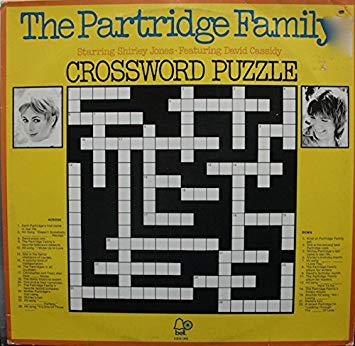 Unexpectedly, 1973 (junk food, streaking) talks about The Partridge Family. The marketing dept at Bell Music made their eighth album a crossword puzzle... mostly it was a lame opportunity to get people to make a note of the record company whose name was in the answer grid. In 1977 (supermodel, quality time) a crossword puzzle was a plot point in M*A*S*H.
1976 (bulimia, minibar) looks at the beginning of Puzzler a magazine which started in 1972 and had very strict rules for crosswords: no plurals, no abbreviations, no slang no gerunds and no past participles. This led to the editor banning quadruped as n answer, quickly thinking it was a past participle.
1988 (lambada, road rage, crop circle) talks about The Gotcha Club a club for those who spotted errors in the New York Times crossword puzzles: a lion could never be king of the jungle because it lives in the Savannah. Those who successfully found mistake were entered into the Gotcha club wit a handwritten letter from Eugene Maleska himself. There were also the Leapers--those how found mistakes that weren't there (thinking "make a go of" was actually "make a goof").
My favorite chapter came in 1996 (chick lit, tamogotchi, McMansion) when Jeremiah Farrell created a puzzle on the day before election day with a clue that said headline in tomorrow's newspaper. The answer could have been either Clinton or Bob Dole. And people were shocked because they assumed that he was predicted the Presidency. But the surrounding clues could have been answered either way. For example: black Halloween animal could be Cat or Bat giving you either the C for Clinton or the B for bob dole. Amazing.
In 1999 (staycation, bling) he actually tackles Mandarin. There are Chinese crosswords done with ideograms! Meanwhile 2002 (google, blog) looks at crosswords that go right to left in Arabic.
2007 looks at Frank Longo's longest crossword--a 25 foot long puzzle with 2813 answers. The clues started easy on the left and got harder as you went right.
This is a wonderful book for anyone who enjoys puzzles. Its full of fun facts and little anecdotes. Best of all if one year's information proves to be dull, all chapters are about three pages so you can easily get through it to a more exciting next one.

 I Just Read About That...
Leave a comment